MD MAHIN SHAHRIAR
DEPARTMENT OF SOCIOLOGY
MSS 1ST SEMESTER
SHAHJALAL UNIVERSITY OF SCIENCE AND TECHNOLOGY,
SYLHET, BANGLADESH
2023
Philosophical Assumptions
and Interpretive Frameworks
Distribution
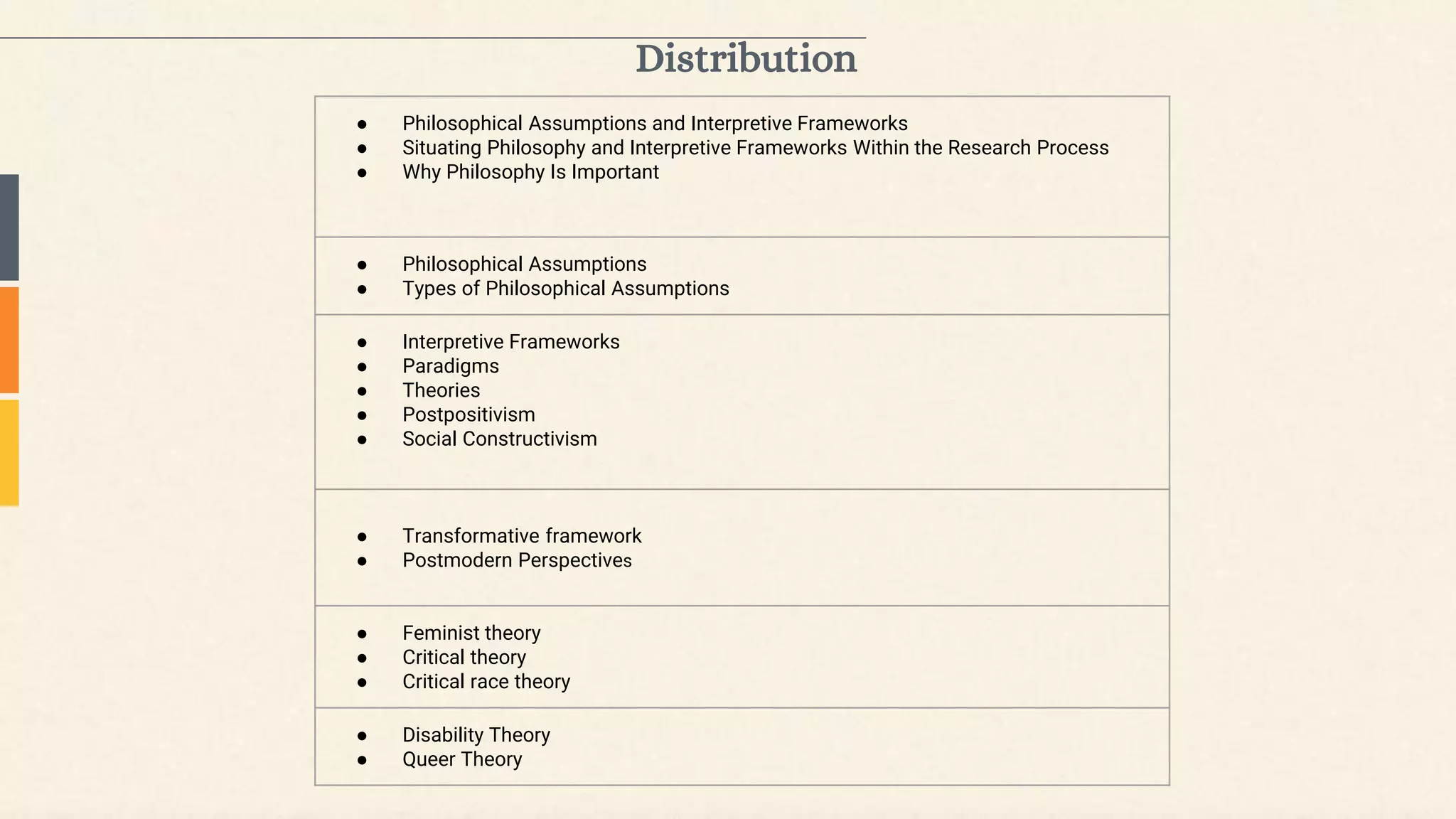
● Philosophical Assumptions and Interpretive Frameworks
● Situating Philosophy and Interpretive Frameworks Within the Research Process
● Why Philosophy Is Important
● Philosophical Assumptions
● Types of Philosophical Assumptions
● Interpretive Frameworks
● Paradigms
● Theories
● Postpositivism
● Social Constructivism
● Transformative framework
● Postmodern Perspectives
● Feminist theory
● Critical theory
● Critical race theory
● Disability Theory
● Queer Theory
Philosophical Assumptions and
Interpretive Frameworks
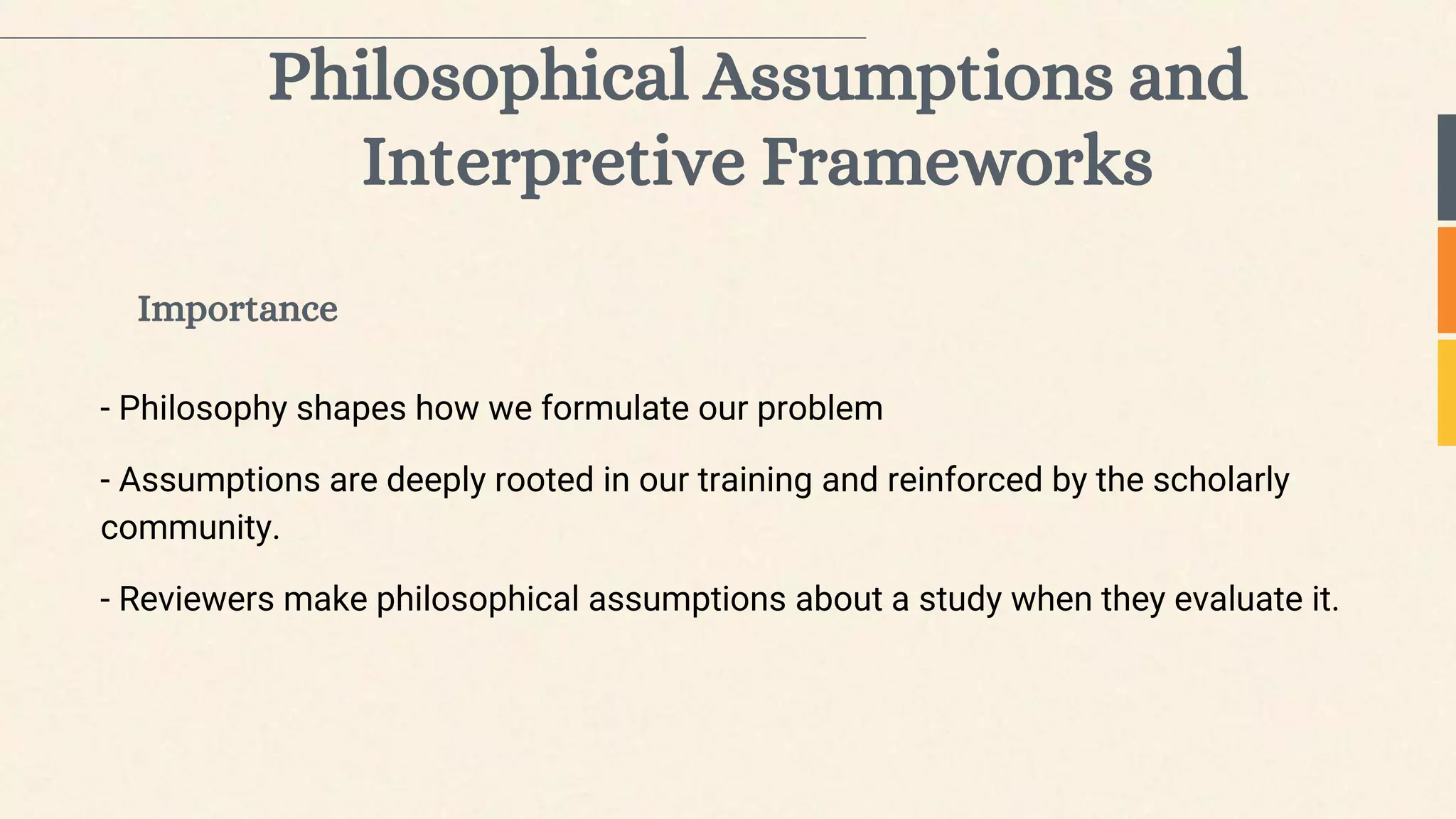
- Philosophy shapes how we formulate our problem
- Assumptions are deeply rooted in our training and reinforced by the scholarly
community.
- Reviewers make philosophical assumptions about a study when they evaluate it.
Importance
Interpretive Frameworks:
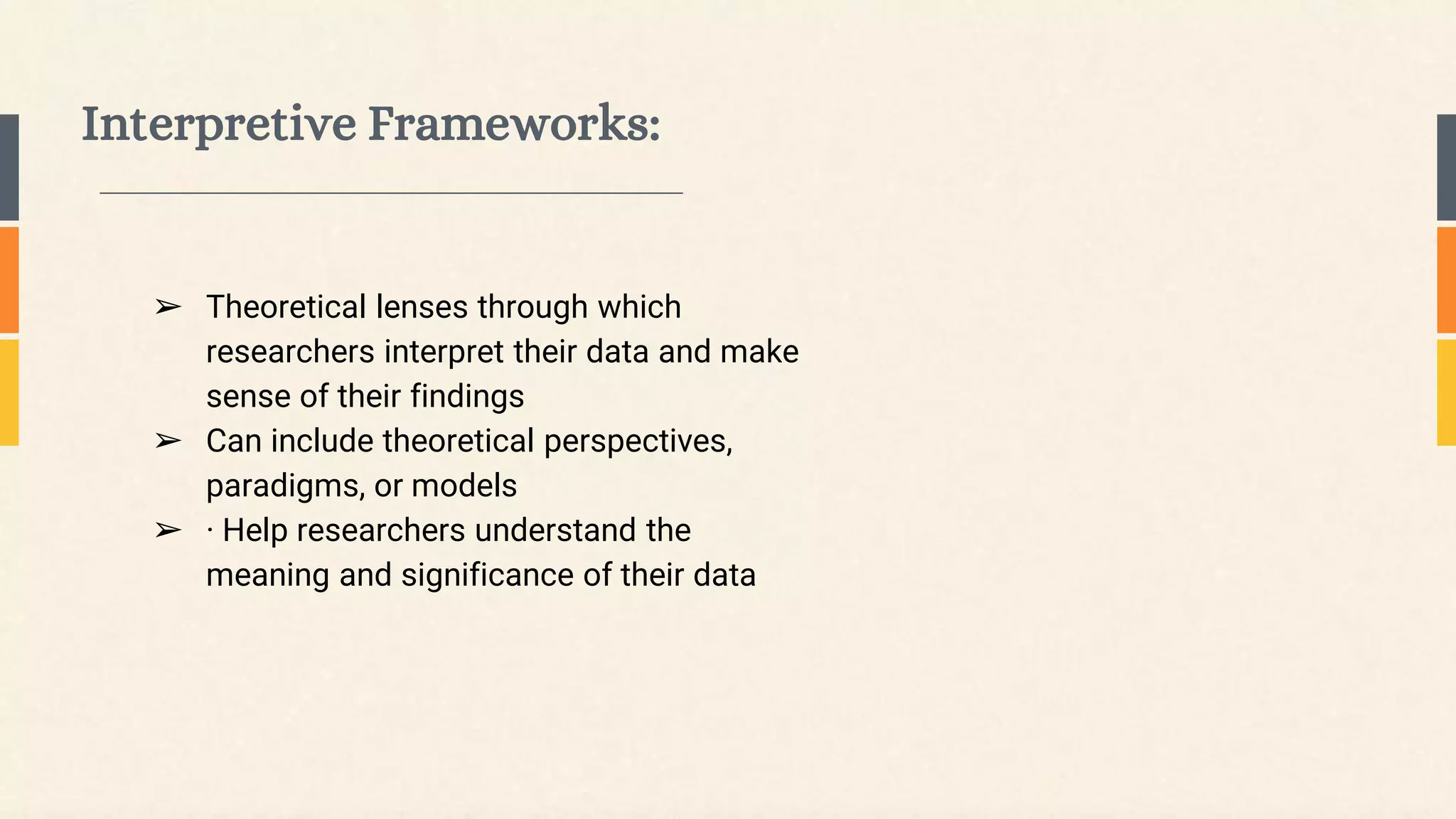
➢ Theoretical lenses through which
researchers interpret their data and make
sense of their findings
➢ Can include theoretical perspectives,
paradigms, or models
➢ · Help researchers understand the
meaning and significance of their data
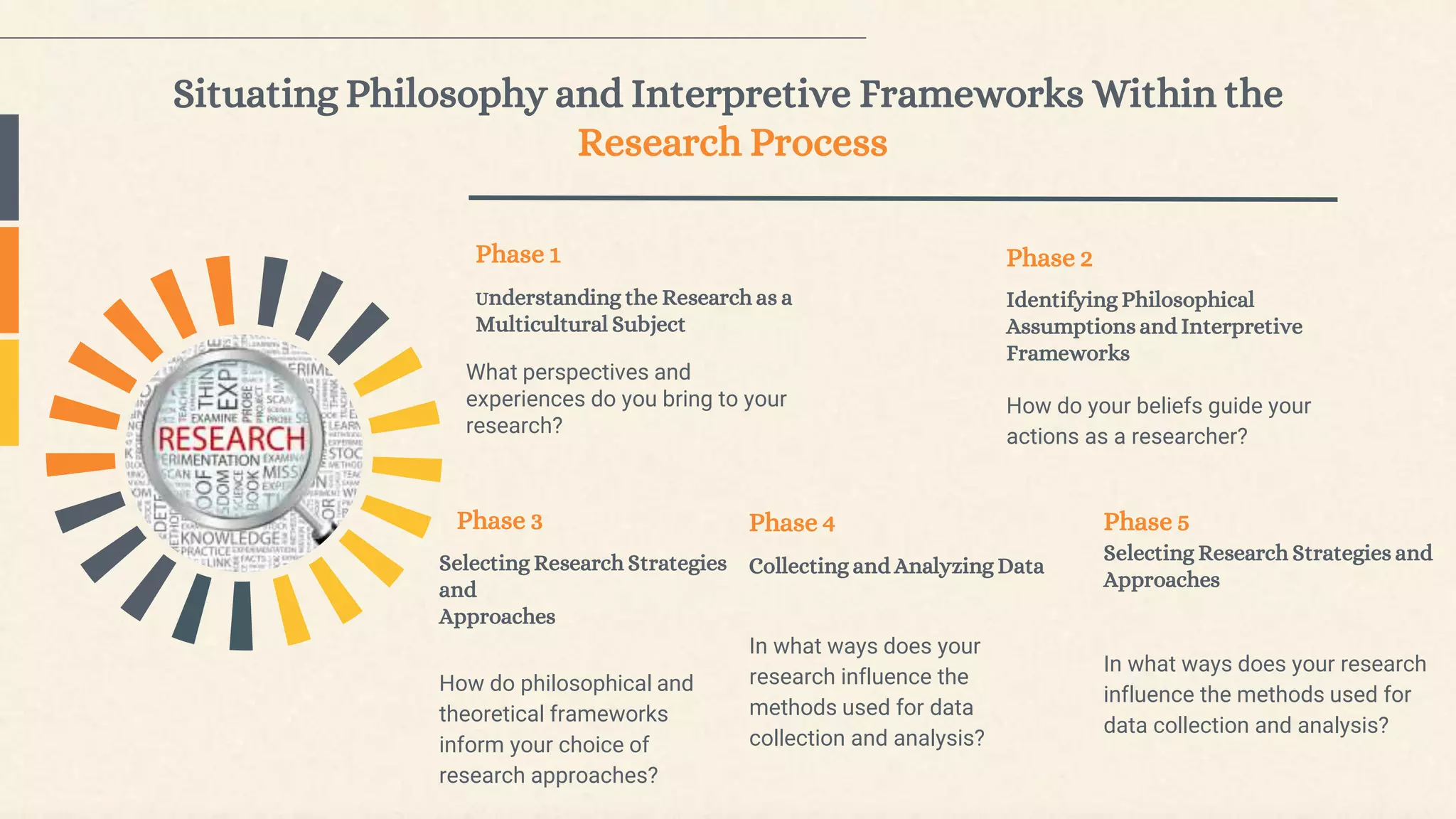
Situating Philosophy and Interpretive Frameworks Within the
Research Process
How do your beliefs guide your
actions as a researcher?
Identifying Philosophical
Assumptions and Interpretive
Frameworks
In what ways does your
research influence the
methods used for data
collection and analysis?
Understanding the Research as a
Multicultural Subject
What perspectives and
experiences do you bring to your
research?
Selecting Research Strategies
and
Approaches
How do philosophical and
theoretical frameworks
inform your choice of
research approaches?
Collecting and Analyzing Data
Phase 2
Phase 1
Phase 3 Phase 4 Phase 5
Selecting Research Strategies and
Approaches
In what ways does your research
influence the methods used for
data collection and analysis?
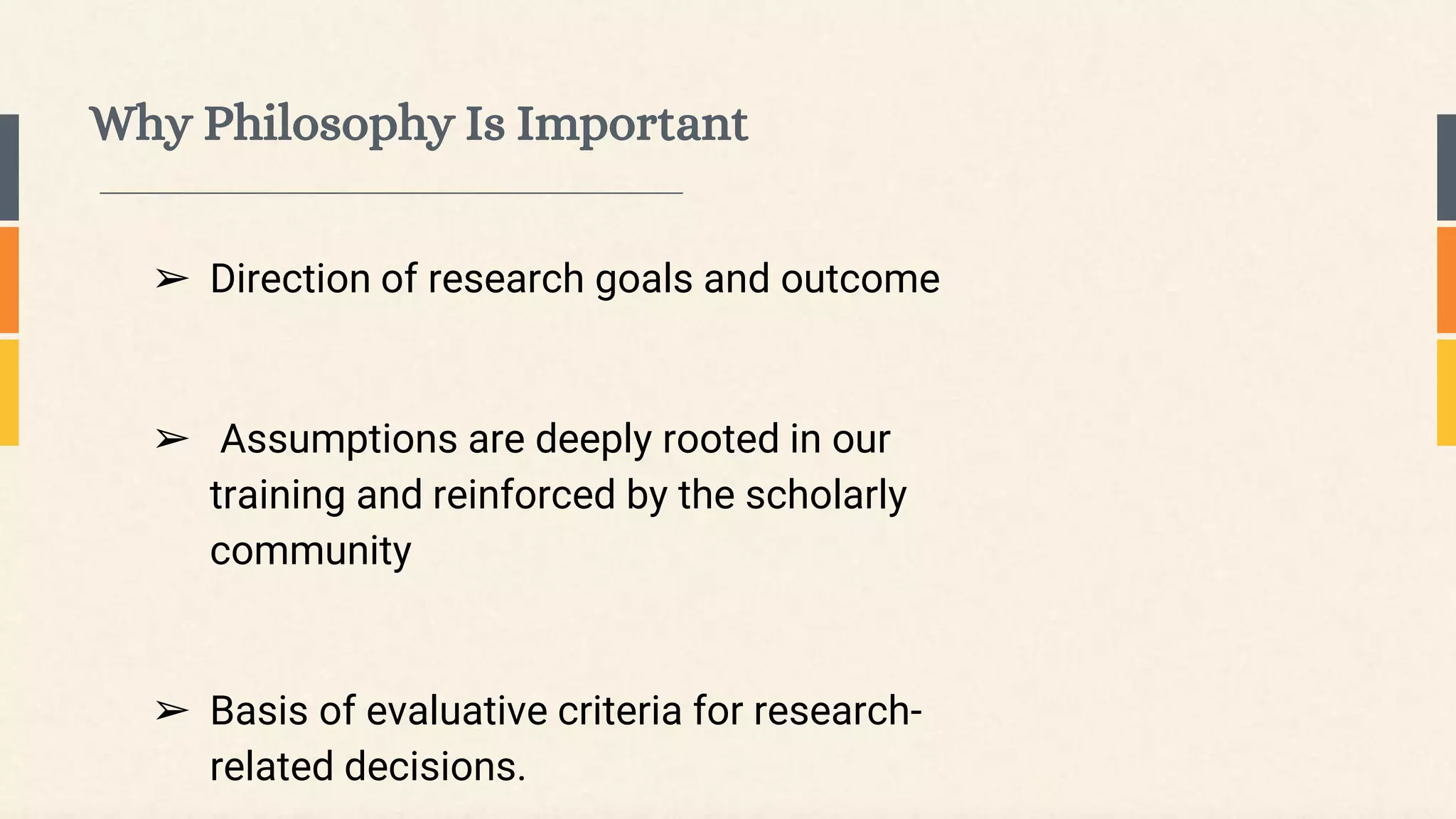
Why Philosophy Is Important
➢ Direction of research goals and outcome
➢ Assumptions are deeply rooted in our
training and reinforced by the scholarly
community
➢ Basis of evaluative criteria for research-
related decisions.
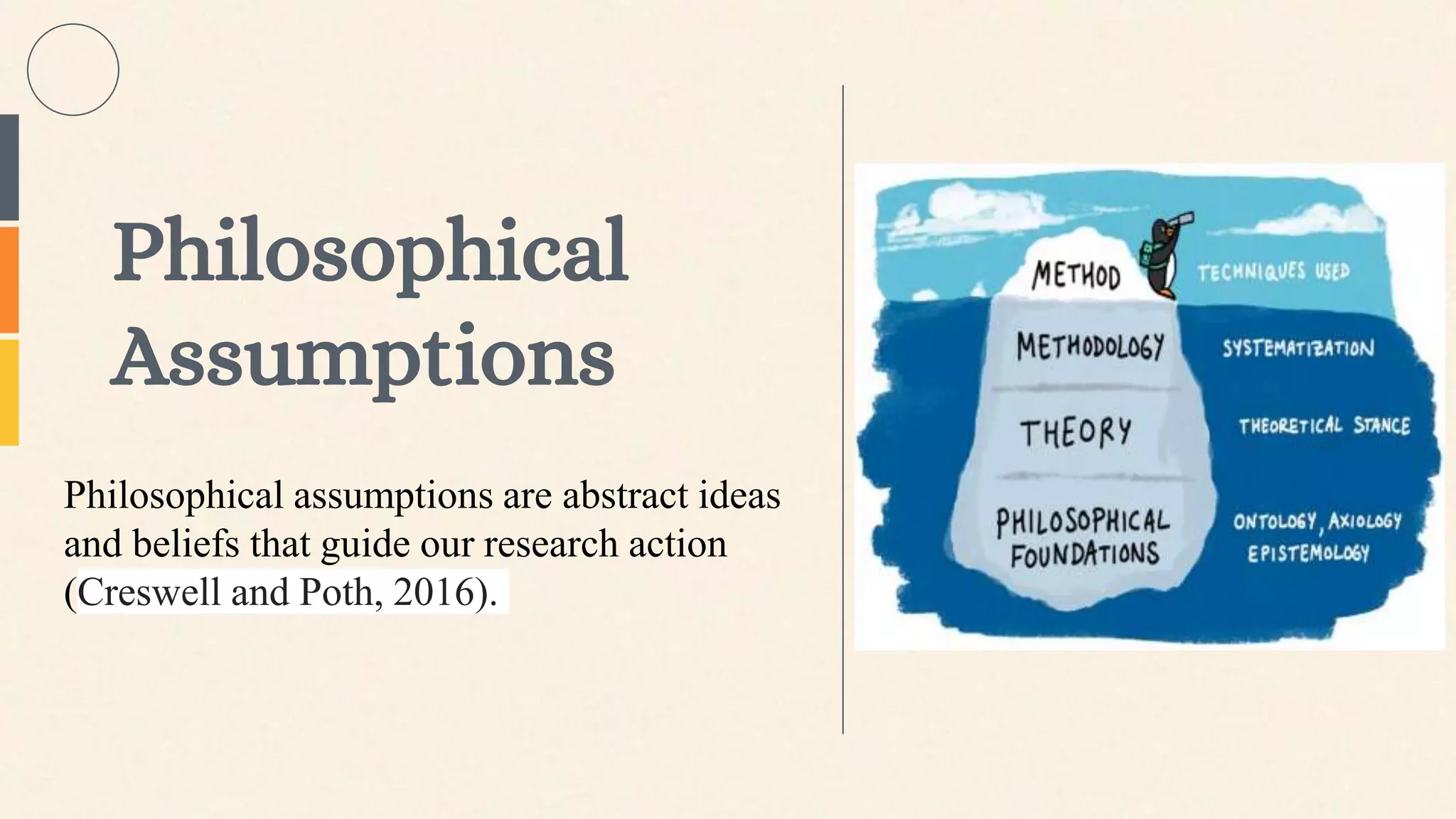
Philosophical
Assumptions
Philosophical assumptions are abstract ideas
and beliefs that guide our research action
(Creswell and Poth, 2016).
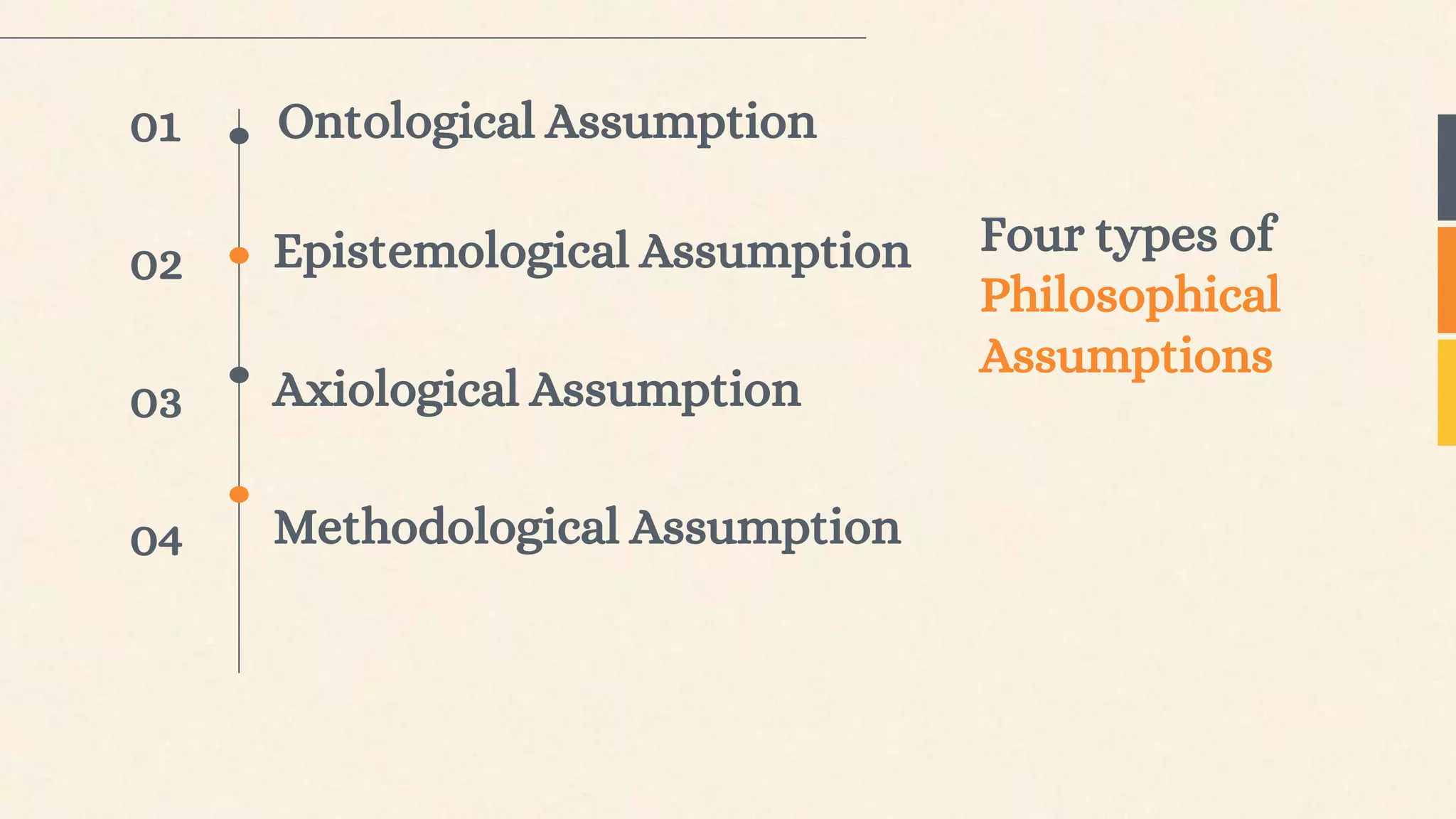
Ontological Assumption
01
Epistemological Assumption
02
04
Four types of
Philosophical
Assumptions
Axiological Assumption
03
Methodological Assumption
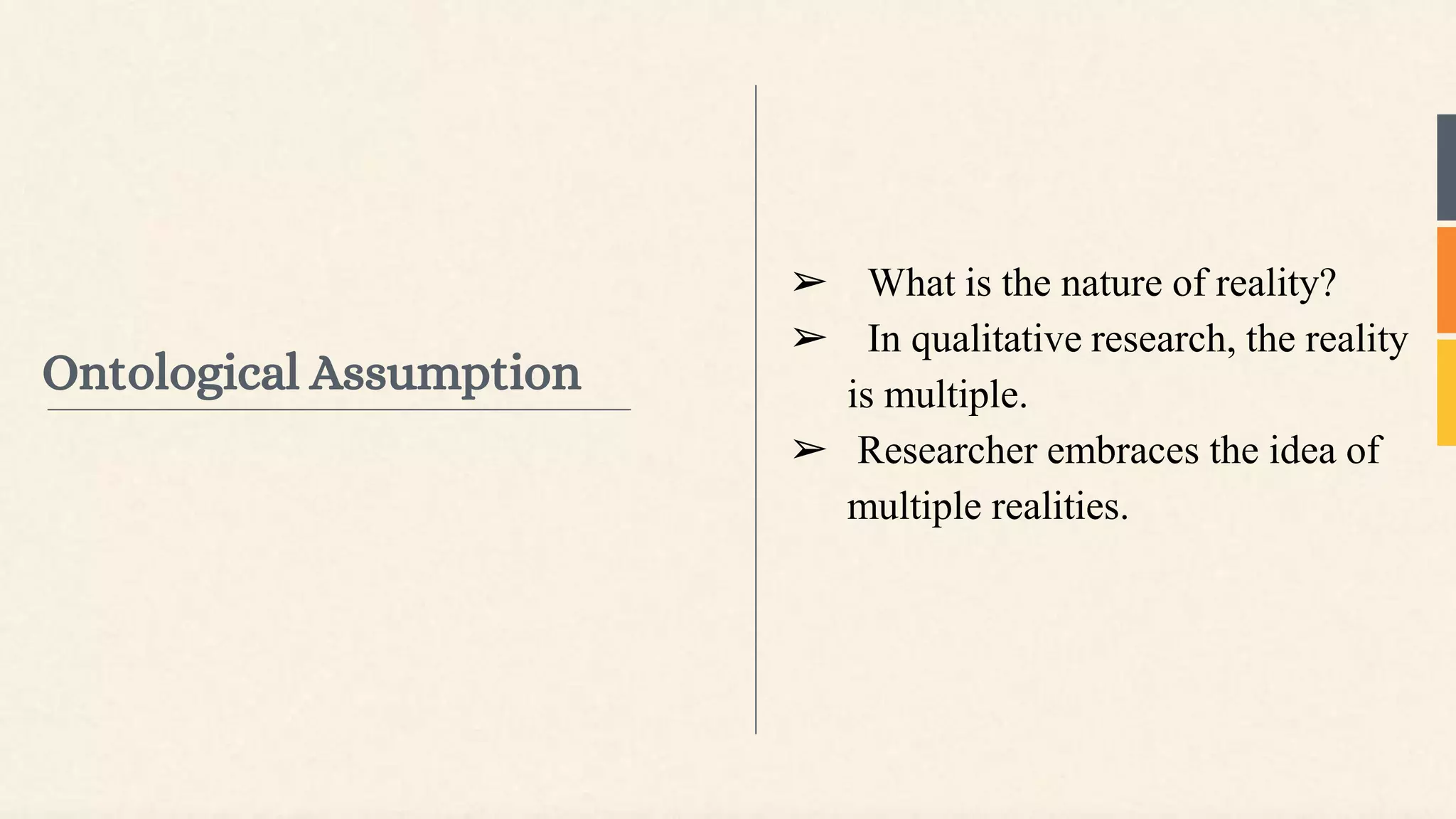
Ontological Assumption
➢ What is the nature of reality?
➢ In qualitative research, the reality
is multiple.
➢ Researcher embraces the idea of
multiple realities.
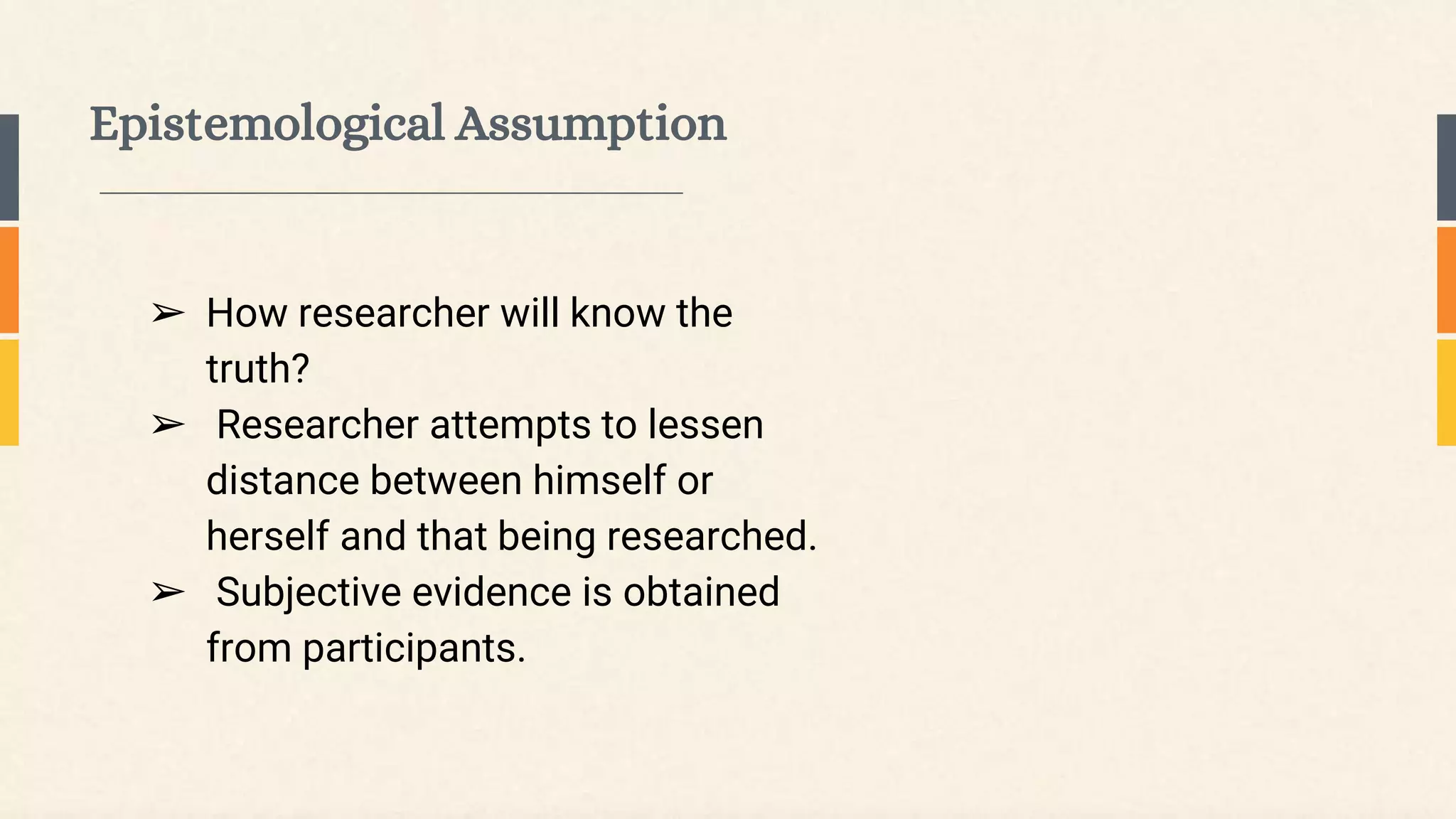
Epistemological Assumption
➢ How researcher will know the
truth?
➢ Researcher attempts to lessen
distance between himself or
herself and that being researched.
➢ Subjective evidence is obtained
from participants.
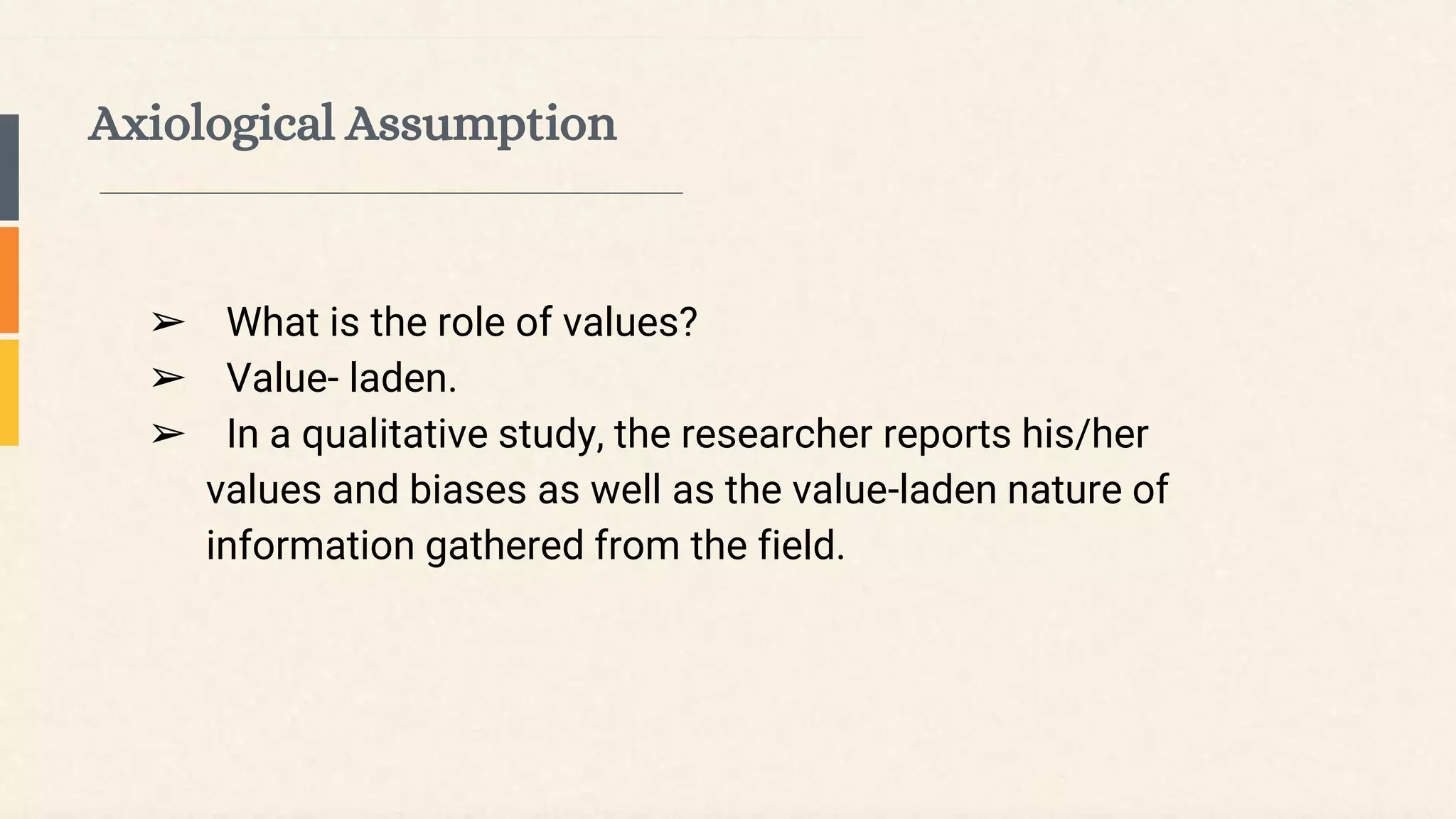
Axiological Assumption
➢ What is the role of values?
➢ Value- laden.
➢ In a qualitative study, the researcher reports his/her
values and biases as well as the value-laden nature of
information gathered from the field.
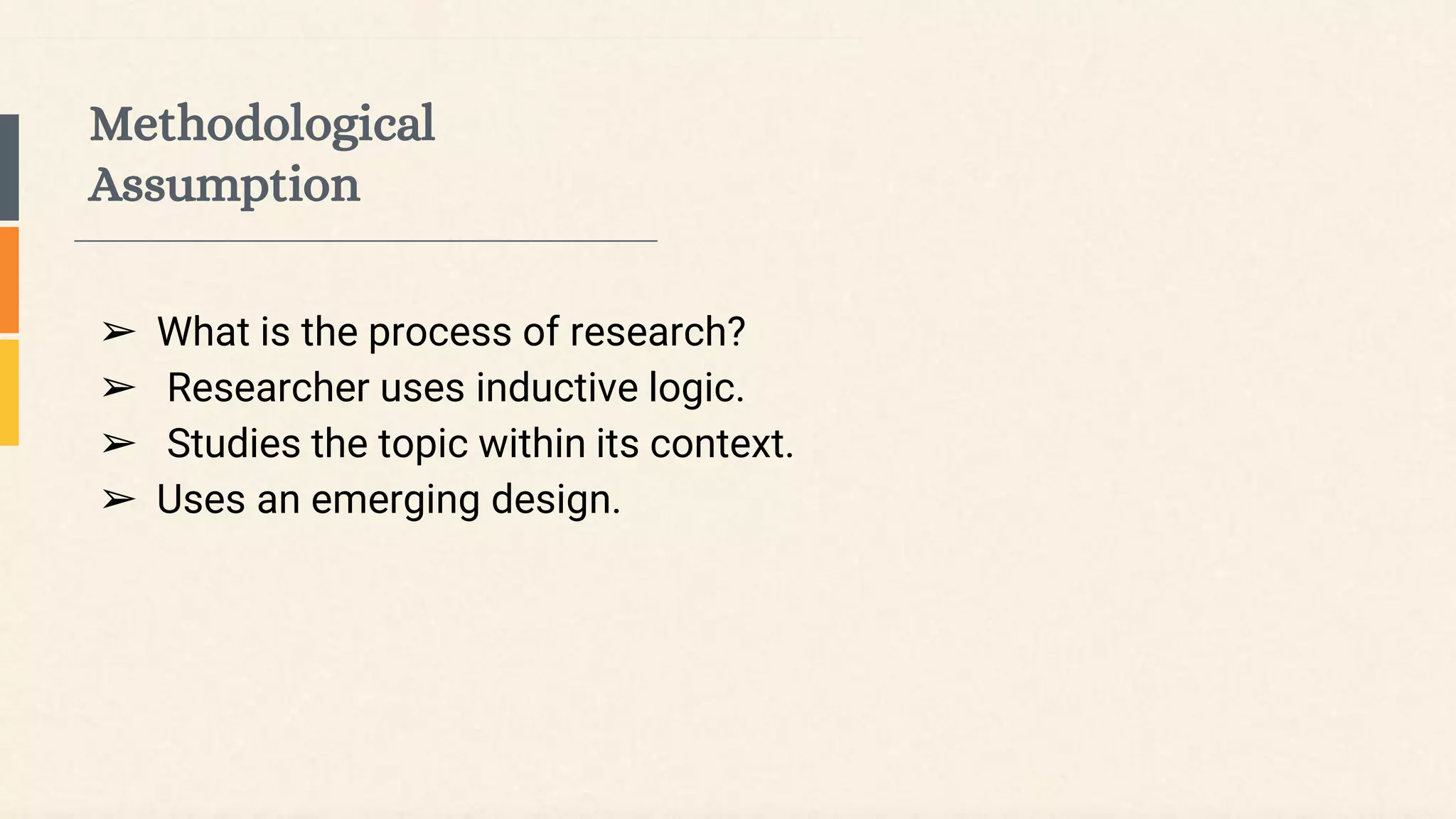
Methodological
Assumption
➢ What is the process of research?
➢ Researcher uses inductive logic.
➢ Studies the topic within its context.
➢ Uses an emerging design.
An interpretive framework provides the theoretical
constructs, analytical focus and general forms of research
questions that guide the research to read his or her data in
a particular way.
-Interpretation and Interpretive framework by Johanna Moisander and Anu Valtonen
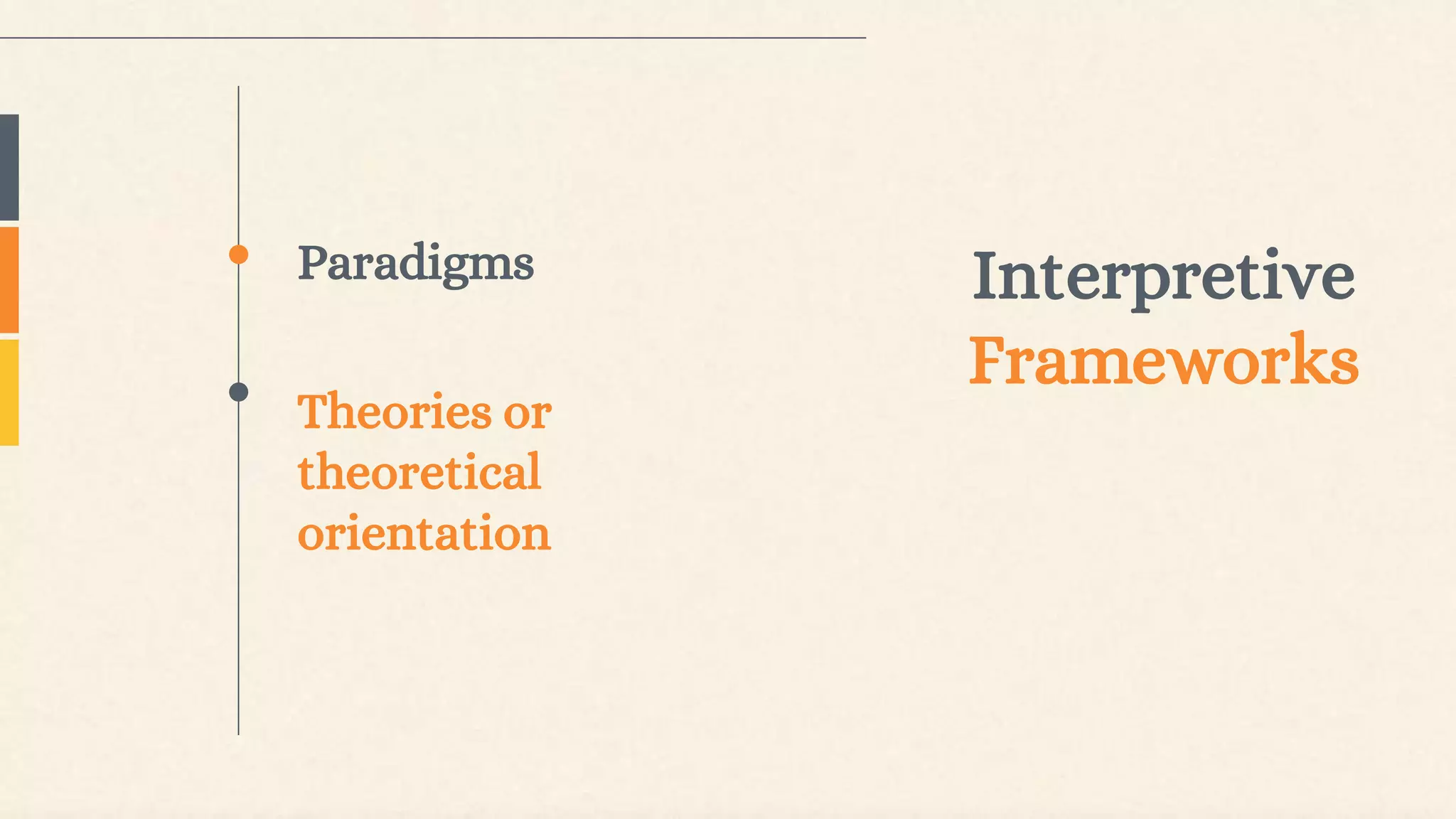
Interpretive Framework
Paradigms Interpretive
Frameworks
Theories or
theoretical
orientation
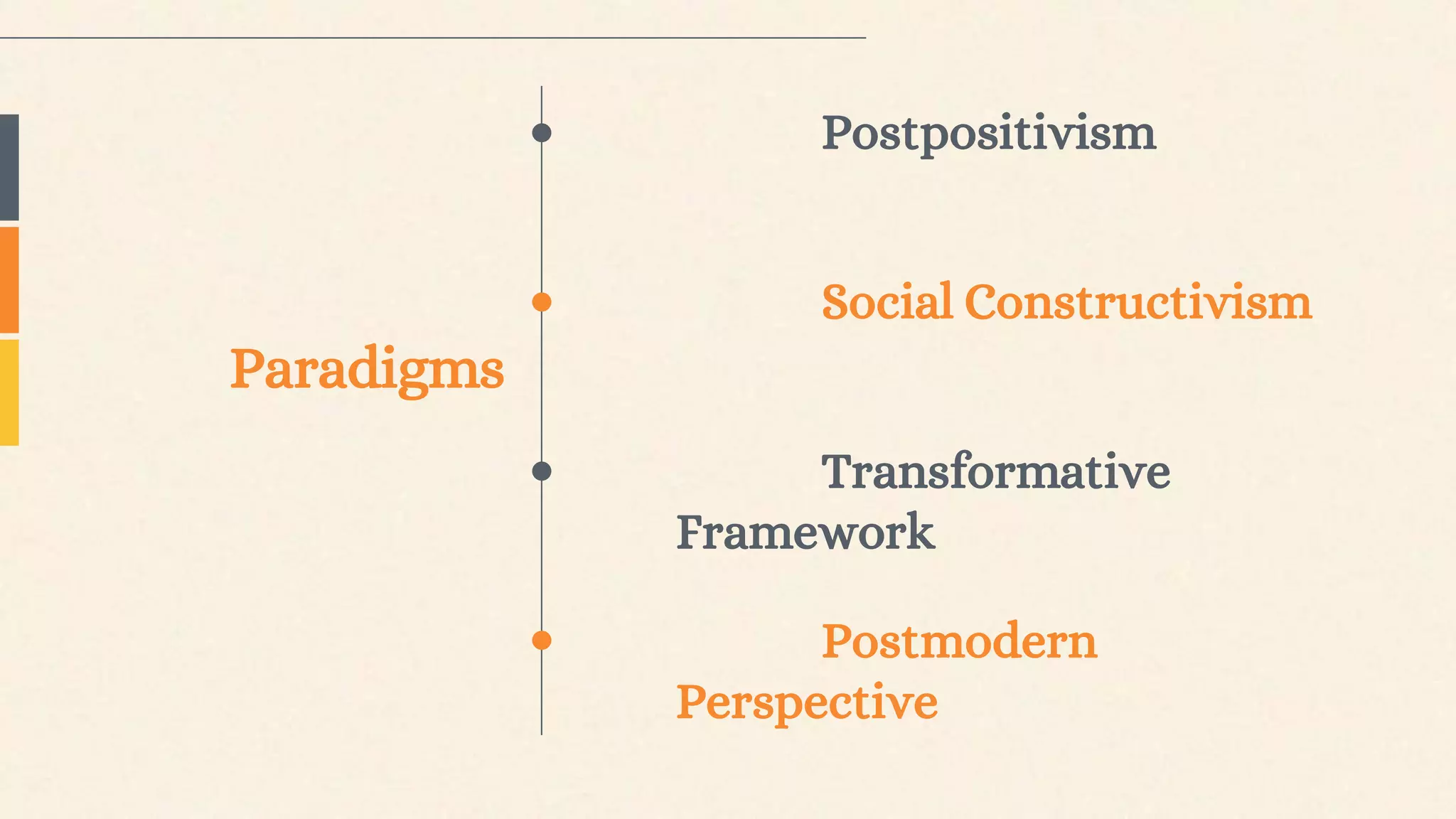
Postpositivism
Social Constructivism
Transformative
Framework
Postmodern
Perspective
Paradigms
Feminist Theories
Critical theory
Queer theory
Disability theories
Theor
ies
Postpositi
vism
● Logical, empirical, cause-and-effect oriented, and
deterministic based on a priori theories.
● Rigorous methods of qualitative data collection
and analysis.
● Ontology- single reality
● Epistemology- Reality can only be approximated,
but it is constructed through research and
statistics.
● Axiology- The researcher’s biases need to be
controlled and not expressed in a study.
● Methodology- Scientific method
Social
Constructivism
● Focus on the specific contexts in which people
live and work in order to understand the
historical and cultural settings of the
participants.
● Ontology-Multiple realities
● Epistemology-Reality is co-constructed between
the researcher and the researched and shaped
by individual experiences
● Axiology-There is respect for indigenous values
● Methodology-interviewing, observing, and
analyzing texts.
Transformative
framework
● The basic tenet of this transformative framework is that
knowledge is not neutral and it reflects the power and
social relationships within society.
● The purpose of knowledge construction is to aid people to
improve society (Mertens, 2003).
● These individuals include marginalized groups, who faced
these issues such as oppression, domination, suppression,
alienation, and hegemony.
● As these issues are studied and exposed, the researchers
provide a voice for these participants, raising their
consciousness and improving their lives.
● Researcher may ask participants to help with designing
the questions, collecting the data, analyzing it, and shaping
the final report of the research.
Postmodern
Perspectives
● Postmodernism might be considered a family of
theories and perspectives that have something in
common (Slife & Williams, 1995)
● The basic concept is that knowledge claims
must be set within the conditions of the world
today and in the multiple perspectives of class,
race, gender, and other group affiliations.
● These conditions include the presence of
“metanarratives” or universals that hold true
regardless of the social conditions.
Feminist theory
● Discrimination and exclusion on the basis of sex and
gender.
● Objectification
● Structural and economic inequality
● Power and oppression
● Gender roles and stereotypes
Key areas of focus within
feminist theory include:
Critical theory
● Critical and Traditional Theory (Horkheimer)
● Dialectic of the Enlightenment (Adorno and
Horkheimer)
● Knowledge and Human Interests (Habermas)
● The Structural Transformation of the Public Sphere
(Habermas)
● One-Dimensional Man (Marcuse)
● The Work of Art in the Age of Mechanical
Reproduction (Benjamin)
(Ashley Crossman, 2019)
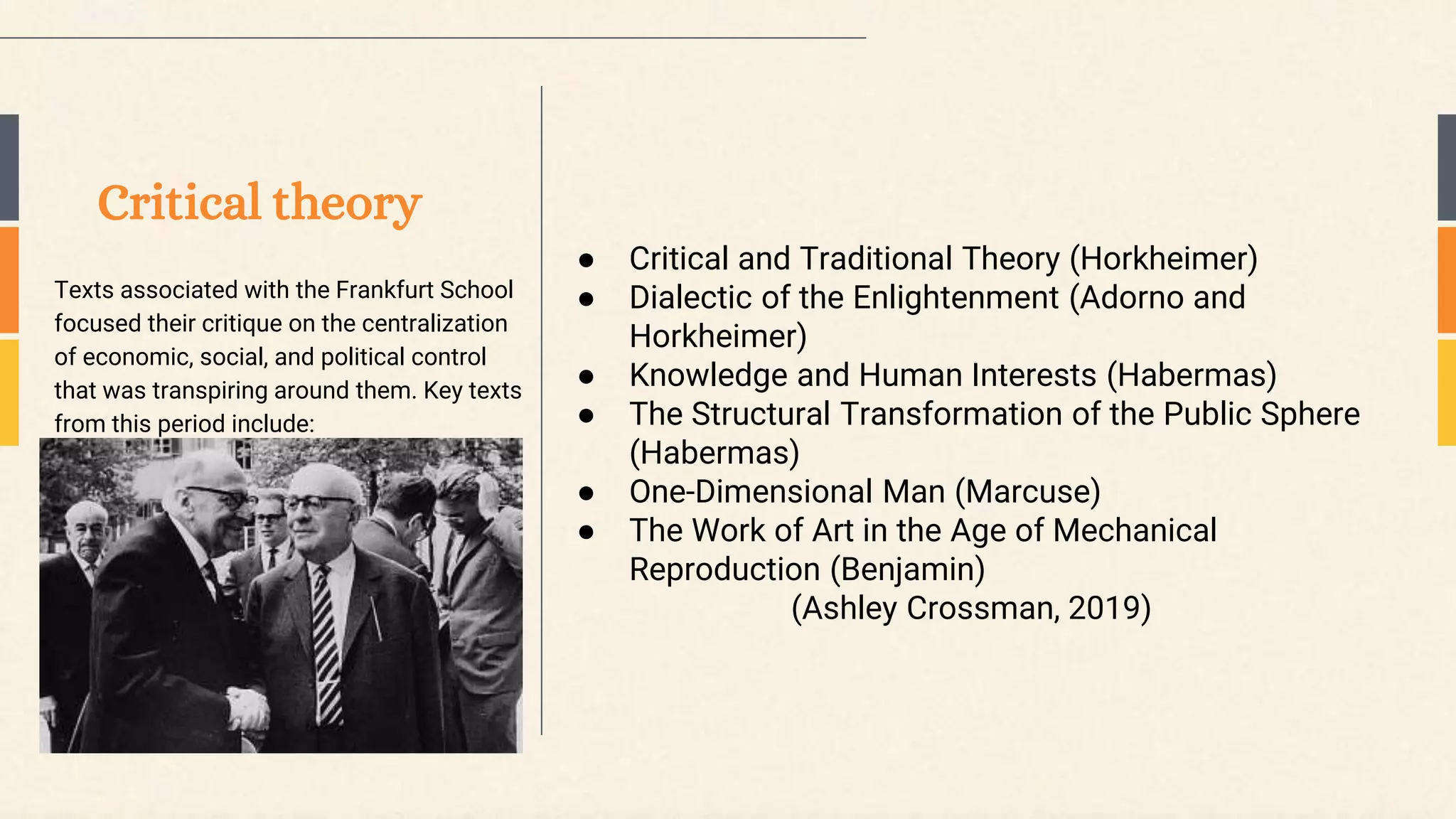
Texts associated with the Frankfurt School
focused their critique on the centralization
of economic, social, and political control
that was transpiring around them. Key texts
from this period include:
Critical race theory
Critical race theory, on the other hand, is a framework
that examines how race and racism intersect with other
forms of oppression, such as class, gender, and sexuality.
It emerged in the United States in the 1970s and 1980s
as a response to the limitations of traditional civil rights
approaches to addressing racial inequality.
(Ansell, Amy (2008). "Critical Race Theory". In
Schaefer, Richard T. (ed.)
Critical theory and
Critical race theory
Both critical theory and critical race theory share a
commitment to social justice and the recognition of power
imbalances in society. However, critical race theory
specifically focuses on the ways in which race and racism
operate in society, while critical theory has a broader scope
that includes other forms of oppression.
Disability Theory
● Disability inquiry addresses the meaning of inclusion in
schools and compasses administrators, teachers and parents
who have children with disabilities(Mertens, 2009,2015).
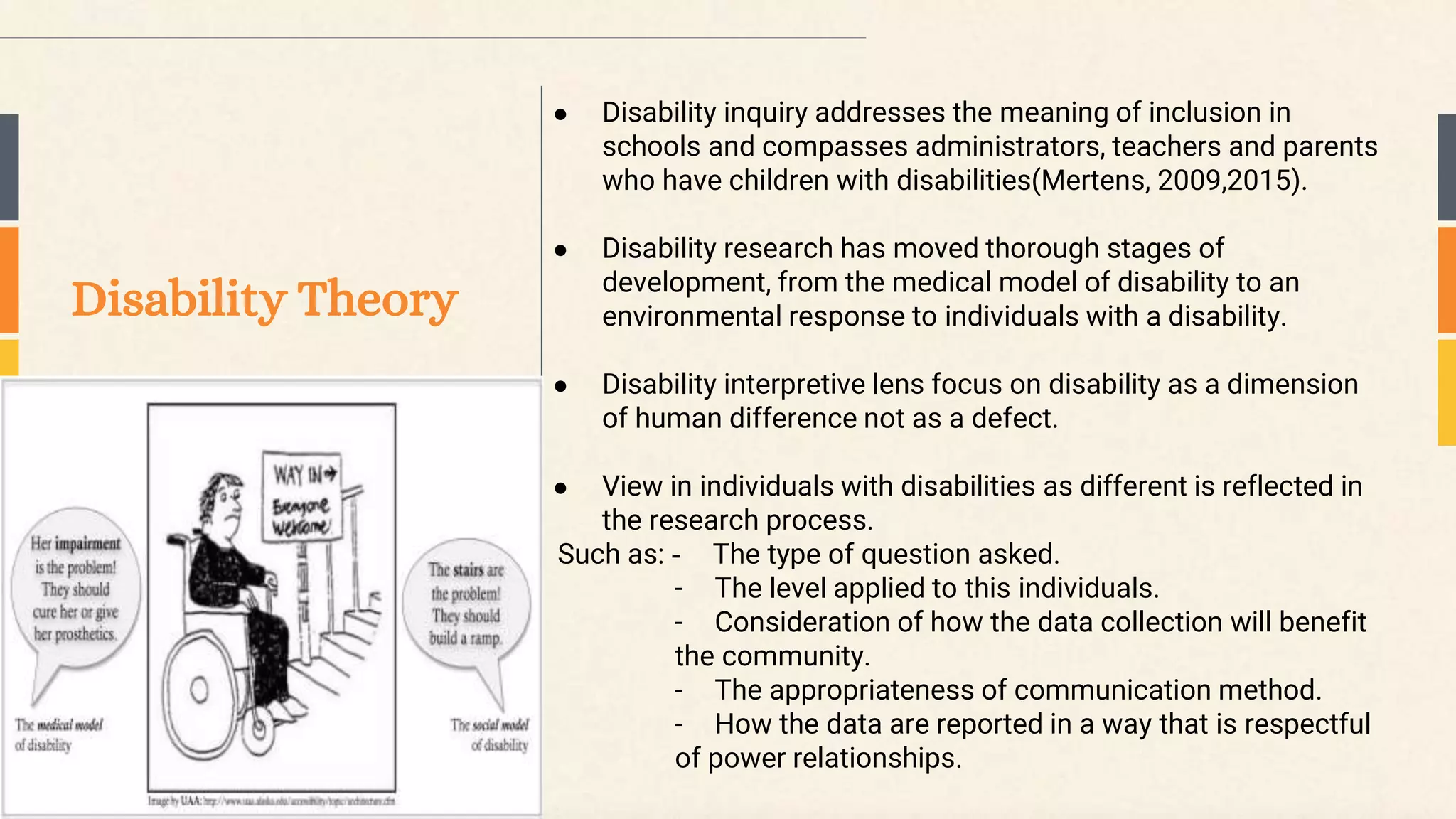
● Disability research has moved thorough stages of
development, from the medical model of disability to an
environmental response to individuals with a disability.
● Disability interpretive lens focus on disability as a dimension
of human difference not as a defect.
● View in individuals with disabilities as different is reflected in
the research process.
Such as: - The type of question asked.
- The level applied to this individuals.
- Consideration of how the data collection will benefit
the community.
- The appropriateness of communication method.
- How the data are reported in a way that is respectful
of power relationships.
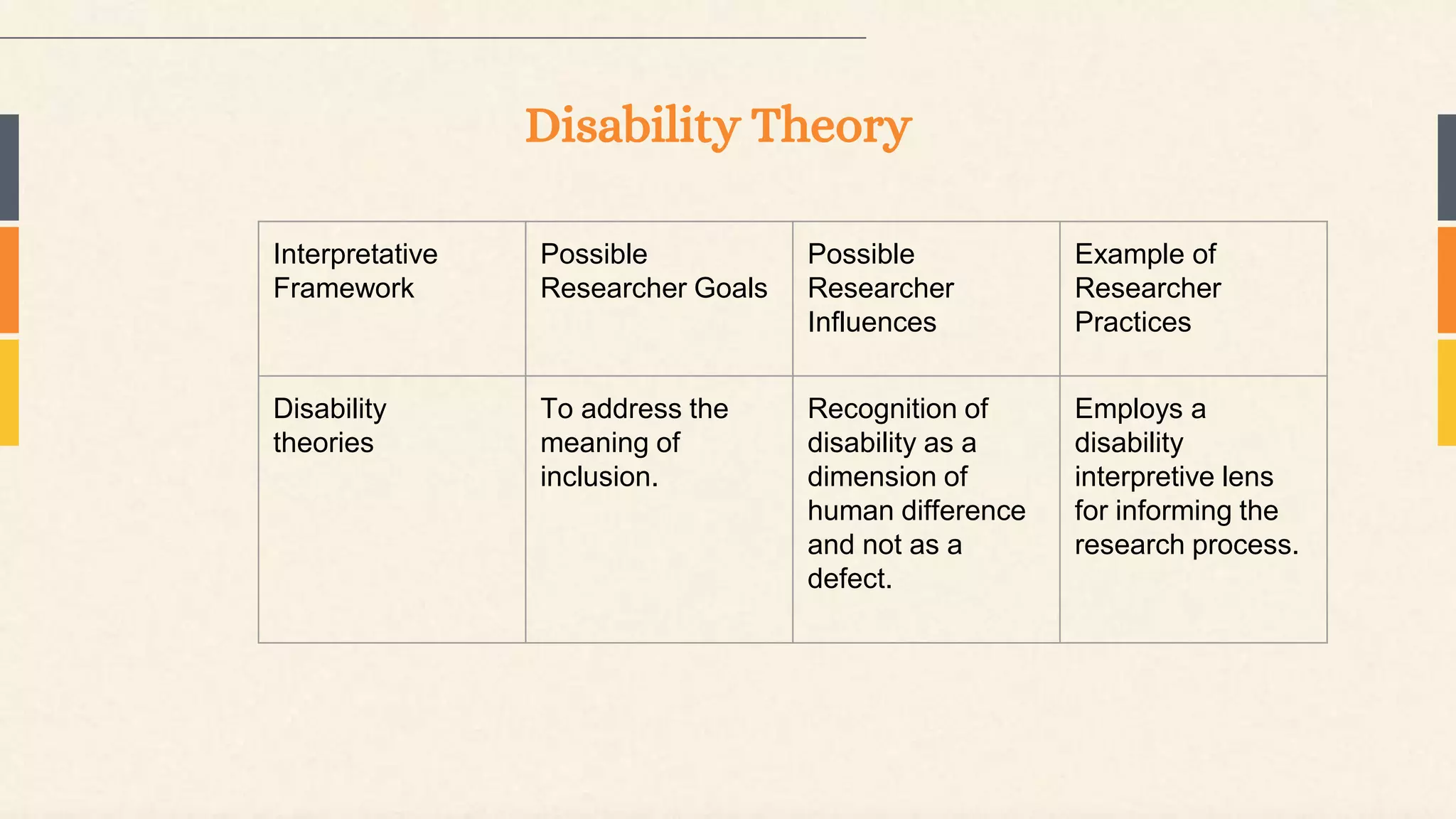
Interpretative
Framework
Possible
Researcher Goals
Possible
Researcher
Influences
Example of
Researcher
Practices
Disability
theories
To address the
meaning of
inclusion.
Recognition of
disability as a
dimension of
human difference
and not as a
defect.
Employs a
disability
interpretive lens
for informing the
research process.
Disability Theory
Queer Theory
● This theory explores the myriads complexities of the
construct, identity and how identities reproduced and
performed in social forums.
● Characterized by variety of methods and strategies relating
to individual identity (plumner, 2011a, watson, 2005)
● Writers use a postmordern or poststructural orientation to
critic and deconstruct dominant theories related to identity.
Key areas of focus within
Queer theory include:
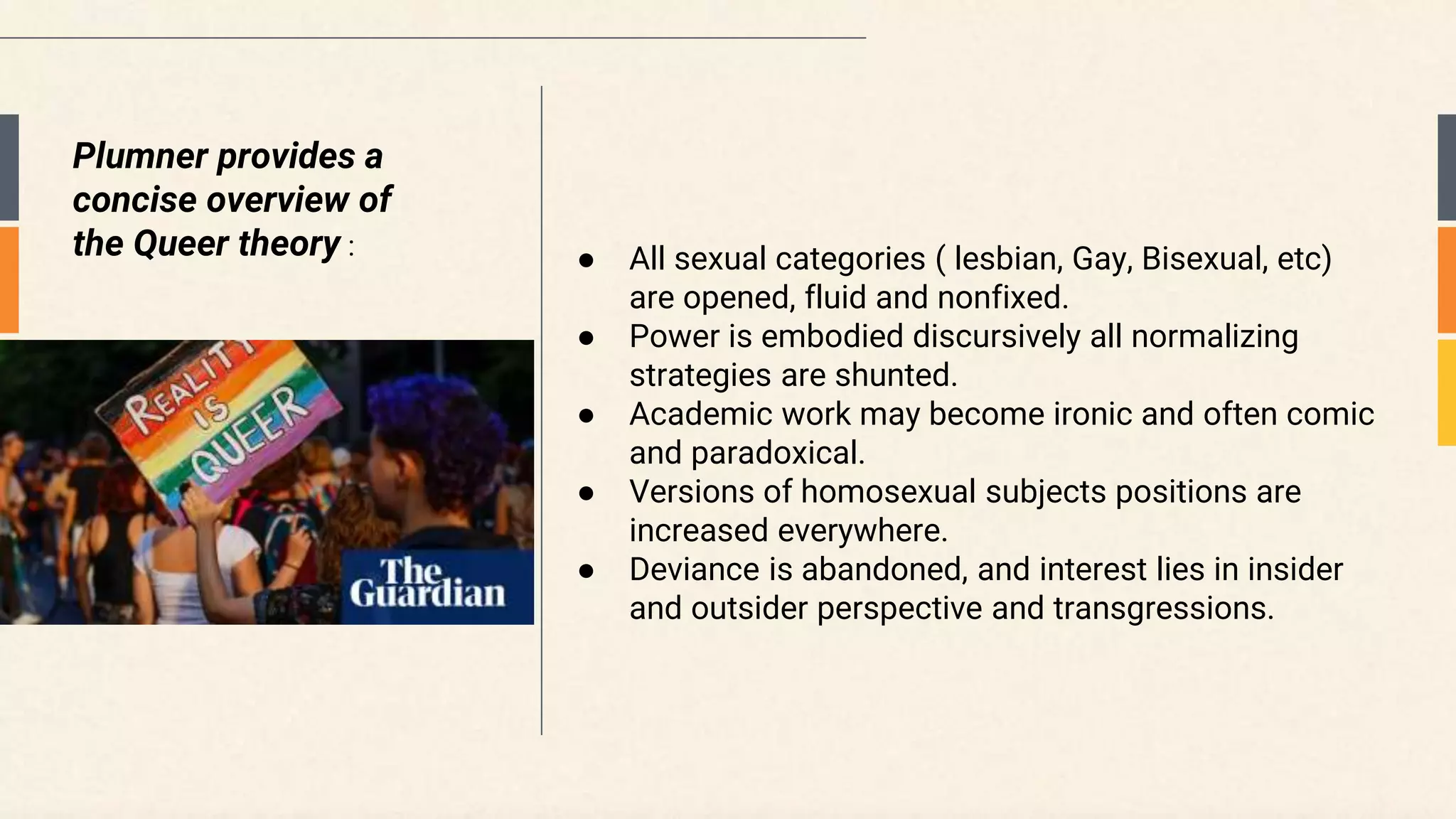
● All sexual categories ( lesbian, Gay, Bisexual, etc)
are opened, fluid and nonfixed.
● Power is embodied discursively all normalizing
strategies are shunted.
● Academic work may become ironic and often comic
and paradoxical.
● Versions of homosexual subjects positions are
increased everywhere.
● Deviance is abandoned, and interest lies in insider
and outsider perspective and transgressions.
Plumner provides a
concise overview of
the Queer theory :
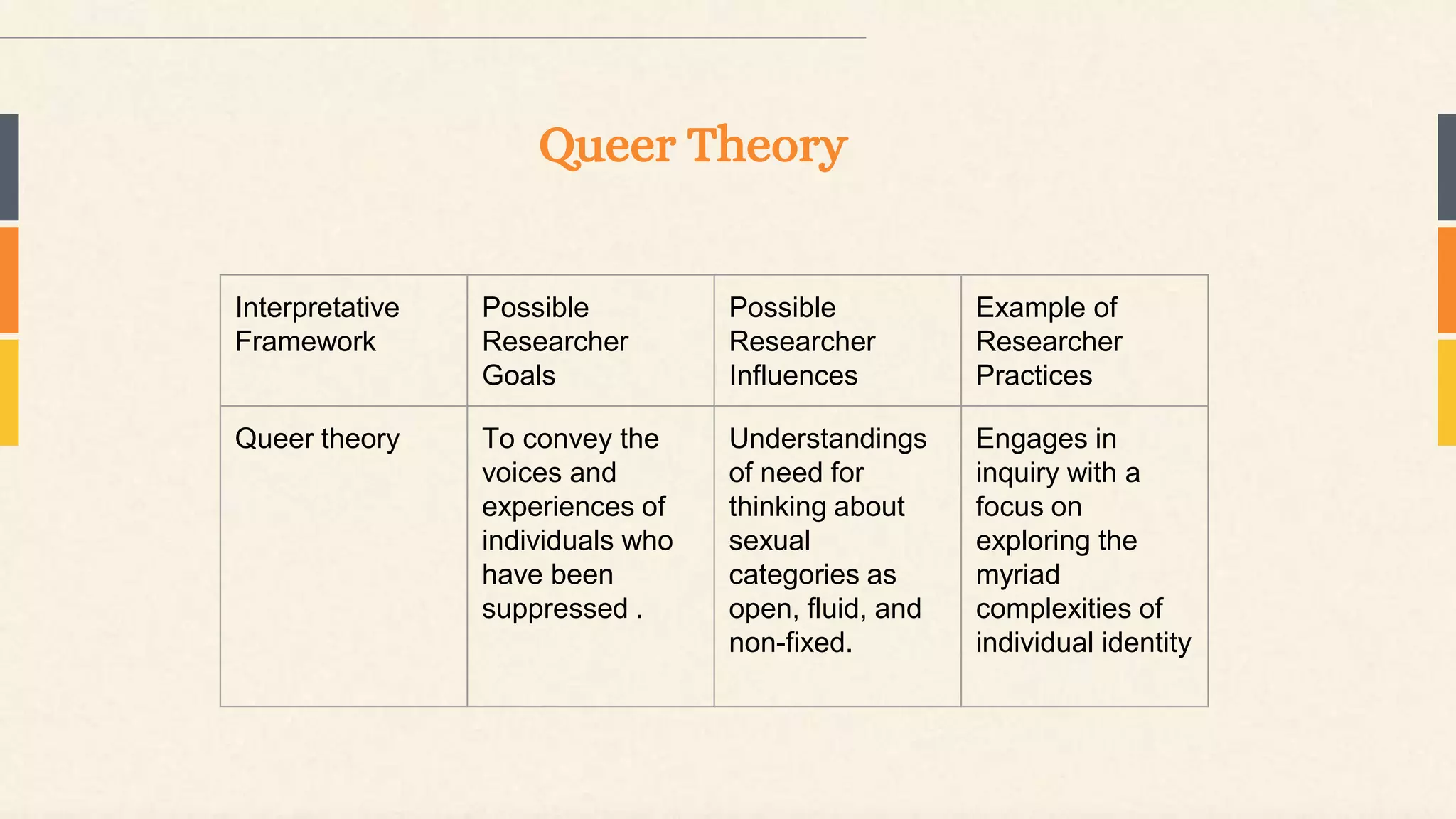
Interpretative
Framework
Possible
Researcher
Goals
Possible
Researcher
Influences
Example of
Researcher
Practices
Queer theory To convey the
voices and
experiences of
individuals who
have been
suppressed .
Understandings
of need for
thinking about
sexual
categories as
open, fluid, and
non-fixed.
Engages in
inquiry with a
focus on
exploring the
myriad
complexities of
individual identity
Queer Theory
The End

Philosophical Assumptions and Interpretive Frameworks.pptx

  • 1.
    MD MAHIN SHAHRIAR DEPARTMENTOF SOCIOLOGY MSS 1ST SEMESTER SHAHJALAL UNIVERSITY OF SCIENCE AND TECHNOLOGY, SYLHET, BANGLADESH 2023 Philosophical Assumptions and Interpretive Frameworks
  • 2.
    Distribution ● Philosophical Assumptionsand Interpretive Frameworks ● Situating Philosophy and Interpretive Frameworks Within the Research Process ● Why Philosophy Is Important ● Philosophical Assumptions ● Types of Philosophical Assumptions ● Interpretive Frameworks ● Paradigms ● Theories ● Postpositivism ● Social Constructivism ● Transformative framework ● Postmodern Perspectives ● Feminist theory ● Critical theory ● Critical race theory ● Disability Theory ● Queer Theory
  • 3.
    Philosophical Assumptions and InterpretiveFrameworks - Philosophy shapes how we formulate our problem - Assumptions are deeply rooted in our training and reinforced by the scholarly community. - Reviewers make philosophical assumptions about a study when they evaluate it. Importance
  • 4.
    Interpretive Frameworks: ➢ Theoreticallenses through which researchers interpret their data and make sense of their findings ➢ Can include theoretical perspectives, paradigms, or models ➢ · Help researchers understand the meaning and significance of their data
  • 5.
    Situating Philosophy andInterpretive Frameworks Within the Research Process How do your beliefs guide your actions as a researcher? Identifying Philosophical Assumptions and Interpretive Frameworks In what ways does your research influence the methods used for data collection and analysis? Understanding the Research as a Multicultural Subject What perspectives and experiences do you bring to your research? Selecting Research Strategies and Approaches How do philosophical and theoretical frameworks inform your choice of research approaches? Collecting and Analyzing Data Phase 2 Phase 1 Phase 3 Phase 4 Phase 5 Selecting Research Strategies and Approaches In what ways does your research influence the methods used for data collection and analysis?
  • 6.
    Why Philosophy IsImportant ➢ Direction of research goals and outcome ➢ Assumptions are deeply rooted in our training and reinforced by the scholarly community ➢ Basis of evaluative criteria for research- related decisions.
  • 7.
    Philosophical Assumptions Philosophical assumptions areabstract ideas and beliefs that guide our research action (Creswell and Poth, 2016).
  • 8.
    Ontological Assumption 01 Epistemological Assumption 02 04 Fourtypes of Philosophical Assumptions Axiological Assumption 03 Methodological Assumption
  • 9.
    Ontological Assumption ➢ Whatis the nature of reality? ➢ In qualitative research, the reality is multiple. ➢ Researcher embraces the idea of multiple realities.
  • 10.
    Epistemological Assumption ➢ Howresearcher will know the truth? ➢ Researcher attempts to lessen distance between himself or herself and that being researched. ➢ Subjective evidence is obtained from participants.
  • 11.
    Axiological Assumption ➢ Whatis the role of values? ➢ Value- laden. ➢ In a qualitative study, the researcher reports his/her values and biases as well as the value-laden nature of information gathered from the field.
  • 12.
    Methodological Assumption ➢ What isthe process of research? ➢ Researcher uses inductive logic. ➢ Studies the topic within its context. ➢ Uses an emerging design.
  • 13.
    An interpretive frameworkprovides the theoretical constructs, analytical focus and general forms of research questions that guide the research to read his or her data in a particular way. -Interpretation and Interpretive framework by Johanna Moisander and Anu Valtonen Interpretive Framework
  • 14.
  • 15.
  • 16.
    Feminist Theories Critical theory Queertheory Disability theories Theor ies
  • 17.
    Postpositi vism ● Logical, empirical,cause-and-effect oriented, and deterministic based on a priori theories. ● Rigorous methods of qualitative data collection and analysis. ● Ontology- single reality ● Epistemology- Reality can only be approximated, but it is constructed through research and statistics. ● Axiology- The researcher’s biases need to be controlled and not expressed in a study. ● Methodology- Scientific method
  • 18.
    Social Constructivism ● Focus onthe specific contexts in which people live and work in order to understand the historical and cultural settings of the participants. ● Ontology-Multiple realities ● Epistemology-Reality is co-constructed between the researcher and the researched and shaped by individual experiences ● Axiology-There is respect for indigenous values ● Methodology-interviewing, observing, and analyzing texts.
  • 19.
    Transformative framework ● The basictenet of this transformative framework is that knowledge is not neutral and it reflects the power and social relationships within society. ● The purpose of knowledge construction is to aid people to improve society (Mertens, 2003). ● These individuals include marginalized groups, who faced these issues such as oppression, domination, suppression, alienation, and hegemony. ● As these issues are studied and exposed, the researchers provide a voice for these participants, raising their consciousness and improving their lives. ● Researcher may ask participants to help with designing the questions, collecting the data, analyzing it, and shaping the final report of the research.
  • 20.
    Postmodern Perspectives ● Postmodernism mightbe considered a family of theories and perspectives that have something in common (Slife & Williams, 1995) ● The basic concept is that knowledge claims must be set within the conditions of the world today and in the multiple perspectives of class, race, gender, and other group affiliations. ● These conditions include the presence of “metanarratives” or universals that hold true regardless of the social conditions.
  • 21.
    Feminist theory ● Discriminationand exclusion on the basis of sex and gender. ● Objectification ● Structural and economic inequality ● Power and oppression ● Gender roles and stereotypes Key areas of focus within feminist theory include:
  • 22.
    Critical theory ● Criticaland Traditional Theory (Horkheimer) ● Dialectic of the Enlightenment (Adorno and Horkheimer) ● Knowledge and Human Interests (Habermas) ● The Structural Transformation of the Public Sphere (Habermas) ● One-Dimensional Man (Marcuse) ● The Work of Art in the Age of Mechanical Reproduction (Benjamin) (Ashley Crossman, 2019) Texts associated with the Frankfurt School focused their critique on the centralization of economic, social, and political control that was transpiring around them. Key texts from this period include:
  • 23.
    Critical race theory Criticalrace theory, on the other hand, is a framework that examines how race and racism intersect with other forms of oppression, such as class, gender, and sexuality. It emerged in the United States in the 1970s and 1980s as a response to the limitations of traditional civil rights approaches to addressing racial inequality. (Ansell, Amy (2008). "Critical Race Theory". In Schaefer, Richard T. (ed.)
  • 24.
    Critical theory and Criticalrace theory Both critical theory and critical race theory share a commitment to social justice and the recognition of power imbalances in society. However, critical race theory specifically focuses on the ways in which race and racism operate in society, while critical theory has a broader scope that includes other forms of oppression.
  • 25.
    Disability Theory ● Disabilityinquiry addresses the meaning of inclusion in schools and compasses administrators, teachers and parents who have children with disabilities(Mertens, 2009,2015). ● Disability research has moved thorough stages of development, from the medical model of disability to an environmental response to individuals with a disability. ● Disability interpretive lens focus on disability as a dimension of human difference not as a defect. ● View in individuals with disabilities as different is reflected in the research process. Such as: - The type of question asked. - The level applied to this individuals. - Consideration of how the data collection will benefit the community. - The appropriateness of communication method. - How the data are reported in a way that is respectful of power relationships.
  • 26.
    Interpretative Framework Possible Researcher Goals Possible Researcher Influences Example of Researcher Practices Disability theories Toaddress the meaning of inclusion. Recognition of disability as a dimension of human difference and not as a defect. Employs a disability interpretive lens for informing the research process. Disability Theory
  • 27.
    Queer Theory ● Thistheory explores the myriads complexities of the construct, identity and how identities reproduced and performed in social forums. ● Characterized by variety of methods and strategies relating to individual identity (plumner, 2011a, watson, 2005) ● Writers use a postmordern or poststructural orientation to critic and deconstruct dominant theories related to identity. Key areas of focus within Queer theory include:
  • 28.
    ● All sexualcategories ( lesbian, Gay, Bisexual, etc) are opened, fluid and nonfixed. ● Power is embodied discursively all normalizing strategies are shunted. ● Academic work may become ironic and often comic and paradoxical. ● Versions of homosexual subjects positions are increased everywhere. ● Deviance is abandoned, and interest lies in insider and outsider perspective and transgressions. Plumner provides a concise overview of the Queer theory :
  • 29.
    Interpretative Framework Possible Researcher Goals Possible Researcher Influences Example of Researcher Practices Queer theoryTo convey the voices and experiences of individuals who have been suppressed . Understandings of need for thinking about sexual categories as open, fluid, and non-fixed. Engages in inquiry with a focus on exploring the myriad complexities of individual identity Queer Theory
  • 30.