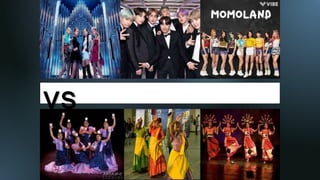
Philippine
Folk
Dance
P H Y S I C A L E D U C A T I O N
VS
TRIVIA !
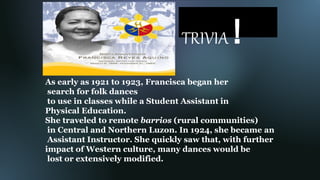
As early as 1921 to 1923, Francisca began her
search for folk dances
to use in classes while a Student Assistant in
Physical Education.
She traveled to remote barrios (rural communities)
in Central and Northern Luzon. In 1924, she became an
Assistant Instructor. She quickly saw that, with further
impact of Western culture, many dances would be
lost or extensively modified.
TRIVIA !
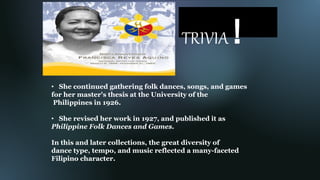
• She continued gathering folk dances, songs, and games
for her master's thesis at the University of the
Philippines in 1926.
• She revised her work in 1927, and published it as
Philippine Folk Dances and Games.
In this and later collections, the great diversity of
dance type, tempo, and music reflected a many-faceted
Filipino character.
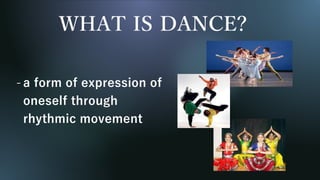
WHAT IS DANCE?
- a form of expression of
oneself through
rhythmic movement
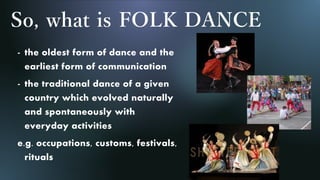
So, what is FOLK DANCE
- the oldest form of dance and the
earliest form of communication
- the traditional dance of a given
country which evolved naturally
and spontaneously with
everyday activities
e.g. occupations, customs, festivals,
rituals
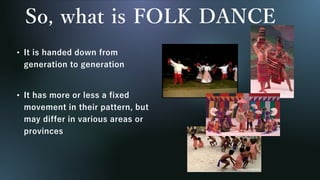
So, what is FOLK DANCE
• It is handed down from
generation to generation
• It has more or less a fixed
movement in their pattern, but
may differ in various areas or
provinces
5 Major Classifications of
Philippine Folk Dances
1. Cordillera Dances
2. Spanish Influenced Dances
3. Muslim Dances
4. Tribal Dances
5. Rural Dances
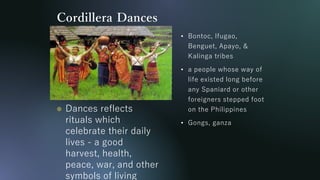
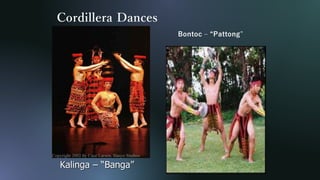
Cordillera Dances
• Bontoc, Ifugao,
Benguet, Apayo, &
Kalinga tribes
• a people whose way of
life existed long before
any Spaniard or other
foreigners stepped foot
on the Philippines
• Gongs, ganza
 Dances reflects
rituals which
celebrate their daily
lives - a good
harvest, health,
peace, war, and other
symbols of living
Cordillera Dances
Bontoc – “Pattong”
Kalinga – “Banga”
Bontoc – “Pattong”
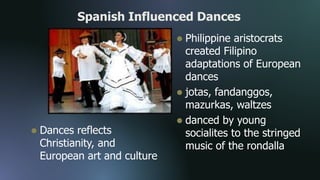
Spanish Influenced Dances
 Dances reflects
Christianity, and
European art and culture
 Philippine aristocrats
created Filipino
adaptations of European
dances
 jotas, fandanggos,
mazurkas, waltzes
 danced by young
socialites to the stringed
music of the rondalla
“Habanera”
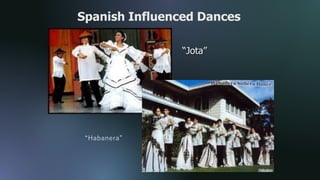
Spanish Influenced Dances
“Jota”
“Habanera”
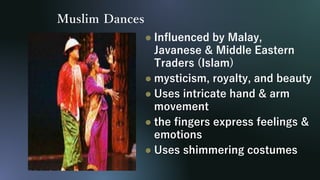
Muslim Dances
 Influenced by Malay,
Javanese & Middle Eastern
Traders (Islam)
 mysticism, royalty, and beauty
 Uses intricate hand & arm
movement
 the fingers express feelings &
emotions
 Uses shimmering costumes
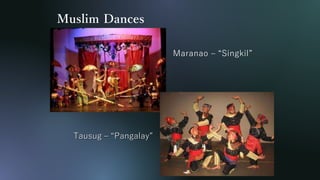
Muslim Dances
Maranao – “Singkil”
Tausug – “Pangalay”
Tausug – “Pangalay”
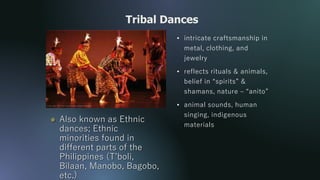
• intricate craftsmanship in
metal, clothing, and
jewelry
• reflects rituals & animals,
belief in “spirits” &
shamans, nature – “anito”
• animal sounds, human
singing, indigenous
materials
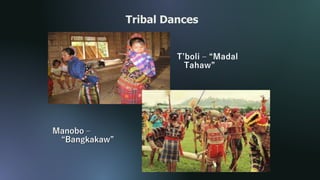
Tribal Dances
 Also known as Ethnic
dances; Ethnic
minorities found in
different parts of the
Philippines (T’boli,
Bilaan, Manobo, Bagobo,
etc.)
T’boli – “Madal
Tahaw”
Tribal Dances
Manobo –
“Bangkakaw”
Manobo – “Bangkakaw”
COSTUMES
IN
PHILIPPINE
FOLK DANCE
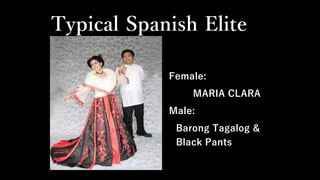
Typical Spanish Elite
Female:
MARIA CLARA
Male:
Barong Tagalog &
Black Pants
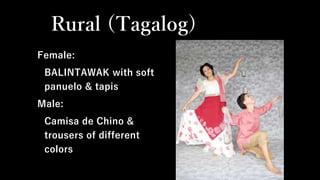
Rural (Tagalog)
Female:
BALINTAWAK with soft
panuelo & tapis
Male:
Camisa de Chino &
trousers of different
colors
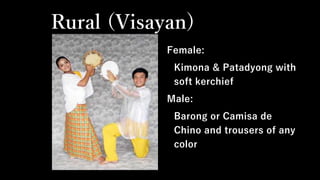
Rural (Visayan)
Female:
Kimona & Patadyong with
soft kerchief
Male:
Barong or Camisa de
Chino and trousers of any
color
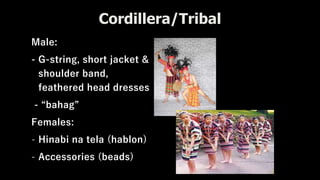
Male:
- G-string, short jacket &
shoulder band,
feathered head dresses
- “bahag”
Females:
- Hinabi na tela (hablon)
- Accessories (beads)
Cordillera/Tribal
• “Sigpit” or
“Sablay”
• patadyong
• Malong
• pants
Muslim
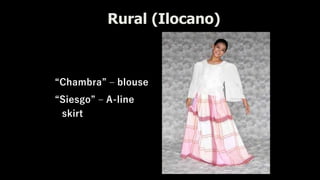
“Chambra” – blouse
“Siesgo” – A-line
skirt
Rural (Ilocano)
REFERENCES
• 2010. Catacutan, Allen. Fundamentals in Philippine
Folk Dance + Filipino Cultural Communities. 5
October 2010.
http://www.scribd.com/doc/38738236/Fundamenta
ls-in-Philippine-Folk-Dance-Filipino-Cultural-
Communities
• 2008. Philippine Folk Dance Society, Cultural Center
of the Philippines. A Classic Collection of Philippine
Folk Dances Series III, 28th National Folk Dance

Philippine Folk Dance.pptx

  • 1.
    Philippine Folk Dance P H YS I C A L E D U C A T I O N
  • 2.
  • 3.
    TRIVIA ! As earlyas 1921 to 1923, Francisca began her search for folk dances to use in classes while a Student Assistant in Physical Education. She traveled to remote barrios (rural communities) in Central and Northern Luzon. In 1924, she became an Assistant Instructor. She quickly saw that, with further impact of Western culture, many dances would be lost or extensively modified.
  • 4.
    TRIVIA ! • Shecontinued gathering folk dances, songs, and games for her master's thesis at the University of the Philippines in 1926. • She revised her work in 1927, and published it as Philippine Folk Dances and Games. In this and later collections, the great diversity of dance type, tempo, and music reflected a many-faceted Filipino character.
  • 5.
    WHAT IS DANCE? -a form of expression of oneself through rhythmic movement
  • 6.
    So, what isFOLK DANCE - the oldest form of dance and the earliest form of communication - the traditional dance of a given country which evolved naturally and spontaneously with everyday activities e.g. occupations, customs, festivals, rituals
  • 7.
    So, what isFOLK DANCE • It is handed down from generation to generation • It has more or less a fixed movement in their pattern, but may differ in various areas or provinces
  • 8.
    5 Major Classificationsof Philippine Folk Dances 1. Cordillera Dances 2. Spanish Influenced Dances 3. Muslim Dances 4. Tribal Dances 5. Rural Dances
  • 9.
    Cordillera Dances • Bontoc,Ifugao, Benguet, Apayo, & Kalinga tribes • a people whose way of life existed long before any Spaniard or other foreigners stepped foot on the Philippines • Gongs, ganza  Dances reflects rituals which celebrate their daily lives - a good harvest, health, peace, war, and other symbols of living
  • 10.
    Cordillera Dances Bontoc –“Pattong” Kalinga – “Banga”
  • 11.
  • 12.
    Spanish Influenced Dances Dances reflects Christianity, and European art and culture  Philippine aristocrats created Filipino adaptations of European dances  jotas, fandanggos, mazurkas, waltzes  danced by young socialites to the stringed music of the rondalla
  • 13.
  • 14.
  • 15.
    Muslim Dances  Influencedby Malay, Javanese & Middle Eastern Traders (Islam)  mysticism, royalty, and beauty  Uses intricate hand & arm movement  the fingers express feelings & emotions  Uses shimmering costumes
  • 16.
    Muslim Dances Maranao –“Singkil” Tausug – “Pangalay”
  • 17.
  • 18.
    • intricate craftsmanshipin metal, clothing, and jewelry • reflects rituals & animals, belief in “spirits” & shamans, nature – “anito” • animal sounds, human singing, indigenous materials Tribal Dances  Also known as Ethnic dances; Ethnic minorities found in different parts of the Philippines (T’boli, Bilaan, Manobo, Bagobo, etc.)
  • 19.
    T’boli – “Madal Tahaw” TribalDances Manobo – “Bangkakaw”
  • 20.
  • 21.
  • 22.
    Typical Spanish Elite Female: MARIACLARA Male: Barong Tagalog & Black Pants
  • 23.
    Rural (Tagalog) Female: BALINTAWAK withsoft panuelo & tapis Male: Camisa de Chino & trousers of different colors
  • 24.
    Rural (Visayan) Female: Kimona &Patadyong with soft kerchief Male: Barong or Camisa de Chino and trousers of any color
  • 25.
    Male: - G-string, shortjacket & shoulder band, feathered head dresses - “bahag” Females: - Hinabi na tela (hablon) - Accessories (beads) Cordillera/Tribal
  • 26.
    • “Sigpit” or “Sablay” •patadyong • Malong • pants Muslim
  • 27.
    “Chambra” – blouse “Siesgo”– A-line skirt Rural (Ilocano)
  • 28.
    REFERENCES • 2010. Catacutan,Allen. Fundamentals in Philippine Folk Dance + Filipino Cultural Communities. 5 October 2010. http://www.scribd.com/doc/38738236/Fundamenta ls-in-Philippine-Folk-Dance-Filipino-Cultural- Communities • 2008. Philippine Folk Dance Society, Cultural Center of the Philippines. A Classic Collection of Philippine Folk Dances Series III, 28th National Folk Dance