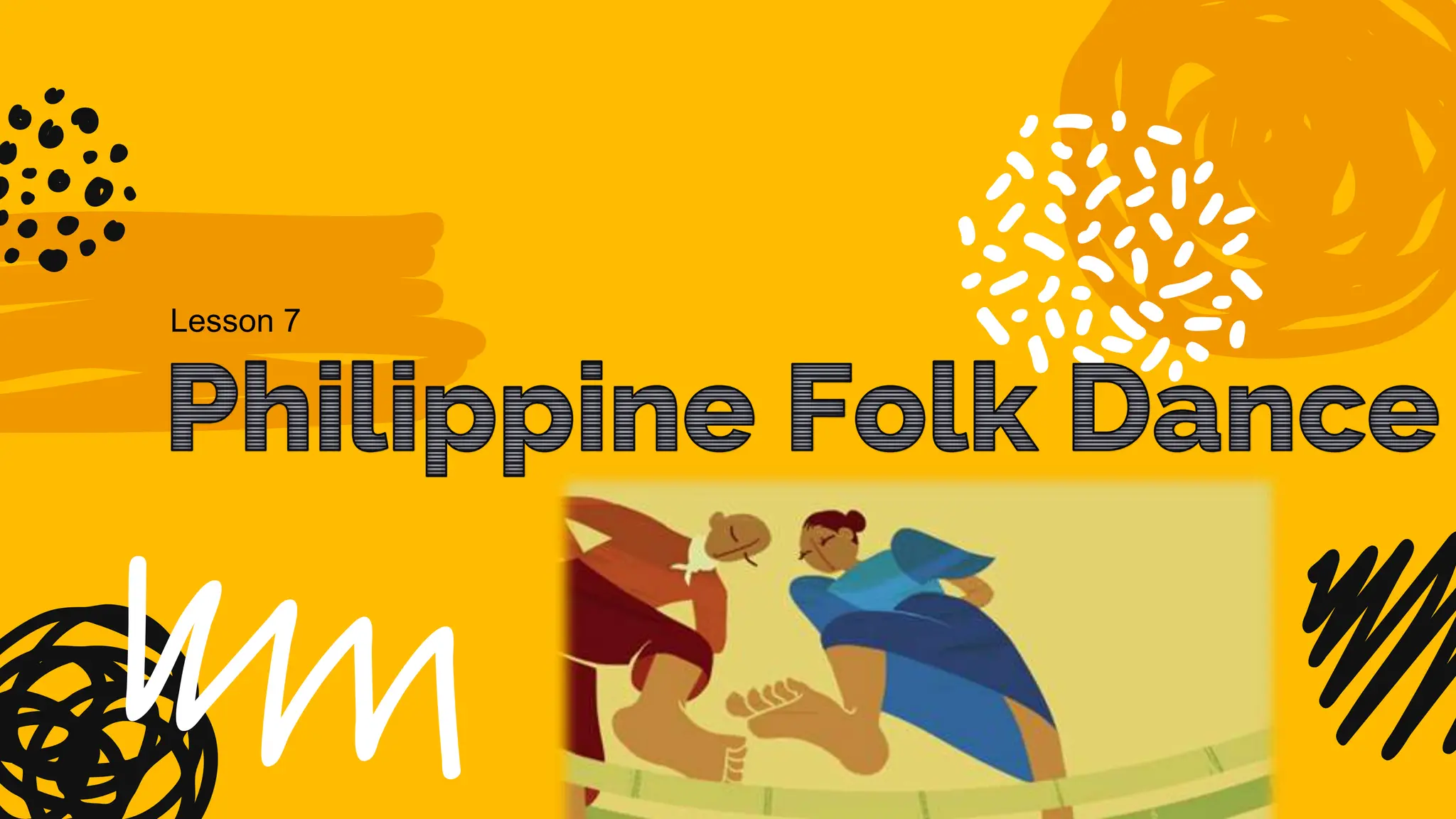
Lesson 7
AT THE END OF THE LESSON, THE STUDENTS WILL BE ABLE TO:
1. Determine the Nature of Folk Dance.
2. Identify the classifications of Philippine Folk Dance
3. Value the importance of Folk Dance to our country and to our
health.
4. Recognize the value of one’s health through participation in
physical activity assessment.
2
 The oldest form of dance and the
earliest form of communication
 Evolved naturally and spontaneously
with everyday activities
 It has fixed movement in their pattern
but it may differ in various areas or
provinces.
3
4
 Filipino folk dances are colorful, beautiful, and
vibrant. Their movement, dress, and music reveal
the unique Filipino culture and are important in
building a national Filipino identity.
 Most dances in the country were inspired by
everyday activities, such as working in the fields
and harvesting rice, as well as celebrations such
as feasts, weddings, and births.
5
Reference: http://www.ethnicgroupsphilippines.com/2016/02/15/philippine-folk-dances/
6
In the Philippines, dance is as diverse as
the culture intermingling in the
archipelago.
7
8
Cordillera Dances
 Dances reflects rituals
which celebratee their daily
lives – a good harvest,
health, peace, war and
other symbols living.
 Tribes like Bontoc, Ifugao,
Benguet, Apayo and Kalinga
introduce this concept ofd
dance.
9
Spanish Influence Dance
 Dances reflects Christianity
and European art and
Culture.
 Philippine Aristocrats
created Filipino Adaptations
of European dances.
10
Muslim Dances
 Influenced by Malay,
Javanese and Middle
Eastern traders. (Islam)
 Uses intricate hand and arm
movements.
 Uses bright and shimmering
costumes.
 Mysticism, royalty and
beauty is the main concept.
11
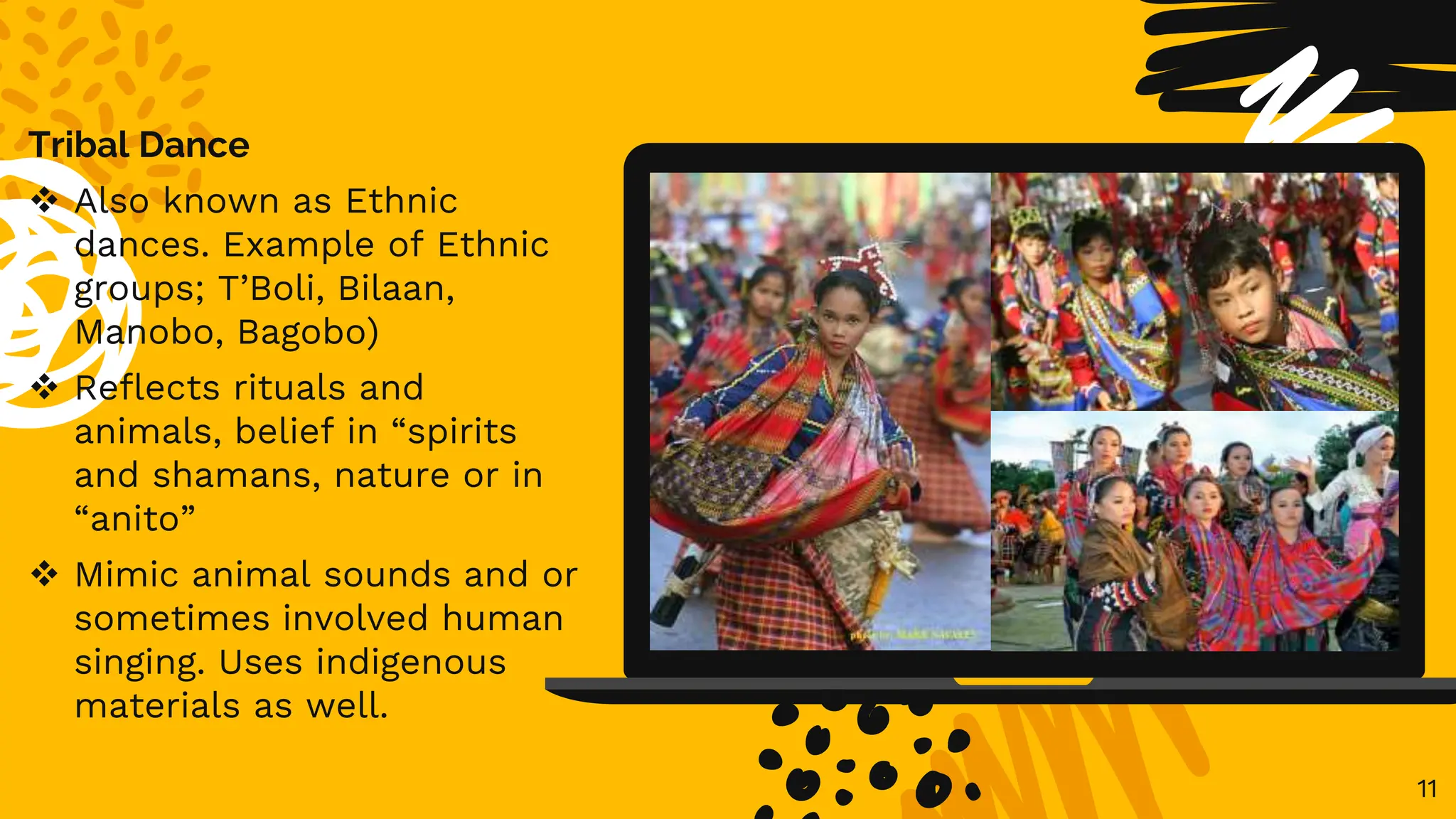
Tribal Dance
 Also known as Ethnic
dances. Example of Ethnic
groups; T’Boli, Bilaan,
Manobo, Bagobo)
 Reflects rituals and
animals, belief in “spirits
and shamans, nature or in
“anito”
 Mimic animal sounds and or
sometimes involved human
singing. Uses indigenous
materials as well.
12
Rural/Countryside Dances
 Reflects the simple life of
people in the barrio.
 Daily activities of the
peasants.
 Shows gaiety, laughter and
festivities.
 Performed in fiestas to
honor patron saints.
What makes Philippine folk dance
different from one another?
13
 Filipino dance has always been in spotlight, thanks to various awards and
recognitions given to various dance troupes. There are the likes of the
Ramon Obusan Dance Troup and the Bayanihan Dance Troupe, both of
whom have traveled around the world to promote the country’s various
dances.
 There are, of course, Filipino groups that have reaped awards from
genres like jazz, hip-hop, and ballet – there's Ballet Philippines,
Philippine All Stars, Jabbawockeez, ATeam and UPeepz.
 But before these groups made it locally and worldwide came 5 women
who developed and promoted Filipino folk and modern dance.
14
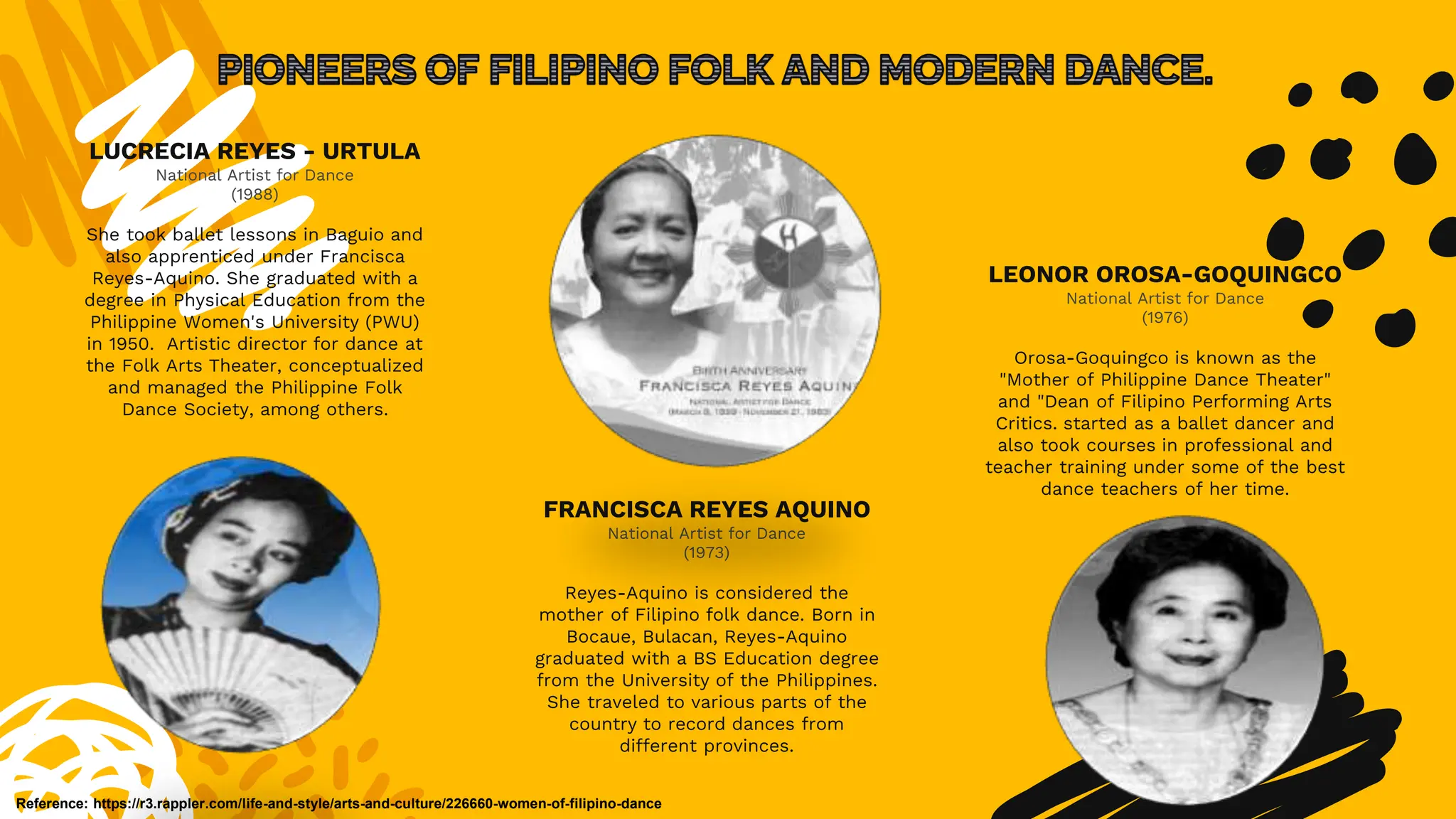
FRANCISCA REYES AQUINO
National Artist for Dance
(1973)
Reyes-Aquino is considered the
mother of Filipino folk dance. Born in
Bocaue, Bulacan, Reyes-Aquino
graduated with a BS Education degree
from the University of the Philippines.
She traveled to various parts of the
country to record dances from
different provinces.
LEONOR OROSA-GOQUINGCO
National Artist for Dance
(1976)
Orosa-Goquingco is known as the
"Mother of Philippine Dance Theater"
and "Dean of Filipino Performing Arts
Critics. started as a ballet dancer and
also took courses in professional and
teacher training under some of the best
dance teachers of her time.
LUCRECIA REYES - URTULA
National Artist for Dance
(1988)
She took ballet lessons in Baguio and
also apprenticed under Francisca
Reyes-Aquino. She graduated with a
degree in Physical Education from the
Philippine Women's University (PWU)
in 1950. Artistic director for dance at
the Folk Arts Theater, conceptualized
and managed the Philippine Folk
Dance Society, among others.
Reference: https://r3.rappler.com/life-and-style/arts-and-culture/226660-women-of-filipino-dance
LIGAYA FERNANDO AMILBANGSA
Ramon Magsaysay Awardee
(1976)
Orosa-Goquingco is known as the "Mother of
Philippine Dance Theater" and "Dean of
Filipino Performing Arts Critics. started as a
ballet dancer and also took courses in
professional and teacher training under some
of the best dance teachers of her time.
ALICE REYES
National Artist for Dance
(2014)
She took ballet lessons in Baguio and
also apprenticed under Francisca
Reyes-Aquino. She graduated with a
degree in Physical Education from the
Philippine Women's University (PWU)
in 1950. Artistic director for dance at
the Folk Arts Theater, conceptualized
and managed the Philippine Folk
Dance Society, among others.
Reference: https://r3.rappler.com/life-and-style/arts-and-culture/226660-women-of-filipino-dance
17
“
What matters for now is for every Filipino to
protect our tradition and let no one distort it
under the guise of modernization. Leave the
folk dance as they are.
Heritage must not be sacrificed for progress
18
FRANCISCA REYES-AQUNO
National Artist for Dance
19

Lesson 7 - Folk Dance Short History and Background

  • 1.
  • 2.
    AT THE ENDOF THE LESSON, THE STUDENTS WILL BE ABLE TO: 1. Determine the Nature of Folk Dance. 2. Identify the classifications of Philippine Folk Dance 3. Value the importance of Folk Dance to our country and to our health. 4. Recognize the value of one’s health through participation in physical activity assessment. 2
  • 3.
     The oldestform of dance and the earliest form of communication  Evolved naturally and spontaneously with everyday activities  It has fixed movement in their pattern but it may differ in various areas or provinces. 3
  • 4.
  • 5.
     Filipino folkdances are colorful, beautiful, and vibrant. Their movement, dress, and music reveal the unique Filipino culture and are important in building a national Filipino identity.  Most dances in the country were inspired by everyday activities, such as working in the fields and harvesting rice, as well as celebrations such as feasts, weddings, and births. 5 Reference: http://www.ethnicgroupsphilippines.com/2016/02/15/philippine-folk-dances/
  • 6.
  • 7.
    In the Philippines,dance is as diverse as the culture intermingling in the archipelago. 7
  • 8.
    8 Cordillera Dances  Dancesreflects rituals which celebratee their daily lives – a good harvest, health, peace, war and other symbols living.  Tribes like Bontoc, Ifugao, Benguet, Apayo and Kalinga introduce this concept ofd dance.
  • 9.
    9 Spanish Influence Dance Dances reflects Christianity and European art and Culture.  Philippine Aristocrats created Filipino Adaptations of European dances.
  • 10.
    10 Muslim Dances  Influencedby Malay, Javanese and Middle Eastern traders. (Islam)  Uses intricate hand and arm movements.  Uses bright and shimmering costumes.  Mysticism, royalty and beauty is the main concept.
  • 11.
    11 Tribal Dance  Alsoknown as Ethnic dances. Example of Ethnic groups; T’Boli, Bilaan, Manobo, Bagobo)  Reflects rituals and animals, belief in “spirits and shamans, nature or in “anito”  Mimic animal sounds and or sometimes involved human singing. Uses indigenous materials as well.
  • 12.
    12 Rural/Countryside Dances  Reflectsthe simple life of people in the barrio.  Daily activities of the peasants.  Shows gaiety, laughter and festivities.  Performed in fiestas to honor patron saints.
  • 13.
    What makes Philippinefolk dance different from one another? 13
  • 14.
     Filipino dancehas always been in spotlight, thanks to various awards and recognitions given to various dance troupes. There are the likes of the Ramon Obusan Dance Troup and the Bayanihan Dance Troupe, both of whom have traveled around the world to promote the country’s various dances.  There are, of course, Filipino groups that have reaped awards from genres like jazz, hip-hop, and ballet – there's Ballet Philippines, Philippine All Stars, Jabbawockeez, ATeam and UPeepz.  But before these groups made it locally and worldwide came 5 women who developed and promoted Filipino folk and modern dance. 14
  • 15.
    FRANCISCA REYES AQUINO NationalArtist for Dance (1973) Reyes-Aquino is considered the mother of Filipino folk dance. Born in Bocaue, Bulacan, Reyes-Aquino graduated with a BS Education degree from the University of the Philippines. She traveled to various parts of the country to record dances from different provinces. LEONOR OROSA-GOQUINGCO National Artist for Dance (1976) Orosa-Goquingco is known as the "Mother of Philippine Dance Theater" and "Dean of Filipino Performing Arts Critics. started as a ballet dancer and also took courses in professional and teacher training under some of the best dance teachers of her time. LUCRECIA REYES - URTULA National Artist for Dance (1988) She took ballet lessons in Baguio and also apprenticed under Francisca Reyes-Aquino. She graduated with a degree in Physical Education from the Philippine Women's University (PWU) in 1950. Artistic director for dance at the Folk Arts Theater, conceptualized and managed the Philippine Folk Dance Society, among others. Reference: https://r3.rappler.com/life-and-style/arts-and-culture/226660-women-of-filipino-dance
  • 16.
    LIGAYA FERNANDO AMILBANGSA RamonMagsaysay Awardee (1976) Orosa-Goquingco is known as the "Mother of Philippine Dance Theater" and "Dean of Filipino Performing Arts Critics. started as a ballet dancer and also took courses in professional and teacher training under some of the best dance teachers of her time. ALICE REYES National Artist for Dance (2014) She took ballet lessons in Baguio and also apprenticed under Francisca Reyes-Aquino. She graduated with a degree in Physical Education from the Philippine Women's University (PWU) in 1950. Artistic director for dance at the Folk Arts Theater, conceptualized and managed the Philippine Folk Dance Society, among others. Reference: https://r3.rappler.com/life-and-style/arts-and-culture/226660-women-of-filipino-dance
  • 17.
  • 18.
    “ What matters fornow is for every Filipino to protect our tradition and let no one distort it under the guise of modernization. Leave the folk dance as they are. Heritage must not be sacrificed for progress 18 FRANCISCA REYES-AQUNO National Artist for Dance
  • 19.