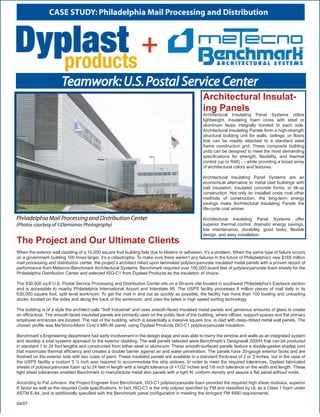
CASE STUDY: Philadelphia Mail Processing and Distribution


                                                                 +
                       Teamwork: U.S. Postal Service Center
                                                                                                  Architectural Insulat-
                                                                                                  ing Panels
                                                                                                  Architectural Insulating Panel Systems utilize
                                                                                                  lightweight, insulating foam cores with steel or
                                                                                                  aluminum faces integrally bonded to each side.
                                                                                                  Architectural Insulating Panels form a high-strength
                                                                                                  structural building unit for walls, ceilings, or floors
                                                                                                  that can be readily attached to a standard steel
                                                                                                  frame construction grid. These composite building
                                                                                                  units can be designed to meet the most demanding
                                                                                                  specifications for strength, flexibility, and thermal
                                                                                                  control (up to R48) - - while providing a broad array
                                                                                                  of architectural colors and textures.

                                                                                                  Architectural Insulating Panel Systems are an
                                                                                                  economical alternative to metal clad buildings with
                                                                                                  batt insulation, insulated concrete forms, or tilt-up
                                                                                                  construction. Not only do installed costs rival other
                                                                                                  methods of construction, the long-term energy
                                                                                                  savings make Architectural Insulating Panels the
                                                                                                  life-cycle cost winner.

Philadelphia Mail Processing and Distribution Center                                              Architectural Insulating Panel Systems offer
(Photos courtesy of ©Damianos Photography)                                                        superior thermal control, dramatic energy savings,
                                                                                                  low maintenance, durability, good looks, flexible
                                                                                                  design, and easy installation.
The Project and Our Ultimate Clients
When the exterior wall cladding of a 10,000 square foot building fails due to blisters or adhesion, it’s a problem. When the same type of failure occurs
on a government building 100 times larger, it’s a catastrophe. To make sure there weren’t any failures in the future of Philadelphia’s new $165 million
mail processing and distribution center, the project’s architect relied upon laminated polyisocyanurate insulated metal panels with a proven record of
performance from Metecno-Benchmark Architectural Systems. Benchmark required over 100,000 board feet of polyisocyanurate foam sheets for the
Philadelphia Distribution Center and selected ISO-C1 from Dyplast Products as the insulation of choice.

The 930,000 sq-ft U.S. Postal Service Processing and Distribution Center sits on a 50-acre site located in southwest Philadelphia's Eastwick section
and is accessible to nearby Philadelphia International Airport and Interstate 95. The USPS facility processes 8 million pieces of mail daily in its
630,000 square foot, split level workroom. To get the mail in and out as quickly as possible, the facility has more than 100 loading and unloading
docks, located on the sides and along the back of the workroom, and uses the latest in high speed sorting technology.

The building is of a style the architect calls “Soft Industrial” and uses smooth-faced insulated metal panels and generous amounts of glass to create
an office-look. The smooth faced insulated panels are primarily used on the public face of the building, where offices, support spaces and the primary
employee entrances are located. The rest of the building, which is essentially a massive square box, is clad with deep-ribbed metal wall panels. The
chosen profile was MeTecno-Morin Corp’s MR-36 panel, using Dyplast Products ISO-C1 polyisocyanurate insulation.

Benchmark’s Engineering department had early involvement in the design stage and was able to marry the window and walls as an integrated system
and develop a total systems approach to the exterior cladding. The wall panels selected were Benchmark’s Designwall 2000H that can be produced
in standard 1 to 24 foot lengths and constructed from either steel or aluminum. These smooth-surfaced panels feature a double-gasket shiplap joint
that maximizes thermal efficiency and creates a double barrier against air and water penetration. The panels have 20-gauge exterior faces and are
finished on the exterior side with two coats of paint. These insulated panels are available in a standard thickness of 2 or 3 inches, but in the case of
the USPS facility a custom 3 ¼ inch was required to accommodate the strip widows. In order to meet the required tolerances, Dyplast fabricated
sheets of polyisocyanurate foam up to 24 feet in length with a height tolerance of +1/32 inches and 1/8 inch tolerance on the width and length. These
tight sheet tolerances enabled Benchmark to manufacture metal skin panels with a tight fit, uniform density and assure a flat panel without voids.

According to Pat Johnson, the Project Engineer from Benchmark, ISO-C1 polyisocyanurate foam provided the required high shear modulus, superior
K factor as well as the required Code specifications. In fact, ISO-C1 is the only polyiso specified by FM and classified by UL as a Class 1 foam under
ASTM E-84, and is additionally specified with the Benchmark panel configuration in meeting the stringent FM 4880 requirements.

04/07
The Client’s Perspectives
                                                          Bill Powell, project contract manager at USPS, said the
                                                          construction of the Philadelphia facility was in the works for
                                                          almost two decades before any dirt was moved. The project,
                                                          which broke ground in August 2003, was completed in late
                                                          2006. The project's mission is to streamline and consolidate
                                                          postal services for the city, Powell said. In the process, it has
                                                          become the first urban processing center built to use
                                                          computer-aided distribution networks, and Powell said it
                                                          could serve as the model for future centers in major cities.
                                                          Kling of Philadelphia designed the building, keeping in mind
                                                          both the efficient circulation of mail and the thousands of
                                                          workers soon to inhabit the massive building. "It became
                                                          natural to think of a separating, organizing element between
                                                          the administrative elements and the workroom," Kling project
“The new 930,000-sq.-ft. USPS distribution center         director Richard Farley said. For the general contractors, a
                                                          joint venture of J.E. Dunn Construction of Kansas City and
in Philadelphia will not only streamline and              INTECH Construction from Philadelphia, construction has
consolidate the city's postal service, it will create a   required "a little bit of everything," said Travis Noble, senior
new model for future facilities.”                         project manager from Dunn Construction.
                                                          "This is a great project in the sense that we are dealing with
Key Players!                                              a lot of different types of construction in one project," Noble
                                                          added. Skinned with smooth, silver metal panels and hori-
Owner: U.S. Postal Service, Arlington, Va.                zontal strip windows, the support building sits in front of the
                                                          separating wall. The look, which Kling designer Robert Little
Architect: Kling, Philadelphia                            called "soft industrial," is similar to a modern, corporate office
                                                          building. Little used the panels and strip windows to exag-
General Contractors: J.E. Dunn Construction,              gerate the building's horizontal proportion. "The metal
Kansas City, Mo.; INTECH Construction, Philadelphia       panels provide a sleekness that could not be achieved in the
                                                          same way with other materials," Little added. "The building
Construction Managers: Jacobs Facilities, Laurel,         would appear more massive then it actually is if brick or
Md.; Gilbane Building Co., Arlington, Va.                 precast panels were used."
Building Panel Designer/Provider: MeTecno-                Like the support area, the workroom is also a steel-framed
Benchmark                                                 facility with metal deck and concrete floors. The exterior is a
                                                          corrugated, field-assembled, metal panel with exposed
Insulation Supplier: Dyplast Products                     fasteners that works as a cost-effective solution to keeping
                                                          with the industrial aesthetic. Structural bays in the workroom
Mechanization: IG Associates, Philadelphia                area are 50 ft. by 50 ft., running the height of the workroom,
Geotech Services: Langan Engineering, Philadelphia        which is split between two levels. Although the entire facility
                                                          is the same height, the workroom area is two levels while the
Fire Protection Services: Rolf Jensen & Assoc.,           support areas are split into three levels.
Fairfax, Va.
Polyiso vs. Alternatives
                                                                       Dyplast ISO-C1’s service temperature range is -297F to +300F, making it an
                                                                       excellent product for architectural and structural panel applications. Although
                                                                       conventional wisdom has been that new generations of pentane-blown foams
                                                                       have poorer thermal insulating properties, Dyplast broke the paradigm by
                                                                       achieving an industry-best aged K-factor of 0.18 at 75F (independent labora-
                                                                       tory), reaching compliance with the traditional ASTM C591 standard that many
                                                                       had lobbied to make less restrictive. And ISO-C1’s K-factor improves signifi-
                                                                       cantly as temperatures drop. ISO-C1 is the only polyiso specified by Factory
                                                                       Mutual and classified by Underwriters Laboratories.

                                                                       With the lowest K-factor of any commercially viable insulation, polyiso is the
                                                                       insulation-of-choice for the majority of architectural panel applications where
                                                                       high shear modulus, superior K factor, as well as requisite Code specifications
                                                                       are applicable. And twenty years after installation ISO-C1 retains essentially
                                                                       the same physical properties as it had after six months. Insulation alternatives
                                                                       for architectural panel applications are often selected only because of lack of
                                                                       familiarity with the improved characteristics of polyiso. For instance:
Dyplast Products’ polyisocyanurate bunstock exiting the
free-rise tunnel. ISO-C1 can then be cut virtually to any length
                                                                       ■ Polyiso’s insulating value is 40% better than typical structural panels made with
and subsequently cut in sheets to 1/32” tolerance.                       Expanded Polystyrene (EPS); EPS also has inferior water absorption and service
                                                                         temperature ranges;
Why MeTecno-Benchmark                                                  ■ Extruded Polystyrene (XPS) also has poorer insulating value with an aged
                                                                         K-factor of 0.259 vs. 0.18 for ISO-C1, and is manufactured in short lengths that

Architectural Systems?                                                   make it unsuitable for long wall, roof, or floor applications;
                                                                       ■ Polyurethane (PUR) insulation has been generally replaced by polyisocyanurate
The 2000 series features a double-gasket shiplap joint in                (PIR) insulation, which is a form of polyurethane but with better K-factor and
both vertical and horizontal applications to maximize thermal            dimensional stability. Polyurethane foam-in-place insulation is utilized in limited
efficiency and create a double barrier against air and water             applications, but susceptibility to blistering, outgassing of foaming agent
penetration. Laminated construction allows for the maximum               residues, and shrinkage must be considered.
design flexibility for custom fabricated applications. In
addition, Designwall™ 2000 allows for the use of Dyplast’s             Introduction Dyplast Products
ISO-C1 polyisocyanurate with its extraodinary insulating               Dyplast Products is the preeminent manufacturer of polyisocyanurate and
value, low water absorption, high strength, dimensional                expanded polystyrene rigid foam products, and also offers a variety of comple-
stability, and other excellent physical properties. Custom             mentary products for commercial, industrial, and residential customers. With
fabricated shapes are also available to meet a variety of              world-class production facilities in Miami, Florida, we offer our customers unsur-
design criteria. As with Designwall™ 500 and 1000, the 2000            passed responsiveness using a wide range of product configurations. Our
Series exterior surfaces are offered in embossed steel.                customer-focused staff, combined with our sound financial footing, ensure we
                                                                       deliver incomparable value to our customers far into the future. Dyplast
                                                                       Products is the preeminent manufacturer of polyisocyanurate and expanded
                                                                       polystyrene rigid foam products, and also offers a variety of complementary
                                                                       products for commercial, industrial, and residential customers. With world-class
                                                                       production facilities in Miami, Florida, we offer our customers unsurpassed
                                                                       responsiveness using a wide range of product configurations. Our customer-
                                                                       focused staff, combined with our sound financial footing, ensure we deliver
                                                                       incomparable value to our customers far into the future.

                                                                       Introduction to MeTecno-
                                                                       Benchmark
                                                                       MeTecno-Benchmark Architectural Systems is a Columbus, Ohio based manu-
                                                                       facturer of premium flat architectural metal wall panel systems. Metecno-
                                                                       Benchmark utilizes laminated panel technology with polyisocyanurate foam
                                                                       insulation that allows for maximum thermal efficiency plus design flexibility for
                                                                       custom fabricated applications.

                                                                       MeTecno-Benchmark Architectural Systems is a rapidly growing company
                                                                       focused on serving the building industries with excellent products and customer
                                                                       response. MeTecno-Benchmark excels at both large and small projects, and
                                                                       works directly with architects, project managers and owners to achieve the
                                                                       maximum in building design, value, and on-time service. MeTecno-Benchmark
                                                                       pledges to do whatever it takes to maintain its satisfied customers.


       12501 NW 38th Ave                                                                                               Architectural Systems
        Miami, FL 33054                             Because project conditions and local codes vary, the         P.O. Box 07928; 720 Marion Rd.
                                               customer is responsible for determining product applicabil-            Columbus, Ohio 43207
          800.433.5551                          ity and installation procedures. No warranties are given or
     www.dyplastproducts.com                   implied. All implied warranties of merchantability or fitness               614.444.0110
                                                      for a particular purpose are expressly excluded.            www.benchmarkpanels.com

Case Study: Philadelphia Mail Processing and Distribution

  • 1.
    CASE STUDY: PhiladelphiaMail Processing and Distribution + Teamwork: U.S. Postal Service Center Architectural Insulat- ing Panels Architectural Insulating Panel Systems utilize lightweight, insulating foam cores with steel or aluminum faces integrally bonded to each side. Architectural Insulating Panels form a high-strength structural building unit for walls, ceilings, or floors that can be readily attached to a standard steel frame construction grid. These composite building units can be designed to meet the most demanding specifications for strength, flexibility, and thermal control (up to R48) - - while providing a broad array of architectural colors and textures. Architectural Insulating Panel Systems are an economical alternative to metal clad buildings with batt insulation, insulated concrete forms, or tilt-up construction. Not only do installed costs rival other methods of construction, the long-term energy savings make Architectural Insulating Panels the life-cycle cost winner. Philadelphia Mail Processing and Distribution Center Architectural Insulating Panel Systems offer (Photos courtesy of ©Damianos Photography) superior thermal control, dramatic energy savings, low maintenance, durability, good looks, flexible design, and easy installation. The Project and Our Ultimate Clients When the exterior wall cladding of a 10,000 square foot building fails due to blisters or adhesion, it’s a problem. When the same type of failure occurs on a government building 100 times larger, it’s a catastrophe. To make sure there weren’t any failures in the future of Philadelphia’s new $165 million mail processing and distribution center, the project’s architect relied upon laminated polyisocyanurate insulated metal panels with a proven record of performance from Metecno-Benchmark Architectural Systems. Benchmark required over 100,000 board feet of polyisocyanurate foam sheets for the Philadelphia Distribution Center and selected ISO-C1 from Dyplast Products as the insulation of choice. The 930,000 sq-ft U.S. Postal Service Processing and Distribution Center sits on a 50-acre site located in southwest Philadelphia's Eastwick section and is accessible to nearby Philadelphia International Airport and Interstate 95. The USPS facility processes 8 million pieces of mail daily in its 630,000 square foot, split level workroom. To get the mail in and out as quickly as possible, the facility has more than 100 loading and unloading docks, located on the sides and along the back of the workroom, and uses the latest in high speed sorting technology. The building is of a style the architect calls “Soft Industrial” and uses smooth-faced insulated metal panels and generous amounts of glass to create an office-look. The smooth faced insulated panels are primarily used on the public face of the building, where offices, support spaces and the primary employee entrances are located. The rest of the building, which is essentially a massive square box, is clad with deep-ribbed metal wall panels. The chosen profile was MeTecno-Morin Corp’s MR-36 panel, using Dyplast Products ISO-C1 polyisocyanurate insulation. Benchmark’s Engineering department had early involvement in the design stage and was able to marry the window and walls as an integrated system and develop a total systems approach to the exterior cladding. The wall panels selected were Benchmark’s Designwall 2000H that can be produced in standard 1 to 24 foot lengths and constructed from either steel or aluminum. These smooth-surfaced panels feature a double-gasket shiplap joint that maximizes thermal efficiency and creates a double barrier against air and water penetration. The panels have 20-gauge exterior faces and are finished on the exterior side with two coats of paint. These insulated panels are available in a standard thickness of 2 or 3 inches, but in the case of the USPS facility a custom 3 ¼ inch was required to accommodate the strip widows. In order to meet the required tolerances, Dyplast fabricated sheets of polyisocyanurate foam up to 24 feet in length with a height tolerance of +1/32 inches and 1/8 inch tolerance on the width and length. These tight sheet tolerances enabled Benchmark to manufacture metal skin panels with a tight fit, uniform density and assure a flat panel without voids. According to Pat Johnson, the Project Engineer from Benchmark, ISO-C1 polyisocyanurate foam provided the required high shear modulus, superior K factor as well as the required Code specifications. In fact, ISO-C1 is the only polyiso specified by FM and classified by UL as a Class 1 foam under ASTM E-84, and is additionally specified with the Benchmark panel configuration in meeting the stringent FM 4880 requirements. 04/07
  • 2.
    The Client’s Perspectives Bill Powell, project contract manager at USPS, said the construction of the Philadelphia facility was in the works for almost two decades before any dirt was moved. The project, which broke ground in August 2003, was completed in late 2006. The project's mission is to streamline and consolidate postal services for the city, Powell said. In the process, it has become the first urban processing center built to use computer-aided distribution networks, and Powell said it could serve as the model for future centers in major cities. Kling of Philadelphia designed the building, keeping in mind both the efficient circulation of mail and the thousands of workers soon to inhabit the massive building. "It became natural to think of a separating, organizing element between the administrative elements and the workroom," Kling project “The new 930,000-sq.-ft. USPS distribution center director Richard Farley said. For the general contractors, a joint venture of J.E. Dunn Construction of Kansas City and in Philadelphia will not only streamline and INTECH Construction from Philadelphia, construction has consolidate the city's postal service, it will create a required "a little bit of everything," said Travis Noble, senior new model for future facilities.” project manager from Dunn Construction. "This is a great project in the sense that we are dealing with Key Players! a lot of different types of construction in one project," Noble added. Skinned with smooth, silver metal panels and hori- Owner: U.S. Postal Service, Arlington, Va. zontal strip windows, the support building sits in front of the separating wall. The look, which Kling designer Robert Little Architect: Kling, Philadelphia called "soft industrial," is similar to a modern, corporate office building. Little used the panels and strip windows to exag- General Contractors: J.E. Dunn Construction, gerate the building's horizontal proportion. "The metal Kansas City, Mo.; INTECH Construction, Philadelphia panels provide a sleekness that could not be achieved in the same way with other materials," Little added. "The building Construction Managers: Jacobs Facilities, Laurel, would appear more massive then it actually is if brick or Md.; Gilbane Building Co., Arlington, Va. precast panels were used." Building Panel Designer/Provider: MeTecno- Like the support area, the workroom is also a steel-framed Benchmark facility with metal deck and concrete floors. The exterior is a corrugated, field-assembled, metal panel with exposed Insulation Supplier: Dyplast Products fasteners that works as a cost-effective solution to keeping with the industrial aesthetic. Structural bays in the workroom Mechanization: IG Associates, Philadelphia area are 50 ft. by 50 ft., running the height of the workroom, Geotech Services: Langan Engineering, Philadelphia which is split between two levels. Although the entire facility is the same height, the workroom area is two levels while the Fire Protection Services: Rolf Jensen & Assoc., support areas are split into three levels. Fairfax, Va.
  • 3.
    Polyiso vs. Alternatives Dyplast ISO-C1’s service temperature range is -297F to +300F, making it an excellent product for architectural and structural panel applications. Although conventional wisdom has been that new generations of pentane-blown foams have poorer thermal insulating properties, Dyplast broke the paradigm by achieving an industry-best aged K-factor of 0.18 at 75F (independent labora- tory), reaching compliance with the traditional ASTM C591 standard that many had lobbied to make less restrictive. And ISO-C1’s K-factor improves signifi- cantly as temperatures drop. ISO-C1 is the only polyiso specified by Factory Mutual and classified by Underwriters Laboratories. With the lowest K-factor of any commercially viable insulation, polyiso is the insulation-of-choice for the majority of architectural panel applications where high shear modulus, superior K factor, as well as requisite Code specifications are applicable. And twenty years after installation ISO-C1 retains essentially the same physical properties as it had after six months. Insulation alternatives for architectural panel applications are often selected only because of lack of familiarity with the improved characteristics of polyiso. For instance: Dyplast Products’ polyisocyanurate bunstock exiting the free-rise tunnel. ISO-C1 can then be cut virtually to any length ■ Polyiso’s insulating value is 40% better than typical structural panels made with and subsequently cut in sheets to 1/32” tolerance. Expanded Polystyrene (EPS); EPS also has inferior water absorption and service temperature ranges; Why MeTecno-Benchmark ■ Extruded Polystyrene (XPS) also has poorer insulating value with an aged K-factor of 0.259 vs. 0.18 for ISO-C1, and is manufactured in short lengths that Architectural Systems? make it unsuitable for long wall, roof, or floor applications; ■ Polyurethane (PUR) insulation has been generally replaced by polyisocyanurate The 2000 series features a double-gasket shiplap joint in (PIR) insulation, which is a form of polyurethane but with better K-factor and both vertical and horizontal applications to maximize thermal dimensional stability. Polyurethane foam-in-place insulation is utilized in limited efficiency and create a double barrier against air and water applications, but susceptibility to blistering, outgassing of foaming agent penetration. Laminated construction allows for the maximum residues, and shrinkage must be considered. design flexibility for custom fabricated applications. In addition, Designwall™ 2000 allows for the use of Dyplast’s Introduction Dyplast Products ISO-C1 polyisocyanurate with its extraodinary insulating Dyplast Products is the preeminent manufacturer of polyisocyanurate and value, low water absorption, high strength, dimensional expanded polystyrene rigid foam products, and also offers a variety of comple- stability, and other excellent physical properties. Custom mentary products for commercial, industrial, and residential customers. With fabricated shapes are also available to meet a variety of world-class production facilities in Miami, Florida, we offer our customers unsur- design criteria. As with Designwall™ 500 and 1000, the 2000 passed responsiveness using a wide range of product configurations. Our Series exterior surfaces are offered in embossed steel. customer-focused staff, combined with our sound financial footing, ensure we deliver incomparable value to our customers far into the future. Dyplast Products is the preeminent manufacturer of polyisocyanurate and expanded polystyrene rigid foam products, and also offers a variety of complementary products for commercial, industrial, and residential customers. With world-class production facilities in Miami, Florida, we offer our customers unsurpassed responsiveness using a wide range of product configurations. Our customer- focused staff, combined with our sound financial footing, ensure we deliver incomparable value to our customers far into the future. Introduction to MeTecno- Benchmark MeTecno-Benchmark Architectural Systems is a Columbus, Ohio based manu- facturer of premium flat architectural metal wall panel systems. Metecno- Benchmark utilizes laminated panel technology with polyisocyanurate foam insulation that allows for maximum thermal efficiency plus design flexibility for custom fabricated applications. MeTecno-Benchmark Architectural Systems is a rapidly growing company focused on serving the building industries with excellent products and customer response. MeTecno-Benchmark excels at both large and small projects, and works directly with architects, project managers and owners to achieve the maximum in building design, value, and on-time service. MeTecno-Benchmark pledges to do whatever it takes to maintain its satisfied customers. 12501 NW 38th Ave Architectural Systems Miami, FL 33054 Because project conditions and local codes vary, the P.O. Box 07928; 720 Marion Rd. customer is responsible for determining product applicabil- Columbus, Ohio 43207 800.433.5551 ity and installation procedures. No warranties are given or www.dyplastproducts.com implied. All implied warranties of merchantability or fitness 614.444.0110 for a particular purpose are expressly excluded. www.benchmarkpanels.com