DGAs and Threat
Intelligence
JOHN BAMBENEK, BAMBENEK CONSULTING
PHDAYS V
Intro
 President and Chief Forensic Examiner for Bambenek
Consulting
 Adjunct Faculty in CS Department at the University of
Illinois at Urbana-Champaign
 Producer of open-source intel feeds
 Work with companies and LE all over the world to address
growth in cybercrime
About Threat Intelligence
 Information is a set of unprocessed data that may or may
not contain actionable intelligence.
 Intelligence is the art of critically examining information to
draw meaningful and actionable conclusions based on
observations and information.
About Threat Intelligence
 Many “threat intelligence” companies drown their
customers with information.
 Few actually process that information to find intelligence.
 Involves analyzing adversary capabilities, intentions and
motivations.
Why does this matter?
 Reverse engineering malware, finding a DGA and resolving
all the domains gives you useful information.
 Knowing how and why an adversary makes the decisions
they do can lead to more successful operations.
 Knowing how to distinguish between signal and the large
amount of noise in doing this is key.
Adversarial objectives
 Here we are generally talking about organized crime, usually
financially motivated.
 What we know:
 Highly rational actors
 Hierarchical organizational structure, potentially siloed
 May hire “outside experts” for specific tasks
 Generally technological sophisticated
 Desire to remain “quiet”
 Desire to remain resilient over the long-term
A History of Malware C2 Networks
 An adversary wants to persist over the long-term and make
their networks more resilient against enforcement actions.
 Domains tend to be easier to take down the IPs due to
avoidance of jurisdictional issues.
 Development over time will largely show adversaries have
acted in ways to ensure increased resiliency.
 We can continue to map forward over time where they are
likely to go in the future as a result.
Static IP/Host lists
 In the beginning there were static domain or IP lists.
Sometimes only one, many times several.
 Domains tend to be easier to take down the IPs due to
avoidance of jurisdictional issues.
 Adversarial response: Increase number of domains and
diversity jurisdictions and service providers.
Proxies
 The addition of proxies added a new element.
 A domain or IP seizure COULD still sever control but it
would not inherently lead to loss of already stolen data.
 Our response: Usually less enthusiastic to take down
domains and IPs because what is on “back end” server is
most valuable.
Dynamic DNS
 Then there was dynamic dns (dyndns, no-ip, 3322.org, etc)
 Allowed for rapidly changing IP address but still tied to a
DNS zone.
 Still in use, especially for lower end crime and some
espionage operations.
Fast Flux
 Fast Flux domains use multiple A records with short TTL to
create rolling lists of (usually) proxies to maintain control.
 Seize a machine, victim happily moves on to the next
controller.
 Sometimes (but not always) defined “networks” of fast flux
nodes. Occasionally just compromised machines.
Fast Flux
 Fast flux example:
divewithsharks.hk. 1800 IN A 70.68.187.xxx [xxx.vf.shawcable.net]
divewithsharks.hk. 1800 IN A 76.209.81.xxx [SBIS-AS - AT&T Internet Services]
divewithsharks.hk. 1800 IN A 85.207.74.xxx [adsl-ustixxx-74-207-85.bluetone.cz]
divewithsharks.hk. 1800 IN A 90.144.43.xxx [d90-144-43-xxx.cust.tele2.fr]
divewithsharks.hk. 1800 IN A 142.165.41.xxx [142-165-41-xxx.msjw.hsdb.sasknet.sk.ca]
 Even though A records are resilient, the domain is still
controlling and if you can seize the name-servers the botnet is
decapitated.
Double Flux
 Evolution of Fast Flux with has short TTLs for name servers
as well.
 This makes the controlling services more resilient too.
 Still can seize domain(s) and the botnet is decapitated.
Double Flux example
ns1.myheroisyourslove.hk.854 IN A 70.227.218.xxx [ppp-70-227-218-xxx.dsl.sfldmi.ameritech.net]
ns2.myheroisyourslove.hk.854 IN A 70.136.16.xxx [adsl-70-136-16-xxx.dsl.bumttx.sbcglobal.net]
ns3.myheroisyourslove.hk. 854 IN A 68.59.76.xxx [c-68-59-76-xxx.hsd1.al.comcast.net]
ns4.myheroisyourslove.hk. 854 IN A 70.126.19.xxx [xxx-19.126-70.tampabay.res.rr.com]
ns5.myheroisyourslove.hk. 854 IN A 70.121.157.xxx [xxx.157.121.70.cfl.res.rr.com]
Some time later:
ns1.myheroisyourslove.hk. 3596 IN A 75.67.15.xxx [c-75-67-15-xxx.hsd1.ma.comcast.net]
ns2.myheroisyourslove.hk. 3596 IN A 75.22.239.xxx [adsl-75-22-239-xxx.dsl.chcgil.sbcglobal.net]
ns3.myheroisyourslove.hk. 3596 IN A 75.33.248.xxx [adsl-75-33-248-xxx.dsl.chcgil.sbcglobal.net]
ns4.myheroisyourslove.hk. 180 IN A 69.238.210.xxx [ppp-69-238-210-xxx.dsl.irvnca.pacbell.net]
ns5.myheroisyourslove.hk. 3596 IN A 70.64.222.xxx [xxx.mj.shawcable.net]
Double Flux
 Important note, while the IP addresses change frequently,
you can still disrupt the network by domain seizure.
 Might not recover data but no future loss would occur.
Introduction of tor / i2p hidden services
 Involves the use of anonymization technologies to hide
where the infrastructure actually is.
 Very hard to takedown without cooperation of privacy
networks which is unlikely to happen.
 Our response: Most organizations can block tor / i2p,
consumers still vulnerable.
Domain Generation Algorithms
 Usually a complex math algorithm to create pseudo-
random but predictable domain names.
 Now instead of a static list, you have a dynamic list of
hundreds or thousands of domains and adversary only
needs to have a couple registered at a time.
 Can shop registrars to avoid suspension.
Use of Multiple Techniques
 The most resilient malware C2 use multiple methods of
callback.
 Static Lists
 DGAs
 Tor/I2P
 If one or two are blocked, still able to control machine.
Reverse Engineering DGAs
 Many blog posts about reversing specific DGAs, Johannes Bader has
the most online at his blog:
 Johannesbader.ch
 No real shortcuts except working through IDA/Debugger and reversing
the function.
 Look for functions that iterate many times.
 There will be at least a function to generate the domains and a
function to connect to all of them to find the C2.
 As with all reverse engineering, be aware of obfuscation and decoy
code meant to deceive you.
Reversing DGAs Example
From http://johannesbader.ch/2015/05/the-dga-of-ranbyus/
Types of DGAs
 Almost all DGAs use some time of “Seed”.
 Types:
 Date-based
 Static seed
 Dynamic seed
 Seed has to be globally consistent so all victims use the
same one at the same time.
Other DGA Hardening Techniques
 Choice of gTLD matters.
 Some doing have WHOIS protection, make it hard to sinkhole
 Rotation of seeds
 Some malware has rudimentary “sinkhole awareness”
 Adversarial objectives: Maintain control, limit surveillance
Examples of select DGAs - Conficker
 Used PNRG with date seed to generate domains.
 A and B created 250 domains across 5 and 8 gTLDs.
 C and D upped this to 50,000 across 140 gTLDs in response
to registries banning the use of conficker DGA domains.
Examples of select DGAs - Cryptolocker
 Used 1000 domains a day across 7 gTLDs. Order domains
are queries in based on GetTickCount()
 Eerily similar to DGA described in Wikipedia article on
DGAs.
 Used previously by Flashback OSX Worm.
 Never changed during the life of the malware campaign.
 Successfully taken down in June 2014.
 Special thanks to Vladimir Kropotov for his help on this!
Examples of select DGAs - Cryptolocker
 Intel conclusions:
 Likely written by a third party.
 Went days without a domain registered, actor wanted to get paid
but wasn’t overly concerned about keeping everything going
24x7.
 Tended not to shift registrar even after domains were suspended.
 Likely didn’t monitor his own domains because the ratio of
malicious to sinkholed domains was about 1:125.
 Way to go on the OPSEC good guys. D
Examples of select DGAs - Tinba
 Generated 1,000 domains a day, not date-seeded.
 Seeded by an initial hostname and a defined gTLD.
 Change seeds often and tends to update already infected
machines.
 At least sinkholing tended to be ineffective for more than a few days.
Examples of select DGAs - Tinba
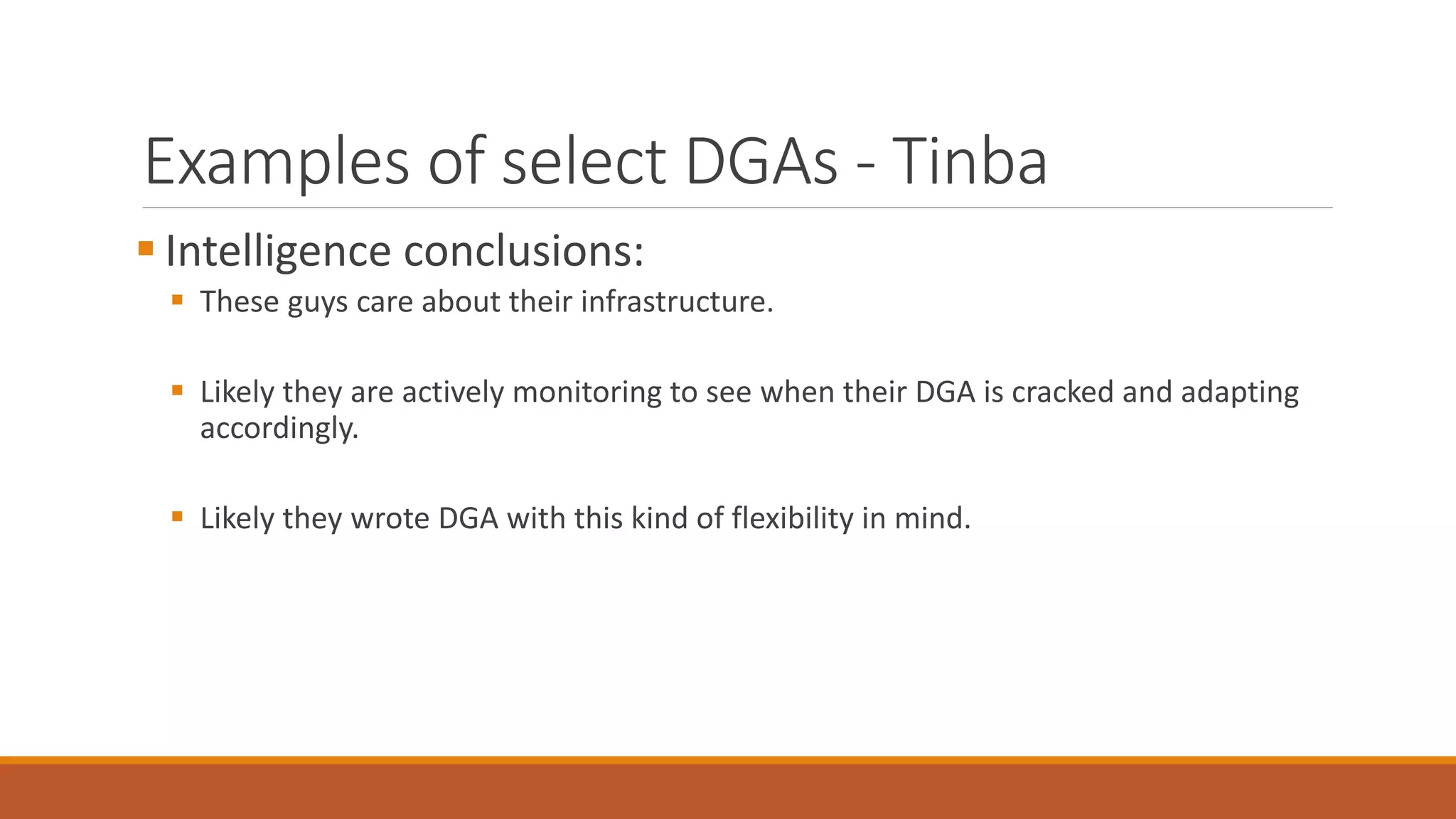
 Intelligence conclusions:
 These guys care about their infrastructure.
 Likely they are actively monitoring to see when their DGA is cracked and adapting
accordingly.
 Likely they wrote DGA with this kind of flexibility in mind.
Examples of select DGAs - Bedep
 Uses a dynamic seed – currency exchange values for
foreign currency
 European Central Bank produces daily feeds of the rates, this
is used as source data.
 Impossible to predict in advance even though code to
generate the domains is publicly available.
 http://asert.arbornetworks.com/bedeps-dga-trading-foreign-exchange-for-
malware-domains/
Examples of select DGAs - Bedep
 To date, all successful takedowns (and for that matter
unsuccessful takedowns) seized malicious DGA domains in
advance while simultaneously suspending current domains.
 This would decapitate a botnet if and only if there was no
fallback mechanism to reach the C2 (i.e. tor).
 How can you do this for Bedep when you don’t know future
currency values?
 Intelligence conclusion: this is obviously an intentional choice.
What the use of DGAs give the good guys
 Easy ability to sinkhole unused DGA domains to gather
additional intelligence.
 Easier ability to do bulk takedowns.
 *IF* you can predict domains in advance.
 The ability to surveil malicious infrastructure in near real-
time.
What the use of DGAs give the good guys
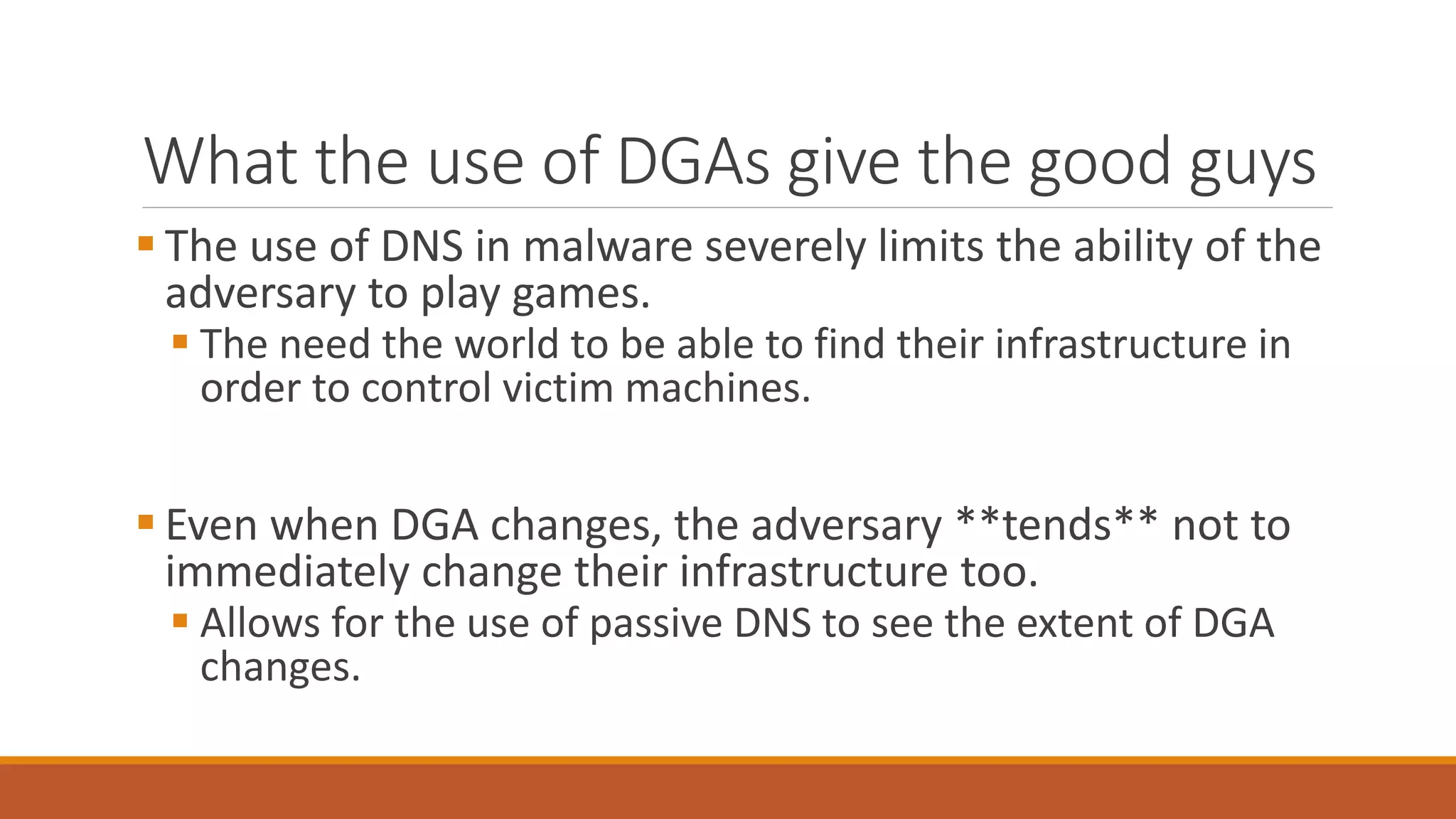
 The use of DNS in malware severely limits the ability of the
adversary to play games.
 The need the world to be able to find their infrastructure in
order to control victim machines.
 Even when DGA changes, the adversary **tends** not to
immediately change their infrastructure too.
 Allows for the use of passive DNS to see the extent of DGA
changes.
Sinkholing
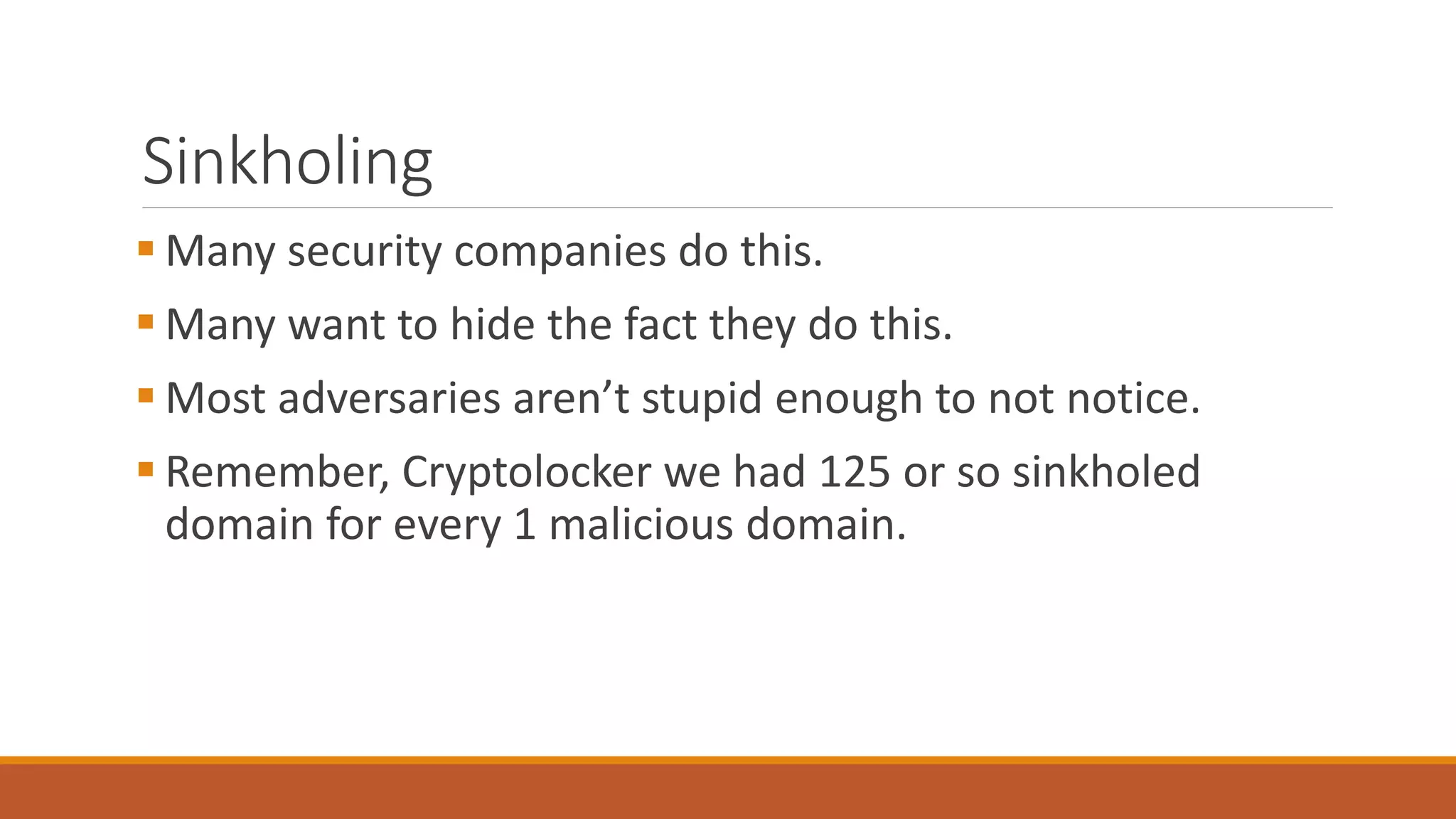
 Many security companies do this.
 Many want to hide the fact they do this.
 Most adversaries aren’t stupid enough to not notice.
 Remember, Cryptolocker we had 125 or so sinkholed
domain for every 1 malicious domain.
Feed generation on DGAs
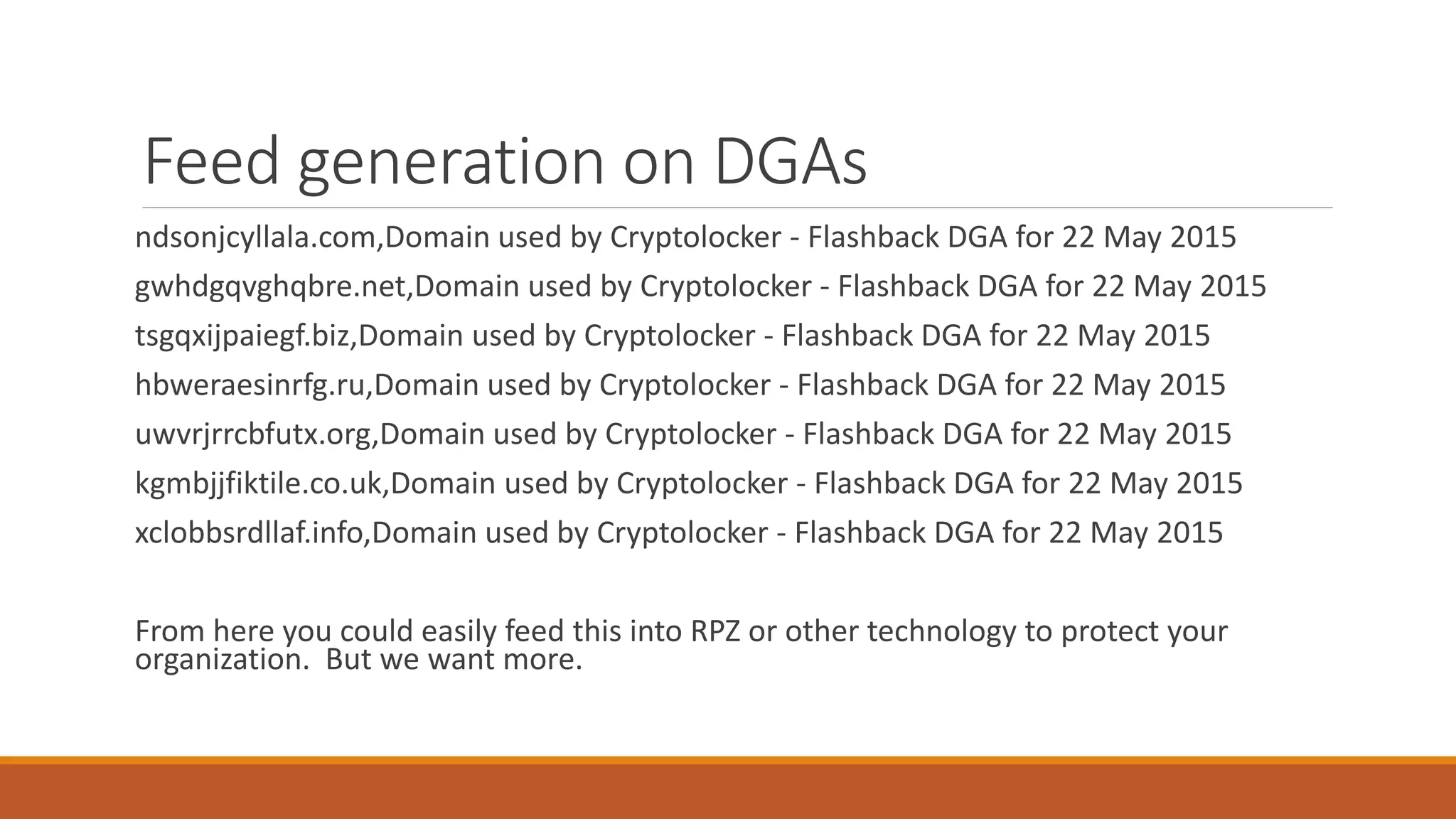
ndsonjcyllala.com,Domain used by Cryptolocker - Flashback DGA for 22 May 2015
gwhdgqvghqbre.net,Domain used by Cryptolocker - Flashback DGA for 22 May 2015
tsgqxijpaiegf.biz,Domain used by Cryptolocker - Flashback DGA for 22 May 2015
hbweraesinrfg.ru,Domain used by Cryptolocker - Flashback DGA for 22 May 2015
uwvrjrrcbfutx.org,Domain used by Cryptolocker - Flashback DGA for 22 May 2015
kgmbjjfiktile.co.uk,Domain used by Cryptolocker - Flashback DGA for 22 May 2015
xclobbsrdllaf.info,Domain used by Cryptolocker - Flashback DGA for 22 May 2015
From here you could easily feed this into RPZ or other technology to protect your
organization. But we want more.
How to set up surveillance on a DGA
 Easy to set up with shell scripting and a non-t1.micro AWS
instance.
 Requires GNU parallel and adns-tools to handle bulk DNS
queries.
DGA surveillance
 Pre-generate all domains 2 days before to 2 days in future.
 Pipe all those domains into adnshost using parallel to limit
the number of lines.
 Able to process over 200,000 domains inside 10 minutes
(and I’m not done optimizing).
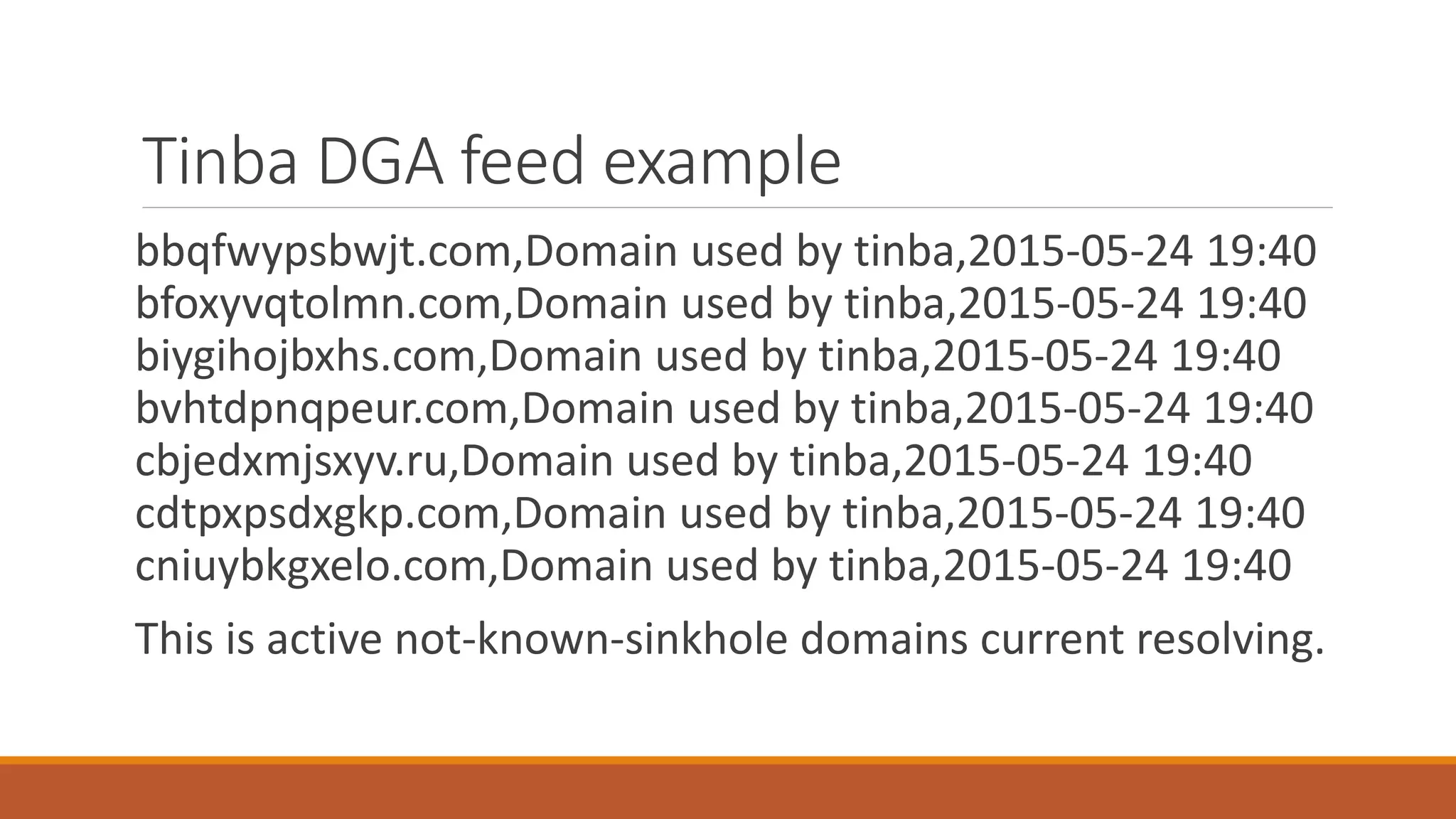
Tinba DGA feed example
bbqfwypsbwjt.com,Domain used by tinba,2015-05-24 19:40
bfoxyvqtolmn.com,Domain used by tinba,2015-05-24 19:40
biygihojbxhs.com,Domain used by tinba,2015-05-24 19:40
bvhtdpnqpeur.com,Domain used by tinba,2015-05-24 19:40
cbjedxmjsxyv.ru,Domain used by tinba,2015-05-24 19:40
cdtpxpsdxgkp.com,Domain used by tinba,2015-05-24 19:40
cniuybkgxelo.com,Domain used by tinba,2015-05-24 19:40
This is active not-known-sinkhole domains current resolving.
A note on intelligence bias
 How we look at threats and what we tend to do with
information will affect how we gather intel and how we
process it.
 I tend to be involved in takedowns so I am generally
uninterested in sinkholes.
 If you protect an organization, however, you care about your
client machines reaching out to sinkholes because they are still
infected.
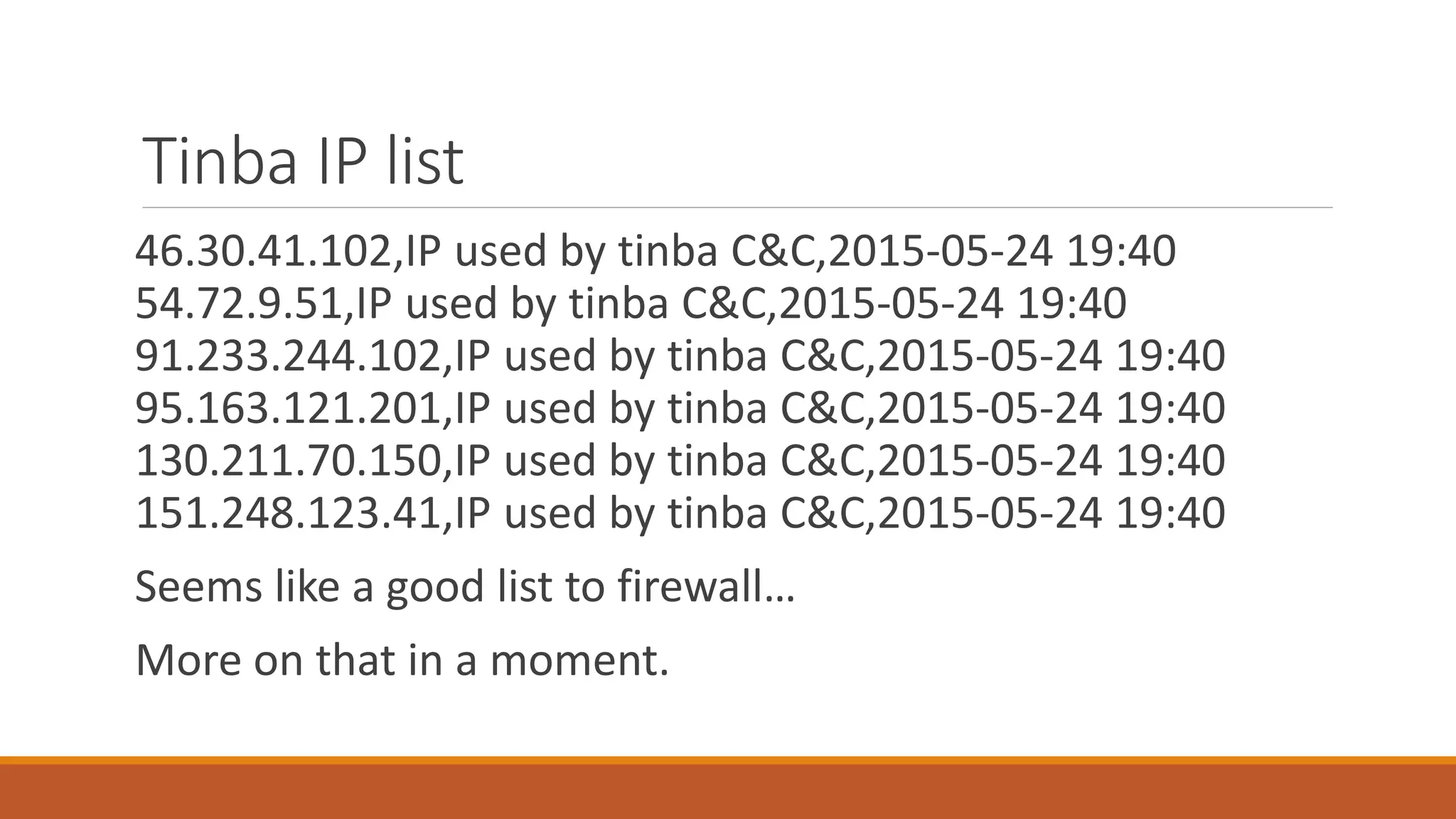
Tinba IP list
46.30.41.102,IP used by tinba C&C,2015-05-24 19:40
54.72.9.51,IP used by tinba C&C,2015-05-24 19:40
91.233.244.102,IP used by tinba C&C,2015-05-24 19:40
95.163.121.201,IP used by tinba C&C,2015-05-24 19:40
130.211.70.150,IP used by tinba C&C,2015-05-24 19:40
151.248.123.41,IP used by tinba C&C,2015-05-24 19:40
Seems like a good list to firewall…
More on that in a moment.
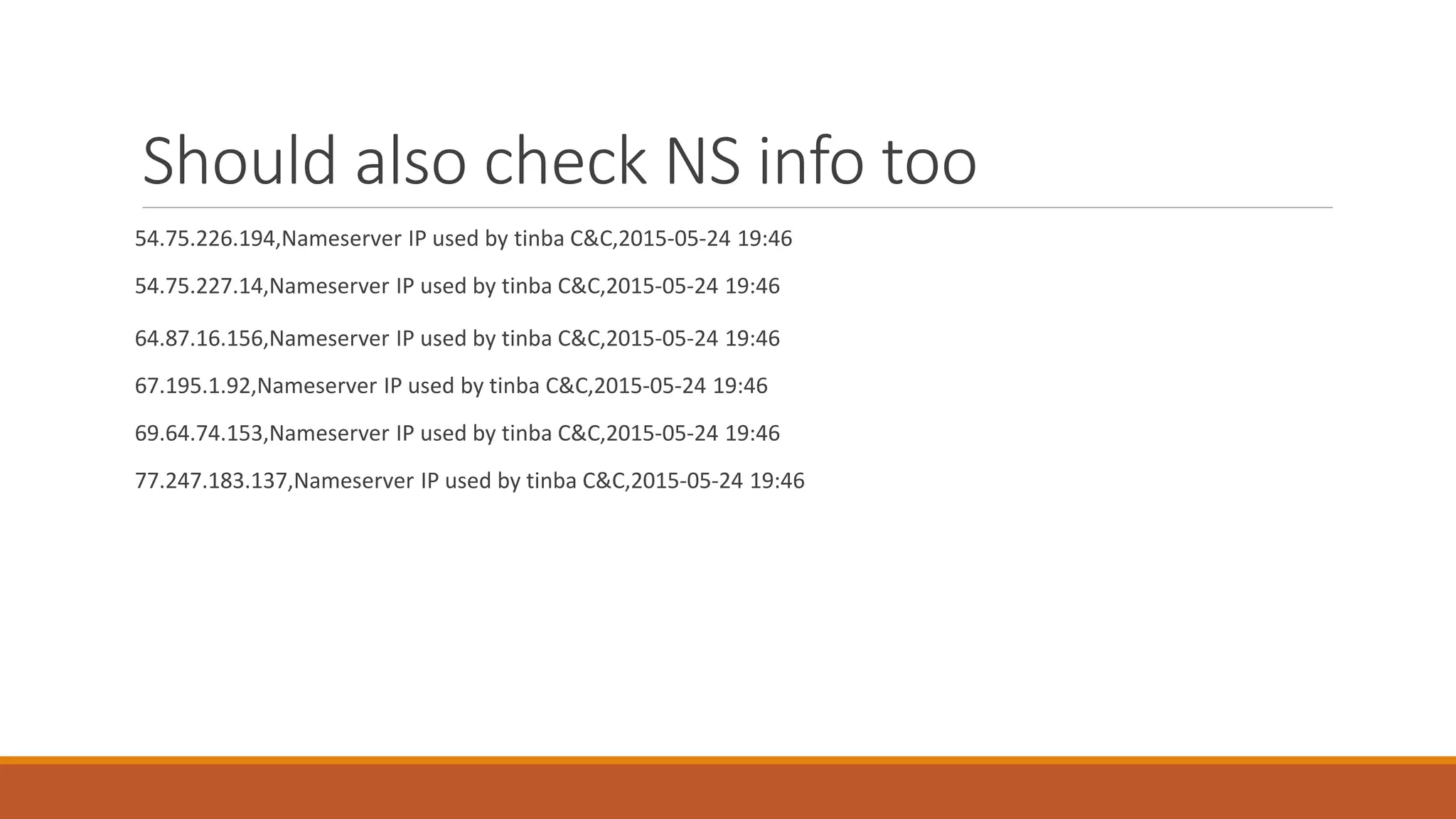
Should also check NS info too
54.75.226.194,Nameserver IP used by tinba C&C,2015-05-24 19:46
54.75.227.14,Nameserver IP used by tinba C&C,2015-05-24 19:46
64.87.16.156,Nameserver IP used by tinba C&C,2015-05-24 19:46
67.195.1.92,Nameserver IP used by tinba C&C,2015-05-24 19:46
69.64.74.153,Nameserver IP used by tinba C&C,2015-05-24 19:46
77.247.183.137,Nameserver IP used by tinba C&C,2015-05-24 19:46
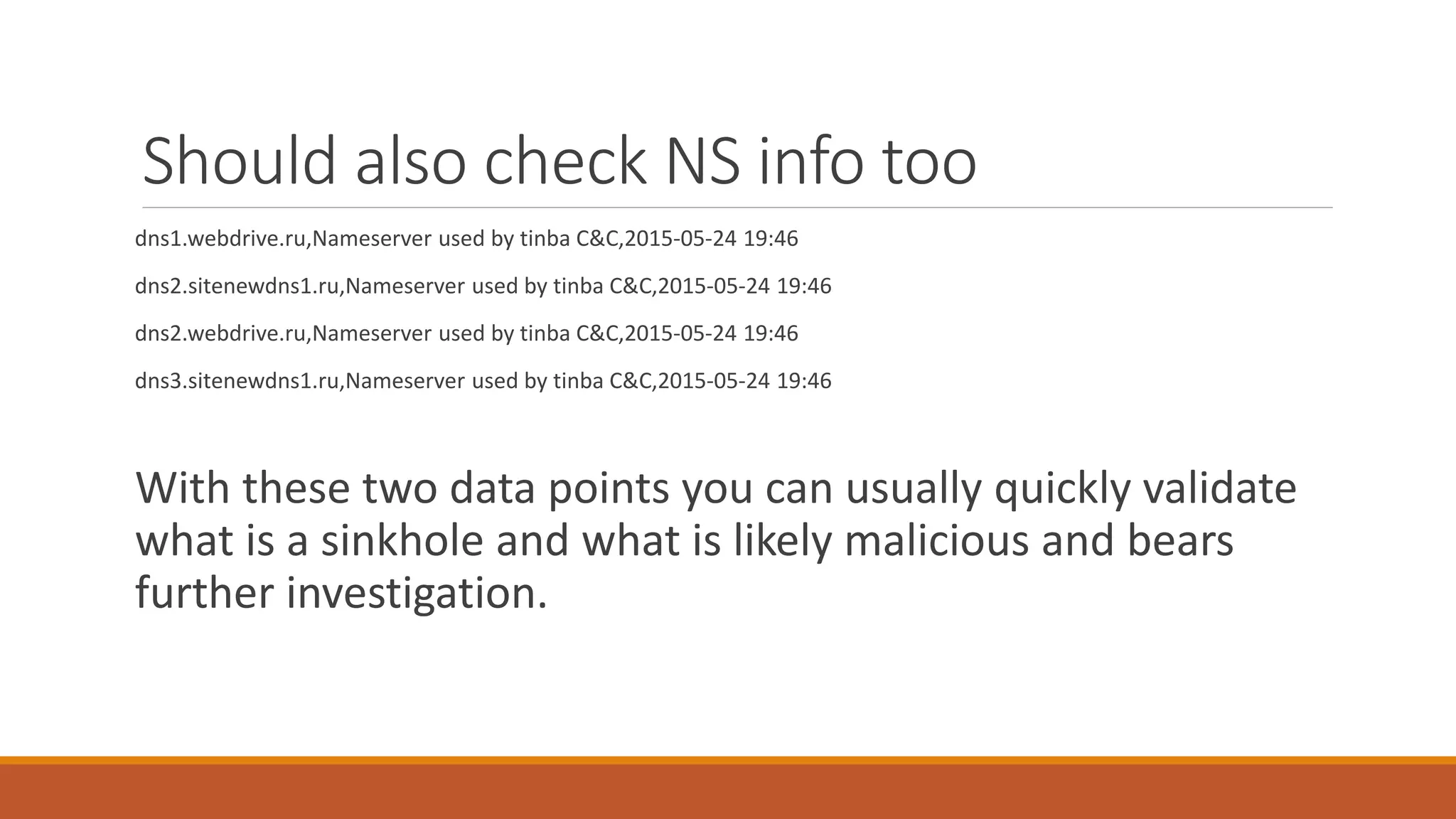
Should also check NS info too
dns1.webdrive.ru,Nameserver used by tinba C&C,2015-05-24 19:46
dns2.sitenewdns1.ru,Nameserver used by tinba C&C,2015-05-24 19:46
dns2.webdrive.ru,Nameserver used by tinba C&C,2015-05-24 19:46
dns3.sitenewdns1.ru,Nameserver used by tinba C&C,2015-05-24 19:46
With these two data points you can usually quickly validate
what is a sinkhole and what is likely malicious and bears
further investigation.
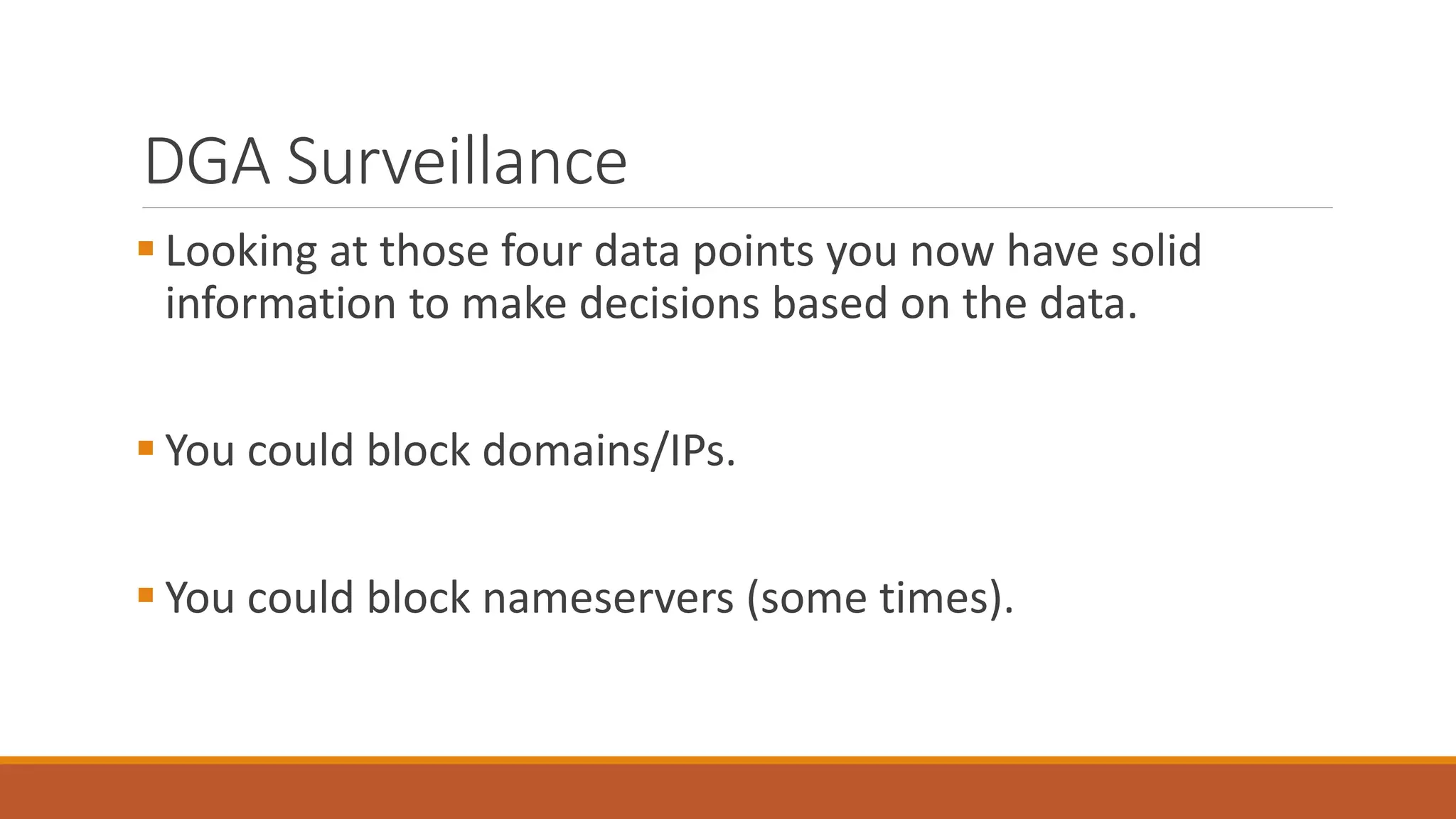
DGA Surveillance
 Looking at those four data points you now have solid
information to make decisions based on the data.
 You could block domains/IPs.
 You could block nameservers (some times).
Adversarial Response
 Adversaries know we are doing this.
 In response:
 They change seeds frequently
 They have non-DGA communication mechanisms
 They engage in counterintelligence
Counterintelligence
 The tactics by which an adversary thwarts attempts to
gather information on itself.
 Remember the domain and IP lists before?
 What if an adversary registers domains that they aren’t
using?
Counterintelligence – or worse version
 What if adversary knows you pump your IP lists directly into your firewall (and I
know people do this with my feeds)?
 Anyone recognize these IP addresses?
198.41.0.4
192.228.79.201
192.33.4.12
199.7.91.13
192.203.230.10
192.5.5.241
192.112.36.4
128.63.2.53
192.36.148.17
192.58.128.30
193.0.14.129
199.7.83.42
202.12.27.33
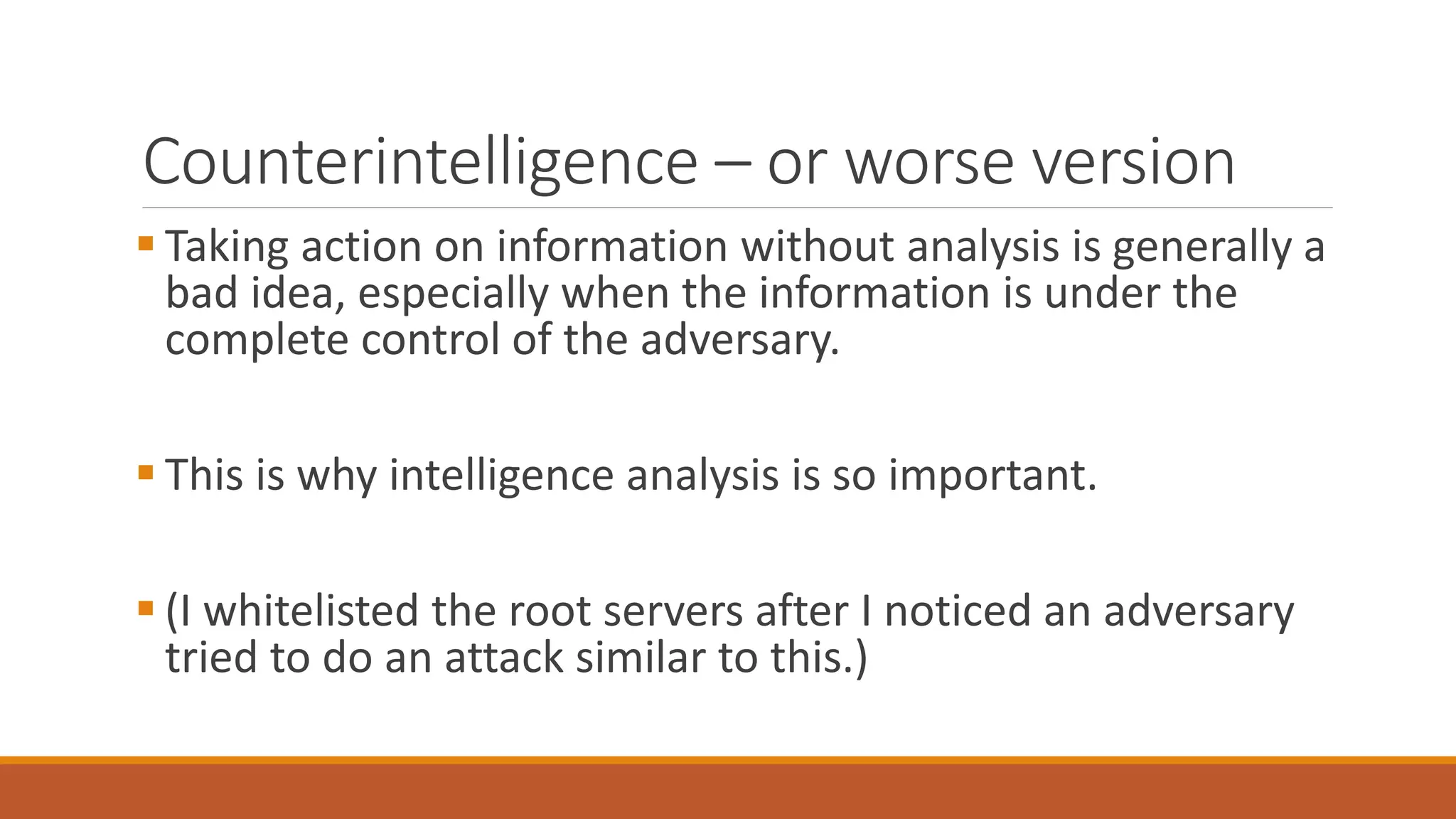
Counterintelligence – or worse version
 Taking action on information without analysis is generally a
bad idea, especially when the information is under the
complete control of the adversary.
 This is why intelligence analysis is so important.
 (I whitelisted the root servers after I noticed an adversary
tried to do an attack similar to this.)
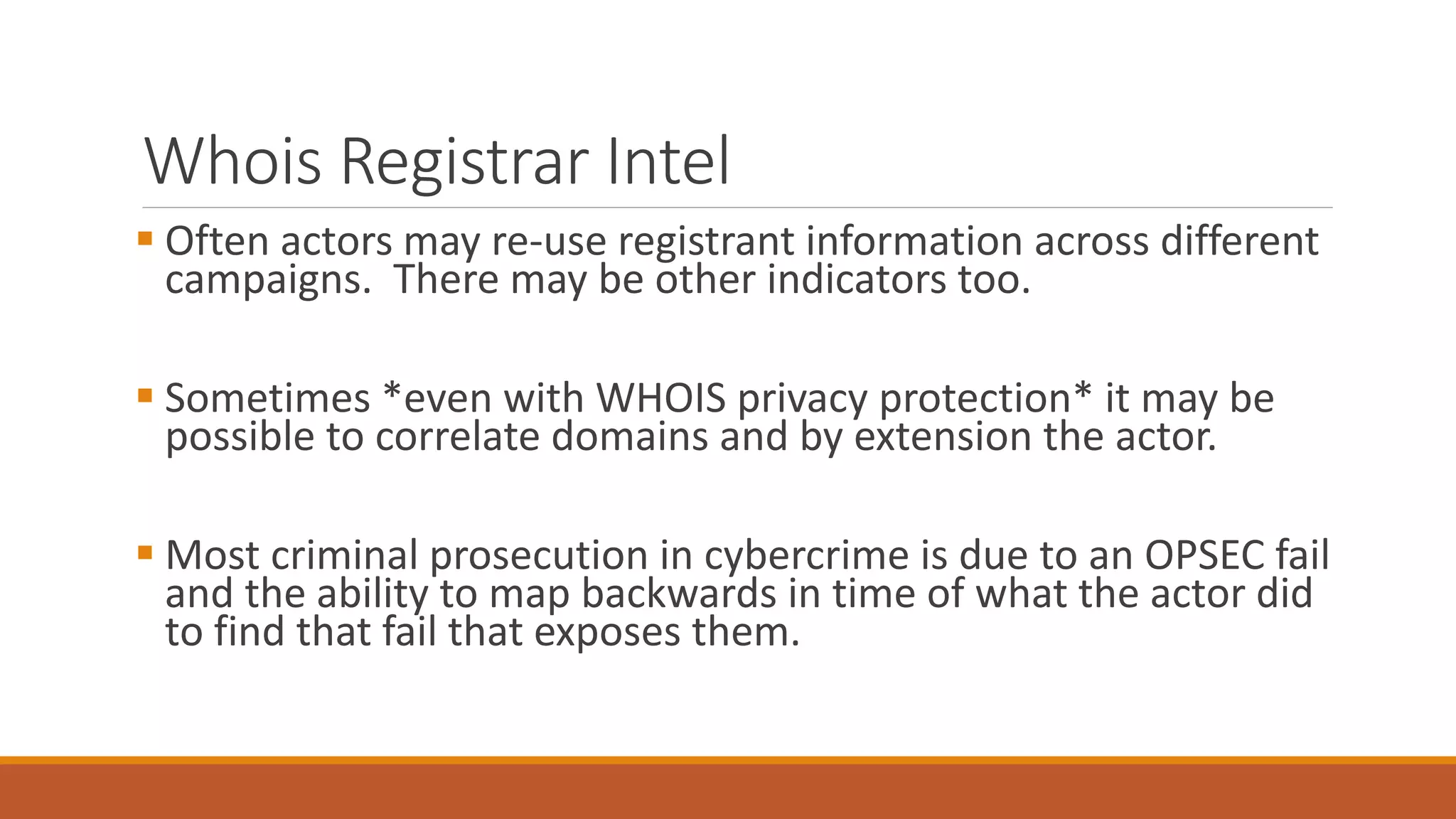
Whois Registrar Intel
 Often actors may re-use registrant information across different
campaigns. There may be other indicators too.
 Sometimes *even with WHOIS privacy protection* it may be
possible to correlate domains and by extension the actor.
 Most criminal prosecution in cybercrime is due to an OPSEC fail
and the ability to map backwards in time of what the actor did
to find that fail that exposes them.
Surveillance is nice, what about
notification?
 Creation of feeds and intake is still a passive tactic.
 It is all possible to automate notifications when key
changes happen to allow for more near-time actions.
 This uses the Pushover application (Apple and Google
stores) which has a very simple API.
New Dyre domain registered
New Matsnu domains registered
Pivoting
 Now that I know the-fancastar.com and seedwisdonn.com
serve NS for Matsnu, I can see what else is served by those
nameservers to find additional intelligence.
 Caution is due, this may not always yield results and may
yield false positives. Always correlate with something else
before making a final judgement.
Last adversarial response
 Starting to see sinkhole-aware malware.
 Some malware always authenticated the C2, but sinkholes
still could gather intel.
 Now malware is being written to attempt to bypass
sinkholes altogether.
The Future?
 DGAs will be around for awhile as part of several methods
of communication to victim machines.
 Tor/I2P will continue to be used because of its advantages
but DGAs still needed due to ease of blocking tor.
 Increase in the use of “interesting” dynamic seeds.
Questions?
Thanks PHDays V!
My feeds: osint.bambenekconsulting.com/feeds/
jcb@bambenekconsulting.com
www.bambenekconsulting.com
+1 312 425 7225

PHDAYS: DGAs and Threat Intelligence

  • 1.
    DGAs and Threat Intelligence JOHNBAMBENEK, BAMBENEK CONSULTING PHDAYS V
  • 2.
    Intro  President andChief Forensic Examiner for Bambenek Consulting  Adjunct Faculty in CS Department at the University of Illinois at Urbana-Champaign  Producer of open-source intel feeds  Work with companies and LE all over the world to address growth in cybercrime
  • 3.
    About Threat Intelligence Information is a set of unprocessed data that may or may not contain actionable intelligence.  Intelligence is the art of critically examining information to draw meaningful and actionable conclusions based on observations and information.
  • 4.
    About Threat Intelligence Many “threat intelligence” companies drown their customers with information.  Few actually process that information to find intelligence.  Involves analyzing adversary capabilities, intentions and motivations.
  • 5.
    Why does thismatter?  Reverse engineering malware, finding a DGA and resolving all the domains gives you useful information.  Knowing how and why an adversary makes the decisions they do can lead to more successful operations.  Knowing how to distinguish between signal and the large amount of noise in doing this is key.
  • 6.
    Adversarial objectives  Herewe are generally talking about organized crime, usually financially motivated.  What we know:  Highly rational actors  Hierarchical organizational structure, potentially siloed  May hire “outside experts” for specific tasks  Generally technological sophisticated  Desire to remain “quiet”  Desire to remain resilient over the long-term
  • 7.
    A History ofMalware C2 Networks  An adversary wants to persist over the long-term and make their networks more resilient against enforcement actions.  Domains tend to be easier to take down the IPs due to avoidance of jurisdictional issues.  Development over time will largely show adversaries have acted in ways to ensure increased resiliency.  We can continue to map forward over time where they are likely to go in the future as a result.
  • 8.
    Static IP/Host lists In the beginning there were static domain or IP lists. Sometimes only one, many times several.  Domains tend to be easier to take down the IPs due to avoidance of jurisdictional issues.  Adversarial response: Increase number of domains and diversity jurisdictions and service providers.
  • 9.
    Proxies  The additionof proxies added a new element.  A domain or IP seizure COULD still sever control but it would not inherently lead to loss of already stolen data.  Our response: Usually less enthusiastic to take down domains and IPs because what is on “back end” server is most valuable.
  • 10.
    Dynamic DNS  Thenthere was dynamic dns (dyndns, no-ip, 3322.org, etc)  Allowed for rapidly changing IP address but still tied to a DNS zone.  Still in use, especially for lower end crime and some espionage operations.
  • 11.
    Fast Flux  FastFlux domains use multiple A records with short TTL to create rolling lists of (usually) proxies to maintain control.  Seize a machine, victim happily moves on to the next controller.  Sometimes (but not always) defined “networks” of fast flux nodes. Occasionally just compromised machines.
  • 12.
    Fast Flux  Fastflux example: divewithsharks.hk. 1800 IN A 70.68.187.xxx [xxx.vf.shawcable.net] divewithsharks.hk. 1800 IN A 76.209.81.xxx [SBIS-AS - AT&T Internet Services] divewithsharks.hk. 1800 IN A 85.207.74.xxx [adsl-ustixxx-74-207-85.bluetone.cz] divewithsharks.hk. 1800 IN A 90.144.43.xxx [d90-144-43-xxx.cust.tele2.fr] divewithsharks.hk. 1800 IN A 142.165.41.xxx [142-165-41-xxx.msjw.hsdb.sasknet.sk.ca]  Even though A records are resilient, the domain is still controlling and if you can seize the name-servers the botnet is decapitated.
  • 13.
    Double Flux  Evolutionof Fast Flux with has short TTLs for name servers as well.  This makes the controlling services more resilient too.  Still can seize domain(s) and the botnet is decapitated.
  • 14.
    Double Flux example ns1.myheroisyourslove.hk.854IN A 70.227.218.xxx [ppp-70-227-218-xxx.dsl.sfldmi.ameritech.net] ns2.myheroisyourslove.hk.854 IN A 70.136.16.xxx [adsl-70-136-16-xxx.dsl.bumttx.sbcglobal.net] ns3.myheroisyourslove.hk. 854 IN A 68.59.76.xxx [c-68-59-76-xxx.hsd1.al.comcast.net] ns4.myheroisyourslove.hk. 854 IN A 70.126.19.xxx [xxx-19.126-70.tampabay.res.rr.com] ns5.myheroisyourslove.hk. 854 IN A 70.121.157.xxx [xxx.157.121.70.cfl.res.rr.com] Some time later: ns1.myheroisyourslove.hk. 3596 IN A 75.67.15.xxx [c-75-67-15-xxx.hsd1.ma.comcast.net] ns2.myheroisyourslove.hk. 3596 IN A 75.22.239.xxx [adsl-75-22-239-xxx.dsl.chcgil.sbcglobal.net] ns3.myheroisyourslove.hk. 3596 IN A 75.33.248.xxx [adsl-75-33-248-xxx.dsl.chcgil.sbcglobal.net] ns4.myheroisyourslove.hk. 180 IN A 69.238.210.xxx [ppp-69-238-210-xxx.dsl.irvnca.pacbell.net] ns5.myheroisyourslove.hk. 3596 IN A 70.64.222.xxx [xxx.mj.shawcable.net]
  • 15.
    Double Flux  Importantnote, while the IP addresses change frequently, you can still disrupt the network by domain seizure.  Might not recover data but no future loss would occur.
  • 16.
    Introduction of tor/ i2p hidden services  Involves the use of anonymization technologies to hide where the infrastructure actually is.  Very hard to takedown without cooperation of privacy networks which is unlikely to happen.  Our response: Most organizations can block tor / i2p, consumers still vulnerable.
  • 17.
    Domain Generation Algorithms Usually a complex math algorithm to create pseudo- random but predictable domain names.  Now instead of a static list, you have a dynamic list of hundreds or thousands of domains and adversary only needs to have a couple registered at a time.  Can shop registrars to avoid suspension.
  • 18.
    Use of MultipleTechniques  The most resilient malware C2 use multiple methods of callback.  Static Lists  DGAs  Tor/I2P  If one or two are blocked, still able to control machine.
  • 19.
    Reverse Engineering DGAs Many blog posts about reversing specific DGAs, Johannes Bader has the most online at his blog:  Johannesbader.ch  No real shortcuts except working through IDA/Debugger and reversing the function.  Look for functions that iterate many times.  There will be at least a function to generate the domains and a function to connect to all of them to find the C2.  As with all reverse engineering, be aware of obfuscation and decoy code meant to deceive you.
  • 20.
    Reversing DGAs Example Fromhttp://johannesbader.ch/2015/05/the-dga-of-ranbyus/
  • 21.
    Types of DGAs Almost all DGAs use some time of “Seed”.  Types:  Date-based  Static seed  Dynamic seed  Seed has to be globally consistent so all victims use the same one at the same time.
  • 22.
    Other DGA HardeningTechniques  Choice of gTLD matters.  Some doing have WHOIS protection, make it hard to sinkhole  Rotation of seeds  Some malware has rudimentary “sinkhole awareness”  Adversarial objectives: Maintain control, limit surveillance
  • 23.
    Examples of selectDGAs - Conficker  Used PNRG with date seed to generate domains.  A and B created 250 domains across 5 and 8 gTLDs.  C and D upped this to 50,000 across 140 gTLDs in response to registries banning the use of conficker DGA domains.
  • 24.
    Examples of selectDGAs - Cryptolocker  Used 1000 domains a day across 7 gTLDs. Order domains are queries in based on GetTickCount()  Eerily similar to DGA described in Wikipedia article on DGAs.  Used previously by Flashback OSX Worm.  Never changed during the life of the malware campaign.  Successfully taken down in June 2014.  Special thanks to Vladimir Kropotov for his help on this!
  • 25.
    Examples of selectDGAs - Cryptolocker  Intel conclusions:  Likely written by a third party.  Went days without a domain registered, actor wanted to get paid but wasn’t overly concerned about keeping everything going 24x7.  Tended not to shift registrar even after domains were suspended.  Likely didn’t monitor his own domains because the ratio of malicious to sinkholed domains was about 1:125.  Way to go on the OPSEC good guys. D
  • 26.
    Examples of selectDGAs - Tinba  Generated 1,000 domains a day, not date-seeded.  Seeded by an initial hostname and a defined gTLD.  Change seeds often and tends to update already infected machines.  At least sinkholing tended to be ineffective for more than a few days.
  • 27.
    Examples of selectDGAs - Tinba  Intelligence conclusions:  These guys care about their infrastructure.  Likely they are actively monitoring to see when their DGA is cracked and adapting accordingly.  Likely they wrote DGA with this kind of flexibility in mind.
  • 28.
    Examples of selectDGAs - Bedep  Uses a dynamic seed – currency exchange values for foreign currency  European Central Bank produces daily feeds of the rates, this is used as source data.  Impossible to predict in advance even though code to generate the domains is publicly available.  http://asert.arbornetworks.com/bedeps-dga-trading-foreign-exchange-for- malware-domains/
  • 29.
    Examples of selectDGAs - Bedep  To date, all successful takedowns (and for that matter unsuccessful takedowns) seized malicious DGA domains in advance while simultaneously suspending current domains.  This would decapitate a botnet if and only if there was no fallback mechanism to reach the C2 (i.e. tor).  How can you do this for Bedep when you don’t know future currency values?  Intelligence conclusion: this is obviously an intentional choice.
  • 30.
    What the useof DGAs give the good guys  Easy ability to sinkhole unused DGA domains to gather additional intelligence.  Easier ability to do bulk takedowns.  *IF* you can predict domains in advance.  The ability to surveil malicious infrastructure in near real- time.
  • 31.
    What the useof DGAs give the good guys  The use of DNS in malware severely limits the ability of the adversary to play games.  The need the world to be able to find their infrastructure in order to control victim machines.  Even when DGA changes, the adversary **tends** not to immediately change their infrastructure too.  Allows for the use of passive DNS to see the extent of DGA changes.
  • 32.
    Sinkholing  Many securitycompanies do this.  Many want to hide the fact they do this.  Most adversaries aren’t stupid enough to not notice.  Remember, Cryptolocker we had 125 or so sinkholed domain for every 1 malicious domain.
  • 33.
    Feed generation onDGAs ndsonjcyllala.com,Domain used by Cryptolocker - Flashback DGA for 22 May 2015 gwhdgqvghqbre.net,Domain used by Cryptolocker - Flashback DGA for 22 May 2015 tsgqxijpaiegf.biz,Domain used by Cryptolocker - Flashback DGA for 22 May 2015 hbweraesinrfg.ru,Domain used by Cryptolocker - Flashback DGA for 22 May 2015 uwvrjrrcbfutx.org,Domain used by Cryptolocker - Flashback DGA for 22 May 2015 kgmbjjfiktile.co.uk,Domain used by Cryptolocker - Flashback DGA for 22 May 2015 xclobbsrdllaf.info,Domain used by Cryptolocker - Flashback DGA for 22 May 2015 From here you could easily feed this into RPZ or other technology to protect your organization. But we want more.
  • 34.
    How to setup surveillance on a DGA  Easy to set up with shell scripting and a non-t1.micro AWS instance.  Requires GNU parallel and adns-tools to handle bulk DNS queries.
  • 35.
    DGA surveillance  Pre-generateall domains 2 days before to 2 days in future.  Pipe all those domains into adnshost using parallel to limit the number of lines.  Able to process over 200,000 domains inside 10 minutes (and I’m not done optimizing).
  • 36.
    Tinba DGA feedexample bbqfwypsbwjt.com,Domain used by tinba,2015-05-24 19:40 bfoxyvqtolmn.com,Domain used by tinba,2015-05-24 19:40 biygihojbxhs.com,Domain used by tinba,2015-05-24 19:40 bvhtdpnqpeur.com,Domain used by tinba,2015-05-24 19:40 cbjedxmjsxyv.ru,Domain used by tinba,2015-05-24 19:40 cdtpxpsdxgkp.com,Domain used by tinba,2015-05-24 19:40 cniuybkgxelo.com,Domain used by tinba,2015-05-24 19:40 This is active not-known-sinkhole domains current resolving.
  • 37.
    A note onintelligence bias  How we look at threats and what we tend to do with information will affect how we gather intel and how we process it.  I tend to be involved in takedowns so I am generally uninterested in sinkholes.  If you protect an organization, however, you care about your client machines reaching out to sinkholes because they are still infected.
  • 38.
    Tinba IP list 46.30.41.102,IPused by tinba C&C,2015-05-24 19:40 54.72.9.51,IP used by tinba C&C,2015-05-24 19:40 91.233.244.102,IP used by tinba C&C,2015-05-24 19:40 95.163.121.201,IP used by tinba C&C,2015-05-24 19:40 130.211.70.150,IP used by tinba C&C,2015-05-24 19:40 151.248.123.41,IP used by tinba C&C,2015-05-24 19:40 Seems like a good list to firewall… More on that in a moment.
  • 39.
    Should also checkNS info too 54.75.226.194,Nameserver IP used by tinba C&C,2015-05-24 19:46 54.75.227.14,Nameserver IP used by tinba C&C,2015-05-24 19:46 64.87.16.156,Nameserver IP used by tinba C&C,2015-05-24 19:46 67.195.1.92,Nameserver IP used by tinba C&C,2015-05-24 19:46 69.64.74.153,Nameserver IP used by tinba C&C,2015-05-24 19:46 77.247.183.137,Nameserver IP used by tinba C&C,2015-05-24 19:46
  • 40.
    Should also checkNS info too dns1.webdrive.ru,Nameserver used by tinba C&C,2015-05-24 19:46 dns2.sitenewdns1.ru,Nameserver used by tinba C&C,2015-05-24 19:46 dns2.webdrive.ru,Nameserver used by tinba C&C,2015-05-24 19:46 dns3.sitenewdns1.ru,Nameserver used by tinba C&C,2015-05-24 19:46 With these two data points you can usually quickly validate what is a sinkhole and what is likely malicious and bears further investigation.
  • 41.
    DGA Surveillance  Lookingat those four data points you now have solid information to make decisions based on the data.  You could block domains/IPs.  You could block nameservers (some times).
  • 42.
    Adversarial Response  Adversariesknow we are doing this.  In response:  They change seeds frequently  They have non-DGA communication mechanisms  They engage in counterintelligence
  • 43.
    Counterintelligence  The tacticsby which an adversary thwarts attempts to gather information on itself.  Remember the domain and IP lists before?  What if an adversary registers domains that they aren’t using?
  • 44.
    Counterintelligence – orworse version  What if adversary knows you pump your IP lists directly into your firewall (and I know people do this with my feeds)?  Anyone recognize these IP addresses? 198.41.0.4 192.228.79.201 192.33.4.12 199.7.91.13 192.203.230.10 192.5.5.241 192.112.36.4 128.63.2.53 192.36.148.17 192.58.128.30 193.0.14.129 199.7.83.42 202.12.27.33
  • 45.
    Counterintelligence – orworse version  Taking action on information without analysis is generally a bad idea, especially when the information is under the complete control of the adversary.  This is why intelligence analysis is so important.  (I whitelisted the root servers after I noticed an adversary tried to do an attack similar to this.)
  • 46.
    Whois Registrar Intel Often actors may re-use registrant information across different campaigns. There may be other indicators too.  Sometimes *even with WHOIS privacy protection* it may be possible to correlate domains and by extension the actor.  Most criminal prosecution in cybercrime is due to an OPSEC fail and the ability to map backwards in time of what the actor did to find that fail that exposes them.
  • 47.
    Surveillance is nice,what about notification?  Creation of feeds and intake is still a passive tactic.  It is all possible to automate notifications when key changes happen to allow for more near-time actions.  This uses the Pushover application (Apple and Google stores) which has a very simple API.
  • 48.
    New Dyre domainregistered
  • 49.
  • 50.
    Pivoting  Now thatI know the-fancastar.com and seedwisdonn.com serve NS for Matsnu, I can see what else is served by those nameservers to find additional intelligence.  Caution is due, this may not always yield results and may yield false positives. Always correlate with something else before making a final judgement.
  • 51.
    Last adversarial response Starting to see sinkhole-aware malware.  Some malware always authenticated the C2, but sinkholes still could gather intel.  Now malware is being written to attempt to bypass sinkholes altogether.
  • 52.
    The Future?  DGAswill be around for awhile as part of several methods of communication to victim machines.  Tor/I2P will continue to be used because of its advantages but DGAs still needed due to ease of blocking tor.  Increase in the use of “interesting” dynamic seeds.
  • 53.
    Questions? Thanks PHDays V! Myfeeds: osint.bambenekconsulting.com/feeds/ jcb@bambenekconsulting.com www.bambenekconsulting.com +1 312 425 7225