Faculty of Economics and Business Administration
Department of Management Information and Operations Management
FEB PhD Day 2013
24 May, 2013
FACULTY OF ECONOMICS AND BUSINESS ADMINISTRATION
An exploration of the relationship between
modeling behavior and process model quality
Jan Claes
Teaching assistant : PhD 2009 - 2015aa
Supervisor : Geert Poels
Co-supervisor : Frederik Gailly
Faculty of Economics and Business Administration
Department of Management Information and Operations Management
FEB PhD Day 2013
2/18
Outline
Business Process Modeling (BPM)
 Process model quality
“what is a good process model?”
 Process of process modeling (PPM)
“how to make a good process model?”
Visualizing the PPM with PPMCharts
Observations, hypotheses, future work
 Structured Process Modeling (SPM)
Faculty of Economics and Business Administration
Department of Management Information and Operations Management
FEB PhD Day 2013
3/18
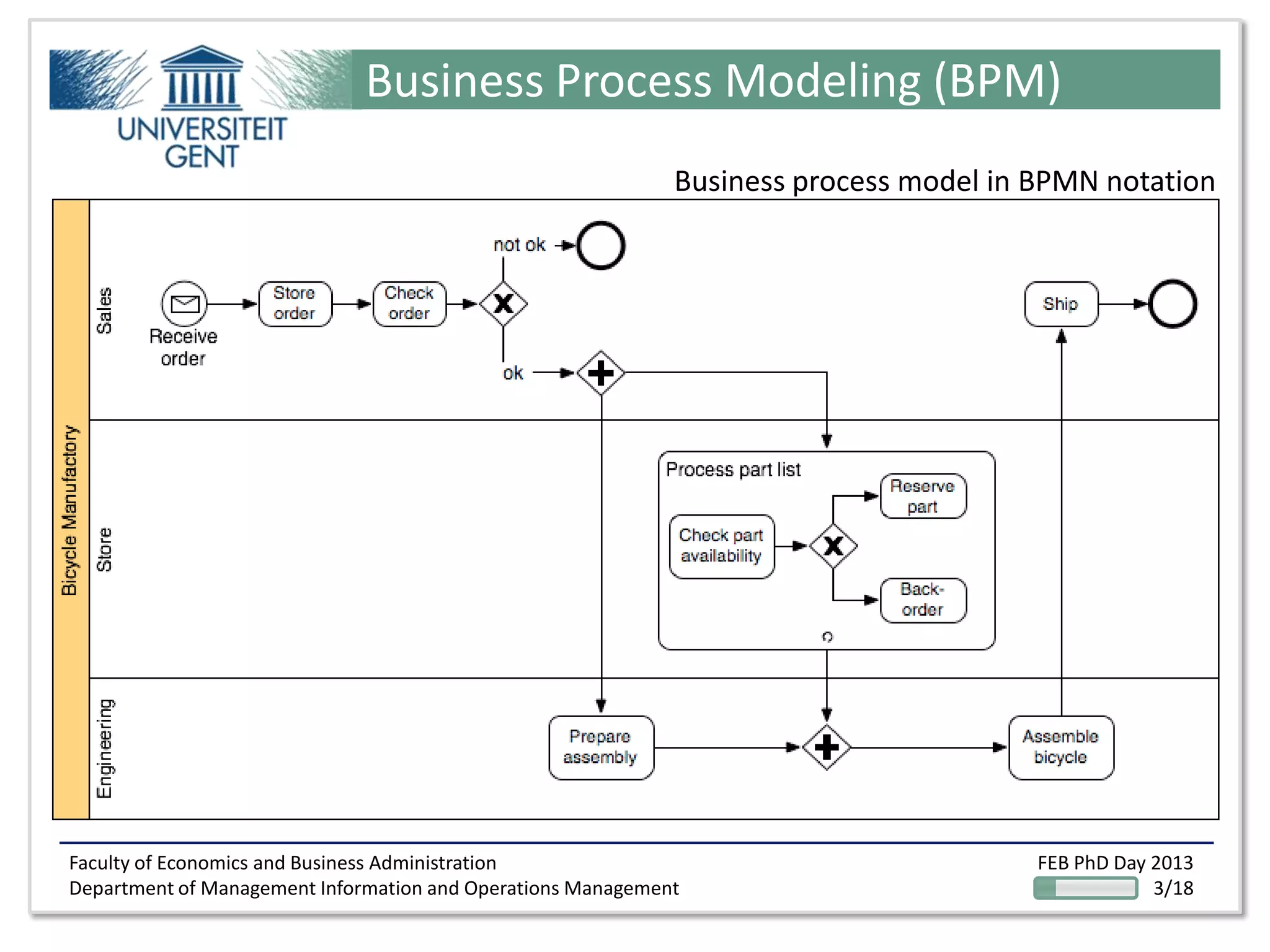
Business Process Modeling (BPM)
Business process model in BPMN notation
Faculty of Economics and Business Administration
Department of Management Information and Operations Management
FEB PhD Day 2013
4/18
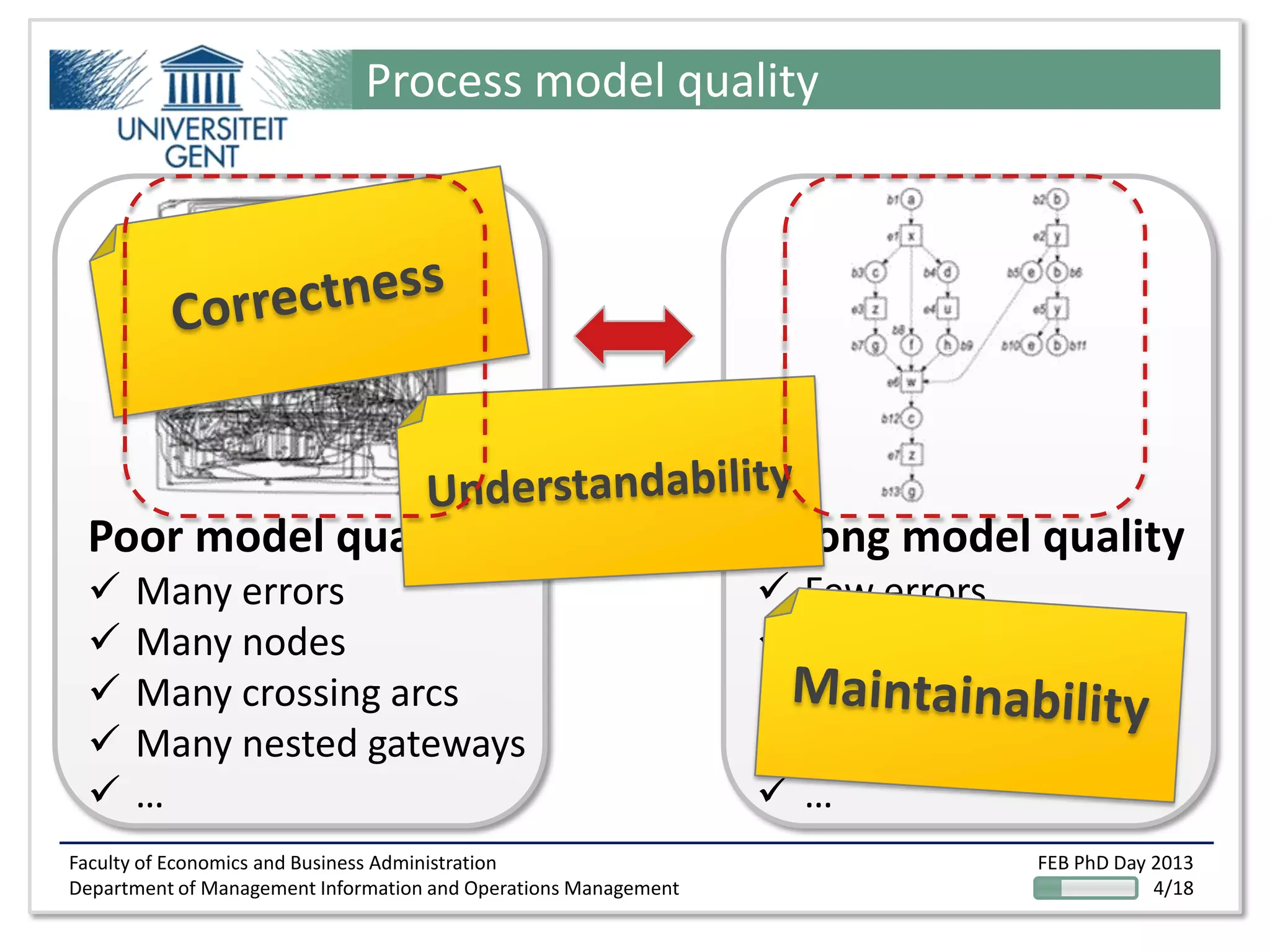
Process model quality
Poor model quality
 Many errors
 Many nodes
 Many crossing arcs
 Many nested gateways
 …
Strong model quality
 Few errors
 Few nodes
 Few crossing arcs
 Few nested gateways
 …
Faculty of Economics and Business Administration
Department of Management Information and Operations Management
FEB PhD Day 2013
5/18
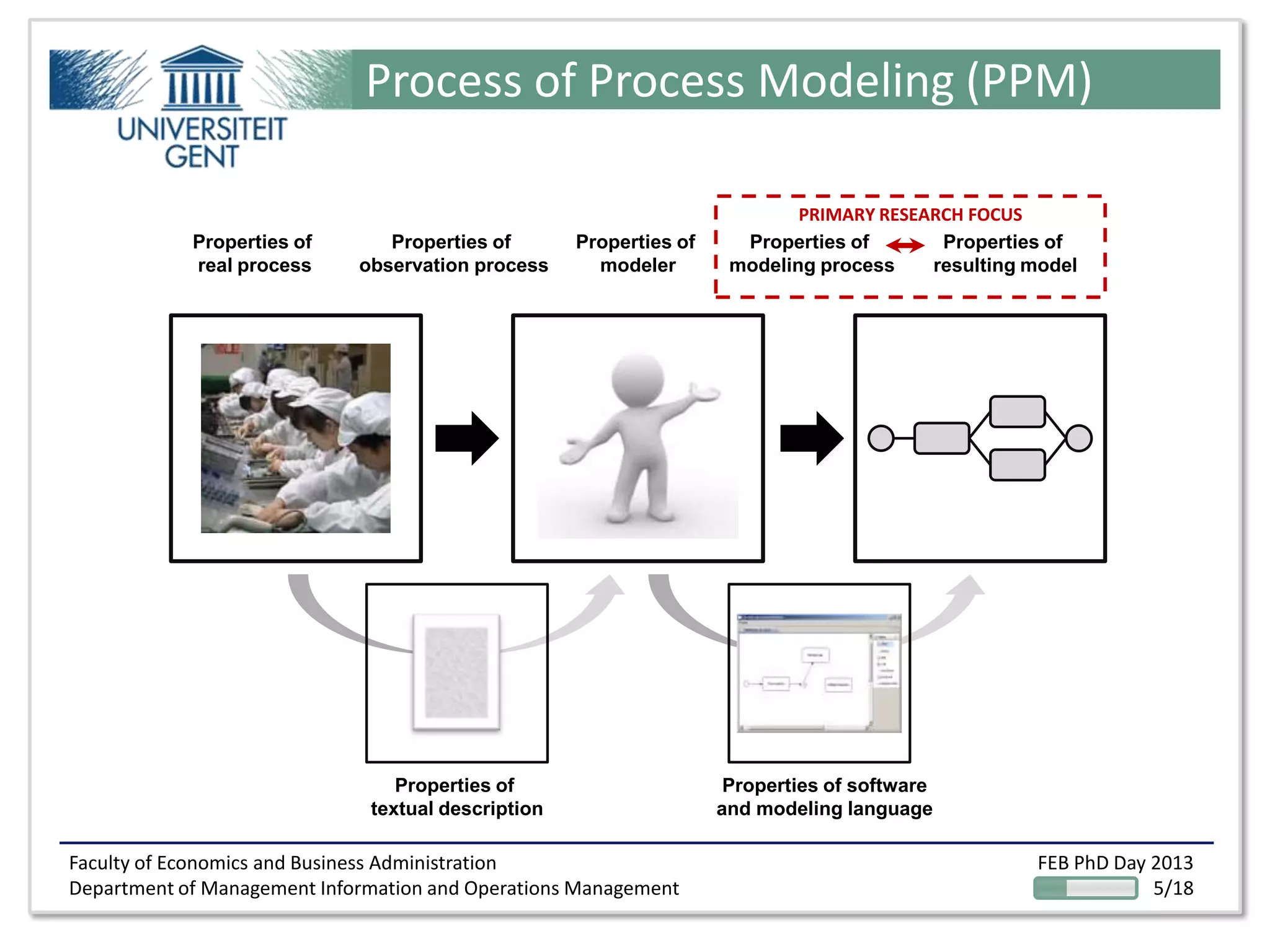
Process of Process Modeling (PPM)
Properties of
textual description
Properties of
modeler
Properties of
modeling process
Properties of
resulting model
PRIMARY RESEARCH FOCUS
Properties of
real process
Properties of
observation process
Properties of software
and modeling language
Faculty of Economics and Business Administration
Department of Management Information and Operations Management
FEB PhD Day 2013
6/18
Process of Process Modeling (PPM)
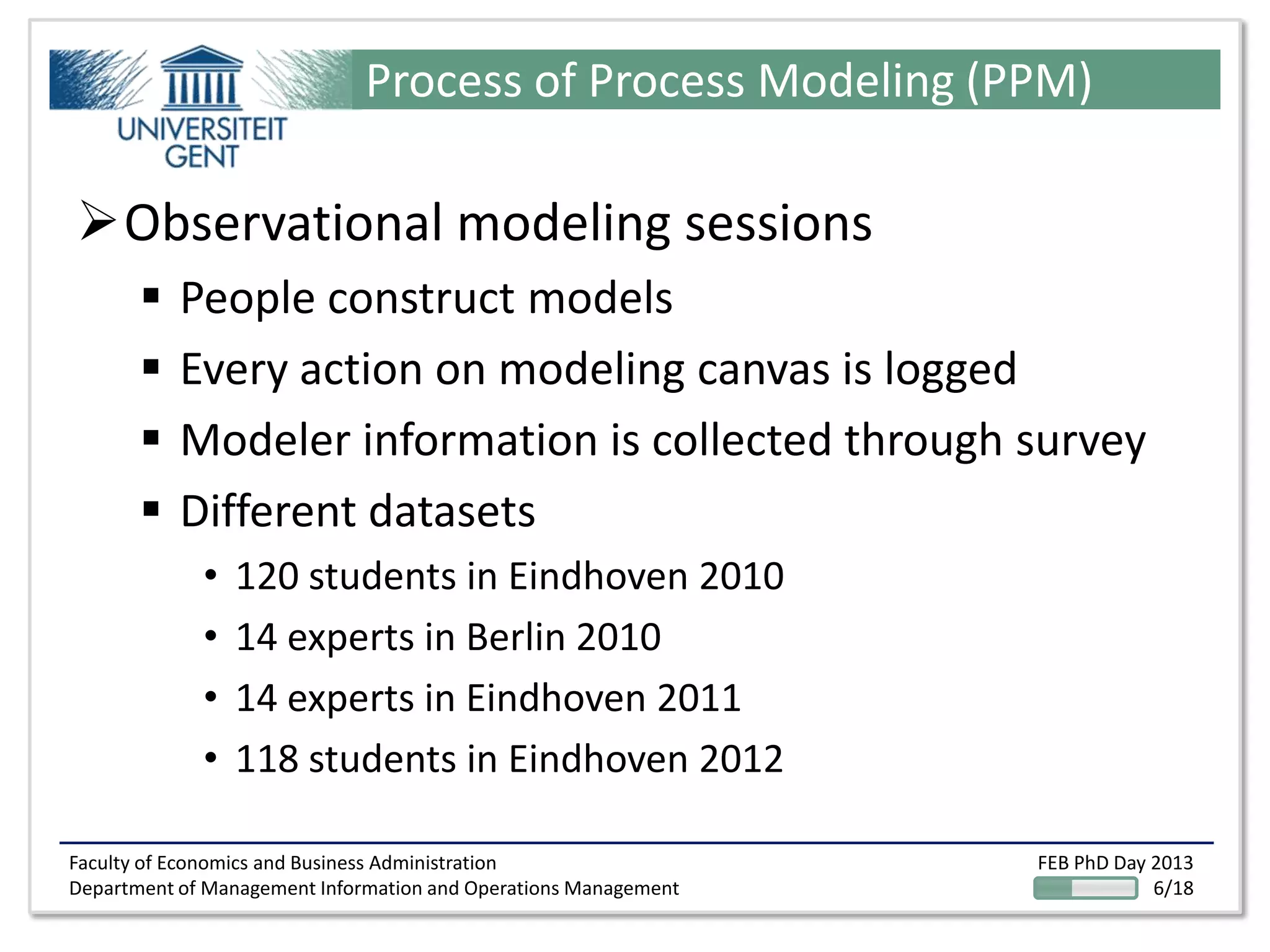
Observational modeling sessions
 People construct models
 Every action on modeling canvas is logged
 Modeler information is collected through survey
 Different datasets
• 120 students in Eindhoven 2010
• 14 experts in Berlin 2010
• 14 experts in Eindhoven 2011
• 118 students in Eindhoven 2012
Faculty of Economics and Business Administration
Department of Management Information and Operations Management
FEB PhD Day 2013
7/18
Process of Process Modeling (PPM)
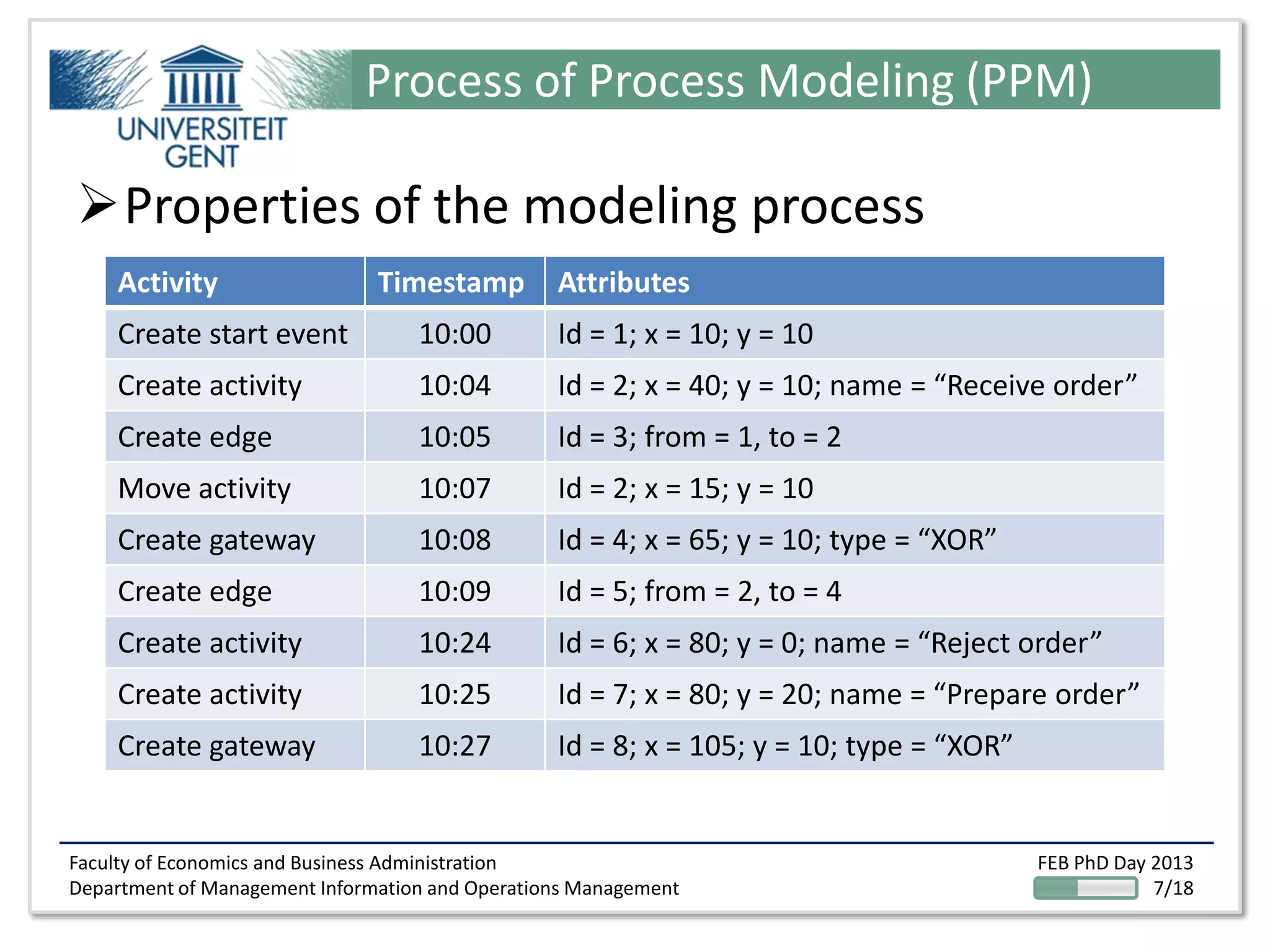
Properties of the modeling process
Activity Timestamp Attributes
Create start event 10:00 Id = 1; x = 10; y = 10
Create activity 10:04 Id = 2; x = 40; y = 10; name = “Receive order”
Create edge 10:05 Id = 3; from = 1, to = 2
Move activity 10:07 Id = 2; x = 15; y = 10
Create gateway 10:08 Id = 4; x = 65; y = 10; type = “XOR”
Create edge 10:09 Id = 5; from = 2, to = 4
Create activity 10:24 Id = 6; x = 80; y = 0; name = “Reject order”
Create activity 10:25 Id = 7; x = 80; y = 20; name = “Prepare order”
Create gateway 10:27 Id = 8; x = 105; y = 10; type = “XOR”
Faculty of Economics and Business Administration
Department of Management Information and Operations Management
FEB PhD Day 2013
8/18
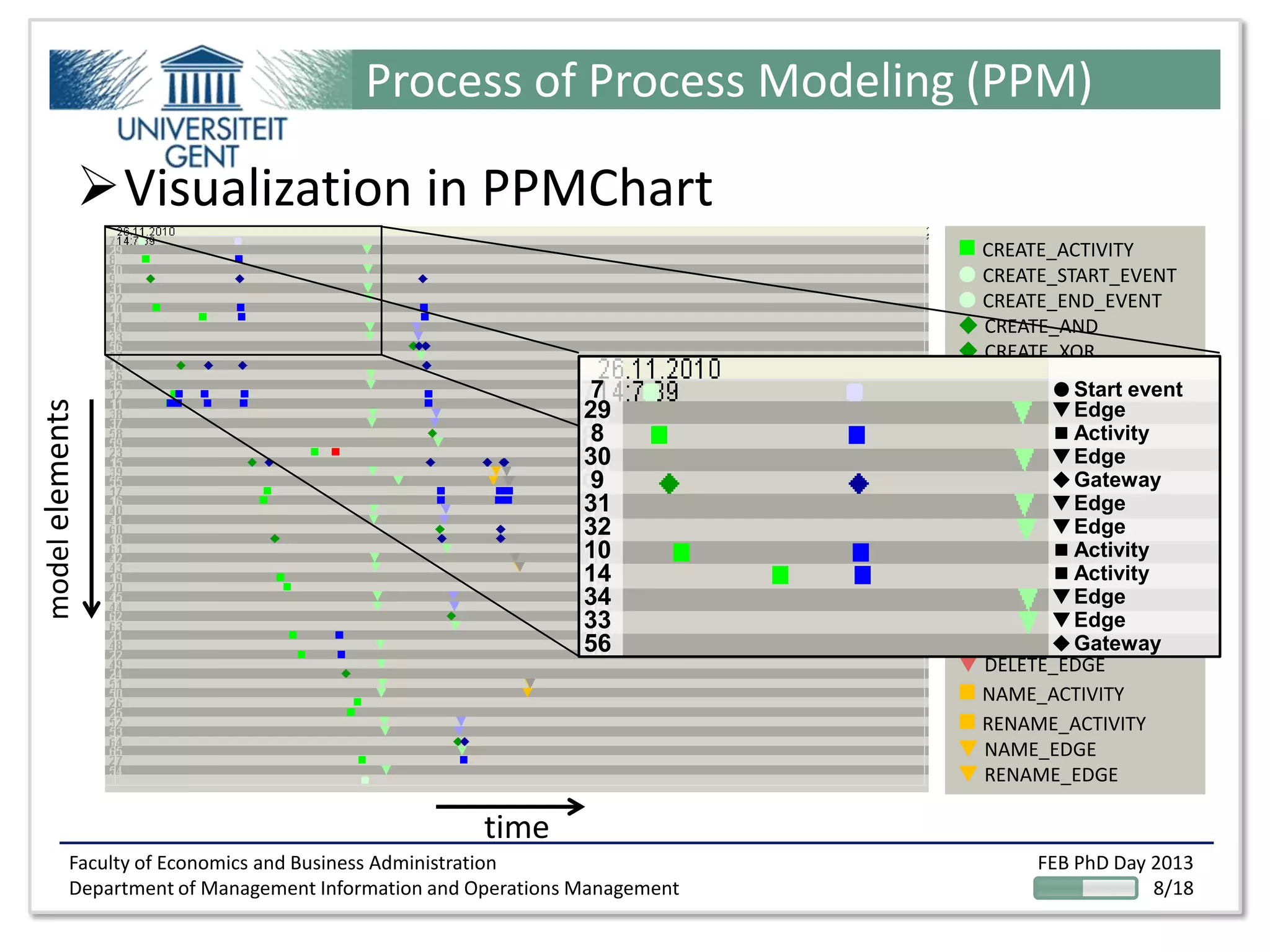
 CREATE_ACTIVITY
 CREATE_START_EVENT
 CREATE_END_EVENT
 CREATE_AND
 CREATE_XOR
 CREATE_EDGE
 MOVE_ACTIVITY
 MOVE_START_EVENT
 MOVE_END_EVENT
 MOVE_AND
 MOVE_XOR
 DELETE_ACTIVITY
DELETE_START_EVENT
 DELETE-END_EVENT
 DELETE_AND
 DELETE_XOR
 DELETE_EDGE
 NAME_ACTIVITY
 RENAME_ACTIVITY
 NAME_EDGE
 RENAME_EDGE
Process of Process Modeling (PPM)
Visualization in PPMChart
 Start event
 Edge
 Activity
 Gateway
 Edge
 Activity
 Edge
 Edge
 Activity
 Edge
 Gateway
 Edge
7
29
8
9
32
14
30
31
10
33
56
34
time
modelelements
Faculty of Economics and Business Administration
Department of Management Information and Operations Management
FEB PhD Day 2013
9/18
Process of Process Modeling (PPM)
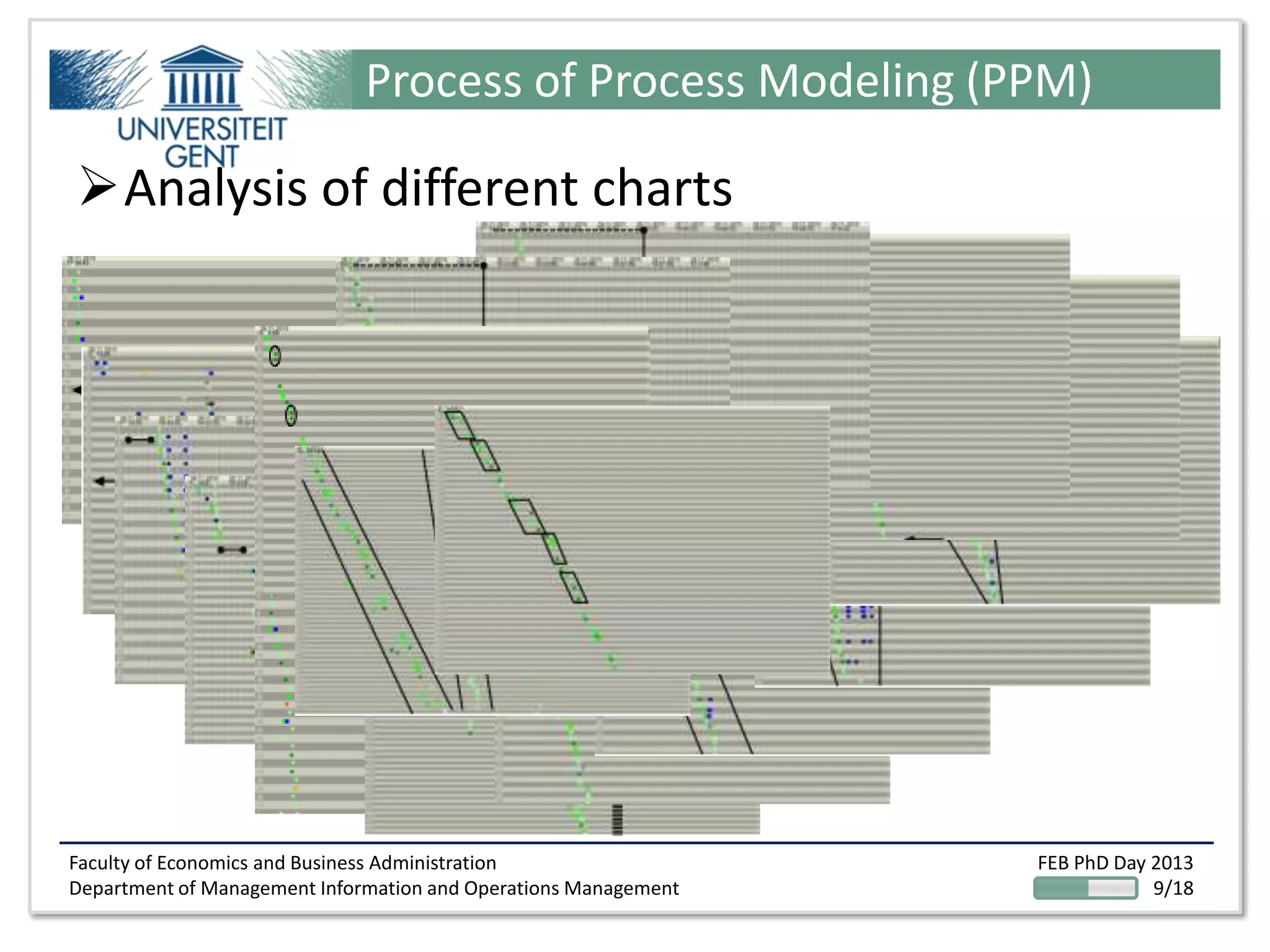
Analysis of different charts
Faculty of Economics and Business Administration
Department of Management Information and Operations Management
FEB PhD Day 2013
10/18
Process of Process Modeling (PPM)
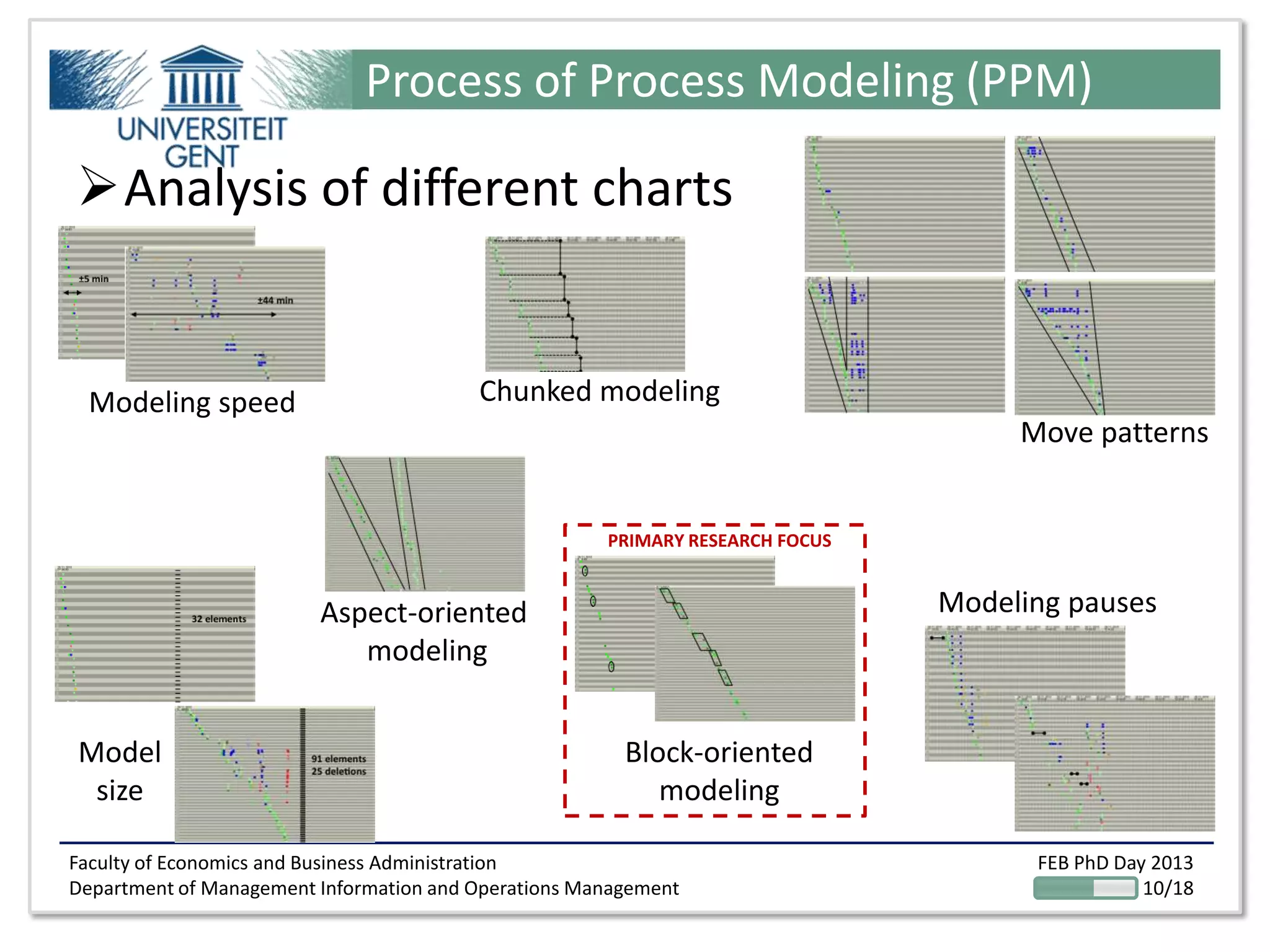
Analysis of different charts
Modeling speed
Model
size
Aspect-oriented
modeling
Chunked modeling
Move patterns
Block-oriented
modeling
Modeling pauses
PRIMARY RESEARCH FOCUS
Faculty of Economics and Business Administration
Department of Management Information and Operations Management
FEB PhD Day 2013
11/18
Structured Process Modeling (SPM)
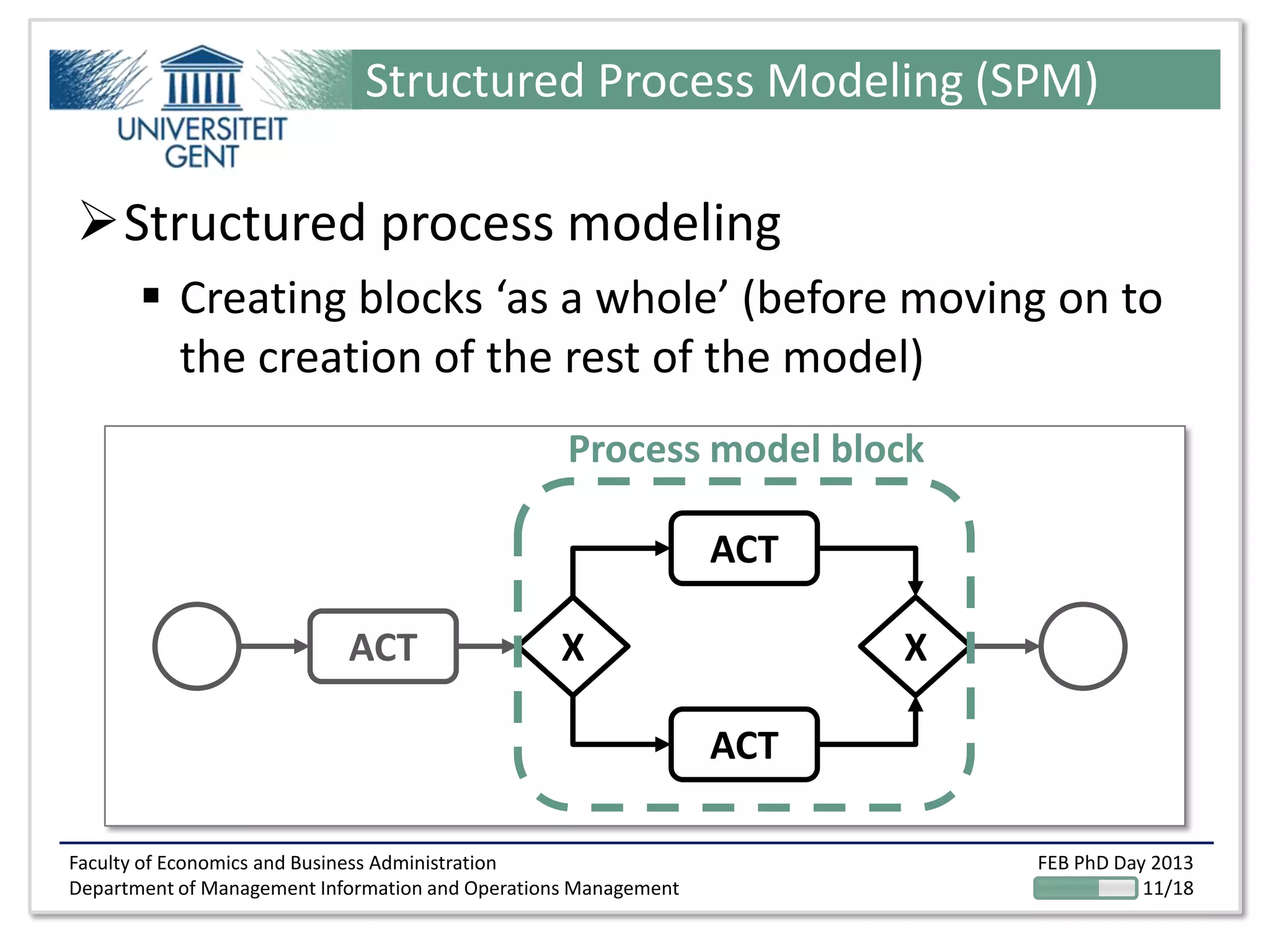
Structured process modeling
 Creating blocks ‘as a whole’ (before moving on to
the creation of the rest of the model)
ACT
ACT
X XACT
Process model block
Faculty of Economics and Business Administration
Department of Management Information and Operations Management
FEB PhD Day 2013
12/18
Structured Process Modeling (SPM)
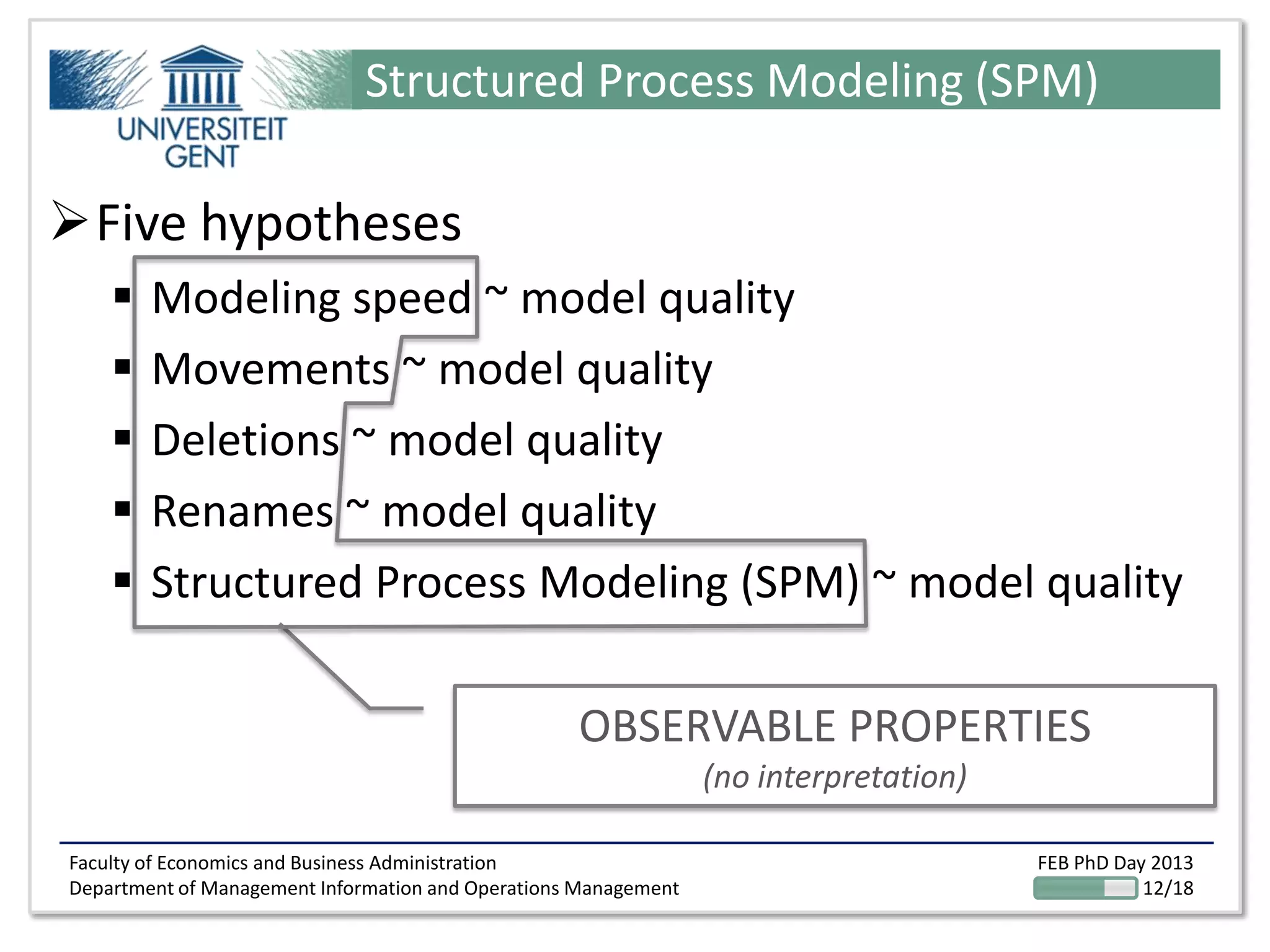
Five hypotheses
 Modeling speed ~ model quality
 Movements ~ model quality
 Deletions ~ model quality
 Renames ~ model quality
 Structured Process Modeling (SPM) ~ model quality
OBSERVABLE PROPERTIES
(no interpretation)
Faculty of Economics and Business Administration
Department of Management Information and Operations Management
FEB PhD Day 2013
13/18
Structured Process Modeling (SPM)
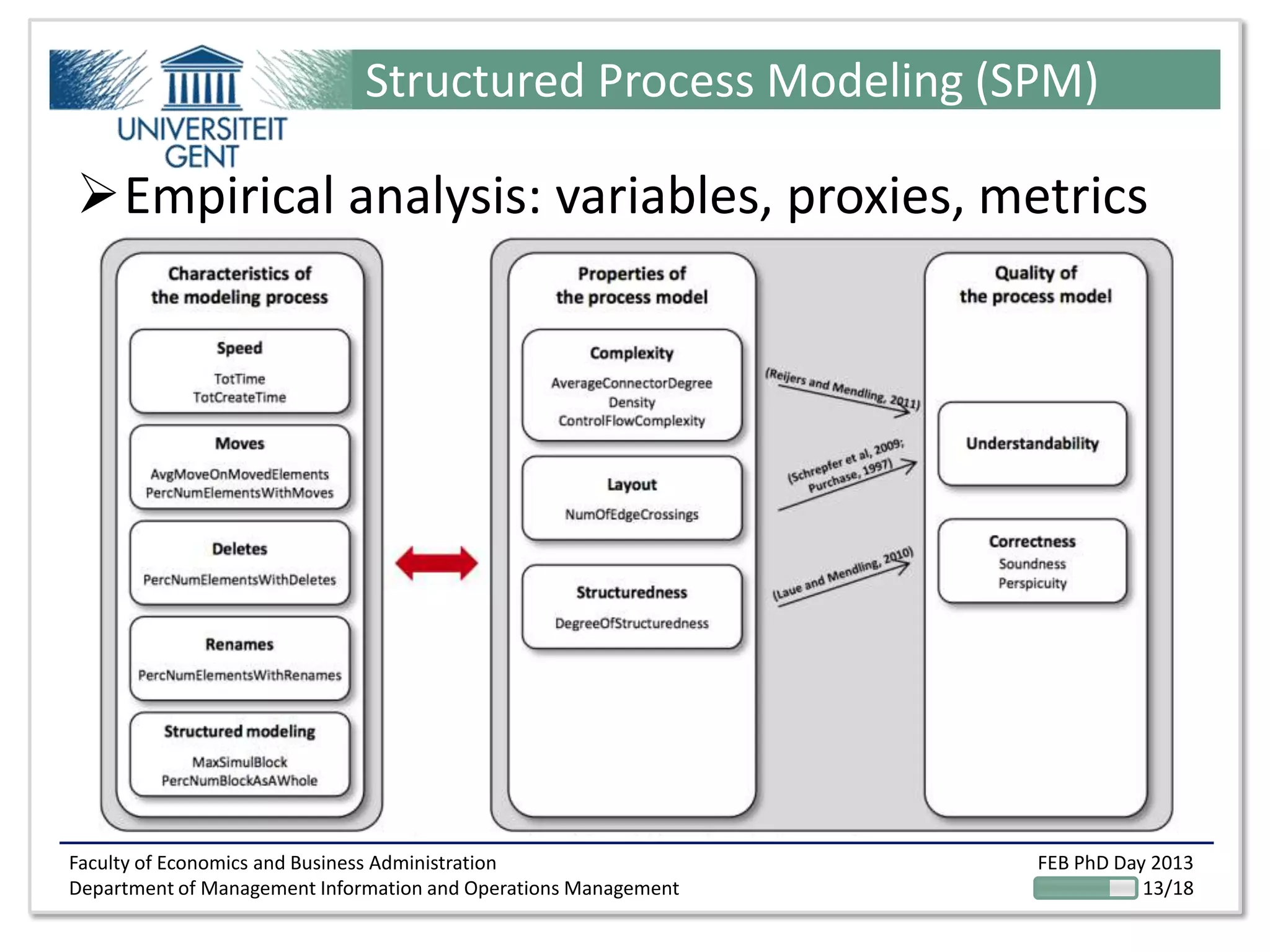
Empirical analysis: variables, proxies, metrics
Faculty of Economics and Business Administration
Department of Management Information and Operations Management
FEB PhD Day 2013
14/18
OBSERVE
OBSERVE
OBSERVE
OBSERVE
Structured Process Modeling (SPM)
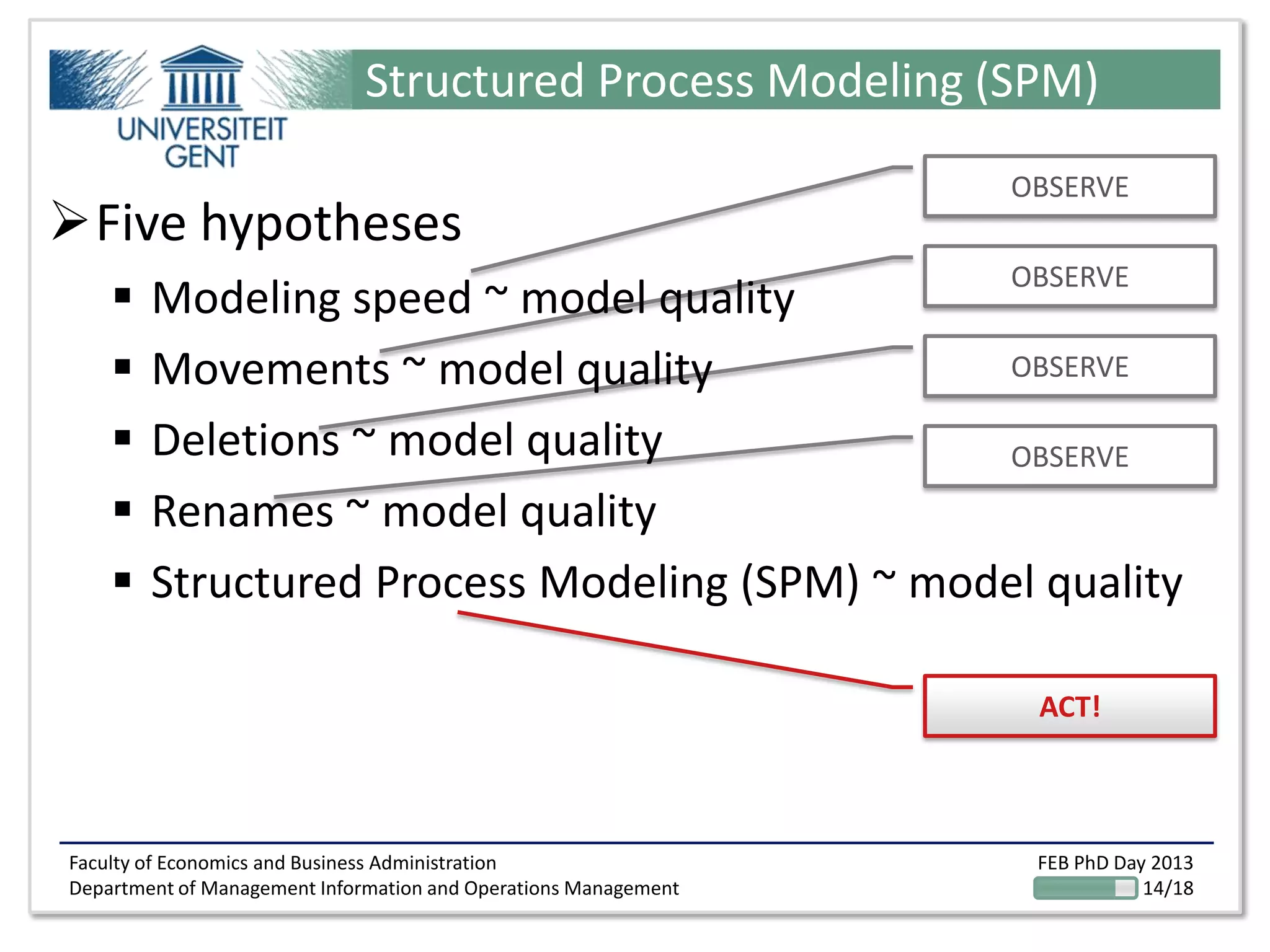
Five hypotheses
 Modeling speed ~ model quality
 Movements ~ model quality
 Deletions ~ model quality
 Renames ~ model quality
 Structured Process Modeling (SPM) ~ model quality
ACT!
Faculty of Economics and Business Administration
Department of Management Information and Operations Management
FEB PhD Day 2013
15/18
Structured Process Modeling (SPM)
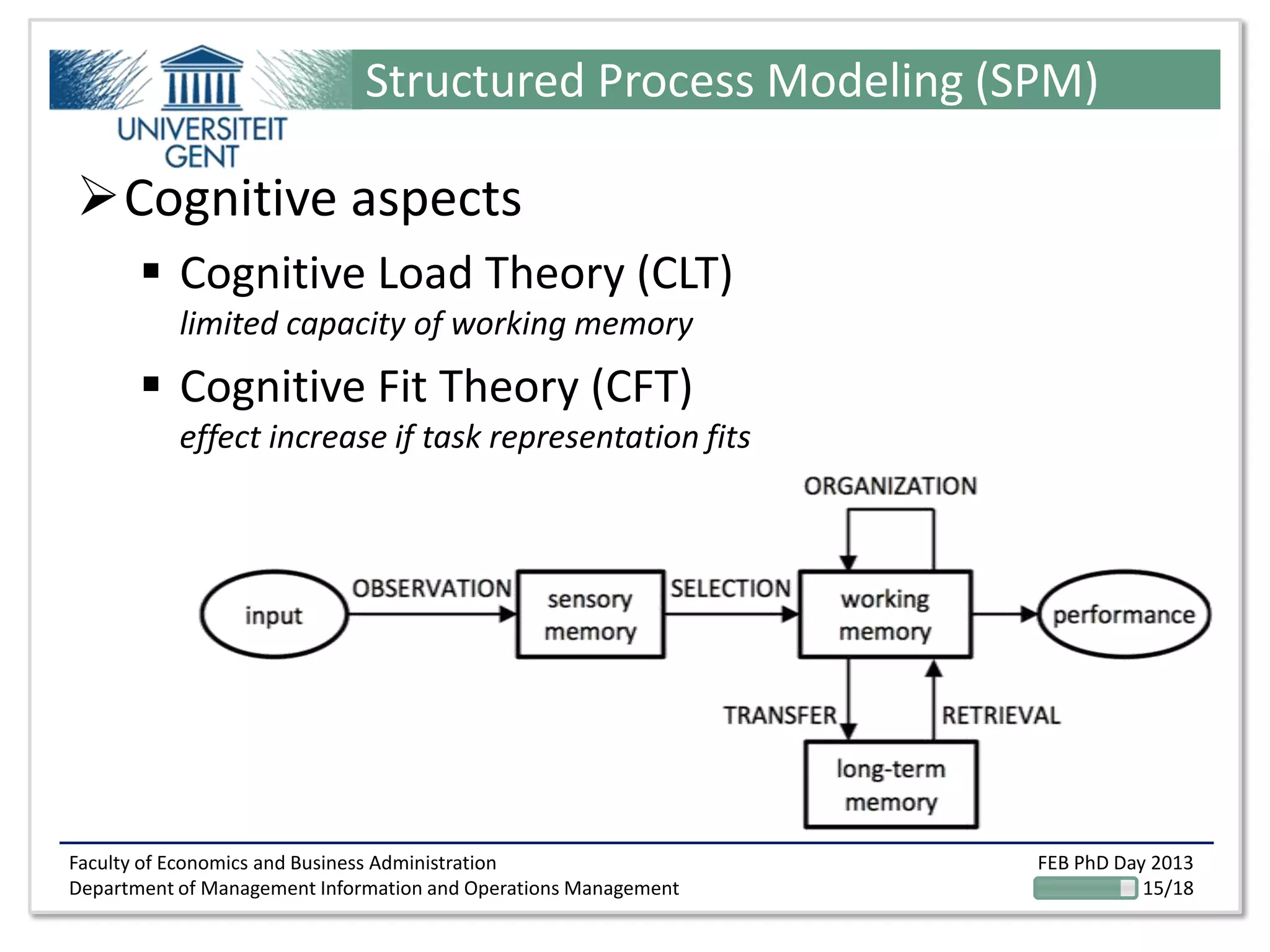
Cognitive aspects
 Cognitive Load Theory (CLT)
limited capacity of working memory
 Cognitive Fit Theory (CFT)
effect increase if task representation fits
Faculty of Economics and Business Administration
Department of Management Information and Operations Management
FEB PhD Day 2013
16/18
Structured Process Modeling (SPM)
Previous research
 Process mining research: merging event logs
 Recently changed scope of PhD research after promising
results of explorative research described in this presentation
Faculty of Economics and Business Administration
Department of Management Information and Operations Management
FEB PhD Day 2013
17/18
Structured Process Modeling (SPM)
Future research: Structured Process Modeling
 Literature review: cognition, problem solving, coding
principles, process model quality, visualization
 Theory development: structured process modeling,
causality relation with model quality, confounding
variables (modeler, tool, model language, case, …)
 Tool support: syntax highlighting, error
indication/correction, structured modeling, …
Faculty of Economics and Business Administration
Department of Management Information and Operations Management
FEB PhD Day 2013
18/18
Contact information
Jan Claes
jan.claes@ugent.be
http://www.janclaes.info
Twitter: @janclaesbelgium
Thanks for your attention!
Do you have feedback
on my research (plans)?

PhD Day 2013

  • 1.
    Faculty of Economicsand Business Administration Department of Management Information and Operations Management FEB PhD Day 2013 24 May, 2013 FACULTY OF ECONOMICS AND BUSINESS ADMINISTRATION An exploration of the relationship between modeling behavior and process model quality Jan Claes Teaching assistant : PhD 2009 - 2015aa Supervisor : Geert Poels Co-supervisor : Frederik Gailly
  • 2.
    Faculty of Economicsand Business Administration Department of Management Information and Operations Management FEB PhD Day 2013 2/18 Outline Business Process Modeling (BPM)  Process model quality “what is a good process model?”  Process of process modeling (PPM) “how to make a good process model?” Visualizing the PPM with PPMCharts Observations, hypotheses, future work  Structured Process Modeling (SPM)
  • 3.
    Faculty of Economicsand Business Administration Department of Management Information and Operations Management FEB PhD Day 2013 3/18 Business Process Modeling (BPM) Business process model in BPMN notation
  • 4.
    Faculty of Economicsand Business Administration Department of Management Information and Operations Management FEB PhD Day 2013 4/18 Process model quality Poor model quality  Many errors  Many nodes  Many crossing arcs  Many nested gateways  … Strong model quality  Few errors  Few nodes  Few crossing arcs  Few nested gateways  …
  • 5.
    Faculty of Economicsand Business Administration Department of Management Information and Operations Management FEB PhD Day 2013 5/18 Process of Process Modeling (PPM) Properties of textual description Properties of modeler Properties of modeling process Properties of resulting model PRIMARY RESEARCH FOCUS Properties of real process Properties of observation process Properties of software and modeling language
  • 6.
    Faculty of Economicsand Business Administration Department of Management Information and Operations Management FEB PhD Day 2013 6/18 Process of Process Modeling (PPM) Observational modeling sessions  People construct models  Every action on modeling canvas is logged  Modeler information is collected through survey  Different datasets • 120 students in Eindhoven 2010 • 14 experts in Berlin 2010 • 14 experts in Eindhoven 2011 • 118 students in Eindhoven 2012
  • 7.
    Faculty of Economicsand Business Administration Department of Management Information and Operations Management FEB PhD Day 2013 7/18 Process of Process Modeling (PPM) Properties of the modeling process Activity Timestamp Attributes Create start event 10:00 Id = 1; x = 10; y = 10 Create activity 10:04 Id = 2; x = 40; y = 10; name = “Receive order” Create edge 10:05 Id = 3; from = 1, to = 2 Move activity 10:07 Id = 2; x = 15; y = 10 Create gateway 10:08 Id = 4; x = 65; y = 10; type = “XOR” Create edge 10:09 Id = 5; from = 2, to = 4 Create activity 10:24 Id = 6; x = 80; y = 0; name = “Reject order” Create activity 10:25 Id = 7; x = 80; y = 20; name = “Prepare order” Create gateway 10:27 Id = 8; x = 105; y = 10; type = “XOR”
  • 8.
    Faculty of Economicsand Business Administration Department of Management Information and Operations Management FEB PhD Day 2013 8/18  CREATE_ACTIVITY  CREATE_START_EVENT  CREATE_END_EVENT  CREATE_AND  CREATE_XOR  CREATE_EDGE  MOVE_ACTIVITY  MOVE_START_EVENT  MOVE_END_EVENT  MOVE_AND  MOVE_XOR  DELETE_ACTIVITY DELETE_START_EVENT  DELETE-END_EVENT  DELETE_AND  DELETE_XOR  DELETE_EDGE  NAME_ACTIVITY  RENAME_ACTIVITY  NAME_EDGE  RENAME_EDGE Process of Process Modeling (PPM) Visualization in PPMChart  Start event  Edge  Activity  Gateway  Edge  Activity  Edge  Edge  Activity  Edge  Gateway  Edge 7 29 8 9 32 14 30 31 10 33 56 34 time modelelements
  • 9.
    Faculty of Economicsand Business Administration Department of Management Information and Operations Management FEB PhD Day 2013 9/18 Process of Process Modeling (PPM) Analysis of different charts
  • 10.
    Faculty of Economicsand Business Administration Department of Management Information and Operations Management FEB PhD Day 2013 10/18 Process of Process Modeling (PPM) Analysis of different charts Modeling speed Model size Aspect-oriented modeling Chunked modeling Move patterns Block-oriented modeling Modeling pauses PRIMARY RESEARCH FOCUS
  • 11.
    Faculty of Economicsand Business Administration Department of Management Information and Operations Management FEB PhD Day 2013 11/18 Structured Process Modeling (SPM) Structured process modeling  Creating blocks ‘as a whole’ (before moving on to the creation of the rest of the model) ACT ACT X XACT Process model block
  • 12.
    Faculty of Economicsand Business Administration Department of Management Information and Operations Management FEB PhD Day 2013 12/18 Structured Process Modeling (SPM) Five hypotheses  Modeling speed ~ model quality  Movements ~ model quality  Deletions ~ model quality  Renames ~ model quality  Structured Process Modeling (SPM) ~ model quality OBSERVABLE PROPERTIES (no interpretation)
  • 13.
    Faculty of Economicsand Business Administration Department of Management Information and Operations Management FEB PhD Day 2013 13/18 Structured Process Modeling (SPM) Empirical analysis: variables, proxies, metrics
  • 14.
    Faculty of Economicsand Business Administration Department of Management Information and Operations Management FEB PhD Day 2013 14/18 OBSERVE OBSERVE OBSERVE OBSERVE Structured Process Modeling (SPM) Five hypotheses  Modeling speed ~ model quality  Movements ~ model quality  Deletions ~ model quality  Renames ~ model quality  Structured Process Modeling (SPM) ~ model quality ACT!
  • 15.
    Faculty of Economicsand Business Administration Department of Management Information and Operations Management FEB PhD Day 2013 15/18 Structured Process Modeling (SPM) Cognitive aspects  Cognitive Load Theory (CLT) limited capacity of working memory  Cognitive Fit Theory (CFT) effect increase if task representation fits
  • 16.
    Faculty of Economicsand Business Administration Department of Management Information and Operations Management FEB PhD Day 2013 16/18 Structured Process Modeling (SPM) Previous research  Process mining research: merging event logs  Recently changed scope of PhD research after promising results of explorative research described in this presentation
  • 17.
    Faculty of Economicsand Business Administration Department of Management Information and Operations Management FEB PhD Day 2013 17/18 Structured Process Modeling (SPM) Future research: Structured Process Modeling  Literature review: cognition, problem solving, coding principles, process model quality, visualization  Theory development: structured process modeling, causality relation with model quality, confounding variables (modeler, tool, model language, case, …)  Tool support: syntax highlighting, error indication/correction, structured modeling, …
  • 18.
    Faculty of Economicsand Business Administration Department of Management Information and Operations Management FEB PhD Day 2013 18/18 Contact information Jan Claes jan.claes@ugent.be http://www.janclaes.info Twitter: @janclaesbelgium Thanks for your attention! Do you have feedback on my research (plans)?

Editor's Notes

  • #4 Start point(s)End point(s)ActivitiesOrderDecision pointsThroughput timesetc