Ghent university, Economics and Business Administration
jan.claes@ugent.be - www.janclaes.info
BPMS2@BPM 2016
21 September, 2016
FACULTY OF ECONOMICS AND BUSINESS ADMINISTRATION
Towards a structured process modeling method
Building the prescriptive modeling theory
Jan Claes, Irene Vanderfeesten, Frederik Gailly, Paul Grefen and Geert Poels
Ghent university, Economics and Business Administration
jan.claes@ugent.be - www.janclaes.info
BPMS2@BPM 2016
2/14
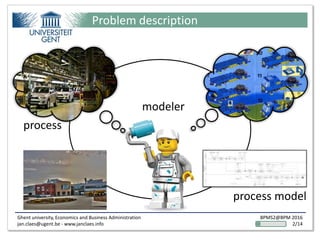
Problem description
process model
modeler
process
Ghent university, Economics and Business Administration
jan.claes@ugent.be - www.janclaes.info
BPMS2@BPM 2016
3/14
Problem description
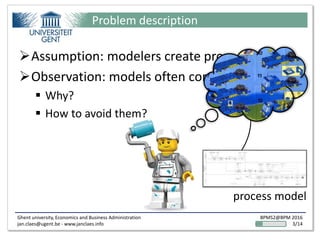
Assumption: modelers create process models
Observation: models often contain errors
 Why?
 How to avoid them?
process model
Ghent university, Economics and Business Administration
jan.claes@ugent.be - www.janclaes.info
BPMS2@BPM 2016
4/14
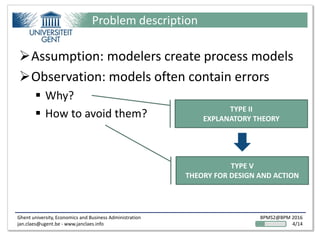
Problem description
Assumption: modelers create process models
Observation: models often contain errors
 Why?
 How to avoid them? TYPE II
EXPLANATORY THEORY
TYPE V
THEORY FOR DESIGN AND ACTION
Ghent university, Economics and Business Administration
jan.claes@ugent.be - www.janclaes.info
BPMS2@BPM 2016
5/14
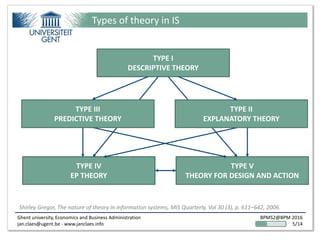
TYPE V
THEORY FOR DESIGN AND ACTION
TYPE IV
EP THEORY
TYPE I
DESCRIPTIVE THEORY
Shirley Gregor, The nature of theory in information systems, MIS Quarterly, Vol 30 (3), p. 611–642, 2006.
Types of theory in IS
TYPE II
EXPLANATORY THEORY
TYPE III
PREDICTIVE THEORY
Ghent university, Economics and Business Administration
jan.claes@ugent.be - www.janclaes.info
BPMS2@BPM 2016
6/14
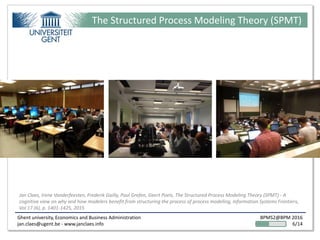
The Structured Process Modeling Theory (SPMT)
Jan Claes, Irene Vanderfeesten, Frederik Gailly, Paul Grefen, Geert Poels, The Structured Process Modeling Theory (SPMT) - A
cognitive view on why and how modelers benefit from structuring the process of process modeling, Information Systems Frontiers,
Vol 17 (6), p. 1401-1425, 2015
Ghent university, Economics and Business Administration
jan.claes@ugent.be - www.janclaes.info
BPMS2@BPM 2016
7/14
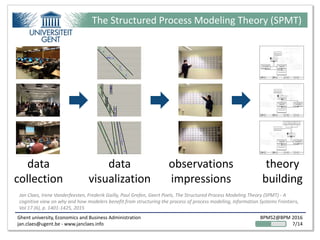
The Structured Process Modeling Theory (SPMT)
Jan Claes, Irene Vanderfeesten, Frederik Gailly, Paul Grefen, Geert Poels, The Structured Process Modeling Theory (SPMT) - A
cognitive view on why and how modelers benefit from structuring the process of process modeling, Information Systems Frontiers,
Vol 17 (6), p. 1401-1425, 2015
data
collection
data
visualization
observations
impressions
theory
building
Ghent university, Economics and Business Administration
jan.claes@ugent.be - www.janclaes.info
BPMS2@BPM 2016
8/14
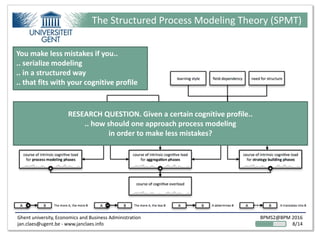
The Structured Process Modeling Theory (SPMT)
You make less mistakes if you..You make less mistakes if you..
.. serialize modeling
You make less mistakes if you..
.. serialize modeling
.. in a structured way
You make less mistakes if you..
.. serialize modeling
.. in a structured way
.. that fits with your cognitive profile
RESEARCH QUESTION. Given a certain cognitive profile..
.. how should one approach process modeling
in order to make less mistakes?
Ghent university, Economics and Business Administration
jan.claes@ugent.be - www.janclaes.info
BPMS2@BPM 2016
9/14
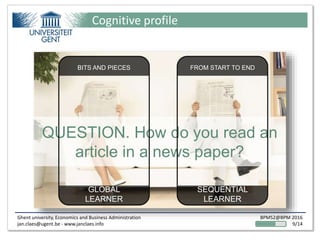
Cognitive profile
QUESTION. How do you read an
article in a news paper?
BITS AND PIECES
GLOBAL
LEARNER
FROM START TO END
SEQUENTIAL
LEARNER
Ghent university, Economics and Business Administration
jan.claes@ugent.be - www.janclaes.info
BPMS2@BPM 2016
10/14
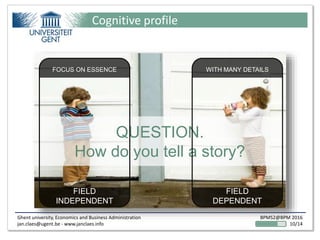
Cognitive profile
QUESTION.
How do you tell a story?
FOCUS ON ESSENCE
FIELD
INDEPENDENT
WITH MANY DETAILS
FIELD
DEPENDENT
Ghent university, Economics and Business Administration
jan.claes@ugent.be - www.janclaes.info
BPMS2@BPM 2016
11/14
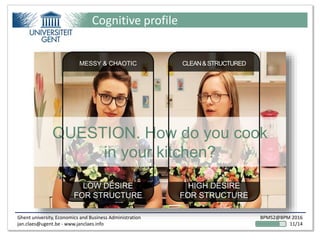
Cognitive profile
QUESTION. How do you cook
in your kitchen?
MESSY & CHAOTIC
LOW DESIRE
FOR STRUCTURE
CLEAN&STRUCTURED
HIGH DESIRE
FOR STRUCTURE
Ghent university, Economics and Business Administration
jan.claes@ugent.be - www.janclaes.info
BPMS2@BPM 2016
12/14
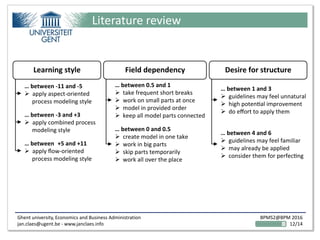
Literature review
Ghent university, Economics and Business Administration
jan.claes@ugent.be - www.janclaes.info
BPMS2@BPM 2016
13/14
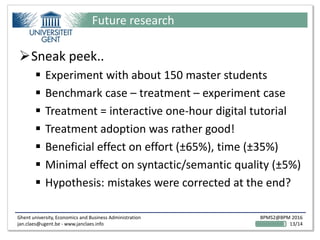
Future research
Sneak peek..
 Experiment with about 150 master students
 Benchmark case – treatment – experiment case
 Treatment = interactive one-hour digital tutorial
 Treatment adoption was rather good!
 Beneficial effect on effort (±65%), time (±35%)
 Minimal effect on syntactic/semantic quality (±5%)
 Hypothesis: mistakes were corrected at the end?
Ghent university, Economics and Business Administration
jan.claes@ugent.be - www.janclaes.info
BPMS2@BPM 2016
14/14
Contact information
Jan Claes
jan.claes@ugent.be
http://www.janclaes.info
Twitter: @janclaesbelgium
Thanks for your attention!
Do you know expert modeling practitioners that
would be interested to participate in these
experiments in order to test external
validity of the results?

BPMS2@BPM2016

  • 1.
    Ghent university, Economicsand Business Administration jan.claes@ugent.be - www.janclaes.info BPMS2@BPM 2016 21 September, 2016 FACULTY OF ECONOMICS AND BUSINESS ADMINISTRATION Towards a structured process modeling method Building the prescriptive modeling theory Jan Claes, Irene Vanderfeesten, Frederik Gailly, Paul Grefen and Geert Poels
  • 2.
    Ghent university, Economicsand Business Administration jan.claes@ugent.be - www.janclaes.info BPMS2@BPM 2016 2/14 Problem description process model modeler process
  • 3.
    Ghent university, Economicsand Business Administration jan.claes@ugent.be - www.janclaes.info BPMS2@BPM 2016 3/14 Problem description Assumption: modelers create process models Observation: models often contain errors  Why?  How to avoid them? process model
  • 4.
    Ghent university, Economicsand Business Administration jan.claes@ugent.be - www.janclaes.info BPMS2@BPM 2016 4/14 Problem description Assumption: modelers create process models Observation: models often contain errors  Why?  How to avoid them? TYPE II EXPLANATORY THEORY TYPE V THEORY FOR DESIGN AND ACTION
  • 5.
    Ghent university, Economicsand Business Administration jan.claes@ugent.be - www.janclaes.info BPMS2@BPM 2016 5/14 TYPE V THEORY FOR DESIGN AND ACTION TYPE IV EP THEORY TYPE I DESCRIPTIVE THEORY Shirley Gregor, The nature of theory in information systems, MIS Quarterly, Vol 30 (3), p. 611–642, 2006. Types of theory in IS TYPE II EXPLANATORY THEORY TYPE III PREDICTIVE THEORY
  • 6.
    Ghent university, Economicsand Business Administration jan.claes@ugent.be - www.janclaes.info BPMS2@BPM 2016 6/14 The Structured Process Modeling Theory (SPMT) Jan Claes, Irene Vanderfeesten, Frederik Gailly, Paul Grefen, Geert Poels, The Structured Process Modeling Theory (SPMT) - A cognitive view on why and how modelers benefit from structuring the process of process modeling, Information Systems Frontiers, Vol 17 (6), p. 1401-1425, 2015
  • 7.
    Ghent university, Economicsand Business Administration jan.claes@ugent.be - www.janclaes.info BPMS2@BPM 2016 7/14 The Structured Process Modeling Theory (SPMT) Jan Claes, Irene Vanderfeesten, Frederik Gailly, Paul Grefen, Geert Poels, The Structured Process Modeling Theory (SPMT) - A cognitive view on why and how modelers benefit from structuring the process of process modeling, Information Systems Frontiers, Vol 17 (6), p. 1401-1425, 2015 data collection data visualization observations impressions theory building
  • 8.
    Ghent university, Economicsand Business Administration jan.claes@ugent.be - www.janclaes.info BPMS2@BPM 2016 8/14 The Structured Process Modeling Theory (SPMT) You make less mistakes if you..You make less mistakes if you.. .. serialize modeling You make less mistakes if you.. .. serialize modeling .. in a structured way You make less mistakes if you.. .. serialize modeling .. in a structured way .. that fits with your cognitive profile RESEARCH QUESTION. Given a certain cognitive profile.. .. how should one approach process modeling in order to make less mistakes?
  • 9.
    Ghent university, Economicsand Business Administration jan.claes@ugent.be - www.janclaes.info BPMS2@BPM 2016 9/14 Cognitive profile QUESTION. How do you read an article in a news paper? BITS AND PIECES GLOBAL LEARNER FROM START TO END SEQUENTIAL LEARNER
  • 10.
    Ghent university, Economicsand Business Administration jan.claes@ugent.be - www.janclaes.info BPMS2@BPM 2016 10/14 Cognitive profile QUESTION. How do you tell a story? FOCUS ON ESSENCE FIELD INDEPENDENT WITH MANY DETAILS FIELD DEPENDENT
  • 11.
    Ghent university, Economicsand Business Administration jan.claes@ugent.be - www.janclaes.info BPMS2@BPM 2016 11/14 Cognitive profile QUESTION. How do you cook in your kitchen? MESSY & CHAOTIC LOW DESIRE FOR STRUCTURE CLEAN&STRUCTURED HIGH DESIRE FOR STRUCTURE
  • 12.
    Ghent university, Economicsand Business Administration jan.claes@ugent.be - www.janclaes.info BPMS2@BPM 2016 12/14 Literature review
  • 13.
    Ghent university, Economicsand Business Administration jan.claes@ugent.be - www.janclaes.info BPMS2@BPM 2016 13/14 Future research Sneak peek..  Experiment with about 150 master students  Benchmark case – treatment – experiment case  Treatment = interactive one-hour digital tutorial  Treatment adoption was rather good!  Beneficial effect on effort (±65%), time (±35%)  Minimal effect on syntactic/semantic quality (±5%)  Hypothesis: mistakes were corrected at the end?
  • 14.
    Ghent university, Economicsand Business Administration jan.claes@ugent.be - www.janclaes.info BPMS2@BPM 2016 14/14 Contact information Jan Claes jan.claes@ugent.be http://www.janclaes.info Twitter: @janclaesbelgium Thanks for your attention! Do you know expert modeling practitioners that would be interested to participate in these experiments in order to test external validity of the results?

Editor's Notes

  • #4 Start point(s) End point(s) Activities Order Decision points Throughput times etc