PHASE CHANGE MATERIALS
(PCM)
R.SARATHKUMAR
2016251038
M.E. R and AC
RA7212 SEMINAR
1
• Introduction
• What is a PCM
• PCM physical principle and behavior
• Water as a PCM
• PCM classification
• PCM general applications
• PCM application in medical field
• Birth asphyxia (detailed study)
• Conclusion
2
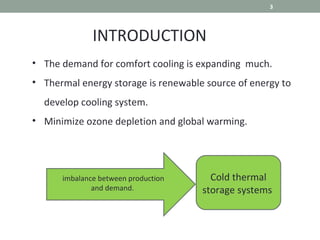
• The demand for comfort cooling is expanding much.
• Thermal energy storage is renewable source of energy to
develop cooling system.
• Minimize ozone depletion and global warming.
Cold thermal
storage systems
imbalance between production
and demand.
INTRODUCTION
3
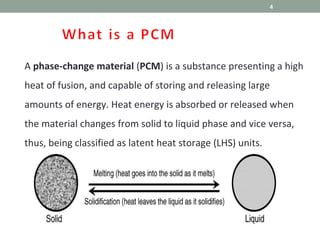
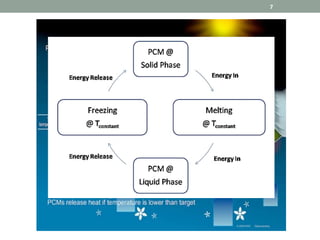
A phase-change material (PCM) is a substance presenting a high
heat of fusion, and capable of storing and releasing large
amounts of energy. Heat energy is absorbed or released when
the material changes from solid to liquid phase and vice versa,
thus, being classified as latent heat storage (LHS) units.
4
HOW IS PCM MANUFACTURED?
PCMs are manufactured by mixing various chemicals in
particular proportions under appropriate environment
conditions.
5
WHAT ARE THE MATERIAL PROPERTIES?
Material Latent Heat, Density, Specific Heat in liquid and solid
state, thermal conductivity in liquid and solid state, toxicity,
flammability, operating temperature range and maximum
operating temperature would be the specifications.
6
HOW DO YOU MANIPULATE THE PHASE CHANGE
TEMPERATURE?
By adding different chemicals or altering the
proportions of it
IS THE PCM TOXIC OR CORROSIVE? (TO STEEL?)
savEnrg PCM use non toxic base materials - some
inorganic PCMs may be corrosive to some metals
WHAT IS THE PCM MADE OUT OF?
PCMs are made from either inorganic chemicals or
organic chemicals
7
The Latent Heat of
fusion is the amount of
thermal energy required
to cause a liquid to
freeze into solid
8
9
• Latent Heat
• Sensible Heat
10
11
Heat
(energy) is
transferre
d into the
ice.
The heat is
used to break
the bonds
between
molecules, not
to increase the
average kinetic
energy of the
molecules.
Since the bonds
among the ice
molecules have been
broken, water is
formed. The water
molecules, at this
moment, have the
same average kinetic
energy as they did
when they were ice.
Since the ice
and water
molecules both
have the same
average kinetic
energy, they
are at the same
Kelvin
temperature.
• Changing levels
12
13
Source Research Gate
PCMs can be
categorized on
the basis of
latent heat of
fusion and
melting
temperature
14
ORGANIC MATERIALS melt and freeze frequently without phase separation
that help to retain their latent heat of fusion.
Paraffin Non-paraffin
mostly straight chain
n-alkanes and with the
increase in chain length
of paraffin wax, melting
point and latent heat of
fusion increase
Non-paraffin have the
advantage of higher heat
of fusion but comes at
the expense of higher
cost
15
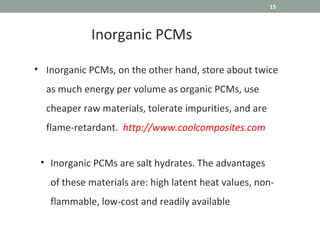
• Inorganic PCMs, on the other hand, store about twice
as much energy per volume as organic PCMs, use
cheaper raw materials, tolerate impurities, and are
flame-retardant. http://www.coolcomposites.com
Inorganic PCMs
• Inorganic PCMs are salt hydrates. The advantages
of these materials are: high latent heat values, non-
flammable, low-cost and readily available
16
• These are combination of two or more
components and shows minimum melting
temperature. Eutectic almost melts and freezes
without phase separation
• Eutectics tend to be solutions of salts in water
that have a phase change temperature below 0°C
(32°F).
Eutectics
B. Zalba et al. / Applied Thermal Engineering 2 (2003) 251–283
Inorganic PCMs
17
Organic PCMs
B. Zalba et al. / Applied Thermal Engineering 2 (2003) 251–283
18
• Commonly
used PCMs
19
20
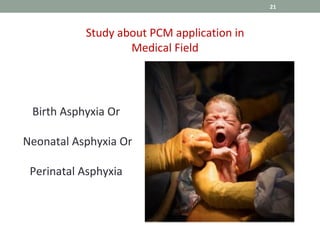
Study about PCM application in
Medical Field
Birth Asphyxia Or
Neonatal Asphyxia Or
Perinatal Asphyxia
21
Asphyxia means LACK OF OXYGEN. Birth asphyxia happens when a baby's
brain and other organs do not get enough oxygen before, during or right after
birth. Without oxygen, cells cannot work properly. Waste products (acids)
build up in the cells and cause temporary or permanent damage
Some causes of birth asphyxia may include:
•Too little oxygen in the mother's blood before or during birth
•Problems with the placenta separating from the uterus too soon
•Very long or difficult delivery
What Is Birth Asphyxia?
This causes hypoxic-ischemic encephalopathy
22
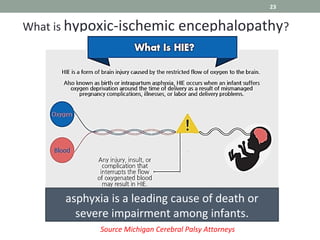
What is hypoxic-ischemic encephalopathy?
asphyxia is a leading cause of death or
severe impairment among infants.
Source Michigan Cerebral Palsy Attorneys
23
THE IMPACT OF ASPHYXIA
2/3 of
infant
mortality
in India
Second
largest cause
of death
among
infants in
first month
WHO says
683,000
babies
died in
2012
Source ; ISHRAE JOURNAL -JULY AUGUST 2015
4times of
Chepauk
Stadium
seating is
150000
24
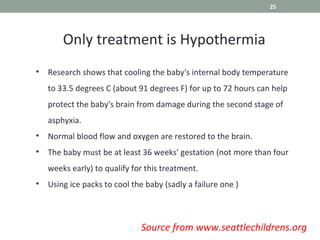
• Research shows that cooling the baby's internal body temperature
to 33.5 degrees C (about 91 degrees F) for up to 72 hours can help
protect the baby's brain from damage during the second stage of
asphyxia.
• Normal blood flow and oxygen are restored to the brain.
• The baby must be at least 36 weeks' gestation (not more than four
weeks early) to qualify for this treatment.
• Using ice packs to cool the baby (sadly a failure one )
Only treatment is Hypothermia
Source from www.seattlechildrens.org
25
The Problem in conventional
• Very expensive 15-20lakh
• Require very high manual supervision
• Possibility for Tissue damage (fat necrosis)
• Uninterrupted power needed to run
26
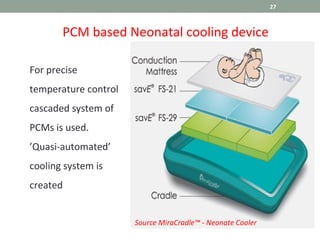
PCM based Neonatal cooling device
For precise
temperature control
cascaded system of
PCMs is used.
’Quasi-automated’
cooling system is
created
Source MiraCradle™ - Neonate Cooler
27
• Passive heating and cooling substances , usually made of a
salt hydride , fatty acid and ester or paraffin such as
Octadene
• PCMs are solid at room temperature , but when in contact
with warmer objects they liquefy and absorb and store
heat
• Liquid PCMs can solidify and give off heat
• Once its is stored in refrigerator for 6 to 8 hours it can been
used up to for 72hours without uninterrupted power
August 2, 2015
28
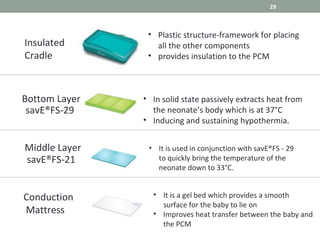
• Plastic structure-framework for placing
all the other components
• provides insulation to the PCM
Insulated
Cradle
savE®FS-29
• In solid state passively extracts heat from
the neonate’s body which is at 37°C
• Inducing and sustaining hypothermia.
savE®FS-21
Bottom Layer
Middle Layer • It is used in conjunction with savE®FS - 29
to quickly bring the temperature of the
neonate down to 33°C.
Conduction
Mattress
• It is a gel bed which provides a smooth
surface for the baby to lie on
• Improves heat transfer between the baby and
the PCM
29
A NEONATAL COOLING DEVICE IN USE
Source MiraCradle™ - Neonate Cooler
30
Advantages
• Cost is 1/10th
of existing equipment
• All PCMs are reusable so no maintenance cost
• Does not require electricity when in use
• No intimidating wires and circuits for nurses and doctors
31
32

Phase Changing Material Introduction with Medical application

  • 1.
  • 2.
    • Introduction • Whatis a PCM • PCM physical principle and behavior • Water as a PCM • PCM classification • PCM general applications • PCM application in medical field • Birth asphyxia (detailed study) • Conclusion 2
  • 3.
    • The demandfor comfort cooling is expanding much. • Thermal energy storage is renewable source of energy to develop cooling system. • Minimize ozone depletion and global warming. Cold thermal storage systems imbalance between production and demand. INTRODUCTION 3
  • 4.
    A phase-change material(PCM) is a substance presenting a high heat of fusion, and capable of storing and releasing large amounts of energy. Heat energy is absorbed or released when the material changes from solid to liquid phase and vice versa, thus, being classified as latent heat storage (LHS) units. 4
  • 5.
    HOW IS PCMMANUFACTURED? PCMs are manufactured by mixing various chemicals in particular proportions under appropriate environment conditions. 5 WHAT ARE THE MATERIAL PROPERTIES? Material Latent Heat, Density, Specific Heat in liquid and solid state, thermal conductivity in liquid and solid state, toxicity, flammability, operating temperature range and maximum operating temperature would be the specifications.
  • 6.
    6 HOW DO YOUMANIPULATE THE PHASE CHANGE TEMPERATURE? By adding different chemicals or altering the proportions of it IS THE PCM TOXIC OR CORROSIVE? (TO STEEL?) savEnrg PCM use non toxic base materials - some inorganic PCMs may be corrosive to some metals WHAT IS THE PCM MADE OUT OF? PCMs are made from either inorganic chemicals or organic chemicals
  • 7.
  • 8.
    The Latent Heatof fusion is the amount of thermal energy required to cause a liquid to freeze into solid 8
  • 9.
  • 10.
    • Latent Heat •Sensible Heat 10
  • 11.
  • 12.
    Heat (energy) is transferre d intothe ice. The heat is used to break the bonds between molecules, not to increase the average kinetic energy of the molecules. Since the bonds among the ice molecules have been broken, water is formed. The water molecules, at this moment, have the same average kinetic energy as they did when they were ice. Since the ice and water molecules both have the same average kinetic energy, they are at the same Kelvin temperature. • Changing levels 12
  • 13.
    13 Source Research Gate PCMscan be categorized on the basis of latent heat of fusion and melting temperature
  • 14.
    14 ORGANIC MATERIALS meltand freeze frequently without phase separation that help to retain their latent heat of fusion. Paraffin Non-paraffin mostly straight chain n-alkanes and with the increase in chain length of paraffin wax, melting point and latent heat of fusion increase Non-paraffin have the advantage of higher heat of fusion but comes at the expense of higher cost
  • 15.
    15 • Inorganic PCMs,on the other hand, store about twice as much energy per volume as organic PCMs, use cheaper raw materials, tolerate impurities, and are flame-retardant. http://www.coolcomposites.com Inorganic PCMs • Inorganic PCMs are salt hydrates. The advantages of these materials are: high latent heat values, non- flammable, low-cost and readily available
  • 16.
    16 • These arecombination of two or more components and shows minimum melting temperature. Eutectic almost melts and freezes without phase separation • Eutectics tend to be solutions of salts in water that have a phase change temperature below 0°C (32°F). Eutectics
  • 17.
    B. Zalba etal. / Applied Thermal Engineering 2 (2003) 251–283 Inorganic PCMs 17
  • 18.
    Organic PCMs B. Zalbaet al. / Applied Thermal Engineering 2 (2003) 251–283 18
  • 19.
  • 20.
  • 21.
    Study about PCMapplication in Medical Field Birth Asphyxia Or Neonatal Asphyxia Or Perinatal Asphyxia 21
  • 22.
    Asphyxia means LACKOF OXYGEN. Birth asphyxia happens when a baby's brain and other organs do not get enough oxygen before, during or right after birth. Without oxygen, cells cannot work properly. Waste products (acids) build up in the cells and cause temporary or permanent damage Some causes of birth asphyxia may include: •Too little oxygen in the mother's blood before or during birth •Problems with the placenta separating from the uterus too soon •Very long or difficult delivery What Is Birth Asphyxia? This causes hypoxic-ischemic encephalopathy 22
  • 23.
    What is hypoxic-ischemicencephalopathy? asphyxia is a leading cause of death or severe impairment among infants. Source Michigan Cerebral Palsy Attorneys 23
  • 24.
    THE IMPACT OFASPHYXIA 2/3 of infant mortality in India Second largest cause of death among infants in first month WHO says 683,000 babies died in 2012 Source ; ISHRAE JOURNAL -JULY AUGUST 2015 4times of Chepauk Stadium seating is 150000 24
  • 25.
    • Research showsthat cooling the baby's internal body temperature to 33.5 degrees C (about 91 degrees F) for up to 72 hours can help protect the baby's brain from damage during the second stage of asphyxia. • Normal blood flow and oxygen are restored to the brain. • The baby must be at least 36 weeks' gestation (not more than four weeks early) to qualify for this treatment. • Using ice packs to cool the baby (sadly a failure one ) Only treatment is Hypothermia Source from www.seattlechildrens.org 25
  • 26.
    The Problem inconventional • Very expensive 15-20lakh • Require very high manual supervision • Possibility for Tissue damage (fat necrosis) • Uninterrupted power needed to run 26
  • 27.
    PCM based Neonatalcooling device For precise temperature control cascaded system of PCMs is used. ’Quasi-automated’ cooling system is created Source MiraCradle™ - Neonate Cooler 27
  • 28.
    • Passive heatingand cooling substances , usually made of a salt hydride , fatty acid and ester or paraffin such as Octadene • PCMs are solid at room temperature , but when in contact with warmer objects they liquefy and absorb and store heat • Liquid PCMs can solidify and give off heat • Once its is stored in refrigerator for 6 to 8 hours it can been used up to for 72hours without uninterrupted power August 2, 2015 28
  • 29.
    • Plastic structure-frameworkfor placing all the other components • provides insulation to the PCM Insulated Cradle savE®FS-29 • In solid state passively extracts heat from the neonate’s body which is at 37°C • Inducing and sustaining hypothermia. savE®FS-21 Bottom Layer Middle Layer • It is used in conjunction with savE®FS - 29 to quickly bring the temperature of the neonate down to 33°C. Conduction Mattress • It is a gel bed which provides a smooth surface for the baby to lie on • Improves heat transfer between the baby and the PCM 29
  • 30.
    A NEONATAL COOLINGDEVICE IN USE Source MiraCradle™ - Neonate Cooler 30
  • 31.
    Advantages • Cost is1/10th of existing equipment • All PCMs are reusable so no maintenance cost • Does not require electricity when in use • No intimidating wires and circuits for nurses and doctors 31
  • 32.