ENTERING INTO VALUE-ADDED PARTNERSHIPS WITH YOUR HMOsRoger H. Strube, M.D.Managed Care Consultant
The Cost and Cost Containment of Medical CareRoger H. Strube, M.D.Managed Care Consultant
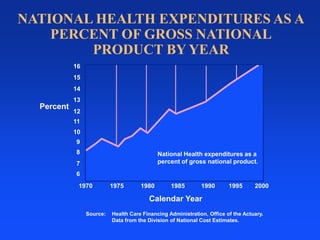
The Cost = 18% of GNP$2.3 Trillion
NATIONAL HEALTH EXPENDITURES AS APERCENT OF GROSS NATIONALPRODUCT BY YEAR16151413Percent12111098National Health expenditures as apercent of gross national product.761970197519801985199019952000Calendar YearSource:	Health Care Financing Administration, Office of the Actuary.	Data from the Division of National Cost Estimates.
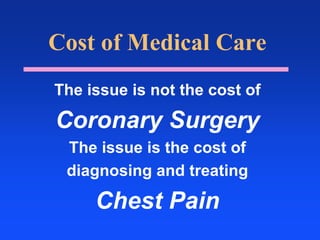
Cost of Medical CareThe issue is not the cost ofCoronary SurgeryThe issue is the cost ofdiagnosing and treatingChest Pain
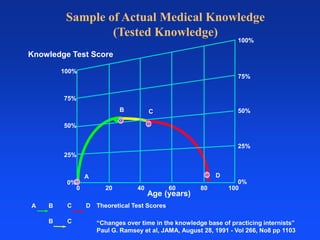
Sample of Actual Medical Knowledge(Tested Knowledge)100%Knowledge Test Score100%75%75%B50%C50%25%25%DA0%0%204060801000Age (years)Theoretical Test Scores“Changes over time in the knowledge base of practicing internists”Paul G. Ramsey et al, JAMA, August 28, 1991 - Vol 266, No8 pp 1103CDABBC
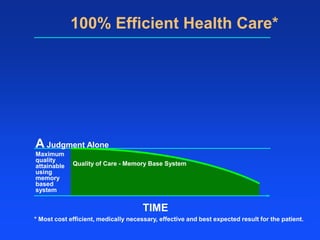
100% Efficient Health Care*A Judgment AloneMaximumqualityattainableusingmemorybasedsystemQuality of Care - Memory Base SystemTIME* Most cost efficient, medically necessary, effective and best expected result for the patient.
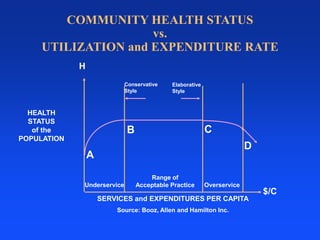
COMMUNITY HEALTH STATUSvs.UTILIZATION and EXPENDITURE RATEHConservativeStyleElaborativeStyleHEALTHSTATUSof thePOPULATIONCBDARange ofAcceptable PracticeUnderserviceOverservice$/CSERVICES and EXPENDITURES PER CAPITASource: Booz, Allen and Hamilton Inc.
EPIPHANYA spiritual eventin whichthe essence of a truthappears to the subject as ina sudden flash of recognition
A New ParadigmThe Hypotheses isan IconoclasmIt is impossible for physicians to makeappropriate medical decisions using thepresent memory-based systemThe information is too great and the medicalknowledge too broad for the mind to manageAll physicians are on Mission Impossible
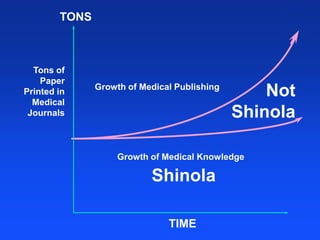
TONSTons ofPaperPrinted inMedicalJournalsNotShinolaGrowth of Medical PublishingGrowth of Medical KnowledgeShinolaTIME
Managed CareManaged care is not the cause of thephysician’s problems, it is a response to thecost and quality issues resulting from thefailure of the memory based medical decisionmaking process.  Managed care is not simplyanother iteration of insurance or administration. It is the major catalyst and driving force behindthe most significant, positive changes in theAmerican medical delivery system in thiscentury.  It is the agent of change which willfundamentally alter how medicine is delivered.
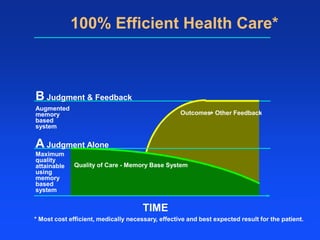
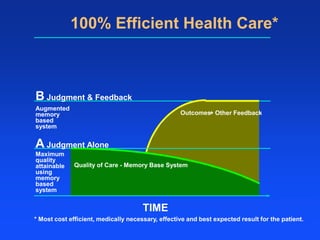
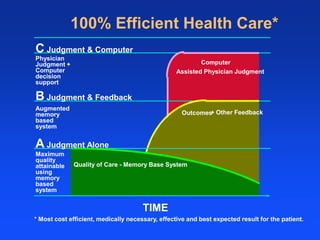
100% Efficient Health Care*B Judgment & FeedbackAugmentedmemorybasedsystemOutcomes+ Other FeedbackA Judgment AloneMaximumqualityattainableusingmemorybasedsystemQuality of Care - Memory Base SystemTIME* Most cost efficient, medically necessary, effective and best expected result for the patient.
PLATEAU OF COMPARABLE OUTCOMESOPRESSURE TO CONTROL COSTBCPRESSURE TO SATISFY PATIENTSDAQQ = QUANTITY OF MEDICAL SERVICESCONFLICTING PRESSURES ON THEHEALTH SERVICE DELIVERY SYSTEMO = CLINICAL OUTCOME
Malpractice  The “Malpractice Crisis” is not caused by the litigious society or too many lawyers.  It is the response of the patient to the errors which result from the failure of the memory based medical decision making process.  Half of the medical care delivered in America ($500 Billion Dollars) is unnecessary, inappropriate, ineffective or harmful.  “Defensive Medicine” is no defense as excessive testing and procedures do not result in better decision making and could do harm to the patient.  The solution is through electronic decision support tools applied in real time.
Continuous Quality Improvement The Application of   CQI to the Medical Care Delivery  System                                                                           Roger H. Strube, M.D.
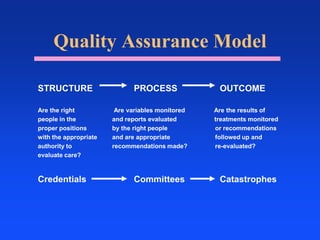
Quality Assurance ModelSTRUCTURE		PROCESS	         OUTCOMEAre the right	       Are variables monitored                 Are the results ofpeople in the	      and reports evaluated                      treatments monitoredproper positions	      by the right people	          or recommendationswith the appropriate	      and are appropriate	          followed up andauthority to	      recommendations made?	          re-evaluated?evaluate care?Credentials		Committees	         Catastrophes
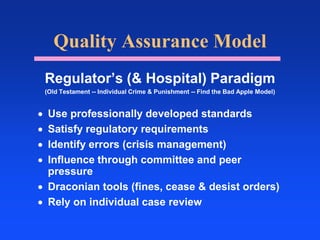
Quality Assurance ModelRegulator’s (& Hospital) Paradigm(Old Testament -- Individual Crime & Punishment -- Find the Bad Apple Model)Use professionally developed standards
Satisfy regulatory requirements
Identify errors (crisis management)
Influence through committee and peer pressure
Draconian tools (fines, cease & desist orders)
Rely on individual case reviewBusiness Value Based Limited Resource ModelPurchaser's ParadigmEmployers demand the appropriate, effective, & efficient delivery of health care & preventive services
The management of all employee benefits (medical, workers comp, EAP, disability, etc.) will be awarded to a single full service financially sound entity
Purchasers are willing to pay for quality & value for the employee - if the health plan has the lowest price
Business awarded based on proof the MCO can deliver quality care at low cost (NCQA  certification, HEDIS data, recommendations from Consultants -RFP/RFI*)    			* RFP/RFI  =  questions consultants pirate from NCQA & HEDIS
An Introduction to Total Quality Management( TQM  )and theDeming PhilosophyRoger H. Strube, M.D.Managed Care Consultant
The Study of Quality is the First Step in the Never Ending Journey of Continuous Quality ImprovementTQM is a set of enabling components and a value systemapplied by the people in an organization which leads to acycle of continuous improvement of the quality of theprocesses and and resulting outputs (outcomes) of theentity.A tool for organizational learning - the way anorganization re-engineers their business to meetcustomer needs and expectations.
Components of theHealth Care IndustryCustomers
Suppliers
Managers
Workers
Investors
Materials
MachinesThe ultimate goal of TQM is the satisfaction of the customerInternal customers	External Customers  Other Departments           Members  Fellow  Employees           Members‘  Families  Plan Management             Physicians  Corporate                          Facilities        Management               Home Health  Other Plans                             Agencies                                             Community
CorporatePlan ManagementPlan SupervisorsWorkersCustomers
- NEXT -- TOPIC -
W. Edwards DemingContinuous Quality ImprovementManagement Theoryfor theTRANSFORMATION OF BUSINESS THROUGHAPPLICATION OF THE FOURTEEN POINTSRoger H. Strube, M.D.Managed Care Consultant
The W. Edwards Deming StoryInvited to Japan after WWII by a General McArthur staffer to advise on restoration of the phone system
invited back in 1950 by JUSE to consult on improving the quality of Japanese exports
Dr. Deming provided the quality improvement roadmap an promised, if followed, they would dominate world trade
Emperor Herohito awarded him the Second Order Medal of the Sacred Treasure for his efforts
The Japanese government created the coveted DEMING PRIZE which was awarded to Florida Power & Light several years agoPOINT ONECreate constancy of purpose toward improvement of product (medical care) and service, with the aim to become competitive and to stay in business, and to provide jobs.Reflect a total commitment to constantly improving quality in all ways
Look at the long term view for the organization
Develop a mission statement and make it a living documentPOINT  TWOAdopt a new philosophy.  We are in a new economic age (managed care).  Western management must awaken to the challenge, must learn their responsibilities, and take on leadership for changeCustomer satisfaction is the focus of corporate thinking
Your goal should be to provide your “customers” with the best possible care in the most appropriate setting
Use industry standards and guidelines (“emenarem”*) to fulfill your customers’ reasonable expectations and constantly improve the services you provide* “emenarem” derived from the Milliman & Robertson criteria sets, as in “The director of cost containment told the UR nurse to ‘emenarem’ out of the hospital.”
POINT  THREECease dependence on inspection ("Quality Assurance") to achieve quality.  Eliminate the need for inspection on a mass basis by building quality into the product(medical care) in the first place.“Inspection with the aim of finding the bad ones and throwing them out is too late, ineffective, costly.
Quality comes not from inspection but from improvement of the process.”- W. Edwards Deming
POINT FOUREnd the practice of awarding business on the basis of price tag.  Instead, minimize total medical cost (eliminate unnecessary procedures.)  Reduce the number of suppliers for any one service (limited provider network) on the basis of a long-term relationship of loyalty and trust.
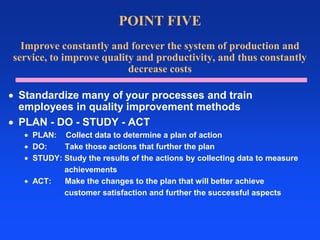
POINT FIVEImprove constantly and forever the system of production and service, to improve quality and productivity, and thus constantly decrease costsStandardize many of your processes and train employees in quality improvement methods
PLAN - DO - STUDY - ACT
PLAN:    Collect data to determine a plan of action
DO:        Take those actions that further the plan
STUDY: Study the results of the actions by collecting data to measure                  achievementsACT:      Make the changes to the plan that will better achieve                  customer satisfaction and further the successful aspects
Practice GuidelinesMeasurementandFeedbackYou cannot managewhat you don’t measureCLOSE THE LOOP
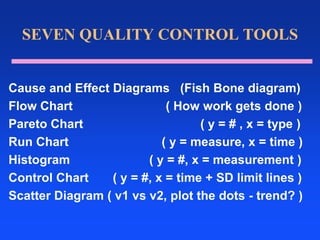
SEVEN QUALITY CONTROL TOOLSCause and Effect Diagrams   (Fish Bone diagram)Flow Chart                           ( How work gets done )Pareto Chart                                  ( y = # , x = type )Run Chart                           ( y = measure, x = time )Histogram                       ( y = #, x = measurement )Control Chart       ( y = #, x = time + SD limit lines )Scatter Diagram ( v1 vs v2, plot the dots - trend? )
POINT  SIXInstitute training on the job
POINT  SEVENInstitute leadership (see point 12).  The aim of leadership should be to help people and machinesand gadgets to do a better job.  Leadership of management (government, insurance companies, H.M.O.s) is in need of overhaul, as well as leadership of production workers (providers)An organization’s leadership should motivate employees to participate in the constancy of purpose adopted by the organization
It is the responsibility of the employees to try out and trust the new environment and polices, to learn skills, and to develop a different way of relating to their supervisorsPOINT  EIGHTDrive out fear, so that everyone may work effectively for the company.TYPES OF FEARFear of change                              1 Lack of job security
Fear of making mistakes              2 Performance appraisal
Fear of punishment                      3 Ignorance of company
Fear of being powerless                   goals    to control the aspects of             4 Poor supervision    your professional life                   5 Lack of operational    because of the following:                definitions                                                            6 Not knowing the job                                                            7 Being blamed for                                                                system problems
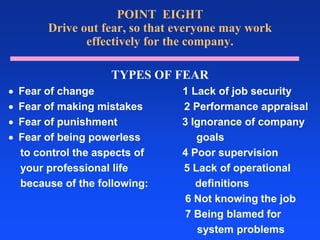
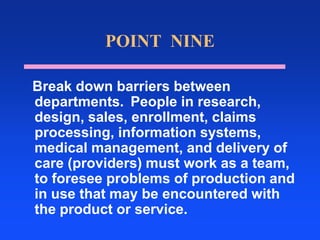
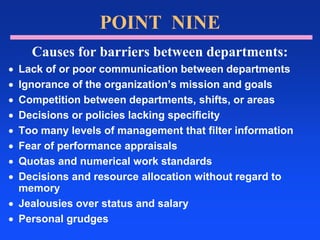
POINT  NINE  Break down barriers between departments.People in research, design, sales, enrollment, claims processing, information systems, medical management, and delivery of care (providers) must work as a team, to foresee problems of production and in use that may be encountered with the product or service.
POINT  NINECauses for barriers between departments:Lack of or poor communication between departments
Ignorance of the organization’s mission and goals
Competition between departments, shifts, or areas
Decisions or policies lacking specificity
Too many levels of management that filter information
Fear of performance appraisals
Quotas and numerical work standards
Decisions and resource allocation without regard to memory
Jealousies over status and salary
Personal grudgesPOINT  TEN   Eliminate slogans, exhortations, and targets for the work force (days/K) asking for zero defects and new levels of productivity   Such exhortations only create adversarial relationships because most causes of low quality and low productivity belong to the system and thus lie beyond the power of the work force
POINT  ELEVEN11a.	Eliminate work standards (quotas -- days/K, claims/hour, etc.) on the factory floor (insurance company or HMO production areas).  Substitute leadership.  11b. Eliminate management by objective,  Eliminate management by numbers, numerical goals.  Substitute leadership.
POINT  TWELVE12a. Remove barriers that rob managed care workers of their right to pride of workmanship.  The responsibility of managers must be changed from sheer numbers (days/K) to quality
12b. Remove barriers that rob people in management and delivery of care of their right to pride of workmanship.  This means complete abolishment of the annual or merit rating and of management by objective, management by numbers
Deming believed that performance appraisals destroy teamwork and focus on the short term
People must be viewed as the most valuable resource a company possesses
Pride in  their work is the essential, most important attribute of a highly productive worker POINT  THIRTEENInstitute a vigorous program ofeducation and self-improvementfor everyoneEducate everyone in thenew philosophy
POINT  FOURTEENPut everybody in the medical care system to work to accomplish the transformation. The transformation is everybody's jobManagement must demonstrate an unequivocal commitment to TQM, which should be driven by conviction
Management should drive out fear and eliminate other inhibitors and barriers to quality improvement
Quality improvement must be proceeded first by education of employees on what quality means and the needs of the customers
Quality is not a department function
Quality improvement is a never-ending process
Inspection by the government or any other agency does not mean quality control
Quality improvement cannot be accomplished without the total involvement of employees - NEXT -- TOPIC -
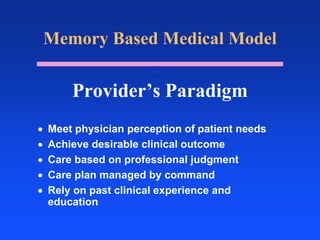
Memory Based Medical Model.Provider’s ParadigmMeet physician perception of patient needs
Achieve desirable clinical outcome
Care based on professional judgment
Care plan managed by command
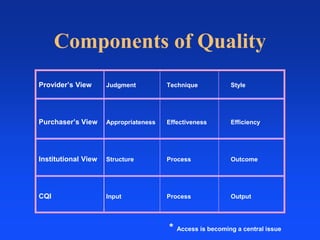
Rely on past clinical experience and educationComponents of QualityProvider’s View	  Judgment	Technique		StylePurchaser’s View	  Appropriateness	Effectiveness	EfficiencyInstitutional View	  Structure		Process		OutcomeCQI		  Input		Process		Output	*  Access is becoming a central issue
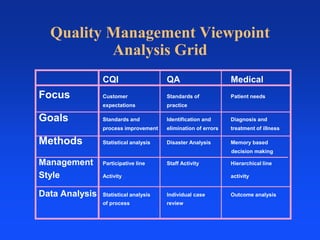
Quality Management Viewpoint Analysis GridCQI		QA		Medical Focus		Customer		Standards of	Patient needs			expectations	practice		Goals		Standards and	Identification and	Diagnosis and process improvement	elimination of errors	treatment of illnessMethodsStatistical analysis	Disaster Analysis	Memory based 					                                           decision makingManagement	Participative line	Staff Activity	Hierarchical lineStyle		Activity				activityData Analysis	Statistical analysis	Individual case	Outcome analysis 			of process		review
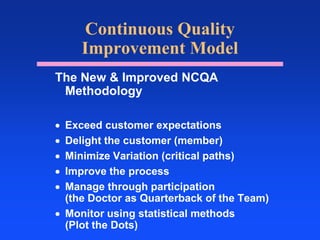
Continuous Quality Improvement ModelThe New & Improved NCQA MethodologyExceed customer expectations
Delight the customer (member)
Minimize Variation (critical paths)
Improve the process
Manage through participation(the Doctor as Quarterback of the Team)
Monitor using statistical methods(Plot the Dots)Continuous Quality Improvement ModelGeneral CQI ConceptsFocus on the customer
Analyze and fix the process, not the people
Invest in your people -- training and education
Do it right the first time
Work as a team
Use data analysis to continuously improvethe processThe Realities of Clinical Practice are ChangingThe patient must define personal values and goals
The data will define potential (acceptable) outcomes
The knowledge based computer programs will present alternatives (cook book)
The physician must negotiate the ambiguities with the patient (informed consent)
The patient and the physician will agree on the most acceptable treatment (disease state management)
The outcome of the interaction will become part of the disease state data base (determine best practices)
The decision support tools (cook book) will be updated to incorporate best practices (close the loop) Quality ImprovementRoadblocks and ChallengesThe single most important cultural change which must occur is from a QUALITY ASSURANCE, find the bad apple, mind set to the QUALITY IMPROVEMENT, improve the crop, paradigm.
The focus on the customer  & process, measurement of standard elements, empowerment of the workers,  and constant environmental change is resisted by many middle managers in business and most medical professionals. The Realities of Clinical Practice are ChangingThe physician must transitionfromCaptain of the Ship 				       to Quarterback of the Team
Why Invest inContinuous Quality Improvement?“Inspection with the aim of finding the bad ones and throwing them out is too late, ineffective, costly.
Quality comes not from inspection but from improvement of the process.”
- W. Edwards Deming- NEXT -- TOPIC -
NCQA   AccreditationThe Plan’s PerspectiveA Walter Mitty* StoryFantasy vs RealityRoger H. Strube, M.D.                * “The Secret Life of Walter Mitty” -- James Thurber
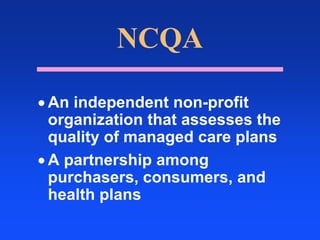
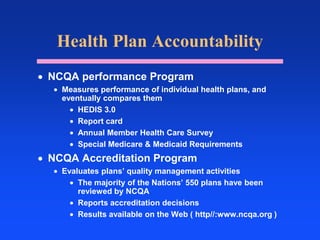
NCQAAn independent non-profit organization that assesses the quality of managed care plans
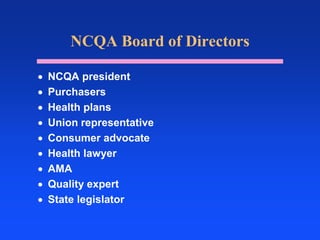
A partnership among purchasers, consumers, and health plans NCQA Board of DirectorsNCQA president
Purchasers
Health plans
Union representative
Consumer advocate
Health lawyer
AMA
Quality expert
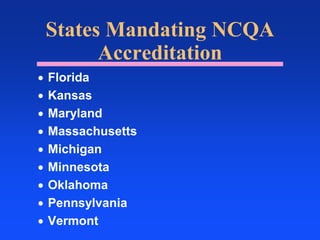
State legislatorStates Mandating NCQA AccreditationFlorida
Kansas
Maryland
Massachusetts
Michigan
Minnesota
Oklahoma
Pennsylvania
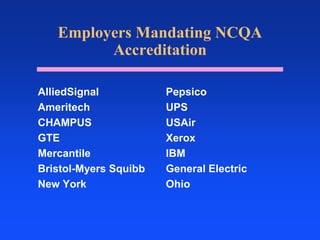
VermontEmployers Mandating NCQA AccreditationAlliedSignal			PepsicoAmeritech			UPSCHAMPUS			USAirGTE				XeroxMercantile			IBMBristol-Myers Squibb	General ElectricNew York			Ohio
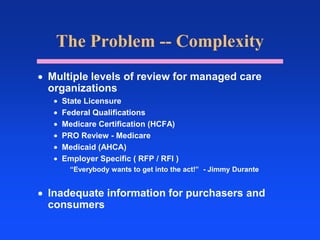
The Problem -- ComplexityMultiple levels of review for managed care organizations
State Licensure
Federal Qualifications
Medicare Certification (HCFA)
PRO Review - Medicare
Medicaid (AHCA)

Pharm Mfgr Advise1998

  • 1.
    ENTERING INTO VALUE-ADDEDPARTNERSHIPS WITH YOUR HMOsRoger H. Strube, M.D.Managed Care Consultant
  • 2.
    The Cost andCost Containment of Medical CareRoger H. Strube, M.D.Managed Care Consultant
  • 3.
    The Cost =18% of GNP$2.3 Trillion
  • 4.
    NATIONAL HEALTH EXPENDITURESAS APERCENT OF GROSS NATIONALPRODUCT BY YEAR16151413Percent12111098National Health expenditures as apercent of gross national product.761970197519801985199019952000Calendar YearSource: Health Care Financing Administration, Office of the Actuary. Data from the Division of National Cost Estimates.
  • 5.
    Cost of MedicalCareThe issue is not the cost ofCoronary SurgeryThe issue is the cost ofdiagnosing and treatingChest Pain
  • 6.
    Sample of ActualMedical Knowledge(Tested Knowledge)100%Knowledge Test Score100%75%75%B50%C50%25%25%DA0%0%204060801000Age (years)Theoretical Test Scores“Changes over time in the knowledge base of practicing internists”Paul G. Ramsey et al, JAMA, August 28, 1991 - Vol 266, No8 pp 1103CDABBC
  • 7.
    100% Efficient HealthCare*A Judgment AloneMaximumqualityattainableusingmemorybasedsystemQuality of Care - Memory Base SystemTIME* Most cost efficient, medically necessary, effective and best expected result for the patient.
  • 8.
    COMMUNITY HEALTH STATUSvs.UTILIZATIONand EXPENDITURE RATEHConservativeStyleElaborativeStyleHEALTHSTATUSof thePOPULATIONCBDARange ofAcceptable PracticeUnderserviceOverservice$/CSERVICES and EXPENDITURES PER CAPITASource: Booz, Allen and Hamilton Inc.
  • 9.
    EPIPHANYA spiritual eventinwhichthe essence of a truthappears to the subject as ina sudden flash of recognition
  • 10.
    A New ParadigmTheHypotheses isan IconoclasmIt is impossible for physicians to makeappropriate medical decisions using thepresent memory-based systemThe information is too great and the medicalknowledge too broad for the mind to manageAll physicians are on Mission Impossible
  • 11.
    TONSTons ofPaperPrinted inMedicalJournalsNotShinolaGrowthof Medical PublishingGrowth of Medical KnowledgeShinolaTIME
  • 12.
    Managed CareManaged careis not the cause of thephysician’s problems, it is a response to thecost and quality issues resulting from thefailure of the memory based medical decisionmaking process. Managed care is not simplyanother iteration of insurance or administration. It is the major catalyst and driving force behindthe most significant, positive changes in theAmerican medical delivery system in thiscentury. It is the agent of change which willfundamentally alter how medicine is delivered.
  • 13.
    100% Efficient HealthCare*B Judgment & FeedbackAugmentedmemorybasedsystemOutcomes+ Other FeedbackA Judgment AloneMaximumqualityattainableusingmemorybasedsystemQuality of Care - Memory Base SystemTIME* Most cost efficient, medically necessary, effective and best expected result for the patient.
  • 14.
    PLATEAU OF COMPARABLEOUTCOMESOPRESSURE TO CONTROL COSTBCPRESSURE TO SATISFY PATIENTSDAQQ = QUANTITY OF MEDICAL SERVICESCONFLICTING PRESSURES ON THEHEALTH SERVICE DELIVERY SYSTEMO = CLINICAL OUTCOME
  • 15.
    Malpractice The“Malpractice Crisis” is not caused by the litigious society or too many lawyers. It is the response of the patient to the errors which result from the failure of the memory based medical decision making process. Half of the medical care delivered in America ($500 Billion Dollars) is unnecessary, inappropriate, ineffective or harmful. “Defensive Medicine” is no defense as excessive testing and procedures do not result in better decision making and could do harm to the patient. The solution is through electronic decision support tools applied in real time.
  • 16.
    Continuous Quality ImprovementThe Application of CQI to the Medical Care Delivery System Roger H. Strube, M.D.
  • 17.
    Quality Assurance ModelSTRUCTURE PROCESS OUTCOMEAre the right Are variables monitored Are the results ofpeople in the and reports evaluated treatments monitoredproper positions by the right people or recommendationswith the appropriate and are appropriate followed up andauthority to recommendations made? re-evaluated?evaluate care?Credentials Committees Catastrophes
  • 18.
    Quality Assurance ModelRegulator’s(& Hospital) Paradigm(Old Testament -- Individual Crime & Punishment -- Find the Bad Apple Model)Use professionally developed standards
  • 19.
  • 20.
  • 21.
  • 22.
    Draconian tools (fines,cease & desist orders)
  • 23.
    Rely on individualcase reviewBusiness Value Based Limited Resource ModelPurchaser's ParadigmEmployers demand the appropriate, effective, & efficient delivery of health care & preventive services
  • 24.
    The management ofall employee benefits (medical, workers comp, EAP, disability, etc.) will be awarded to a single full service financially sound entity
  • 25.
    Purchasers are willingto pay for quality & value for the employee - if the health plan has the lowest price
  • 26.
    Business awarded basedon proof the MCO can deliver quality care at low cost (NCQA certification, HEDIS data, recommendations from Consultants -RFP/RFI*) * RFP/RFI = questions consultants pirate from NCQA & HEDIS
  • 27.
    An Introduction toTotal Quality Management( TQM )and theDeming PhilosophyRoger H. Strube, M.D.Managed Care Consultant
  • 28.
    The Study ofQuality is the First Step in the Never Ending Journey of Continuous Quality ImprovementTQM is a set of enabling components and a value systemapplied by the people in an organization which leads to acycle of continuous improvement of the quality of theprocesses and and resulting outputs (outcomes) of theentity.A tool for organizational learning - the way anorganization re-engineers their business to meetcustomer needs and expectations.
  • 29.
    Components of theHealthCare IndustryCustomers
  • 30.
  • 31.
  • 32.
  • 33.
  • 34.
  • 35.
    MachinesThe ultimate goalof TQM is the satisfaction of the customerInternal customers External Customers Other Departments Members Fellow Employees Members‘ Families Plan Management Physicians Corporate Facilities Management Home Health Other Plans Agencies Community
  • 36.
  • 37.
    - NEXT --TOPIC -
  • 38.
    W. Edwards DemingContinuousQuality ImprovementManagement Theoryfor theTRANSFORMATION OF BUSINESS THROUGHAPPLICATION OF THE FOURTEEN POINTSRoger H. Strube, M.D.Managed Care Consultant
  • 39.
    The W. EdwardsDeming StoryInvited to Japan after WWII by a General McArthur staffer to advise on restoration of the phone system
  • 40.
    invited back in1950 by JUSE to consult on improving the quality of Japanese exports
  • 41.
    Dr. Deming providedthe quality improvement roadmap an promised, if followed, they would dominate world trade
  • 42.
    Emperor Herohito awardedhim the Second Order Medal of the Sacred Treasure for his efforts
  • 43.
    The Japanese governmentcreated the coveted DEMING PRIZE which was awarded to Florida Power & Light several years agoPOINT ONECreate constancy of purpose toward improvement of product (medical care) and service, with the aim to become competitive and to stay in business, and to provide jobs.Reflect a total commitment to constantly improving quality in all ways
  • 44.
    Look at thelong term view for the organization
  • 45.
    Develop a missionstatement and make it a living documentPOINT TWOAdopt a new philosophy. We are in a new economic age (managed care). Western management must awaken to the challenge, must learn their responsibilities, and take on leadership for changeCustomer satisfaction is the focus of corporate thinking
  • 46.
    Your goal shouldbe to provide your “customers” with the best possible care in the most appropriate setting
  • 47.
    Use industry standardsand guidelines (“emenarem”*) to fulfill your customers’ reasonable expectations and constantly improve the services you provide* “emenarem” derived from the Milliman & Robertson criteria sets, as in “The director of cost containment told the UR nurse to ‘emenarem’ out of the hospital.”
  • 48.
    POINT THREECeasedependence on inspection ("Quality Assurance") to achieve quality. Eliminate the need for inspection on a mass basis by building quality into the product(medical care) in the first place.“Inspection with the aim of finding the bad ones and throwing them out is too late, ineffective, costly.
  • 49.
    Quality comes notfrom inspection but from improvement of the process.”- W. Edwards Deming
  • 50.
    POINT FOUREnd thepractice of awarding business on the basis of price tag. Instead, minimize total medical cost (eliminate unnecessary procedures.) Reduce the number of suppliers for any one service (limited provider network) on the basis of a long-term relationship of loyalty and trust.
  • 51.
    POINT FIVEImprove constantlyand forever the system of production and service, to improve quality and productivity, and thus constantly decrease costsStandardize many of your processes and train employees in quality improvement methods
  • 52.
    PLAN - DO- STUDY - ACT
  • 53.
    PLAN: Collect data to determine a plan of action
  • 54.
    DO: Take those actions that further the plan
  • 55.
    STUDY: Study theresults of the actions by collecting data to measure achievementsACT: Make the changes to the plan that will better achieve customer satisfaction and further the successful aspects
  • 56.
    Practice GuidelinesMeasurementandFeedbackYou cannotmanagewhat you don’t measureCLOSE THE LOOP
  • 57.
    SEVEN QUALITY CONTROLTOOLSCause and Effect Diagrams (Fish Bone diagram)Flow Chart ( How work gets done )Pareto Chart ( y = # , x = type )Run Chart ( y = measure, x = time )Histogram ( y = #, x = measurement )Control Chart ( y = #, x = time + SD limit lines )Scatter Diagram ( v1 vs v2, plot the dots - trend? )
  • 58.
    POINT SIXInstitutetraining on the job
  • 59.
    POINT SEVENInstituteleadership (see point 12). The aim of leadership should be to help people and machinesand gadgets to do a better job. Leadership of management (government, insurance companies, H.M.O.s) is in need of overhaul, as well as leadership of production workers (providers)An organization’s leadership should motivate employees to participate in the constancy of purpose adopted by the organization
  • 60.
    It is theresponsibility of the employees to try out and trust the new environment and polices, to learn skills, and to develop a different way of relating to their supervisorsPOINT EIGHTDrive out fear, so that everyone may work effectively for the company.TYPES OF FEARFear of change 1 Lack of job security
  • 61.
    Fear of makingmistakes 2 Performance appraisal
  • 62.
    Fear of punishment 3 Ignorance of company
  • 63.
    Fear of beingpowerless goals to control the aspects of 4 Poor supervision your professional life 5 Lack of operational because of the following: definitions 6 Not knowing the job 7 Being blamed for system problems
  • 64.
    POINT NINE Break down barriers between departments.People in research, design, sales, enrollment, claims processing, information systems, medical management, and delivery of care (providers) must work as a team, to foresee problems of production and in use that may be encountered with the product or service.
  • 65.
    POINT NINECausesfor barriers between departments:Lack of or poor communication between departments
  • 66.
    Ignorance of theorganization’s mission and goals
  • 67.
  • 68.
    Decisions or policieslacking specificity
  • 69.
    Too many levelsof management that filter information
  • 70.
  • 71.
    Quotas and numericalwork standards
  • 72.
    Decisions and resourceallocation without regard to memory
  • 73.
  • 74.
    Personal grudgesPOINT TEN Eliminate slogans, exhortations, and targets for the work force (days/K) asking for zero defects and new levels of productivity Such exhortations only create adversarial relationships because most causes of low quality and low productivity belong to the system and thus lie beyond the power of the work force
  • 75.
    POINT ELEVEN11a. Eliminatework standards (quotas -- days/K, claims/hour, etc.) on the factory floor (insurance company or HMO production areas). Substitute leadership. 11b. Eliminate management by objective, Eliminate management by numbers, numerical goals. Substitute leadership.
  • 76.
    POINT TWELVE12a.Remove barriers that rob managed care workers of their right to pride of workmanship. The responsibility of managers must be changed from sheer numbers (days/K) to quality
  • 77.
    12b. Remove barriersthat rob people in management and delivery of care of their right to pride of workmanship. This means complete abolishment of the annual or merit rating and of management by objective, management by numbers
  • 78.
    Deming believed thatperformance appraisals destroy teamwork and focus on the short term
  • 79.
    People must beviewed as the most valuable resource a company possesses
  • 80.
    Pride in their work is the essential, most important attribute of a highly productive worker POINT THIRTEENInstitute a vigorous program ofeducation and self-improvementfor everyoneEducate everyone in thenew philosophy
  • 81.
    POINT FOURTEENPuteverybody in the medical care system to work to accomplish the transformation. The transformation is everybody's jobManagement must demonstrate an unequivocal commitment to TQM, which should be driven by conviction
  • 82.
    Management should driveout fear and eliminate other inhibitors and barriers to quality improvement
  • 83.
    Quality improvement mustbe proceeded first by education of employees on what quality means and the needs of the customers
  • 84.
    Quality is nota department function
  • 85.
    Quality improvement isa never-ending process
  • 86.
    Inspection by thegovernment or any other agency does not mean quality control
  • 87.
    Quality improvement cannotbe accomplished without the total involvement of employees - NEXT -- TOPIC -
  • 88.
    Memory Based MedicalModel.Provider’s ParadigmMeet physician perception of patient needs
  • 89.
  • 90.
    Care based onprofessional judgment
  • 91.
  • 92.
    Rely on pastclinical experience and educationComponents of QualityProvider’s View Judgment Technique StylePurchaser’s View Appropriateness Effectiveness EfficiencyInstitutional View Structure Process OutcomeCQI Input Process Output * Access is becoming a central issue
  • 93.
    Quality Management ViewpointAnalysis GridCQI QA Medical Focus Customer Standards of Patient needs expectations practice Goals Standards and Identification and Diagnosis and process improvement elimination of errors treatment of illnessMethodsStatistical analysis Disaster Analysis Memory based decision makingManagement Participative line Staff Activity Hierarchical lineStyle Activity activityData Analysis Statistical analysis Individual case Outcome analysis of process review
  • 94.
    Continuous Quality ImprovementModelThe New & Improved NCQA MethodologyExceed customer expectations
  • 95.
  • 96.
  • 97.
  • 98.
    Manage through participation(theDoctor as Quarterback of the Team)
  • 99.
    Monitor using statisticalmethods(Plot the Dots)Continuous Quality Improvement ModelGeneral CQI ConceptsFocus on the customer
  • 100.
    Analyze and fixthe process, not the people
  • 101.
    Invest in yourpeople -- training and education
  • 102.
    Do it rightthe first time
  • 103.
  • 104.
    Use data analysisto continuously improvethe processThe Realities of Clinical Practice are ChangingThe patient must define personal values and goals
  • 105.
    The data willdefine potential (acceptable) outcomes
  • 106.
    The knowledge basedcomputer programs will present alternatives (cook book)
  • 107.
    The physician mustnegotiate the ambiguities with the patient (informed consent)
  • 108.
    The patient andthe physician will agree on the most acceptable treatment (disease state management)
  • 109.
    The outcome ofthe interaction will become part of the disease state data base (determine best practices)
  • 110.
    The decision supporttools (cook book) will be updated to incorporate best practices (close the loop) Quality ImprovementRoadblocks and ChallengesThe single most important cultural change which must occur is from a QUALITY ASSURANCE, find the bad apple, mind set to the QUALITY IMPROVEMENT, improve the crop, paradigm.
  • 111.
    The focus onthe customer & process, measurement of standard elements, empowerment of the workers, and constant environmental change is resisted by many middle managers in business and most medical professionals. The Realities of Clinical Practice are ChangingThe physician must transitionfromCaptain of the Ship to Quarterback of the Team
  • 112.
    Why Invest inContinuousQuality Improvement?“Inspection with the aim of finding the bad ones and throwing them out is too late, ineffective, costly.
  • 113.
    Quality comes notfrom inspection but from improvement of the process.”
  • 114.
    - W. EdwardsDeming- NEXT -- TOPIC -
  • 115.
    NCQA AccreditationThe Plan’s PerspectiveA Walter Mitty* StoryFantasy vs RealityRoger H. Strube, M.D. * “The Secret Life of Walter Mitty” -- James Thurber
  • 116.
    NCQAAn independent non-profitorganization that assesses the quality of managed care plans
  • 117.
    A partnership amongpurchasers, consumers, and health plans NCQA Board of DirectorsNCQA president
  • 118.
  • 119.
  • 120.
  • 121.
  • 122.
  • 123.
  • 124.
  • 125.
    State legislatorStates MandatingNCQA AccreditationFlorida
  • 126.
  • 127.
  • 128.
  • 129.
  • 130.
  • 131.
  • 132.
  • 133.
    VermontEmployers Mandating NCQAAccreditationAlliedSignal PepsicoAmeritech UPSCHAMPUS USAirGTE XeroxMercantile IBMBristol-Myers Squibb General ElectricNew York Ohio
  • 134.
    The Problem --ComplexityMultiple levels of review for managed care organizations
  • 135.
  • 136.
  • 137.
  • 138.
    PRO Review -Medicare
  • 139.