Good Clinical Practice 101:
1
An Introduction
Presented by: Lester “Jao” Lacorte, MD
Medical Officer – Commissioner’s Fellow
Division of Bioresearch Monitoring
Office of Compliance
Center for Devices and Radiological Health
Objectives:
2
 Define Good Clinical Practice (GCP)
 Outline the goals of GCP
 Provide a historical perspective on GCP
 Outline FDA regulations relating to GCP
in medical device research
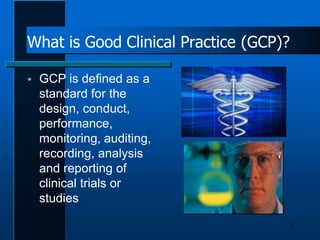
What is Good Clinical Practice (GCP)?
 GCP is defined as a
standard for the
design, conduct,
performance,
monitoring, auditing,
recording, analysis
and reporting of
clinical trials or
studies
3
Additional terms defined:
 Clinical Investigation
 Clinical Investigator
 Human Subject
 Institutional Review Board
4
Why is GCP important?
 GCP compliance
provides public
assurance that the
rights, safety and
well-being of human
subjects involved in
research are
protected
5
What are the goals of GCP?
6
 To protect the rights, safety and welfare of
humans participating in research
 To assure the quality, reliability and integrity
of data collected
 To provide standards and guidelines for the
conduct of clinical research
 Good Clinical Practice = Ethics + Quality Data
What are the foundations for the
ethical conduct of clinical research?
7
 The Nuremberg Code (1947)
 The Declaration of Helsinki (1964)
 The Belmont Report (1979)
 International Conference on Harmonisation
(ICH-GCP)
 International Standards Organization 14155
 Code of Federal Regulations
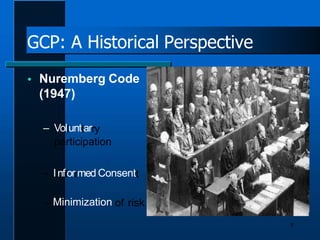
GCP: A Historical Perspective
 Nuremberg Code
(1947)
– Vollunttarry
participation
– IInfforrmed Consentt
– Minimization of risk
8
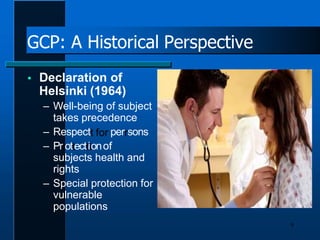
GCP: A Historical Perspective
 Declaration of
Helsinki (1964)
– Well-being of subject
takes precedence
– Respectt for perrsons
– Prrottecttiionof
subjects health and
rights
– Special protection for
vulnerable
populations
9
GCP: A Historical Perspective
 Belmont Report
Ethical Principles
(1979)
– Respectt fforrPerrsons
• IInfforrmedconsentt
• Prrottecttiionof
vulnerable
populations
– Beneffiicence
• Non--mallffeasance
– Justtiice
• Faiirrness
10
The International Conference on
Harmonisation (ICH-GCP)
11
 GCP is an international quality standard that is
provided by the International Conference on
Harmonisation (ICH)
 Goals: Harmonize technical procedures and
standards; improve quality; speed time to market
 In 1997, the FDA endorsed the GCP Guidelines
developed by ICH
 ICH guidelines have been adopted into law in several
countries, but used as guidance for the FDA in the
form of GCP
What are the 13 principles of ICH-GCP?
12
 Ethics:
1..Etthiicall conductt of clliiniicall ttrriialls
2. Benefits justify risks
3. Rights, safety, and well-being of subjects prevail
 Protocol and science:
4. Nonclinical and clinical information supports the trial
5. Compliance with a scientifically sound,
detailed protocol
What are the 13 principles of ICH-GCP? (cont.)
13
 Responsibilities:
6. IRB/IEC approval prior to initiation
7. Medical care/decisions by qualified physician
8. Each individual is qualified (education,
training, experience) to perform his/her tasks
 Informed Consent:
9. Freely given from every subject prior to
participation
 Data quality and integrity:
10. Accurate reporting, interpretation, and
verification
11. Protects confidentiality of records
 Investigational Products
12. Conform to GMP’s and used per protocol
 Quality Control/Quality Assurance
13. Systtems with prrocedurres to ensurre qualliittyof
every aspect of the trial
14
What are the 13 principles of ICH-GCP? (cont.)
A Comparison
DECLARATION OF HELSINKI:
e.g. ethical and scientific
• Etthiicallprriinciiplles
• Focus:: Physiiciians in
rresearrch
• World MediicallAssemblly--
International medical
societies
• Guiidance with brroad
recommendations
ICH-GCP:
• Broader principles e.g.
ethical, scientific &
operational for
designing, conducting,
reporting & recording
trials
• Focus:: Drug sponsorrs,,
investigators & IRB
• Reprresenttattiives from
industry and public
health
• Guidance document but
has the effect of law
when put into Regulatio115n5
International Standards Organization
16
 ISO 14155: Clinical Investigation of
Medical Devices for Human Subjects
– Assiisttssponsorrs,, moniittorrs,,and clliiniicall
iinvesttiigattorrsin the desiign and conductt of
device clinical investigations
– Assists regulatory bodies and ethics
committees in their roles of reviewing
clinical investigational plans
What constitutes Good Clinical
Practice in device research?
17
 IRB-approved protocol
 Valid Informed Consent
 Monitoring Plan
 Adverse Device Effect Reporting [Adverse
Event (AE) or Serious Adverse Event (SAE)]
 Proper documentation
 Valid data collection/reporting procedures
Who is responsible for GCP
compliance?
18
 Sponsors
 Clinical Investigators (CIs)
 Independent Ethics Committees (IECs)
– IInssttiittuttiionallReviiew Boarrdss((IIRBs))
 Contract Research Organizations (CROs)
 Research nurses
 Clinical Research Coordinators (CRCs)
 Clinical Research Associates (CRAs)
 Medical monitors
 Data entry personnel
 Others
How does FDA implement GCP?
19
 21 CFR 11 – Electronic Records & Signatures
 21 CFR 50 – Protection of Human Subjects
 21 CFR 54 – Financial Disclosure
 21 CFR 56 – Institutional Review Boards
 21 CFR 812 – Investtiigattiionall Deviice Exempttiions
 21 CFR 814 – Premarket Approval of Medical
Devices
Summary:
20
 Defined Good Clinical Practice (GCP)
 Outlined the goals of GCP
 Presented a historical perspective on
GCP
 Outlined FDA regulations relating to
GCP in medical device research
For further information:
21
 FDA Good Clinical Practice Regulations
& ICH Guidance
http://www.fda.gov

Presentation -good-clinical-practice-101--an-introduction-(pdf-version)

  • 1.
    Good Clinical Practice101: 1 An Introduction Presented by: Lester “Jao” Lacorte, MD Medical Officer – Commissioner’s Fellow Division of Bioresearch Monitoring Office of Compliance Center for Devices and Radiological Health
  • 2.
    Objectives: 2  Define GoodClinical Practice (GCP)  Outline the goals of GCP  Provide a historical perspective on GCP  Outline FDA regulations relating to GCP in medical device research
  • 3.
    What is GoodClinical Practice (GCP)?  GCP is defined as a standard for the design, conduct, performance, monitoring, auditing, recording, analysis and reporting of clinical trials or studies 3
  • 4.
    Additional terms defined: Clinical Investigation  Clinical Investigator  Human Subject  Institutional Review Board 4
  • 5.
    Why is GCPimportant?  GCP compliance provides public assurance that the rights, safety and well-being of human subjects involved in research are protected 5
  • 6.
    What are thegoals of GCP? 6  To protect the rights, safety and welfare of humans participating in research  To assure the quality, reliability and integrity of data collected  To provide standards and guidelines for the conduct of clinical research  Good Clinical Practice = Ethics + Quality Data
  • 7.
    What are thefoundations for the ethical conduct of clinical research? 7  The Nuremberg Code (1947)  The Declaration of Helsinki (1964)  The Belmont Report (1979)  International Conference on Harmonisation (ICH-GCP)  International Standards Organization 14155  Code of Federal Regulations
  • 8.
    GCP: A HistoricalPerspective  Nuremberg Code (1947) – Vollunttarry participation – IInfforrmed Consentt – Minimization of risk 8
  • 9.
    GCP: A HistoricalPerspective  Declaration of Helsinki (1964) – Well-being of subject takes precedence – Respectt for perrsons – Prrottecttiionof subjects health and rights – Special protection for vulnerable populations 9
  • 10.
    GCP: A HistoricalPerspective  Belmont Report Ethical Principles (1979) – Respectt fforrPerrsons • IInfforrmedconsentt • Prrottecttiionof vulnerable populations – Beneffiicence • Non--mallffeasance – Justtiice • Faiirrness 10
  • 11.
    The International Conferenceon Harmonisation (ICH-GCP) 11  GCP is an international quality standard that is provided by the International Conference on Harmonisation (ICH)  Goals: Harmonize technical procedures and standards; improve quality; speed time to market  In 1997, the FDA endorsed the GCP Guidelines developed by ICH  ICH guidelines have been adopted into law in several countries, but used as guidance for the FDA in the form of GCP
  • 12.
    What are the13 principles of ICH-GCP? 12  Ethics: 1..Etthiicall conductt of clliiniicall ttrriialls 2. Benefits justify risks 3. Rights, safety, and well-being of subjects prevail  Protocol and science: 4. Nonclinical and clinical information supports the trial 5. Compliance with a scientifically sound, detailed protocol
  • 13.
    What are the13 principles of ICH-GCP? (cont.) 13  Responsibilities: 6. IRB/IEC approval prior to initiation 7. Medical care/decisions by qualified physician 8. Each individual is qualified (education, training, experience) to perform his/her tasks  Informed Consent: 9. Freely given from every subject prior to participation
  • 14.
     Data qualityand integrity: 10. Accurate reporting, interpretation, and verification 11. Protects confidentiality of records  Investigational Products 12. Conform to GMP’s and used per protocol  Quality Control/Quality Assurance 13. Systtems with prrocedurres to ensurre qualliittyof every aspect of the trial 14 What are the 13 principles of ICH-GCP? (cont.)
  • 15.
    A Comparison DECLARATION OFHELSINKI: e.g. ethical and scientific • Etthiicallprriinciiplles • Focus:: Physiiciians in rresearrch • World MediicallAssemblly-- International medical societies • Guiidance with brroad recommendations ICH-GCP: • Broader principles e.g. ethical, scientific & operational for designing, conducting, reporting & recording trials • Focus:: Drug sponsorrs,, investigators & IRB • Reprresenttattiives from industry and public health • Guidance document but has the effect of law when put into Regulatio115n5
  • 16.
    International Standards Organization 16 ISO 14155: Clinical Investigation of Medical Devices for Human Subjects – Assiisttssponsorrs,, moniittorrs,,and clliiniicall iinvesttiigattorrsin the desiign and conductt of device clinical investigations – Assists regulatory bodies and ethics committees in their roles of reviewing clinical investigational plans
  • 17.
    What constitutes GoodClinical Practice in device research? 17  IRB-approved protocol  Valid Informed Consent  Monitoring Plan  Adverse Device Effect Reporting [Adverse Event (AE) or Serious Adverse Event (SAE)]  Proper documentation  Valid data collection/reporting procedures
  • 18.
    Who is responsiblefor GCP compliance? 18  Sponsors  Clinical Investigators (CIs)  Independent Ethics Committees (IECs) – IInssttiittuttiionallReviiew Boarrdss((IIRBs))  Contract Research Organizations (CROs)  Research nurses  Clinical Research Coordinators (CRCs)  Clinical Research Associates (CRAs)  Medical monitors  Data entry personnel  Others
  • 19.
    How does FDAimplement GCP? 19  21 CFR 11 – Electronic Records & Signatures  21 CFR 50 – Protection of Human Subjects  21 CFR 54 – Financial Disclosure  21 CFR 56 – Institutional Review Boards  21 CFR 812 – Investtiigattiionall Deviice Exempttiions  21 CFR 814 – Premarket Approval of Medical Devices
  • 20.
    Summary: 20  Defined GoodClinical Practice (GCP)  Outlined the goals of GCP  Presented a historical perspective on GCP  Outlined FDA regulations relating to GCP in medical device research
  • 21.
    For further information: 21 FDA Good Clinical Practice Regulations & ICH Guidance http://www.fda.gov