







AIDS TO CLINICAL IMPROVEMENT By: Dr. Gamal Abdulrahman P.I. Physician On 31 May, 2007 @ 11:45 hrs
INTRODUCTION WHO BELIEVES IMPROVING QUALITY REDUCES COST?
 
Overuse   (inappropriate procedures & medical treatments, where the risk to the patient outweighs any potential benefit.) Under use   (Failure to deliver care that would benefit the patient.  Misuse
GOAL The goal is the best possible medical outcomes at the lowest necessary cost
INTRODUCTION QUALITY IMPROVEMENT IS THE SCIENCE OF PROCESS MANAGEMENT Start With knowledge of: Processes Systems Human Psychology Variation A system for ongoing learning
INTRODUCTION HOW DO CLINICIANS REDUCE COSTS? Improving the Quality of Care by managing processes of care.
MANAGING A PROCESS MEANS: The right data In the right format At the right time & place In the right hands (the clinicians who operate the process)
PATIENTS’ QUALITY FACTORS   Hospital cleanliness Smoothness of admission & discharge Accuracy & clarity of billing statements Courtesy of Hospital employees Response times for calls & requests Level of technology available  Nurse Competency Availability of physician specialists in the field
PATIENTS’ QUALITY FACTORS   “ track record” for medical complications Availability of good emergency care Price –reasonable Respect patient’s rights for decision
DEFINITION A CUSTOMER (Patient)   is anyone who has expectations regarding a process’s operation or outputs. Expectations   arises from past experiences, current needs, unique internal preferences.
QUALITY HEALTH CARE SHOULD BE:   Safe  -  avoiding injuries to patients    from the care that is    intended to help them. • Effective  -  providing services based    on scientific knowledge    to all who could benefit    and refraining from    providing services to those    not likely to benefit   (avoiding  under use  and  overuse , respectively).
QUALITY HEALTH CARE SHOULD BE: Patient centered  -  providing care that  is respectful of and responsive  individual patient preferences,  needs, and values and ensuring  that patient values guide all  clinical decisions. Timely  -  reducing waits and  sometimes harmful delays for  both those who receive and  those who give care.
  QUALITY HEALTH CARE SHOULD BE: Efficient  -  avoiding waste, including  waste of equipment, supplies,  ideas, and energy.  Equitable  -  providing care that does not  vary in quality because of  personal characteristics  such as gender, ethnicity,  geographic location, and  socioeconomic status.
CLASSES OF OUTCOMES Physical Outcomes Medical outcomes: complications & therapeutic goals Includes functional status measures (patient perceptions of medical  outcomes) Service Outcomes Satisfaction : patient & families, communities, professionals, purchasers, & employees Includes access issues (eg. waiting times) Cost Outcomes Another outcome of a clinical process Includes the cost of the burden of disease.
MEDICAL OUTCOMES Medical outcomes relate directly to health care costs. Are of 3 types: Therapeutic goals/biologic function The patient’s ability to function (functional status, as reported by the patient) Complications (process failures/defects)
SERVICE OUTCOMES Are of 2 types: The physician-patient relationship. Access issues : convenience Vs hassle (scheduling, travel times, registration, physical comfort, waiting times etc)
COST OUTCOMES Quality & cost are two sides of a coin, anything you do to one,  affects the other.
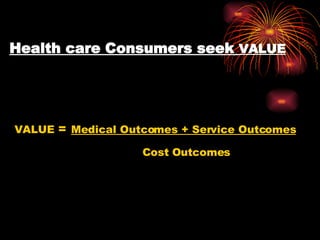
Health care Consumers seek  VALUE VALUE  =   Medical Outcomes + Service Outcomes Cost Outcomes
VARIATION IN CLINICAL PRACTICE Variation in hospitalization rates – the “decision to treat”. High rates of care judged inappropriate or equivocal. Variation in the process of care – the “manner of treatment” Variation in “expert” opinion – perceived treatment outcomes.
REASONS FOR PRACTICE VARIATION Complexity (how many factors can the human mind simultaneously balance to optimize an outcome). Lack of valid clinical knowledge.  Subjective judgment/uncertainty  (subjective evaluation is notoriously poor across groups or overtime). Human error (humans are inherently fallible information processors).
 
CLINICAL STANDARDS CLINICAL PRACTICE : Peer review, clinical audit & confidential enquiries are examples of this approach which may involve single or multiple professional groups & their interface with management. CLINICAL COMPETENCE : system to assess individual practitioners against clear criteria in order to recognize achievement & to promote continuing development.


Thank You

Breast masses

  • 1.
  • 2.
    AIDS TO CLINICALIMPROVEMENT By: Dr. Gamal Abdulrahman P.I. Physician On 31 May, 2007 @ 11:45 hrs
  • 3.
    INTRODUCTION WHO BELIEVESIMPROVING QUALITY REDUCES COST?
  • 4.
  • 5.
    Overuse (inappropriate procedures & medical treatments, where the risk to the patient outweighs any potential benefit.) Under use (Failure to deliver care that would benefit the patient. Misuse
  • 6.
    GOAL The goalis the best possible medical outcomes at the lowest necessary cost
  • 7.
    INTRODUCTION QUALITY IMPROVEMENTIS THE SCIENCE OF PROCESS MANAGEMENT Start With knowledge of: Processes Systems Human Psychology Variation A system for ongoing learning
  • 8.
    INTRODUCTION HOW DOCLINICIANS REDUCE COSTS? Improving the Quality of Care by managing processes of care.
  • 9.
    MANAGING A PROCESSMEANS: The right data In the right format At the right time & place In the right hands (the clinicians who operate the process)
  • 10.
    PATIENTS’ QUALITY FACTORS Hospital cleanliness Smoothness of admission & discharge Accuracy & clarity of billing statements Courtesy of Hospital employees Response times for calls & requests Level of technology available Nurse Competency Availability of physician specialists in the field
  • 11.
    PATIENTS’ QUALITY FACTORS “ track record” for medical complications Availability of good emergency care Price –reasonable Respect patient’s rights for decision
  • 12.
    DEFINITION A CUSTOMER(Patient) is anyone who has expectations regarding a process’s operation or outputs. Expectations arises from past experiences, current needs, unique internal preferences.
  • 13.
    QUALITY HEALTH CARESHOULD BE: Safe - avoiding injuries to patients from the care that is intended to help them. • Effective - providing services based on scientific knowledge to all who could benefit and refraining from providing services to those not likely to benefit (avoiding under use and overuse , respectively).
  • 14.
    QUALITY HEALTH CARESHOULD BE: Patient centered - providing care that is respectful of and responsive individual patient preferences, needs, and values and ensuring that patient values guide all clinical decisions. Timely - reducing waits and sometimes harmful delays for both those who receive and those who give care.
  • 15.
    QUALITYHEALTH CARE SHOULD BE: Efficient - avoiding waste, including waste of equipment, supplies, ideas, and energy. Equitable - providing care that does not vary in quality because of personal characteristics such as gender, ethnicity, geographic location, and socioeconomic status.
  • 16.
    CLASSES OF OUTCOMESPhysical Outcomes Medical outcomes: complications & therapeutic goals Includes functional status measures (patient perceptions of medical outcomes) Service Outcomes Satisfaction : patient & families, communities, professionals, purchasers, & employees Includes access issues (eg. waiting times) Cost Outcomes Another outcome of a clinical process Includes the cost of the burden of disease.
  • 17.
    MEDICAL OUTCOMES Medicaloutcomes relate directly to health care costs. Are of 3 types: Therapeutic goals/biologic function The patient’s ability to function (functional status, as reported by the patient) Complications (process failures/defects)
  • 18.
    SERVICE OUTCOMES Areof 2 types: The physician-patient relationship. Access issues : convenience Vs hassle (scheduling, travel times, registration, physical comfort, waiting times etc)
  • 19.
    COST OUTCOMES Quality& cost are two sides of a coin, anything you do to one, affects the other.
  • 20.
    Health care Consumersseek VALUE VALUE = Medical Outcomes + Service Outcomes Cost Outcomes
  • 21.
    VARIATION IN CLINICALPRACTICE Variation in hospitalization rates – the “decision to treat”. High rates of care judged inappropriate or equivocal. Variation in the process of care – the “manner of treatment” Variation in “expert” opinion – perceived treatment outcomes.
  • 22.
    REASONS FOR PRACTICEVARIATION Complexity (how many factors can the human mind simultaneously balance to optimize an outcome). Lack of valid clinical knowledge. Subjective judgment/uncertainty (subjective evaluation is notoriously poor across groups or overtime). Human error (humans are inherently fallible information processors).
  • 23.
  • 24.
    CLINICAL STANDARDS CLINICALPRACTICE : Peer review, clinical audit & confidential enquiries are examples of this approach which may involve single or multiple professional groups & their interface with management. CLINICAL COMPETENCE : system to assess individual practitioners against clear criteria in order to recognize achievement & to promote continuing development.
  • 25.
  • 26.
  • 27.
  • 28.