
Pharmacogenetics
Submitted To - Dr. Shaweta
Sharma
Submitted By – Pushpak
Singh Bhati
Overview
 Pharmacogenetics
 Historical Milestones
 Aim of pharmacogenetics
 Benefits of pharmacogenetics
 Steps in pharmacogenetics
 challenges of Pharmacogenomics
 Case Study
Pharmacogenetics
The word “Pharmacogenetics” comes
from the words :
 Pharmacology - The science of
drugs
Genetics - The study of genes and
their functions
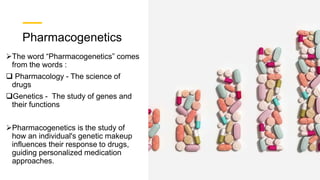
Pharmacogenetics is the study of
how an individual's genetic makeup
influences their response to drugs,
guiding personalized medication
approaches.
Pharmacogenetics Historical
Milestones
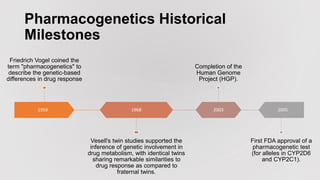
1959
Friedrich Vogel coined the
term "pharmacogenetics" to
describe the genetic-based
differences in drug response
1968
Vesell's twin studies supported the
inference of genetic involvement in
drug metabolism, with identical twins
sharing remarkable similarities to
drug response as compared to
fraternal twins.
2003
Completion of the
Human Genome
Project (HGP).
2005
First FDA approval of a
pharmacogenetic test
(for alleles in CYP2D6
and CYP2C1).
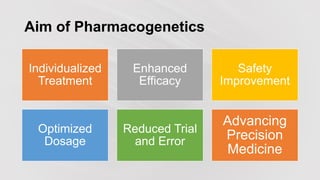
Aim of Pharmacogenetics
Individualized
Treatment
Enhanced
Efficacy
Safety
Improvement
Optimized
Dosage
Reduced Trial
and Error
Advancing
Precision
Medicine
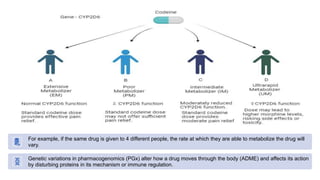
For example, if the same drug is given to 4 different people, the rate at which they are able to metabolize the drug will
vary.
Genetic variations in pharmacogenomics (PGx) alter how a drug moves through the body (ADME) and affects its action
by disturbing proteins in its mechanism or immune regulation.
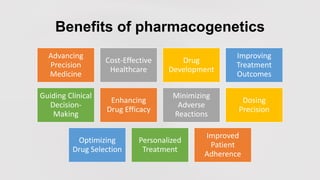
Benefits of pharmacogenetics
Advancing
Precision
Medicine
Cost-Effective
Healthcare
Drug
Development
Improving
Treatment
Outcomes
Guiding Clinical
Decision-
Making
Enhancing
Drug Efficacy
Minimizing
Adverse
Reactions
Dosing
Precision
Optimizing
Drug Selection
Personalized
Treatment
Improved
Patient
Adherence
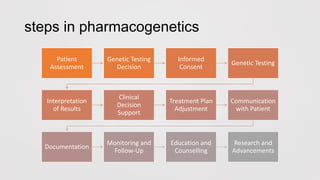
steps in pharmacogenetics
Patient
Assessment
Genetic Testing
Decision
Informed
Consent
Genetic Testing
Interpretation
of Results
Clinical
Decision
Support
Treatment Plan
Adjustment
Communication
with Patient
Documentation
Monitoring and
Follow-Up
Education and
Counselling
Research and
Advancements
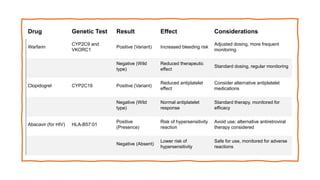
Drug Genetic Test Result Effect Considerations
Warfarin
CYP2C9 and
VKORC1
Positive (Variant) Increased bleeding risk
Adjusted dosing, more frequent
monitoring
Negative (Wild
type)
Reduced therapeutic
effect
Standard dosing, regular monitoring
Clopidogrel CYP2C19 Positive (Variant)
Reduced antiplatelet
effect
Consider alternative antiplatelet
medications
Negative (Wild
type)
Normal antiplatelet
response
Standard therapy, monitored for
efficacy
Abacavir (for HIV) HLA-B57:01
Positive
(Presence)
Risk of hypersensitivity
reaction
Avoid use; alternative antiretroviral
therapy considered
Negative (Absent)
Lower risk of
hypersensitivity
Safe for use, monitored for adverse
reactions
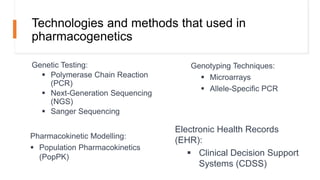
Technologies and methods that used in
pharmacogenetics
Genetic Testing:
 Polymerase Chain Reaction
(PCR)
 Next-Generation Sequencing
(NGS)
 Sanger Sequencing
Genotyping Techniques:
 Microarrays
 Allele-Specific PCR
Pharmacokinetic Modelling:
 Population Pharmacokinetics
(PopPK)
Electronic Health Records
(EHR):
 Clinical Decision Support
Systems (CDSS)
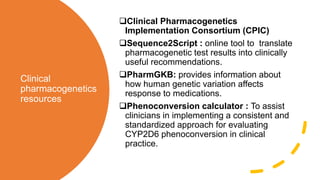
Clinical
pharmacogenetics
resources
Clinical Pharmacogenetics
Implementation Consortium (CPIC)
Sequence2Script : online tool to translate
pharmacogenetic test results into clinically
useful recommendations.
PharmGKB: provides information about
how human genetic variation affects
response to medications.
Phenoconversion calculator : To assist
clinicians in implementing a consistent and
standardized approach for evaluating
CYP2D6 phenoconversion in clinical
practice.
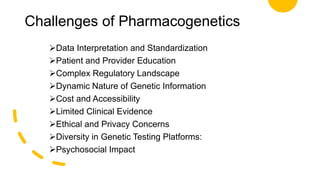
Challenges of Pharmacogenetics
Data Interpretation and Standardization
Patient and Provider Education
Complex Regulatory Landscape
Dynamic Nature of Genetic Information
Cost and Accessibility
Limited Clinical Evidence
Ethical and Privacy Concerns
Diversity in Genetic Testing Platforms:
Psychosocial Impact
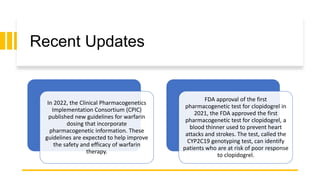
Recent Updates
In 2022, the Clinical Pharmacogenetics
Implementation Consortium (CPIC)
published new guidelines for warfarin
dosing that incorporate
pharmacogenetic information. These
guidelines are expected to help improve
the safety and efficacy of warfarin
therapy.
FDA approval of the first
pharmacogenetic test for clopidogrel in
2021, the FDA approved the first
pharmacogenetic test for clopidogrel, a
blood thinner used to prevent heart
attacks and strokes. The test, called the
CYP2C19 genotyping test, can identify
patients who are at risk of poor response
to clopidogrel.
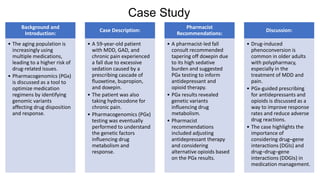
Case Study
Background and
Introduction:
• The aging population is
increasingly using
multiple medications,
leading to a higher risk of
drug-related issues.
• Pharmacogenomics (PGx)
is discussed as a tool to
optimize medication
regimens by identifying
genomic variants
affecting drug disposition
and response.
Case Description:
• A 59-year-old patient
with MDD, GAD, and
chronic pain experienced
a fall due to excessive
sedation caused by a
prescribing cascade of
fluoxetine, bupropion,
and doxepin.
• The patient was also
taking hydrocodone for
chronic pain.
• Pharmacogenomics (PGx)
testing was eventually
performed to understand
the genetic factors
influencing drug
metabolism and
response.
Pharmacist
Recommendations:
• A pharmacist-led fall
consult recommended
tapering off doxepin due
to its high sedative
burden and suggested
PGx testing to inform
antidepressant and
opioid therapy.
• PGx results revealed
genetic variants
influencing drug
metabolism.
• Pharmacist
recommendations
included adjusting
antidepressant therapy
and considering
alternative opioids based
on the PGx results.
Discussion:
• Drug-induced
phenoconversion is
common in older adults
with polypharmacy,
especially in the
treatment of MDD and
pain.
• PGx-guided prescribing
for antidepressants and
opioids is discussed as a
way to improve response
rates and reduce adverse
drug reactions.
• The case highlights the
importance of
considering drug–gene
interactions (DGIs) and
drug–drug–gene
interactions (DDGIs) in
medication management.
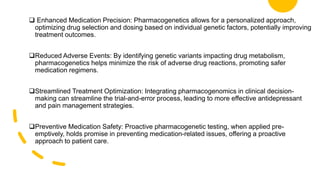
 Enhanced Medication Precision: Pharmacogenetics allows for a personalized approach,
optimizing drug selection and dosing based on individual genetic factors, potentially improving
treatment outcomes.
Reduced Adverse Events: By identifying genetic variants impacting drug metabolism,
pharmacogenetics helps minimize the risk of adverse drug reactions, promoting safer
medication regimens.
Streamlined Treatment Optimization: Integrating pharmacogenomics in clinical decision-
making can streamline the trial-and-error process, leading to more effective antidepressant
and pain management strategies.
Preventive Medication Safety: Proactive pharmacogenetic testing, when applied pre-
emptively, holds promise in preventing medication-related issues, offering a proactive
approach to patient care.
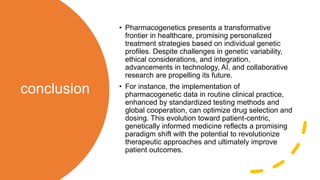
conclusion
• Pharmacogenetics presents a transformative
frontier in healthcare, promising personalized
treatment strategies based on individual genetic
profiles. Despite challenges in genetic variability,
ethical considerations, and integration,
advancements in technology, AI, and collaborative
research are propelling its future.
• For instance, the implementation of
pharmacogenetic data in routine clinical practice,
enhanced by standardized testing methods and
global cooperation, can optimize drug selection and
dosing. This evolution toward patient-centric,
genetically informed medicine reflects a promising
paradigm shift with the potential to revolutionize
therapeutic approaches and ultimately improve
patient outcomes.
•Thank You

Pharmacogenetics- Introduction, History with case Study - 2024

  • 1.
    Pharmacogenetics Submitted To -Dr. Shaweta Sharma Submitted By – Pushpak Singh Bhati
  • 2.
    Overview  Pharmacogenetics  HistoricalMilestones  Aim of pharmacogenetics  Benefits of pharmacogenetics  Steps in pharmacogenetics  challenges of Pharmacogenomics  Case Study
  • 3.
    Pharmacogenetics The word “Pharmacogenetics”comes from the words :  Pharmacology - The science of drugs Genetics - The study of genes and their functions Pharmacogenetics is the study of how an individual's genetic makeup influences their response to drugs, guiding personalized medication approaches.
  • 4.
    Pharmacogenetics Historical Milestones 1959 Friedrich Vogelcoined the term "pharmacogenetics" to describe the genetic-based differences in drug response 1968 Vesell's twin studies supported the inference of genetic involvement in drug metabolism, with identical twins sharing remarkable similarities to drug response as compared to fraternal twins. 2003 Completion of the Human Genome Project (HGP). 2005 First FDA approval of a pharmacogenetic test (for alleles in CYP2D6 and CYP2C1).
  • 5.
  • 6.
    For example, ifthe same drug is given to 4 different people, the rate at which they are able to metabolize the drug will vary. Genetic variations in pharmacogenomics (PGx) alter how a drug moves through the body (ADME) and affects its action by disturbing proteins in its mechanism or immune regulation.
  • 7.
    Benefits of pharmacogenetics Advancing Precision Medicine Cost-Effective Healthcare Drug Development Improving Treatment Outcomes GuidingClinical Decision- Making Enhancing Drug Efficacy Minimizing Adverse Reactions Dosing Precision Optimizing Drug Selection Personalized Treatment Improved Patient Adherence
  • 8.
    steps in pharmacogenetics Patient Assessment GeneticTesting Decision Informed Consent Genetic Testing Interpretation of Results Clinical Decision Support Treatment Plan Adjustment Communication with Patient Documentation Monitoring and Follow-Up Education and Counselling Research and Advancements
  • 9.
    Drug Genetic TestResult Effect Considerations Warfarin CYP2C9 and VKORC1 Positive (Variant) Increased bleeding risk Adjusted dosing, more frequent monitoring Negative (Wild type) Reduced therapeutic effect Standard dosing, regular monitoring Clopidogrel CYP2C19 Positive (Variant) Reduced antiplatelet effect Consider alternative antiplatelet medications Negative (Wild type) Normal antiplatelet response Standard therapy, monitored for efficacy Abacavir (for HIV) HLA-B57:01 Positive (Presence) Risk of hypersensitivity reaction Avoid use; alternative antiretroviral therapy considered Negative (Absent) Lower risk of hypersensitivity Safe for use, monitored for adverse reactions
  • 10.
    Technologies and methodsthat used in pharmacogenetics Genetic Testing:  Polymerase Chain Reaction (PCR)  Next-Generation Sequencing (NGS)  Sanger Sequencing Genotyping Techniques:  Microarrays  Allele-Specific PCR Pharmacokinetic Modelling:  Population Pharmacokinetics (PopPK) Electronic Health Records (EHR):  Clinical Decision Support Systems (CDSS)
  • 11.
    Clinical pharmacogenetics resources Clinical Pharmacogenetics Implementation Consortium(CPIC) Sequence2Script : online tool to translate pharmacogenetic test results into clinically useful recommendations. PharmGKB: provides information about how human genetic variation affects response to medications. Phenoconversion calculator : To assist clinicians in implementing a consistent and standardized approach for evaluating CYP2D6 phenoconversion in clinical practice.
  • 12.
    Challenges of Pharmacogenetics DataInterpretation and Standardization Patient and Provider Education Complex Regulatory Landscape Dynamic Nature of Genetic Information Cost and Accessibility Limited Clinical Evidence Ethical and Privacy Concerns Diversity in Genetic Testing Platforms: Psychosocial Impact
  • 13.
    Recent Updates In 2022,the Clinical Pharmacogenetics Implementation Consortium (CPIC) published new guidelines for warfarin dosing that incorporate pharmacogenetic information. These guidelines are expected to help improve the safety and efficacy of warfarin therapy. FDA approval of the first pharmacogenetic test for clopidogrel in 2021, the FDA approved the first pharmacogenetic test for clopidogrel, a blood thinner used to prevent heart attacks and strokes. The test, called the CYP2C19 genotyping test, can identify patients who are at risk of poor response to clopidogrel.
  • 14.
    Case Study Background and Introduction: •The aging population is increasingly using multiple medications, leading to a higher risk of drug-related issues. • Pharmacogenomics (PGx) is discussed as a tool to optimize medication regimens by identifying genomic variants affecting drug disposition and response. Case Description: • A 59-year-old patient with MDD, GAD, and chronic pain experienced a fall due to excessive sedation caused by a prescribing cascade of fluoxetine, bupropion, and doxepin. • The patient was also taking hydrocodone for chronic pain. • Pharmacogenomics (PGx) testing was eventually performed to understand the genetic factors influencing drug metabolism and response. Pharmacist Recommendations: • A pharmacist-led fall consult recommended tapering off doxepin due to its high sedative burden and suggested PGx testing to inform antidepressant and opioid therapy. • PGx results revealed genetic variants influencing drug metabolism. • Pharmacist recommendations included adjusting antidepressant therapy and considering alternative opioids based on the PGx results. Discussion: • Drug-induced phenoconversion is common in older adults with polypharmacy, especially in the treatment of MDD and pain. • PGx-guided prescribing for antidepressants and opioids is discussed as a way to improve response rates and reduce adverse drug reactions. • The case highlights the importance of considering drug–gene interactions (DGIs) and drug–drug–gene interactions (DDGIs) in medication management.
  • 15.
     Enhanced MedicationPrecision: Pharmacogenetics allows for a personalized approach, optimizing drug selection and dosing based on individual genetic factors, potentially improving treatment outcomes. Reduced Adverse Events: By identifying genetic variants impacting drug metabolism, pharmacogenetics helps minimize the risk of adverse drug reactions, promoting safer medication regimens. Streamlined Treatment Optimization: Integrating pharmacogenomics in clinical decision- making can streamline the trial-and-error process, leading to more effective antidepressant and pain management strategies. Preventive Medication Safety: Proactive pharmacogenetic testing, when applied pre- emptively, holds promise in preventing medication-related issues, offering a proactive approach to patient care.
  • 16.
    conclusion • Pharmacogenetics presentsa transformative frontier in healthcare, promising personalized treatment strategies based on individual genetic profiles. Despite challenges in genetic variability, ethical considerations, and integration, advancements in technology, AI, and collaborative research are propelling its future. • For instance, the implementation of pharmacogenetic data in routine clinical practice, enhanced by standardized testing methods and global cooperation, can optimize drug selection and dosing. This evolution toward patient-centric, genetically informed medicine reflects a promising paradigm shift with the potential to revolutionize therapeutic approaches and ultimately improve patient outcomes.
  • 17.