Phantom Limb Pain
PATRICIA TOMAS SABATER
Nurse Resident of Primary Care
Tutor: Isabelle Mattei
Health Center: Son Serra – La Vileta
28/07/2015
Phantom limb pain. Introduction
• Ambrose Pare, a 16th century French military
surgeon: Described the concept of phantom
limb pain (PLP) as being the pain perceived
by the region of the body no longer present.1
• Silas Weir Mitchell, a famous Civil War surgeon
in the 19th century: coined the term “phantom
limb pain” and provided a comprehensive
description of this condition. 1
Phantom limb pain. Introduction
Now, in 2015…
It continues to remain a poorly understood
and difficult to treat medical condition.
Phantom limb pain. Introduction
• May be present in up to 70-80% of patients subjected
to amputation because of trauma or peripheral vascular
disease2
.
• Several factors have been associated with its
occurrence, including pre-amputation pain, the etiology,
and the amputation level2
.
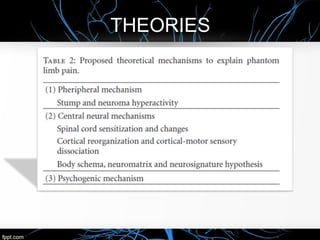
• The proposed pathophysiological mechanisms are
still in research and include peripheral, central and
psychological factors. Treatment options are still limited,
and less than 10% of patients report long-term
improvement.2
THEORIES
Pharmacologic Treatment
A systematic review of the literature3
indicates
that further research is needed, as no level 1
evidence that is specific to the treatment of PLP
currently exists.
Currently, the best evidence (level 2) exists for
the use of:
-IV ketamine and IV morphine perioperatively for
short-term treatment of PLP
-and PO morphine for an intermediate to long-
term treatment effect (8 weeks to 1 year).
Non Pharmacological Treatment
- Transcutaneous electrical nerve
stimulation (TENS )
- Electroconvulsive therapy (ECT )
- Mirror therapy
- Acupuncture, deep brain stimulation,
psychotherapy and spinal cord, among
others.
Factors that relieve pain and phantom
sensations4
• Pulling the stump,
• Lifting the stump above the level of gravity,
• Active exercises of the stump,
• Hot water,
• Use of prosthesis,
• Remain lying very still,
• Drinking cold beverages
• Sometimes the pressure on the sciatic nerve
above the stump occasionally removes phantom
limb pain and sensations.
Mirror Therapy1
• Was first reported by Ramachandran and Rogers-
Ramachandran in 1996 and is suggested to help PLP by
resolving the visual-proprioceptive dissociation in the
brain.
• It is based on “The mirror neurons theory”.
• The patient watches the reflection of their intact limb
moving in a mirror placed parasagittally between their
arms or legs while simultaneously moving the phantom
hand or foot in a manner similar to what they are
observing so that the virtual limb replaces the phantom
limb.
Mirror Therapy
• Consequently, since the activation of these mirror
neurons modulates somatosensory inputs, their
activation may block protopathic pain perception in the
phantom limb.1
LATEST RESEARCH. FEBRUARY 2014
How can we help a patient who has both
limbs amputated?
Or
A patient who has shown resistance to a
variety of treatments (including mirror
therapy)
MYOELECTRIC PATTERN
RECOGNITION5
• Recently, virtual reality (VR) has
been employed as a more
sophisticated mirror therapy.
• The virtual limb responds directly to
myoelectric activity at the stump,
while the illusion of a restored limb is
enhanced through augmented reality
(AR). Further, phantom motions are
facilitated and encouraged through
gaming.
• The sustained level of pain
reported by the patient was
gradually reduced to complete
pain-free periods.
CONCLUSIONS
There is still no one unifying theory relative to the
mechanism of PLP. Specific mechanism-based
treatments are still evolving, and most treatments are
based on recommendations for neuropathic pain.
Further research is needed to elucidate the relationship
between the different proposed mechanisms underlying
PLP.
REFERENCES
1. Subedi B., Grossberg GT. Review Article. PhantomLimb Pain: Mechanisms
and Treatment Approaches. Hindawi Publishing Corporation. Pain Research
and Treatment Volume. 2011: Article ID 864605.
2. Malavera MA., Carrillo S., Gomezese OF, García R., Silva FA. Revisión.
Fisiopatología y tratamiento del dolor de miembro fantasma. Rev.
colombanestesiol. 2014;4 2(1):40–46.
3. Cormick Z., Chang-Chien G., Marshall B., Huang M., Harden R. Review
Article. Phantom Limb Pain: A Systematic neuroanatomical-Based Review
of Pharmacologic Treatment. Pain Medicine 2014; 15: 292–305.
4. Vaquerizo A. Postamputation pain. Rev Soc Esp Dolor 2000; 7: Supl. II, 60-
77.
5. Ortiz-Catalan M. , Sander N., Kristoffersen M.B., Håkansson B., Brånemark
R. Treatment of phantom limb pain (PLP) based on augmented reality and
gaming controlled by myoelectric pattern recognition: a case study of a
chronic PLP patient. ORIGINAL RESEARCHARTICLE published:
25February2014 doi: 10.3389/fnins.2014.00024
THANK YOU

Phantom limb pain

  • 1.
    Phantom Limb Pain PATRICIATOMAS SABATER Nurse Resident of Primary Care Tutor: Isabelle Mattei Health Center: Son Serra – La Vileta 28/07/2015
  • 2.
    Phantom limb pain.Introduction • Ambrose Pare, a 16th century French military surgeon: Described the concept of phantom limb pain (PLP) as being the pain perceived by the region of the body no longer present.1 • Silas Weir Mitchell, a famous Civil War surgeon in the 19th century: coined the term “phantom limb pain” and provided a comprehensive description of this condition. 1
  • 3.
    Phantom limb pain.Introduction Now, in 2015… It continues to remain a poorly understood and difficult to treat medical condition.
  • 4.
    Phantom limb pain.Introduction • May be present in up to 70-80% of patients subjected to amputation because of trauma or peripheral vascular disease2 . • Several factors have been associated with its occurrence, including pre-amputation pain, the etiology, and the amputation level2 . • The proposed pathophysiological mechanisms are still in research and include peripheral, central and psychological factors. Treatment options are still limited, and less than 10% of patients report long-term improvement.2
  • 5.
  • 6.
    Pharmacologic Treatment A systematicreview of the literature3 indicates that further research is needed, as no level 1 evidence that is specific to the treatment of PLP currently exists. Currently, the best evidence (level 2) exists for the use of: -IV ketamine and IV morphine perioperatively for short-term treatment of PLP -and PO morphine for an intermediate to long- term treatment effect (8 weeks to 1 year).
  • 7.
    Non Pharmacological Treatment -Transcutaneous electrical nerve stimulation (TENS ) - Electroconvulsive therapy (ECT ) - Mirror therapy - Acupuncture, deep brain stimulation, psychotherapy and spinal cord, among others.
  • 8.
    Factors that relievepain and phantom sensations4 • Pulling the stump, • Lifting the stump above the level of gravity, • Active exercises of the stump, • Hot water, • Use of prosthesis, • Remain lying very still, • Drinking cold beverages • Sometimes the pressure on the sciatic nerve above the stump occasionally removes phantom limb pain and sensations.
  • 10.
    Mirror Therapy1 • Wasfirst reported by Ramachandran and Rogers- Ramachandran in 1996 and is suggested to help PLP by resolving the visual-proprioceptive dissociation in the brain. • It is based on “The mirror neurons theory”. • The patient watches the reflection of their intact limb moving in a mirror placed parasagittally between their arms or legs while simultaneously moving the phantom hand or foot in a manner similar to what they are observing so that the virtual limb replaces the phantom limb.
  • 11.
    Mirror Therapy • Consequently,since the activation of these mirror neurons modulates somatosensory inputs, their activation may block protopathic pain perception in the phantom limb.1
  • 12.
    LATEST RESEARCH. FEBRUARY2014 How can we help a patient who has both limbs amputated? Or A patient who has shown resistance to a variety of treatments (including mirror therapy)
  • 13.
    MYOELECTRIC PATTERN RECOGNITION5 • Recently,virtual reality (VR) has been employed as a more sophisticated mirror therapy. • The virtual limb responds directly to myoelectric activity at the stump, while the illusion of a restored limb is enhanced through augmented reality (AR). Further, phantom motions are facilitated and encouraged through gaming. • The sustained level of pain reported by the patient was gradually reduced to complete pain-free periods.
  • 14.
    CONCLUSIONS There is stillno one unifying theory relative to the mechanism of PLP. Specific mechanism-based treatments are still evolving, and most treatments are based on recommendations for neuropathic pain. Further research is needed to elucidate the relationship between the different proposed mechanisms underlying PLP.
  • 15.
    REFERENCES 1. Subedi B.,Grossberg GT. Review Article. PhantomLimb Pain: Mechanisms and Treatment Approaches. Hindawi Publishing Corporation. Pain Research and Treatment Volume. 2011: Article ID 864605. 2. Malavera MA., Carrillo S., Gomezese OF, García R., Silva FA. Revisión. Fisiopatología y tratamiento del dolor de miembro fantasma. Rev. colombanestesiol. 2014;4 2(1):40–46. 3. Cormick Z., Chang-Chien G., Marshall B., Huang M., Harden R. Review Article. Phantom Limb Pain: A Systematic neuroanatomical-Based Review of Pharmacologic Treatment. Pain Medicine 2014; 15: 292–305. 4. Vaquerizo A. Postamputation pain. Rev Soc Esp Dolor 2000; 7: Supl. II, 60- 77. 5. Ortiz-Catalan M. , Sander N., Kristoffersen M.B., Håkansson B., Brånemark R. Treatment of phantom limb pain (PLP) based on augmented reality and gaming controlled by myoelectric pattern recognition: a case study of a chronic PLP patient. ORIGINAL RESEARCHARTICLE published: 25February2014 doi: 10.3389/fnins.2014.00024
  • 16.