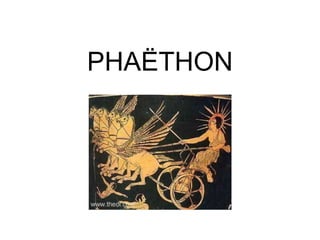
PHAËTHON
• Gods of the Sun. The titan HYPERION, 
god of the sun, was father of HELIOS, 
also a god of the sun. 
• Later the god APOLLO became a god of 
the sun as well. 
• The sun-god dwells in the East, crosses 
the dome of the sky in his chariot drawn 
by a team of four horses, descends in the 
West into the stream of Oceanus, which 
encircles the earth, and then sails back to 
the East to begin a new day.
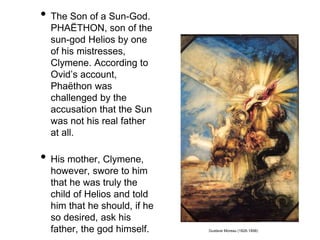
• The Son of a Sun-God. 
PHAËTHON, son of the 
sun-god Helios by one 
of his mistresses, 
Clymene. According to 
Ovid’s account, 
Phaëthon was 
challenged by the 
accusation that the Sun 
was not his real father 
at all. 
• His mother, Clymene, 
however, swore to him 
that he was truly the 
child of Helios and told 
him that he should, if he 
so desired, ask his 
father, the god himself. Gustave Moreau (1826-1898)
• Ovid describes in glowing terms the magnificent palace of the Sun, with its 
towering columns, gleaming with gold and polished ivory. 
• Phaëthon, awed by the grandeur, is prevented from coming too close to the 
god because of his radiance. 
• Helios, however, confirms Clymene’s account of Phaëthon’s parentage, 
lays aside the rays that shine around his head, and orders his son to 
approach. 
• He embraces him and promises on an oath sworn by the Styx that the boy 
may have any gift that he likes so that he may dispel his doubts once and 
for all.
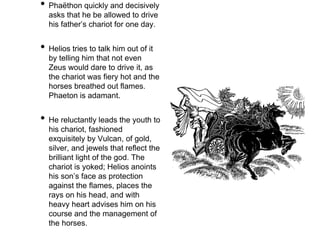
• Phaëthon quickly and decisively 
asks that he be allowed to drive 
his father’s chariot for one day. 
• Helios tries to talk him out of it 
by telling him that not even 
Zeus would dare to drive it, as 
the chariot was fiery hot and the 
horses breathed out flames. 
Phaeton is adamant. 
• He reluctantly leads the youth to 
his chariot, fashioned 
exquisitely by Vulcan, of gold, 
silver, and jewels that reflect the 
brilliant light of the god. The 
chariot is yoked; Helios anoints 
his son’s face as protection 
against the flames, places the 
rays on his head, and with 
heavy heart advises him on his 
course and the management of 
the horses.
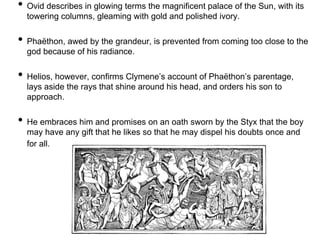
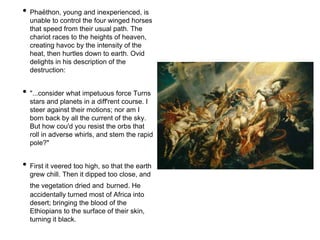
• Phaëthon, young and inexperienced, is 
unable to control the four winged horses 
that speed from their usual path. The 
chariot races to the heights of heaven, 
creating havoc by the intensity of the 
heat, then hurtles down to earth. Ovid 
delights in his description of the 
destruction: 
• "...consider what impetuous force Turns 
stars and planets in a diff'rent course. I 
steer against their motions; nor am I 
born back by all the current of the sky. 
But how cou'd you resist the orbs that 
roll in adverse whirls, and stem the rapid 
pole?" 
• First it veered too high, so that the earth 
grew chill. Then it dipped too close, and 
the vegetation dried and burned. He 
accidentally turned most of Africa into 
desert; bringing the blood of the 
Ethiopians to the surface of their skin, 
turning it black.
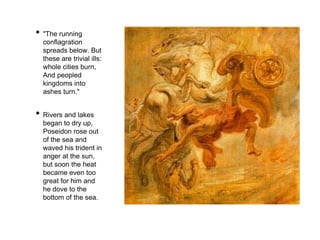
• "The running 
conflagration 
spreads below. But 
these are trivial ills: 
whole cities burn, 
And peopled 
kingdoms into 
ashes turn." 
• Rivers and lakes 
began to dry up, 
Poseidon rose out 
of the sea and 
waved his trident in 
anger at the sun, 
but soon the heat 
became even too 
great for him and 
he dove to the 
bottom of the sea.
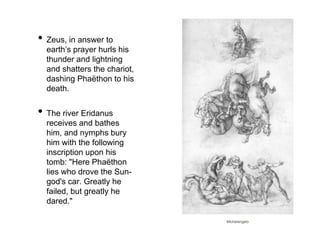
• Zeus, in answer to 
earth’s prayer hurls his 
thunder and lightning 
and shatters the chariot, 
dashing Phaëthon to his 
death. 
• The river Eridanus 
receives and bathes 
him, and nymphs bury 
him with the following 
inscription upon his 
tomb: "Here Phaëthon 
lies who drove the Sun-god's 
car. Greatly he 
failed, but greatly he 
dared." 
Michelangelo

Phaethon

  • 1.
  • 2.
    • Gods ofthe Sun. The titan HYPERION, god of the sun, was father of HELIOS, also a god of the sun. • Later the god APOLLO became a god of the sun as well. • The sun-god dwells in the East, crosses the dome of the sky in his chariot drawn by a team of four horses, descends in the West into the stream of Oceanus, which encircles the earth, and then sails back to the East to begin a new day.
  • 3.
    • The Sonof a Sun-God. PHAËTHON, son of the sun-god Helios by one of his mistresses, Clymene. According to Ovid’s account, Phaëthon was challenged by the accusation that the Sun was not his real father at all. • His mother, Clymene, however, swore to him that he was truly the child of Helios and told him that he should, if he so desired, ask his father, the god himself. Gustave Moreau (1826-1898)
  • 4.
    • Ovid describesin glowing terms the magnificent palace of the Sun, with its towering columns, gleaming with gold and polished ivory. • Phaëthon, awed by the grandeur, is prevented from coming too close to the god because of his radiance. • Helios, however, confirms Clymene’s account of Phaëthon’s parentage, lays aside the rays that shine around his head, and orders his son to approach. • He embraces him and promises on an oath sworn by the Styx that the boy may have any gift that he likes so that he may dispel his doubts once and for all.
  • 5.
    • Phaëthon quicklyand decisively asks that he be allowed to drive his father’s chariot for one day. • Helios tries to talk him out of it by telling him that not even Zeus would dare to drive it, as the chariot was fiery hot and the horses breathed out flames. Phaeton is adamant. • He reluctantly leads the youth to his chariot, fashioned exquisitely by Vulcan, of gold, silver, and jewels that reflect the brilliant light of the god. The chariot is yoked; Helios anoints his son’s face as protection against the flames, places the rays on his head, and with heavy heart advises him on his course and the management of the horses.
  • 6.
    • Phaëthon, youngand inexperienced, is unable to control the four winged horses that speed from their usual path. The chariot races to the heights of heaven, creating havoc by the intensity of the heat, then hurtles down to earth. Ovid delights in his description of the destruction: • "...consider what impetuous force Turns stars and planets in a diff'rent course. I steer against their motions; nor am I born back by all the current of the sky. But how cou'd you resist the orbs that roll in adverse whirls, and stem the rapid pole?" • First it veered too high, so that the earth grew chill. Then it dipped too close, and the vegetation dried and burned. He accidentally turned most of Africa into desert; bringing the blood of the Ethiopians to the surface of their skin, turning it black.
  • 7.
    • "The running conflagration spreads below. But these are trivial ills: whole cities burn, And peopled kingdoms into ashes turn." • Rivers and lakes began to dry up, Poseidon rose out of the sea and waved his trident in anger at the sun, but soon the heat became even too great for him and he dove to the bottom of the sea.
  • 8.
    • Zeus, inanswer to earth’s prayer hurls his thunder and lightning and shatters the chariot, dashing Phaëthon to his death. • The river Eridanus receives and bathes him, and nymphs bury him with the following inscription upon his tomb: "Here Phaëthon lies who drove the Sun-god's car. Greatly he failed, but greatly he dared." Michelangelo