Welcome to the PGPTP Secondary Science Session Dawn Berkeley, Seminar Leader
Professional ValuesFocus on our primary mission of closing the achievement gap by setting high expectations for our students, our colleagues and ourselves.Maximize our experience – working with a sense of urgency, seeking out and welcoming experiences, resources, and feedback in order to grow.Be flexible.Respect one another.Model a Culture of Achievement.
Group NormsBe respectful of one anotherNo side conversationsBe on timeFocus on things within your controlNo war stories…limit dwelling (whining or complaining)No blame or excusesNo interruptingTake ownership of the session by actively participating
So, what’s different?2nd Year Completion Requirements:Requirement #1 – Assessment Projects (5)Professional Development PlanAligning Strategies to Content Requirements & Student NeedsAnalyzing Content, Standards, and ResourcesDiagnosing Student Readiness, Setting Achievement Goals and Monitoring Progress – Part 1Diagnosing Student Readiness, Setting Achievement Goals and Monitoring Progress – Part 1Requirement #2 – Updated PES Component 4 – “Setting Goals for Student Achievement and Professional Development”Requirement #3 – Improving Practice Analysis and Reflection (5 – 7 pg. reflection)
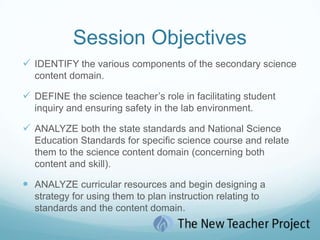
Session ObjectivesIDENTIFY the various components of the secondary science content domain.DEFINE the science teacher’s role in facilitating student inquiry and ensuring safety in the lab environment.ANALYZE both the state standards and National Science Education Standards for specific science course and relate them to the science content domain (concerning both content and skill).ANALYZE curricular resources and begin designing a strategy for using them to plan instruction relating to standards and the content domain.
OpeningThe Importance of Science EducationWhy teach secondary science?
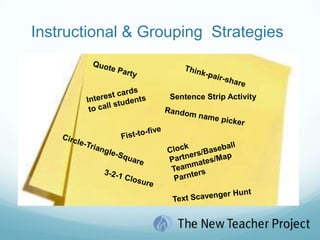
Quote PartyAfter receiving your quote, you will:Circulate around the room and pair up with different participants
Each time you pair up, read your quote on the strip aloud and briefly discuss the quote.
Pair up with at least 4 other people in the five minutes allotted.5 min.
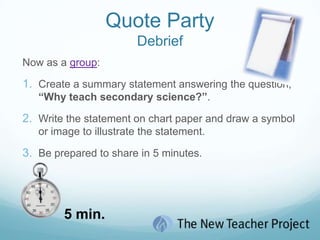
Quote PartyDebriefNow as a group:Create a summary statement answering the question, “Why teach secondary science?”.Write the statement on chart paper and draw a symbol or image to illustrate the statement.Be prepared to share in 5 minutes.5 min.
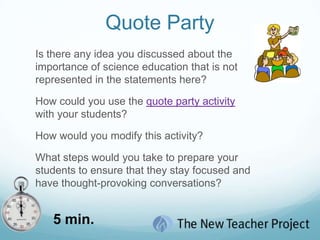
Quote PartyIs there any idea you discussed about the importance of science education that is not represented in the statements here?How could you use the quote party activity with your students?How would you modify this activity?What steps would you take to prepare your students to ensure that they stay focused and have thought-provoking conversations?5 min.
One of the big goals of science instruction is to foster the habits and skills of inquiry so that students will be keen observers of the world who will analyze evidence before making decisions….
Section 1The Secondary Science Content DomainDefining the Content DomainDeepening Our Understanding of the Science Content Domain
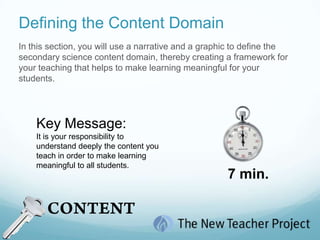
Defining the Content DomainIn this section, you will use a narrative and a graphic to define the secondary science content domain, thereby creating a framework for your teaching that helps to make learning meaningful for your students. Key Message:It is your responsibility to understand deeply the content you teach in order to make learning meaningful to all students.   CONTENT7 min.
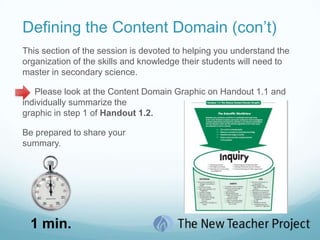
Defining the Content Domain (con’t)This section of the session is devoted to helping you understand the organization of the skills and knowledge their students will need to master in secondary science.     Please look at the Content Domain Graphic on Handout 1.1 and individually summarize the				                   graphic in step 1 of Handout 1.2.Be prepared to share your 			 	         summary.1 min.
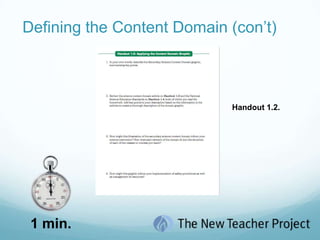
Defining the Content Domain (con’t)Handout 1.2.1 min.
Defining the Content Domain (con’t)       Individually, please review the content domain article you read for homework on Handout 1.3.        Add to the list key phrases you highlighted in the content domain article.         Use the ideas shared from group to review and revise your own summary.7 min.
Defining the Content Domain (con’t)Now with a partner, do a think-pair-share about questions 3, 4 and 5 on Handout 1.2.Rationale/Why are we doing this?8 min.
Defining the Content Domain (con’t)How does the organizational structure of the Content Domain graphic compare to how you have previously thought about science?How might this illustration of the secondary science content domain inform your science instruction?  How does each element of the domain fit into the structure of each of the classes or courses you teach?
Defining the Content Domain (con’t)How might this graphic inform your implementation of safety procedures as well as management of resources?Consider the statement near the top of the graphic that students of science should be exposed to “the inherent relationships between physical, earth, and life sciences regardless of how these topics are presented in school curricula.”  Choose a topic under one of the discipline headers (Earth Science, Life Science, and Physical Science), and explain how it is related to a topic in each of the other two disciplines.
Defining the Content Domain (con’t)       Please reflect on the question in Step 6 of Handout 1.2.  How will you communicate the science content domain to your students to help them understand what they are learning throughout the year?      Record on a sentence strip what you would say to introduce the content domain to your students.  Please use key terms or phrases from your summaries to think specifically about the domain’s structure and organization.  Try to write on the sentence strips the exact words you might use…….  Once you are done, please post your strips on the back wall.  3 min.
Deepening Our Understanding of the Science Content Domain       Please turn to Chapter 6 of the National Science Education Standards on Handout 1.4.The National Science Education Standards (NSES) are a valuable resources and outline what students need to know, understand and be able to do to be scientifically literate at different grade levels….INSTRUCTION & ASSESSMENT
Deepening Our Understanding of the Science Content DomainIn this first part of the session, you will spend five minutes clarifying the organization of the standards.			Why is it important to analyze the 				organization of the standards?  What is the benefit to both teacher 				and student in doing so?Why?INSTRUCTION & ASSESSMENT
Deepening Our Understanding of the Science Content Domain       Now, using both Handouts 1.5 and 1.4, you will engage in a Scavenger Hunt.  To add a little friendly competition, please mark a tally on the chart paper each time your group completes                                                  q a question.Why?4 min.
Deepening Our Understanding of the Science Content DomainIn Sessions 8 – 15, we will delve more deeply into the unifying concepts and scientific inquiry skills……See the Course Overview in the PM for more details…..
Deepening Our Understanding of the Science Content DomainNow, that you are more familiar with the organization of the NSES, you will discuss the philosophy behind the standards.
Deepening Our Understanding of the Science Content DomainHow do the national content standards described in Chapter 6 relate to the science content domain  What similarities and differences exist?Why do you think the NSES have switched the emphasis in science education from teaching many concepts and topics to teaching “depth over breadth” – that is, teaching fewer concepts more deeply?  Do you agree/disagree with this approach?  Why or why not?How do the scope and sequence of courses taught at your school compare to the approach suggested in this document?Session 14 will address theme-based science instruction…..
Session ObjectivesIDENTIFY the various components of the secondary science content domain.
DEFINE the science teacher’s role in facilitating student inquiry and ensuring safety in the lab environment.ANALYZE both the state standards and National Science Education Standards for specific science course and relate them to the science content domain (concerning both content and skill).ANALYZE curricular resources and begin designing a strategy for using them to plan instruction relating to standards and the content domain.
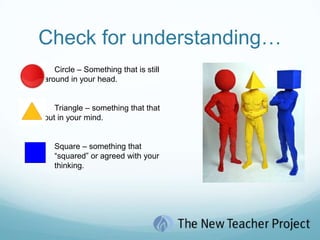
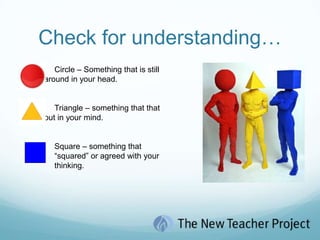
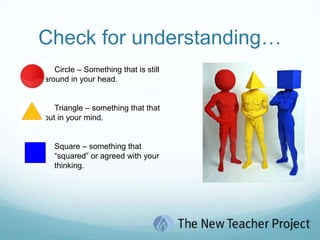
Check for understanding…	Circle – Something that is still going around in your head.  Triangle – something that that stood out in your mind.  	Square – something that 	“squared” or agreed with your 	thinking.
Section 2Examining Science StandardsIn this Section, we will compare the NSES to the standards outlined by PGCPS for your teaching assignment.If you teach more than one science course, please select the course for which you most need to develop background knowledge and understanding…..
Examining Science StandardsPlease take out your copies of the NSES and locate the section that lists and explains the standards for the course you are teaching and/or have selected for this activity.  Only use the discipline in your grade level span, either 5 – 8 or grades 9 – 12.
Examining Science StandardsYou will be completing Handout 1.6, andas you do so, think about how the standards are organized and wordedand what information supports each standard in both the national and state standards.What key messages does this activity align to?Content, instruction & assessment
Examining Science StandardsBefore you begin analyzing the standards, consider the following:Key concepts are one way of identifying important/priority standards
The term “key concepts” are also referred to as “enduring understandings”
In the “backward design” process, key concepts are idenfied first, follwed by assessment alignment before choosing instructional activities…CONTENT, INSTRUCTION & ASSESSMENT
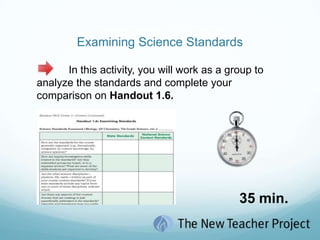
Examining Science StandardsIn this activity, you will work as a group to analyze the standards and complete your comparison on Handout 1.6.  35 min.
Examining Science StandardsDebriefHow closely aligned are the state and national standards?  Were there significant differences between them in terms of organization, wording and content coverage?How deeply did the sets of standards address content and inquiry?What do the standards say about ensuring safety in the science classroom?
Session ObjectivesIDENTIFY the various components of the secondary science content domain.
DEFINE the science teacher’s role in facilitating student inquiry and ensuring safety in the lab environment.
ANALYZE both the state standards and National Science Education Standards for specific science course and relate them to the science content domain (concerning both content and skill).ANALYZE curricular resources and begin designing a strategy for using them to plan instruction relating to standards and the content domain.
Check for understanding…	Circle – Something that is still going around in your head.  Triangle – something that that stood out in your mind.  	Square – something that 	“squared” or agreed with your 	thinking.
10 min.
Section 3Analyzing Curriculum ResourcesIn this Section, we will now evaluate curriculum resources to determine how they support teaching of the state standards and how they may need to be supplemented.How does this activity help to inform your instruction?
Section 3Analyzing Curriculum ResourcesRemain with the group and refer to the sample curriculum analysis on Handout 1.7a.  For this activity, you will need to reference a copy of your curriculum (homework).Before we proceed, what key messages are addressed?20 min.INSTRUCTION
Section 3Analyzing Curriculum ResourcesGroup DebriefWhat was challenging about the process of analyzing your state standards?How will this process inform your instruction?In which areas did you find that you need to supplement the curriculum?If you had more time to complete this process, what would you focus on or study more deeply?  Why?
Section 3Analyzing Curriculum ResourcesKey Message:INSTRUCTION

Pgptp session 1

  • 1.
    Welcome to thePGPTP Secondary Science Session Dawn Berkeley, Seminar Leader
  • 2.
    Professional ValuesFocus onour primary mission of closing the achievement gap by setting high expectations for our students, our colleagues and ourselves.Maximize our experience – working with a sense of urgency, seeking out and welcoming experiences, resources, and feedback in order to grow.Be flexible.Respect one another.Model a Culture of Achievement.
  • 3.
    Group NormsBe respectfulof one anotherNo side conversationsBe on timeFocus on things within your controlNo war stories…limit dwelling (whining or complaining)No blame or excusesNo interruptingTake ownership of the session by actively participating
  • 4.
    So, what’s different?2ndYear Completion Requirements:Requirement #1 – Assessment Projects (5)Professional Development PlanAligning Strategies to Content Requirements & Student NeedsAnalyzing Content, Standards, and ResourcesDiagnosing Student Readiness, Setting Achievement Goals and Monitoring Progress – Part 1Diagnosing Student Readiness, Setting Achievement Goals and Monitoring Progress – Part 1Requirement #2 – Updated PES Component 4 – “Setting Goals for Student Achievement and Professional Development”Requirement #3 – Improving Practice Analysis and Reflection (5 – 7 pg. reflection)
  • 6.
    Session ObjectivesIDENTIFY thevarious components of the secondary science content domain.DEFINE the science teacher’s role in facilitating student inquiry and ensuring safety in the lab environment.ANALYZE both the state standards and National Science Education Standards for specific science course and relate them to the science content domain (concerning both content and skill).ANALYZE curricular resources and begin designing a strategy for using them to plan instruction relating to standards and the content domain.
  • 7.
    OpeningThe Importance ofScience EducationWhy teach secondary science?
  • 8.
    Quote PartyAfter receivingyour quote, you will:Circulate around the room and pair up with different participants
  • 9.
    Each time youpair up, read your quote on the strip aloud and briefly discuss the quote.
  • 10.
    Pair up withat least 4 other people in the five minutes allotted.5 min.
  • 11.
    Quote PartyDebriefNow asa group:Create a summary statement answering the question, “Why teach secondary science?”.Write the statement on chart paper and draw a symbol or image to illustrate the statement.Be prepared to share in 5 minutes.5 min.
  • 12.
    Quote PartyIs thereany idea you discussed about the importance of science education that is not represented in the statements here?How could you use the quote party activity with your students?How would you modify this activity?What steps would you take to prepare your students to ensure that they stay focused and have thought-provoking conversations?5 min.
  • 13.
    One of thebig goals of science instruction is to foster the habits and skills of inquiry so that students will be keen observers of the world who will analyze evidence before making decisions….
  • 14.
    Section 1The SecondaryScience Content DomainDefining the Content DomainDeepening Our Understanding of the Science Content Domain
  • 15.
    Defining the ContentDomainIn this section, you will use a narrative and a graphic to define the secondary science content domain, thereby creating a framework for your teaching that helps to make learning meaningful for your students. Key Message:It is your responsibility to understand deeply the content you teach in order to make learning meaningful to all students. CONTENT7 min.
  • 16.
    Defining the ContentDomain (con’t)This section of the session is devoted to helping you understand the organization of the skills and knowledge their students will need to master in secondary science. Please look at the Content Domain Graphic on Handout 1.1 and individually summarize the graphic in step 1 of Handout 1.2.Be prepared to share your summary.1 min.
  • 17.
    Defining the ContentDomain (con’t)Handout 1.2.1 min.
  • 18.
    Defining the ContentDomain (con’t) Individually, please review the content domain article you read for homework on Handout 1.3. Add to the list key phrases you highlighted in the content domain article. Use the ideas shared from group to review and revise your own summary.7 min.
  • 19.
    Defining the ContentDomain (con’t)Now with a partner, do a think-pair-share about questions 3, 4 and 5 on Handout 1.2.Rationale/Why are we doing this?8 min.
  • 20.
    Defining the ContentDomain (con’t)How does the organizational structure of the Content Domain graphic compare to how you have previously thought about science?How might this illustration of the secondary science content domain inform your science instruction? How does each element of the domain fit into the structure of each of the classes or courses you teach?
  • 21.
    Defining the ContentDomain (con’t)How might this graphic inform your implementation of safety procedures as well as management of resources?Consider the statement near the top of the graphic that students of science should be exposed to “the inherent relationships between physical, earth, and life sciences regardless of how these topics are presented in school curricula.” Choose a topic under one of the discipline headers (Earth Science, Life Science, and Physical Science), and explain how it is related to a topic in each of the other two disciplines.
  • 22.
    Defining the ContentDomain (con’t) Please reflect on the question in Step 6 of Handout 1.2. How will you communicate the science content domain to your students to help them understand what they are learning throughout the year? Record on a sentence strip what you would say to introduce the content domain to your students. Please use key terms or phrases from your summaries to think specifically about the domain’s structure and organization. Try to write on the sentence strips the exact words you might use……. Once you are done, please post your strips on the back wall. 3 min.
  • 23.
    Deepening Our Understandingof the Science Content Domain Please turn to Chapter 6 of the National Science Education Standards on Handout 1.4.The National Science Education Standards (NSES) are a valuable resources and outline what students need to know, understand and be able to do to be scientifically literate at different grade levels….INSTRUCTION & ASSESSMENT
  • 24.
    Deepening Our Understandingof the Science Content DomainIn this first part of the session, you will spend five minutes clarifying the organization of the standards. Why is it important to analyze the organization of the standards? What is the benefit to both teacher and student in doing so?Why?INSTRUCTION & ASSESSMENT
  • 25.
    Deepening Our Understandingof the Science Content Domain Now, using both Handouts 1.5 and 1.4, you will engage in a Scavenger Hunt. To add a little friendly competition, please mark a tally on the chart paper each time your group completes q a question.Why?4 min.
  • 26.
    Deepening Our Understandingof the Science Content DomainIn Sessions 8 – 15, we will delve more deeply into the unifying concepts and scientific inquiry skills……See the Course Overview in the PM for more details…..
  • 27.
    Deepening Our Understandingof the Science Content DomainNow, that you are more familiar with the organization of the NSES, you will discuss the philosophy behind the standards.
  • 28.
    Deepening Our Understandingof the Science Content DomainHow do the national content standards described in Chapter 6 relate to the science content domain What similarities and differences exist?Why do you think the NSES have switched the emphasis in science education from teaching many concepts and topics to teaching “depth over breadth” – that is, teaching fewer concepts more deeply? Do you agree/disagree with this approach? Why or why not?How do the scope and sequence of courses taught at your school compare to the approach suggested in this document?Session 14 will address theme-based science instruction…..
  • 29.
    Session ObjectivesIDENTIFY thevarious components of the secondary science content domain.
  • 30.
    DEFINE the scienceteacher’s role in facilitating student inquiry and ensuring safety in the lab environment.ANALYZE both the state standards and National Science Education Standards for specific science course and relate them to the science content domain (concerning both content and skill).ANALYZE curricular resources and begin designing a strategy for using them to plan instruction relating to standards and the content domain.
  • 31.
    Check for understanding… Circle– Something that is still going around in your head. Triangle – something that that stood out in your mind. Square – something that “squared” or agreed with your thinking.
  • 32.
    Section 2Examining ScienceStandardsIn this Section, we will compare the NSES to the standards outlined by PGCPS for your teaching assignment.If you teach more than one science course, please select the course for which you most need to develop background knowledge and understanding…..
  • 33.
    Examining Science StandardsPleasetake out your copies of the NSES and locate the section that lists and explains the standards for the course you are teaching and/or have selected for this activity. Only use the discipline in your grade level span, either 5 – 8 or grades 9 – 12.
  • 34.
    Examining Science StandardsYouwill be completing Handout 1.6, andas you do so, think about how the standards are organized and wordedand what information supports each standard in both the national and state standards.What key messages does this activity align to?Content, instruction & assessment
  • 35.
    Examining Science StandardsBeforeyou begin analyzing the standards, consider the following:Key concepts are one way of identifying important/priority standards
  • 36.
    The term “keyconcepts” are also referred to as “enduring understandings”
  • 37.
    In the “backwarddesign” process, key concepts are idenfied first, follwed by assessment alignment before choosing instructional activities…CONTENT, INSTRUCTION & ASSESSMENT
  • 38.
    Examining Science StandardsInthis activity, you will work as a group to analyze the standards and complete your comparison on Handout 1.6. 35 min.
  • 39.
    Examining Science StandardsDebriefHowclosely aligned are the state and national standards? Were there significant differences between them in terms of organization, wording and content coverage?How deeply did the sets of standards address content and inquiry?What do the standards say about ensuring safety in the science classroom?
  • 40.
    Session ObjectivesIDENTIFY thevarious components of the secondary science content domain.
  • 41.
    DEFINE the scienceteacher’s role in facilitating student inquiry and ensuring safety in the lab environment.
  • 42.
    ANALYZE both thestate standards and National Science Education Standards for specific science course and relate them to the science content domain (concerning both content and skill).ANALYZE curricular resources and begin designing a strategy for using them to plan instruction relating to standards and the content domain.
  • 43.
    Check for understanding… Circle– Something that is still going around in your head. Triangle – something that that stood out in your mind. Square – something that “squared” or agreed with your thinking.
  • 44.
  • 45.
    Section 3Analyzing CurriculumResourcesIn this Section, we will now evaluate curriculum resources to determine how they support teaching of the state standards and how they may need to be supplemented.How does this activity help to inform your instruction?
  • 46.
    Section 3Analyzing CurriculumResourcesRemain with the group and refer to the sample curriculum analysis on Handout 1.7a. For this activity, you will need to reference a copy of your curriculum (homework).Before we proceed, what key messages are addressed?20 min.INSTRUCTION
  • 47.
    Section 3Analyzing CurriculumResourcesGroup DebriefWhat was challenging about the process of analyzing your state standards?How will this process inform your instruction?In which areas did you find that you need to supplement the curriculum?If you had more time to complete this process, what would you focus on or study more deeply? Why?
  • 48.
    Section 3Analyzing CurriculumResourcesKey Message:INSTRUCTION