SCIENCE FRAMEWORK FOR PHILIPPINE BASIC EDUCATION
Department of Science and Technology
SCIENCE EDUCATION INSTITUTE
University of the Philippines
National Institute for Science and Mathematics Education Development
Science Framework for Philippine Basic Education
All rights reserved.
©2011 by the Science Education Institute, Department of Science and Technology (SEI-DOST)
and the University of the Philippines National Institute for Science and Mathematics Education Development (UP NISMED),
Manila, Philippines
Citation:
SEI-DOST & UP NISMED, (2011). Science framework for philippine basic education.
Manila: SEI-DOST & UP NISMED.
ISBN 978-971-8600-46-7
Published by:
Science Education Institute, Department of Science and Technology
1st
and 2nd
Levels, Science Heritage Building
DOST Compound, General Santos Avenue
Bicutan, Taguig City, Metro Manila, Philippines
Tel. Nos. (632) 837-1359, (632) 839-0241, Fax No. (632) 837-1924
http://www.sei.dost.gov.ph / www.science-scholarships.ph and
University of the Philippines National Institute for Science and Mathematics Education Development
E. Quirino Avenue, UP Campus
Diliman, Quezon City 1101 Philippines
Tel. No. (632) 927-4276, Fax No. (632) 928-3545
http://www.upd.edu.ph/~ismed/ e-mail: nismed@up.edu.ph
Request for permission to use any material from this publication or for further information should be addressed to the copyright
holders.
Printed in Metro Manila, Philippines
Foreword
This framework is the product of months of careful planning and discussions, with ideas
coming from the best minds in the field of science, prior to the actual drafting of the
manuscript. Although there may have been opposing views during the development of this
framework, which is not unusual when experts meet, the final output is proof that individuals
with diverse backgrounds and beliefs could be united by a common vision and goal.
The “Science Framework for Philippine Basic Education” contains resources that will help
curriculum developers, teachers, school administrators and policy makers to design and
implement science curricula that empower students to “learn to learn” and cause them to better
understand and use science in their everyday life. The strategies consider only Grades 1-10,
however, because of the progressive nature of the concepts, curriculum development could
easily be extended to cover K-12.
It is hoped that this framework will be widely used and applied by the various stakeholders,
and that together we will work towards achieving the vision of scientifically, technologically,
environmentally literate and productive individuals through quality science education.
Dr. Filma G. Brawner
Director, Science Education Institute
CONTENTS
I. Overview . . . . . . . . . . . . . . . . . . . . . . . . . . . . . . . . . . . . . . . . . . . . . . . . . . . . . . . . . . . . 1
• Importance of the School Science Education . . . . . . . . . . . . . . . . . . . . . . . . . 1
• Challenges in Science Education: Philippines Context . . . . . . . . . . . . . . . . . . 1
• Rationale . . . . . . . . . . . . . . . . . . . . . . . . . . . . . . . . . . . . . . . . . . . . . . . . . . . . . . . 2
• The Project Output and Team Members . . . . . . . . . . . . . . . . . . . . . . . . . . . . 3
• For Whom is the Framework . . . . . . . . . . . . . . . . . . . . . . . . . . . . . . . . . . . . . . 4
• The Guiding Principles of Science Curriculum Framework . . . . . . . . . . . . . . . 4
II. What is in the Framework . . . . . . . . . . . . . . . . . . . . . . . . . . . . . . . . . . . . . . . . . . . . . 6
III. Curriculum Components . . . . . . . . . . . . . . . . . . . . . . . . . . . . . . . . . . . . . . . . . . . . . . . 9
• Component 1: Inquiry Skills . . . . . . . . . . . . . . . . . . . . . . . . . . . . . . . . . . . . . . . 9
• Component 2: Scientific Attitudes . . . . . . . . . . . . . . . . . . . . . . . . . . . . . . . . . . 12
• Component 3: Content and Connections . . . . . . . . . . . . . . . . . . . . . . . . . . . . 17
References . . . . . . . . . . . . . . . . . . . . . . . . . . . . . . . . . . . . . . . . . . . . . . . . . . . . . . . . . . . . . . . . 21
ANNEXES
Focus Questions, Science Ideas and Sample Learners’ Performance
A Focus Questions on Each Subject Area. . . . . . . . . . . . . . . . . . . . . . . . . . . . . . . . 24
B Focus Questions in Each Grade Range. . . . . . . . . . . . . . . . . . . . . . . . . . . . . . . . 35
C Life Science . . . . . . . . . . . . . . . . . . . . . . . . . . . . . . . . . . . . . . . . . . . . . . . . . . . . . 45
D Physical Science
D-1 Force, Motion and Energy. . . . . . . . . . . . . . . . . . . . . . . . . . . . . . . . . . . . . . 72
D-2 Matter. . . . . . . . . . . . . . . . . . . . . . . . . . . . . . . . . . . . . . . . . . . . . . . . . . . . . . 95
E Earth and Space . . . . . . . . . . . . . . . . . . . . . . . . . . . . . . . . . . . . . . . . . . . . . . . . .115
SCIENCE CURRICULUM FRAMEWORK FOR BASIC EDUCATION 1
SCIENCE CURRICULUM FRAMEWORK
FOR BASIC EDUCATION
I. Overview
Science is important to everyone. School science education should support the
development of scientific literacy in all students as well as motivate them to pursue careers
in science, technology, and engineering. These statements were drawn from a series of
consultation meetings and focus group discussions with different sectors of society held in
2006: industry, university, scientists, parents, teachers, school administrators, community
leaders, media, students, and many others.
• Importance of the School Science Education
Science is useful because of its links to technology and industry, which, from a
national perspective, are areas of high priority for development. Science provides ways of
making sense of the world systematically. It develops students’ scientific inquiry skills,
values and attitudes, such as objectivity, curiosity, and honesty and habits of mind including
critical thinking. All these are useful to the individual student for his own personal
development, future career, and life in general. These skills, values, attitudes, and
dispositions are likewise useful to the community that an individual student belongs to, and
are further useful to the country that he lives in.
The learning of science is also important for the nation’s cultural development and
preservation of its cultural identity. Science is most useful to a nation when it is utilized to
solve its own problems and challenges, keeping a nation's cultural uniqueness and
peculiarities intact. Thus in many countries, science teaching and learning is linked with
culture.
• Challenges in Science Education: Philippines Context
Some Filipino students have gained recognition for their high level of
accomplishments in the International Science and Engineering Fair, Robotics Competition,
and Physics Olympiad, to name a few. There are also reports of students in far-flung rural
schools scoring much higher than the international mean in the case of the Third/Trends in
International Mathematics and Science Study (TIMSS) or have gone beyond the 75%
mastery level in the case of the National Achievement Test (NAT).
SCIENCE CURRICULUM FRAMEWORK FOR BASIC EDUCATION 2
However, the accomplishments of a few students are overshadowed by the
consistently poor performance of Filipino students in international assessment studies and
national assessment studies. Studies reveal that Filipino students have low retention of
concepts, have limited reasoning and analytical skills, and poor communication skills (they
cannot express ideas or explanations of events and phenomena in their own words) (UP
NISMED, 2004). In addition, a large percentage of Grade 6 and fourth year students in
selected schools cannot apply concepts to real-life problem solving situations nor design an
investigation to solve a problem (UP NISMED, 2005).
Many educators and graduate student researchers have identified several factors
behind the low performance in science of Filipino students. These are: quality of teachers,
the teaching-learning process, the school curriculum, instructional materials, and
administrative support (DOST-SEI, 2006).
There are many efforts by various stakeholders in science education to address these
concerns. The UP National Institute for Science and Mathematics Education Development
with three major functions–curriculum development, training and research in science and
mathematics (UP Board of Regents, 1997), designated as the National Center for
Innovations and Research (DOST SEI, 2005), deemed it wise to focus its efforts on the
science curriculum to improve the quality of education at the elementary and secondary
school levels. The curriculum dictates how instruction and assessment of student learning
should be done and guides service providers in designing professional development
programs for teachers.
• Rationale
In the Philippines and around the world, people are talking about a science and
technology-based world and a knowledge-based economy. Given the expectations and skills
required to live successfully in such an environment and the varied problems of science
education in the country, there is a need to rethink what the vision of science education is.
The current direction of curriculum development in many countries is towards
scientific literacy, where the science education needs of all students are differentiated from
those who have an interest in scientific careers. An example is York University’s 21st
Century Science, which has a Foundation Science subject to be taken by all students, and a
second optional subject, Additional Science, for those students who wish to proceed with
disciplines in science in later years.
Several questions have been asked: Does the present science curriculum for basic
education address the needs of students from different communities who might drop out of
school at different grade or year levels? Does the science curriculum in basic education
provide avenues for students to engage in science and encourage them to take science-
related careers? Does science in basic education help students become informed citizens so
SCIENCE CURRICULUM FRAMEWORK FOR BASIC EDUCATION 3
that they can participate in making wise decisions about issues that involve science and
technology now and when they become decision makers in government and in industry?
These questions were deliberated on lengthily by science education specialists,
cognitive psychologists, and even school teachers. They also noted that the existing science
curriculum at the basic education level do not jibe with the expectations of industry, the
university, and society in general. More specifically, they observed that the present
curriculum is overloaded, discipline-based, and caters to college bound students. They
based their conclusion on the data that drop out rate is high, that is, for every 100 pupils
that enroll in Grade 1, only 65 finish Grade 6; while 56 students enroll in secondary school,
only 46 graduate in fourth year (BESRA, 2006). In addition, of those who pursue tertiary
education, only about 2% choose careers in science and related fields.
The present science curriculum was updated a few years back (RBEC, 2003) but the
same description in terms of its content and emphasis still hold.
Thus, the Project Team arrived at these vision statements:
The Philippines’ Grades 1-10 Science Curriculum envisions the development of
scientifically, technologically, and environmentally literate and productive members of
society. They must possess effective communication and interpersonal and life long
learning skills as well as scientific values and attitudes. These skills will be acquired
through a curriculum that focuses on knowledge relevant to real world and encompasses
methods of inquiry. These will be implemented in a learning environment that promotes
the construction of ideas and instills respect for others.
The Framework begins at Grade 1 because the kindergarten curriculum cannot be
pigeonholed into the usual subjects in basic education, such as science, mathematics,
reading, and writing. Even though concepts from these subjects are taught every day in
kindergarten, they are so interrelated that it is difficult to distinguish one from another.
• The Project Output and Team Members
The major output is a coherent, comprehensive science curriculum framework for
basic education with development of scientific inquiry as its overarching emphasis. It
promotes the core science concepts and skills to enable students “learn how to learn.”
This science curriculum framework is a result of a series of brainstorming and
marathon sessions to rethink the vision for Grades 1-10 school science based on the
expectations for citizens in a technologically-driven world. Its goals and content are
oriented towards producing scientifically literate citizens, and decision makers. It takes into
account emerging social and global issues and concerns, new international trends in
curriculum planning and design, and other pedagogical developments.
SCIENCE CURRICULUM FRAMEWORK FOR BASIC EDUCATION 4
The Core Group is composed of science educators, heads of professional science
teachers’ organizations, scientists and engineers, teachers, and senior specialists and
researchers of DOST-SEI. The Technical Working Group is made up of science education
specialists and science education associates of UP NISMED.
• For Whom is the Framework
The science curriculum framework is a resource for curriculum developers, faculty of
teacher education institutions, teachers, school administrators, and policy makers to design,
implement, and assess the content of the science curricula.
Specifically, the document will help schools, teachers, and instructional materials
developers in addressing the needs of students to prepare them for the world of work, for
pursuing their interest in science and related fields, and to become responsible citizens. It
emphasizes the need to learn and use real life contexts to enhance learning, develops skills
for independent study or self-learning and inculcates in students the love and desire to
acquire ‘learn how to learn’ skills.
For school administrators, the science curriculum framework will guide them on the
selection of quality instructional materials and equipment for science teaching and learning.
This framework will also inform policy makers to formulate appropriate legislation as
well as allocate resources to support quality science education.
• The Guiding Principles of Science Curriculum Framework
Science is for everyone. This principle recognizes the proactive relationship between
science and society. This means putting science into the service of individuals and society.
Science education should aim for scientific literacy that is operational in understanding
oneself, common human welfare, social, and civic affairs. Science should permeate all levels
of society. Whether or not students pursue a university education, they should leave school
with a level of understanding and scientific literacy that will prepare them to be informed
and participative citizens who are able to make judgments and decisions regarding science
applications that may have social, health, or environmental impacts.
Science is both content and process. Science content and science process are
intertwined. The value of science processes is to advance content or the body of
knowledge. Without content, students will have difficulty utilizing the science process skills.
Science processes cannot exist in a vacuum. They are learned in context.
School science should emphasize depth rather breadth, coherence rather than
fragmentation, and use of evidence in constructing explanation.
SCIENCE CURRICULUM FRAMEWORK FOR BASIC EDUCATION 5
School science should be relevant and useful. To be relevant and useful, the teaching
of science should be organized around situations, problems or projects that engage the
students both as an individual and a member of a team.
School science should nurture interest in learning. Students are generally interested
in problems that puzzle them. They have a natural urge to find solutions. Organizing the
curriculum around problems or phenomena that puzzle students helps motivate them to
learn.
Rather than relying solely on textbooks, teachers are encouraged to use hands-on
learning activities to develop students’ interest and let them become active learners.
School science should demonstrate a commitment to the development of a culture
of science. A culture of science is characterized by excellence, integrity, hard work, and
discipline.
School science should promote the strong link between science and technology,
including indigenous technology.
School science should recognize that science and technology reflect, influence, and
shape our culture. The science curriculum should recognize the place of science and
technology in everyday human affairs. It should integrate science and technology in the
civic, personal, social, economic, and the values and ethical aspects of life.
SCIENCE CURRICULUM FRAMEWORK FOR BASIC EDUCATION 6
II. What is in the Framework
The curriculum framework is the overall structure for organizing learning and
teaching. It ensures that learning experiences provided to students are commensurate with
their abilities at different stages and with their ways of perceiving and learning about the
world. The framework is not the curriculum itself. Rather, it is a skeleton that provides the
basis for a strong, organized, and cohesive curriculum.
It is not a syllabus, but a framework. According to Bybee (1990), “a framework is like
the broad sketches of an architect’s plan. The framework gives an initial picture of the
program and is based on certain specifications. The architect’s plan has to fulfill certain
requirements. At the same time, the more specific details are left to the contractors and
the carpenters. Everyone knows there will be modifications as the framework is developed
and implemented, but there should be some fidelity to the original intentions,
specifications, and design.”
This Framework is organized around three interlocking components namely: (1)
inquiry skills, (2) scientific attitudes, and (3) content and connections. Being interrelated,
these components are woven together in order to support the holistic development of a
scientifically literate individual. The Framework sets out what all students should know,
understand, value, and be able to do from Grade 1 to Grade 10. The Technical Working
Group deems it best to use Grades 1-10 (G1-10) instead of Grades 1-Year 4 to emphasize
that there is no break in the continuum of the curriculum from elementary school to high
school.
Rather than being prescriptive, its basic purpose is to provide a structure around
which educators, curriculum developers, textbook writers, and teachers can develop
instructional materials incorporating coherent learning activities and experiences that
prepare students to become scientifically literate in a dynamic, rapidly changing, and
increasingly technological society.
The Framework includes the core content that describes the major science concepts
that all students are expected to learn to become scientifically literate as well as the
competencies that indicate what students should be able to do and demonstrate at the end
of Grade 2, Grade 4, Grade 6, Grade 8 and Grade 10. As such, it is envisioned to provide a
common curriculum direction so that a more even spread of curriculum support materials
are developed and professional development aligned with curriculum change are
implemented to the advantage of Filipino students.
SCIENCE CURRICULUM FRAMEWORK FOR BASIC EDUCATION 7
The Framework has two key features, which makes it different from previous
curriculum documents in the Philippines: its focus on the cohesiveness of the three
components and its Grade 1 to Grade 10 approach. While particular grade levels make
unique contributions and may require different approaches, the G1-10 approach adopted
by the Framework provides a picture of the total span of the basic education of students. It
encourages a developmental and integrated approach to curriculum planning, teaching, and
learning. It addresses the need to develop students’ understanding of the big ideas of
science over the years rather than over weeks and months and the importance of
considering both content knowledge and its applications. It enables students to progress
smoothly through the grade levels and avoids the major disjunctions between stages of
schooling evident in some previous approaches to curriculum. Thus, it provides the basis for
continuity and consistency in the students’ basic education.
Taken as a whole, students in each grade level learn about the three content areas
(life science, physical science, and earth and space science) in one school year. Such an
organization emphasizes understanding the connections and interrelationship of various
science concepts. This is in contrast to the traditional presentation of science content as
separate subjects where knowledge is taught to build mastery of a collection of isolated
facts, principles, and procedures.
There are three overarching themes: maintaining good health and living safely;
utilizing energy and coping with changes; and conserving and protecting the environment.
These themes are used in various real life contexts across grade levels. The latter is in
keeping with the pervasive trend in science education where the focus of the curriculum is
SCIENCE CURRICULUM FRAMEWORK FOR BASIC EDUCATION 8
from content-focused science to one that prepares students for better understanding and
use of science in their everyday life (Fensham, 2006).
SCIENCE CURRICULUM FRAMEWORK FOR BASIC EDUCATION 9
III. Curriculum Components
Component 1: Inquiry Skills
Science is a way of thinking about and investigating the world in which we live. This
component addresses those skills scientists use to discover and explain physical
phenomena. These skills include asking questions about the world, designing and
conducting investigations, employing different strategies to obtain information, and
communicating results. Activities such as scientific investigations, experiments, project
work, field work, group discussion, and debates allow students to be actively engaged in the
following processes.
In the early grades, students should be exposed to science as a “hands-on, minds-
on” process and encouraged to explore and raise questions about the world around them.
As they go up the grades, they should develop skills to design and conduct investigations
addressing self-, as well as teacher-generated questions, and involving identifying and
controlling variables. Through the grades, students should develop abilities to
systematically collect and organize data and communicate investigations, culminating in
abilities to formulate explanations or models based on results of investigations.
Among the inquiry skills that should be developed through the years of schooling is
analyzing and evaluating information, procedures, and claims. A person should not accept
every piece of information offered to him as true without some analysis. When confronted
with a certain claim, one should counter with, What is your basis for saying so? How do you
know? Why do you say so? One should always ask for supporting evidence, or search for
further clarifying information. Moreover, one must develop the skill to recognize faulty
arguments or reasoning that lumps facts and opinions together.
The ability to make decisions based on sound judgment and logical reasoning is an
important inquiry skill that should be honed early on. People have to decide on many things
in the course of a single day. What to eat, which to buy, how to get there. These may
appear to be simple questions requiring simple answers. But to arrive at the best answer,
one must ask a string of other questions that will probe deeper into the situation.
What to eat: Is it nutritious? Is it too oily or salty?
Which to buy: Is it durable? Is it environment friendly?
How to get there: Is it safe? Is it on time?
Decision making is a skill that involves the use of other skills. To make good
decisions, one must know how to analyze, evaluate, assess.
These inquiry skills are summarized in the following chart.
SCIENCE CURRICULUM FRAMEWORK FOR BASIC EDUCATION 10
Grade Level A. Ask
questions
about the
natural world
(materials,
events,
phenomena,
and
experiences)
B. Design and conduct
investigations using
appropriate procedure,
materials, tools, and
equipment to gather
evidence
C. Employ
different
strategies to
obtain
information from
different sources
D. Communicate
results of
investigations
using appropriate
presentation
tools
Grades 1-2 • Ask
questions
based on
observations
• Use senses to
observe
• Use simple tools
(e.g., hand lens) to
observe and collect
data
• Use different
strategies in
obtaining
relevant
information
(e.g. library,
discussion
groups,
resource
persons,
interviews,
surveys)
• Draw/illustrate
observations
• Give
explanations
based on
observations
Grades 3-4 • Ask
questions
based on
observations
• Carry out simple
tests to answer
questions and gather
evidence
• Collect data using
appropriate tools
and equipment
• Use metric system
• Use different
strategies in
obtaining
relevant
information
(e.g. library,
discussion
groups,
resource
persons,
interviews,
surveys)
• Gather
information
from available
sources print
and non-print
materials,
resource
persons)
• Cite sources of
information
• Organize and
explain data
using tables,
graphs and
charts
• State
inferences
based on data
• Propose
explanations
based on
evidence
gathered
SCIENCE CURRICULUM FRAMEWORK FOR BASIC EDUCATION 11
Grades 5-6 • Ask scientific
questions
that can be
investigated
empirically
• Carry out structured
scientific
investigations
- Visualize the steps
in an investigation
- Identify variables
which should be
held constant and
one which should
be changed
- Collect data using
appropriate tools
and equipment
- Record and
organize data
- Analyze and
interpret collected
data
- Hypothesize
reasons for varying
results obtained
• Gather
relevant
information
from reliable
sources (e.g.
print and non-
print
materials,
resource
persons,
websites)
• Cite sources of
information
• Present data in
different
formats (e.g.
flow chart,
schematic
diagrams,
sketches and
other available
technology
• Discuss topics
in groups
• Propose
explanations
based on
evidence
gathered
- State a conclusion
based on the data
(may be
relationship
between variables)
Grades 7-8 • Ask
questions
often built
on prior
knowledge
that can be
investigated
empirically
• Design and conduct
scientific semi-
structured
investigations
- Identify the
problem to be
investigated
- Identify variables
involved in the
investigation
- Plan a procedure to
answer the
question
- Collect data using
appropriate tools
and equipment
- Record and
organize data
- Analyze and
interpret collected
data
• Evaluate
sources of
information
(e.g. reliable,
credible
• Gather relevant
information
from reliable
sources (e.g.,
print and non-
print
materials,
resource
persons,
websites,
scientific
journals)
• Use sources of
information in
support of
investigation
Prepare a written
report
• Summarize
ideas gathered
from different
sources
• Present data in
appropriate
formats
• Justify
interpretation
of data
• Clarify or
elaborate
explanations
with reasons
and evidence
SCIENCE CURRICULUM FRAMEWORK FOR BASIC EDUCATION 12
• State a conclusion
based on the data
(may be relationship
between variables)
• Cite sources of
information
Grades 9-10 • Ask
questions
beyond
direct
observations
which may
be based on
science
principles
• Design and conduct
unstructured
scientific
investigation
- Identify a problem
to be investigated
- State the objectives
of the investigation
- Identify variables
involved in the
investigation
- Plan a procedure to
solve the problem
- Collect data using
appropriate tools
and equipment
- Record and
organize data
- Analyze and
interpret collected
data (consider
sources of error,
limitations of
instruments)
- Consider
alternative or
possible
explanations of
data
• Gather
relevant
information
from reliable
sources (e.g.,
print and non-
print
materials,
resource
persons,
websites,
scientific
journals)
• Cite references
using currently
accepted styles
• Write a
complete
report of
investigation
• Summarize
and present
results of
investigation
using available
technology
and
considering
alternative
perspectives
Component 2: Scientific Attitudes
Another component of the Science Curriculum Framework involves the development
of certain attitudes in learners. These refer to values and habits of mind which are especially
important in science and are necessary if students are to become lifelong learners and
productive citizens. Such attitudes should be developed from Grade 1 up to Grade 10 as
they are crucial in helping students appreciate the pleasure of learning to learn and to
reduce their dependency on transmission of knowledge.
SCIENCE CURRICULUM FRAMEWORK FOR BASIC EDUCATION 13
Being scientifically literate goes beyond mere understanding of the basic concepts of
science. Students learn the skills and methods of science by doing science. They learn the
values and attitudes of science by applying them to science. Actively engaging students in
science helps them develop good attitudes and dispositions.
The list below gives a brief description of some attitudes that should be developed as
students do science.
Critical Thinking. Development of inquiry skills contribute towards development of
critical thinking in learners.
Critical thinking skills are not taught directly. They are developed through inquiry
activities that students engage in and through their attempts to explain the outcomes of
their investigations using evidence and logical argument. When making comparisons, they
learn to recognize when a comparison might be unfair because the conditions were not
kept the same.
The development of critical thinking in the elementary grades begins when the
teacher asks the students “How do you know?” and they give reasonable answers. They
accept answers that are supported by observations, facts found in books or from other
reliable sources. They learn to rely on evidence to support their statements.
In the first two years of secondary school, students should be given the opportunity to
pursue scientific questions that interest them. Group projects provide such opportunities in
a context that encourages students to satisfy their curiosity, demonstrate honesty,
skepticism, and persistence, and show a willingness to engage in thinking.
At the end of Grade 8, they will understand that in science it is important to keep
honest, accurate, and clear records; that hypotheses are valuable even if not proven true,
for as long as they lead to fruitful investigations; and that different explanations for the
same set of evidence can be given and it may be difficult to tell which one is correct. They
will recognize that science is a tool for understanding their surroundings. They will respect
other people and all living things and they will assume responsibility for taking care of the
environment. They will value cooperation, teamwork, and interacting and listening to
others.
At this level, students learn to be skeptical of arguments based on biased samples--
small samples or samples with no control. They question claims based on vague assertions
such as “Everybody says…” or on statements made by celebrities or non-experts. They are
able to see and criticize the faulty reasoning in arguments that lump fact and opinion
together and those that lack a conclusion that follows logically from the evidence. They are
able to use their thinking skills to make informed decisions in daily life.
SCIENCE CURRICULUM FRAMEWORK FOR BASIC EDUCATION 14
In the last years of secondary school, students should focus on strengthening their
ability to evaluate data and claims. This skill is essential for making wise decisions about
personal, community, social, and environmental issues.
Students learn the value of suspending judgment in the absence of credible evidence
and logical arguments in doing science. Openness to new and maybe radical ideas about
how the world works can be developed by studying events in the history of science. The
history of science shows the tentative nature of scientific theories and that it takes years for
new ideas to be accepted by the scientific community. Students may be involved in the
discussion of societal issues related to science and technology in an effort to judge the
credibility of various sources of information and make decisions based on sound judgment
and logical reasoning.
At the end of secondary school, students will understand that curiosity, honesty,
openness, and skepticism are embedded in science. They will show by their actions in the
community caring and respect for the environment and all living things. They will realize the
value of new data or interpretations that can lead to different explanations of phenomena,
as well as changes in knowledge.
At the end of secondary school, they will realize that people tend to select only the
data that support their argument and often ignore those that are in contradiction. They will
insist that assumptions be clarified to allow them to judge whether they are reasonable and
accurate. They will suggest alternative explanations for a set of data. They will apply proper
criteria to judge different courses of action or points of view.
Critical thinking skills can be developed and with practice can become life-long skills.
Scientifically literate people possess these skills that enable them to evaluate claims and
assertions by analyzing them. Analyzing the use of supporting evidence, the language used,
and the logic of the arguments presented allow them to judge the veracity of such claims.
Curiosity. School should be a place where students are encouraged to be curious. A
curious person is someone who desires to know or to learn. How do clouds form? What
makes this toy run? But most people express their curiosity merely by posing a question.
Oftentimes there is little effort to search for the answer. Curiosity must lead to action. To
express wonderment is simply the first step. One must also possess an active desire to
explore and tinker, to investigate and learn from the results.
In the lower grades, the highest priority is to encourage student’s curiosity about the
world around them. They should be encouraged to explore their immediate environment
and to ask questions that can be answered descriptively over those requiring abstract
explanations. Teachers can help them select questions that they can answer by collecting,
sorting, counting, drawing, taking things apart, or making something.
SCIENCE CURRICULUM FRAMEWORK FOR BASIC EDUCATION 15
In the upper elementary grades sustaining curiosity is still high priority. At this stage,
students should learn to state their questions in a form that can be answered by conducting
investigations, building and testing things, and consulting references. They should learn that
it is possible to formulate different explanations for a given set of evidence and that it is not
easy to tell which of the possibilities is best. At this stage honesty in recording and reporting
data rather than the correctness of explanations should be emphasized.
Creativity. Many people think that creativity resides only in artists. But anyone can be
creative, no matter which field he is in, so long as he is able to use his imagination. A
creative person is someone who is always trying to cook up something new or different.
Perhaps it’s a faster or safer way of doing something. Perhaps it’s a cheaper product or a
different solution to a problem. That something may come from putting two (or more)
things together in a novel way, or from seeing connections between ideas that seem
unrelated, or from simply changing one’s perspective. Society will certainly benefit from the
work of creative people who suggest innovative and relevant ways to solve problems.
Intellectual Honesty. Being honest means being truthful. Thus, being intellectually
honest means not copying someone else’s work and claiming it to be one’s own. It means
recording each and every observation and not selecting only those that support one’s
hypothesis. It means reporting the actual results of an investigation and not leaving out
those that challenge one’s premises. Being intellectually honest means not misleading
others to achieve personal goals.
Accuracy. In the course of schoolwork, students are expected to observe, describe,
and measure. They are required to record everything and communicate what they have
learned. If the students are careless in their measurements and sloppy in their record-
keeping, then the results of their inquiry may not be reliable. Students should strive to be
accurate at all times, which may be broadly defined as free from mistakes or blunders as the
result of being careful.
Objectivity. An objective person is able to deal with facts or conditions as they are,
without being swayed by his personal feelings, prejudices, and expectations. While it may
be impossible for someone to be totally impartial, people should be aware that their
personal biases may color their judgment, and the observations and findings that they
report may be tainted with distortions arising from personal beliefs or preconceived
notions. An objective person always validates observations and explanations.
Independent Thinking. An independent thinker is one who tries to answer questions
on his own, using his own observations and experiences. He does not simply accept the
ideas and opinions of others. He looks for relevant data and information and then makes up
his own mind. Independent thinking does not mean you do not need the help of others. It
just means one does not form an opinion or conclusion based on what others think or say.
Just because everybody believes in something does not mean one has to believe in it, too.
An independent thinker uses his own mind, even if that leads to mistakes.
SCIENCE CURRICULUM FRAMEWORK FOR BASIC EDUCATION 16
Active Listening. Participating in discussions with other people is one way of learning
new things. But in a discussion people are often interested only in expressing their own
views, neglecting to give the other person the chance to be heard and understood.
Communication is two-way. Thus, one should listen actively, not simply wait for others to
finish so that he can jump in and resume talking. Even if he holds an opposite viewpoint, an
active listener must exert every effort to understand what other people are saying. And to
demonstrate understanding, he must be able to state in his own words what they have said.
Assuming Responsibility. In a team, everyone has an important role to play. Each
member is required to perform a certain task. A responsible person will not simply
accomplish what he is assigned to do. He will carry it out to the best of his ability.
Taking Initiative. A person with initiative is a source of delight to his fellow workers.
When he sees something that needs to be done, he does not go and look for someone to do
it. He simply goes ahead and does it himself, without being told. He does not wait for
orders, memos, or requests. When confronted with a problem, he analyzes it, makes a
decision, and acts on it. When volunteers are needed, he is among the first to raise his
hand. When action is needed, a person with initiative is keen on providing it.
Perseverance. A person who perseveres is someone who persists despite difficulties,
who keeps on trying in the face of failures, who carries on regardless of disappointments. A
persevering person treats each difficulty, each failure, each disappointment as a learning
experience. They pursue a problem until a satisfactory solution is found. Thus, persons who
are persevering will likely succeed, whatever their undertaking, because persons with
perseverance do not quit.
SCIENCE CURRICULUM FRAMEWORK FOR BASIC EDUCATION 17
Component 3: Content and Connections
None of the basic process skills associated with science such as observing, measuring,
classifying and inferring, is unique to science. However, in science, these process skills are
given meaning by the context of the subject matter under investigation. The content areas
in the Framework give such context.
In this Framework, there are three content areas covered: (1) Life Science; (2) Physical
Science; and (3) Earth and Space Science. This framework does not spell out all of the
science content that can be included in a school science curriculum. Rather, it is organized
around core or big ideas, which are broad, important understandings that students should
understand and retain long after they have completed their basic education. These big ideas
link seemingly different, isolated and unrelated facts and phenomena to a coherent whole.
They help unify the curriculum to avoid a loosely connected array of topic-driven lessons.
In this Framework, the term enduring understandings is used to refer to these big
ideas. These enduring understandings have the following characteristics: enduring value
beyond the classroom; reside at the heart of the discipline; require uncoverage of abstract
ideas; and offer the potential for engaging students (Wiggins and McTighe, 2005). When
students grasp the enduring understandings in the content areas, they could rethink other
ideas they thought they already know, raise more questions and generate new ideas. Thus,
students are empowered to think in new ways and are enabled to transfer the ideas
meaningfully in appropriate contexts.
The annexes in this document include the enduring understandings for each of the content
areas, which are given as numbered statements. These are followed by related essential
questions, which are listed after the enduring understandings. Wiggins and McTighe (2005)
give four different but overlapping meanings which characterize essential questions: (1)
important questions that recur throughout our lives; (2) point to the core of big ideas in a
subject and to the frontiers of technical knowledge; (3) help students effectively inquire and
make sense of important but complicated ideas, knowledge, and know-how; and (4) will
most engage a specific and diverse set of learners.
SCIENCE CURRICULUM FRAMEWORK FOR BASIC EDUCATION 18
The annexes (Annex C, D & E) for the content area also comprises a list of focus
questions, science ideas, and sample learners’ performance for Grades 1-2, Grades 3-4,
Grades 5-6, Grades 7-8, and Grades 9-10. The focus questions are more specific to the
concepts that will eventually lead the students to grasp the big ideas. These focus questions
are designed to relate to questions students may have about the world around them or
questions they need to answer in order to understand emerging scientific, technological,
and environmental issues. Annex A includes all focus questions in each subject area from
Grade 1 to Grade 10. This presentation provides a quick view of how key concepts spiral
and progress through the grades for a subject area. Annex B arranges the focus questions
according to grade range (e.g., Grades 1-2, Grades 3-4) covering the three subject area. This
provides the extent of science content coverage for a grade range.
The science ideas for each content area include the fundamental concepts in the
discipline that have not changed over time and are similar to concepts found in the basic
education science curricula in different countries. These science ideas are key concepts that
provide a foundation for the acquisition of deeper understanding of scientific knowledge as
students progress through the curriculum from Grade 1 to Grade 10. Thus, in this
Framework, the science ideas are developed systematically to build students’
understanding across Grade 1 to Grade 10, where they gradually learn concepts at
increasing levels of complexity.
The sample learners’ performance is a statement that describes an activity, skill, and
outcome which students are expected to do and carry out. These will demonstrate their
understanding of the concept and their ability to apply the science ideas in various contexts.
Most of science teaching is so compartmentalized that students are seldom given the
opportunity to make connections that allow them to develop a fuller understanding of the
importance and application of science and technology in their everyday life.
The application of knowledge and skills may start with familiar contexts. It is important
that students participate in activities and experiences that enable them to build accurate
and powerful conceptual connections. As their inquiry skills are developed and their ability
to access and use concepts and information are honed, they are able to make the
connections between these concepts and their applications. They begin to describe and
explain the relationships between seemingly disconnected phenomena and events. It is the
role of the science teacher to help students connect what they already know whenever they
encounter a new idea or application. Further, the science teacher should facilitate the
transfer of students’ knowledge and skills to unfamiliar contexts.
SCIENCE CURRICULUM FRAMEWORK FOR BASIC EDUCATION 19
In this Framework, students are introduced to numerous real-life applications of science
concepts. Embedding these concepts in the context of students’ daily life helps them
develop a more coherent understanding of the concept or process they are learning.
Without such connections students are likely to view science ideas as unrelated and
discrete instead of unifying and holistic.
As the interactions among science, technology and society are learned, students
begin to appreciate that technological design and problem solving involve many other
factors besides the scientific. They begin to develop an understanding of natural hazards,
the role of technology in relation to personal, health and societal issues, and learn about
risks and sound decision-making. Teachers need to communicate that science cannot
answer all questions and technology cannot solve all human problems or meet all human
needs. Students should appreciate what science and technology can reasonably contribute
to society and what these cannot do. For example, new technologies often will decrease
some risks but increase others. Teachers need to develop student understanding with
concrete examples that avoid an exclusive focus on problems.
Connecting learning to events and activities in students’ lives enables them to develop
understandings that will last a lifetime. Many science concepts can be taught using
environmental and economic connections. Students’ motivation improves when the science
they are learning enables them to influence and take courses of action such as those
deemed important in preventing disasters, promoting safe and healthy living, protecting the
environment and making wise decisions in daily life. Students can also learn and develop
through active participation in organized experiences that meet community needs. These
are opportunities where they can use their acquired knowledge and skills in real life
situations in their own communities. In so doing, they realize the importance of having a
good understanding of science concepts, of being productive citizens, and being able to
help improve the quality of life in their communities.
SCIENCE CURRICULUM FRAMEWORK FOR BASIC EDUCATION 20
SCIENCE CURRICULUM FRAMEWORK FOR BASIC EDUCATION 21
References
ACARA Australian Curriculum Consultation Portal (12/02/2010). Australian
Curriculum, Draft Consultation version 1.0.Retrieved March 10, 2010 from
http://www.theage.com.au/pdf/ScienceK-10.pdf.
Bybee, R. W., Buchwald, C. E., Crissman, S., Heil, D. R., Kuerbis, P. J., Matsumoto, C.,
& McInerney, J. D.. (1990). Science and technology education for the middle years:
Frameworks for curriculum and instruction. Washington DC: National Center for
Improving Science Instruction.
Connecticut Prekindergarten–Grade 8, Science Curriculum Standards Including Grade-
Level Expectations (March 2009). Retrieved June 2, 2010 from
http://www.sde.ct.gov/sde/lib/sde/pdf/curriculum/science/PK8_sciencecurriculumstan
dards2009.pdf
Department of Education, National Education for all Committee (NEC) (2006). Basic
Education Reform Agenda (2005-2010).
Fensham, P. (2006). Student interest in science: The problem, possible solutions, and
constraints. As found in Conference Proceedings for ACER Research Conference
2006. Retrieved October 8, 2008 from
http://www.acer.edu.au/research_conferences/2006.html.
Michigan Curriculum Framework (2000). Retrieved September 7, 2006 from
http://www.ed.mtu.edu/~khungewe/subjects/SCIENCE.pdf.
Singapore Curriculum Planning & Development Division (2007). Science Syllabus Lower
Secondary, Express/Normal (Academic). Retrieved June 10, 2010 from
http://www.moe.gov.sg/education/syllabuses/sciences/files/science-lower-secondary-
2008.pdf
Singapore Curriculum Planning & Development Division (2007). Science Syllabus
Primary 2008. Retrieved June 10, 2010 from
http://www.moe.gov.sg/education/syllabuses/sciences/files/science-primary-2008.pdf
The New Zealand Curriculum for English-medium teaching and learning in years 1–13
(2007). Retrieved July 2, 2010 from
http://www.youblisher.com/p/29101-NZ-Curriculum-Document/
The Ontario Curriculum Grades 1-8 Science and Technology (2007).
Retrieved March 14, 2008 from
http://www.edu.gov.on.ca/eng/curriculum/elementary/scientec18currb.pdf
SCIENCE CURRICULUM FRAMEWORK FOR BASIC EDUCATION 22
The University of York. Twenty First Century Science. Retrieved August 6, 2007 from
http://21stcenturyscience.org/the-courses/core-science-science-for-
literacy,907,NA.html
Wiggins, G. and McTighe, J. (2005). Understanding by design (expanded 2nd
ed.).
Alexandria, VA: Association for Supervision and Curriculum Development.
Annexes
Focus Questions
Science Ideas
Sample Learners’ Performance
Annex A:
Focus Questions on Each Subject Area
L I F E S C I E N C E
Grades 1 to 6
Grades 1-2 Grades 3-4 Grades 5-6
Humans
What are the external parts of the
human body?
What are the functions of each
part?
How do the senses work?
What makes humans similar to
each other? What makes them
different?
What are the needs of humans?
What health habits should be
practiced regularly?
What are the basic food groups?
How can common accidents be
avoided?
Humans
What are the parts and functions
of the major organs of the human
body?
What are the stages in the life
cycle of humans?
How do we acquire and maintain
good health?
What first aid procedure is used
to treat common minor injuries?
Humans
How do we maintain good
health?
What do adolescents need for
normal physical growth and
development?
How do the different parts of
the body work together to
perform specific functions?
What changes occur in the body
during puberty?
How are babies conceived?
How do we avoid getting sick?
Animals
How are animals similar? How
are they different?
What are the functions of each
part?
What are the needs of animals?
Where do animals live?
How do animals move?
Animals
Where do animals live?
What do animals eat?
How do animals produce their
young?
Which animals are useful?
What harm may be caused by
some animals?
Living Things
How are living things
classified?
How do plants make food?
Why is it important for humans
to take care of their
environment?
Plants
How are plants similar? How are
they different?
What are the needs of plants?
Where do plants live?
Plants
What are the life stages of a
flowering plant?
How are plants propagated?
What are the uses of plants?
What are the signs of allergies or
poisoning by plants?
Microorganisms
In what ways are
microorganisms useful?
Annex A: Focus Questions on Each Subject Area
SCIENCE CURRICULUM FRAMEWORK FOR BASIC EDUCATION 26
Grades 7 to 10
Grades 7-8 Grades 9-10
Structure and Function: Humans and Other
Animals
What makes up the human body?
Immune System
How does the body protect itself from harmful
microorganisms and other substances?
How does the body’s immune system become
weak?
What can be done to boost the body’s natural
immune system?
Taking Care of the Body
What are some of the signs that something is
wrong with the health of a person?
How are infectious diseases transmitted?
Why are some drugs harmful to health?
How do we maintain good health and prevent
diseases?
Structure and Function: Plants
What enables plants to function normally?
Ecosystems
How do organisms relate with each other and their
environment?
The Cell
Why is the cell important?
Genetics
How are traits passed from one generation to the
next?
What happens when there are changes in the
genetic material?
How are the principles of genetics applied to
produce new plant varieties?
Evolution and Biodiversity
Why are there different kinds of organisms? How
did each kind come to be?
Why are there more kinds of organisms in some
areas than others?
Why is high biodiversity important?
Health-related Issues
What are some issues related to health
maintenance and treatment of disease?
F O R C E , E N E R G Y , A N D M O T I O N
Grades 1 to 6
Grades 1-2 Grades 3-4 Grades 5-6
Force and Motion
How do we move objects?
Force and Motion
What causes objects to move?
Force and Motion
What role does frictional force play
in daily life?
What are the effects of
gravitational force on people and
objects?
What are the effects of magnets on
objects?
Electricity
What objects need electricity to
work?
Why is electricity useful?
How can the things run by
electricity be used safely?
Electricity
What makes up an electric
circuit?
What materials allow an electric
current to flow through them?
How can electricity be used
safely?
Energy Transfer and
Transformation
How is energy transferred from
one object to another?
Into what other forms of energy
can electrical energy be
transformed?
What are other sources of energy
for electricity generation?
How is electricity generated from
power stations?
Light and Heat
What are the sources of light
and heat?
Why are light and heat
important to people?
How can we prevent harmful
effects of light and heat?
Light
What happens when light strikes
opaque, translucent, and
transparent materials?
Electricity
What are the ways of connecting
an electric circuit?
How can electricity be used safely?
Sound
What are the different ways of
making sound?
Why is sound important to
people?
Sound
How is sound produced?
How does sound travel?
Light
What happens when light strikes
different materials?
Sound
What factors affect the pitch of
sound?
Annex A: Focus Questions on Each Subject Area
SCIENCE CURRICULUM FRAMEWORK FOR BASIC EDUCATION 28
Grades 7 to 10
Grades 7-8 Grades 9-10
Force and Motion
How is the motion of an object measured and
described?
How do forces affect the motion of objects?
How do forces affect the size, shape, strength and
stability of objects?
Force and Motion
Why do objects move?
What happens when objects collide?
What makes objects move in circular motion?
What keeps heavenly bodies in orbit?
Energy
How is energy utilized in daily life?
How are the different sources of energy used to
generate electricity?
How does electricity reach homes and industries?
Why are transformers needed in distributing
electricity?
How do motors and generators work?
How is electrical energy consumption measured?
Energy
How is energy related to work?
What happens to a system when energy is
transferred from or to it?
How does heat transfer from one body to
another?
How do combustion engines work?
How do waves travel?
What happens to waves when they encounter
different materials?
What are the technological applications of
sound waves?
What makes up the electromagnetic (EM)
spectrum?
How are the different types of electromagnetic
radiation used?
What determines the color of an object?
Annex A: Focus Questions on Each Subject Area
SCIENCE CURRICULUM FRAMEWORK FOR BASIC EDUCATION 29
M A T T E R
Grades 1 to 6
Grades 1-2 Grades 3-4 Grades 5-6
Characteristics of Objects
Around Us
What are different ways of
describing objects?
What are objects made out of?
Properties of Materials
Where do we get materials we
use everyday?
How are properties of materials
measured accurately?
What properties of materials
make them useful for particular
purposes?
What are some ways of
minimizing waste materials?
Changes that Materials
Undergo
What are different ways to
change properties of materials?
What happens when materials
are mixed?
What happens when materials
are exposed to different
conditions?
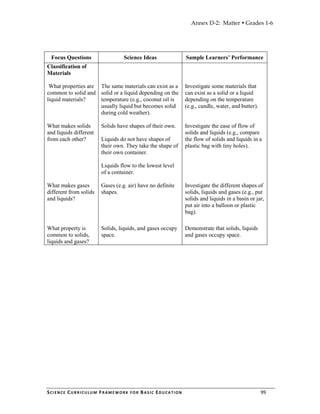
Classification of Materials
What properties are common to
solid and liquid materials?
What makes them different from
each other?
What makes gases different from
solids and liquids?
What property is common to
solids, liquids and gases?
Annex A: Focus Questions on Each Subject Area
SCIENCE CURRICULUM FRAMEWORK FOR BASIC EDUCATION 30
Grades 7 to 10
Grades 7-8 Grades 9-10
Properties and Classification of Matter
What is the basis for choosing particular materials
for specific uses at home and in industry?
What are the properties of matter?
What are the different ways of classifying matter?
How can mixtures be separated?
What are some industrial applications of methods
of separating mixtures?
Changes Matter Undergoes
What happens when matter undergoes physical
change?
When does the state of a substance change?
What happens when matter undergoes chemical
change?
What are some biological and industrial processes
that involve chemical change?
Structure of Matter
What is matter made of?
Why is it important to know about the structure
of matter?
The Periodic Table
What is the relationship between the properties
of an element and its atomic structure?
How are elements organized in the periodic
table?
Annex A: Focus Questions on Each Subject Area
SCIENCE CURRICULUM FRAMEWORK FOR BASIC EDUCATION 31
Grades 7-8 Grades 9-10
Chemical Reactions
What takes place during a chemical reaction?
What are the chemical reactions involved in
some common biological and industrial
processes?
How can you tell that a chemical reaction has
taken place?
What information does a chemical equation
provide?
Is energy involved when substances react with
each other?
Annex A: Focus Questions on Each Subject Area
SCIENCE CURRICULUM FRAMEWORK FOR BASIC EDUCATION 32
E A R T H & S P A C E
Grades 1 to 6
Grades 1-2 Grades 3-4 Grades 5-6
OUR SURROUNDINGS
What makes up our natural
surroundings?
SOIL
What makes up the land?
Why is soil important?
SOIL
What makes up soil?
In what ways does soil become
unsuitable for growing plants
and other purposes?
How can we protect the soil
from being polluted?
SOIL
Where does soil come from?
What happens to soil when it
rains?
WATER
Where does water come from?
Why is water important?
WATER
In what ways does water become
unsuitable for living things?
How can we protect our water
resources?
Why is there not enough
drinking water?
WATER
How does the Sun affect the
water on Earth’s surface?
What is the role of water in
processes that change the shape
of the land?
AIR
In what ways does air become
harmful to living things?
How can we help keep the air
clean?
WEATHER
What are the different types of
weather?
What is wind?
What seasons have you
experienced in your locality?
WEATHER
How does the weather affect
human activities?
What is the atmosphere?
What factors affect the weather?
WEATHER
What makes air move?
What are the different types of
clouds?
What weather patterns affect
your community?
Annex A: Focus Questions on Each Subject Area
SCIENCE CURRICULUM FRAMEWORK FOR BASIC EDUCATION 33
Grades 1-2 Grades 3-4 Grades 5-6
NATURAL HAZARDS
Typhoons
What happens during typhoons?
What changes can you observe
in the surroundings when a
typhoon is coming?
Earthquakes
What happens during
earthquakes?
How are different localities
affected by an earthquake?
NATURAL HAZARDS
Typhoons
How can you tell how fast
typhoon winds are?
What do the storm warning
signals mean?
Earthquakes
Where do earthquakes occur?
How would you describe an
earthquake?
Volcanic Eruptions
What happens during volcanic
eruptions?
How can you tell that a volcano
is acting up?
NATURAL HAZARDS
Typhoons
Why is the Philippines prone to
typhoons?
Earthquakes
What hazards do earthquakes
bring?
What is a tsunami?
What causes an earthquake?
Volcanic Eruptions
What do the volcano alert levels
mean?
Why are there volcanoes?
Landslides
What can trigger landslides?
Which areas are prone to
landslides?
ASTRONOMY
What natural objects can be
seen in the sky?
What changes can be observed
about the Sun and Moon?
ASTRONOMY
Why is the Sun important?
What causes day and night?
Why does the shape of the Moon
seem to change?
ASTRONOMY
How are the Sun and the
planets arranged in the solar
system?
What are stars?
Annex A: Focus Questions on Each Subject Area
SCIENCE CURRICULUM FRAMEWORK FOR BASIC EDUCATION 34
Grades 7 to 10
Grades 7-8 Grades 9-10
FEATURES OF EARTH
What are the major features of Earth?
ROCKS
What are rocks made of?
Why are rocks important?
What are the effects of mining on the economy,
society, and environment?
PLATE TECTONICS
Why are there earthquakes?
Why are there volcanoes?
Why are there mountains?
CLIMATE
What is climate?
How do people contribute to global climate
change?
What are the possible effects of global climate
change?
What can we do about global climate change?
ASTRONOMY
How is Earth different from other members of
the Solar System?
What happens as Earth goes around the Sun?
What happens as the Moon goes around Earth?
How do we benefit from space research and
exploration?
Annex B:
Focus Questions in Each Grade Range
Grades 1 to 6
Life Science
Physical Science
Earth Science
Force, Motion & Energy Matter
HUMANS
What are the external
parts of the human
body?
What are the functions
of each part?
How do the senses
work?
What makes humans
similar to each other?
What makes them
different?
What are the needs of
humans?
What health habits
should be practiced
regularly?
What are the basic
food groups?
How can common
accidents be avoided?
ANIMALS
How are animals
similar? How are they
different?
What are the functions
of each part?
What are the needs of
animals?
Where do animals
live?
FORCE AND MOTION
How do we move
objects?
ELECTRICITY
What objects need
electricity to work?
Why is electricity useful?
How can the things run
by electricity be used
safely?
LIGHT AND HEAT
What are the sources of
light and heat?
Why are light and heat
important to people?
How can we prevent
some harmful effects of
light and heat?
SOUND
What are the different
ways of making sound?
Why is sound important
to people?
CHARACTERISTICS
OF OBJECTS
AROUND US
What are different ways
of describing objects?
What are objects made
out of?
OUR
SURROUNDINGS
What makes up our
natural surroundings?
SOIL
What makes up the
land?
Why is soil important?
WATER
Where does water
come from?
Why is water
important?
WEATHER
What are the different
types of weather?
What is wind?
What seasons have you
experienced in your
locality?
NATURAL
HAZARDS
Typhoons
What happens during
typhoons?
What changes can you
observe in the
surroundings when a
typhoon is coming?
Earthquakes
What happens during
earthquakes?
How are different
localities affected by an
earthquake?
Annex B: Focus Questions in Each Grade Range
SCIENCE CURRICULUM FRAMEWORK FOR BASIC EDUCATION 37
Life Science
Physical Science
Earth Science
Force, Motion & Energy Matter
How do animals
move?
PLANTS
How are plants
similar?
How are they
different?
What are the needs of
plants?
Where do plants live?
ASTRONOMY
What natural objects
can be seen in the sky?
What changes can be
observed about the Sun
and Moon?
Annex B: Focus Questions in Each Grade Range
SCIENCE CURRICULUM FRAMEWORK FOR BASIC EDUCATION 38
Grades 3 to 4
Life Science
Physical Science
Earth Science
Force, Motion &
Energy
Matter
HUMANS
What are the parts and
functions of the major
organs of the human
body?
What are the stages in
the life cycle of
humans?
How do we acquire and
maintain good health?
What first aid procedure
is used to treat common
minor injuries?
ANIMALS
Where do animals live?
What do animals eat?
How do animals
produce their young?
Which animals are
useful?
What harm may be
caused by some
animals?
PLANTS
What are the life stages
of a flowering plant?
How are plants
propagated?
What are the uses of
plants?
What are the signs of
allergies or poisoning
by plants?
FORCE & MOTION
What causes objects to
move?
ELECTRICITY
What makes up an
electric circuit?
What materials allow an
electric current to flow
through them?
How can electricity be
used safely?
LIGHT
What happens when
light strikes opaque,
translucent, and
transparent materials?
SOUND
How is sound
produced?
How does sound travel?
PROPERTIES OF
MATERIALS
Where do we get
materials we use
everyday?
How are properties of
materials measured
accurately?
What properties of
materials make them
useful for particular
purposes?
What are some ways of
minimizing waste
materials?
CLASSIFICATION
OF MATERIALS
What properties are
common to solid and
liquid materials?
What makes them
different from each
other?
What makes gases
different from solids
and liquids?
What property is
common to solids,
liquids and gases?
SOIL
What makes up soil?
In what ways does soil
become unsuitable for
growing plants and
other purposes?
How can we protect the
soil from being
polluted?
WATER
In what ways does water
become unsuitable for
living things?
How can we protect our
water resources?
Why is there not enough
drinking water?
AIR
In what ways does air
become harmful to
living things?
How can we help keep
the air clean?
WEATHER
How does the weather
affect human activities?
What is the atmosphere?
What factors affect the
weather?
NATURAL
HAZARDS
Typhoons
Annex B: Focus Questions in Each Grade Range
SCIENCE CURRICULUM FRAMEWORK FOR BASIC EDUCATION 39
Life Science
Physical Science
Earth Science
Force, Motion &
Energy
Matter
How can you tell how
fast typhoon winds are?
What do the storm
warning signals mean?
Earthquakes
Where do earthquakes
occur?
How would you
describe an earthquake?
Volcanic Eruptions
What happens during
volcanic eruptions?
How can you tell that a
volcano is acting up?
ASTRONOMY
Why is the Sun
important?
What causes day and
night?
Why does the shape of
the Moon seem to
change?
Annex B: Focus Questions in Each Grade Range
SCIENCE CURRICULUM FRAMEWORK FOR BASIC EDUCATION 40
Grades 5 to 6
Life Science
Physical Science
Earth Science
Force, Motion &
Energy
Matter
HUMANS
How do we maintain
good health?
What do adolescents
need for normal
physical growth and
development?
How do the different
parts of the body work
together to perform
specific functions?
What changes occur in
the body during
puberty?
How are babies
conceived?
How do we avoid
getting sick?
LIVING THINGS
How are living things
classified?
How do plants make
food?
Why is it important for
humans to take care of
their environment?
MICROORGANISMS
In what ways are
microorganisms useful?
FORCE AND
MOTION
What role does
frictional force play in
daily life?
What are the effects of
gravitational force on
people and objects?
What are the effects of
magnets on objects?
ENERGY
TRANSFER &
TRANSFORMATION
How is energy
transferred from one
object to another?
Into what other forms of
energy can electrical
energy be transformed?
What are other sources
of energy for electricity
generation?
How is electricity
generated from power
stations?
ELECTRICITY
What are the ways of
connecting an electric
circuit?
How can electricity be
used safely?
LIGHT
What happens when
light strikes different
materials?
CHANGES THAT
MATERIALS
UNDERGO
What are different ways
to change properties of
materials?
What happens when
materials are mixed?
What happens when
materials are exposed to
different conditions?
SOIL
Where does soil come
from?
What happens to soil
when it rains?
WATER
How does the Sun affect
the water on Earth’s
surface?
What is the role of
water in processes that
change the shape of the
land?
WEATHER
What makes air move?
What are the different
types of clouds?
What weather patterns
affect your community?
NATURAL
HAZARDS
Typhoons
Why is the Philippines
prone to typhoons?
Earthquakes
What hazards do
earthquakes bring?
What is a tsunami?
What causes an
earthquake?
Annex B: Focus Questions in Each Grade Range
SCIENCE CURRICULUM FRAMEWORK FOR BASIC EDUCATION 41
Life Science
Physical Science
Earth Science
Force, Motion &
Energy
Matter
SOUND
What factors affect the
pitch of sound?
Volcanic Eruptions
What do the volcano
alert levels mean?
Why are there
volcanoes?
Landslides
What can trigger
landslides?
Which areas are prone
to landslides?
ASTRONOMY
How are the Sun and the
planets arranged in the
solar system?
What are stars?
Annex B: Focus Questions in Each Grade Range
SCIENCE CURRICULUM FRAMEWORK FOR BASIC EDUCATION 42
Grades 7 to 8
Life Science
Physical Science
Earth Science
Force, Motion &
Energy
Matter
STRUCTURE AND
FUNCTION:
HUMANS AND
OTHER ANIMALS
What makes up the
human body?
TAKING CARE OF
THE BODY
What are some of the
signs that something is
wrong with the health of
a person?
How are infectious
diseases transmitted?
Why are some drugs
harmful to health?
How do we maintain
good health and prevent
diseases?
STRUCTURE AND
FUNCTION: PLANTS
What enables plants to
function normally?
ECOSYSTEMS
How do organisms
relate with each other
and their environment?
FORCE AND
MOTION
How is the motion of an
object measured and
described?
How do forces affect the
motion of objects?
How do forces affect the
size, shape, strength and
stability of objects?
ENERGY
How is energy utilized
in daily life?
How are the different
sources of energy used
to generate electricity?
How does electricity
reach homes and
industries?
Why are transformers
needed in distributing
electricity?
How do motors and
generators work?
How is electrical energy
consumption measured?
PROPERTIES AND
CLASSIFICATION
OF MATTER
What is the basis for
choosing particular
materials for specific
uses at home and in
industry?
What are the properties
of matter?
What are the different
ways of classifying
matter?
How can mixtures be
separated?
What are some
industrial applications
of methods of
separating mixtures?
CHANGES MATTER
UNDERGOES
What happens when
matter undergoes
physical change?
When does the state of a
substance change?
What happens when
matter undergoes
chemical change?
What are some
biological and industrial
processes that involve
chemical change?
FEATURES OF
EARTH
What are the major
features of Earth?
ROCKS
What are rocks made
of?
Why are rocks
important?
What are the effects of
mining on the economy,
society, and
environment?
PLATE TECTONICS
Why are there
earthquakes?
Why are there
volcanoes?
Why are there
mountains?
Annex B: Focus Questions in Each Grade Range
SCIENCE CURRICULUM FRAMEWORK FOR BASIC EDUCATION 43
Grades 9 to 10
Life Science
Physical Science
Earth Science
Force, Motion &
Energy
Matter
IMMUNE SYSTEM
How does the body
protect itself from
harmful
microorganisms and
other substances?
How does the body’s
immune system
become weak?
What can be done to
boost the body’s
natural immune
system?
THE CELL
Why is the cell
important?
GENETICS
How are traits passed
from one generation to
the next?
What happens when
there are changes in the
genetic material?
How are the principles
of genetics applied to
produce new plant
varieties?
EVOLUTION AND
BIODIVERSITY
Why are there different
kinds of organisms?
How did each kind
come to be?
Why are there more
kinds of organisms in
some areas than in
others?
FORCE AND
MOTION
Why do objects move?
What happens when
objects collide?
What makes objects
move in circular
motion?
What keeps heavenly
bodies in orbit?
ENERGY
How is energy related
to work?
What happens to a
system when energy is
transferred from or to
it?
How does heat transfer
from one body to
another?
How do combustion
engines work?
How do waves travel?
What happens to waves
when they encounter
different materials?
What are the
technological
applications of sound
waves?
What makes up the
electromagnetic (EM)
spectrum?
STRUCTURE OF
MATTER
What is matter made
of?
Why is it important to
know about the
structure of matter?
THE PERIODIC
TABLE
What is the
relationship between
the properties of an
element and its atomic
structure?
How are elements
organized in the
periodic table?
CHEMICAL
REACTIONS
What takes place
during a chemical
reaction?
What are the chemical
reactions involved in
some common
biological and
industrial processes?
How can you tell that a
chemical reaction has
taken place?
What information does
a chemical equation
provide?
Is energy involved
when substances react
with each other?
CLIMATE
What is climate?
How do people
contribute to global
climate change?
What are the possible
effects of global
climate change?
What can we do about
global climate change?
ASTRONOMY
How is Earth different
from other members of
the Solar System?
What happens as Earth
goes around the Sun?
What happens as the
Moon goes around
Earth?
How do we benefit
from space research
and exploration?
Annex B: Focus Questions in Each Grade Range
SCIENCE CURRICULUM FRAMEWORK FOR BASIC EDUCATION 44
Life Science
Physical Science
Earth Science
Force, Motion &
Energy
Matter
Why is high
biodiversity important?
Health-related Issues
What are some issues
related to health
maintenance and
treatment of disease?
How are the different
types of
electromagnetic
radiation used?
What determines the
color of an object?
Annex C:
Life Science
L I F E S C I E N C E
Grades 1 to 6
Enduring Understandings
I. Organisms share common characteristics that distinguish them from
nonliving things.
II. Organisms exist in highly diverse forms.
III. Organisms interact among themselves and with their environment to
survive.
IV. The cell is the basic functional unit of organisms. All necessary life
processes occur within the cell.
V. Organisms have mechanisms and processes for passing genetic
information from one generation to the next.
VI. Organisms change over time.
VII. Humans practice health and safety measures and learn how to deal
with emergencies.
VIII. Humans develop technology to enhance the quality of life.
Essential Questions
1. How are organisms different from nonliving things?
2. How are organisms similar or different from each other?
3. How are organisms structured to ensure efficiency and survival?
4. How do energy and materials flow within an ecosystem?
5. How do organisms reproduce?
6. How is genetic information passed from parents to offspring?
7. How do new species arise?
8. How does diversity affect the stability of ecosystems?
9. How does technology enhance the quality of life?
Annex C: Life Science Grades 1-6
SCIENCE CURRICULUM FRAMEWORK FOR BASIC EDUCATION 47
Grades 1 and 2
Life science starts with inquiries about humans, animals, and plants. Topics
about humans include parts and functions of the human body, the five senses, and how
to take care of them. Based on learnings about their physical characteristics, children
learn to compare similarities and differences among them. Then, they recognize their
basic needs to grow healthy, after which they study basic food groups, right amounts
of eating them, healthy eating habits, and general safety rules at home and in school.
Since children are familiar with animals as they play and take care of their pets,
inquiry about animals includes parts and functions, similarities and differences, basic
needs, movements, and habitats. Associated with these topics are kindness and proper
care of common pet animals.
Introductory topics about flowering plants, the ones which are attractive and
interesting to children, start with inquiry about their parts and functions. This is
followed by studying similarities and differences, basic needs, and habitats. Proper care
of common plants are also discussed, especially those found in their neighborhood.
Focus Questions Science Ideas
Sample Learners’
Performance
Humans
What are the external parts of
the human body?
What are the functions of each
part?
The body is composed of the
head, torso, and limbs. Each is
composed of smaller parts and
each of these parts has a
function.
Describe the parts and
functions of the body from
head to foot.
Demonstrate how parts of the
body work together.
How do the senses work? Humans use their senses to
learn things and events in
their surroundings.
The senses work together.
The senses should be well
taken care of.
Humans use gadgets to extend
the power of their sense of
sight (e. g., eyeglasses,
magnifying lens).
Explain how each of the senses
works alone or with other
senses.
Describe learning experiences
using the senses.
Demonstrate how to take care
of the senses.
Demonstrate how to use a
magnifying lens.
What makes humans similar to
each other? What makes them
different?
People have the same body
parts but they may differ in
height, weight, and other
characteristics.
Compare similarities and
differences among humans.
Annex C: Life Science Grades 1-6
SCIENCE CURRICULUM FRAMEWORK FOR BASIC EDUCATION 48
Focus Questions Science Ideas
Sample Learners’
Performance
What are the needs of
humans?
Humans have basic needs to
survive: clean food, water,
and air.
Humans have other needs:
protective shelter and
clothing, enough rest and
sleep, recreation, and love and
care.
Cite observable characteristics
of spoiled food, contaminated
water, and dirty air.
Describe possible effects of
eating spoiled food, drinking
contaminated water, and
breathing dirty air.
Give situations to show what
will happen if their other needs
are not met.
What health habits should be
practiced regularly?
Humans need to practice
certain health habits regularly,
e.g., personal hygiene, rest,
and recreation.
Demonstrate health habits: (a)
personal hygiene; (b) before
going to sleep; (c) before,
during, and after play or
recreation; (d) during study
hours; and (e) other health
habits to avoid diseases.
Practice health habits in
school, especially during snack
and lunch time.
What are the basic food
groups?
Food may be grouped into go,
grow, and glow foods.
Go, grow, and glow foods
should be cleanly stored,
cooked, and packed.
Classify foods into go, grow,
and glow foods.
Describe the importance of go,
grow, and glow foods.
Demonstrate how to clean,
store, cook, and pack foods
cleanly.
Given samples of foods, select
which are go, grow and glow
foods.
How can common accidents
be avoided?
Accidents can be avoided if
we observe basic safety rules.
Demonstrate ways of avoiding
common accidents at home and
in school.
Annex C: Life Science Grades 1-6
SCIENCE CURRICULUM FRAMEWORK FOR BASIC EDUCATION 49
Focus Questions Science Ideas
Sample Learners’
Performance
Animals
How are animals similar?
How are they different?
What are the functions of each
part?
Most animals have the
following body parts: head,
torso, and limbs.
Most animals may have the
same body parts but these
may look differently.
Each part is made up of
smaller parts with specific
functions.
Describe the parts and
functions of common animals
by (a) drawing and labeling
them; and (b) using descriptive
adjectives.
Compare animal body parts by
(a) drawing and labeling them;
and (b) using descriptive
adjectives.
What are the needs of
animals?
Animals have basic needs:
clean water and air, and
nourishing food.
Describe the basic needs of
animals.
Describe animals which lack
any of these basic needs.
Describe the other needs of
animals.
Describe animals which lack
any of these needs.
Demonstrate how to take care
of pets properly.
Where do animals live? Animals live everywhere---in
our homes as pets, in the zoo,
in farms, in bodies of water,
and in forests.
Describe the places where
animals live.
Predict what might happen if
these places were polluted or
destroyed.
How do animals move? Animals move in different
ways depending on body
structure.
Water animals move
differently from land animals.
Describe the movements of
animals, e.g., chicks, turtles,
fish, as they eat.
Describe movements of
animals living in different
places.
Plants
What are the parts of a plant?
What are the functions of each
part?
A plant has the following
parts: roots, stem/ trunk,
branch, leaf, flower, fruit, and
seed.
Each part has corresponding
functions.
Describe the parts and
functions of a common
flowering plant by (a) drawing
and labeling them; and (b)
using descriptive adjectives.
Annex C: Life Science Grades 1-6
SCIENCE CURRICULUM FRAMEWORK FOR BASIC EDUCATION 50
Focus Questions Science Ideas
Sample Learners’
Performance
How are plants similar? How
are they different?
Plants have the same parts but
they look differently.
Compare and contrast the
different plant parts by (a)
drawing and labeling them;
and (b) using descriptive
adjectives.
What are the needs of plants? The basic needs of plants are
water, air, and sunlight.
Plants have other needs:
healthy environment, and
care.
Describe the basic needs of
plants.
Describe plants which lack any
of these basic needs.
Describe the other needs of
plants.
Describe plants which lack any
of these needs.
Where do plants live? Plants live on land, in water,
and in many other places.
Describe the different places
where plants live.
Predict what might happen if
these places were polluted or
destroyed.
Annex C: Life Science Grades 1-6
SCIENCE CURRICULUM FRAMEWORK FOR BASIC EDUCATION 51
Grades 3 and 4
The study of life sciences continues with inquiries about humans, animals, and
plants. At this level, the study of the human body is focused on its major organs and
how they work together. Then, the life stages of humans are explained. Health
education is elevated to a higher level by studying proper nutrition, the adolescent food
pyramid, and healthy eating habits.
Inquiries about animals include the following topics: what animals eat, how
animals reproduce, life stages of common animals, useful and harmful animals, and first
aid to stings and bites. On the other hand, inquiries about plants include the following
topics: seed germination, life stages of flowering plants, simple plant propagation
methods, useful and harmful plants, and first aid to stings and poisonings.
Focus Questions Science Ideas
Sample Learners’
Performance
Humans
What are the parts and
functions of the major organs
of the human body?
The major organs of the body
are the skin, the brain,
muscles, bones, heart, lungs,
stomach, intestines, liver,
kidneys, and reproductive
organs. Each of them has
specific functions.
In a drawing or model of the
human body, locate the major
organs of the body.
Describe the functions of these
major organs.
Identify the parts of the body
that work together to allow
movement.
Describe what happens to food
as it passes through the food
tube until waste goes out of
the body.
Describe what happens when
inhaled air goes into and
moves out of the body.
Trace the flow of blood to
different parts of the body.
Trace the excretion of body
wastes.
What are the stages in the life
cycle of humans?
Humans go through different
life stages: infancy, early
childhood, middle childhood,
Describe the life stages in the
life cycle of humans.
Annex C: Life Science Grades 1-6
SCIENCE CURRICULUM FRAMEWORK FOR BASIC EDUCATION 52
Focus Questions Science Ideas
Sample Learners’
Performance
adolescence, adulthood, and
old age.
The needs of the body (food,
exercise, and recreation) vary
at each stage.
Demonstrate appropriate food
and exercises for physical
fitness and mental alertness.
How do we acquire and
maintain good health?
Good health starts with proper
nutrition.
Proper nutrition means eating
the right foods in the right
amounts every day to keep the
body healthy.
The food guide pyramid
teaches the principle of eating
a variety of foods and drinking
water in the right amounts
every day.
Good eating habits help make
the body healthy.
Describe what proper nutrition
means.
Explain how to use a
Philippine food guide to make
healthy food choices every
day.
Choose food using a
Philippine food guide pyramid
during snack and lunch time.
Demonstrate healthy eating
habits during snack and lunch
time.
What first aid procedure is
used to treat common minor
injuries?
First aid remedies may be
applied to common minor
injuries.
Emergency medical service is
needed in the following
instances: severe pain,
swelling, fever, numbness or
tingling sensation, deep
wound, wound over bones (e.
g., wound over the shin),
and/or inability to use the
injured part.
Describe what a first aid kit
contains.
Demonstrate how to give first
aid to common minor injuries
such as sprains, strains, and
bruises; burns; cuts, abrasions,
and scratches; cracked skin on
hands, feet, and lips; and nose
bleeding.
Demonstrate how to seek
emergency medical service.
Animals
Where do animals live?
What do animals eat?
Animals live in varied habitats
on land and in water.
Some animals eat plants only
(herbivores), some animals eat
other animals (carnivores),
Describe the different kinds of
animals that live on land.
Describe the different kinds of
animals that live in water.
Describe the small animals
that live in the soil.
Classify animals as
herbivores, carnivores, or
Annex C: Life Science Grades 1-6
SCIENCE CURRICULUM FRAMEWORK FOR BASIC EDUCATION 53
Focus Questions Science Ideas
Sample Learners’
Performance
and others eat both plants and
animals (omnivores).
The structure of the teeth of an
animal is a clue to what the
animal eats.
omnivores.
Infer whether an animal is an
herbivore, a carnivore, or an
omnivore through the structure
of its teeth.
How do animals produce their
young?
Animals may be egg layers or
live bearers.
Some insects, e.g., butterfly,
mosquito, undergo complete
metamorphosis during their
life cycle: egg, larva, pupa,
and adult.
Some insect have incomplete
metamorphosis during their
life cycle: egg, nymph, and
adult.
Classify animals as egg layers
or live bearers.
Describe the life stages of
common insects that undergo
complete and incomplete
metamorphoses.
Identify the stages in the life
cycle of a harmful insect at
which they can be eradicated.
Which animals are useful? Animals may be sources of
food, medicine, and materials
for clothing and accessories.
Some animals can be pets.
Some help humans in very
special ways: as work animals,
and for security and protection
against danger.
Describe useful or harmful
animals.
Describe how to be kind and
take care of useful animals.
Describe how to avoid being
harmed by animals.
What harm may be caused by
some animals?
Even some useful animals
may cause diseases and harm.
Some animals may cause
allergies due to bites and
stings or poisoning.
Emergency medical service is
needed for dog bites, snake
bites and bee stings.
Make a poster to show what to
do when harmed by animals.
Annex C: Life Science Grades 1-6
SCIENCE CURRICULUM FRAMEWORK FOR BASIC EDUCATION 54
Focus Questions Science Ideas
Sample Learners’
Performance
Plants
What are the life stages of a
flowering plant?
Seed germination begins when
the seed coat breaks and the
embryonic root starts growing.
The basic factors needed for a
seed to germinate are water,
air, and the right temperature.
The life cycle of a flowering
plant has the following stages:
seed, seedling, young plant,
and mature plant.
Flowers need to be pollinated
in order to produce fruits and
seeds.
Humans, animals, wind, and
water help in pollination of
flowers.
Describe the parts and
function of a seed.
Describe the appearance of a
seed that has germinated.
Demonstrate how to germinate
seeds.
Conduct experiments which
test the basic factors needed
for seed germination.
Demonstrate how to plant
seeds that have germinated.
Trace the life stages of a
flowering plant.
Explain the role of pollination
in plant reproduction.
Demonstrate how flowers get
pollinated.
Explain the roles of flowers,
fruits, and seeds in plant
reproduction.
How are plants propagated? Plant propagation is the
process of increasing the
number of plants, at the same
time keeping their desirable
characteristics.
Plant propagation may involve
seeds or other plant parts. It
may be natural or artificial.
Demonstrate how to propagate
and take care of common
garden vegetables, medicinal
plants, and fruit trees through
different methods.
What are the uses of plants? Plants may be sources of food,
medicine, clothing, household
materials, and shelter.
They are used for landscaping
and beautification.
In the Philippines, these are
Describe useful, harmful, and
useful but sometimes harmful
plants.
Annex C: Life Science Grades 1-6
SCIENCE CURRICULUM FRAMEWORK FOR BASIC EDUCATION 55
Focus Questions Science Ideas
Sample Learners’
Performance
some important medicinal
plants: sambong, lagundi,
akapulko, and niyog-niyugan.
Some plants may be harmful
such as weeds that harm crop
plants and those that cause
itchiness and poisoning.
Demonstrate how to make an
infusion, decoction, and
poultice using medicinal
plants.
What are the signs of allergies
or poisoning by plants?
Itchiness, swelling, rashes, a
tingling sensation, difficulty in
breathing, and hives are usual
signs of allergies and
poisoning by plants.
Medical or professional help is
needed in cases of allergies
and poisoning.
Describe signs that a person
has been poisoned or has
shown allergic reactions to
plants.
Annex C: Life Science Grades 1-6
SCIENCE CURRICULUM FRAMEWORK FOR BASIC EDUCATION 56
Grades 5 and 6
At these grade levels, students learn more about the human body. They study
how different parts of the body work together to perform specific body processes. The
students also study the changes that happen to their bodies with the onset of puberty
and the different needs of the body to ensure proper growth and development.
Learners describe major groups of living things, including microorganisms and
viruses. They investigate interactions among organisms especially with humans to infer
the role of these organisms in human health, food production, and consumption. Using
varied activities, they cite ways of keeping their bodies and the environment clean to
prevent diseases. Moreover, they propose ways of protecting and conserving living
things and their environment.
Focus Questions Science Ideas
Sample Learners’
Performance
Humans
How do we maintain good
health?
What do adolescents need
for normal physical growth
and development?
Good health is maintained
through proper nutrition,
hygiene, rest, and recreation.
Adolescents have nutritional
needs that have to be met for
normal growth and
development.
Cite ways of maintaining good
health (e.g., eating a balanced
diet, drinking an adequate
amount of water daily,
obtaining a sufficient amount
of sleep regularly,
participating in regular sports
or recreational activities).
Demonstrate habits of
cleanliness needed by
adolescents.
Prepare a balanced meal based
on prescribed daily nutrition
guidelines.
Using food labels, identify the
nutrients that are present in a
food product.
Practice safety and cleanliness
in handling the food.
Describe emergency situations
(e.g., food poisoning, choking,
chemical poisoning) that
require adult intervention.
Make a poster showing what
to do in cases of emergency.
Annex C: Life Science Grades 1-6
SCIENCE CURRICULUM FRAMEWORK FOR BASIC EDUCATION 57
Focus Questions Science Ideas
Sample Learners’
Performance
How do the different parts of
the body work together to
perform specific functions?
Different parts of the body
work together to perform
specific functions for
digestion, breathing,
excretion, reproduction, and
receiving and interpreting
information from the
environment.
Using illustrations and
models, identify parts of the
human body that work
together to perform specific
functions.
Describe the different solid
and liquid food that enter the
body and the changes these
undergo as they are processed
in different parts of the body.
Trace the path of air and what
happens to it inside the body.
Explain the role of the brain
and spinal cord in body
processes.
What changes occur in the
body during puberty?
Distinctive physical changes
occur at puberty: in girls
between ages 9-12 and in
boys between ages 10-17.
At puberty, a person is
already capable of
reproduction.
Describe some physical,
mental, and emotional
changes that occur during
puberty.
Explain the possible
consequences of intimate
physical relationships.
How are babies conceived? Babies are conceived through
the process of fertilization
whereby sperm from the male
and egg from the female unite
to form a zygote. The zygote
grows and develops into a
baby.
Describe the process of
fertilization and the
development of the zygote
(fertilized egg) until the baby
is born.
How do we avoid getting
sick?
We can avoid getting sick by
observing good health
practices and maintaining
clean surroundings.
Microorganisms and viruses
cause various diseases.
Some diseases caused by
microorganisms may be
waterborne, such as typhoid;
Describe ways of preventing
diseases of the different
organs related to the different
body processes.
Give evidence that
microorganisms exist.
Identify diseases caused by
microorganisms and viruses
and enumerate ways to
Annex C: Life Science Grades 1-6
SCIENCE CURRICULUM FRAMEWORK FOR BASIC EDUCATION 58
Focus Questions Science Ideas
Sample Learners’
Performance
or airborne, such as influenza. prevent them.
Describe healthy habits to
prevent the spread of viruses
that cause diseases.
Explain why clean water and
air are important.
Report gathered information
on the effects of cigarette
smoking, alcohol intake and
use of prohibited drugs.
Produce creative work to
inform others about the
dangers of the above-
mentioned unhealthy habits
and encourage others to stay
away from them.
Living things
How are living things
classified?
The major groups of livings
things are: animals, plants,
fungi, and microorganisms.
The major vertebrate animal
groups are mammals, fishes,
reptiles, amphibians and
birds.
The major invertebrate groups
of animals are arthropods,
worms, mollusks,
echinoderms, coelenterates or
cnidarians, and sponges.
The major groups of plants
are flowering and
nonflowering plants.
Classify living things into
animals, plants, fungi, and
microorganisms.
Describe the distinguishing
characteristics of major
vertebrate animal groups.
Classify common vertebrates
belonging to the major groups.
Describe the distinguishing
characteristics of major
invertebrate animal groups.
Classify common
invertebrates according to the
major groups.
Compare the characteristics of
flowering and nonflowering
plants.
Classify common plants into
flowering and nonflowering
plants.
Annex C: Life Science Grades 1-6
SCIENCE CURRICULUM FRAMEWORK FOR BASIC EDUCATION 59
Focus Questions Science Ideas
Sample Learners’
Performance
How do plants make food? Plants make food using
energy from the sun, carbon
dioxide from the air, and
water absorbed through its
roots.
Plants form the base of the
food chain.
Test for the presence of starch
in leaves.
Test the gas released by plants
in sunlight.
Construct arrow diagrams
showing the relationship
among plants, animals, and
microorganisms.
Why is it important for
humans to take care of their
environment?
Preservation of the
environment ensures survival
of living things, including
humans.
Changes in their environment,
whether caused by natural or
human means, can affect
living things and the
relationships between them.
Many plants, animals, fungi
and microorganisms are
adapted to live on land and in
water under environmental
conditions favorable to them.
Describe interrelationships
among plants, animals, fungi
and microorganisms in
specific environments.
Analyze the effect of the loss
of a population of living
things in a food chain/a food
web.
Illustrate (e.g., flow diagram,
collage, essay, story) how a
given human activity affects a
specific ecosystem.
Participate in activities for the
protection and conservation of
living things, especially
endangered species, and their
natural environment.
Annex C: Life Science Grades 1-6
SCIENCE CURRICULUM FRAMEWORK FOR BASIC EDUCATION 60
Focus Questions Science Ideas
Sample Learners’
Performance
Microorganisms
In what ways are
microorganisms useful?
Some microorganisms
decompose dead organisms
and food wastes to return
nutrients to the soil.
Some microorganisms are
useful in fermentation of food
products.
Some microorganisms may
cause spoilage during food
preparation, storage,
distribution, and handling.
Food spoilage may be
prevented by salting, freezing,
and drying.
Investigate the effect of
microorganisms in
decomposing dead organisms
and composting.
Explain the role of
microorganisms in
fermentation (e.g., cheese and
yogurt making).
Cite evidence that food is not
fit for eating.
Describe ways of preventing
food from spoiling.
Cite advantages and
disadvantages of specific food
preservation techniques.
L I F E S C I E N C E
Grades 7 to 10
Enduring Understandings
I. Organisms share common characteristics that distinguish them from
nonliving things.
II. Organisms exist in highly diverse forms.
III. Organisms interact among themselves and with their environment to
survive.
IV. The cell is the basic functional unit of organisms. All necessary life
processes occur within the cell.
V. Organisms have mechanisms and processes for passing genetic
information from one generation to the next.
VI. Organisms change over time.
VII. Humans practice health and safety measures and learn how to deal
with emergencies.
VIII. Humans develop technology to enhance the quality of life.
Essential Questions
1. How are organisms different from nonliving things?
2. How are organisms similar or different from each other?
3. How are organisms structured to ensure efficiency and survival?
4. How do energy and materials flow within an ecosystem?
5. How do organisms reproduce?
6. How is genetic information passed from parents to offspring?
7. How do new species arise?
8. How does diversity affect the stability of ecosystems?
9. How does technology enhance the quality of life?
Annex C: Life Science Grades 7-10
SCIENCE CURRICULUM FRAMEWORK FOR BASIC EDUCATION 62
Grades 7 and 8
In this level, students learn about the interrelationships among body systems of
humans and other animals as well as of plant systems. Discussion will be at the tissue or
cellular level. Applications will focus on health practices and habits that address
adolescent issues and concerns particularly at the time of puberty. Tissue or cellular
level studies will likewise be taken up with regard to plant systems. The most important
plant processes, chief of which is photosynthesis, will be given emphasis.
Investigations on natural and managed ecosystems in the community will be
done, including the impact of human activities on environmental problems. Sustainable
practices and conservation activities will be given attention.
Focus Questions Science Ideas
Sample Learners’
Performance
Structure and Function:
Humans and Other Animals
What makes up the human
body?
Humans, as well as other
animals, have organ systems
that work together to provide
the body with nutrients and
oxygen, and remove solid,
liquid, and gaseous wastes.
They also have structures to
enable them to move and
reproduce.
All these functions are
coordinated by the nervous
and the endocrine systems.
The cell is the smallest
functional unit of all
organisms.
Describe the levels of
organization of bodies of living
things (organisms).
Illustrate with examples that
different organs working
together to perform a particular
function make up a system (e.g.,
organs related to the processes of
digestion, control and
coordination, and others taken
up in the elementary grades).
Explain the interaction of
different systems within an
organism (e.g., respiratory
system brings oxygen into the
body, and the circulatory system
brings oxygen into the body, and
the circulatory system transport
oxygen to the cells) and why
such interactions are necessary
to the organism’s survival.
Describe the parts of the cell,
including nucleus, cytoplasm,
Annex C: Life Science Grades 7-10
SCIENCE CURRICULUM FRAMEWORK FOR BASIC EDUCATION 63
Focus Questions Science Ideas
Sample Learners’
Performance
Organs are made up of
tissues, and tissues are made
up of cells.
Organisms may be unicellular
(e.g., Amoeba, bacteria) or
multicellular (e.g., vertebrates
and invertebrates).
Multicellular organisms are
made up of different types of
cells.
and cell membrane, and how
they function to support life.
Report on how scientists arrived
at the concept that the cell is the
basic unit of life.
Using a microscope, draw
unicellular organisms, or cells
from different tissues of the
animal body.
Taking Care of the Body
What are some of the signs
that something is wrong with
the health of a person?
How are infectious diseases
transmitted?
Loss of appetite, fever,
weight loss, insomnia, body
pains are some symptoms that
something is wrong with
one’s health.
Laboratory tests are done to
assess the internal physical
condition of a person.
Diseases are deviations from
the normal structure or
function of any body part,
organ, or system.
Infectious diseases are
usually caused by
microorganisms (bacteria,
fungi, or protozoa) and
viruses that invade the body.
Infectious diseases may be
transmitted in different ways:
animal to person (bird flu and
rabies), person to person
(pneumonia, tuberculosis,
HIV, and other STDs), and
person to animal to person
Interview a medical professional
about laboratory analysis results.
Demonstrate ways to prevent the
spread of diseases (e.g., personal
hygiene, environmental
cleanliness).
Propose ways to keep the
environment clean and sanitized
to prevent food-borne and water-
borne diseases in humans.
Interpret posters regarding
transmission of diseases caused
by harmful bacteria and viruses.
Annex C: Life Science Grades 7-10
SCIENCE CURRICULUM FRAMEWORK FOR BASIC EDUCATION 64
Focus Questions Science Ideas
Sample Learners’
Performance
Why are some drugs harmful
to health?
How do we maintain good
health and prevent diseases?
(schistosomiasis).
Infectious diseases can be
acquired by touching, eating,
drinking or inhaling
something that contains
disease-causing
microorganisms.
Engaging in sexual activity at
an early age may result in
reproductive health problems,
other sexually transmitted
diseases, and unplanned
parenthood.
Some drugs alter the
functioning of the central
nervous system.
Cigarettes, alcoholic drinks
and dangerous drugs are
particularly harmful to the
nervous and the endocrine
systems.
Proper precautions should be
observed in buying and taking
vitamins, medicines, cosmetic
products, and other food
supplements.
Food provides energy and
supplies building materials
for growth and development.
Balanced meals provide the
right amount of proteins, fats,
carbohydrates, vitamins,
minerals, and water.
Adequate sleep, exercise, rest
and recreation contribute to
endurance, muscular strength
and coordination, and mental
Interpret in your own words the
messages delivered by
advertisements of cigarettes, and
alcoholic drinks. Discuss
messages of informative videos
on dangerous drugs.
Role play about the possible
consequences of drug addiction,
smoking, and early sexual
activity.
Interpret instructions in labels of
vitamins, medicines and other
food supplements.
Make menus for daily meals
consisting of foods available in
the community which are rich in
proteins, fats, carbohydrates,
vitamins, and minerals.
Demonstrate habits that prevent
dehydration, and contribute to
endurance, muscular strength
and coordination, and mental
alertness.
Annex C: Life Science Grades 7-10
SCIENCE CURRICULUM FRAMEWORK FOR BASIC EDUCATION 65
Focus Questions Science Ideas
Sample Learners’
Performance
alertness.
Structure and Function:
Plants
What enables plants to
function normally?
Plants have structures to
obtain nutrients from the
environment, make their own
food, and reproduce.
Plants have structures to store
the food and distribute it
within the plant body for their
growth and development.
Plant cells differ from animal
cells.
Explain how plants obtain
nutrients from the environment,
make their own food, and
reproduce.
Give examples of plant body
parts that store food.
Identify the main differences
between plant cells and animal
cells using a compound
microscope. Discuss differences
between plant cells and animal
cells based on electron
micrographs from the book.
Ecosystems
How do organisms relate with
each other and their
environment?
Organisms interact with each
other and with the nonliving
components (abiotic factors)
of the environment.
Organisms in ecosystems
may be grouped into
producers, consumers, and
decomposers.
Energy flows through
ecosystems in one direction,
usually from the Sun, through
producers to consumers and
then to decomposers resulting
in food webs.
Decomposers break down
dead living organisms into
their constituent nutrients
which become part of the
land, water, and air.
Producers take up these
Observe an ecosystem as a
community of living organisms
interacting with each other and
with the abiotic factors of the
environment (i. e., light, water,
space, temperature, soil and
climate).
Record data and infer
interactions and
interrelationships in the observed
ecosystem.
Construct a food web to explain
the flow of energy from the Sun
to producers, consumers, and
decomposers in the farm, in
pond ecosystems, or in salt water
ecosystems.
Observe composting materials
and identify typical
decomposers. Record changes in
Annex C: Life Science Grades 7-10
SCIENCE CURRICULUM FRAMEWORK FOR BASIC EDUCATION 66
Focus Questions Science Ideas
Sample Learners’
Performance
nutrients into their bodies as
they make food for
themselves.
Nutrients move to consumers
through feeding relationships
at different levels and then to
decomposers, thus resulting
in the cycling of nutrients
between living and nonliving
factors of the environment.
The constant flow of energy
and cycling of materials result
in balance and stability in
ecosystems.
Changes caused by natural
processes (fluctuations in
populations of living
organisms; weather and
climate) and human activities
may result in imbalances in
ecosystems.
As stewards of the
environment, it is important
for humans to maintain
stability in ecosystems.
the composted material.
Investigate the effect of compost
on plant growth and
development.
Explain diagrams about feeding
relationships in different
ecosystems.
Analyze reasons on possible
results regarding disruptions in
the flow of energy and /or the
cycling of materials.
Predict the effect of losses of
prey or predator populations in
different ecosystems.
Debate on the advantages and
disadvantages of a practice or
technology (e.g., GMO crops,
conversion of agricultural lands
to residential or recreational
areas).
Discuss examples of sustainable
practices (e.g., coral reef and
mangrove rehabilitation,
establishment of marine
sanctuaries and forest reserves)
to inspire care for the
environment.
Conduct environmental
campaigns such as tree planting,
composting, non-use of plastic
bags, segregation of waste, and
burning of garbage.
Annex C: Life Science Grades 7-10
SCIENCE CURRICULUM FRAMEWORK FOR BASIC EDUCATION 67
Grades 9 and 10
In these grade levels, students learn about the body’s immune system before
they discuss issues regarding transmission of infectious diseases and dangerous drugs.
The study of cell organelles will facilitate understanding of heredity, evolution, and
biodiversity. Current issues surrounding new varieties and products produced through
genetic manipulation and engineering will be tackled in student focus group discussions.
Practical applications of these concepts will be used in raising understanding of
issues about health-related technologies as in stem cell treatment of disease, and in
campaigns against unhealthy practices such as use of dangerous drugs.
Focus Questions Science Ideas
Sample Learners’
Performance
Immune System
How does the body protect
itself from harmful
microorganisms and other
substances?
How does the body’s immune
system become weak?
What can be done to boost the
body’s natural immune
system?
Humans have an immune system
that protects them from diseases
caused by harmful microorganisms,
viruses, and other substances.
Maintaining one’s health strengthens
the body’s immune system.
Lack of sleep, poor nutrition,
smoking, excessive intake of
alcohol, use of illegal drugs, and
exposure to disease-causing
microorganisms may weaken the
immune system.
Humans need to be vaccinated to
strengthen the body’s immunity
against harmful microorganisms and
viruses.
Vaccines consist of weakened
disease-causing microorganisms that
stimulate the production of
antibodies.
Describe the body’s three lines
of defense.
Demonstrate measures to
prevent the spread of disease-
causing organisms.
Report on cases of individuals
whose immune system has been
weakened and got sick.
Review own personal records of
vaccinations received and
discuss possible consequences if
these were not given to you.
Annex C: Life Science Grades 7-10
SCIENCE CURRICULUM FRAMEWORK FOR BASIC EDUCATION 68
Focus Questions Science Ideas
Sample Learners’
Performance
The Cell
Why is the cell important?
The cell is the smallest functional
unit of an organism.
Cells are capable of carrying out all
the basic life processes, such as
reaction to stimuli, movement,
respiration, metabolism,
reproduction, and photosynthesis (in
photosynthetic organisms).
The processes that take place in the
cell are used by viruses to replicate
themselves, thus harming the
organism.
Describe the basic life processes
and the organelles in which they
take place.
Differentiate between
prokaryotic cells and eukaryotic
cells, in terms of their general
structures and degrees of
complexity based on pictures in
books.
Cite preventive measures and
advisories regarding viral
diseases given by health
authorities.
Genetics
How are traits passed from
one generation to the next?
Among sexually-reproducing
organisms, traits are passed on to
offspring through the union of
reproductive cells from both parents.
Reproductive cells, which are
formed through the process of
meiosis, contain the genes which
code for the traits.
These genes are found in the
deoxyribonucleic acid (DNA),
which is packed in chromosomes
contained in the nucleus.
The number of chromosomes
remains fixed for each kind of
organism.
Meiosis also allows variation, which
explains why offspring of the same
parents do not look exactly alike.
Genetic disorders (e.g., Down
Interpret pictures of animals
with their offspring; and
identify which trait was passed
on from parents to offspring.
Describe the structure and
function of DNA.
Explain how the fixed number
of chromosomes is maintained
through the process of meiosis
in sex cells and mitosis in body
cells.
Explain how meiosis
contributes to the genetic
variability of organisms.
Draw chromosomes during
meiosis to show Mendel’s laws
of segregation and independent
assortment.
Annex C: Life Science Grades 7-10
SCIENCE CURRICULUM FRAMEWORK FOR BASIC EDUCATION 69
Focus Questions Science Ideas
Sample Learners’
Performance
What happens when there are
changes in the genetic
material?
Syndrome) occur when the process
of meiosis does not proceed in an
orderly manner.
In organisms that reproduce
asexually, the exact set of genetic
material is inherited by the
offspring.
Mutation occurs when there are
permanent changes in the genetic
material. This may be caused by
substances from the environment
that gains entry into the cells or may
occur spontaneously.
Mutations may be harmful,
beneficial or have no effect on the
individual organism’s survival.
Mutations that occur in the
reproductive cells may be passed on
to the next generation.
Interpret diagrams which show
cell division in organisms such
as bacteria and other one-celled
organisms.
Explain how mutations in the
DNA sequence of a gene may
be silent or result in phenotypic
change in an organism and in its
offspring.
How are the principles of
genetics applied to produce
new plant varieties?
In plants, desired traits (e.g., disease
or pest resistance, shorter crop life
cycle, stress tolerance and
productive yield) may be made to
come out through cross-breeding
techniques and manipulation of the
genetic material.
Through cross-breeding, plants can
carry multiple sets of chromosomes,
allowing for greater variation.
Cite examples and show
pictures of plants improved
through genetic manipulation
and cross-breeding techniques
(e.g., different colors of flower,
leaf variegation).
Annex C: Life Science Grades 7-10
SCIENCE CURRICULUM FRAMEWORK FOR BASIC EDUCATION 70
Focus Questions Science Ideas
Sample Learners’
Performance
Evolution and Biodiversity
Why are there different kinds
of organisms? How did each
kind come to be?
Why are there more kinds of
organisms in some areas than
others?
Why is high biodiversity
important?
When changes in the genetic
material (mutations) result in
individuals that can no longer
reproduce with members of the
original population of organisms, a
different kind of organism (species)
evolves.
There are more kinds of organisms
in the tropics than in temperate
regions. Scientists propose varied
reasons for this observation.
Biodiversity promotes stability in a
constantly changing environment.
Biodiversity provides a wider range
of resources for food, medicine, fuel
and other essential needs of human
and other living organisms.
Evolution and biodiversity are the
results of genetic changes.
Extinction of species may occur
when the adaptive characteristics of
a species are insufficient to permit
its survival in a changing
environment.
Explain how the processes of
genetic mutation and natural
selection are related to the
evolution of species.
Write an essay on the question:
Why is biodiversity higher in the
tropics than in higher latitudes?
Report on/ show pictures of
Philippines species included in
the Red List of International
Union for Conservation of
Nature (IUCN).
Plan advocacy activities for
your community on ways of
protecting endangered and
threatened species.
Annex C: Life Science Grades 7-10
SCIENCE CURRICULUM FRAMEWORK FOR BASIC EDUCATION 71
Focus Questions Science Ideas
Sample Learners’
Performance
Health-related Issues
What are some issues related
to health maintenance and
treatment of disease?
Scientific research has paved the
way for the development of new
cures and treatments (e.g., stem cell
treatment, hormone treatment).
There may be varied perspectives
regarding the use of these new
treatments.
Conduct debates on the pros and
cons of issues (e.g., stem cell
treatment) arising from the use
of different technologies in
treating diseases.
Write a reaction paper on
controversial medical practices
(e.g., sources of organs for
transplant).
Prepare a poster about your
group’s stand on an issue (e.g.,
an item in the reproductive
health bill).
Annex D:
Physical Science
1 Force, Motion, and Energy
F O R C E , M O T I O N , A N D E N E R G Y
Grades 1 to 6
Enduring Understandings
I. Matter and energy interact. Their interaction involves forces.
II. There are four basic forces in nature: gravitational force, electromagnetic
force, strong nuclear force, and weak nuclear force. These forces have
different characteristics and vary in strength.
III. Forces can change the shape and motion of objects. Changes in the motion
of an object depend on the strength and direction of the applied force.
IV. Energy exists in many forms. It can be transferred and transformed. During
these processes, the total energy remains the same.
V. Technologies are available for harnessing energy from various sources. Each
energy resource has its advantages and disadvantages.
VI. Energy resources should be used wisely and managed properly because
they can impact living conditions and the environment.
VII. Energy is involved whenever change occurs in matter.
VIII. The amount of matter and energy in the universe remains the same.
Essential Questions
1. What is energy?
2. How is energy used in daily life? What energy options are available for
particular purposes?
3. How are force and energy related?
4. What happens to the energy in a system – where does the energy come
from, how is it changed within the system and where does it ultimately go?
How does the energy flow affect the materials in the system?
5. What phenomena are related to the interaction of different forms of energy
with materials? What changes take place in these interactions?
6. How do the conservation of energy principle and the concept of efficiency
apply to interactions?
7. What safety measures are associated with the use of different forms of
energy?
8. How do energy resources development and use in daily life impact the
environment?
9. How do advances in energy-related technology affect the quality of our lives?
Annex D-1: Force, Motion and Energy Grades 1-6
SCIENCE CURRICULUM FRAMEWORK FOR BASIC EDUCATION 74
Grades 1 and 2
At this stage, children observe, explore, and ask questions about materials and objects
around them. They use first-hand experience and simple information sources to answer
questions. They follow simple instructions to reduce the risks to themselves and to others. They
explore using the senses of sight, hearing, smell, touch, and taste, and record observations. They
communicate what happens in a variety of ways (e.g., telling and drawing). They make simple
comparisons and identify simple patterns or associations; compare what happens with what
they expected to happen, and try to describe it in their own words.
Children manipulate objects by pushing, pulling, throwing, rolling, or dropping on the
ground. They construct simple toys which can be moved by wind and water. The concepts of
electricity, light, heat, and sound are introduced but they are not yet identified as forms of
energy. Instead, the importance of these different forms of energy to people and the safety
precautions needed in using them are highlighted.
Focus Questions Science Ideas
Sample Learners’
Performance
Force and Motion
How do we move objects? Objects can be moved in
different ways, e.g., by
pushing, pulling, dropping,
kicking, and turning.
Some objects are easy to
move; some are difficult to
move.
People, animals, wind,
magnets, and flowing water
can cause objects to move.
Demonstrate ways in making
an object move.
Given different actions,
identify which involves
pulling (e.g., flying a kite) and
pushing (kicking a ball).
Given different actions, tell
which objects are easier to
move.
Describe how people and
animals can cause objects to
move (e.g. basketball player:
throwing a ball; horse: pulling
a cart).
Investigate the effects of
magnets on different objects
(e.g. pins will be moved by a
magnet, whereas plastic beads
will not).
Construct simple toys that can
be moved by wind (e.g. wind
wheel) and flowing water (e.g.
water wheel).
Annex D-1: Force, Motion and Energy Grades 1-6
SCIENCE CURRICULUM FRAMEWORK FOR BASIC EDUCATION 75
Focus Questions Science Ideas
Sample Learners’
Performance
Investigate how the speed of
wind affects an object (e.g.
blowing above and below a
soap bubble).
Electricity
What objects need electricity
to work?
Why is electricity useful?
How can the things run by
electricity be used safely?
Some objects (e.g., fluorescent
lamp, electric fan, and
television) need electricity
from outlets.
Some objects (e.g., camera,
wall clock) need electricity
from batteries.
Electricity can be used to
produce light, sound, heat, and
motion.
Accidents related to electricity
can be prevented by observing
safe practices.
Name things at home and
school that use electricity.
Using pictures, choose the
objects that need electricity to
work.
Demonstrate how to put the
batteries correctly on things
like toys and flashlights.
Group things that produce
light, sound, heat and motion
due to electricity (e.g., light –
bulb, fluorescent lamp; sound
– stereo, television; heat –
oven, flat iron; motion –
electric fan, washing
machine).
Using posters or drawings, put
a check mark on practices that
will avoid accidents in using
electricity.
Light and Heat
What are the sources of light
and heat?
Why are light and heat
important to people?
The Sun is the main source of
light and heat on Earth.
Light is needed in order to see
things.
When there is little or no light
from the Sun, we need other
kinds of light to see (e.g., light
bulb, lighted candle).
Heat is used in many ways,
e.g., cooking food, making
tools, drying grains.
Name sources of light and
heat.
Show that you need light to
see objects.
Given a set of drawings, check
objects that give off heat.
Annex D-1: Force, Motion and Energy Grades 1-6
SCIENCE CURRICULUM FRAMEWORK FOR BASIC EDUCATION 76
Focus Questions Science Ideas
Sample Learners’
Performance
How can we prevent harmful
effects of light and heat?
Other sources of light and heat
are fire and light bulbs.
Overexposure to sunlight can
cause sunburn.
Staring at the Sun and bright
lights can damage the eyes.
Suggest ways to prevent
getting sunburn on the beach
or while playing outdoors.
Sound
What are the different ways of
making sound?
Why is sound important to
people?
Talking, clapping, and tapping
objects are some ways of
making sound.
Sounds may be loud or soft.
Sounds tell people what to do,
warn them of danger, help
them to relax.
Demonstrate ways of making
sounds.
Demonstrate how to make a
loud sound and a soft sound
(e.g., tapping the table hard
will produce a loud sound
while tapping it lightly will
produce a soft sound).
Given some sounds, tell what
the sounds mean (e.g., church
bells ringing; sirens wailing
from fire truck, dogs barking,
alarm clock ringing, or music
produced by different
instruments)
Annex D-1: Force, Motion and Energy Grades 1-6
SCIENCE CURRICULUM FRAMEWORK FOR BASIC EDUCATION 77
Grades 3 and 4
At this stage, the children continue to describe and manipulate objects but this time
scientific terms such as force and electric circuit are introduced. The concept of electricity, light,
and sound are discussed but are not yet identified as forms of energy. Instead, their different
properties and safety precautions in using them are investigated.
Focus Questions Science Ideas
Sample Learners’
Performance
Force and Motion
What causes objects to move? Pushing or pulling can make
objects move.
Pushing or pulling can also
change the size, shape, and
direction of the movement of
an object.
A push or a pull is called
force.
The motion of an object
depends on the strength and
direction of the force.
A force is needed to slow
down, speed up, stop, or
change the direction of a
moving object.
Forces can be measured (e.g.,
using spring scales) and their
values can be compared.
Describe the effects of force
on objects (e.g., a toy car goes
forward when pushed and goes
backward when pulled; a clay
dough changes in size and
shape when pressed or
stretched)
Demonstrate the effect of
forces to the direction of the
motion of the object (e.g., right
push for right movement of the
object).
Investigate the effect of the
strength of force to the motion
of the object.
Investigate how forces can
change the motion of objects.
Measure force using a spring
scale.
Electricity
What makes up an electric
circuit?
An electric circuit is
composed of a power supply
(e.g. electrical outlet or
battery), connecting wires, and
a load (e.g. light bulb, TV,
electric fan).
An electric circuit works when
the parts are connected
properly.
Investigate how to make a
flashlight bulb light using a
battery and connecting wires.
Annex D-1: Force, Motion and Energy Grades 1-6
SCIENCE CURRICULUM FRAMEWORK FOR BASIC EDUCATION 78
Focus Questions Science Ideas
Sample Learners’
Performance
What materials allow an
electric current to flow
through them?
How can electricity be used
safely?
Some materials (e.g., steel,
aluminium, iron, and water)
allow electric current to pass
through.
Some materials (e.g., wood,
cloth, and plastic) do not allow
electric current to pass
through.
Accidents related to electricity
can be prevented by observing
safe practices.
Investigate materials that
conduct electricity by using an
electric circuit.
Name ways to use electricity
safely (e.g., do not touch the
water in the pail when a heater
is still plugged in; do not touch
bare electrical wires; inform
adults when there are exposed
wires in the house).
Explain why electricians wear
shoes with rubber soles when
working with appliances and
tools that use electricity.
Light
What happens when light
strikes opaque, translucent,
and transparent materials?
Light passes through
transparent materials.
Light is blocked by opaque
materials.
Some light passes through
translucent materials.
When light strikes translucent
and opaque materials,
shadows are formed.
Classify materials into
transparent, translucent, and
opaque (e.g., glass-transparent;
white plastic grocery bag-
translucent; wood-opaque).
Name uses of transparent,
translucent, and opaque
materials (e.g., food in a
plastic wrap can be easily seen
without opening it; glare from
sunlight is reduced by frosted
glass windows; dark-colored
containers are used to protect
food, drink and medicines
from light).
Investigate how the size and
shape of the shadows change
with the distance of the object
from the light source.
Sound
How is sound produced? Sound is produced by Produce sounds using wind,
Annex D-1: Force, Motion and Energy Grades 1-6
SCIENCE CURRICULUM FRAMEWORK FOR BASIC EDUCATION 79
Focus Questions Science Ideas
Sample Learners’
Performance
How does sound travel?
vibrating objects.
Different objects produce
different sounds.
Sound travels in all directions
from the source.
Sound requires a medium
(solids, liquids, and air) to
pass through.
Sound gets fainter as it travels
farther away from the source.
percussion, and stringed
instruments.
Produce sounds using different
objects.
Demonstrate that sound can
travel in all directions.
Demonstrate that sound can
travel through solids, liquids,
and air (e.g., placing a
vibrating tuning fork in a
shallow container with water).
Relate the distance of the
source of the sound based on
the sound it makes.
Annex D-1: Force, Motion and Energy Grades 1-6
SCIENCE CURRICULUM FRAMEWORK FOR BASIC EDUCATION 80
Grades 5 and 6
At this stage, the children continue to investigate and manipulate objects. They ask
questions which can be investigated scientifically. This time electricity, light, heat, and sound are
introduced as forms of energy. The relationship of force and energy is also emphasized. The
children will continue to explore the properties of the different forms of energy. The safety
precautions related to the different forms of energy are reinforced.
Focus Questions Science Ideas
Sample Learners’
Performance
Force and Motion
What role does frictional force
play in daily life?
What are the effects of
gravitational force on people
and objects?
What are the effects of
magnets on objects?
Frictional force or friction
causes objects in motion to
slow down or stop. It can also
prevent an object from starting
to move.
Frictional force occurs when
two surfaces in contact rub
against each other.
Gravitational force pulls all
objects downward towards the
ground.
The amount of gravitational
force between two objects
depends on their masses and
the distance between them.
An object has weight because
of gravitational force acting
between the Earth and the
object.
Magnets exert a force on
objects. A magnet can push or
pull another magnet.
Every magnet has a North and
South pole.
Investigate the factors that
affect friction (e.g., types of
surfaces in contact, how hard
the two surfaces are pressed).
Cite situations where friction
is useful (e.g., our shoes do
not slip because of friction)
and when it is a problem (e.g.,
stuck windows or doors).
Name ways to reduce friction
(e.g., use lubricants).
Cite effects of gravitational
force on people and objects
(e.g., it is more difficult
climbing a mountain slope
than going down; it is harder
to climb up a stairs than going
down; objects thrown upward
will fall).
Investigate the force exerted
by a magnet on an object at
different distances.
Investigate how a magnetic
compass behaves when placed
near a magnet.
Annex D-1: Force, Motion and Energy Grades 1-6
SCIENCE CURRICULUM FRAMEWORK FOR BASIC EDUCATION 81
Focus Questions Science Ideas
Sample Learners’
Performance
Magnets will repel when like
poles are placed near each
other, and attract when unlike
poles are placed near each
other.
A wire carrying a current
behaves like a magnet. This is
called an electromagnet.
Investigate how two magnets
behave when (1) they are
placed pole to pole; (2) one of
the magnets is turned 180o
.
Investigate ways to increase
the strength of an
electromagnet.
Energy Transfer and
Transformation
How is energy transferred
from one object to another?
Into what other forms of
energy can electrical energy be
transformed?
What are other sources of
energy for electricity
generation?
Energy is transferred to
objects when force is applied.
Energy is the ability to do
work.
Work is done when the force
exerted on an object causes it
to move.
Simple machines are devices
that make work easier and
faster.
Lever, pulley, wheel and axle,
inclined plane, and gear are
simple machines.
Electrical energy can be
transformed into light, heat,
and sound through electrical
devices.
Electrical energy, light, heat,
and sound are some of the
forms of energy.
Energy can be obtained from
fossil fuels, wind, the Sun,
running water, and heat from
the ground.
Investigate how a specific
simple machine can make
work easier (e.g., multiplies
the force; changes the
direction of force).
Give examples of energy
transformation observed in the
house (e.g., radio – electrical
energy to sound; electric lamp
– electrical energy to light;
oven toaster – electrical
energy to heat and light).
Research on what source of
energy for electricity
generation is used in your
community.
Annex D-1: Force, Motion and Energy Grades 1-6
SCIENCE CURRICULUM FRAMEWORK FOR BASIC EDUCATION 82
Focus Questions Science Ideas
Sample Learners’
Performance
How is electricity generated
from power stations?
Electricity can be generated
from power plants. In power
plants, turbines are turned to
move generators, which
generate electricity.
A hydroelectric power plant
uses water stored in a dam.
The water is made to flow
down a pipe to turn the
turbines.
A geothermal power plant
uses heat from the Earth.
Steam from the Earth’s crust is
made to flow through a pipe to
turn the turbine.
Describe how electricity is
generated from geothermal
and hydroelectric power
plants.
Electricity
What are the ways of
connecting an electric circuit?
How can electricity be used
safely?
Electrical circuits can be
connected in series or in
parallel.
A closed circuit is needed in
order for light bulbs and other
electrical appliances to work.
Accidents related to electricity
can be prevented by observing
safe practices.
Demonstrate how to connect
bulbs in series and in parallel.
Name ways to use electricity
safely (e.g., avoid plugging
too many electrical devices to
a single wall outlet; do not buy
electrical devices that do not
have the ICC [International
Code Council] mark).
Light
What happens when light
strikes different materials?
Light is reflected when it
strikes a surface.
Light bends when it passes
from one medium to another
(e.g., air to water).
Demonstrate reflecting
sunlight using plane mirrors.
Demonstrate phenomena
showing that light bends as it
passes from one material to
another.
Annex D-1: Force, Motion and Energy Grades 1-6
SCIENCE CURRICULUM FRAMEWORK FOR BASIC EDUCATION 83
Focus Questions Science Ideas
Sample Learners’
Performance
Light is split into different
colors when it strikes certain
materials (e.g. prism, water
droplets).
Demonstrate how a rainbow is
formed using prism and water
droplets.
Sound
What factors affect the pitch of
sound?
The pitch of sounds depends
on properties (e.g., thickness,
length, amount of stretch) of
the vibrating materials.
Investigate the factors that
affect pitch.
Construct toys that produce
sounds with various pitches.
F O R C E , M O T I O N , A N D E N E R G Y
Grades 7 to 10
Enduring Understandings
I. Matter and energy interact. Their interaction involves forces.
II. There are four basic forces in nature: gravitational force, electromagnetic
force, strong nuclear force, and weak nuclear force. These forces have
different characteristics and vary in strength.
III. Forces can change the shape and motion of objects. Changes in the motion
of an object depend on the strength and direction of the applied force.
IV. Energy exists in many forms. It can be transferred and transformed. During
these processes, the total energy remains the same.
V. Technologies are available for harnessing energy from various sources. Each
energy resource has its advantages and disadvantages.
VI. Energy resources should be used wisely and managed properly because
they can impact living conditions and the environment.
VII. Energy is involved whenever change occurs in matter.
VIII. The amount of matter and energy in the universe remains the same.
Essential Questions
1. What is energy?
2. How is energy used in daily life? What energy options are available for
particular purposes?
3. How are force and energy related?
4. What happens to the energy in a system – where does the energy come
from, how is it changed within the system and where does it ultimately go?
How does the energy flow affect the materials in the system?
5. What phenomena are related to the interaction of different forms of energy
with materials? What changes take place in these interactions?
6. How do the conservation of energy principle and the concept of efficiency
apply to interactions?
7. What safety measures are associated with the use of different forms of
energy?
8. How do energy resources development and use in daily life impact the
environment?
9. How do advances in energy-related technology affect the quality of our lives?
Annex D-1: Force, Motion and Energy Grades 7-10
SCIENCE CURRICULUM FRAMEWORK FOR BASIC EDUCATION 85
Grades 7 and 8
During the first two years of high school, learners build on their scientific knowledge and
understanding of force, motion, and energy through the processes of inquiry. They use their
acquired and existing knowledge of these concepts to explain phenomena and events. Graphs,
diagrams, and equations are used to quantitatively and qualitatively analyze the motion of an
object in terms of their position, speed, and direction. They predict or describe the motion of
objects and the possible outcome brought about by interactions between or among them.
Students learn how electricity is generated from varied sources. They can now trace
how electrical energy produced in power plants are distributed or transmitted to the community
and homes. At this stage, students begin to understand and appreciate the role of motors,
generators, and transformers in the generation, distribution and utilization of electricity. As they
gain a deeper understanding of the transformation and transfer of energy, students can
determine the advantages and disadvantages of using the different sources of energy to
generate electricity and reflect on the implications of using a particular energy resource.
Focus Questions Science Ideas
Sample Learners’
Performance
Force and Motion
How is the motion of an
object measured and
described?
The motion of an object can
be described in terms of its
position, direction of motion,
and speed.
The motion of an object can
be measured and represented
in different ways.
Illustrate the motion of objects
using vector diagrams, tables, and
graphs of position, velocity, or
acceleration against time.
Analyze and interpret graphs of
position, velocity, or acceleration
against time, using empirical data.
Use graphs or equations to calculate
the distance covered, displacement,
speed, velocity and acceleration of a
moving object.
Annex D-1: Force, Motion and Energy Grades 7-10
SCIENCE CURRICULUM FRAMEWORK FOR BASIC EDUCATION 86
Focus Questions Science Ideas
Sample Learners’
Performance
How do forces affect the
motion of objects?
How do forces affect the
size, shape, strength and
stability of objects?
Two or more forces acting
on an object produce a net
force equal to zero
(balanced) or greater than
zero (unbalanced).
A net force greater than zero
causes changes in the
object’s speed and/or
direction.
The change in the motion of
an object depends on the
amount and direction of the
net force acting on it.
An object is stretched if the
forces acting on it are
directed away from each
other. It is compressed if the
forces are acting toward
each other.
Structures can be designed
in different ways to
withstand certain loads and
destructive forces.
An object is stable if its
center of gravity lies nearer
its base.
Show through a diagram, that two
or more forces acting on an object
may add up or cancel out each other
to produce a net force greater than
or equal to zero.
Investigate how balanced and
unbalanced forces affect the motion
of an object.
Investigate the effects of
unbalanced forces on the size,
shape, strength and stability of
objects.
Using limited set of materials,
design the tallest free standing
bridge which can accommodate a
certain amount of load.
Investigate the factors affecting the
stability of an object.
Energy
How is energy utilized in
daily life?
The Sun emits energy in the
form of heat and light.
Energy from the Sun can be
transformed into other
forms.
When energy is transformed
into other forms, heat is
released to the environment.
Show by examples how the
different forms of energy are used
for specific purposes.
Describe how energy is transformed
from one form to another.
Gather observations to show that
transformation of energy involve
the production of heat.
Annex D-1: Force, Motion and Energy Grades 7-10
SCIENCE CURRICULUM FRAMEWORK FOR BASIC EDUCATION 87
Focus Questions Science Ideas
Sample Learners’
Performance
How are the different
sources of energy used to
generate electricity?
How does electricity reach
homes and industries?
The energy from water,
wind, heat from the Earth’s
interior, and fossil fuels can
be used to generate
electricity in power plants.
Heat from burning fuels is
used to convert water into
steam, which in turn runs the
turbine. The turbine then
makes the generator rotate
and this generates electricity.
The wind, water, and steam
from the Earth are also used
to turn the turbines.
Nuclear energy is used in
many countries to generate
electricity but there are
many issues confronting its
use and the disposal of waste
materials.
The electricity produced at
the power plant is distributed
to neighboring communities
through transmission lines
and transformers.
Transformers are used to
Research and describe how
different types of power plants
generate electricity.
List the energy transformations that
take place between the raw material
of the energy resource and the
production of electricity.
Compare energy resources in terms
of availability, current uses and
environmental issues related to their
use to produce electricity.
Determine the advantages and
disadvantages of using the different
sources of energy to generate
electricity (cost of building power
stations, the reliability of the energy
source, the relative cost of energy
generated, the location in which the
energy is needed and environmental
impact).
Research on technological
innovations that help solve
problems related to the use of
energy sources (e.g., alternative fuel
cars).
Present both the positive and
negative implications of nuclear
power plants, as an alternative
source of energy in the Philippine
context, through debate/role
playing.
Trace, using diagrams, the
transmission and distribution of
electricity from power plants to the
communities.
Annex D-1: Force, Motion and Energy Grades 7-10
SCIENCE CURRICULUM FRAMEWORK FOR BASIC EDUCATION 88
Focus Questions Science Ideas
Sample Learners’
Performance
Why are transformers
needed in distributing
electricity?
increase the voltage from the
power station for long
distance transmission. At the
other end, they are used to
reduce the voltage for
distribution to homes and
industries.
The voltage distributed in
the Philippines is 220 volts.
Electrical appliances which
require voltage lower than
220 volts must be connected
to a transformer to operate.
In the transformer, the
alternating current in the
primary coil produces a
changing magnetic field in
the secondary coil, thereby
producing current through it.
Explain what will happen if you
plug a 110-volt appliance to a 220-
volt outlet.
Construct a model of a transformer.
How do motors and
generators work?
Magnetic fields are regions
of space where magnetic
materials experience forces.
Permanent magnets and
moving charges (electric
current) are sources of
magnetic fields.
When electricity passes
through a coil that is in the
presence of a magnetic field,
it will move and twist.
If an electrical coil is moved
through a magnetic field,
current will be induced in
the coil.
Explore the magnetic field around a
permanent magnet and wire
carrying current using magnetic
materials, iron sand, and magnetic
compasses.
Construct a simple motor to
demonstrate energy transformation
Use a generator to demonstrate how
electricity is produced in a circuit.
Use improvised simple d.c. motor
and generator to demonstrate how
electrical energy is transformed to
mechanical energy and mechanical
energy to electrical energy
respectively.
Explain how generators and
transformers work on the principle
of electromagnetic induction.
Annex D-1: Force, Motion and Energy Grades 7-10
SCIENCE CURRICULUM FRAMEWORK FOR BASIC EDUCATION 89
Focus Questions Science Ideas
Sample Learners’
Performance
How is electrical energy
consumption measured?
Different electrical
appliances consume varying
amounts of electrical energy.
The total amount of
electrical energy used
depends on the wattage
(energy consumption) of the
electrical appliance and the
amount of time it is used.
Compare wattage of different light
bulbs and appliances available at
homes.
Compare your family’s monthly
average electrical energy
consumption with that of your
groupmates. Explain why some
families consume more than others.
Describe ways of reducing
electrical energy consumption in the
home or school.
Research and report on factors to
consider (e.g., wattage, duration of
use, life span) when buying or using
an electrical appliance.
Annex D-1: Force, Motion and Energy Grades 7-10
SCIENCE CURRICULUM FRAMEWORK FOR BASIC EDUCATION 90
Grades 9 and 10
At grades 9 and 10, students use the laws and principles associated with motion,
gravitational force, and energy conservation to explain the different phenomena observed. They
develop understanding of the efficiency of mechanical devices by designing and building
structures, and investigating their efficiency according to some factors. They learn about
technological advances in medicine, communications, and transportation. They also use their
knowledge of the behavior, properties, and characteristics of waves to explain their applications
in technology and evaluate their impact on society and the environment.
Focus Questions Science Ideas
Sample Learners’
Performance
Force and Motion
Why do objects move?
What happens when
objects collide?
An object at rest will remain at
rest while a moving object will
continue moving unless an
unbalanced force acts upon it.
The greater the unbalanced
force acting on an object, the
larger the change in its motion.
The more massive the object,
the greater the unbalanced force
needed to achieve the same
change in motion.
Whenever an object exerts a
force on another object, the
second object exerts an equal
and opposite force on the first.
Mass and velocity affect the
momentum of moving objects.
Use Newton’s laws of motion to
explain or predict different
patterns of motion of objects
(e.g., linear and uniform circular
motion, velocity and acceleration,
momentum and inertia).
Given two cars of different
masses travelling at the same
speed, predict what the outcome
will be if they collide.
Given two cars of the same mass
travelling at different speeds,
predict what the outcome will be
if they collide.
Conduct experiments to illustrate
conservation of momentum.
Annex D-1: Force, Motion and Energy Grades 7-10
SCIENCE CURRICULUM FRAMEWORK FOR BASIC EDUCATION 91
Focus Questions Science Ideas
Sample Learners’
Performance
What makes objects
move in circular motion?
What keeps heavenly
bodies in orbit?
Objects in circular motion
experience a force pulling them
toward the center.
Two objects pull on each other
with a force that depends on
their masses and the distance
between them. The heavenly
bodies are held in their orbits
by such a force (gravitational
force).
The greater the masses, the
greater is the gravitational
force; the greater the distance,
the smaller the gravitational
force.
Using a model, demonstrate how
centripetal force causes an object
to move in circular motion.
Given the masses of several
planets and the distances between
them, compare the gravitational
force between selected planets.
Energy
How is energy related to
work?
When a force is applied on a
body and causes it to move
through a distance, work is
done on it.
When work is done on a body,
energy is transferred to it.
The energy used to overcome
friction is transformed mostly
into heat so no machine can be
100% efficient and cannot
generate more energy than was
put into it.
The greater the percentage of
the energy that is usefully
transformed in a device, the
more efficient it is.
Use the relationship between
work and force to calculate the
work done on or by the system.
Explain the relationship between
work and energy using various
samples of simple machines.
Perform simple experiment to
demonstrate the idea, “The work
out is less than the work in.”.
Evaluate the effectiveness of
some existing methods used to
increase the efficiency of
machines.
What happens to a
system when energy is
transferred from or to it?
Whenever energy is transferred
from or to a system, its energy
tends to become more
Annex D-1: Force, Motion and Energy Grades 7-10
SCIENCE CURRICULUM FRAMEWORK FOR BASIC EDUCATION 92
Focus Questions Science Ideas
Sample Learners’
Performance
dispersed. The overall effect is
that the energy is spread out
uniformly, but the total amount
of energy never changes.
When energy is transferred
from or to a system, some of its
measurable characteristics
change. These measured
characteristics can be used to
determine how much energy
was transferred to the system.
The Law of Conservation of
Energy can be used to predict
and describe the motion of
objects.
Determine the amount of energy
transferred to or from a body
using the measured changes in its
characteristics (e.g. speed for
kinetic energy; height for
gravitational potential energy).
Use equations, diagrams or
models (e.g. roller coaster model,
pendulum and yoyo) to describe
the transformation of potential
energy into kinetic energy and
vice versa. Describe at what point
is the kinetic energy maximum
and the potential energy
minimum and vice versa.
How does heat transfer
from one body to
another?
How do combustion
engines work?
Heat transfers from one body to
another because of temperature
difference. The larger the
temperature difference, the
faster the rate at which heat is
transferred.
Internal combustion engines,
such as vehicle engines and
refrigerators, do work by
transferring heat from one
system to another.
The efficiency of engines
depends on the temperature
difference between the hot and
cold reservoirs.
Investigate how heat transfers
from one material to another or
the surroundings.
Using models, demonstrate how
heat is transferred and
transformed in internal
combustion engines.
How do waves travel? Some waves, e.g., sound,
require a material through
which it can travel. Some
waves, e.g., electromagnetic
waves, travel in empty space.
Use a wave model to demonstrate
how wave travels through a
material.
Use a model to show the
relationship among frequency,
Annex D-1: Force, Motion and Energy Grades 7-10
SCIENCE CURRICULUM FRAMEWORK FOR BASIC EDUCATION 93
Focus Questions Science Ideas
Sample Learners’
Performance
What happens to waves
when they encounter
different materials?
What are the
technological
applications of sound
waves?
Waves can be described in
terms of their frequency,
amplitude, wavelength, and
wave velocity.
Waves can be transmitted,
absorbed or scattered by
different materials.
Ultrasonic waves can be used to
produce images of objects
inside the body.
Sound waves travel in all
directions; this property is used
in designing structures and
technological devices (e.g.,
concert hall and musical
instruments).
amplitude, wavelength, and wave
velocity.
Observe and describe basic
properties of both longitudinal
and transverse wave.
Determine the speed of wave
using wavelength and frequency.
Investigate on factors affecting
the speed of sound (e.g. kind of
materials and temperature) and
infer that sound travels with
different speeds through a
material.
Report on the different
applications of sound waves in
medicine and other industries
(e.g., ultrasound imaging, radar,
ultrasonic/supersonic devices).
What makes up the
electromagnetic (EM)
spectrum?
How are the different
types of electromagnetic
radiation used?
The electromagnetic spectrum
is composed of different types
of electromagnetic radiation.
The different wavelengths of
electromagnetic radiation have
different uses and harmful
effects on humans.
Highly energetic types of EM
radiation may be harmful to
Given an illustration of an EM
spectrum, differentiate the types
of electromagnetic radiation,
namely radio waves, microwaves,
infrared rays, visible light,
ultraviolet rays, X-rays, and
gamma rays, in terms of their
properties and characteristics.
Use the properties and
characteristics of different types
of EM radiation to explain their
specific uses (e.g. microwaves,
radio waves, infrared rays and
visible light for communication;
ultraviolet for sterilizing, gamma
Annex D-1: Force, Motion and Energy Grades 7-10
SCIENCE CURRICULUM FRAMEWORK FOR BASIC EDUCATION 94
Focus Questions Science Ideas
Sample Learners’
Performance
What determines the
color of an object?
humans.
EM waves carry energy as they
travel through space.
EM waves travel at the same
speed through space.
The color of an object is
perceived according to the
wavelength of visible light that
it reflects and reaches the
human eye.
The different wavelengths of
visible light are reflected and
transmitted differently by
different object surfaces.
rays and X-rays for medical
diagnosis and treatment)
Evaluate the possible hazards
associated with the use of the
different types of electromagnetic
radiation.
Discuss about ionizing radiation
in terms of its beneficial uses (e.g.
applications to medicine and
industry) and harmful effects to
humans.
Describe ways of avoiding
overexposure to natural and man
made sources of ionizing
radiation.
Using a prism, show that light is
composed of several colors or
wavelengths.
Annex D:
Physical Science
2 Matter
M A T T E R
Grades 1 to 6
Enduring Understandings
I. The uses of matter are determined by their properties.
II. Classification of matter is based on physical and chemical properties.
III. The structure of matter determines the properties and uses of
materials.
IV. Matter may undergo different types of changes.
V. Matter is made up of atoms, whose properties determine the
observable characteristics of materials.
VI. The arrangement and motion of atoms determine the phase of matter.
The motion of these particles is related to the energy of the system.
VII. There are different forces that hold matter together.
VIII. In chemical reactions, energy is either released or absorbed.
IX. The amount of matter is the same before and after a chemical reaction.
X. Physical and chemical interactions between matter and energy bring
about the changes observed in matter.
XI. New materials and devices are continually being developed by
modifying the structure of matter.
Essential Questions
1. What are the different properties of matter?
2. What are different ways of classifying matter?
3. What is matter made of?
4. How does the structure of matter determine its properties and uses?
5. What changes does matter undergo?
6. How do chemical reactions change the properties of matter?
7. How are new substances formed?
8. How are matter and energy related?
9. How are the quantities of matter in a chemical reaction determined?
10. How have new materials impacted humans and the environment?
Annex D-2: Matter Grades 1-6
SCIENCE CURRICULUM FRAMEWORK FOR BASIC EDUCATION 97
Grades 1 and 2
In these grade levels, learners’ curiosity is aroused by letting them observe and
manipulate common things and objects in their immediate surroundings. They use first-hand
experience as they explore using the senses of sight, hearing, smell, touch and taste, as
appropriate. They begin to make and record observations. They learn to classify objects based
on their observable properties. They start to communicate what they observe orally or by
making simple drawings. At these grade levels, they begin to distinguish between objects and
materials (i.e., objects are made up of one or more materials).
Focus Questions Science Ideas Sample Learners’ Performance
Characteristics of
Objects Around Us
What are different
ways of describing
objects?
What are objects
made out of?
Objects have different colors,
odor, tastes, sizes, shapes, and
texture.
Objects may also be described as
to their hotness or coldness,
heaviness or lightness,
brittleness, ease of bending,
hardness, ability to be attracted
by a magnet, and ability to get
hot.
Objects may be classified
according to color, odor, taste,
size, shape and other
characteristics such as hotness or
coldness, heaviness or lightness.
Objects around us (e.g., scissors,
bags, and shoes, toy) are made
out of one or more materials
(metal, rubber, plastic, wood,
and leather).
Sort objects according to color, odor,
taste, size, shape and how they feel to
your touch.
Group objects that are hot or cold,
heavy or light, brittle or not, easy or
hard to bend, hard or soft, attracted or
not attracted by a magnet using the
senses and simple tools like magnets,
and pliers.
Identify different materials in familiar
objects (e.g., bag, chair, bicycle).
Given an object, identify the materials
it is made out of.
Annex D-2: Matter Grades 1-6
SCIENCE CURRICULUM FRAMEWORK FOR BASIC EDUCATION 98
Grades 3 and 4
At these grade levels, the focus is on the useful properties of materials. Students
understand that there is a connection between the properties of materials and the specific
purposes for which these are used. They learn to use simple equipment and measuring devices
like rulers, balances and thermometers to further describe some of the properties of materials
like size, weight and temperature. They practice safety and conservation measures.
At this stage, learners classify materials into solid, liquid and gas and describe their
common properties and those that make them different from each other.
Focus Questions Science Ideas Sample Learners’ Performance
Properties of
Materials
Where do we get
materials we use
everyday?
Almost all things that we use are
made from materials that have
been taken from land, water, air,
plants and animals.
Report the results of a group
discussion on what materials are
made into objects and the sources
of the materials used in making
these objects (e.g., wooden chairs
and tables come from trees, T-shirts
from cotton plants, leather shoes
from animals, salt from the sea).
How are properties
of materials
measured
accurately?
Tools such as rulers, weighing
scales, and thermometers are used
to measure some properties of
materials like size, weight, and
temperature.
Use simple measuring devices
properly.
Report measurements and
observations accurately.
What properties of
materials make them
useful for particular
purposes?
Materials have specific properties
appropriate for their use (e.g.,
waterproof raincoat, glass for
windows, metal pan for cooking,
rubber for tires).
Investigate the appropriate use of
different materials for specific uses
(e.g., compare plastic, paper and
cloth to make an umbrella.)
What are some ways
of minimizing waste
materials?
Waste materials are minimized by
using or buying only the right
amount needed.
Some waste materials may be
reused or recycled.
Demonstrate ways of reducing
wastes and recycling materials and
objects in daily activities (e.g.,
using only what is needed in the
right amount, reusing bottles and
plastics, collecting aluminum soft
drink cans, plastic bottles and
newspapers for recycling in
factories).
Annex D-2: Matter Grades 1-6
SCIENCE CURRICULUM FRAMEWORK FOR BASIC EDUCATION 99
Focus Questions Science Ideas Sample Learners’ Performance
Classification of
Materials
What properties are
common to solid and
liquid materials?
The same materials can exist as a
solid or a liquid depending on the
temperature (e.g., coconut oil is
usually liquid but becomes solid
during cold weather).
Investigate some materials that
can exist as a solid or a liquid
depending on the temperature
(e.g., candle, water, and butter).
What makes solids
and liquids different
from each other?
What makes gases
different from solids
and liquids?
Solids have shapes of their own.
Liquids do not have shapes of
their own. They take the shape of
their own container.
Liquids flow to the lowest level
of a container.
Gases (e.g. air) have no definite
shapes.
Investigate the ease of flow of
solids and liquids (e.g., compare
the flow of solids and liquids in a
plastic bag with tiny holes).
Investigate the different shapes of
solids, liquids and gases (e.g., put
solids and liquids in a basin or jar,
put air into a balloon or plastic
bag).
What property is
common to solids,
liquids and gases?
Solids, liquids, and gases occupy
space.
Demonstrate that solids, liquids
and gases occupy space.
Annex D-2: Matter Grades 1-6
SCIENCE CURRICULUM FRAMEWORK FOR BASIC EDUCATION 100
Grades 5 and 6
Students at these grade levels investigate changes in properties of materials when these
are mixed with each other or when these are exposed to certain conditions such as pressure and
temperature variations. Learners begin to understand that changes may be temporary or
permanent; changes may also have either good or bad effects.
Students evaluate practices that may either destroy or deplete resources in their
community and make decision to reuse and recycle some common materials.
Focus Questions Science Ideas Sample Learners’ Performance
Changes that
Materials
Undergo
What are different
ways to change
properties of
materials?
Some properties of materials can
change when they are pressed, bent,
cooled, boiled, burned or mixed
with other materials.
These changes may be temporary or
permanent; they may have good or
bad effects.
Investigate changes in properties of
materials when exposed to certain
conditions such as temperature
changes, or mixing with other
materials (e.g., report changes in size,
color, temperature and state before
and after mixing two or more
materials).
Give examples of correct and safe
ways of using household items (e.g.,
do not leave lighted candles
unattended; keep medicines, cleaning
agents, and insecticides out of
children’s reach).
Explain the good or bad effects of
changes in materials the environment.
What happens
when materials
are mixed
together?
When a solid material is added to a
liquid material, three things may
happen: the solid does not mix with
the liquid, the solid mixes with the
liquid completely; or the solid
mixes with the liquid but not
completely.
Investigate how different materials
can be combined to make useful
materials (e.g., water and cement to
make concrete, water and starch to
make paste).
Investigate observable changes that
materials undergo when they are
mixed with water or other common
liquids (e.g., different materials such
as salt, sand, and mongo seeds in
different containers with water; same
amount of a material such as salt in
different liquids such as oil, vinegar,
and water).
M A T T E R
Grades 7 to 10
Enduring Understandings
I. The uses of matter are determined by their properties.
II. Classification of matter is based on physical and chemical properties.
III. The structure of matter determines the properties and uses of
materials.
IV. Matter may undergo different types of changes.
V. Matter is made up of atoms, whose properties determine the
observable characteristics of materials.
VI. The arrangement and motion of atoms determine the phase of matter.
The motion of these particles is related to the energy of the system.
VII. There are different forces that hold matter together.
VIII. In chemical reactions, energy is either released or absorbed.
IX. The amount of matter is the same before and after a chemical reaction.
X. Physical and chemical interactions between matter and energy bring
about the changes observed in matter.
XI. New materials and devices are continually being developed by
modifying the structure of matter.
Essential Questions
1. What are the different properties of matter?
2. What are different ways of classifying matter?
3. What is matter made of?
4. How does the structure of matter determine its properties and uses?
5. What changes does matter undergo?
6. How do chemical reactions change the properties of matter?
7. How are new substances formed?
8. How are matter and energy related?
9. How are the quantities of matter in a chemical reaction determined?
10. How have new materials impacted humans and the environment?
Annex D-2: Matter Grades 7-10
SCIENCE CURRICULUM FRAMEWORK FOR BASIC EDUCATION 102
Grades 7 and 8
In these grade levels, students classify matter in different ways, measure their
properties, and utilize the properties to separate mixtures. As students have more experiences
with matter around them, their focus shifts from the extensive (extrinsic) properties of objects,
which depend on the amount of matter, to intensive (intrinsic) properties, which do not.
At this stage, they begin to appreciate that knowing the properties of matter is helpful
in considering its varied uses, availability, and limitations.
Students also describe and investigate ways in which matter changes. They describe
common physical and chemical changes in terms of properties.
Focus Questions Science Ideas
Sample Learners’
Performance
Properties of
Matter
What is the basis for
choosing particular
materials for
specific uses at
home and in
industry?
What are the
properties of
matter?
The uses of materials are
determined by their properties.
The properties of matter are the
distinguishing characteristics of
matter.
Matter includes everything around
us—living and nonliving.
Given an object, explain why a
specific material was used in
making the object.
Report the results of an
interview on what raw materials
in the community are used in
different cottage industries (e.g.,
clay becomes pottery products,
fibers and plant parts become
fabric, bags, or home
decorations).
Find out and describe how
selected materials are
manufactured and used in
everyday goods (e.g., plastics
from fossil fuels, glass from
sand, paper from wood, starch
from corn or cassava).
Distinguish different materials
(e.g., metals, ceramics, glass,
plastics and fibers) in terms of
their properties. Describe how
these materials are related to
their uses.
Demonstrate how physical
properties of materials are
Annex D-2: Matter Grades 7-10
SCIENCE CURRICULUM FRAMEWORK FOR BASIC EDUCATION 103
Focus Questions Science Ideas
Sample Learners’
Performance
What are the
different ways of
classifying matter?
Matter has physical properties. It
also has extensive (extrinsic) and
intensive (intrinsic) properties.
A physical property is a
characteristic that remains the
same as long as the identity of the
sample of matter is unchanged.
Examples of physical properties
are mass, temperature, color, and
state.
Extensive properties of materials,
such as mass, size, and volume
depend on the amount of matter.
The intensive properties (e.g.,
density, boiling point, melting
point, electrical conductivity,
solubility) of matter do not change
regardless of the amount of matter.
Intensive properties are more
useful than extensive properties in
identifying a sample of matter
because every sample of a given
substance exhibits the same set of
intensive properties.
One way of classifying matter is
based on how well it maintains its
shape and volume: solids, liquids,
and gases. These are also called
states of matter.
measured using devices such as
spring balance, graduated
cylinders, and calibrated
containers that measure volume.
Investigate the physical
properties of different samples
of matter (e.g., copper metal,
rubbing alcohol, rock salt).
Group several given materials in
different ways, based on
observations and measurements
of the characteristic physical
properties.
Using appropriate tools and
measurement units, measure
physical properties of samples of
matter such as density, hardness,
solubility and boiling point.
Explain how the properties of
liquids and solids determine
their uses (e.g., oil as lubricant;
water to dissolve different solids,
metals for bridges).
Demonstrate that air can be
compressed (e.g., in bicycle
tires).
Describe how the properties of
air, such as its compressibility
and insulating quality, are used
in common products (e.g.,
vehicle tires, sleeping bags, fire
extinguishers).
Annex D-2: Matter Grades 7-10
SCIENCE CURRICULUM FRAMEWORK FOR BASIC EDUCATION 104
Focus Questions Science Ideas
Sample Learners’
Performance
Classification based on
Composition: Mixtures and
Substances
Another way of classification is
based on composition. This
classification identifies matter as
mixtures or substances.
Mixtures
Mixtures are made of
combinations of elements and/or
compounds. Mixtures do not have
fixed compositions and can be
separated easily.
Mixtures can either be
heterogeneous or homogeneous.
A heterogeneous mixture (e.g., oil
and vinegar in a salad dressing)
consists of two or more parts,
called phases, which differ in
properties.
A homogeneous mixture has the
same properties throughout a
sample of matter.
Identify the gaseous components
of the atmosphere (e.g., nitrogen,
oxygen, argon, carbon dioxide).
Report on the importance of
oxygen gas (e.g., its importance
to living things and to industry,
its involvement in the processes
of combustion and rusting).
Report on the importance of
carbon dioxide gas (e.g., its
importance to living things and
to industry).
Demonstrate safety in handling
containers with liquids and gases
under pressure (e.g., LPG tank,
disinfectants in spray cans).
Given different samples of
matter, classify whether these
are substances or mixtures.
Given various samples,
distinguish between
homogeneous and heterogeneous
mixtures.
Annex D-2: Matter Grades 7-10
SCIENCE CURRICULUM FRAMEWORK FOR BASIC EDUCATION 105
Focus Questions Science Ideas
Sample Learners’
Performance
Solutions are homogeneous
mixtures (e.g., a thoroughly stirred
mixture of sugar in water, a solid
solution of copper and zinc, which
is called brass).
A solution has two components:
solute and solvent. The solute
(e.g., salt in seawater, carbon
dioxide dissolved in carbonated
drinks) is any substance dissolved
in the solvent. The solvent is the
component present in largest
amount and is the medium wherein
the solute is mixed or dissolved.
Substances: Elements and
Compounds
A substance can either be an
element or a compound, and it
cannot be broken down by
physical means.
A substance has at least one
property that differentiates it from
others (e.g., aluminum is a good
conductor of heat; iron reacts with
moist air forming rust; sodium
carbonate is a white, odorless
powder that dissolves in water;
water has physical properties that
allow it to support life).
Substances can be identified in
terms of their intensive properties,
e.g. density, boiling point, melting
point, electrical conductivity, and
solubility.
An element is composed of a
single type of atom.
Elements can be chemically
combined to form compounds with
new properties.
Identify solutes and solvents in
various kinds of solutions (e.g.,
gold and copper in gold rings;
sugar in water; oxygen and
nitrogen in air).
Describe the properties of
common elements (e.g., carbon,
iron, and aluminum), and
compounds (e.g., water, table
salt, and baking soda).
Describe how the properties of
simple compounds, such as
water and table salt, are different
from the properties of the
elements of which they are made
of.
Using appropriate (may be
improvised) equipment and
apparatus, measure density,
boiling point, and electrical
conductivity of selected
substances (e.g., salt, sugar,
sodium hydroxide, ethyl or
isopropyl alcohol).
Describe the six elements
(oxygen, carbon, hydrogen,
nitrogen, calcium, and
Annex D-2: Matter Grades 7-10
SCIENCE CURRICULUM FRAMEWORK FOR BASIC EDUCATION 106
Focus Questions Science Ideas
Sample Learners’
Performance
Chemical symbols are used to
identify elements. Each element is
assigned a symbol which can be
used as an abbreviation for the
name of the element.
Elements: Metals, Nonmetals,
and Semimetals
Metals allow heat and electricity to
pass easily. They are good
conductors. Non- metals are poor
conductors of heat and electricity.
Other properties of metals are:
luster, malleability, and ductility.
Compounds: Acids, Bases and
Salts
A compound is either formed from
or decomposed into its elements by
a chemical means.
Some compounds may be acid,
base or salt. Acids and bases are
corrosive. Acids have sour taste
and react with metals. Bases have
bitter taste and slippery feel. Acids
and bases neutralize each other to
form salt.
phosphorus) that make up 99%
of the mass of the human body.
Report on the two most abundant
elements in the Earth’s crust:
oxygen (46.6%) and silicon
(27.7%).
Report on the importance of
nitrogen (e.g., as an essential
constituent of all plant and
animal tissue, its use in the
production of fertilizers.)
Given common food and
household product labels,
identify the ingredients of the
product. Determine whether
each of the ingredients is an
element or a compound.
Given samples of materials,
distinguish between metals and
nonmetals based on properties
observed.
Explain how the properties of
metal elements determine their
uses (e.g., copper versus
aluminum in wiring, aluminum
versus stainless steel in
plumbing).
Given different samples of
substances and mixtures found at
home, conduct an inquiry to
determine which are acids or
bases using natural indicators
like eggplant skin, mayana
leaves, or purple-colored camote
leaves.
Measure the pH of common
household solutions using
available indicators and identify
them as acids or bases.
Report on the uses of acids and
bases in agriculture, industry,
Annex D-2: Matter Grades 7-10
SCIENCE CURRICULUM FRAMEWORK FOR BASIC EDUCATION 107
Focus Questions Science Ideas
Sample Learners’
Performance
How can mixtures
be separated?
Mixtures may be separated based
on the properties of the
components such as particle size,
magnetic properties, solubility,
medicine, and manufacturing.
Investigate the effects of acids
and bases on various materials
(e.g., metals, wood, plastics,
glass, gravel, metal nails, ‘tin’
cans).
Demonstrate proper and safe
use, handling, and storage of
common household cleaning
solutions (e.g. bleach,
disinfectants, liquid sosa).
Demonstrate safety procedures
for handling chemicals and
apparatus as well as disposal of
used chemicals (e.g., wash hands
after handling chemicals, take
note of universal warning
symbols, dilute acids with water
before disposing).
Interpret a chart/poster depicting
the hazards of certain chemicals
and procedures in case of
accidents or spills.
Given labels of various
household products, use your
knowledge of properties of
substances to relate them to their
identified uses (e.g., strong bases
to clean fats from sink drains).
Report on the properties, uses
and environmental impact of any
of the following: mining or
refining copper or gold; using
fertilizers on crops like rice and
corn; and widespread use of
plastics.
Demonstrate the different
methods (e.g., sieving,
evaporation, filtration,
Annex D-2: Matter Grades 7-10
SCIENCE CURRICULUM FRAMEWORK FOR BASIC EDUCATION 108
Focus Questions Science Ideas
Sample Learners’
Performance
What are some
industrial
applications of
methods of
separating mixtures?
density, and boiling point.
A mixture of two solids where the
particles of one are larger than the
other may be separated by sieving.
Insoluble solids are separated from
liquids by decanting or filtration.
A dissolved solid in a liquid may
be recovered by evaporation.
distillation, magnetic attraction,
and paper chromatography) of
separating the components of a
given mixture based on
differences in properties.
Report on some industrial
applications of methods of
separation (e.g., use of
evaporation in salt making; use
of cheesecloth to separate seeds
and skin from juice and pulp to
make fruit jellies, and sieving of
sand and gravel).
Report on the techniques
involved in obtaining pure water
(e.g. distillation and reverse
osmosis).
Changes Matter
Undergoes
What happens when
matter undergoes
physical change?
When does the state
of a substance
change?
When matter undergoes physical
change, changes in state, shape,
size, and texture are observed.
When matter undergoes a change
in state, its physical properties
(e.g., shape, volume, and texture)
change, i.e., a physical change is
observed. But not all physical
changes are due to a change in
state.
Physical changes do not change
the identity of matter.
A substance changes its state when
it gains heat or loses heat.
Heating and cooling cause changes
in some of the physical properties
of matter.
Cite examples of physical
changes (e.g., cutting paper,
making clay models, carving
wood, melting ice, and freezing
ice cream).
Explain the processes that take
place in the following: clothes
dry when exposed to the sun,
droplets of water form outside a
cold jar, wax melt, and dry ice
disappear without melting.
Identify the factors which
brought about these physical
changes.
Investigate the effect of heat on
water and the effect of cooling
steam.
Determine the temperature at
which ice melts.
Annex D-2: Matter Grades 7-10
SCIENCE CURRICULUM FRAMEWORK FOR BASIC EDUCATION 109
Focus Questions Science Ideas
Sample Learners’
Performance
What happens when
matter undergoes
chemical change?
What are some
biological and
industrial processes
that involve
chemical change?
Evaporation and condensation are
two important changes in state that
take place in the water cycle.
The state in which a substance
exists can also be changed by
changing the pressure. Containers
of liquefied petroleum gas (LPG)
are under pressure.
New materials are formed as a
result of chemical change, during
which heat is given off or taken in.
In a chemical change, the identity
of matter is changed, producing
new substances with different
composition and therefore
different properties.
A chemical property refers to a
characteristic that is involved when
the identity of a sample of matter
is changed (e.g., one chemical
property of iron is that it forms rust
in the presence of oxygen and
moisture).
Chemical properties are also
intensive properties (e.g., density,
electrical conductivity) which can
also be used for identification.
Both physical and chemical
changes may take place
simultaneously in a given sample
of matter. Both changes may also
take place one after the other.
Determine the effect of the
surrounding temperature on the
rate of melting of ice.
Illustrate how water moves from
the Earth to the sky and back to
the Earth by changing from one
state to another.
Explain how propane and butane
gases contained in cylinders are
used as fuels at home and in
industry.
Report on the preparation of
cheese, butter, and other dairy
products from milk; manufacture
of sugar, molasses, medicine,
alcohol, paper, and other
products from sugar cane; and
manufacture of yeast, alcohol,
wine, vinegar, and nata de coco
from coconut water to explore
ideas on chemical change.
Describe the observable changes
that result from such processes
as bleaching of clothes, reaction
of acid with metals and other
substances, rusting of iron,
combustion of gasoline, and
decomposition of animal waste.
Describe physical and chemical
changes that take place in
household products and explain
how these changes affect the use
of the products (e.g., role of
baking soda in making bread;
role of heat in cooking an egg,
adding lime to soil).
Report all the changes observed
while observing the burning of
candle. Tell whether each
change is physical or chemical.
Annex D-2: Matter Grades 7-10
SCIENCE CURRICULUM FRAMEWORK FOR BASIC EDUCATION 110
Grades 9 and 10
The study of matter is done at two levels: macroscopic and submicroscopic. The
macroscopic level deals with the properties of visible objects. At the sub-microscopic level,
chemical structure and properties are interpreted in terms of the rearrangement of atoms. In
Grades 9-10, students begin to develop the concepts of atoms and molecules to describe and
explain the structure and behavior of matter.
Knowing the basic structure of matter enables the students to explain and demonstrate
ways that materials could be changed to make them more useful. They learn that interactions
between the submicroscopic components of different substances bring about atomic
rearrangements that change the properties of the substance or lead to the formation of new
substances. Students also gain a conceptual understanding of the law of conservation of mass.
At these year levels, students learn that all processes involve transfer of energy. The
concept of energy is useful because the total energy never changes and its availability limits
what can occur in every interaction. At the atomic scale, students can infer that energy can be
released or absorbed due to changes taking place in chemical reactions.
Focus Questions Science Ideas
Sample Learners’
Performance
Structure of
Matter
What is matter made
up of?
According to the particle model of
matter: all matter is made up of
particles called atoms which are in
constant motion; atoms are too small
to be seen even with a light
microscope; all atoms of one
substance are identical; and
temperature affects the speed at
which atoms move.
Individual atoms may combine to
form discrete, electrically neutral
groups of atoms called molecules.
Just as atoms are the smallest unit
particles of elements, molecules are
the smallest unit particles of most
compounds.
Most compounds consisting only of
nonmetals are molecular substances.
Report on the experiments
done by scientists to show that
matter consists of atoms.
Use the particle model of
matter to describe the
difference between pure
substances (which have
identical atoms) and mixtures
(which have different atoms).
Explain why the following
compounds are called
molecules: chlorine (Cl2),
oxygen (O2), water (H2O),
ethanol(C2H5OH) and sucrose
(C12H22O11).
Annex D-2: Matter Grades 7-10
SCIENCE CURRICULUM FRAMEWORK FOR BASIC EDUCATION 111
Focus Questions Science Ideas
Sample Learners’
Performance
Why is it important
to know about the
structure of matter?
The arrangement of atoms, their
chemical composition, and the way
they interact and move determine
the state and the properties of a
substance.
Only by understanding atomic
structure can we know how atoms
may be combined to form different
substances and how these can also
be modified to make other useful
products.
Within atoms are electrons,
neutrons, and protons, which
determine how atoms combine,
arrange and interact to form
substances.
Explain why specific
substances are used for the
manufacture of desired
products (e.g., plastic
containers for milk and fruit
juices; tough polymer for car
bumpers; aluminum for soft
drink cans; polystyrene
(Styrofoam) for disposable
coffee cups).
The Periodic Table
What is the
relationship between
the properties of an
element and its
atomic structure?
How are elements
organized in the
periodic table?
The electronic structure of atoms,
especially the outermost electrons
(called valence electrons),
determines the chemical properties
of elements.
The elements in the same group of
the periodic table have similar
chemical properties because they
have the same number of valence
electrons (e.g., all elements in Group
1 have only one valence electron
and all are active metals, except for
hydrogen, which is a nonmetal).
The periodic table organizes and
correlates the elements showing
regular trends in their properties.
The placement of elements in the
periodic table is determined by
common chemical and physical
properties.
The periodic table is useful for
predicting common properties of
elements and compounds and for
Given available data on the
physical and chemical
properties of common
elements, predict which of
these elements belong to the
same group. Explain the basis
of the groupings.
Compare and contrast the
physical properties of elements
within a group (e.g., alkali
metals) and between groups
(e.g., the carbon group and
inert gases) in the periodic
table.
Compare the properties of
elements (e.g., metal,
nonmetallic, metalloid) based
Annex D-2: Matter Grades 7-10
SCIENCE CURRICULUM FRAMEWORK FOR BASIC EDUCATION 112
Focus Questions Science Ideas
Sample Learners’
Performance
designing new materials for new
technologies.
The number of protons and the
number of electrons in an atom is
equal.
In isotopes of an element, the
number of protons is the same but
the number of neutrons vary (e.g.,
12
C, 13
C, 14
C).
on their position in the periodic
table.
Given the properties needed
for a new product, identify the
possible elements appropriate
for manufacturing the product.
Explain your choice using the
periodic table.
Use the periodic table to
correlate the number of
protons, neutrons, and
electrons in an atom (e.g.,
carbon, nitrogen, oxygen,
chlorine).
Report on isotopes used in
medicine and industry.
Chemical
Reactions
What takes place
during a chemical
reaction?
What are the
chemical reactions
involved in some
common biological
and industrial
processes?
In a chemical reaction, one or more
substances are changed into other
substances. The starting materials
are called reactants and the
substances formed are called
products.
A chemical reaction is a process
that leads to the formation of new
products.
A chemical reaction can become
faster or slower depending on the
following factors: nature of the
reactants, ability of the reactants to
come in contact with each other,
concentration of the reactants,
temperature, and availability of
catalysts (rate-accelerating agents).
A chemical reaction has taken place
if any of the following is observed:
change in color, production of a
gas, formation of a precipitate,
change in temperature, production
Report on how chemical
reactions are employed in the
use of some common products
(e.g., soap, baking soda,
antacid, gasoline).
Compare the properties of
reactants to the properties of
products in a given chemical
reaction (e.g., decomposition
of sugar:
C12H22O11 12 C + 11
H20)
Determine which factor
hastens a chemical reaction
(e.g., meat dish will not spoil
easily when placed in a
refrigerator; when exposed to
broken cells such as a cut on
skin, H2O2 decomposes and
produces oxygen bubbles,
making the wound heal faster;
and stirring a juice powder in
water dissolves it faster).
Determine evidence of
Annex D-2: Matter Grades 7-10
SCIENCE CURRICULUM FRAMEWORK FOR BASIC EDUCATION 113
Focus Questions Science Ideas
Sample Learners’
Performance
How can you tell
that a chemical
reaction has taken
place?
What information
does a chemical
equation provide?
of light.
A chemical equation is a
quantitative description of a specific
chemical reaction.
If a chemical reaction takes place in
a sealed container that does not
allow matter to enter or escape, the
mass of the container and its
contents after the reaction will be
the same as their combined mass
before reaction. This is the Law of
Conservation of Mass.
chemical reactions after
observing actual reactions
(e.g., rusting of iron, reaction
between baking soda and
vinegar, burning of a strip of
magnesium, and
decomposition of hydrogen
peroxide in the presence of
potato or turnips) taking place.
Explain the importance of
knowing the properties
of substances and their
chemical reactions in order for
people to live safely (e.g., fire
prevention, food preparation)
and help solve environmental
challenges (e.g., acid spills, oil
spills, thinning of the ozone
layer, global warming).
Demonstrate safety procedures
for handling chemicals and
apparatus as well as disposal of
used chemicals (e.g., wash
hands after handling
chemicals, take note of
universal warning symbols,
dilute acids with water before
disposing).
Write balanced chemical
equations of important
chemical reactions (e.g.,
photosynthesis: 6 CO2 + 6
H2O + energy C6H12O6
+ 6 O2).
Use an inquiry process to
investigate the law
of conservation of mass in a
chemical reaction (e.g. reaction
between calcium carbonate and
dilute (3M) hydrochloric acid
in a sealed container to give
calcium chloride, water and
carbon dioxide gas). Compare
the values of mass before and
after the reaction and explain
Annex D-2: Matter Grades 7-10
SCIENCE CURRICULUM FRAMEWORK FOR BASIC EDUCATION 114
Focus Questions Science Ideas
Sample Learners’
Performance
Is energy involved
when substances
react with each
other?
Chemical energy is released or
absorbed during chemical reactions.
Breaking a chemical bond always
needs energy. Making a chemical
bond always releases energy.
An exothermic reaction has taken
place if the total amount of energy
in the products is less than the total
amount in the reactants. The
difference in energy is released as
heat to the surroundings and the
reaction mixture becomes hotter. An
example is the burning of methane.
An endothermic reaction has taken
place if the total energy of all the
bonds of all products is greater
than that of all reactants. The
reaction absorbs energy from its
surroundings as it proceeds and the
reaction mixture becomes colder.
An example is sodium hydrogen
carbonate (baking soda) dissolving
in water or ammonium chloride
dissolving in water.
any discrepancies.
Recognize that the number of
atoms in a chemical reaction
does not change.
After measuring initial
temperature of each of the
following dilute solutions and
the temperature after mixing,
determine whether each
reaction is exothermic or
endothermic: sodium
hydroxide and hydrochloric
acid; ammonium chloride
dissolved in water.
Annex E:
Earth and Space
E A R T H A N D S P A C E
Grades 1 to 6
Enduring Understandings
I. The Earth system consists of parts which interact with one another
through a variety of processes.
II. The surface of Earth keeps on changing as different processes
repeatedly build it up and wear it down.
III. Processes on Earth are driven by gravity and by energy from the Sun
and Earth’s interior.
IV. Interactions between Earth’s parts involve the transfer and
transformation of energy, as well as movement of materials.
V. Earth has finite resources. As humans utilize the planet’s resources,
the Earth system is impacted in various ways.
VI. Earth is a member of a solar system which is a small part of a vast
universe.
VII. Technology expands our knowledge of the Earth system, our solar
system, and the universe.
VIII. The study of Earth’s origin and processes involves different branches
of science.
Essential Questions
1. What are the major features of Earth?
2. Why does the surface of Earth keep changing?
3. How do interactions between land, water and air influence the
weather? The climate?
4. How does water cycle through the different parts of the Earth system?
5. What Earth resources are used in everyday life?
6. How can people help conserve resources for the present and future
generations?
7. How is Earth different from other members of our solar system?
8. How is Earth affected by other bodies in space?
Annex E: Earth and Space Grades 1-6
SCIENCE CURRICULUM FRAMEWORK FOR BASIC EDUCATION 117
Grades 1 and 2
At these grade levels, students begin to appreciate the living and nonliving things that
make up their surroundings. Students learn that many things they use everyday come from the
natural surroundings so that there is a need to protect and use them wisely. They also become
more conscious about some natural events (e.g., typhoons and earthquakes), and the hazards
associated with them. They observe changes in the weather, including when the rainy season
and dry season occur in their locality. They watch objects in the sky more often so that they can
observe changes in their appearance.
Specifically, students in Grades 1 and 2 observe the land around their homes and school
and identify plants grown for human consumption. They investigate where the water they use
comes from and suggest ways to save them. They give evidence or demonstrate that air is
everywhere. They learn about the types of weather and the precautions to be observed during a
thunderstorm, especially if they are out of the house. They find out changes in the surroundings
before and during typhoons. Most children would have experienced earthquakes so they
should be able to follow instructions during an earthquake drill as well as decide what to
prepare in case their families have to be evacuated to a safer location. When they observe the
sky, they realize that some objects are seen only during daytime, some objects are observed
only at night, while others can be seen both during daytime and at night. Finally, students are
given opportunities to share their experiences on how the natural events and objects in the sky
affect them and their families.
The idea being promoted is to be prepared ahead of time in case a natural phenomenon
results to a disaster that brings danger and risks to people and property.
Focus Questions Science Ideas
Sample Learners’
Performance
OUR SURROUNDINGS
What makes up our natural
surroundings?
Our natural surroundings
consist of many things such
as: people, plants, and
animals; rocks and soil; lakes
and streams; hills and
mountains; sunlight and air.
We depend on our
surroundings for many things
that we use in daily life.
Describe the surroundings
around your home and school.
Identify which things are
natural and which are man-
made.
List or draw the things we use
in daily life that come from
our surroundings.
Annex E: Earth and Space Grades 1-6
SCIENCE CURRICULUM FRAMEWORK FOR BASIC EDUCATION 118
Focus Questions Science Ideas
Sample Learners’
Performance
WATER
Where does water come from?
Why is water important?
Water comes from different
sources (e.g., rain, streams, the
sea, under the ground).
Water has many uses at home
and in the community.
Identify bodies of water in the
community.
Describe how these bodies of
water are used.
Identify sources of water in
the community.
Describe how water is used at
home and in the community.
Suggest ways of using water
wisely.
WEATHER
What are the different types of
weather?
What is wind?
The weather can be sunny,
cloudy, windy or rainy.
The weather changes from
time to time.
Moving air is called wind.
Wind can move things.
Use pictorial representations
to describe the weather in your
community for a week.
Describe weather disturbances
experienced in the community.
Tell what activities can or
cannot be done during
different weather conditions.
What seasons have you
experienced in your locality?
The Philippines goes through
a dry season and a rainy
season.
Cite months when you
experience dry season and
rainy season and the problems
associated with each season.
NATURAL HAZARDS
Typhoons
What happens during
typhoons?
Typhoons bring strong winds
and heavy rains.
People can stay safe from
typhoon hazards if they
prepare ahead of time.
Describe the effects of
typhoons on the community.
Locate the evacuation area in
your community in cases of
typhoon and flooding.
Demonstrate what to do
before, during, and after a
thunderstorm or typhoon.
Annex E: Earth and Space Grades 1-6
SCIENCE CURRICULUM FRAMEWORK FOR BASIC EDUCATION 119
Focus Questions Science Ideas
Sample Learners’
Performance
What changes can you observe
in the surroundings when a
typhoon is coming?
As a typhoon approaches,
changes in the weather occur
(e.g., thicker and darker
clouds, stronger and gustier
winds, heavier rainfall).
People can stay safe from
typhoon hazards if they
prepare ahead of time.
Describe the changes in the
surroundings that accompany
a typhoon.
Demonstrate what to do
before, during, and after a
thunderstorm or typhoon.
Earthquakes
What happens during
earthquakes?
During an earthquake, the
ground shakes and objects
may fall.
Most earthquake victims are
hit by collapsing walls or
falling objects.
People can stay safe from
earthquake hazards if they
prepare ahead of time.
Describe what happens during
an earthquake.
Follow instructions during an
earthquake drill.
How are different localities
affected by an earthquake?
People who live in different
places are affected by
earthquakes in different ways
(e.g. houses built on soil or
sand will experience more
shaking than those built on
solid rock; communities in
coastal areas may be hit by
dangerous seawaves; villages
located near or on slopes may
be threatened by landslides).
People can stay safe from
earthquake hazards if they
prepare ahead of time.
Using poster illustrations
explain what to do before,
during, or after earthquakes.
Annex E: Earth and Space Grades 1-6
SCIENCE CURRICULUM FRAMEWORK FOR BASIC EDUCATION 120
Focus Questions Science Ideas
Sample Learners’
Performance
ASTRONOMY
What natural objects can be
seen in the sky?
The Sun can be seen during
the day while stars can be seen
at night.
The Moon can be seen during
the day and at night.
Name natural objects that can
be seen regularly in the sky.
Describe the characteristics of
natural objects in the sky.
What changes can be observed
about the Sun and Moon?
The Sun appears to rise in the
morning and set in the
afternoon.
The shape of the lighted part
of the Moon changes.
Determine directions using the
rising or setting Sun as
reference.
Draw changes in the
appearance of the Moon.
Annex E: Earth and Space Grades 1-6
SCIENCE CURRICULUM FRAMEWORK FOR BASIC EDUCATION 121
Grades 3 and 4
At these grade levels, students start to do more organized investigations and use simple
technologies to help solve some environmental problems. They learn to weigh the positive and
negative effects of changing weather on the physical environment as well as plants, animals, and
human beings. Still giving emphasis on disasters preparedness, students start to interpret storm
signals, earthquake intensity scales, and read maps to know if their locality is near a fault. Their
knowledge and skills related to natural hazards are increased by adding volcanic eruption in the
list. At this point, students learn to use models to explain objects and events that cannot be
handled or investigated directly.
Specifically, students investigate how to improve the properties of soil for planting,
differentiate clean and polluted water, and identify the kind and sources of particles in the air
we breathe. They relate improper waste disposal to land, water, and air pollution. They find out
why water for drinking and domestic use is in limited supply. They learn how to recover fresh
water from sea water using the process of desalination.
Students are familiar with the day-night phenomenon but many students are unable to
visualize why this occurs. Using a model of the Earth, Moon, and Sun, students explain the
concept of day and night as well as changes in the shape of the Moon.
Focus Questions Science Ideas
Sample Learners’
Performance
SOIL
What makes up soil? Soil is made of fragments of
rock, remains of dead plants
and animals, water, and air.
Soils may differ from each
other in color, texture, and
capacity to hold water.
Given a soil sample, describe
what it is made of.
Given different soil samples,
classify them in at least two
ways.
Annex E: Earth and Space Grades 1-6
SCIENCE CURRICULUM FRAMEWORK FOR BASIC EDUCATION 122
Focus Questions Science Ideas
Sample Learners’
Performance
In what ways does soil
become unsuitable for
growing plants and other
purposes?
How can we protect the soil
from being polluted?
The soil may become polluted
due to wastes from different
sources (e.g., used batteries,
waste oil, leftover thinner).
Polluted soil is harmful to
living things.
Proper disposal of wastes can
help protect the soil from
pollution.
Do simple investigations to
improve the quality of soil.
Participate in school and
community activities to care
for and improve the
environment.
Suggest ways of disposing
wastes properly.
WATER
In what ways does water
become unsuitable for living
things?
How can we protect our water
resources?
Why is there not enough
drinking water?
Water can be polluted in
different ways (e.g., household
wastes thrown into rivers).
Polluted water is harmful to
living things.
Proper waste disposal can help
protect sources of water from
pollution.
Describe bodies of water in
the community.
Compare clean water and
polluted water.
Describe how human activities
can affect the quality of water
in bodies of water in the
community.
Predict what will happen if the
quality and quantity of water
in the community continue to
decrease.
Gather information on how
people can help protect
surface and underground
waters.
Suggest ways to dispose of
wastes properly.
Suggest ways to use water
wisely.
Cite laws related to water
pollution in the community.
Participate in school and
Annex E: Earth and Space Grades 1-6
SCIENCE CURRICULUM FRAMEWORK FOR BASIC EDUCATION 123
Focus Questions Science Ideas
Sample Learners’
Performance
community activities to care
for and improve the
environment.
Project: Conduct interviews
with older people about
changes in the quantity and
quality of water supply in the
community.
Why is there not enough
drinking water?
Most of the water on Earth is
in the oceans.
Not everyone has access to
water that is safe to use.
When people practice sound
water use, they can help
protect the environment and
save on money and energy.
Investigate the quality of
drinking water in the
community.
Collect water samples from
the house or school for
biological analysis to be done
by authorized persons.
Illustrate how water from the
source is purified in your
community.
Explain why the depth of the
water table is important in
locating artesian wells and
sewage systems.
Infer that freshwater is in
limited supply.
Illustrate how groundwater
near the sea may become salty
and unfit for drinking.
Illustrate how freshwater can
be recovered from saltwater
(water desalination).
AIR
In what ways does air become
harmful to living things?
How can we help keep the air
clean?
The air may become polluted
in different ways (e.g., by
burning trash, smoke from
vehicles).
Polluted air is harmful to
living things.
Compare clean air and
polluted air.
Investigate the kinds and sizes
of particles collected in air
using a particle collector.
Infer the sources of particles in
Annex E: Earth and Space Grades 1-6
SCIENCE CURRICULUM FRAMEWORK FOR BASIC EDUCATION 124
Focus Questions Science Ideas
Sample Learners’
Performance
Air pollution may be
prevented or reduced in many
ways.
polluted air.
Locate where the particles
may be coming from.
Explain how these particles
can be carried to places far
from the source.
Predict what will happen if the
quality of the air in your
community continues to
deteriorate.
Suggest ways to dispose of
wastes properly.
Identify ways to keep the air
clean.
Cite laws related to keeping
air clean in your community.
Project: Report the results of
interviews with resource
persons on the effect of
‘smoke belchers’ on the
quality of air.
Project: Participate in
promoting clean air projects
(e.g., planting trees, writing a
letter to local officials, making
posters).
WEATHER
How does the weather affect
human activities?
Weather events can damage
property,
harm people,
destroy crops, disrupt
transportation and
telecommunications,
and cut off power and water
supplies.
Tell what activities can or
cannot be done during
different weather conditions
(at the personal, family and
community level).
Give examples of positive and
negative effects of different
kinds of weather on people,
other living things and the
physical environment.
Annex E: Earth and Space Grades 1-6
SCIENCE CURRICULUM FRAMEWORK FOR BASIC EDUCATION 125
Focus Questions Science Ideas
Sample Learners’
Performance
Demonstrate safety
precautions, given varied
weather conditions.
What is the atmosphere?
What factors affect the
weather?
The blanket of air that covers
the whole Earth is called the
atmosphere.
Weather occurs in the lower
part of the atmosphere.
Factors affecting the weather
include air temperature,
humidity, and rainfall.
Identify factors that affect the
weather.
Demonstrate how to measure
air temperature using a
thermometer.
Compare the air temperature
between areas with and
without trees.
Describe the air temperature,
humidity, rainfall, wind
condition, and cloudiness
during a particular weather
event.
Gather weather data (e.g.,
temperature, pressure, wind
speed, humidity, rainfall).
NATURAL HAZARDS
Typhoons
How can you tell how fast
typhoon winds are?
The speed of the wind can be
estimated using wind scales
(e.g., Beaufort Wind Scale).
The winds are strongest near
the eye of a typhoon.
People can stay safe from
typhoon hazards if they
prepare ahead of time.
Demonstrate what to do
before, during, and after a
thunderstorm or typhoon.
Annex E: Earth and Space Grades 1-6
SCIENCE CURRICULUM FRAMEWORK FOR BASIC EDUCATION 126
Focus Questions Science Ideas
Sample Learners’
Performance
What do the storm warning
signals mean?
The storm signals give
information about how fast the
winds are, what the effects
may be, and how much time
you have to prepare.
People can stay safe from
typhoon hazards if they
prepare ahead of time.
Explain that typhoon signals
are based on wind speed rather
than on rainfall intensity.
Suggest ways to prepare your
home and community for the
coming of a weather
disturbance (e.g., typhoons or
the monsoons).
Demonstrate what to do
before, during, and after a
thunderstorm or typhoon.
Earthquakes
Where do earthquakes occur? Earthquakes commonly occur
along faults.
Scientists make maps which
show the location of faults.
People can stay safe from
earthquake hazards if they
prepare ahead of time.
Using a hazard map, tell
whether your home is near a
fault.
Demonstrate what to do
before, during, and after an
earthquake.
How would you describe an
earthquake?
How strong an earthquake is
may be described using
intensity scales (e.g., Modified
Mercalli Intensity Scale,
Philippine Earthquake
Intensity Scale).
People can stay safe from
earthquake hazards if they
prepare ahead of time.
Explain why different places
experience different
earthquake intensities.
Demonstrate what to do
before, during, and after an
earthquake.
Project: Prepare an emergency
kit to take in case you have to
evacuate your home.
Volcanic Eruptions
What happens during volcanic
eruptions?
When a volcano erupts, hot
rocks and gases come out.
People can stay safe from
volcano hazards if they
Identify the nearest volcano in
your locality.
Describe some of the hazards
resulting from volcanic
Annex E: Earth and Space Grades 1-6
SCIENCE CURRICULUM FRAMEWORK FOR BASIC EDUCATION 127
Focus Questions Science Ideas
Sample Learners’
Performance
prepare ahead of time. eruptions.
Demonstrate what to do
before, during, and after a
volcanic eruption.
How can you tell that a
volcano is acting up?
Volcanoes commonly show
some warning signs before
they erupt.
People can stay safe from
volcano hazards if they
prepare ahead of time.
Describe what effects can be
observed when hot, molten
rock is on its way to the
surface.
Demonstrate what to do
before, during, and after a
volcanic eruption.
ASTRONOMY
Why is the Sun important? The Sun gives off heat and
light which are needed by
plants, humans, and other
animals.
Describe how heat from the
Sun is utilized in the
community.
What causes day and night?
Why does the shape of the
Moon seem to change?
We experience day and night
because Earth turns on its axis.
The shape of the Moon
appears to change as it goes
around Earth.
Using illustrations or a model,
explain why it is daytime in
one place on Earth but
nighttime in another.
Using illustrations or a model,
describe the changes in the
appearance of the Moon.
Annex E: Earth and Space Grades 1-6
SCIENCE CURRICULUM FRAMEWORK FOR BASIC EDUCATION 128
Grades 5 and 6
At these grade levels, students learn about soil formation, which occurs over a long
period of time and soil erosion, which takes place rapidly. Students simulate how moving water
changes the shape of the land and look for indicators in the community that show such
processes are taking place or had taken place. They also study how the Sun affects water on the
Earth’s surface to introduce the water cycle. Students study the types of clouds and relate this
to particular weather conditions. They learn that Earth’s surface is unequally heated, creating
high and low atmospheric pressures in different places. They trace how typhoons develop.
Students also learn about ITCZ and monsoons (amihan and habagat) and how these phenomena
affect people and the environment. Students design projects to include measurement of
rainfall in their locality and observation of the weather conditions overtime.
They study why the Philippines or a certain place in the country is prone to typhoons,
why earthquakes occur, why volcanoes erupt, and why landslides occur. They are taught how
to read and use a map to trace the path of a typhoon, interpret news reports about typhoons
correctly, learn that earthquakes cannot be predicted up to now, and identify areas prone to
landslides. Again, these topics are taught to help students and their families to live safely.
Students’ interest in the heavenly bodies and the unknown are enhanced with the
discussion of the properties of the eight members of the solar system to enable them to infer if
any of these planets can support life as we know it. They learn about stars and constellations,
and how knowledge of such helps in determining directions.
Focus Questions Science Ideas
Sample Learners’
Performance
SOIL
Where does soil come from? Soil is formed when rocks
break into pieces and decay
through weathering.
The formation of soil takes a
very long time.
Explain how weathering of
rocks occurs (e.g., effect of
plants and animals, rusting of
iron in rocks, exposure to sun
and rain, exposure to gases in
the air).
Simulate weathering of rocks.
Explain why it takes a long
time for rocks to weather.
What happens to soil when it
rains?
Soil may be carried away by
running water or the wind.
Human activities speed up soil
erosion.
Identify the different layers of
the soil profile.
Identify agents of erosion in
the community.
Annex E: Earth and Space Grades 1-6
SCIENCE CURRICULUM FRAMEWORK FOR BASIC EDUCATION 129
Focus Questions Science Ideas
Sample Learners’
Performance
People need to conserve and
protect soil resources for
future generations.
Investigate how soils may be
transferred to other places.
Illustrate how sediments are
carried away from the
mountains to bodies of water
when it rains.
Illustrate with examples how
soil erosion affects people,
plants, animals, and the
physical environment.
Demonstrate ways to
minimize the effects of soil
erosion.
WATER
How does the Sun affect the
water on Earth’s surface?
Energy from the Sun drives
the movement of water in a
process called the water cycle.
In one stage of the water
cycle, water is brought to
various areas on Earth by
clouds.
Give evidence that water in
the environment undergoes
evaporation, condensation and
precipitation.
Trace where water supply in
the community originally
comes from.
Illustrate how rainwater is
stored in watersheds.
Infer why vegetation cover in
watershed areas is important.
Enumerate the importance of
watersheds.
Relate the effect of destruction
of watersheds to flooding or
drought.
Suggest ways to protect
watersheds in the community.
Participate in projects
conserving and protecting
watershed areas.
Annex E: Earth and Space Grades 1-6
SCIENCE CURRICULUM FRAMEWORK FOR BASIC EDUCATION 130
Focus Questions Science Ideas
Sample Learners’
Performance
What is the role of water in
processes that change the
shape of the land?
Running water is the primary
cause of erosion which leads
to various changes in the
landscape.
Water can carry materials
from place to place (e.g., sand
is carried by streams to the
sea).
Give indicators that the land
surface changes.
WEATHER
What makes air move?
What are the different types of
clouds?
Unequal heating of Earth’s
surface by the Sun makes the
air move.
Rising warm air leads to low
atmospheric pressure.
Typhoons form in low
pressure areas.
Clouds may be classified into
cumulus, stratus, or cirrus
clouds.
Explain how wind is formed
based on the movement of
cool and warm air.
Explain why the wind blows
from a body of water during
the day while it blows towards
the body of water during the
night.
Differentiate or draw the three
main types of clouds.
Describe what kind of weather
is related to the different types
of clouds.
Explain that air moves from
high pressure to low pressure
areas.
Annex E: Earth and Space Grades 1-6
SCIENCE CURRICULUM FRAMEWORK FOR BASIC EDUCATION 131
Focus Questions Science Ideas
Sample Learners’
Performance
What weather patterns affect
your community?
Every year, the Philippines is
affected by monsoons, the
ITCZ, and tropical cyclones.
The weather in one place may
be different from the weather
in another place.
Measure and record rainfall in
the area once a week during
the school year.
Record and compare weather
data from month to month for
the whole school year to
observe patterns.
Predict when the rainy season
will occur in the coming year
based on observed patterns.
Distinguish amihan from
habagat.
NATURAL HAZARDS
Typhoons
Why is the Philippines prone
to typhoons?
The Philippines is surrounded
by large bodies of warm water
where tropical cyclones
commonly form.
People can stay safe from
typhoon hazards if they
prepare ahead of time.
Use a map to show the
boundaries of the Philippine
Area of Responsibility.
(Under what conditions do
typhoons form?)
Use a map to show where
typhoons commonly form.
Use a map to show the path
(track) of typhoons.
Explain why typhoons weaken
when they encounter land.
Demonstrate what to do
before, during, and after a
thunderstorm or typhoon.
Annex E: Earth and Space Grades 1-6
SCIENCE CURRICULUM FRAMEWORK FOR BASIC EDUCATION 132
Focus Questions Science Ideas
Sample Learners’
Performance
Earthquakes
What hazards do earthquakes
bring?
What is a tsunami?
Hazards brought about by
earthquakes include ground
shaking, landslides, and
tsunamis.
A tsunami is a powerful sea
wave that can move inland,
causing harm and great
destruction in coastal
communities.
People can stay safe from
earthquake hazards if they
prepare ahead of time.
Locate the nearest high ground
in your area and describe how
to get there.
Identify hazards resulting from
earthquakes.
Demonstrate what to do
before, during, and after an
earthquake.
Demonstrate what to do
before, during, and after a
tsunami.
What causes an earthquake? Earthquakes are caused by the
sudden movement of rocks
underground.
When the seafloor suddenly
moves, the water above it is
set into motion and tsunamis
are formed.
People can stay safe from
earthquake hazards if they
prepare ahead of time.
Show how you can help others
during and after an
earthquake.
Locate and describe how to
get to the nearest evacuation
center in your community.
Choose materials to take in
case you need to evacuate
your home.
Demonstrate what to do
before, during, and after a
tsunami.
Volcanic Eruptions
What do the volcano alert
levels mean?
Volcano alert levels give
information about changes in
the ‘behavior’ of a volcano
and how soon an eruption is
expected.
People can stay safe from
volcano hazards if they
prepare ahead of time.
Demonstrate what to do
before, during, and after a
volcanic eruption.
Interpret volcano alert signals
and suggest what people
should do vis-a- vis the alert
signal.
Annex E: Earth and Space Grades 1-6
SCIENCE CURRICULUM FRAMEWORK FOR BASIC EDUCATION 133
Focus Questions Science Ideas
Sample Learners’
Performance
Why are there volcanoes? In some places inside Earth,
rocks melt, and the molten
rock rises to the surface and
forms volcanoes.
People can stay safe from
volcano hazards if they
prepare ahead of time.
Locate the nearest active
volcano in your province.
Determine the safest and most
efficient route for rescue
purposes, using a map.
Demonstrate what to do
before, during, and after a
volcanic eruption.
Landslides
What can trigger landslides?
Which areas are prone to
landslides?
Landslides may be triggered
by heavy rains, an earthquake,
or volcanic activity.
Landslides are likely to occur
along slopes that are steep,
made of broken rocks,
saturated with water, and lack
vegetation.
People can stay safe from the
hazards related to landslides if
they prepare ahead of time.
Identify natural phenomena in
the community that could
trigger landslides (or other
similar processes).
Identify places in the
community where landslides
(or other similar processes)
may be a threat.
Demonstrate what to do
before, during, and after a
landslide.
Design projects on how to
protect your community from
hazards related to landslides.
ASTRONOMY
How are the Sun and the
planets arranged in the solar
system?
The Sun is located in the
center of the solar system.
Eight planets orbit the Sun.
The inner planets are small
and made of rock while the
outer ones are large and made
of gas.
Most of the planets have
moons.
Compare and contrast the
eight planets.
Identify the planets which are
visible to the naked eye with
the help of a resource person.
Annex E: Earth and Space Grades 1-6
SCIENCE CURRICULUM FRAMEWORK FOR BASIC EDUCATION 134
Focus Questions Science Ideas
Sample Learners’
Performance
What are stars? Stars are objects like the Sun
but very far away.
Constellations are groups of
stars that occupy a certain area
in the sky.
Infer the characteristics of
stars by describing the
characteristics of the Sun.
Locate directions using a
particular star (e.g. Polaris)
and or group of stars (e.g.,
Southern Cross) as reference
points.
E A R T H A N D S P A C E
Grades 7 to 10
Essential Understandings
I. The Earth system consists of parts which interact with one another
through a variety of processes.
II. The surface of Earth keeps on changing as different processes
repeatedly build it up and wear it down.
III. Processes on Earth are driven by gravity and by energy from the Sun
and Earth’s interior.
IV. Interactions between Earth’s parts involve the transfer and
transformation of energy, as well as movement of materials.
V. Earth has finite resources. As humans utilize the planet’s resources,
the Earth system is impacted in various ways.
VI. Earth is a member of a solar system which is a small part of a vast
universe.
VII. Technology expands our knowledge of the Earth system, our solar
system, and the universe.
VIII. The study of Earth’s origin and processes involves different branches
of science.
Essential Questions
1. What are the major features of Earth?
2. Why does the surface of Earth keep changing?
3. How do interactions between land, water and air influence the
weather? The climate?
4. How does water cycle through the different parts of the Earth system?
5. What Earth resources are used in everyday life?
6. How can people help conserve resources for the present and future
generations?
7. How is Earth different from other members of our solar system?
8. How is Earth affected by other bodies in space?
Annex E: Earth and Space Grades 7-10
SCIENCE CURRICULUM FRAMEWORK FOR BASIC EDUCATION 136
Grades 7 and 8
At this stage, students acquire skills in reading and using topographic maps. They describe
features of the Earth with focus on Philippine landforms and bodies of water, analyze potential
hazards in disaster-prone areas, and design ways to protect people and property. Students
discuss the significance of natural resources and devise ways to protect and conserve these
resources. They use models to describe geologic phenomena based on the plate tectonics
theory. Rocks are studied because of their economic importance and because they contain
records of the geologic past. Students evaluate the advantages and disadvantages of mining
and quarrying.
Students compare and contrast the Philippines with other countries, especially those
located in the Pacific Ring of Fire. They relate changes on Earth’s surface with what happens in
the Earth’s interior. They infer that the processes that occur today are similar to those that
occurred in the past. They trace natural cycles that create the features of Earth. They analyze
catastrophic events that may have led to the extinction of some species, making them aware
that similar events may occur in the future.
Focus Questions Science Ideas
Sample Learners’
Performance
FEATURES OF EARTH
What are the major features of
Earth?
Earth is surrounded by an
atmosphere whose
composition and
characteristics change with
altitude.
The surface of Earth consists
mainly of continents and
oceans. Significant features
seen on continents include
belts of volcanoes and
mountain ranges while clusters
of volcanic islands and
trenches are found in the
oceans.
Interpret diagrams showing the
temperature, pressure and
composition of the atmosphere
at different altitudes.
Describe the surface features of
the Earth.
Identify major bodies of water
around the world.
Locate the Philippines in terms
of latitude and longitude, using
a globe or map.
Annex E: Earth and Space Grades 7-10
SCIENCE CURRICULUM FRAMEWORK FOR BASIC EDUCATION 137
Focus Questions Science Ideas
Sample Learners’
Performance
Earth’s interior consists of the
crust, mantle, and core. The
surface of the crust is where
people, other animals, and
plants live.
The crust is made mostly of
rocks which are classified into
three types: igneous,
sedimentary, and
metamorphic.
Interpret information found in
maps.
Identify landforms and bodies
of water in the Philippines as
shown in topographic maps.
Compare the features of the
ocean floor with those found on
land.
Differentiate the crust from the
mantle.
Classify common rocks into
igneous, sedimentary, and
metamorphic.
Explain how caves are formed
(include formation of stalactites
and stalagmites).
ROCKS
What are rocks made of?
Why are rocks important?
What are the effects of mining
on the economy, society, and
environment?
Most rocks are made of
minerals. Some rocks are
made of parts of plants or
animals while others are made
of the broken pieces of other
rocks.
Rocks are important because
they contain fossils and
records of past events; they are
indicators of ancient
environments; and they are
economically valuable.
Mining contributes to the
economy in many ways.
Different sectors of society
view mining in different ways.
Mining impacts the
environment in different ways.
Describe why fossils are
formed in sedimentary rocks.
Describe how fossils may be
used to interpret the geologic
past and understand past
environmental conditions.
Describe how fossils may be
used to match rocks (having
similar ages) from different
places.
Describe the uses of the rocks
based on their physical
properties and chemical
composition.
Locate where natural resources
(e.g., minerals, forests,
mangrove, coral reefs, energy
sources) in the Philippines are
found using different kinds of
maps.
Annex E: Earth and Space Grades 7-10
SCIENCE CURRICULUM FRAMEWORK FOR BASIC EDUCATION 138
Focus Questions Science Ideas
Sample Learners’
Performance
Report the results of interviews
with resource persons (e.g., the
value of rocks and minerals,
and how rocks are quarried and
minerals are mined).
Explain how quarrying and
mining change the surface of
Earth.
Infer that minerals are a
nonrenewable resource, i.e.,
they may be depleted with use
or take a long time to form.
Suggest ways to reduce the
negative impact of quarrying
and mining on people, other
living things and the physical
environment.
PLATE TECTONICS
Why are there earthquakes?
Why are there volcanoes?
Why are there mountains?
Earthquakes, volcanic
eruptions, and mountain
building result from the
movement of the lithosphere.
The lithosphere consists of the
crust and the uppermost part
of the mantle.
The lithosphere is broken up
into segments called plates.
The plates move and interact
along their boundaries.
Convection in the mantle is
believed to be the cause of
plate movement but the details
are not clear yet.
Explain that earthquakes and
volcanic eruptions can occur
both on land and under the sea
and that these events can
change Earth’s surface features.
Identify major characteristics
that are similar among countries
located along the Pacific rim.
Compare and contrast the
different layers of Earth in
terms of composition and
physical properties.
Explain how movement inside
Earth makes the lithosphere
move.
Explain how Earth’s surface
Annex E: Earth and Space Grades 7-10
SCIENCE CURRICULUM FRAMEWORK FOR BASIC EDUCATION 139
Focus Questions Science Ideas
Sample Learners’
Performance
has changed over time due to
the continuous movement of the
lithosphere.
Explain how earthquakes,
volcanic eruptions, and
mountain building result from
the movement of the
lithosphere.
Annex E: Earth and Space Grades 7-10
SCIENCE CURRICULUM FRAMEWORK FOR BASIC EDUCATION 140
Grades 9 and 10
At these levels, students focus on issues that affect life on Earth and the physical
environment. Attention is directed to the study of climate change—its causes and effects, and
our role in mitigating the effects. Students design projects or conduct investigations that will
help them in coping with and/or adapting to major risks and dangers associated with climate
change.
Having learned many physical science concepts, students explain astronomical phenomena
such as the apparent movement of the Sun, Moon and stars and use these knowledge to locate
directions, estimate time, and discuss how these movements affect life on Earth. They evaluate the
environmental, social, health and economic aspects of advances in space research and
technology that affect daily life (e.g., cell phones, locating oil deposits, detecting forest fires) and
suggest ways to address specific concerns.
Annex E: Earth and Space Grades 7-10
SCIENCE CURRICULUM FRAMEWORK FOR BASIC EDUCATION 141
Focus Questions Science Ideas
Sample Learners’
Performance
CLIMATE
What is climate?
How do people contribute to
global climate change?
What are the possible effects
of global climate change?
What can we do about global
climate change?
Climate refers to the condition
of the atmosphere in a place
over long periods of time.
Factors that influence the
climate in a certain location
include distance from the
equator, elevation above sea
level, and surface features.
Factors that affect the climate
of the whole Earth include
energy from the Sun, volcanic
eruptions, and amount of
snow, ice, and clouds that
reflect sunlight.
Some human activities (e.g.
driving a car, burning down
forests, generating electricity)
release greenhouse gases into
the atmosphere, contributing
to global climate change.
Global climate change will
affect people, other living
things and the physical
environment in many ways
(e.g. global warming will lead
to melting of polar ice caps; as
the oceans warm up, sea level
will rise; the rising sea will
threaten coastal communities).
People must find ways to
reduce the risk and mitigate
the effects of global climate
change.
Explain how sea level will
change due to climatic change.
Explain the importance of
each layer of the atmosphere
to living organisms (e.g.,
troposphere where weather
occurs, stratospheric ozone
protects us from harmful
radiation).
Differentiate between ozone
depletion and global warming.
Explain the effects of
changing amount of certain
gases (carbon dioxide, ozone,
methane) on the global
climate.
Explain how human activities
hasten the destruction of the
ozone layer.
Describe the effects of global
warming (e.g., sea level rise,
drying up of lakes, frequency
of forest fires).
Explain the relationship
between local air pollution and
global problems (e.g.,
increasing carbon dioxide with
global warming and melting of
polar ice caps).
Differentiate between weather
and climate.
Describe the climate in your
region.
Describe the climate in the
Philippines.
Draw a diagram (or concept
map?) showing the effects of
Annex E: Earth and Space Grades 7-10
SCIENCE CURRICULUM FRAMEWORK FOR BASIC EDUCATION 142
Focus Questions Science Ideas
Sample Learners’
Performance
global climatic change on
people, plants, animals, and
other living things.
Explain the importance of the
presence of carbon dioxide for
life to survive on Earth
(normal greenhouse effect).
Illustrate how normal
greenhouse effect occurs and
how humans contribute to it.
Suggest activities that will
reduce the emission of carbon
dioxide and other greenhouse
gases into the atmosphere.
Suggest measures to mitigate
the effect of sea level rise
especially in low-lying areas.
ASTRONOMY
How is Earth different from
other members of the Solar
System?
What happens as Earth goes
around the Sun?
What happens as the Moon
goes around Earth?
How do we benefit from space
research and exploration?
As far as we know, Earth is
the only planet with living
things on it, with a protective
atmosphere, and where liquid
water is found in great
amounts.
As Earth orbits the Sun, the
seasons change.
In places along its orbit, Earth
encounters clusters of space
debris, resulting in meteor
showers.
Compare the characteristics or
features of other planets
relative to Earth (i.e., why
human beings cannot survive
on other planets).
Analyze a scenario of changes
on Earth and its inhabitants if
an asteroid or a comet collided
with the Earth.
Discuss the disappearance of
dinosaurs and other living
things due to impact of rocky
Annex E: Earth and Space Grades 7-10
SCIENCE CURRICULUM FRAMEWORK FOR BASIC EDUCATION 143
Focus Questions Science Ideas
Sample Learners’
Performance
As Earth and the Moon move
in space, light from the Sun is
blocked, resulting in eclipses.
People benefit from space
research in many ways (e.g.
communications, breast cancer
detection, weather
forecasting).
bodies from outer space.
Explain the annual change of
seasons.
Explain the occurrence of
meteor showers (shooting
stars).
Explain, using models or
illustrations, how eclipses
occur.
Gather information on how
rockets are sent to space and
how astronauts are prepared
for such travel.
Cite examples of technological
applications in medicine,
communication, and
transportation as a result of
space research.
TECHNICAL WORKING GROUP
2006-2007 2008-2009
Merle C. Tan
Marlene B. Ferido
Risa L. Reyes
Lourdes R. Carale
Josefina Ll. Pabellon
Rodolfo S. Treyes
Marina E. Balce
Eligio C. Obille Jr.
Pia C. Campo
Josefina G. Belen
Amelia E. Punzalan
May R. Chavez
Fe S. de Guzman
Arlene P. de la Cruz
Jacqueline Rose M. Gutierrez
Evelyn L. Josue
Cerilina M. Maramag
Ma. Dulcelina O. Sebastian
Merle C. Tan
Marlene B. Ferido
Risa L. Reyes
Josefina Ll. Pabellon
Rodolfo S. Treyes
Marina E. Balce
Eligio C. Obille Jr.
Amelia E. Punzalan
2010
Merle C. Tan
Marlene B. Ferido
Risa L. Reyes
Rodolfo S. Treyes
Marina E. Balce
Eligio C. Obille Jr.
Amelia E. Punzalan
Cerilina M. Maramag
May R. Chavez
sei_scibasic.pdf
sei_scibasic.pdf
sei_scibasic.pdf

sei_scibasic.pdf

  • 1.
    SCIENCE FRAMEWORK FORPHILIPPINE BASIC EDUCATION Department of Science and Technology SCIENCE EDUCATION INSTITUTE University of the Philippines National Institute for Science and Mathematics Education Development
  • 2.
    Science Framework forPhilippine Basic Education All rights reserved. ©2011 by the Science Education Institute, Department of Science and Technology (SEI-DOST) and the University of the Philippines National Institute for Science and Mathematics Education Development (UP NISMED), Manila, Philippines Citation: SEI-DOST & UP NISMED, (2011). Science framework for philippine basic education. Manila: SEI-DOST & UP NISMED. ISBN 978-971-8600-46-7 Published by: Science Education Institute, Department of Science and Technology 1st and 2nd Levels, Science Heritage Building DOST Compound, General Santos Avenue Bicutan, Taguig City, Metro Manila, Philippines Tel. Nos. (632) 837-1359, (632) 839-0241, Fax No. (632) 837-1924 http://www.sei.dost.gov.ph / www.science-scholarships.ph and University of the Philippines National Institute for Science and Mathematics Education Development E. Quirino Avenue, UP Campus Diliman, Quezon City 1101 Philippines Tel. No. (632) 927-4276, Fax No. (632) 928-3545 http://www.upd.edu.ph/~ismed/ e-mail: nismed@up.edu.ph Request for permission to use any material from this publication or for further information should be addressed to the copyright holders. Printed in Metro Manila, Philippines
  • 3.
    Foreword This framework isthe product of months of careful planning and discussions, with ideas coming from the best minds in the field of science, prior to the actual drafting of the manuscript. Although there may have been opposing views during the development of this framework, which is not unusual when experts meet, the final output is proof that individuals with diverse backgrounds and beliefs could be united by a common vision and goal. The “Science Framework for Philippine Basic Education” contains resources that will help curriculum developers, teachers, school administrators and policy makers to design and implement science curricula that empower students to “learn to learn” and cause them to better understand and use science in their everyday life. The strategies consider only Grades 1-10, however, because of the progressive nature of the concepts, curriculum development could easily be extended to cover K-12. It is hoped that this framework will be widely used and applied by the various stakeholders, and that together we will work towards achieving the vision of scientifically, technologically, environmentally literate and productive individuals through quality science education. Dr. Filma G. Brawner Director, Science Education Institute
  • 5.
    CONTENTS I. Overview .. . . . . . . . . . . . . . . . . . . . . . . . . . . . . . . . . . . . . . . . . . . . . . . . . . . . . . . . . . . 1 • Importance of the School Science Education . . . . . . . . . . . . . . . . . . . . . . . . . 1 • Challenges in Science Education: Philippines Context . . . . . . . . . . . . . . . . . . 1 • Rationale . . . . . . . . . . . . . . . . . . . . . . . . . . . . . . . . . . . . . . . . . . . . . . . . . . . . . . . 2 • The Project Output and Team Members . . . . . . . . . . . . . . . . . . . . . . . . . . . . 3 • For Whom is the Framework . . . . . . . . . . . . . . . . . . . . . . . . . . . . . . . . . . . . . . 4 • The Guiding Principles of Science Curriculum Framework . . . . . . . . . . . . . . . 4 II. What is in the Framework . . . . . . . . . . . . . . . . . . . . . . . . . . . . . . . . . . . . . . . . . . . . . 6 III. Curriculum Components . . . . . . . . . . . . . . . . . . . . . . . . . . . . . . . . . . . . . . . . . . . . . . . 9 • Component 1: Inquiry Skills . . . . . . . . . . . . . . . . . . . . . . . . . . . . . . . . . . . . . . . 9 • Component 2: Scientific Attitudes . . . . . . . . . . . . . . . . . . . . . . . . . . . . . . . . . . 12 • Component 3: Content and Connections . . . . . . . . . . . . . . . . . . . . . . . . . . . . 17 References . . . . . . . . . . . . . . . . . . . . . . . . . . . . . . . . . . . . . . . . . . . . . . . . . . . . . . . . . . . . . . . . 21 ANNEXES Focus Questions, Science Ideas and Sample Learners’ Performance A Focus Questions on Each Subject Area. . . . . . . . . . . . . . . . . . . . . . . . . . . . . . . . 24 B Focus Questions in Each Grade Range. . . . . . . . . . . . . . . . . . . . . . . . . . . . . . . . 35 C Life Science . . . . . . . . . . . . . . . . . . . . . . . . . . . . . . . . . . . . . . . . . . . . . . . . . . . . . 45 D Physical Science D-1 Force, Motion and Energy. . . . . . . . . . . . . . . . . . . . . . . . . . . . . . . . . . . . . . 72 D-2 Matter. . . . . . . . . . . . . . . . . . . . . . . . . . . . . . . . . . . . . . . . . . . . . . . . . . . . . . 95 E Earth and Space . . . . . . . . . . . . . . . . . . . . . . . . . . . . . . . . . . . . . . . . . . . . . . . . .115
  • 7.
    SCIENCE CURRICULUM FRAMEWORKFOR BASIC EDUCATION 1 SCIENCE CURRICULUM FRAMEWORK FOR BASIC EDUCATION I. Overview Science is important to everyone. School science education should support the development of scientific literacy in all students as well as motivate them to pursue careers in science, technology, and engineering. These statements were drawn from a series of consultation meetings and focus group discussions with different sectors of society held in 2006: industry, university, scientists, parents, teachers, school administrators, community leaders, media, students, and many others. • Importance of the School Science Education Science is useful because of its links to technology and industry, which, from a national perspective, are areas of high priority for development. Science provides ways of making sense of the world systematically. It develops students’ scientific inquiry skills, values and attitudes, such as objectivity, curiosity, and honesty and habits of mind including critical thinking. All these are useful to the individual student for his own personal development, future career, and life in general. These skills, values, attitudes, and dispositions are likewise useful to the community that an individual student belongs to, and are further useful to the country that he lives in. The learning of science is also important for the nation’s cultural development and preservation of its cultural identity. Science is most useful to a nation when it is utilized to solve its own problems and challenges, keeping a nation's cultural uniqueness and peculiarities intact. Thus in many countries, science teaching and learning is linked with culture. • Challenges in Science Education: Philippines Context Some Filipino students have gained recognition for their high level of accomplishments in the International Science and Engineering Fair, Robotics Competition, and Physics Olympiad, to name a few. There are also reports of students in far-flung rural schools scoring much higher than the international mean in the case of the Third/Trends in International Mathematics and Science Study (TIMSS) or have gone beyond the 75% mastery level in the case of the National Achievement Test (NAT).
  • 8.
    SCIENCE CURRICULUM FRAMEWORKFOR BASIC EDUCATION 2 However, the accomplishments of a few students are overshadowed by the consistently poor performance of Filipino students in international assessment studies and national assessment studies. Studies reveal that Filipino students have low retention of concepts, have limited reasoning and analytical skills, and poor communication skills (they cannot express ideas or explanations of events and phenomena in their own words) (UP NISMED, 2004). In addition, a large percentage of Grade 6 and fourth year students in selected schools cannot apply concepts to real-life problem solving situations nor design an investigation to solve a problem (UP NISMED, 2005). Many educators and graduate student researchers have identified several factors behind the low performance in science of Filipino students. These are: quality of teachers, the teaching-learning process, the school curriculum, instructional materials, and administrative support (DOST-SEI, 2006). There are many efforts by various stakeholders in science education to address these concerns. The UP National Institute for Science and Mathematics Education Development with three major functions–curriculum development, training and research in science and mathematics (UP Board of Regents, 1997), designated as the National Center for Innovations and Research (DOST SEI, 2005), deemed it wise to focus its efforts on the science curriculum to improve the quality of education at the elementary and secondary school levels. The curriculum dictates how instruction and assessment of student learning should be done and guides service providers in designing professional development programs for teachers. • Rationale In the Philippines and around the world, people are talking about a science and technology-based world and a knowledge-based economy. Given the expectations and skills required to live successfully in such an environment and the varied problems of science education in the country, there is a need to rethink what the vision of science education is. The current direction of curriculum development in many countries is towards scientific literacy, where the science education needs of all students are differentiated from those who have an interest in scientific careers. An example is York University’s 21st Century Science, which has a Foundation Science subject to be taken by all students, and a second optional subject, Additional Science, for those students who wish to proceed with disciplines in science in later years. Several questions have been asked: Does the present science curriculum for basic education address the needs of students from different communities who might drop out of school at different grade or year levels? Does the science curriculum in basic education provide avenues for students to engage in science and encourage them to take science- related careers? Does science in basic education help students become informed citizens so
  • 9.
    SCIENCE CURRICULUM FRAMEWORKFOR BASIC EDUCATION 3 that they can participate in making wise decisions about issues that involve science and technology now and when they become decision makers in government and in industry? These questions were deliberated on lengthily by science education specialists, cognitive psychologists, and even school teachers. They also noted that the existing science curriculum at the basic education level do not jibe with the expectations of industry, the university, and society in general. More specifically, they observed that the present curriculum is overloaded, discipline-based, and caters to college bound students. They based their conclusion on the data that drop out rate is high, that is, for every 100 pupils that enroll in Grade 1, only 65 finish Grade 6; while 56 students enroll in secondary school, only 46 graduate in fourth year (BESRA, 2006). In addition, of those who pursue tertiary education, only about 2% choose careers in science and related fields. The present science curriculum was updated a few years back (RBEC, 2003) but the same description in terms of its content and emphasis still hold. Thus, the Project Team arrived at these vision statements: The Philippines’ Grades 1-10 Science Curriculum envisions the development of scientifically, technologically, and environmentally literate and productive members of society. They must possess effective communication and interpersonal and life long learning skills as well as scientific values and attitudes. These skills will be acquired through a curriculum that focuses on knowledge relevant to real world and encompasses methods of inquiry. These will be implemented in a learning environment that promotes the construction of ideas and instills respect for others. The Framework begins at Grade 1 because the kindergarten curriculum cannot be pigeonholed into the usual subjects in basic education, such as science, mathematics, reading, and writing. Even though concepts from these subjects are taught every day in kindergarten, they are so interrelated that it is difficult to distinguish one from another. • The Project Output and Team Members The major output is a coherent, comprehensive science curriculum framework for basic education with development of scientific inquiry as its overarching emphasis. It promotes the core science concepts and skills to enable students “learn how to learn.” This science curriculum framework is a result of a series of brainstorming and marathon sessions to rethink the vision for Grades 1-10 school science based on the expectations for citizens in a technologically-driven world. Its goals and content are oriented towards producing scientifically literate citizens, and decision makers. It takes into account emerging social and global issues and concerns, new international trends in curriculum planning and design, and other pedagogical developments.
  • 10.
    SCIENCE CURRICULUM FRAMEWORKFOR BASIC EDUCATION 4 The Core Group is composed of science educators, heads of professional science teachers’ organizations, scientists and engineers, teachers, and senior specialists and researchers of DOST-SEI. The Technical Working Group is made up of science education specialists and science education associates of UP NISMED. • For Whom is the Framework The science curriculum framework is a resource for curriculum developers, faculty of teacher education institutions, teachers, school administrators, and policy makers to design, implement, and assess the content of the science curricula. Specifically, the document will help schools, teachers, and instructional materials developers in addressing the needs of students to prepare them for the world of work, for pursuing their interest in science and related fields, and to become responsible citizens. It emphasizes the need to learn and use real life contexts to enhance learning, develops skills for independent study or self-learning and inculcates in students the love and desire to acquire ‘learn how to learn’ skills. For school administrators, the science curriculum framework will guide them on the selection of quality instructional materials and equipment for science teaching and learning. This framework will also inform policy makers to formulate appropriate legislation as well as allocate resources to support quality science education. • The Guiding Principles of Science Curriculum Framework Science is for everyone. This principle recognizes the proactive relationship between science and society. This means putting science into the service of individuals and society. Science education should aim for scientific literacy that is operational in understanding oneself, common human welfare, social, and civic affairs. Science should permeate all levels of society. Whether or not students pursue a university education, they should leave school with a level of understanding and scientific literacy that will prepare them to be informed and participative citizens who are able to make judgments and decisions regarding science applications that may have social, health, or environmental impacts. Science is both content and process. Science content and science process are intertwined. The value of science processes is to advance content or the body of knowledge. Without content, students will have difficulty utilizing the science process skills. Science processes cannot exist in a vacuum. They are learned in context. School science should emphasize depth rather breadth, coherence rather than fragmentation, and use of evidence in constructing explanation.
  • 11.
    SCIENCE CURRICULUM FRAMEWORKFOR BASIC EDUCATION 5 School science should be relevant and useful. To be relevant and useful, the teaching of science should be organized around situations, problems or projects that engage the students both as an individual and a member of a team. School science should nurture interest in learning. Students are generally interested in problems that puzzle them. They have a natural urge to find solutions. Organizing the curriculum around problems or phenomena that puzzle students helps motivate them to learn. Rather than relying solely on textbooks, teachers are encouraged to use hands-on learning activities to develop students’ interest and let them become active learners. School science should demonstrate a commitment to the development of a culture of science. A culture of science is characterized by excellence, integrity, hard work, and discipline. School science should promote the strong link between science and technology, including indigenous technology. School science should recognize that science and technology reflect, influence, and shape our culture. The science curriculum should recognize the place of science and technology in everyday human affairs. It should integrate science and technology in the civic, personal, social, economic, and the values and ethical aspects of life.
  • 12.
    SCIENCE CURRICULUM FRAMEWORKFOR BASIC EDUCATION 6 II. What is in the Framework The curriculum framework is the overall structure for organizing learning and teaching. It ensures that learning experiences provided to students are commensurate with their abilities at different stages and with their ways of perceiving and learning about the world. The framework is not the curriculum itself. Rather, it is a skeleton that provides the basis for a strong, organized, and cohesive curriculum. It is not a syllabus, but a framework. According to Bybee (1990), “a framework is like the broad sketches of an architect’s plan. The framework gives an initial picture of the program and is based on certain specifications. The architect’s plan has to fulfill certain requirements. At the same time, the more specific details are left to the contractors and the carpenters. Everyone knows there will be modifications as the framework is developed and implemented, but there should be some fidelity to the original intentions, specifications, and design.” This Framework is organized around three interlocking components namely: (1) inquiry skills, (2) scientific attitudes, and (3) content and connections. Being interrelated, these components are woven together in order to support the holistic development of a scientifically literate individual. The Framework sets out what all students should know, understand, value, and be able to do from Grade 1 to Grade 10. The Technical Working Group deems it best to use Grades 1-10 (G1-10) instead of Grades 1-Year 4 to emphasize that there is no break in the continuum of the curriculum from elementary school to high school. Rather than being prescriptive, its basic purpose is to provide a structure around which educators, curriculum developers, textbook writers, and teachers can develop instructional materials incorporating coherent learning activities and experiences that prepare students to become scientifically literate in a dynamic, rapidly changing, and increasingly technological society. The Framework includes the core content that describes the major science concepts that all students are expected to learn to become scientifically literate as well as the competencies that indicate what students should be able to do and demonstrate at the end of Grade 2, Grade 4, Grade 6, Grade 8 and Grade 10. As such, it is envisioned to provide a common curriculum direction so that a more even spread of curriculum support materials are developed and professional development aligned with curriculum change are implemented to the advantage of Filipino students.
  • 13.
    SCIENCE CURRICULUM FRAMEWORKFOR BASIC EDUCATION 7 The Framework has two key features, which makes it different from previous curriculum documents in the Philippines: its focus on the cohesiveness of the three components and its Grade 1 to Grade 10 approach. While particular grade levels make unique contributions and may require different approaches, the G1-10 approach adopted by the Framework provides a picture of the total span of the basic education of students. It encourages a developmental and integrated approach to curriculum planning, teaching, and learning. It addresses the need to develop students’ understanding of the big ideas of science over the years rather than over weeks and months and the importance of considering both content knowledge and its applications. It enables students to progress smoothly through the grade levels and avoids the major disjunctions between stages of schooling evident in some previous approaches to curriculum. Thus, it provides the basis for continuity and consistency in the students’ basic education. Taken as a whole, students in each grade level learn about the three content areas (life science, physical science, and earth and space science) in one school year. Such an organization emphasizes understanding the connections and interrelationship of various science concepts. This is in contrast to the traditional presentation of science content as separate subjects where knowledge is taught to build mastery of a collection of isolated facts, principles, and procedures. There are three overarching themes: maintaining good health and living safely; utilizing energy and coping with changes; and conserving and protecting the environment. These themes are used in various real life contexts across grade levels. The latter is in keeping with the pervasive trend in science education where the focus of the curriculum is
  • 14.
    SCIENCE CURRICULUM FRAMEWORKFOR BASIC EDUCATION 8 from content-focused science to one that prepares students for better understanding and use of science in their everyday life (Fensham, 2006).
  • 15.
    SCIENCE CURRICULUM FRAMEWORKFOR BASIC EDUCATION 9 III. Curriculum Components Component 1: Inquiry Skills Science is a way of thinking about and investigating the world in which we live. This component addresses those skills scientists use to discover and explain physical phenomena. These skills include asking questions about the world, designing and conducting investigations, employing different strategies to obtain information, and communicating results. Activities such as scientific investigations, experiments, project work, field work, group discussion, and debates allow students to be actively engaged in the following processes. In the early grades, students should be exposed to science as a “hands-on, minds- on” process and encouraged to explore and raise questions about the world around them. As they go up the grades, they should develop skills to design and conduct investigations addressing self-, as well as teacher-generated questions, and involving identifying and controlling variables. Through the grades, students should develop abilities to systematically collect and organize data and communicate investigations, culminating in abilities to formulate explanations or models based on results of investigations. Among the inquiry skills that should be developed through the years of schooling is analyzing and evaluating information, procedures, and claims. A person should not accept every piece of information offered to him as true without some analysis. When confronted with a certain claim, one should counter with, What is your basis for saying so? How do you know? Why do you say so? One should always ask for supporting evidence, or search for further clarifying information. Moreover, one must develop the skill to recognize faulty arguments or reasoning that lumps facts and opinions together. The ability to make decisions based on sound judgment and logical reasoning is an important inquiry skill that should be honed early on. People have to decide on many things in the course of a single day. What to eat, which to buy, how to get there. These may appear to be simple questions requiring simple answers. But to arrive at the best answer, one must ask a string of other questions that will probe deeper into the situation. What to eat: Is it nutritious? Is it too oily or salty? Which to buy: Is it durable? Is it environment friendly? How to get there: Is it safe? Is it on time? Decision making is a skill that involves the use of other skills. To make good decisions, one must know how to analyze, evaluate, assess. These inquiry skills are summarized in the following chart.
  • 16.
    SCIENCE CURRICULUM FRAMEWORKFOR BASIC EDUCATION 10 Grade Level A. Ask questions about the natural world (materials, events, phenomena, and experiences) B. Design and conduct investigations using appropriate procedure, materials, tools, and equipment to gather evidence C. Employ different strategies to obtain information from different sources D. Communicate results of investigations using appropriate presentation tools Grades 1-2 • Ask questions based on observations • Use senses to observe • Use simple tools (e.g., hand lens) to observe and collect data • Use different strategies in obtaining relevant information (e.g. library, discussion groups, resource persons, interviews, surveys) • Draw/illustrate observations • Give explanations based on observations Grades 3-4 • Ask questions based on observations • Carry out simple tests to answer questions and gather evidence • Collect data using appropriate tools and equipment • Use metric system • Use different strategies in obtaining relevant information (e.g. library, discussion groups, resource persons, interviews, surveys) • Gather information from available sources print and non-print materials, resource persons) • Cite sources of information • Organize and explain data using tables, graphs and charts • State inferences based on data • Propose explanations based on evidence gathered
  • 17.
    SCIENCE CURRICULUM FRAMEWORKFOR BASIC EDUCATION 11 Grades 5-6 • Ask scientific questions that can be investigated empirically • Carry out structured scientific investigations - Visualize the steps in an investigation - Identify variables which should be held constant and one which should be changed - Collect data using appropriate tools and equipment - Record and organize data - Analyze and interpret collected data - Hypothesize reasons for varying results obtained • Gather relevant information from reliable sources (e.g. print and non- print materials, resource persons, websites) • Cite sources of information • Present data in different formats (e.g. flow chart, schematic diagrams, sketches and other available technology • Discuss topics in groups • Propose explanations based on evidence gathered - State a conclusion based on the data (may be relationship between variables) Grades 7-8 • Ask questions often built on prior knowledge that can be investigated empirically • Design and conduct scientific semi- structured investigations - Identify the problem to be investigated - Identify variables involved in the investigation - Plan a procedure to answer the question - Collect data using appropriate tools and equipment - Record and organize data - Analyze and interpret collected data • Evaluate sources of information (e.g. reliable, credible • Gather relevant information from reliable sources (e.g., print and non- print materials, resource persons, websites, scientific journals) • Use sources of information in support of investigation Prepare a written report • Summarize ideas gathered from different sources • Present data in appropriate formats • Justify interpretation of data • Clarify or elaborate explanations with reasons and evidence
  • 18.
    SCIENCE CURRICULUM FRAMEWORKFOR BASIC EDUCATION 12 • State a conclusion based on the data (may be relationship between variables) • Cite sources of information Grades 9-10 • Ask questions beyond direct observations which may be based on science principles • Design and conduct unstructured scientific investigation - Identify a problem to be investigated - State the objectives of the investigation - Identify variables involved in the investigation - Plan a procedure to solve the problem - Collect data using appropriate tools and equipment - Record and organize data - Analyze and interpret collected data (consider sources of error, limitations of instruments) - Consider alternative or possible explanations of data • Gather relevant information from reliable sources (e.g., print and non- print materials, resource persons, websites, scientific journals) • Cite references using currently accepted styles • Write a complete report of investigation • Summarize and present results of investigation using available technology and considering alternative perspectives Component 2: Scientific Attitudes Another component of the Science Curriculum Framework involves the development of certain attitudes in learners. These refer to values and habits of mind which are especially important in science and are necessary if students are to become lifelong learners and productive citizens. Such attitudes should be developed from Grade 1 up to Grade 10 as they are crucial in helping students appreciate the pleasure of learning to learn and to reduce their dependency on transmission of knowledge.
  • 19.
    SCIENCE CURRICULUM FRAMEWORKFOR BASIC EDUCATION 13 Being scientifically literate goes beyond mere understanding of the basic concepts of science. Students learn the skills and methods of science by doing science. They learn the values and attitudes of science by applying them to science. Actively engaging students in science helps them develop good attitudes and dispositions. The list below gives a brief description of some attitudes that should be developed as students do science. Critical Thinking. Development of inquiry skills contribute towards development of critical thinking in learners. Critical thinking skills are not taught directly. They are developed through inquiry activities that students engage in and through their attempts to explain the outcomes of their investigations using evidence and logical argument. When making comparisons, they learn to recognize when a comparison might be unfair because the conditions were not kept the same. The development of critical thinking in the elementary grades begins when the teacher asks the students “How do you know?” and they give reasonable answers. They accept answers that are supported by observations, facts found in books or from other reliable sources. They learn to rely on evidence to support their statements. In the first two years of secondary school, students should be given the opportunity to pursue scientific questions that interest them. Group projects provide such opportunities in a context that encourages students to satisfy their curiosity, demonstrate honesty, skepticism, and persistence, and show a willingness to engage in thinking. At the end of Grade 8, they will understand that in science it is important to keep honest, accurate, and clear records; that hypotheses are valuable even if not proven true, for as long as they lead to fruitful investigations; and that different explanations for the same set of evidence can be given and it may be difficult to tell which one is correct. They will recognize that science is a tool for understanding their surroundings. They will respect other people and all living things and they will assume responsibility for taking care of the environment. They will value cooperation, teamwork, and interacting and listening to others. At this level, students learn to be skeptical of arguments based on biased samples-- small samples or samples with no control. They question claims based on vague assertions such as “Everybody says…” or on statements made by celebrities or non-experts. They are able to see and criticize the faulty reasoning in arguments that lump fact and opinion together and those that lack a conclusion that follows logically from the evidence. They are able to use their thinking skills to make informed decisions in daily life.
  • 20.
    SCIENCE CURRICULUM FRAMEWORKFOR BASIC EDUCATION 14 In the last years of secondary school, students should focus on strengthening their ability to evaluate data and claims. This skill is essential for making wise decisions about personal, community, social, and environmental issues. Students learn the value of suspending judgment in the absence of credible evidence and logical arguments in doing science. Openness to new and maybe radical ideas about how the world works can be developed by studying events in the history of science. The history of science shows the tentative nature of scientific theories and that it takes years for new ideas to be accepted by the scientific community. Students may be involved in the discussion of societal issues related to science and technology in an effort to judge the credibility of various sources of information and make decisions based on sound judgment and logical reasoning. At the end of secondary school, students will understand that curiosity, honesty, openness, and skepticism are embedded in science. They will show by their actions in the community caring and respect for the environment and all living things. They will realize the value of new data or interpretations that can lead to different explanations of phenomena, as well as changes in knowledge. At the end of secondary school, they will realize that people tend to select only the data that support their argument and often ignore those that are in contradiction. They will insist that assumptions be clarified to allow them to judge whether they are reasonable and accurate. They will suggest alternative explanations for a set of data. They will apply proper criteria to judge different courses of action or points of view. Critical thinking skills can be developed and with practice can become life-long skills. Scientifically literate people possess these skills that enable them to evaluate claims and assertions by analyzing them. Analyzing the use of supporting evidence, the language used, and the logic of the arguments presented allow them to judge the veracity of such claims. Curiosity. School should be a place where students are encouraged to be curious. A curious person is someone who desires to know or to learn. How do clouds form? What makes this toy run? But most people express their curiosity merely by posing a question. Oftentimes there is little effort to search for the answer. Curiosity must lead to action. To express wonderment is simply the first step. One must also possess an active desire to explore and tinker, to investigate and learn from the results. In the lower grades, the highest priority is to encourage student’s curiosity about the world around them. They should be encouraged to explore their immediate environment and to ask questions that can be answered descriptively over those requiring abstract explanations. Teachers can help them select questions that they can answer by collecting, sorting, counting, drawing, taking things apart, or making something.
  • 21.
    SCIENCE CURRICULUM FRAMEWORKFOR BASIC EDUCATION 15 In the upper elementary grades sustaining curiosity is still high priority. At this stage, students should learn to state their questions in a form that can be answered by conducting investigations, building and testing things, and consulting references. They should learn that it is possible to formulate different explanations for a given set of evidence and that it is not easy to tell which of the possibilities is best. At this stage honesty in recording and reporting data rather than the correctness of explanations should be emphasized. Creativity. Many people think that creativity resides only in artists. But anyone can be creative, no matter which field he is in, so long as he is able to use his imagination. A creative person is someone who is always trying to cook up something new or different. Perhaps it’s a faster or safer way of doing something. Perhaps it’s a cheaper product or a different solution to a problem. That something may come from putting two (or more) things together in a novel way, or from seeing connections between ideas that seem unrelated, or from simply changing one’s perspective. Society will certainly benefit from the work of creative people who suggest innovative and relevant ways to solve problems. Intellectual Honesty. Being honest means being truthful. Thus, being intellectually honest means not copying someone else’s work and claiming it to be one’s own. It means recording each and every observation and not selecting only those that support one’s hypothesis. It means reporting the actual results of an investigation and not leaving out those that challenge one’s premises. Being intellectually honest means not misleading others to achieve personal goals. Accuracy. In the course of schoolwork, students are expected to observe, describe, and measure. They are required to record everything and communicate what they have learned. If the students are careless in their measurements and sloppy in their record- keeping, then the results of their inquiry may not be reliable. Students should strive to be accurate at all times, which may be broadly defined as free from mistakes or blunders as the result of being careful. Objectivity. An objective person is able to deal with facts or conditions as they are, without being swayed by his personal feelings, prejudices, and expectations. While it may be impossible for someone to be totally impartial, people should be aware that their personal biases may color their judgment, and the observations and findings that they report may be tainted with distortions arising from personal beliefs or preconceived notions. An objective person always validates observations and explanations. Independent Thinking. An independent thinker is one who tries to answer questions on his own, using his own observations and experiences. He does not simply accept the ideas and opinions of others. He looks for relevant data and information and then makes up his own mind. Independent thinking does not mean you do not need the help of others. It just means one does not form an opinion or conclusion based on what others think or say. Just because everybody believes in something does not mean one has to believe in it, too. An independent thinker uses his own mind, even if that leads to mistakes.
  • 22.
    SCIENCE CURRICULUM FRAMEWORKFOR BASIC EDUCATION 16 Active Listening. Participating in discussions with other people is one way of learning new things. But in a discussion people are often interested only in expressing their own views, neglecting to give the other person the chance to be heard and understood. Communication is two-way. Thus, one should listen actively, not simply wait for others to finish so that he can jump in and resume talking. Even if he holds an opposite viewpoint, an active listener must exert every effort to understand what other people are saying. And to demonstrate understanding, he must be able to state in his own words what they have said. Assuming Responsibility. In a team, everyone has an important role to play. Each member is required to perform a certain task. A responsible person will not simply accomplish what he is assigned to do. He will carry it out to the best of his ability. Taking Initiative. A person with initiative is a source of delight to his fellow workers. When he sees something that needs to be done, he does not go and look for someone to do it. He simply goes ahead and does it himself, without being told. He does not wait for orders, memos, or requests. When confronted with a problem, he analyzes it, makes a decision, and acts on it. When volunteers are needed, he is among the first to raise his hand. When action is needed, a person with initiative is keen on providing it. Perseverance. A person who perseveres is someone who persists despite difficulties, who keeps on trying in the face of failures, who carries on regardless of disappointments. A persevering person treats each difficulty, each failure, each disappointment as a learning experience. They pursue a problem until a satisfactory solution is found. Thus, persons who are persevering will likely succeed, whatever their undertaking, because persons with perseverance do not quit.
  • 23.
    SCIENCE CURRICULUM FRAMEWORKFOR BASIC EDUCATION 17 Component 3: Content and Connections None of the basic process skills associated with science such as observing, measuring, classifying and inferring, is unique to science. However, in science, these process skills are given meaning by the context of the subject matter under investigation. The content areas in the Framework give such context. In this Framework, there are three content areas covered: (1) Life Science; (2) Physical Science; and (3) Earth and Space Science. This framework does not spell out all of the science content that can be included in a school science curriculum. Rather, it is organized around core or big ideas, which are broad, important understandings that students should understand and retain long after they have completed their basic education. These big ideas link seemingly different, isolated and unrelated facts and phenomena to a coherent whole. They help unify the curriculum to avoid a loosely connected array of topic-driven lessons. In this Framework, the term enduring understandings is used to refer to these big ideas. These enduring understandings have the following characteristics: enduring value beyond the classroom; reside at the heart of the discipline; require uncoverage of abstract ideas; and offer the potential for engaging students (Wiggins and McTighe, 2005). When students grasp the enduring understandings in the content areas, they could rethink other ideas they thought they already know, raise more questions and generate new ideas. Thus, students are empowered to think in new ways and are enabled to transfer the ideas meaningfully in appropriate contexts. The annexes in this document include the enduring understandings for each of the content areas, which are given as numbered statements. These are followed by related essential questions, which are listed after the enduring understandings. Wiggins and McTighe (2005) give four different but overlapping meanings which characterize essential questions: (1) important questions that recur throughout our lives; (2) point to the core of big ideas in a subject and to the frontiers of technical knowledge; (3) help students effectively inquire and make sense of important but complicated ideas, knowledge, and know-how; and (4) will most engage a specific and diverse set of learners.
  • 24.
    SCIENCE CURRICULUM FRAMEWORKFOR BASIC EDUCATION 18 The annexes (Annex C, D & E) for the content area also comprises a list of focus questions, science ideas, and sample learners’ performance for Grades 1-2, Grades 3-4, Grades 5-6, Grades 7-8, and Grades 9-10. The focus questions are more specific to the concepts that will eventually lead the students to grasp the big ideas. These focus questions are designed to relate to questions students may have about the world around them or questions they need to answer in order to understand emerging scientific, technological, and environmental issues. Annex A includes all focus questions in each subject area from Grade 1 to Grade 10. This presentation provides a quick view of how key concepts spiral and progress through the grades for a subject area. Annex B arranges the focus questions according to grade range (e.g., Grades 1-2, Grades 3-4) covering the three subject area. This provides the extent of science content coverage for a grade range. The science ideas for each content area include the fundamental concepts in the discipline that have not changed over time and are similar to concepts found in the basic education science curricula in different countries. These science ideas are key concepts that provide a foundation for the acquisition of deeper understanding of scientific knowledge as students progress through the curriculum from Grade 1 to Grade 10. Thus, in this Framework, the science ideas are developed systematically to build students’ understanding across Grade 1 to Grade 10, where they gradually learn concepts at increasing levels of complexity. The sample learners’ performance is a statement that describes an activity, skill, and outcome which students are expected to do and carry out. These will demonstrate their understanding of the concept and their ability to apply the science ideas in various contexts. Most of science teaching is so compartmentalized that students are seldom given the opportunity to make connections that allow them to develop a fuller understanding of the importance and application of science and technology in their everyday life. The application of knowledge and skills may start with familiar contexts. It is important that students participate in activities and experiences that enable them to build accurate and powerful conceptual connections. As their inquiry skills are developed and their ability to access and use concepts and information are honed, they are able to make the connections between these concepts and their applications. They begin to describe and explain the relationships between seemingly disconnected phenomena and events. It is the role of the science teacher to help students connect what they already know whenever they encounter a new idea or application. Further, the science teacher should facilitate the transfer of students’ knowledge and skills to unfamiliar contexts.
  • 25.
    SCIENCE CURRICULUM FRAMEWORKFOR BASIC EDUCATION 19 In this Framework, students are introduced to numerous real-life applications of science concepts. Embedding these concepts in the context of students’ daily life helps them develop a more coherent understanding of the concept or process they are learning. Without such connections students are likely to view science ideas as unrelated and discrete instead of unifying and holistic. As the interactions among science, technology and society are learned, students begin to appreciate that technological design and problem solving involve many other factors besides the scientific. They begin to develop an understanding of natural hazards, the role of technology in relation to personal, health and societal issues, and learn about risks and sound decision-making. Teachers need to communicate that science cannot answer all questions and technology cannot solve all human problems or meet all human needs. Students should appreciate what science and technology can reasonably contribute to society and what these cannot do. For example, new technologies often will decrease some risks but increase others. Teachers need to develop student understanding with concrete examples that avoid an exclusive focus on problems. Connecting learning to events and activities in students’ lives enables them to develop understandings that will last a lifetime. Many science concepts can be taught using environmental and economic connections. Students’ motivation improves when the science they are learning enables them to influence and take courses of action such as those deemed important in preventing disasters, promoting safe and healthy living, protecting the environment and making wise decisions in daily life. Students can also learn and develop through active participation in organized experiences that meet community needs. These are opportunities where they can use their acquired knowledge and skills in real life situations in their own communities. In so doing, they realize the importance of having a good understanding of science concepts, of being productive citizens, and being able to help improve the quality of life in their communities.
  • 26.
    SCIENCE CURRICULUM FRAMEWORKFOR BASIC EDUCATION 20
  • 27.
    SCIENCE CURRICULUM FRAMEWORKFOR BASIC EDUCATION 21 References ACARA Australian Curriculum Consultation Portal (12/02/2010). Australian Curriculum, Draft Consultation version 1.0.Retrieved March 10, 2010 from http://www.theage.com.au/pdf/ScienceK-10.pdf. Bybee, R. W., Buchwald, C. E., Crissman, S., Heil, D. R., Kuerbis, P. J., Matsumoto, C., & McInerney, J. D.. (1990). Science and technology education for the middle years: Frameworks for curriculum and instruction. Washington DC: National Center for Improving Science Instruction. Connecticut Prekindergarten–Grade 8, Science Curriculum Standards Including Grade- Level Expectations (March 2009). Retrieved June 2, 2010 from http://www.sde.ct.gov/sde/lib/sde/pdf/curriculum/science/PK8_sciencecurriculumstan dards2009.pdf Department of Education, National Education for all Committee (NEC) (2006). Basic Education Reform Agenda (2005-2010). Fensham, P. (2006). Student interest in science: The problem, possible solutions, and constraints. As found in Conference Proceedings for ACER Research Conference 2006. Retrieved October 8, 2008 from http://www.acer.edu.au/research_conferences/2006.html. Michigan Curriculum Framework (2000). Retrieved September 7, 2006 from http://www.ed.mtu.edu/~khungewe/subjects/SCIENCE.pdf. Singapore Curriculum Planning & Development Division (2007). Science Syllabus Lower Secondary, Express/Normal (Academic). Retrieved June 10, 2010 from http://www.moe.gov.sg/education/syllabuses/sciences/files/science-lower-secondary- 2008.pdf Singapore Curriculum Planning & Development Division (2007). Science Syllabus Primary 2008. Retrieved June 10, 2010 from http://www.moe.gov.sg/education/syllabuses/sciences/files/science-primary-2008.pdf The New Zealand Curriculum for English-medium teaching and learning in years 1–13 (2007). Retrieved July 2, 2010 from http://www.youblisher.com/p/29101-NZ-Curriculum-Document/ The Ontario Curriculum Grades 1-8 Science and Technology (2007). Retrieved March 14, 2008 from http://www.edu.gov.on.ca/eng/curriculum/elementary/scientec18currb.pdf
  • 28.
    SCIENCE CURRICULUM FRAMEWORKFOR BASIC EDUCATION 22 The University of York. Twenty First Century Science. Retrieved August 6, 2007 from http://21stcenturyscience.org/the-courses/core-science-science-for- literacy,907,NA.html Wiggins, G. and McTighe, J. (2005). Understanding by design (expanded 2nd ed.). Alexandria, VA: Association for Supervision and Curriculum Development.
  • 29.
  • 31.
    Annex A: Focus Questionson Each Subject Area
  • 33.
    Focus Questions onEach Subject Area L I F E S C I E N C E Grades 1 to 6 Grades 1-2 Grades 3-4 Grades 5-6 Humans What are the external parts of the human body? What are the functions of each part? How do the senses work? What makes humans similar to each other? What makes them different? What are the needs of humans? What health habits should be practiced regularly? What are the basic food groups? How can common accidents be avoided? Humans What are the parts and functions of the major organs of the human body? What are the stages in the life cycle of humans? How do we acquire and maintain good health? What first aid procedure is used to treat common minor injuries? Humans How do we maintain good health? What do adolescents need for normal physical growth and development? How do the different parts of the body work together to perform specific functions? What changes occur in the body during puberty? How are babies conceived? How do we avoid getting sick? Animals How are animals similar? How are they different? What are the functions of each part? What are the needs of animals? Where do animals live? How do animals move? Animals Where do animals live? What do animals eat? How do animals produce their young? Which animals are useful? What harm may be caused by some animals? Living Things How are living things classified? How do plants make food? Why is it important for humans to take care of their environment? Plants How are plants similar? How are they different? What are the needs of plants? Where do plants live? Plants What are the life stages of a flowering plant? How are plants propagated? What are the uses of plants? What are the signs of allergies or poisoning by plants? Microorganisms In what ways are microorganisms useful?
  • 34.
    Annex A: FocusQuestions on Each Subject Area SCIENCE CURRICULUM FRAMEWORK FOR BASIC EDUCATION 26 Grades 7 to 10 Grades 7-8 Grades 9-10 Structure and Function: Humans and Other Animals What makes up the human body? Immune System How does the body protect itself from harmful microorganisms and other substances? How does the body’s immune system become weak? What can be done to boost the body’s natural immune system? Taking Care of the Body What are some of the signs that something is wrong with the health of a person? How are infectious diseases transmitted? Why are some drugs harmful to health? How do we maintain good health and prevent diseases? Structure and Function: Plants What enables plants to function normally? Ecosystems How do organisms relate with each other and their environment? The Cell Why is the cell important? Genetics How are traits passed from one generation to the next? What happens when there are changes in the genetic material? How are the principles of genetics applied to produce new plant varieties? Evolution and Biodiversity Why are there different kinds of organisms? How did each kind come to be? Why are there more kinds of organisms in some areas than others? Why is high biodiversity important? Health-related Issues What are some issues related to health maintenance and treatment of disease?
  • 35.
    F O RC E , E N E R G Y , A N D M O T I O N Grades 1 to 6 Grades 1-2 Grades 3-4 Grades 5-6 Force and Motion How do we move objects? Force and Motion What causes objects to move? Force and Motion What role does frictional force play in daily life? What are the effects of gravitational force on people and objects? What are the effects of magnets on objects? Electricity What objects need electricity to work? Why is electricity useful? How can the things run by electricity be used safely? Electricity What makes up an electric circuit? What materials allow an electric current to flow through them? How can electricity be used safely? Energy Transfer and Transformation How is energy transferred from one object to another? Into what other forms of energy can electrical energy be transformed? What are other sources of energy for electricity generation? How is electricity generated from power stations? Light and Heat What are the sources of light and heat? Why are light and heat important to people? How can we prevent harmful effects of light and heat? Light What happens when light strikes opaque, translucent, and transparent materials? Electricity What are the ways of connecting an electric circuit? How can electricity be used safely? Sound What are the different ways of making sound? Why is sound important to people? Sound How is sound produced? How does sound travel? Light What happens when light strikes different materials? Sound What factors affect the pitch of sound?
  • 36.
    Annex A: FocusQuestions on Each Subject Area SCIENCE CURRICULUM FRAMEWORK FOR BASIC EDUCATION 28 Grades 7 to 10 Grades 7-8 Grades 9-10 Force and Motion How is the motion of an object measured and described? How do forces affect the motion of objects? How do forces affect the size, shape, strength and stability of objects? Force and Motion Why do objects move? What happens when objects collide? What makes objects move in circular motion? What keeps heavenly bodies in orbit? Energy How is energy utilized in daily life? How are the different sources of energy used to generate electricity? How does electricity reach homes and industries? Why are transformers needed in distributing electricity? How do motors and generators work? How is electrical energy consumption measured? Energy How is energy related to work? What happens to a system when energy is transferred from or to it? How does heat transfer from one body to another? How do combustion engines work? How do waves travel? What happens to waves when they encounter different materials? What are the technological applications of sound waves? What makes up the electromagnetic (EM) spectrum? How are the different types of electromagnetic radiation used? What determines the color of an object?
  • 37.
    Annex A: FocusQuestions on Each Subject Area SCIENCE CURRICULUM FRAMEWORK FOR BASIC EDUCATION 29 M A T T E R Grades 1 to 6 Grades 1-2 Grades 3-4 Grades 5-6 Characteristics of Objects Around Us What are different ways of describing objects? What are objects made out of? Properties of Materials Where do we get materials we use everyday? How are properties of materials measured accurately? What properties of materials make them useful for particular purposes? What are some ways of minimizing waste materials? Changes that Materials Undergo What are different ways to change properties of materials? What happens when materials are mixed? What happens when materials are exposed to different conditions? Classification of Materials What properties are common to solid and liquid materials? What makes them different from each other? What makes gases different from solids and liquids? What property is common to solids, liquids and gases?
  • 38.
    Annex A: FocusQuestions on Each Subject Area SCIENCE CURRICULUM FRAMEWORK FOR BASIC EDUCATION 30 Grades 7 to 10 Grades 7-8 Grades 9-10 Properties and Classification of Matter What is the basis for choosing particular materials for specific uses at home and in industry? What are the properties of matter? What are the different ways of classifying matter? How can mixtures be separated? What are some industrial applications of methods of separating mixtures? Changes Matter Undergoes What happens when matter undergoes physical change? When does the state of a substance change? What happens when matter undergoes chemical change? What are some biological and industrial processes that involve chemical change? Structure of Matter What is matter made of? Why is it important to know about the structure of matter? The Periodic Table What is the relationship between the properties of an element and its atomic structure? How are elements organized in the periodic table?
  • 39.
    Annex A: FocusQuestions on Each Subject Area SCIENCE CURRICULUM FRAMEWORK FOR BASIC EDUCATION 31 Grades 7-8 Grades 9-10 Chemical Reactions What takes place during a chemical reaction? What are the chemical reactions involved in some common biological and industrial processes? How can you tell that a chemical reaction has taken place? What information does a chemical equation provide? Is energy involved when substances react with each other?
  • 40.
    Annex A: FocusQuestions on Each Subject Area SCIENCE CURRICULUM FRAMEWORK FOR BASIC EDUCATION 32 E A R T H & S P A C E Grades 1 to 6 Grades 1-2 Grades 3-4 Grades 5-6 OUR SURROUNDINGS What makes up our natural surroundings? SOIL What makes up the land? Why is soil important? SOIL What makes up soil? In what ways does soil become unsuitable for growing plants and other purposes? How can we protect the soil from being polluted? SOIL Where does soil come from? What happens to soil when it rains? WATER Where does water come from? Why is water important? WATER In what ways does water become unsuitable for living things? How can we protect our water resources? Why is there not enough drinking water? WATER How does the Sun affect the water on Earth’s surface? What is the role of water in processes that change the shape of the land? AIR In what ways does air become harmful to living things? How can we help keep the air clean? WEATHER What are the different types of weather? What is wind? What seasons have you experienced in your locality? WEATHER How does the weather affect human activities? What is the atmosphere? What factors affect the weather? WEATHER What makes air move? What are the different types of clouds? What weather patterns affect your community?
  • 41.
    Annex A: FocusQuestions on Each Subject Area SCIENCE CURRICULUM FRAMEWORK FOR BASIC EDUCATION 33 Grades 1-2 Grades 3-4 Grades 5-6 NATURAL HAZARDS Typhoons What happens during typhoons? What changes can you observe in the surroundings when a typhoon is coming? Earthquakes What happens during earthquakes? How are different localities affected by an earthquake? NATURAL HAZARDS Typhoons How can you tell how fast typhoon winds are? What do the storm warning signals mean? Earthquakes Where do earthquakes occur? How would you describe an earthquake? Volcanic Eruptions What happens during volcanic eruptions? How can you tell that a volcano is acting up? NATURAL HAZARDS Typhoons Why is the Philippines prone to typhoons? Earthquakes What hazards do earthquakes bring? What is a tsunami? What causes an earthquake? Volcanic Eruptions What do the volcano alert levels mean? Why are there volcanoes? Landslides What can trigger landslides? Which areas are prone to landslides? ASTRONOMY What natural objects can be seen in the sky? What changes can be observed about the Sun and Moon? ASTRONOMY Why is the Sun important? What causes day and night? Why does the shape of the Moon seem to change? ASTRONOMY How are the Sun and the planets arranged in the solar system? What are stars?
  • 42.
    Annex A: FocusQuestions on Each Subject Area SCIENCE CURRICULUM FRAMEWORK FOR BASIC EDUCATION 34 Grades 7 to 10 Grades 7-8 Grades 9-10 FEATURES OF EARTH What are the major features of Earth? ROCKS What are rocks made of? Why are rocks important? What are the effects of mining on the economy, society, and environment? PLATE TECTONICS Why are there earthquakes? Why are there volcanoes? Why are there mountains? CLIMATE What is climate? How do people contribute to global climate change? What are the possible effects of global climate change? What can we do about global climate change? ASTRONOMY How is Earth different from other members of the Solar System? What happens as Earth goes around the Sun? What happens as the Moon goes around Earth? How do we benefit from space research and exploration?
  • 43.
    Annex B: Focus Questionsin Each Grade Range
  • 45.
    Focus Questions inEach Grade Range Grades 1 to 6 Life Science Physical Science Earth Science Force, Motion & Energy Matter HUMANS What are the external parts of the human body? What are the functions of each part? How do the senses work? What makes humans similar to each other? What makes them different? What are the needs of humans? What health habits should be practiced regularly? What are the basic food groups? How can common accidents be avoided? ANIMALS How are animals similar? How are they different? What are the functions of each part? What are the needs of animals? Where do animals live? FORCE AND MOTION How do we move objects? ELECTRICITY What objects need electricity to work? Why is electricity useful? How can the things run by electricity be used safely? LIGHT AND HEAT What are the sources of light and heat? Why are light and heat important to people? How can we prevent some harmful effects of light and heat? SOUND What are the different ways of making sound? Why is sound important to people? CHARACTERISTICS OF OBJECTS AROUND US What are different ways of describing objects? What are objects made out of? OUR SURROUNDINGS What makes up our natural surroundings? SOIL What makes up the land? Why is soil important? WATER Where does water come from? Why is water important? WEATHER What are the different types of weather? What is wind? What seasons have you experienced in your locality? NATURAL HAZARDS Typhoons What happens during typhoons? What changes can you observe in the surroundings when a typhoon is coming? Earthquakes What happens during earthquakes? How are different localities affected by an earthquake?
  • 46.
    Annex B: FocusQuestions in Each Grade Range SCIENCE CURRICULUM FRAMEWORK FOR BASIC EDUCATION 37 Life Science Physical Science Earth Science Force, Motion & Energy Matter How do animals move? PLANTS How are plants similar? How are they different? What are the needs of plants? Where do plants live? ASTRONOMY What natural objects can be seen in the sky? What changes can be observed about the Sun and Moon?
  • 47.
    Annex B: FocusQuestions in Each Grade Range SCIENCE CURRICULUM FRAMEWORK FOR BASIC EDUCATION 38 Grades 3 to 4 Life Science Physical Science Earth Science Force, Motion & Energy Matter HUMANS What are the parts and functions of the major organs of the human body? What are the stages in the life cycle of humans? How do we acquire and maintain good health? What first aid procedure is used to treat common minor injuries? ANIMALS Where do animals live? What do animals eat? How do animals produce their young? Which animals are useful? What harm may be caused by some animals? PLANTS What are the life stages of a flowering plant? How are plants propagated? What are the uses of plants? What are the signs of allergies or poisoning by plants? FORCE & MOTION What causes objects to move? ELECTRICITY What makes up an electric circuit? What materials allow an electric current to flow through them? How can electricity be used safely? LIGHT What happens when light strikes opaque, translucent, and transparent materials? SOUND How is sound produced? How does sound travel? PROPERTIES OF MATERIALS Where do we get materials we use everyday? How are properties of materials measured accurately? What properties of materials make them useful for particular purposes? What are some ways of minimizing waste materials? CLASSIFICATION OF MATERIALS What properties are common to solid and liquid materials? What makes them different from each other? What makes gases different from solids and liquids? What property is common to solids, liquids and gases? SOIL What makes up soil? In what ways does soil become unsuitable for growing plants and other purposes? How can we protect the soil from being polluted? WATER In what ways does water become unsuitable for living things? How can we protect our water resources? Why is there not enough drinking water? AIR In what ways does air become harmful to living things? How can we help keep the air clean? WEATHER How does the weather affect human activities? What is the atmosphere? What factors affect the weather? NATURAL HAZARDS Typhoons
  • 48.
    Annex B: FocusQuestions in Each Grade Range SCIENCE CURRICULUM FRAMEWORK FOR BASIC EDUCATION 39 Life Science Physical Science Earth Science Force, Motion & Energy Matter How can you tell how fast typhoon winds are? What do the storm warning signals mean? Earthquakes Where do earthquakes occur? How would you describe an earthquake? Volcanic Eruptions What happens during volcanic eruptions? How can you tell that a volcano is acting up? ASTRONOMY Why is the Sun important? What causes day and night? Why does the shape of the Moon seem to change?
  • 49.
    Annex B: FocusQuestions in Each Grade Range SCIENCE CURRICULUM FRAMEWORK FOR BASIC EDUCATION 40 Grades 5 to 6 Life Science Physical Science Earth Science Force, Motion & Energy Matter HUMANS How do we maintain good health? What do adolescents need for normal physical growth and development? How do the different parts of the body work together to perform specific functions? What changes occur in the body during puberty? How are babies conceived? How do we avoid getting sick? LIVING THINGS How are living things classified? How do plants make food? Why is it important for humans to take care of their environment? MICROORGANISMS In what ways are microorganisms useful? FORCE AND MOTION What role does frictional force play in daily life? What are the effects of gravitational force on people and objects? What are the effects of magnets on objects? ENERGY TRANSFER & TRANSFORMATION How is energy transferred from one object to another? Into what other forms of energy can electrical energy be transformed? What are other sources of energy for electricity generation? How is electricity generated from power stations? ELECTRICITY What are the ways of connecting an electric circuit? How can electricity be used safely? LIGHT What happens when light strikes different materials? CHANGES THAT MATERIALS UNDERGO What are different ways to change properties of materials? What happens when materials are mixed? What happens when materials are exposed to different conditions? SOIL Where does soil come from? What happens to soil when it rains? WATER How does the Sun affect the water on Earth’s surface? What is the role of water in processes that change the shape of the land? WEATHER What makes air move? What are the different types of clouds? What weather patterns affect your community? NATURAL HAZARDS Typhoons Why is the Philippines prone to typhoons? Earthquakes What hazards do earthquakes bring? What is a tsunami? What causes an earthquake?
  • 50.
    Annex B: FocusQuestions in Each Grade Range SCIENCE CURRICULUM FRAMEWORK FOR BASIC EDUCATION 41 Life Science Physical Science Earth Science Force, Motion & Energy Matter SOUND What factors affect the pitch of sound? Volcanic Eruptions What do the volcano alert levels mean? Why are there volcanoes? Landslides What can trigger landslides? Which areas are prone to landslides? ASTRONOMY How are the Sun and the planets arranged in the solar system? What are stars?
  • 51.
    Annex B: FocusQuestions in Each Grade Range SCIENCE CURRICULUM FRAMEWORK FOR BASIC EDUCATION 42 Grades 7 to 8 Life Science Physical Science Earth Science Force, Motion & Energy Matter STRUCTURE AND FUNCTION: HUMANS AND OTHER ANIMALS What makes up the human body? TAKING CARE OF THE BODY What are some of the signs that something is wrong with the health of a person? How are infectious diseases transmitted? Why are some drugs harmful to health? How do we maintain good health and prevent diseases? STRUCTURE AND FUNCTION: PLANTS What enables plants to function normally? ECOSYSTEMS How do organisms relate with each other and their environment? FORCE AND MOTION How is the motion of an object measured and described? How do forces affect the motion of objects? How do forces affect the size, shape, strength and stability of objects? ENERGY How is energy utilized in daily life? How are the different sources of energy used to generate electricity? How does electricity reach homes and industries? Why are transformers needed in distributing electricity? How do motors and generators work? How is electrical energy consumption measured? PROPERTIES AND CLASSIFICATION OF MATTER What is the basis for choosing particular materials for specific uses at home and in industry? What are the properties of matter? What are the different ways of classifying matter? How can mixtures be separated? What are some industrial applications of methods of separating mixtures? CHANGES MATTER UNDERGOES What happens when matter undergoes physical change? When does the state of a substance change? What happens when matter undergoes chemical change? What are some biological and industrial processes that involve chemical change? FEATURES OF EARTH What are the major features of Earth? ROCKS What are rocks made of? Why are rocks important? What are the effects of mining on the economy, society, and environment? PLATE TECTONICS Why are there earthquakes? Why are there volcanoes? Why are there mountains?
  • 52.
    Annex B: FocusQuestions in Each Grade Range SCIENCE CURRICULUM FRAMEWORK FOR BASIC EDUCATION 43 Grades 9 to 10 Life Science Physical Science Earth Science Force, Motion & Energy Matter IMMUNE SYSTEM How does the body protect itself from harmful microorganisms and other substances? How does the body’s immune system become weak? What can be done to boost the body’s natural immune system? THE CELL Why is the cell important? GENETICS How are traits passed from one generation to the next? What happens when there are changes in the genetic material? How are the principles of genetics applied to produce new plant varieties? EVOLUTION AND BIODIVERSITY Why are there different kinds of organisms? How did each kind come to be? Why are there more kinds of organisms in some areas than in others? FORCE AND MOTION Why do objects move? What happens when objects collide? What makes objects move in circular motion? What keeps heavenly bodies in orbit? ENERGY How is energy related to work? What happens to a system when energy is transferred from or to it? How does heat transfer from one body to another? How do combustion engines work? How do waves travel? What happens to waves when they encounter different materials? What are the technological applications of sound waves? What makes up the electromagnetic (EM) spectrum? STRUCTURE OF MATTER What is matter made of? Why is it important to know about the structure of matter? THE PERIODIC TABLE What is the relationship between the properties of an element and its atomic structure? How are elements organized in the periodic table? CHEMICAL REACTIONS What takes place during a chemical reaction? What are the chemical reactions involved in some common biological and industrial processes? How can you tell that a chemical reaction has taken place? What information does a chemical equation provide? Is energy involved when substances react with each other? CLIMATE What is climate? How do people contribute to global climate change? What are the possible effects of global climate change? What can we do about global climate change? ASTRONOMY How is Earth different from other members of the Solar System? What happens as Earth goes around the Sun? What happens as the Moon goes around Earth? How do we benefit from space research and exploration?
  • 53.
    Annex B: FocusQuestions in Each Grade Range SCIENCE CURRICULUM FRAMEWORK FOR BASIC EDUCATION 44 Life Science Physical Science Earth Science Force, Motion & Energy Matter Why is high biodiversity important? Health-related Issues What are some issues related to health maintenance and treatment of disease? How are the different types of electromagnetic radiation used? What determines the color of an object?
  • 55.
  • 57.
    L I FE S C I E N C E Grades 1 to 6 Enduring Understandings I. Organisms share common characteristics that distinguish them from nonliving things. II. Organisms exist in highly diverse forms. III. Organisms interact among themselves and with their environment to survive. IV. The cell is the basic functional unit of organisms. All necessary life processes occur within the cell. V. Organisms have mechanisms and processes for passing genetic information from one generation to the next. VI. Organisms change over time. VII. Humans practice health and safety measures and learn how to deal with emergencies. VIII. Humans develop technology to enhance the quality of life. Essential Questions 1. How are organisms different from nonliving things? 2. How are organisms similar or different from each other? 3. How are organisms structured to ensure efficiency and survival? 4. How do energy and materials flow within an ecosystem? 5. How do organisms reproduce? 6. How is genetic information passed from parents to offspring? 7. How do new species arise? 8. How does diversity affect the stability of ecosystems? 9. How does technology enhance the quality of life?
  • 58.
    Annex C: LifeScience Grades 1-6 SCIENCE CURRICULUM FRAMEWORK FOR BASIC EDUCATION 47 Grades 1 and 2 Life science starts with inquiries about humans, animals, and plants. Topics about humans include parts and functions of the human body, the five senses, and how to take care of them. Based on learnings about their physical characteristics, children learn to compare similarities and differences among them. Then, they recognize their basic needs to grow healthy, after which they study basic food groups, right amounts of eating them, healthy eating habits, and general safety rules at home and in school. Since children are familiar with animals as they play and take care of their pets, inquiry about animals includes parts and functions, similarities and differences, basic needs, movements, and habitats. Associated with these topics are kindness and proper care of common pet animals. Introductory topics about flowering plants, the ones which are attractive and interesting to children, start with inquiry about their parts and functions. This is followed by studying similarities and differences, basic needs, and habitats. Proper care of common plants are also discussed, especially those found in their neighborhood. Focus Questions Science Ideas Sample Learners’ Performance Humans What are the external parts of the human body? What are the functions of each part? The body is composed of the head, torso, and limbs. Each is composed of smaller parts and each of these parts has a function. Describe the parts and functions of the body from head to foot. Demonstrate how parts of the body work together. How do the senses work? Humans use their senses to learn things and events in their surroundings. The senses work together. The senses should be well taken care of. Humans use gadgets to extend the power of their sense of sight (e. g., eyeglasses, magnifying lens). Explain how each of the senses works alone or with other senses. Describe learning experiences using the senses. Demonstrate how to take care of the senses. Demonstrate how to use a magnifying lens. What makes humans similar to each other? What makes them different? People have the same body parts but they may differ in height, weight, and other characteristics. Compare similarities and differences among humans.
  • 59.
    Annex C: LifeScience Grades 1-6 SCIENCE CURRICULUM FRAMEWORK FOR BASIC EDUCATION 48 Focus Questions Science Ideas Sample Learners’ Performance What are the needs of humans? Humans have basic needs to survive: clean food, water, and air. Humans have other needs: protective shelter and clothing, enough rest and sleep, recreation, and love and care. Cite observable characteristics of spoiled food, contaminated water, and dirty air. Describe possible effects of eating spoiled food, drinking contaminated water, and breathing dirty air. Give situations to show what will happen if their other needs are not met. What health habits should be practiced regularly? Humans need to practice certain health habits regularly, e.g., personal hygiene, rest, and recreation. Demonstrate health habits: (a) personal hygiene; (b) before going to sleep; (c) before, during, and after play or recreation; (d) during study hours; and (e) other health habits to avoid diseases. Practice health habits in school, especially during snack and lunch time. What are the basic food groups? Food may be grouped into go, grow, and glow foods. Go, grow, and glow foods should be cleanly stored, cooked, and packed. Classify foods into go, grow, and glow foods. Describe the importance of go, grow, and glow foods. Demonstrate how to clean, store, cook, and pack foods cleanly. Given samples of foods, select which are go, grow and glow foods. How can common accidents be avoided? Accidents can be avoided if we observe basic safety rules. Demonstrate ways of avoiding common accidents at home and in school.
  • 60.
    Annex C: LifeScience Grades 1-6 SCIENCE CURRICULUM FRAMEWORK FOR BASIC EDUCATION 49 Focus Questions Science Ideas Sample Learners’ Performance Animals How are animals similar? How are they different? What are the functions of each part? Most animals have the following body parts: head, torso, and limbs. Most animals may have the same body parts but these may look differently. Each part is made up of smaller parts with specific functions. Describe the parts and functions of common animals by (a) drawing and labeling them; and (b) using descriptive adjectives. Compare animal body parts by (a) drawing and labeling them; and (b) using descriptive adjectives. What are the needs of animals? Animals have basic needs: clean water and air, and nourishing food. Describe the basic needs of animals. Describe animals which lack any of these basic needs. Describe the other needs of animals. Describe animals which lack any of these needs. Demonstrate how to take care of pets properly. Where do animals live? Animals live everywhere---in our homes as pets, in the zoo, in farms, in bodies of water, and in forests. Describe the places where animals live. Predict what might happen if these places were polluted or destroyed. How do animals move? Animals move in different ways depending on body structure. Water animals move differently from land animals. Describe the movements of animals, e.g., chicks, turtles, fish, as they eat. Describe movements of animals living in different places. Plants What are the parts of a plant? What are the functions of each part? A plant has the following parts: roots, stem/ trunk, branch, leaf, flower, fruit, and seed. Each part has corresponding functions. Describe the parts and functions of a common flowering plant by (a) drawing and labeling them; and (b) using descriptive adjectives.
  • 61.
    Annex C: LifeScience Grades 1-6 SCIENCE CURRICULUM FRAMEWORK FOR BASIC EDUCATION 50 Focus Questions Science Ideas Sample Learners’ Performance How are plants similar? How are they different? Plants have the same parts but they look differently. Compare and contrast the different plant parts by (a) drawing and labeling them; and (b) using descriptive adjectives. What are the needs of plants? The basic needs of plants are water, air, and sunlight. Plants have other needs: healthy environment, and care. Describe the basic needs of plants. Describe plants which lack any of these basic needs. Describe the other needs of plants. Describe plants which lack any of these needs. Where do plants live? Plants live on land, in water, and in many other places. Describe the different places where plants live. Predict what might happen if these places were polluted or destroyed.
  • 62.
    Annex C: LifeScience Grades 1-6 SCIENCE CURRICULUM FRAMEWORK FOR BASIC EDUCATION 51 Grades 3 and 4 The study of life sciences continues with inquiries about humans, animals, and plants. At this level, the study of the human body is focused on its major organs and how they work together. Then, the life stages of humans are explained. Health education is elevated to a higher level by studying proper nutrition, the adolescent food pyramid, and healthy eating habits. Inquiries about animals include the following topics: what animals eat, how animals reproduce, life stages of common animals, useful and harmful animals, and first aid to stings and bites. On the other hand, inquiries about plants include the following topics: seed germination, life stages of flowering plants, simple plant propagation methods, useful and harmful plants, and first aid to stings and poisonings. Focus Questions Science Ideas Sample Learners’ Performance Humans What are the parts and functions of the major organs of the human body? The major organs of the body are the skin, the brain, muscles, bones, heart, lungs, stomach, intestines, liver, kidneys, and reproductive organs. Each of them has specific functions. In a drawing or model of the human body, locate the major organs of the body. Describe the functions of these major organs. Identify the parts of the body that work together to allow movement. Describe what happens to food as it passes through the food tube until waste goes out of the body. Describe what happens when inhaled air goes into and moves out of the body. Trace the flow of blood to different parts of the body. Trace the excretion of body wastes. What are the stages in the life cycle of humans? Humans go through different life stages: infancy, early childhood, middle childhood, Describe the life stages in the life cycle of humans.
  • 63.
    Annex C: LifeScience Grades 1-6 SCIENCE CURRICULUM FRAMEWORK FOR BASIC EDUCATION 52 Focus Questions Science Ideas Sample Learners’ Performance adolescence, adulthood, and old age. The needs of the body (food, exercise, and recreation) vary at each stage. Demonstrate appropriate food and exercises for physical fitness and mental alertness. How do we acquire and maintain good health? Good health starts with proper nutrition. Proper nutrition means eating the right foods in the right amounts every day to keep the body healthy. The food guide pyramid teaches the principle of eating a variety of foods and drinking water in the right amounts every day. Good eating habits help make the body healthy. Describe what proper nutrition means. Explain how to use a Philippine food guide to make healthy food choices every day. Choose food using a Philippine food guide pyramid during snack and lunch time. Demonstrate healthy eating habits during snack and lunch time. What first aid procedure is used to treat common minor injuries? First aid remedies may be applied to common minor injuries. Emergency medical service is needed in the following instances: severe pain, swelling, fever, numbness or tingling sensation, deep wound, wound over bones (e. g., wound over the shin), and/or inability to use the injured part. Describe what a first aid kit contains. Demonstrate how to give first aid to common minor injuries such as sprains, strains, and bruises; burns; cuts, abrasions, and scratches; cracked skin on hands, feet, and lips; and nose bleeding. Demonstrate how to seek emergency medical service. Animals Where do animals live? What do animals eat? Animals live in varied habitats on land and in water. Some animals eat plants only (herbivores), some animals eat other animals (carnivores), Describe the different kinds of animals that live on land. Describe the different kinds of animals that live in water. Describe the small animals that live in the soil. Classify animals as herbivores, carnivores, or
  • 64.
    Annex C: LifeScience Grades 1-6 SCIENCE CURRICULUM FRAMEWORK FOR BASIC EDUCATION 53 Focus Questions Science Ideas Sample Learners’ Performance and others eat both plants and animals (omnivores). The structure of the teeth of an animal is a clue to what the animal eats. omnivores. Infer whether an animal is an herbivore, a carnivore, or an omnivore through the structure of its teeth. How do animals produce their young? Animals may be egg layers or live bearers. Some insects, e.g., butterfly, mosquito, undergo complete metamorphosis during their life cycle: egg, larva, pupa, and adult. Some insect have incomplete metamorphosis during their life cycle: egg, nymph, and adult. Classify animals as egg layers or live bearers. Describe the life stages of common insects that undergo complete and incomplete metamorphoses. Identify the stages in the life cycle of a harmful insect at which they can be eradicated. Which animals are useful? Animals may be sources of food, medicine, and materials for clothing and accessories. Some animals can be pets. Some help humans in very special ways: as work animals, and for security and protection against danger. Describe useful or harmful animals. Describe how to be kind and take care of useful animals. Describe how to avoid being harmed by animals. What harm may be caused by some animals? Even some useful animals may cause diseases and harm. Some animals may cause allergies due to bites and stings or poisoning. Emergency medical service is needed for dog bites, snake bites and bee stings. Make a poster to show what to do when harmed by animals.
  • 65.
    Annex C: LifeScience Grades 1-6 SCIENCE CURRICULUM FRAMEWORK FOR BASIC EDUCATION 54 Focus Questions Science Ideas Sample Learners’ Performance Plants What are the life stages of a flowering plant? Seed germination begins when the seed coat breaks and the embryonic root starts growing. The basic factors needed for a seed to germinate are water, air, and the right temperature. The life cycle of a flowering plant has the following stages: seed, seedling, young plant, and mature plant. Flowers need to be pollinated in order to produce fruits and seeds. Humans, animals, wind, and water help in pollination of flowers. Describe the parts and function of a seed. Describe the appearance of a seed that has germinated. Demonstrate how to germinate seeds. Conduct experiments which test the basic factors needed for seed germination. Demonstrate how to plant seeds that have germinated. Trace the life stages of a flowering plant. Explain the role of pollination in plant reproduction. Demonstrate how flowers get pollinated. Explain the roles of flowers, fruits, and seeds in plant reproduction. How are plants propagated? Plant propagation is the process of increasing the number of plants, at the same time keeping their desirable characteristics. Plant propagation may involve seeds or other plant parts. It may be natural or artificial. Demonstrate how to propagate and take care of common garden vegetables, medicinal plants, and fruit trees through different methods. What are the uses of plants? Plants may be sources of food, medicine, clothing, household materials, and shelter. They are used for landscaping and beautification. In the Philippines, these are Describe useful, harmful, and useful but sometimes harmful plants.
  • 66.
    Annex C: LifeScience Grades 1-6 SCIENCE CURRICULUM FRAMEWORK FOR BASIC EDUCATION 55 Focus Questions Science Ideas Sample Learners’ Performance some important medicinal plants: sambong, lagundi, akapulko, and niyog-niyugan. Some plants may be harmful such as weeds that harm crop plants and those that cause itchiness and poisoning. Demonstrate how to make an infusion, decoction, and poultice using medicinal plants. What are the signs of allergies or poisoning by plants? Itchiness, swelling, rashes, a tingling sensation, difficulty in breathing, and hives are usual signs of allergies and poisoning by plants. Medical or professional help is needed in cases of allergies and poisoning. Describe signs that a person has been poisoned or has shown allergic reactions to plants.
  • 67.
    Annex C: LifeScience Grades 1-6 SCIENCE CURRICULUM FRAMEWORK FOR BASIC EDUCATION 56 Grades 5 and 6 At these grade levels, students learn more about the human body. They study how different parts of the body work together to perform specific body processes. The students also study the changes that happen to their bodies with the onset of puberty and the different needs of the body to ensure proper growth and development. Learners describe major groups of living things, including microorganisms and viruses. They investigate interactions among organisms especially with humans to infer the role of these organisms in human health, food production, and consumption. Using varied activities, they cite ways of keeping their bodies and the environment clean to prevent diseases. Moreover, they propose ways of protecting and conserving living things and their environment. Focus Questions Science Ideas Sample Learners’ Performance Humans How do we maintain good health? What do adolescents need for normal physical growth and development? Good health is maintained through proper nutrition, hygiene, rest, and recreation. Adolescents have nutritional needs that have to be met for normal growth and development. Cite ways of maintaining good health (e.g., eating a balanced diet, drinking an adequate amount of water daily, obtaining a sufficient amount of sleep regularly, participating in regular sports or recreational activities). Demonstrate habits of cleanliness needed by adolescents. Prepare a balanced meal based on prescribed daily nutrition guidelines. Using food labels, identify the nutrients that are present in a food product. Practice safety and cleanliness in handling the food. Describe emergency situations (e.g., food poisoning, choking, chemical poisoning) that require adult intervention. Make a poster showing what to do in cases of emergency.
  • 68.
    Annex C: LifeScience Grades 1-6 SCIENCE CURRICULUM FRAMEWORK FOR BASIC EDUCATION 57 Focus Questions Science Ideas Sample Learners’ Performance How do the different parts of the body work together to perform specific functions? Different parts of the body work together to perform specific functions for digestion, breathing, excretion, reproduction, and receiving and interpreting information from the environment. Using illustrations and models, identify parts of the human body that work together to perform specific functions. Describe the different solid and liquid food that enter the body and the changes these undergo as they are processed in different parts of the body. Trace the path of air and what happens to it inside the body. Explain the role of the brain and spinal cord in body processes. What changes occur in the body during puberty? Distinctive physical changes occur at puberty: in girls between ages 9-12 and in boys between ages 10-17. At puberty, a person is already capable of reproduction. Describe some physical, mental, and emotional changes that occur during puberty. Explain the possible consequences of intimate physical relationships. How are babies conceived? Babies are conceived through the process of fertilization whereby sperm from the male and egg from the female unite to form a zygote. The zygote grows and develops into a baby. Describe the process of fertilization and the development of the zygote (fertilized egg) until the baby is born. How do we avoid getting sick? We can avoid getting sick by observing good health practices and maintaining clean surroundings. Microorganisms and viruses cause various diseases. Some diseases caused by microorganisms may be waterborne, such as typhoid; Describe ways of preventing diseases of the different organs related to the different body processes. Give evidence that microorganisms exist. Identify diseases caused by microorganisms and viruses and enumerate ways to
  • 69.
    Annex C: LifeScience Grades 1-6 SCIENCE CURRICULUM FRAMEWORK FOR BASIC EDUCATION 58 Focus Questions Science Ideas Sample Learners’ Performance or airborne, such as influenza. prevent them. Describe healthy habits to prevent the spread of viruses that cause diseases. Explain why clean water and air are important. Report gathered information on the effects of cigarette smoking, alcohol intake and use of prohibited drugs. Produce creative work to inform others about the dangers of the above- mentioned unhealthy habits and encourage others to stay away from them. Living things How are living things classified? The major groups of livings things are: animals, plants, fungi, and microorganisms. The major vertebrate animal groups are mammals, fishes, reptiles, amphibians and birds. The major invertebrate groups of animals are arthropods, worms, mollusks, echinoderms, coelenterates or cnidarians, and sponges. The major groups of plants are flowering and nonflowering plants. Classify living things into animals, plants, fungi, and microorganisms. Describe the distinguishing characteristics of major vertebrate animal groups. Classify common vertebrates belonging to the major groups. Describe the distinguishing characteristics of major invertebrate animal groups. Classify common invertebrates according to the major groups. Compare the characteristics of flowering and nonflowering plants. Classify common plants into flowering and nonflowering plants.
  • 70.
    Annex C: LifeScience Grades 1-6 SCIENCE CURRICULUM FRAMEWORK FOR BASIC EDUCATION 59 Focus Questions Science Ideas Sample Learners’ Performance How do plants make food? Plants make food using energy from the sun, carbon dioxide from the air, and water absorbed through its roots. Plants form the base of the food chain. Test for the presence of starch in leaves. Test the gas released by plants in sunlight. Construct arrow diagrams showing the relationship among plants, animals, and microorganisms. Why is it important for humans to take care of their environment? Preservation of the environment ensures survival of living things, including humans. Changes in their environment, whether caused by natural or human means, can affect living things and the relationships between them. Many plants, animals, fungi and microorganisms are adapted to live on land and in water under environmental conditions favorable to them. Describe interrelationships among plants, animals, fungi and microorganisms in specific environments. Analyze the effect of the loss of a population of living things in a food chain/a food web. Illustrate (e.g., flow diagram, collage, essay, story) how a given human activity affects a specific ecosystem. Participate in activities for the protection and conservation of living things, especially endangered species, and their natural environment.
  • 71.
    Annex C: LifeScience Grades 1-6 SCIENCE CURRICULUM FRAMEWORK FOR BASIC EDUCATION 60 Focus Questions Science Ideas Sample Learners’ Performance Microorganisms In what ways are microorganisms useful? Some microorganisms decompose dead organisms and food wastes to return nutrients to the soil. Some microorganisms are useful in fermentation of food products. Some microorganisms may cause spoilage during food preparation, storage, distribution, and handling. Food spoilage may be prevented by salting, freezing, and drying. Investigate the effect of microorganisms in decomposing dead organisms and composting. Explain the role of microorganisms in fermentation (e.g., cheese and yogurt making). Cite evidence that food is not fit for eating. Describe ways of preventing food from spoiling. Cite advantages and disadvantages of specific food preservation techniques.
  • 72.
    L I FE S C I E N C E Grades 7 to 10 Enduring Understandings I. Organisms share common characteristics that distinguish them from nonliving things. II. Organisms exist in highly diverse forms. III. Organisms interact among themselves and with their environment to survive. IV. The cell is the basic functional unit of organisms. All necessary life processes occur within the cell. V. Organisms have mechanisms and processes for passing genetic information from one generation to the next. VI. Organisms change over time. VII. Humans practice health and safety measures and learn how to deal with emergencies. VIII. Humans develop technology to enhance the quality of life. Essential Questions 1. How are organisms different from nonliving things? 2. How are organisms similar or different from each other? 3. How are organisms structured to ensure efficiency and survival? 4. How do energy and materials flow within an ecosystem? 5. How do organisms reproduce? 6. How is genetic information passed from parents to offspring? 7. How do new species arise? 8. How does diversity affect the stability of ecosystems? 9. How does technology enhance the quality of life?
  • 73.
    Annex C: LifeScience Grades 7-10 SCIENCE CURRICULUM FRAMEWORK FOR BASIC EDUCATION 62 Grades 7 and 8 In this level, students learn about the interrelationships among body systems of humans and other animals as well as of plant systems. Discussion will be at the tissue or cellular level. Applications will focus on health practices and habits that address adolescent issues and concerns particularly at the time of puberty. Tissue or cellular level studies will likewise be taken up with regard to plant systems. The most important plant processes, chief of which is photosynthesis, will be given emphasis. Investigations on natural and managed ecosystems in the community will be done, including the impact of human activities on environmental problems. Sustainable practices and conservation activities will be given attention. Focus Questions Science Ideas Sample Learners’ Performance Structure and Function: Humans and Other Animals What makes up the human body? Humans, as well as other animals, have organ systems that work together to provide the body with nutrients and oxygen, and remove solid, liquid, and gaseous wastes. They also have structures to enable them to move and reproduce. All these functions are coordinated by the nervous and the endocrine systems. The cell is the smallest functional unit of all organisms. Describe the levels of organization of bodies of living things (organisms). Illustrate with examples that different organs working together to perform a particular function make up a system (e.g., organs related to the processes of digestion, control and coordination, and others taken up in the elementary grades). Explain the interaction of different systems within an organism (e.g., respiratory system brings oxygen into the body, and the circulatory system brings oxygen into the body, and the circulatory system transport oxygen to the cells) and why such interactions are necessary to the organism’s survival. Describe the parts of the cell, including nucleus, cytoplasm,
  • 74.
    Annex C: LifeScience Grades 7-10 SCIENCE CURRICULUM FRAMEWORK FOR BASIC EDUCATION 63 Focus Questions Science Ideas Sample Learners’ Performance Organs are made up of tissues, and tissues are made up of cells. Organisms may be unicellular (e.g., Amoeba, bacteria) or multicellular (e.g., vertebrates and invertebrates). Multicellular organisms are made up of different types of cells. and cell membrane, and how they function to support life. Report on how scientists arrived at the concept that the cell is the basic unit of life. Using a microscope, draw unicellular organisms, or cells from different tissues of the animal body. Taking Care of the Body What are some of the signs that something is wrong with the health of a person? How are infectious diseases transmitted? Loss of appetite, fever, weight loss, insomnia, body pains are some symptoms that something is wrong with one’s health. Laboratory tests are done to assess the internal physical condition of a person. Diseases are deviations from the normal structure or function of any body part, organ, or system. Infectious diseases are usually caused by microorganisms (bacteria, fungi, or protozoa) and viruses that invade the body. Infectious diseases may be transmitted in different ways: animal to person (bird flu and rabies), person to person (pneumonia, tuberculosis, HIV, and other STDs), and person to animal to person Interview a medical professional about laboratory analysis results. Demonstrate ways to prevent the spread of diseases (e.g., personal hygiene, environmental cleanliness). Propose ways to keep the environment clean and sanitized to prevent food-borne and water- borne diseases in humans. Interpret posters regarding transmission of diseases caused by harmful bacteria and viruses.
  • 75.
    Annex C: LifeScience Grades 7-10 SCIENCE CURRICULUM FRAMEWORK FOR BASIC EDUCATION 64 Focus Questions Science Ideas Sample Learners’ Performance Why are some drugs harmful to health? How do we maintain good health and prevent diseases? (schistosomiasis). Infectious diseases can be acquired by touching, eating, drinking or inhaling something that contains disease-causing microorganisms. Engaging in sexual activity at an early age may result in reproductive health problems, other sexually transmitted diseases, and unplanned parenthood. Some drugs alter the functioning of the central nervous system. Cigarettes, alcoholic drinks and dangerous drugs are particularly harmful to the nervous and the endocrine systems. Proper precautions should be observed in buying and taking vitamins, medicines, cosmetic products, and other food supplements. Food provides energy and supplies building materials for growth and development. Balanced meals provide the right amount of proteins, fats, carbohydrates, vitamins, minerals, and water. Adequate sleep, exercise, rest and recreation contribute to endurance, muscular strength and coordination, and mental Interpret in your own words the messages delivered by advertisements of cigarettes, and alcoholic drinks. Discuss messages of informative videos on dangerous drugs. Role play about the possible consequences of drug addiction, smoking, and early sexual activity. Interpret instructions in labels of vitamins, medicines and other food supplements. Make menus for daily meals consisting of foods available in the community which are rich in proteins, fats, carbohydrates, vitamins, and minerals. Demonstrate habits that prevent dehydration, and contribute to endurance, muscular strength and coordination, and mental alertness.
  • 76.
    Annex C: LifeScience Grades 7-10 SCIENCE CURRICULUM FRAMEWORK FOR BASIC EDUCATION 65 Focus Questions Science Ideas Sample Learners’ Performance alertness. Structure and Function: Plants What enables plants to function normally? Plants have structures to obtain nutrients from the environment, make their own food, and reproduce. Plants have structures to store the food and distribute it within the plant body for their growth and development. Plant cells differ from animal cells. Explain how plants obtain nutrients from the environment, make their own food, and reproduce. Give examples of plant body parts that store food. Identify the main differences between plant cells and animal cells using a compound microscope. Discuss differences between plant cells and animal cells based on electron micrographs from the book. Ecosystems How do organisms relate with each other and their environment? Organisms interact with each other and with the nonliving components (abiotic factors) of the environment. Organisms in ecosystems may be grouped into producers, consumers, and decomposers. Energy flows through ecosystems in one direction, usually from the Sun, through producers to consumers and then to decomposers resulting in food webs. Decomposers break down dead living organisms into their constituent nutrients which become part of the land, water, and air. Producers take up these Observe an ecosystem as a community of living organisms interacting with each other and with the abiotic factors of the environment (i. e., light, water, space, temperature, soil and climate). Record data and infer interactions and interrelationships in the observed ecosystem. Construct a food web to explain the flow of energy from the Sun to producers, consumers, and decomposers in the farm, in pond ecosystems, or in salt water ecosystems. Observe composting materials and identify typical decomposers. Record changes in
  • 77.
    Annex C: LifeScience Grades 7-10 SCIENCE CURRICULUM FRAMEWORK FOR BASIC EDUCATION 66 Focus Questions Science Ideas Sample Learners’ Performance nutrients into their bodies as they make food for themselves. Nutrients move to consumers through feeding relationships at different levels and then to decomposers, thus resulting in the cycling of nutrients between living and nonliving factors of the environment. The constant flow of energy and cycling of materials result in balance and stability in ecosystems. Changes caused by natural processes (fluctuations in populations of living organisms; weather and climate) and human activities may result in imbalances in ecosystems. As stewards of the environment, it is important for humans to maintain stability in ecosystems. the composted material. Investigate the effect of compost on plant growth and development. Explain diagrams about feeding relationships in different ecosystems. Analyze reasons on possible results regarding disruptions in the flow of energy and /or the cycling of materials. Predict the effect of losses of prey or predator populations in different ecosystems. Debate on the advantages and disadvantages of a practice or technology (e.g., GMO crops, conversion of agricultural lands to residential or recreational areas). Discuss examples of sustainable practices (e.g., coral reef and mangrove rehabilitation, establishment of marine sanctuaries and forest reserves) to inspire care for the environment. Conduct environmental campaigns such as tree planting, composting, non-use of plastic bags, segregation of waste, and burning of garbage.
  • 78.
    Annex C: LifeScience Grades 7-10 SCIENCE CURRICULUM FRAMEWORK FOR BASIC EDUCATION 67 Grades 9 and 10 In these grade levels, students learn about the body’s immune system before they discuss issues regarding transmission of infectious diseases and dangerous drugs. The study of cell organelles will facilitate understanding of heredity, evolution, and biodiversity. Current issues surrounding new varieties and products produced through genetic manipulation and engineering will be tackled in student focus group discussions. Practical applications of these concepts will be used in raising understanding of issues about health-related technologies as in stem cell treatment of disease, and in campaigns against unhealthy practices such as use of dangerous drugs. Focus Questions Science Ideas Sample Learners’ Performance Immune System How does the body protect itself from harmful microorganisms and other substances? How does the body’s immune system become weak? What can be done to boost the body’s natural immune system? Humans have an immune system that protects them from diseases caused by harmful microorganisms, viruses, and other substances. Maintaining one’s health strengthens the body’s immune system. Lack of sleep, poor nutrition, smoking, excessive intake of alcohol, use of illegal drugs, and exposure to disease-causing microorganisms may weaken the immune system. Humans need to be vaccinated to strengthen the body’s immunity against harmful microorganisms and viruses. Vaccines consist of weakened disease-causing microorganisms that stimulate the production of antibodies. Describe the body’s three lines of defense. Demonstrate measures to prevent the spread of disease- causing organisms. Report on cases of individuals whose immune system has been weakened and got sick. Review own personal records of vaccinations received and discuss possible consequences if these were not given to you.
  • 79.
    Annex C: LifeScience Grades 7-10 SCIENCE CURRICULUM FRAMEWORK FOR BASIC EDUCATION 68 Focus Questions Science Ideas Sample Learners’ Performance The Cell Why is the cell important? The cell is the smallest functional unit of an organism. Cells are capable of carrying out all the basic life processes, such as reaction to stimuli, movement, respiration, metabolism, reproduction, and photosynthesis (in photosynthetic organisms). The processes that take place in the cell are used by viruses to replicate themselves, thus harming the organism. Describe the basic life processes and the organelles in which they take place. Differentiate between prokaryotic cells and eukaryotic cells, in terms of their general structures and degrees of complexity based on pictures in books. Cite preventive measures and advisories regarding viral diseases given by health authorities. Genetics How are traits passed from one generation to the next? Among sexually-reproducing organisms, traits are passed on to offspring through the union of reproductive cells from both parents. Reproductive cells, which are formed through the process of meiosis, contain the genes which code for the traits. These genes are found in the deoxyribonucleic acid (DNA), which is packed in chromosomes contained in the nucleus. The number of chromosomes remains fixed for each kind of organism. Meiosis also allows variation, which explains why offspring of the same parents do not look exactly alike. Genetic disorders (e.g., Down Interpret pictures of animals with their offspring; and identify which trait was passed on from parents to offspring. Describe the structure and function of DNA. Explain how the fixed number of chromosomes is maintained through the process of meiosis in sex cells and mitosis in body cells. Explain how meiosis contributes to the genetic variability of organisms. Draw chromosomes during meiosis to show Mendel’s laws of segregation and independent assortment.
  • 80.
    Annex C: LifeScience Grades 7-10 SCIENCE CURRICULUM FRAMEWORK FOR BASIC EDUCATION 69 Focus Questions Science Ideas Sample Learners’ Performance What happens when there are changes in the genetic material? Syndrome) occur when the process of meiosis does not proceed in an orderly manner. In organisms that reproduce asexually, the exact set of genetic material is inherited by the offspring. Mutation occurs when there are permanent changes in the genetic material. This may be caused by substances from the environment that gains entry into the cells or may occur spontaneously. Mutations may be harmful, beneficial or have no effect on the individual organism’s survival. Mutations that occur in the reproductive cells may be passed on to the next generation. Interpret diagrams which show cell division in organisms such as bacteria and other one-celled organisms. Explain how mutations in the DNA sequence of a gene may be silent or result in phenotypic change in an organism and in its offspring. How are the principles of genetics applied to produce new plant varieties? In plants, desired traits (e.g., disease or pest resistance, shorter crop life cycle, stress tolerance and productive yield) may be made to come out through cross-breeding techniques and manipulation of the genetic material. Through cross-breeding, plants can carry multiple sets of chromosomes, allowing for greater variation. Cite examples and show pictures of plants improved through genetic manipulation and cross-breeding techniques (e.g., different colors of flower, leaf variegation).
  • 81.
    Annex C: LifeScience Grades 7-10 SCIENCE CURRICULUM FRAMEWORK FOR BASIC EDUCATION 70 Focus Questions Science Ideas Sample Learners’ Performance Evolution and Biodiversity Why are there different kinds of organisms? How did each kind come to be? Why are there more kinds of organisms in some areas than others? Why is high biodiversity important? When changes in the genetic material (mutations) result in individuals that can no longer reproduce with members of the original population of organisms, a different kind of organism (species) evolves. There are more kinds of organisms in the tropics than in temperate regions. Scientists propose varied reasons for this observation. Biodiversity promotes stability in a constantly changing environment. Biodiversity provides a wider range of resources for food, medicine, fuel and other essential needs of human and other living organisms. Evolution and biodiversity are the results of genetic changes. Extinction of species may occur when the adaptive characteristics of a species are insufficient to permit its survival in a changing environment. Explain how the processes of genetic mutation and natural selection are related to the evolution of species. Write an essay on the question: Why is biodiversity higher in the tropics than in higher latitudes? Report on/ show pictures of Philippines species included in the Red List of International Union for Conservation of Nature (IUCN). Plan advocacy activities for your community on ways of protecting endangered and threatened species.
  • 82.
    Annex C: LifeScience Grades 7-10 SCIENCE CURRICULUM FRAMEWORK FOR BASIC EDUCATION 71 Focus Questions Science Ideas Sample Learners’ Performance Health-related Issues What are some issues related to health maintenance and treatment of disease? Scientific research has paved the way for the development of new cures and treatments (e.g., stem cell treatment, hormone treatment). There may be varied perspectives regarding the use of these new treatments. Conduct debates on the pros and cons of issues (e.g., stem cell treatment) arising from the use of different technologies in treating diseases. Write a reaction paper on controversial medical practices (e.g., sources of organs for transplant). Prepare a poster about your group’s stand on an issue (e.g., an item in the reproductive health bill).
  • 83.
    Annex D: Physical Science 1Force, Motion, and Energy
  • 85.
    F O RC E , M O T I O N , A N D E N E R G Y Grades 1 to 6 Enduring Understandings I. Matter and energy interact. Their interaction involves forces. II. There are four basic forces in nature: gravitational force, electromagnetic force, strong nuclear force, and weak nuclear force. These forces have different characteristics and vary in strength. III. Forces can change the shape and motion of objects. Changes in the motion of an object depend on the strength and direction of the applied force. IV. Energy exists in many forms. It can be transferred and transformed. During these processes, the total energy remains the same. V. Technologies are available for harnessing energy from various sources. Each energy resource has its advantages and disadvantages. VI. Energy resources should be used wisely and managed properly because they can impact living conditions and the environment. VII. Energy is involved whenever change occurs in matter. VIII. The amount of matter and energy in the universe remains the same. Essential Questions 1. What is energy? 2. How is energy used in daily life? What energy options are available for particular purposes? 3. How are force and energy related? 4. What happens to the energy in a system – where does the energy come from, how is it changed within the system and where does it ultimately go? How does the energy flow affect the materials in the system? 5. What phenomena are related to the interaction of different forms of energy with materials? What changes take place in these interactions? 6. How do the conservation of energy principle and the concept of efficiency apply to interactions? 7. What safety measures are associated with the use of different forms of energy? 8. How do energy resources development and use in daily life impact the environment? 9. How do advances in energy-related technology affect the quality of our lives?
  • 86.
    Annex D-1: Force,Motion and Energy Grades 1-6 SCIENCE CURRICULUM FRAMEWORK FOR BASIC EDUCATION 74 Grades 1 and 2 At this stage, children observe, explore, and ask questions about materials and objects around them. They use first-hand experience and simple information sources to answer questions. They follow simple instructions to reduce the risks to themselves and to others. They explore using the senses of sight, hearing, smell, touch, and taste, and record observations. They communicate what happens in a variety of ways (e.g., telling and drawing). They make simple comparisons and identify simple patterns or associations; compare what happens with what they expected to happen, and try to describe it in their own words. Children manipulate objects by pushing, pulling, throwing, rolling, or dropping on the ground. They construct simple toys which can be moved by wind and water. The concepts of electricity, light, heat, and sound are introduced but they are not yet identified as forms of energy. Instead, the importance of these different forms of energy to people and the safety precautions needed in using them are highlighted. Focus Questions Science Ideas Sample Learners’ Performance Force and Motion How do we move objects? Objects can be moved in different ways, e.g., by pushing, pulling, dropping, kicking, and turning. Some objects are easy to move; some are difficult to move. People, animals, wind, magnets, and flowing water can cause objects to move. Demonstrate ways in making an object move. Given different actions, identify which involves pulling (e.g., flying a kite) and pushing (kicking a ball). Given different actions, tell which objects are easier to move. Describe how people and animals can cause objects to move (e.g. basketball player: throwing a ball; horse: pulling a cart). Investigate the effects of magnets on different objects (e.g. pins will be moved by a magnet, whereas plastic beads will not). Construct simple toys that can be moved by wind (e.g. wind wheel) and flowing water (e.g. water wheel).
  • 87.
    Annex D-1: Force,Motion and Energy Grades 1-6 SCIENCE CURRICULUM FRAMEWORK FOR BASIC EDUCATION 75 Focus Questions Science Ideas Sample Learners’ Performance Investigate how the speed of wind affects an object (e.g. blowing above and below a soap bubble). Electricity What objects need electricity to work? Why is electricity useful? How can the things run by electricity be used safely? Some objects (e.g., fluorescent lamp, electric fan, and television) need electricity from outlets. Some objects (e.g., camera, wall clock) need electricity from batteries. Electricity can be used to produce light, sound, heat, and motion. Accidents related to electricity can be prevented by observing safe practices. Name things at home and school that use electricity. Using pictures, choose the objects that need electricity to work. Demonstrate how to put the batteries correctly on things like toys and flashlights. Group things that produce light, sound, heat and motion due to electricity (e.g., light – bulb, fluorescent lamp; sound – stereo, television; heat – oven, flat iron; motion – electric fan, washing machine). Using posters or drawings, put a check mark on practices that will avoid accidents in using electricity. Light and Heat What are the sources of light and heat? Why are light and heat important to people? The Sun is the main source of light and heat on Earth. Light is needed in order to see things. When there is little or no light from the Sun, we need other kinds of light to see (e.g., light bulb, lighted candle). Heat is used in many ways, e.g., cooking food, making tools, drying grains. Name sources of light and heat. Show that you need light to see objects. Given a set of drawings, check objects that give off heat.
  • 88.
    Annex D-1: Force,Motion and Energy Grades 1-6 SCIENCE CURRICULUM FRAMEWORK FOR BASIC EDUCATION 76 Focus Questions Science Ideas Sample Learners’ Performance How can we prevent harmful effects of light and heat? Other sources of light and heat are fire and light bulbs. Overexposure to sunlight can cause sunburn. Staring at the Sun and bright lights can damage the eyes. Suggest ways to prevent getting sunburn on the beach or while playing outdoors. Sound What are the different ways of making sound? Why is sound important to people? Talking, clapping, and tapping objects are some ways of making sound. Sounds may be loud or soft. Sounds tell people what to do, warn them of danger, help them to relax. Demonstrate ways of making sounds. Demonstrate how to make a loud sound and a soft sound (e.g., tapping the table hard will produce a loud sound while tapping it lightly will produce a soft sound). Given some sounds, tell what the sounds mean (e.g., church bells ringing; sirens wailing from fire truck, dogs barking, alarm clock ringing, or music produced by different instruments)
  • 89.
    Annex D-1: Force,Motion and Energy Grades 1-6 SCIENCE CURRICULUM FRAMEWORK FOR BASIC EDUCATION 77 Grades 3 and 4 At this stage, the children continue to describe and manipulate objects but this time scientific terms such as force and electric circuit are introduced. The concept of electricity, light, and sound are discussed but are not yet identified as forms of energy. Instead, their different properties and safety precautions in using them are investigated. Focus Questions Science Ideas Sample Learners’ Performance Force and Motion What causes objects to move? Pushing or pulling can make objects move. Pushing or pulling can also change the size, shape, and direction of the movement of an object. A push or a pull is called force. The motion of an object depends on the strength and direction of the force. A force is needed to slow down, speed up, stop, or change the direction of a moving object. Forces can be measured (e.g., using spring scales) and their values can be compared. Describe the effects of force on objects (e.g., a toy car goes forward when pushed and goes backward when pulled; a clay dough changes in size and shape when pressed or stretched) Demonstrate the effect of forces to the direction of the motion of the object (e.g., right push for right movement of the object). Investigate the effect of the strength of force to the motion of the object. Investigate how forces can change the motion of objects. Measure force using a spring scale. Electricity What makes up an electric circuit? An electric circuit is composed of a power supply (e.g. electrical outlet or battery), connecting wires, and a load (e.g. light bulb, TV, electric fan). An electric circuit works when the parts are connected properly. Investigate how to make a flashlight bulb light using a battery and connecting wires.
  • 90.
    Annex D-1: Force,Motion and Energy Grades 1-6 SCIENCE CURRICULUM FRAMEWORK FOR BASIC EDUCATION 78 Focus Questions Science Ideas Sample Learners’ Performance What materials allow an electric current to flow through them? How can electricity be used safely? Some materials (e.g., steel, aluminium, iron, and water) allow electric current to pass through. Some materials (e.g., wood, cloth, and plastic) do not allow electric current to pass through. Accidents related to electricity can be prevented by observing safe practices. Investigate materials that conduct electricity by using an electric circuit. Name ways to use electricity safely (e.g., do not touch the water in the pail when a heater is still plugged in; do not touch bare electrical wires; inform adults when there are exposed wires in the house). Explain why electricians wear shoes with rubber soles when working with appliances and tools that use electricity. Light What happens when light strikes opaque, translucent, and transparent materials? Light passes through transparent materials. Light is blocked by opaque materials. Some light passes through translucent materials. When light strikes translucent and opaque materials, shadows are formed. Classify materials into transparent, translucent, and opaque (e.g., glass-transparent; white plastic grocery bag- translucent; wood-opaque). Name uses of transparent, translucent, and opaque materials (e.g., food in a plastic wrap can be easily seen without opening it; glare from sunlight is reduced by frosted glass windows; dark-colored containers are used to protect food, drink and medicines from light). Investigate how the size and shape of the shadows change with the distance of the object from the light source. Sound How is sound produced? Sound is produced by Produce sounds using wind,
  • 91.
    Annex D-1: Force,Motion and Energy Grades 1-6 SCIENCE CURRICULUM FRAMEWORK FOR BASIC EDUCATION 79 Focus Questions Science Ideas Sample Learners’ Performance How does sound travel? vibrating objects. Different objects produce different sounds. Sound travels in all directions from the source. Sound requires a medium (solids, liquids, and air) to pass through. Sound gets fainter as it travels farther away from the source. percussion, and stringed instruments. Produce sounds using different objects. Demonstrate that sound can travel in all directions. Demonstrate that sound can travel through solids, liquids, and air (e.g., placing a vibrating tuning fork in a shallow container with water). Relate the distance of the source of the sound based on the sound it makes.
  • 92.
    Annex D-1: Force,Motion and Energy Grades 1-6 SCIENCE CURRICULUM FRAMEWORK FOR BASIC EDUCATION 80 Grades 5 and 6 At this stage, the children continue to investigate and manipulate objects. They ask questions which can be investigated scientifically. This time electricity, light, heat, and sound are introduced as forms of energy. The relationship of force and energy is also emphasized. The children will continue to explore the properties of the different forms of energy. The safety precautions related to the different forms of energy are reinforced. Focus Questions Science Ideas Sample Learners’ Performance Force and Motion What role does frictional force play in daily life? What are the effects of gravitational force on people and objects? What are the effects of magnets on objects? Frictional force or friction causes objects in motion to slow down or stop. It can also prevent an object from starting to move. Frictional force occurs when two surfaces in contact rub against each other. Gravitational force pulls all objects downward towards the ground. The amount of gravitational force between two objects depends on their masses and the distance between them. An object has weight because of gravitational force acting between the Earth and the object. Magnets exert a force on objects. A magnet can push or pull another magnet. Every magnet has a North and South pole. Investigate the factors that affect friction (e.g., types of surfaces in contact, how hard the two surfaces are pressed). Cite situations where friction is useful (e.g., our shoes do not slip because of friction) and when it is a problem (e.g., stuck windows or doors). Name ways to reduce friction (e.g., use lubricants). Cite effects of gravitational force on people and objects (e.g., it is more difficult climbing a mountain slope than going down; it is harder to climb up a stairs than going down; objects thrown upward will fall). Investigate the force exerted by a magnet on an object at different distances. Investigate how a magnetic compass behaves when placed near a magnet.
  • 93.
    Annex D-1: Force,Motion and Energy Grades 1-6 SCIENCE CURRICULUM FRAMEWORK FOR BASIC EDUCATION 81 Focus Questions Science Ideas Sample Learners’ Performance Magnets will repel when like poles are placed near each other, and attract when unlike poles are placed near each other. A wire carrying a current behaves like a magnet. This is called an electromagnet. Investigate how two magnets behave when (1) they are placed pole to pole; (2) one of the magnets is turned 180o . Investigate ways to increase the strength of an electromagnet. Energy Transfer and Transformation How is energy transferred from one object to another? Into what other forms of energy can electrical energy be transformed? What are other sources of energy for electricity generation? Energy is transferred to objects when force is applied. Energy is the ability to do work. Work is done when the force exerted on an object causes it to move. Simple machines are devices that make work easier and faster. Lever, pulley, wheel and axle, inclined plane, and gear are simple machines. Electrical energy can be transformed into light, heat, and sound through electrical devices. Electrical energy, light, heat, and sound are some of the forms of energy. Energy can be obtained from fossil fuels, wind, the Sun, running water, and heat from the ground. Investigate how a specific simple machine can make work easier (e.g., multiplies the force; changes the direction of force). Give examples of energy transformation observed in the house (e.g., radio – electrical energy to sound; electric lamp – electrical energy to light; oven toaster – electrical energy to heat and light). Research on what source of energy for electricity generation is used in your community.
  • 94.
    Annex D-1: Force,Motion and Energy Grades 1-6 SCIENCE CURRICULUM FRAMEWORK FOR BASIC EDUCATION 82 Focus Questions Science Ideas Sample Learners’ Performance How is electricity generated from power stations? Electricity can be generated from power plants. In power plants, turbines are turned to move generators, which generate electricity. A hydroelectric power plant uses water stored in a dam. The water is made to flow down a pipe to turn the turbines. A geothermal power plant uses heat from the Earth. Steam from the Earth’s crust is made to flow through a pipe to turn the turbine. Describe how electricity is generated from geothermal and hydroelectric power plants. Electricity What are the ways of connecting an electric circuit? How can electricity be used safely? Electrical circuits can be connected in series or in parallel. A closed circuit is needed in order for light bulbs and other electrical appliances to work. Accidents related to electricity can be prevented by observing safe practices. Demonstrate how to connect bulbs in series and in parallel. Name ways to use electricity safely (e.g., avoid plugging too many electrical devices to a single wall outlet; do not buy electrical devices that do not have the ICC [International Code Council] mark). Light What happens when light strikes different materials? Light is reflected when it strikes a surface. Light bends when it passes from one medium to another (e.g., air to water). Demonstrate reflecting sunlight using plane mirrors. Demonstrate phenomena showing that light bends as it passes from one material to another.
  • 95.
    Annex D-1: Force,Motion and Energy Grades 1-6 SCIENCE CURRICULUM FRAMEWORK FOR BASIC EDUCATION 83 Focus Questions Science Ideas Sample Learners’ Performance Light is split into different colors when it strikes certain materials (e.g. prism, water droplets). Demonstrate how a rainbow is formed using prism and water droplets. Sound What factors affect the pitch of sound? The pitch of sounds depends on properties (e.g., thickness, length, amount of stretch) of the vibrating materials. Investigate the factors that affect pitch. Construct toys that produce sounds with various pitches.
  • 96.
    F O RC E , M O T I O N , A N D E N E R G Y Grades 7 to 10 Enduring Understandings I. Matter and energy interact. Their interaction involves forces. II. There are four basic forces in nature: gravitational force, electromagnetic force, strong nuclear force, and weak nuclear force. These forces have different characteristics and vary in strength. III. Forces can change the shape and motion of objects. Changes in the motion of an object depend on the strength and direction of the applied force. IV. Energy exists in many forms. It can be transferred and transformed. During these processes, the total energy remains the same. V. Technologies are available for harnessing energy from various sources. Each energy resource has its advantages and disadvantages. VI. Energy resources should be used wisely and managed properly because they can impact living conditions and the environment. VII. Energy is involved whenever change occurs in matter. VIII. The amount of matter and energy in the universe remains the same. Essential Questions 1. What is energy? 2. How is energy used in daily life? What energy options are available for particular purposes? 3. How are force and energy related? 4. What happens to the energy in a system – where does the energy come from, how is it changed within the system and where does it ultimately go? How does the energy flow affect the materials in the system? 5. What phenomena are related to the interaction of different forms of energy with materials? What changes take place in these interactions? 6. How do the conservation of energy principle and the concept of efficiency apply to interactions? 7. What safety measures are associated with the use of different forms of energy? 8. How do energy resources development and use in daily life impact the environment? 9. How do advances in energy-related technology affect the quality of our lives?
  • 97.
    Annex D-1: Force,Motion and Energy Grades 7-10 SCIENCE CURRICULUM FRAMEWORK FOR BASIC EDUCATION 85 Grades 7 and 8 During the first two years of high school, learners build on their scientific knowledge and understanding of force, motion, and energy through the processes of inquiry. They use their acquired and existing knowledge of these concepts to explain phenomena and events. Graphs, diagrams, and equations are used to quantitatively and qualitatively analyze the motion of an object in terms of their position, speed, and direction. They predict or describe the motion of objects and the possible outcome brought about by interactions between or among them. Students learn how electricity is generated from varied sources. They can now trace how electrical energy produced in power plants are distributed or transmitted to the community and homes. At this stage, students begin to understand and appreciate the role of motors, generators, and transformers in the generation, distribution and utilization of electricity. As they gain a deeper understanding of the transformation and transfer of energy, students can determine the advantages and disadvantages of using the different sources of energy to generate electricity and reflect on the implications of using a particular energy resource. Focus Questions Science Ideas Sample Learners’ Performance Force and Motion How is the motion of an object measured and described? The motion of an object can be described in terms of its position, direction of motion, and speed. The motion of an object can be measured and represented in different ways. Illustrate the motion of objects using vector diagrams, tables, and graphs of position, velocity, or acceleration against time. Analyze and interpret graphs of position, velocity, or acceleration against time, using empirical data. Use graphs or equations to calculate the distance covered, displacement, speed, velocity and acceleration of a moving object.
  • 98.
    Annex D-1: Force,Motion and Energy Grades 7-10 SCIENCE CURRICULUM FRAMEWORK FOR BASIC EDUCATION 86 Focus Questions Science Ideas Sample Learners’ Performance How do forces affect the motion of objects? How do forces affect the size, shape, strength and stability of objects? Two or more forces acting on an object produce a net force equal to zero (balanced) or greater than zero (unbalanced). A net force greater than zero causes changes in the object’s speed and/or direction. The change in the motion of an object depends on the amount and direction of the net force acting on it. An object is stretched if the forces acting on it are directed away from each other. It is compressed if the forces are acting toward each other. Structures can be designed in different ways to withstand certain loads and destructive forces. An object is stable if its center of gravity lies nearer its base. Show through a diagram, that two or more forces acting on an object may add up or cancel out each other to produce a net force greater than or equal to zero. Investigate how balanced and unbalanced forces affect the motion of an object. Investigate the effects of unbalanced forces on the size, shape, strength and stability of objects. Using limited set of materials, design the tallest free standing bridge which can accommodate a certain amount of load. Investigate the factors affecting the stability of an object. Energy How is energy utilized in daily life? The Sun emits energy in the form of heat and light. Energy from the Sun can be transformed into other forms. When energy is transformed into other forms, heat is released to the environment. Show by examples how the different forms of energy are used for specific purposes. Describe how energy is transformed from one form to another. Gather observations to show that transformation of energy involve the production of heat.
  • 99.
    Annex D-1: Force,Motion and Energy Grades 7-10 SCIENCE CURRICULUM FRAMEWORK FOR BASIC EDUCATION 87 Focus Questions Science Ideas Sample Learners’ Performance How are the different sources of energy used to generate electricity? How does electricity reach homes and industries? The energy from water, wind, heat from the Earth’s interior, and fossil fuels can be used to generate electricity in power plants. Heat from burning fuels is used to convert water into steam, which in turn runs the turbine. The turbine then makes the generator rotate and this generates electricity. The wind, water, and steam from the Earth are also used to turn the turbines. Nuclear energy is used in many countries to generate electricity but there are many issues confronting its use and the disposal of waste materials. The electricity produced at the power plant is distributed to neighboring communities through transmission lines and transformers. Transformers are used to Research and describe how different types of power plants generate electricity. List the energy transformations that take place between the raw material of the energy resource and the production of electricity. Compare energy resources in terms of availability, current uses and environmental issues related to their use to produce electricity. Determine the advantages and disadvantages of using the different sources of energy to generate electricity (cost of building power stations, the reliability of the energy source, the relative cost of energy generated, the location in which the energy is needed and environmental impact). Research on technological innovations that help solve problems related to the use of energy sources (e.g., alternative fuel cars). Present both the positive and negative implications of nuclear power plants, as an alternative source of energy in the Philippine context, through debate/role playing. Trace, using diagrams, the transmission and distribution of electricity from power plants to the communities.
  • 100.
    Annex D-1: Force,Motion and Energy Grades 7-10 SCIENCE CURRICULUM FRAMEWORK FOR BASIC EDUCATION 88 Focus Questions Science Ideas Sample Learners’ Performance Why are transformers needed in distributing electricity? increase the voltage from the power station for long distance transmission. At the other end, they are used to reduce the voltage for distribution to homes and industries. The voltage distributed in the Philippines is 220 volts. Electrical appliances which require voltage lower than 220 volts must be connected to a transformer to operate. In the transformer, the alternating current in the primary coil produces a changing magnetic field in the secondary coil, thereby producing current through it. Explain what will happen if you plug a 110-volt appliance to a 220- volt outlet. Construct a model of a transformer. How do motors and generators work? Magnetic fields are regions of space where magnetic materials experience forces. Permanent magnets and moving charges (electric current) are sources of magnetic fields. When electricity passes through a coil that is in the presence of a magnetic field, it will move and twist. If an electrical coil is moved through a magnetic field, current will be induced in the coil. Explore the magnetic field around a permanent magnet and wire carrying current using magnetic materials, iron sand, and magnetic compasses. Construct a simple motor to demonstrate energy transformation Use a generator to demonstrate how electricity is produced in a circuit. Use improvised simple d.c. motor and generator to demonstrate how electrical energy is transformed to mechanical energy and mechanical energy to electrical energy respectively. Explain how generators and transformers work on the principle of electromagnetic induction.
  • 101.
    Annex D-1: Force,Motion and Energy Grades 7-10 SCIENCE CURRICULUM FRAMEWORK FOR BASIC EDUCATION 89 Focus Questions Science Ideas Sample Learners’ Performance How is electrical energy consumption measured? Different electrical appliances consume varying amounts of electrical energy. The total amount of electrical energy used depends on the wattage (energy consumption) of the electrical appliance and the amount of time it is used. Compare wattage of different light bulbs and appliances available at homes. Compare your family’s monthly average electrical energy consumption with that of your groupmates. Explain why some families consume more than others. Describe ways of reducing electrical energy consumption in the home or school. Research and report on factors to consider (e.g., wattage, duration of use, life span) when buying or using an electrical appliance.
  • 102.
    Annex D-1: Force,Motion and Energy Grades 7-10 SCIENCE CURRICULUM FRAMEWORK FOR BASIC EDUCATION 90 Grades 9 and 10 At grades 9 and 10, students use the laws and principles associated with motion, gravitational force, and energy conservation to explain the different phenomena observed. They develop understanding of the efficiency of mechanical devices by designing and building structures, and investigating their efficiency according to some factors. They learn about technological advances in medicine, communications, and transportation. They also use their knowledge of the behavior, properties, and characteristics of waves to explain their applications in technology and evaluate their impact on society and the environment. Focus Questions Science Ideas Sample Learners’ Performance Force and Motion Why do objects move? What happens when objects collide? An object at rest will remain at rest while a moving object will continue moving unless an unbalanced force acts upon it. The greater the unbalanced force acting on an object, the larger the change in its motion. The more massive the object, the greater the unbalanced force needed to achieve the same change in motion. Whenever an object exerts a force on another object, the second object exerts an equal and opposite force on the first. Mass and velocity affect the momentum of moving objects. Use Newton’s laws of motion to explain or predict different patterns of motion of objects (e.g., linear and uniform circular motion, velocity and acceleration, momentum and inertia). Given two cars of different masses travelling at the same speed, predict what the outcome will be if they collide. Given two cars of the same mass travelling at different speeds, predict what the outcome will be if they collide. Conduct experiments to illustrate conservation of momentum.
  • 103.
    Annex D-1: Force,Motion and Energy Grades 7-10 SCIENCE CURRICULUM FRAMEWORK FOR BASIC EDUCATION 91 Focus Questions Science Ideas Sample Learners’ Performance What makes objects move in circular motion? What keeps heavenly bodies in orbit? Objects in circular motion experience a force pulling them toward the center. Two objects pull on each other with a force that depends on their masses and the distance between them. The heavenly bodies are held in their orbits by such a force (gravitational force). The greater the masses, the greater is the gravitational force; the greater the distance, the smaller the gravitational force. Using a model, demonstrate how centripetal force causes an object to move in circular motion. Given the masses of several planets and the distances between them, compare the gravitational force between selected planets. Energy How is energy related to work? When a force is applied on a body and causes it to move through a distance, work is done on it. When work is done on a body, energy is transferred to it. The energy used to overcome friction is transformed mostly into heat so no machine can be 100% efficient and cannot generate more energy than was put into it. The greater the percentage of the energy that is usefully transformed in a device, the more efficient it is. Use the relationship between work and force to calculate the work done on or by the system. Explain the relationship between work and energy using various samples of simple machines. Perform simple experiment to demonstrate the idea, “The work out is less than the work in.”. Evaluate the effectiveness of some existing methods used to increase the efficiency of machines. What happens to a system when energy is transferred from or to it? Whenever energy is transferred from or to a system, its energy tends to become more
  • 104.
    Annex D-1: Force,Motion and Energy Grades 7-10 SCIENCE CURRICULUM FRAMEWORK FOR BASIC EDUCATION 92 Focus Questions Science Ideas Sample Learners’ Performance dispersed. The overall effect is that the energy is spread out uniformly, but the total amount of energy never changes. When energy is transferred from or to a system, some of its measurable characteristics change. These measured characteristics can be used to determine how much energy was transferred to the system. The Law of Conservation of Energy can be used to predict and describe the motion of objects. Determine the amount of energy transferred to or from a body using the measured changes in its characteristics (e.g. speed for kinetic energy; height for gravitational potential energy). Use equations, diagrams or models (e.g. roller coaster model, pendulum and yoyo) to describe the transformation of potential energy into kinetic energy and vice versa. Describe at what point is the kinetic energy maximum and the potential energy minimum and vice versa. How does heat transfer from one body to another? How do combustion engines work? Heat transfers from one body to another because of temperature difference. The larger the temperature difference, the faster the rate at which heat is transferred. Internal combustion engines, such as vehicle engines and refrigerators, do work by transferring heat from one system to another. The efficiency of engines depends on the temperature difference between the hot and cold reservoirs. Investigate how heat transfers from one material to another or the surroundings. Using models, demonstrate how heat is transferred and transformed in internal combustion engines. How do waves travel? Some waves, e.g., sound, require a material through which it can travel. Some waves, e.g., electromagnetic waves, travel in empty space. Use a wave model to demonstrate how wave travels through a material. Use a model to show the relationship among frequency,
  • 105.
    Annex D-1: Force,Motion and Energy Grades 7-10 SCIENCE CURRICULUM FRAMEWORK FOR BASIC EDUCATION 93 Focus Questions Science Ideas Sample Learners’ Performance What happens to waves when they encounter different materials? What are the technological applications of sound waves? Waves can be described in terms of their frequency, amplitude, wavelength, and wave velocity. Waves can be transmitted, absorbed or scattered by different materials. Ultrasonic waves can be used to produce images of objects inside the body. Sound waves travel in all directions; this property is used in designing structures and technological devices (e.g., concert hall and musical instruments). amplitude, wavelength, and wave velocity. Observe and describe basic properties of both longitudinal and transverse wave. Determine the speed of wave using wavelength and frequency. Investigate on factors affecting the speed of sound (e.g. kind of materials and temperature) and infer that sound travels with different speeds through a material. Report on the different applications of sound waves in medicine and other industries (e.g., ultrasound imaging, radar, ultrasonic/supersonic devices). What makes up the electromagnetic (EM) spectrum? How are the different types of electromagnetic radiation used? The electromagnetic spectrum is composed of different types of electromagnetic radiation. The different wavelengths of electromagnetic radiation have different uses and harmful effects on humans. Highly energetic types of EM radiation may be harmful to Given an illustration of an EM spectrum, differentiate the types of electromagnetic radiation, namely radio waves, microwaves, infrared rays, visible light, ultraviolet rays, X-rays, and gamma rays, in terms of their properties and characteristics. Use the properties and characteristics of different types of EM radiation to explain their specific uses (e.g. microwaves, radio waves, infrared rays and visible light for communication; ultraviolet for sterilizing, gamma
  • 106.
    Annex D-1: Force,Motion and Energy Grades 7-10 SCIENCE CURRICULUM FRAMEWORK FOR BASIC EDUCATION 94 Focus Questions Science Ideas Sample Learners’ Performance What determines the color of an object? humans. EM waves carry energy as they travel through space. EM waves travel at the same speed through space. The color of an object is perceived according to the wavelength of visible light that it reflects and reaches the human eye. The different wavelengths of visible light are reflected and transmitted differently by different object surfaces. rays and X-rays for medical diagnosis and treatment) Evaluate the possible hazards associated with the use of the different types of electromagnetic radiation. Discuss about ionizing radiation in terms of its beneficial uses (e.g. applications to medicine and industry) and harmful effects to humans. Describe ways of avoiding overexposure to natural and man made sources of ionizing radiation. Using a prism, show that light is composed of several colors or wavelengths.
  • 107.
  • 109.
    M A TT E R Grades 1 to 6 Enduring Understandings I. The uses of matter are determined by their properties. II. Classification of matter is based on physical and chemical properties. III. The structure of matter determines the properties and uses of materials. IV. Matter may undergo different types of changes. V. Matter is made up of atoms, whose properties determine the observable characteristics of materials. VI. The arrangement and motion of atoms determine the phase of matter. The motion of these particles is related to the energy of the system. VII. There are different forces that hold matter together. VIII. In chemical reactions, energy is either released or absorbed. IX. The amount of matter is the same before and after a chemical reaction. X. Physical and chemical interactions between matter and energy bring about the changes observed in matter. XI. New materials and devices are continually being developed by modifying the structure of matter. Essential Questions 1. What are the different properties of matter? 2. What are different ways of classifying matter? 3. What is matter made of? 4. How does the structure of matter determine its properties and uses? 5. What changes does matter undergo? 6. How do chemical reactions change the properties of matter? 7. How are new substances formed? 8. How are matter and energy related? 9. How are the quantities of matter in a chemical reaction determined? 10. How have new materials impacted humans and the environment?
  • 110.
    Annex D-2: MatterGrades 1-6 SCIENCE CURRICULUM FRAMEWORK FOR BASIC EDUCATION 97 Grades 1 and 2 In these grade levels, learners’ curiosity is aroused by letting them observe and manipulate common things and objects in their immediate surroundings. They use first-hand experience as they explore using the senses of sight, hearing, smell, touch and taste, as appropriate. They begin to make and record observations. They learn to classify objects based on their observable properties. They start to communicate what they observe orally or by making simple drawings. At these grade levels, they begin to distinguish between objects and materials (i.e., objects are made up of one or more materials). Focus Questions Science Ideas Sample Learners’ Performance Characteristics of Objects Around Us What are different ways of describing objects? What are objects made out of? Objects have different colors, odor, tastes, sizes, shapes, and texture. Objects may also be described as to their hotness or coldness, heaviness or lightness, brittleness, ease of bending, hardness, ability to be attracted by a magnet, and ability to get hot. Objects may be classified according to color, odor, taste, size, shape and other characteristics such as hotness or coldness, heaviness or lightness. Objects around us (e.g., scissors, bags, and shoes, toy) are made out of one or more materials (metal, rubber, plastic, wood, and leather). Sort objects according to color, odor, taste, size, shape and how they feel to your touch. Group objects that are hot or cold, heavy or light, brittle or not, easy or hard to bend, hard or soft, attracted or not attracted by a magnet using the senses and simple tools like magnets, and pliers. Identify different materials in familiar objects (e.g., bag, chair, bicycle). Given an object, identify the materials it is made out of.
  • 111.
    Annex D-2: MatterGrades 1-6 SCIENCE CURRICULUM FRAMEWORK FOR BASIC EDUCATION 98 Grades 3 and 4 At these grade levels, the focus is on the useful properties of materials. Students understand that there is a connection between the properties of materials and the specific purposes for which these are used. They learn to use simple equipment and measuring devices like rulers, balances and thermometers to further describe some of the properties of materials like size, weight and temperature. They practice safety and conservation measures. At this stage, learners classify materials into solid, liquid and gas and describe their common properties and those that make them different from each other. Focus Questions Science Ideas Sample Learners’ Performance Properties of Materials Where do we get materials we use everyday? Almost all things that we use are made from materials that have been taken from land, water, air, plants and animals. Report the results of a group discussion on what materials are made into objects and the sources of the materials used in making these objects (e.g., wooden chairs and tables come from trees, T-shirts from cotton plants, leather shoes from animals, salt from the sea). How are properties of materials measured accurately? Tools such as rulers, weighing scales, and thermometers are used to measure some properties of materials like size, weight, and temperature. Use simple measuring devices properly. Report measurements and observations accurately. What properties of materials make them useful for particular purposes? Materials have specific properties appropriate for their use (e.g., waterproof raincoat, glass for windows, metal pan for cooking, rubber for tires). Investigate the appropriate use of different materials for specific uses (e.g., compare plastic, paper and cloth to make an umbrella.) What are some ways of minimizing waste materials? Waste materials are minimized by using or buying only the right amount needed. Some waste materials may be reused or recycled. Demonstrate ways of reducing wastes and recycling materials and objects in daily activities (e.g., using only what is needed in the right amount, reusing bottles and plastics, collecting aluminum soft drink cans, plastic bottles and newspapers for recycling in factories).
  • 112.
    Annex D-2: MatterGrades 1-6 SCIENCE CURRICULUM FRAMEWORK FOR BASIC EDUCATION 99 Focus Questions Science Ideas Sample Learners’ Performance Classification of Materials What properties are common to solid and liquid materials? The same materials can exist as a solid or a liquid depending on the temperature (e.g., coconut oil is usually liquid but becomes solid during cold weather). Investigate some materials that can exist as a solid or a liquid depending on the temperature (e.g., candle, water, and butter). What makes solids and liquids different from each other? What makes gases different from solids and liquids? Solids have shapes of their own. Liquids do not have shapes of their own. They take the shape of their own container. Liquids flow to the lowest level of a container. Gases (e.g. air) have no definite shapes. Investigate the ease of flow of solids and liquids (e.g., compare the flow of solids and liquids in a plastic bag with tiny holes). Investigate the different shapes of solids, liquids and gases (e.g., put solids and liquids in a basin or jar, put air into a balloon or plastic bag). What property is common to solids, liquids and gases? Solids, liquids, and gases occupy space. Demonstrate that solids, liquids and gases occupy space.
  • 113.
    Annex D-2: MatterGrades 1-6 SCIENCE CURRICULUM FRAMEWORK FOR BASIC EDUCATION 100 Grades 5 and 6 Students at these grade levels investigate changes in properties of materials when these are mixed with each other or when these are exposed to certain conditions such as pressure and temperature variations. Learners begin to understand that changes may be temporary or permanent; changes may also have either good or bad effects. Students evaluate practices that may either destroy or deplete resources in their community and make decision to reuse and recycle some common materials. Focus Questions Science Ideas Sample Learners’ Performance Changes that Materials Undergo What are different ways to change properties of materials? Some properties of materials can change when they are pressed, bent, cooled, boiled, burned or mixed with other materials. These changes may be temporary or permanent; they may have good or bad effects. Investigate changes in properties of materials when exposed to certain conditions such as temperature changes, or mixing with other materials (e.g., report changes in size, color, temperature and state before and after mixing two or more materials). Give examples of correct and safe ways of using household items (e.g., do not leave lighted candles unattended; keep medicines, cleaning agents, and insecticides out of children’s reach). Explain the good or bad effects of changes in materials the environment. What happens when materials are mixed together? When a solid material is added to a liquid material, three things may happen: the solid does not mix with the liquid, the solid mixes with the liquid completely; or the solid mixes with the liquid but not completely. Investigate how different materials can be combined to make useful materials (e.g., water and cement to make concrete, water and starch to make paste). Investigate observable changes that materials undergo when they are mixed with water or other common liquids (e.g., different materials such as salt, sand, and mongo seeds in different containers with water; same amount of a material such as salt in different liquids such as oil, vinegar, and water).
  • 114.
    M A TT E R Grades 7 to 10 Enduring Understandings I. The uses of matter are determined by their properties. II. Classification of matter is based on physical and chemical properties. III. The structure of matter determines the properties and uses of materials. IV. Matter may undergo different types of changes. V. Matter is made up of atoms, whose properties determine the observable characteristics of materials. VI. The arrangement and motion of atoms determine the phase of matter. The motion of these particles is related to the energy of the system. VII. There are different forces that hold matter together. VIII. In chemical reactions, energy is either released or absorbed. IX. The amount of matter is the same before and after a chemical reaction. X. Physical and chemical interactions between matter and energy bring about the changes observed in matter. XI. New materials and devices are continually being developed by modifying the structure of matter. Essential Questions 1. What are the different properties of matter? 2. What are different ways of classifying matter? 3. What is matter made of? 4. How does the structure of matter determine its properties and uses? 5. What changes does matter undergo? 6. How do chemical reactions change the properties of matter? 7. How are new substances formed? 8. How are matter and energy related? 9. How are the quantities of matter in a chemical reaction determined? 10. How have new materials impacted humans and the environment?
  • 115.
    Annex D-2: MatterGrades 7-10 SCIENCE CURRICULUM FRAMEWORK FOR BASIC EDUCATION 102 Grades 7 and 8 In these grade levels, students classify matter in different ways, measure their properties, and utilize the properties to separate mixtures. As students have more experiences with matter around them, their focus shifts from the extensive (extrinsic) properties of objects, which depend on the amount of matter, to intensive (intrinsic) properties, which do not. At this stage, they begin to appreciate that knowing the properties of matter is helpful in considering its varied uses, availability, and limitations. Students also describe and investigate ways in which matter changes. They describe common physical and chemical changes in terms of properties. Focus Questions Science Ideas Sample Learners’ Performance Properties of Matter What is the basis for choosing particular materials for specific uses at home and in industry? What are the properties of matter? The uses of materials are determined by their properties. The properties of matter are the distinguishing characteristics of matter. Matter includes everything around us—living and nonliving. Given an object, explain why a specific material was used in making the object. Report the results of an interview on what raw materials in the community are used in different cottage industries (e.g., clay becomes pottery products, fibers and plant parts become fabric, bags, or home decorations). Find out and describe how selected materials are manufactured and used in everyday goods (e.g., plastics from fossil fuels, glass from sand, paper from wood, starch from corn or cassava). Distinguish different materials (e.g., metals, ceramics, glass, plastics and fibers) in terms of their properties. Describe how these materials are related to their uses. Demonstrate how physical properties of materials are
  • 116.
    Annex D-2: MatterGrades 7-10 SCIENCE CURRICULUM FRAMEWORK FOR BASIC EDUCATION 103 Focus Questions Science Ideas Sample Learners’ Performance What are the different ways of classifying matter? Matter has physical properties. It also has extensive (extrinsic) and intensive (intrinsic) properties. A physical property is a characteristic that remains the same as long as the identity of the sample of matter is unchanged. Examples of physical properties are mass, temperature, color, and state. Extensive properties of materials, such as mass, size, and volume depend on the amount of matter. The intensive properties (e.g., density, boiling point, melting point, electrical conductivity, solubility) of matter do not change regardless of the amount of matter. Intensive properties are more useful than extensive properties in identifying a sample of matter because every sample of a given substance exhibits the same set of intensive properties. One way of classifying matter is based on how well it maintains its shape and volume: solids, liquids, and gases. These are also called states of matter. measured using devices such as spring balance, graduated cylinders, and calibrated containers that measure volume. Investigate the physical properties of different samples of matter (e.g., copper metal, rubbing alcohol, rock salt). Group several given materials in different ways, based on observations and measurements of the characteristic physical properties. Using appropriate tools and measurement units, measure physical properties of samples of matter such as density, hardness, solubility and boiling point. Explain how the properties of liquids and solids determine their uses (e.g., oil as lubricant; water to dissolve different solids, metals for bridges). Demonstrate that air can be compressed (e.g., in bicycle tires). Describe how the properties of air, such as its compressibility and insulating quality, are used in common products (e.g., vehicle tires, sleeping bags, fire extinguishers).
  • 117.
    Annex D-2: MatterGrades 7-10 SCIENCE CURRICULUM FRAMEWORK FOR BASIC EDUCATION 104 Focus Questions Science Ideas Sample Learners’ Performance Classification based on Composition: Mixtures and Substances Another way of classification is based on composition. This classification identifies matter as mixtures or substances. Mixtures Mixtures are made of combinations of elements and/or compounds. Mixtures do not have fixed compositions and can be separated easily. Mixtures can either be heterogeneous or homogeneous. A heterogeneous mixture (e.g., oil and vinegar in a salad dressing) consists of two or more parts, called phases, which differ in properties. A homogeneous mixture has the same properties throughout a sample of matter. Identify the gaseous components of the atmosphere (e.g., nitrogen, oxygen, argon, carbon dioxide). Report on the importance of oxygen gas (e.g., its importance to living things and to industry, its involvement in the processes of combustion and rusting). Report on the importance of carbon dioxide gas (e.g., its importance to living things and to industry). Demonstrate safety in handling containers with liquids and gases under pressure (e.g., LPG tank, disinfectants in spray cans). Given different samples of matter, classify whether these are substances or mixtures. Given various samples, distinguish between homogeneous and heterogeneous mixtures.
  • 118.
    Annex D-2: MatterGrades 7-10 SCIENCE CURRICULUM FRAMEWORK FOR BASIC EDUCATION 105 Focus Questions Science Ideas Sample Learners’ Performance Solutions are homogeneous mixtures (e.g., a thoroughly stirred mixture of sugar in water, a solid solution of copper and zinc, which is called brass). A solution has two components: solute and solvent. The solute (e.g., salt in seawater, carbon dioxide dissolved in carbonated drinks) is any substance dissolved in the solvent. The solvent is the component present in largest amount and is the medium wherein the solute is mixed or dissolved. Substances: Elements and Compounds A substance can either be an element or a compound, and it cannot be broken down by physical means. A substance has at least one property that differentiates it from others (e.g., aluminum is a good conductor of heat; iron reacts with moist air forming rust; sodium carbonate is a white, odorless powder that dissolves in water; water has physical properties that allow it to support life). Substances can be identified in terms of their intensive properties, e.g. density, boiling point, melting point, electrical conductivity, and solubility. An element is composed of a single type of atom. Elements can be chemically combined to form compounds with new properties. Identify solutes and solvents in various kinds of solutions (e.g., gold and copper in gold rings; sugar in water; oxygen and nitrogen in air). Describe the properties of common elements (e.g., carbon, iron, and aluminum), and compounds (e.g., water, table salt, and baking soda). Describe how the properties of simple compounds, such as water and table salt, are different from the properties of the elements of which they are made of. Using appropriate (may be improvised) equipment and apparatus, measure density, boiling point, and electrical conductivity of selected substances (e.g., salt, sugar, sodium hydroxide, ethyl or isopropyl alcohol). Describe the six elements (oxygen, carbon, hydrogen, nitrogen, calcium, and
  • 119.
    Annex D-2: MatterGrades 7-10 SCIENCE CURRICULUM FRAMEWORK FOR BASIC EDUCATION 106 Focus Questions Science Ideas Sample Learners’ Performance Chemical symbols are used to identify elements. Each element is assigned a symbol which can be used as an abbreviation for the name of the element. Elements: Metals, Nonmetals, and Semimetals Metals allow heat and electricity to pass easily. They are good conductors. Non- metals are poor conductors of heat and electricity. Other properties of metals are: luster, malleability, and ductility. Compounds: Acids, Bases and Salts A compound is either formed from or decomposed into its elements by a chemical means. Some compounds may be acid, base or salt. Acids and bases are corrosive. Acids have sour taste and react with metals. Bases have bitter taste and slippery feel. Acids and bases neutralize each other to form salt. phosphorus) that make up 99% of the mass of the human body. Report on the two most abundant elements in the Earth’s crust: oxygen (46.6%) and silicon (27.7%). Report on the importance of nitrogen (e.g., as an essential constituent of all plant and animal tissue, its use in the production of fertilizers.) Given common food and household product labels, identify the ingredients of the product. Determine whether each of the ingredients is an element or a compound. Given samples of materials, distinguish between metals and nonmetals based on properties observed. Explain how the properties of metal elements determine their uses (e.g., copper versus aluminum in wiring, aluminum versus stainless steel in plumbing). Given different samples of substances and mixtures found at home, conduct an inquiry to determine which are acids or bases using natural indicators like eggplant skin, mayana leaves, or purple-colored camote leaves. Measure the pH of common household solutions using available indicators and identify them as acids or bases. Report on the uses of acids and bases in agriculture, industry,
  • 120.
    Annex D-2: MatterGrades 7-10 SCIENCE CURRICULUM FRAMEWORK FOR BASIC EDUCATION 107 Focus Questions Science Ideas Sample Learners’ Performance How can mixtures be separated? Mixtures may be separated based on the properties of the components such as particle size, magnetic properties, solubility, medicine, and manufacturing. Investigate the effects of acids and bases on various materials (e.g., metals, wood, plastics, glass, gravel, metal nails, ‘tin’ cans). Demonstrate proper and safe use, handling, and storage of common household cleaning solutions (e.g. bleach, disinfectants, liquid sosa). Demonstrate safety procedures for handling chemicals and apparatus as well as disposal of used chemicals (e.g., wash hands after handling chemicals, take note of universal warning symbols, dilute acids with water before disposing). Interpret a chart/poster depicting the hazards of certain chemicals and procedures in case of accidents or spills. Given labels of various household products, use your knowledge of properties of substances to relate them to their identified uses (e.g., strong bases to clean fats from sink drains). Report on the properties, uses and environmental impact of any of the following: mining or refining copper or gold; using fertilizers on crops like rice and corn; and widespread use of plastics. Demonstrate the different methods (e.g., sieving, evaporation, filtration,
  • 121.
    Annex D-2: MatterGrades 7-10 SCIENCE CURRICULUM FRAMEWORK FOR BASIC EDUCATION 108 Focus Questions Science Ideas Sample Learners’ Performance What are some industrial applications of methods of separating mixtures? density, and boiling point. A mixture of two solids where the particles of one are larger than the other may be separated by sieving. Insoluble solids are separated from liquids by decanting or filtration. A dissolved solid in a liquid may be recovered by evaporation. distillation, magnetic attraction, and paper chromatography) of separating the components of a given mixture based on differences in properties. Report on some industrial applications of methods of separation (e.g., use of evaporation in salt making; use of cheesecloth to separate seeds and skin from juice and pulp to make fruit jellies, and sieving of sand and gravel). Report on the techniques involved in obtaining pure water (e.g. distillation and reverse osmosis). Changes Matter Undergoes What happens when matter undergoes physical change? When does the state of a substance change? When matter undergoes physical change, changes in state, shape, size, and texture are observed. When matter undergoes a change in state, its physical properties (e.g., shape, volume, and texture) change, i.e., a physical change is observed. But not all physical changes are due to a change in state. Physical changes do not change the identity of matter. A substance changes its state when it gains heat or loses heat. Heating and cooling cause changes in some of the physical properties of matter. Cite examples of physical changes (e.g., cutting paper, making clay models, carving wood, melting ice, and freezing ice cream). Explain the processes that take place in the following: clothes dry when exposed to the sun, droplets of water form outside a cold jar, wax melt, and dry ice disappear without melting. Identify the factors which brought about these physical changes. Investigate the effect of heat on water and the effect of cooling steam. Determine the temperature at which ice melts.
  • 122.
    Annex D-2: MatterGrades 7-10 SCIENCE CURRICULUM FRAMEWORK FOR BASIC EDUCATION 109 Focus Questions Science Ideas Sample Learners’ Performance What happens when matter undergoes chemical change? What are some biological and industrial processes that involve chemical change? Evaporation and condensation are two important changes in state that take place in the water cycle. The state in which a substance exists can also be changed by changing the pressure. Containers of liquefied petroleum gas (LPG) are under pressure. New materials are formed as a result of chemical change, during which heat is given off or taken in. In a chemical change, the identity of matter is changed, producing new substances with different composition and therefore different properties. A chemical property refers to a characteristic that is involved when the identity of a sample of matter is changed (e.g., one chemical property of iron is that it forms rust in the presence of oxygen and moisture). Chemical properties are also intensive properties (e.g., density, electrical conductivity) which can also be used for identification. Both physical and chemical changes may take place simultaneously in a given sample of matter. Both changes may also take place one after the other. Determine the effect of the surrounding temperature on the rate of melting of ice. Illustrate how water moves from the Earth to the sky and back to the Earth by changing from one state to another. Explain how propane and butane gases contained in cylinders are used as fuels at home and in industry. Report on the preparation of cheese, butter, and other dairy products from milk; manufacture of sugar, molasses, medicine, alcohol, paper, and other products from sugar cane; and manufacture of yeast, alcohol, wine, vinegar, and nata de coco from coconut water to explore ideas on chemical change. Describe the observable changes that result from such processes as bleaching of clothes, reaction of acid with metals and other substances, rusting of iron, combustion of gasoline, and decomposition of animal waste. Describe physical and chemical changes that take place in household products and explain how these changes affect the use of the products (e.g., role of baking soda in making bread; role of heat in cooking an egg, adding lime to soil). Report all the changes observed while observing the burning of candle. Tell whether each change is physical or chemical.
  • 123.
    Annex D-2: MatterGrades 7-10 SCIENCE CURRICULUM FRAMEWORK FOR BASIC EDUCATION 110 Grades 9 and 10 The study of matter is done at two levels: macroscopic and submicroscopic. The macroscopic level deals with the properties of visible objects. At the sub-microscopic level, chemical structure and properties are interpreted in terms of the rearrangement of atoms. In Grades 9-10, students begin to develop the concepts of atoms and molecules to describe and explain the structure and behavior of matter. Knowing the basic structure of matter enables the students to explain and demonstrate ways that materials could be changed to make them more useful. They learn that interactions between the submicroscopic components of different substances bring about atomic rearrangements that change the properties of the substance or lead to the formation of new substances. Students also gain a conceptual understanding of the law of conservation of mass. At these year levels, students learn that all processes involve transfer of energy. The concept of energy is useful because the total energy never changes and its availability limits what can occur in every interaction. At the atomic scale, students can infer that energy can be released or absorbed due to changes taking place in chemical reactions. Focus Questions Science Ideas Sample Learners’ Performance Structure of Matter What is matter made up of? According to the particle model of matter: all matter is made up of particles called atoms which are in constant motion; atoms are too small to be seen even with a light microscope; all atoms of one substance are identical; and temperature affects the speed at which atoms move. Individual atoms may combine to form discrete, electrically neutral groups of atoms called molecules. Just as atoms are the smallest unit particles of elements, molecules are the smallest unit particles of most compounds. Most compounds consisting only of nonmetals are molecular substances. Report on the experiments done by scientists to show that matter consists of atoms. Use the particle model of matter to describe the difference between pure substances (which have identical atoms) and mixtures (which have different atoms). Explain why the following compounds are called molecules: chlorine (Cl2), oxygen (O2), water (H2O), ethanol(C2H5OH) and sucrose (C12H22O11).
  • 124.
    Annex D-2: MatterGrades 7-10 SCIENCE CURRICULUM FRAMEWORK FOR BASIC EDUCATION 111 Focus Questions Science Ideas Sample Learners’ Performance Why is it important to know about the structure of matter? The arrangement of atoms, their chemical composition, and the way they interact and move determine the state and the properties of a substance. Only by understanding atomic structure can we know how atoms may be combined to form different substances and how these can also be modified to make other useful products. Within atoms are electrons, neutrons, and protons, which determine how atoms combine, arrange and interact to form substances. Explain why specific substances are used for the manufacture of desired products (e.g., plastic containers for milk and fruit juices; tough polymer for car bumpers; aluminum for soft drink cans; polystyrene (Styrofoam) for disposable coffee cups). The Periodic Table What is the relationship between the properties of an element and its atomic structure? How are elements organized in the periodic table? The electronic structure of atoms, especially the outermost electrons (called valence electrons), determines the chemical properties of elements. The elements in the same group of the periodic table have similar chemical properties because they have the same number of valence electrons (e.g., all elements in Group 1 have only one valence electron and all are active metals, except for hydrogen, which is a nonmetal). The periodic table organizes and correlates the elements showing regular trends in their properties. The placement of elements in the periodic table is determined by common chemical and physical properties. The periodic table is useful for predicting common properties of elements and compounds and for Given available data on the physical and chemical properties of common elements, predict which of these elements belong to the same group. Explain the basis of the groupings. Compare and contrast the physical properties of elements within a group (e.g., alkali metals) and between groups (e.g., the carbon group and inert gases) in the periodic table. Compare the properties of elements (e.g., metal, nonmetallic, metalloid) based
  • 125.
    Annex D-2: MatterGrades 7-10 SCIENCE CURRICULUM FRAMEWORK FOR BASIC EDUCATION 112 Focus Questions Science Ideas Sample Learners’ Performance designing new materials for new technologies. The number of protons and the number of electrons in an atom is equal. In isotopes of an element, the number of protons is the same but the number of neutrons vary (e.g., 12 C, 13 C, 14 C). on their position in the periodic table. Given the properties needed for a new product, identify the possible elements appropriate for manufacturing the product. Explain your choice using the periodic table. Use the periodic table to correlate the number of protons, neutrons, and electrons in an atom (e.g., carbon, nitrogen, oxygen, chlorine). Report on isotopes used in medicine and industry. Chemical Reactions What takes place during a chemical reaction? What are the chemical reactions involved in some common biological and industrial processes? In a chemical reaction, one or more substances are changed into other substances. The starting materials are called reactants and the substances formed are called products. A chemical reaction is a process that leads to the formation of new products. A chemical reaction can become faster or slower depending on the following factors: nature of the reactants, ability of the reactants to come in contact with each other, concentration of the reactants, temperature, and availability of catalysts (rate-accelerating agents). A chemical reaction has taken place if any of the following is observed: change in color, production of a gas, formation of a precipitate, change in temperature, production Report on how chemical reactions are employed in the use of some common products (e.g., soap, baking soda, antacid, gasoline). Compare the properties of reactants to the properties of products in a given chemical reaction (e.g., decomposition of sugar: C12H22O11 12 C + 11 H20) Determine which factor hastens a chemical reaction (e.g., meat dish will not spoil easily when placed in a refrigerator; when exposed to broken cells such as a cut on skin, H2O2 decomposes and produces oxygen bubbles, making the wound heal faster; and stirring a juice powder in water dissolves it faster). Determine evidence of
  • 126.
    Annex D-2: MatterGrades 7-10 SCIENCE CURRICULUM FRAMEWORK FOR BASIC EDUCATION 113 Focus Questions Science Ideas Sample Learners’ Performance How can you tell that a chemical reaction has taken place? What information does a chemical equation provide? of light. A chemical equation is a quantitative description of a specific chemical reaction. If a chemical reaction takes place in a sealed container that does not allow matter to enter or escape, the mass of the container and its contents after the reaction will be the same as their combined mass before reaction. This is the Law of Conservation of Mass. chemical reactions after observing actual reactions (e.g., rusting of iron, reaction between baking soda and vinegar, burning of a strip of magnesium, and decomposition of hydrogen peroxide in the presence of potato or turnips) taking place. Explain the importance of knowing the properties of substances and their chemical reactions in order for people to live safely (e.g., fire prevention, food preparation) and help solve environmental challenges (e.g., acid spills, oil spills, thinning of the ozone layer, global warming). Demonstrate safety procedures for handling chemicals and apparatus as well as disposal of used chemicals (e.g., wash hands after handling chemicals, take note of universal warning symbols, dilute acids with water before disposing). Write balanced chemical equations of important chemical reactions (e.g., photosynthesis: 6 CO2 + 6 H2O + energy C6H12O6 + 6 O2). Use an inquiry process to investigate the law of conservation of mass in a chemical reaction (e.g. reaction between calcium carbonate and dilute (3M) hydrochloric acid in a sealed container to give calcium chloride, water and carbon dioxide gas). Compare the values of mass before and after the reaction and explain
  • 127.
    Annex D-2: MatterGrades 7-10 SCIENCE CURRICULUM FRAMEWORK FOR BASIC EDUCATION 114 Focus Questions Science Ideas Sample Learners’ Performance Is energy involved when substances react with each other? Chemical energy is released or absorbed during chemical reactions. Breaking a chemical bond always needs energy. Making a chemical bond always releases energy. An exothermic reaction has taken place if the total amount of energy in the products is less than the total amount in the reactants. The difference in energy is released as heat to the surroundings and the reaction mixture becomes hotter. An example is the burning of methane. An endothermic reaction has taken place if the total energy of all the bonds of all products is greater than that of all reactants. The reaction absorbs energy from its surroundings as it proceeds and the reaction mixture becomes colder. An example is sodium hydrogen carbonate (baking soda) dissolving in water or ammonium chloride dissolving in water. any discrepancies. Recognize that the number of atoms in a chemical reaction does not change. After measuring initial temperature of each of the following dilute solutions and the temperature after mixing, determine whether each reaction is exothermic or endothermic: sodium hydroxide and hydrochloric acid; ammonium chloride dissolved in water.
  • 129.
  • 131.
    E A RT H A N D S P A C E Grades 1 to 6 Enduring Understandings I. The Earth system consists of parts which interact with one another through a variety of processes. II. The surface of Earth keeps on changing as different processes repeatedly build it up and wear it down. III. Processes on Earth are driven by gravity and by energy from the Sun and Earth’s interior. IV. Interactions between Earth’s parts involve the transfer and transformation of energy, as well as movement of materials. V. Earth has finite resources. As humans utilize the planet’s resources, the Earth system is impacted in various ways. VI. Earth is a member of a solar system which is a small part of a vast universe. VII. Technology expands our knowledge of the Earth system, our solar system, and the universe. VIII. The study of Earth’s origin and processes involves different branches of science. Essential Questions 1. What are the major features of Earth? 2. Why does the surface of Earth keep changing? 3. How do interactions between land, water and air influence the weather? The climate? 4. How does water cycle through the different parts of the Earth system? 5. What Earth resources are used in everyday life? 6. How can people help conserve resources for the present and future generations? 7. How is Earth different from other members of our solar system? 8. How is Earth affected by other bodies in space?
  • 132.
    Annex E: Earthand Space Grades 1-6 SCIENCE CURRICULUM FRAMEWORK FOR BASIC EDUCATION 117 Grades 1 and 2 At these grade levels, students begin to appreciate the living and nonliving things that make up their surroundings. Students learn that many things they use everyday come from the natural surroundings so that there is a need to protect and use them wisely. They also become more conscious about some natural events (e.g., typhoons and earthquakes), and the hazards associated with them. They observe changes in the weather, including when the rainy season and dry season occur in their locality. They watch objects in the sky more often so that they can observe changes in their appearance. Specifically, students in Grades 1 and 2 observe the land around their homes and school and identify plants grown for human consumption. They investigate where the water they use comes from and suggest ways to save them. They give evidence or demonstrate that air is everywhere. They learn about the types of weather and the precautions to be observed during a thunderstorm, especially if they are out of the house. They find out changes in the surroundings before and during typhoons. Most children would have experienced earthquakes so they should be able to follow instructions during an earthquake drill as well as decide what to prepare in case their families have to be evacuated to a safer location. When they observe the sky, they realize that some objects are seen only during daytime, some objects are observed only at night, while others can be seen both during daytime and at night. Finally, students are given opportunities to share their experiences on how the natural events and objects in the sky affect them and their families. The idea being promoted is to be prepared ahead of time in case a natural phenomenon results to a disaster that brings danger and risks to people and property. Focus Questions Science Ideas Sample Learners’ Performance OUR SURROUNDINGS What makes up our natural surroundings? Our natural surroundings consist of many things such as: people, plants, and animals; rocks and soil; lakes and streams; hills and mountains; sunlight and air. We depend on our surroundings for many things that we use in daily life. Describe the surroundings around your home and school. Identify which things are natural and which are man- made. List or draw the things we use in daily life that come from our surroundings.
  • 133.
    Annex E: Earthand Space Grades 1-6 SCIENCE CURRICULUM FRAMEWORK FOR BASIC EDUCATION 118 Focus Questions Science Ideas Sample Learners’ Performance WATER Where does water come from? Why is water important? Water comes from different sources (e.g., rain, streams, the sea, under the ground). Water has many uses at home and in the community. Identify bodies of water in the community. Describe how these bodies of water are used. Identify sources of water in the community. Describe how water is used at home and in the community. Suggest ways of using water wisely. WEATHER What are the different types of weather? What is wind? The weather can be sunny, cloudy, windy or rainy. The weather changes from time to time. Moving air is called wind. Wind can move things. Use pictorial representations to describe the weather in your community for a week. Describe weather disturbances experienced in the community. Tell what activities can or cannot be done during different weather conditions. What seasons have you experienced in your locality? The Philippines goes through a dry season and a rainy season. Cite months when you experience dry season and rainy season and the problems associated with each season. NATURAL HAZARDS Typhoons What happens during typhoons? Typhoons bring strong winds and heavy rains. People can stay safe from typhoon hazards if they prepare ahead of time. Describe the effects of typhoons on the community. Locate the evacuation area in your community in cases of typhoon and flooding. Demonstrate what to do before, during, and after a thunderstorm or typhoon.
  • 134.
    Annex E: Earthand Space Grades 1-6 SCIENCE CURRICULUM FRAMEWORK FOR BASIC EDUCATION 119 Focus Questions Science Ideas Sample Learners’ Performance What changes can you observe in the surroundings when a typhoon is coming? As a typhoon approaches, changes in the weather occur (e.g., thicker and darker clouds, stronger and gustier winds, heavier rainfall). People can stay safe from typhoon hazards if they prepare ahead of time. Describe the changes in the surroundings that accompany a typhoon. Demonstrate what to do before, during, and after a thunderstorm or typhoon. Earthquakes What happens during earthquakes? During an earthquake, the ground shakes and objects may fall. Most earthquake victims are hit by collapsing walls or falling objects. People can stay safe from earthquake hazards if they prepare ahead of time. Describe what happens during an earthquake. Follow instructions during an earthquake drill. How are different localities affected by an earthquake? People who live in different places are affected by earthquakes in different ways (e.g. houses built on soil or sand will experience more shaking than those built on solid rock; communities in coastal areas may be hit by dangerous seawaves; villages located near or on slopes may be threatened by landslides). People can stay safe from earthquake hazards if they prepare ahead of time. Using poster illustrations explain what to do before, during, or after earthquakes.
  • 135.
    Annex E: Earthand Space Grades 1-6 SCIENCE CURRICULUM FRAMEWORK FOR BASIC EDUCATION 120 Focus Questions Science Ideas Sample Learners’ Performance ASTRONOMY What natural objects can be seen in the sky? The Sun can be seen during the day while stars can be seen at night. The Moon can be seen during the day and at night. Name natural objects that can be seen regularly in the sky. Describe the characteristics of natural objects in the sky. What changes can be observed about the Sun and Moon? The Sun appears to rise in the morning and set in the afternoon. The shape of the lighted part of the Moon changes. Determine directions using the rising or setting Sun as reference. Draw changes in the appearance of the Moon.
  • 136.
    Annex E: Earthand Space Grades 1-6 SCIENCE CURRICULUM FRAMEWORK FOR BASIC EDUCATION 121 Grades 3 and 4 At these grade levels, students start to do more organized investigations and use simple technologies to help solve some environmental problems. They learn to weigh the positive and negative effects of changing weather on the physical environment as well as plants, animals, and human beings. Still giving emphasis on disasters preparedness, students start to interpret storm signals, earthquake intensity scales, and read maps to know if their locality is near a fault. Their knowledge and skills related to natural hazards are increased by adding volcanic eruption in the list. At this point, students learn to use models to explain objects and events that cannot be handled or investigated directly. Specifically, students investigate how to improve the properties of soil for planting, differentiate clean and polluted water, and identify the kind and sources of particles in the air we breathe. They relate improper waste disposal to land, water, and air pollution. They find out why water for drinking and domestic use is in limited supply. They learn how to recover fresh water from sea water using the process of desalination. Students are familiar with the day-night phenomenon but many students are unable to visualize why this occurs. Using a model of the Earth, Moon, and Sun, students explain the concept of day and night as well as changes in the shape of the Moon. Focus Questions Science Ideas Sample Learners’ Performance SOIL What makes up soil? Soil is made of fragments of rock, remains of dead plants and animals, water, and air. Soils may differ from each other in color, texture, and capacity to hold water. Given a soil sample, describe what it is made of. Given different soil samples, classify them in at least two ways.
  • 137.
    Annex E: Earthand Space Grades 1-6 SCIENCE CURRICULUM FRAMEWORK FOR BASIC EDUCATION 122 Focus Questions Science Ideas Sample Learners’ Performance In what ways does soil become unsuitable for growing plants and other purposes? How can we protect the soil from being polluted? The soil may become polluted due to wastes from different sources (e.g., used batteries, waste oil, leftover thinner). Polluted soil is harmful to living things. Proper disposal of wastes can help protect the soil from pollution. Do simple investigations to improve the quality of soil. Participate in school and community activities to care for and improve the environment. Suggest ways of disposing wastes properly. WATER In what ways does water become unsuitable for living things? How can we protect our water resources? Why is there not enough drinking water? Water can be polluted in different ways (e.g., household wastes thrown into rivers). Polluted water is harmful to living things. Proper waste disposal can help protect sources of water from pollution. Describe bodies of water in the community. Compare clean water and polluted water. Describe how human activities can affect the quality of water in bodies of water in the community. Predict what will happen if the quality and quantity of water in the community continue to decrease. Gather information on how people can help protect surface and underground waters. Suggest ways to dispose of wastes properly. Suggest ways to use water wisely. Cite laws related to water pollution in the community. Participate in school and
  • 138.
    Annex E: Earthand Space Grades 1-6 SCIENCE CURRICULUM FRAMEWORK FOR BASIC EDUCATION 123 Focus Questions Science Ideas Sample Learners’ Performance community activities to care for and improve the environment. Project: Conduct interviews with older people about changes in the quantity and quality of water supply in the community. Why is there not enough drinking water? Most of the water on Earth is in the oceans. Not everyone has access to water that is safe to use. When people practice sound water use, they can help protect the environment and save on money and energy. Investigate the quality of drinking water in the community. Collect water samples from the house or school for biological analysis to be done by authorized persons. Illustrate how water from the source is purified in your community. Explain why the depth of the water table is important in locating artesian wells and sewage systems. Infer that freshwater is in limited supply. Illustrate how groundwater near the sea may become salty and unfit for drinking. Illustrate how freshwater can be recovered from saltwater (water desalination). AIR In what ways does air become harmful to living things? How can we help keep the air clean? The air may become polluted in different ways (e.g., by burning trash, smoke from vehicles). Polluted air is harmful to living things. Compare clean air and polluted air. Investigate the kinds and sizes of particles collected in air using a particle collector. Infer the sources of particles in
  • 139.
    Annex E: Earthand Space Grades 1-6 SCIENCE CURRICULUM FRAMEWORK FOR BASIC EDUCATION 124 Focus Questions Science Ideas Sample Learners’ Performance Air pollution may be prevented or reduced in many ways. polluted air. Locate where the particles may be coming from. Explain how these particles can be carried to places far from the source. Predict what will happen if the quality of the air in your community continues to deteriorate. Suggest ways to dispose of wastes properly. Identify ways to keep the air clean. Cite laws related to keeping air clean in your community. Project: Report the results of interviews with resource persons on the effect of ‘smoke belchers’ on the quality of air. Project: Participate in promoting clean air projects (e.g., planting trees, writing a letter to local officials, making posters). WEATHER How does the weather affect human activities? Weather events can damage property, harm people, destroy crops, disrupt transportation and telecommunications, and cut off power and water supplies. Tell what activities can or cannot be done during different weather conditions (at the personal, family and community level). Give examples of positive and negative effects of different kinds of weather on people, other living things and the physical environment.
  • 140.
    Annex E: Earthand Space Grades 1-6 SCIENCE CURRICULUM FRAMEWORK FOR BASIC EDUCATION 125 Focus Questions Science Ideas Sample Learners’ Performance Demonstrate safety precautions, given varied weather conditions. What is the atmosphere? What factors affect the weather? The blanket of air that covers the whole Earth is called the atmosphere. Weather occurs in the lower part of the atmosphere. Factors affecting the weather include air temperature, humidity, and rainfall. Identify factors that affect the weather. Demonstrate how to measure air temperature using a thermometer. Compare the air temperature between areas with and without trees. Describe the air temperature, humidity, rainfall, wind condition, and cloudiness during a particular weather event. Gather weather data (e.g., temperature, pressure, wind speed, humidity, rainfall). NATURAL HAZARDS Typhoons How can you tell how fast typhoon winds are? The speed of the wind can be estimated using wind scales (e.g., Beaufort Wind Scale). The winds are strongest near the eye of a typhoon. People can stay safe from typhoon hazards if they prepare ahead of time. Demonstrate what to do before, during, and after a thunderstorm or typhoon.
  • 141.
    Annex E: Earthand Space Grades 1-6 SCIENCE CURRICULUM FRAMEWORK FOR BASIC EDUCATION 126 Focus Questions Science Ideas Sample Learners’ Performance What do the storm warning signals mean? The storm signals give information about how fast the winds are, what the effects may be, and how much time you have to prepare. People can stay safe from typhoon hazards if they prepare ahead of time. Explain that typhoon signals are based on wind speed rather than on rainfall intensity. Suggest ways to prepare your home and community for the coming of a weather disturbance (e.g., typhoons or the monsoons). Demonstrate what to do before, during, and after a thunderstorm or typhoon. Earthquakes Where do earthquakes occur? Earthquakes commonly occur along faults. Scientists make maps which show the location of faults. People can stay safe from earthquake hazards if they prepare ahead of time. Using a hazard map, tell whether your home is near a fault. Demonstrate what to do before, during, and after an earthquake. How would you describe an earthquake? How strong an earthquake is may be described using intensity scales (e.g., Modified Mercalli Intensity Scale, Philippine Earthquake Intensity Scale). People can stay safe from earthquake hazards if they prepare ahead of time. Explain why different places experience different earthquake intensities. Demonstrate what to do before, during, and after an earthquake. Project: Prepare an emergency kit to take in case you have to evacuate your home. Volcanic Eruptions What happens during volcanic eruptions? When a volcano erupts, hot rocks and gases come out. People can stay safe from volcano hazards if they Identify the nearest volcano in your locality. Describe some of the hazards resulting from volcanic
  • 142.
    Annex E: Earthand Space Grades 1-6 SCIENCE CURRICULUM FRAMEWORK FOR BASIC EDUCATION 127 Focus Questions Science Ideas Sample Learners’ Performance prepare ahead of time. eruptions. Demonstrate what to do before, during, and after a volcanic eruption. How can you tell that a volcano is acting up? Volcanoes commonly show some warning signs before they erupt. People can stay safe from volcano hazards if they prepare ahead of time. Describe what effects can be observed when hot, molten rock is on its way to the surface. Demonstrate what to do before, during, and after a volcanic eruption. ASTRONOMY Why is the Sun important? The Sun gives off heat and light which are needed by plants, humans, and other animals. Describe how heat from the Sun is utilized in the community. What causes day and night? Why does the shape of the Moon seem to change? We experience day and night because Earth turns on its axis. The shape of the Moon appears to change as it goes around Earth. Using illustrations or a model, explain why it is daytime in one place on Earth but nighttime in another. Using illustrations or a model, describe the changes in the appearance of the Moon.
  • 143.
    Annex E: Earthand Space Grades 1-6 SCIENCE CURRICULUM FRAMEWORK FOR BASIC EDUCATION 128 Grades 5 and 6 At these grade levels, students learn about soil formation, which occurs over a long period of time and soil erosion, which takes place rapidly. Students simulate how moving water changes the shape of the land and look for indicators in the community that show such processes are taking place or had taken place. They also study how the Sun affects water on the Earth’s surface to introduce the water cycle. Students study the types of clouds and relate this to particular weather conditions. They learn that Earth’s surface is unequally heated, creating high and low atmospheric pressures in different places. They trace how typhoons develop. Students also learn about ITCZ and monsoons (amihan and habagat) and how these phenomena affect people and the environment. Students design projects to include measurement of rainfall in their locality and observation of the weather conditions overtime. They study why the Philippines or a certain place in the country is prone to typhoons, why earthquakes occur, why volcanoes erupt, and why landslides occur. They are taught how to read and use a map to trace the path of a typhoon, interpret news reports about typhoons correctly, learn that earthquakes cannot be predicted up to now, and identify areas prone to landslides. Again, these topics are taught to help students and their families to live safely. Students’ interest in the heavenly bodies and the unknown are enhanced with the discussion of the properties of the eight members of the solar system to enable them to infer if any of these planets can support life as we know it. They learn about stars and constellations, and how knowledge of such helps in determining directions. Focus Questions Science Ideas Sample Learners’ Performance SOIL Where does soil come from? Soil is formed when rocks break into pieces and decay through weathering. The formation of soil takes a very long time. Explain how weathering of rocks occurs (e.g., effect of plants and animals, rusting of iron in rocks, exposure to sun and rain, exposure to gases in the air). Simulate weathering of rocks. Explain why it takes a long time for rocks to weather. What happens to soil when it rains? Soil may be carried away by running water or the wind. Human activities speed up soil erosion. Identify the different layers of the soil profile. Identify agents of erosion in the community.
  • 144.
    Annex E: Earthand Space Grades 1-6 SCIENCE CURRICULUM FRAMEWORK FOR BASIC EDUCATION 129 Focus Questions Science Ideas Sample Learners’ Performance People need to conserve and protect soil resources for future generations. Investigate how soils may be transferred to other places. Illustrate how sediments are carried away from the mountains to bodies of water when it rains. Illustrate with examples how soil erosion affects people, plants, animals, and the physical environment. Demonstrate ways to minimize the effects of soil erosion. WATER How does the Sun affect the water on Earth’s surface? Energy from the Sun drives the movement of water in a process called the water cycle. In one stage of the water cycle, water is brought to various areas on Earth by clouds. Give evidence that water in the environment undergoes evaporation, condensation and precipitation. Trace where water supply in the community originally comes from. Illustrate how rainwater is stored in watersheds. Infer why vegetation cover in watershed areas is important. Enumerate the importance of watersheds. Relate the effect of destruction of watersheds to flooding or drought. Suggest ways to protect watersheds in the community. Participate in projects conserving and protecting watershed areas.
  • 145.
    Annex E: Earthand Space Grades 1-6 SCIENCE CURRICULUM FRAMEWORK FOR BASIC EDUCATION 130 Focus Questions Science Ideas Sample Learners’ Performance What is the role of water in processes that change the shape of the land? Running water is the primary cause of erosion which leads to various changes in the landscape. Water can carry materials from place to place (e.g., sand is carried by streams to the sea). Give indicators that the land surface changes. WEATHER What makes air move? What are the different types of clouds? Unequal heating of Earth’s surface by the Sun makes the air move. Rising warm air leads to low atmospheric pressure. Typhoons form in low pressure areas. Clouds may be classified into cumulus, stratus, or cirrus clouds. Explain how wind is formed based on the movement of cool and warm air. Explain why the wind blows from a body of water during the day while it blows towards the body of water during the night. Differentiate or draw the three main types of clouds. Describe what kind of weather is related to the different types of clouds. Explain that air moves from high pressure to low pressure areas.
  • 146.
    Annex E: Earthand Space Grades 1-6 SCIENCE CURRICULUM FRAMEWORK FOR BASIC EDUCATION 131 Focus Questions Science Ideas Sample Learners’ Performance What weather patterns affect your community? Every year, the Philippines is affected by monsoons, the ITCZ, and tropical cyclones. The weather in one place may be different from the weather in another place. Measure and record rainfall in the area once a week during the school year. Record and compare weather data from month to month for the whole school year to observe patterns. Predict when the rainy season will occur in the coming year based on observed patterns. Distinguish amihan from habagat. NATURAL HAZARDS Typhoons Why is the Philippines prone to typhoons? The Philippines is surrounded by large bodies of warm water where tropical cyclones commonly form. People can stay safe from typhoon hazards if they prepare ahead of time. Use a map to show the boundaries of the Philippine Area of Responsibility. (Under what conditions do typhoons form?) Use a map to show where typhoons commonly form. Use a map to show the path (track) of typhoons. Explain why typhoons weaken when they encounter land. Demonstrate what to do before, during, and after a thunderstorm or typhoon.
  • 147.
    Annex E: Earthand Space Grades 1-6 SCIENCE CURRICULUM FRAMEWORK FOR BASIC EDUCATION 132 Focus Questions Science Ideas Sample Learners’ Performance Earthquakes What hazards do earthquakes bring? What is a tsunami? Hazards brought about by earthquakes include ground shaking, landslides, and tsunamis. A tsunami is a powerful sea wave that can move inland, causing harm and great destruction in coastal communities. People can stay safe from earthquake hazards if they prepare ahead of time. Locate the nearest high ground in your area and describe how to get there. Identify hazards resulting from earthquakes. Demonstrate what to do before, during, and after an earthquake. Demonstrate what to do before, during, and after a tsunami. What causes an earthquake? Earthquakes are caused by the sudden movement of rocks underground. When the seafloor suddenly moves, the water above it is set into motion and tsunamis are formed. People can stay safe from earthquake hazards if they prepare ahead of time. Show how you can help others during and after an earthquake. Locate and describe how to get to the nearest evacuation center in your community. Choose materials to take in case you need to evacuate your home. Demonstrate what to do before, during, and after a tsunami. Volcanic Eruptions What do the volcano alert levels mean? Volcano alert levels give information about changes in the ‘behavior’ of a volcano and how soon an eruption is expected. People can stay safe from volcano hazards if they prepare ahead of time. Demonstrate what to do before, during, and after a volcanic eruption. Interpret volcano alert signals and suggest what people should do vis-a- vis the alert signal.
  • 148.
    Annex E: Earthand Space Grades 1-6 SCIENCE CURRICULUM FRAMEWORK FOR BASIC EDUCATION 133 Focus Questions Science Ideas Sample Learners’ Performance Why are there volcanoes? In some places inside Earth, rocks melt, and the molten rock rises to the surface and forms volcanoes. People can stay safe from volcano hazards if they prepare ahead of time. Locate the nearest active volcano in your province. Determine the safest and most efficient route for rescue purposes, using a map. Demonstrate what to do before, during, and after a volcanic eruption. Landslides What can trigger landslides? Which areas are prone to landslides? Landslides may be triggered by heavy rains, an earthquake, or volcanic activity. Landslides are likely to occur along slopes that are steep, made of broken rocks, saturated with water, and lack vegetation. People can stay safe from the hazards related to landslides if they prepare ahead of time. Identify natural phenomena in the community that could trigger landslides (or other similar processes). Identify places in the community where landslides (or other similar processes) may be a threat. Demonstrate what to do before, during, and after a landslide. Design projects on how to protect your community from hazards related to landslides. ASTRONOMY How are the Sun and the planets arranged in the solar system? The Sun is located in the center of the solar system. Eight planets orbit the Sun. The inner planets are small and made of rock while the outer ones are large and made of gas. Most of the planets have moons. Compare and contrast the eight planets. Identify the planets which are visible to the naked eye with the help of a resource person.
  • 149.
    Annex E: Earthand Space Grades 1-6 SCIENCE CURRICULUM FRAMEWORK FOR BASIC EDUCATION 134 Focus Questions Science Ideas Sample Learners’ Performance What are stars? Stars are objects like the Sun but very far away. Constellations are groups of stars that occupy a certain area in the sky. Infer the characteristics of stars by describing the characteristics of the Sun. Locate directions using a particular star (e.g. Polaris) and or group of stars (e.g., Southern Cross) as reference points.
  • 150.
    E A RT H A N D S P A C E Grades 7 to 10 Essential Understandings I. The Earth system consists of parts which interact with one another through a variety of processes. II. The surface of Earth keeps on changing as different processes repeatedly build it up and wear it down. III. Processes on Earth are driven by gravity and by energy from the Sun and Earth’s interior. IV. Interactions between Earth’s parts involve the transfer and transformation of energy, as well as movement of materials. V. Earth has finite resources. As humans utilize the planet’s resources, the Earth system is impacted in various ways. VI. Earth is a member of a solar system which is a small part of a vast universe. VII. Technology expands our knowledge of the Earth system, our solar system, and the universe. VIII. The study of Earth’s origin and processes involves different branches of science. Essential Questions 1. What are the major features of Earth? 2. Why does the surface of Earth keep changing? 3. How do interactions between land, water and air influence the weather? The climate? 4. How does water cycle through the different parts of the Earth system? 5. What Earth resources are used in everyday life? 6. How can people help conserve resources for the present and future generations? 7. How is Earth different from other members of our solar system? 8. How is Earth affected by other bodies in space?
  • 151.
    Annex E: Earthand Space Grades 7-10 SCIENCE CURRICULUM FRAMEWORK FOR BASIC EDUCATION 136 Grades 7 and 8 At this stage, students acquire skills in reading and using topographic maps. They describe features of the Earth with focus on Philippine landforms and bodies of water, analyze potential hazards in disaster-prone areas, and design ways to protect people and property. Students discuss the significance of natural resources and devise ways to protect and conserve these resources. They use models to describe geologic phenomena based on the plate tectonics theory. Rocks are studied because of their economic importance and because they contain records of the geologic past. Students evaluate the advantages and disadvantages of mining and quarrying. Students compare and contrast the Philippines with other countries, especially those located in the Pacific Ring of Fire. They relate changes on Earth’s surface with what happens in the Earth’s interior. They infer that the processes that occur today are similar to those that occurred in the past. They trace natural cycles that create the features of Earth. They analyze catastrophic events that may have led to the extinction of some species, making them aware that similar events may occur in the future. Focus Questions Science Ideas Sample Learners’ Performance FEATURES OF EARTH What are the major features of Earth? Earth is surrounded by an atmosphere whose composition and characteristics change with altitude. The surface of Earth consists mainly of continents and oceans. Significant features seen on continents include belts of volcanoes and mountain ranges while clusters of volcanic islands and trenches are found in the oceans. Interpret diagrams showing the temperature, pressure and composition of the atmosphere at different altitudes. Describe the surface features of the Earth. Identify major bodies of water around the world. Locate the Philippines in terms of latitude and longitude, using a globe or map.
  • 152.
    Annex E: Earthand Space Grades 7-10 SCIENCE CURRICULUM FRAMEWORK FOR BASIC EDUCATION 137 Focus Questions Science Ideas Sample Learners’ Performance Earth’s interior consists of the crust, mantle, and core. The surface of the crust is where people, other animals, and plants live. The crust is made mostly of rocks which are classified into three types: igneous, sedimentary, and metamorphic. Interpret information found in maps. Identify landforms and bodies of water in the Philippines as shown in topographic maps. Compare the features of the ocean floor with those found on land. Differentiate the crust from the mantle. Classify common rocks into igneous, sedimentary, and metamorphic. Explain how caves are formed (include formation of stalactites and stalagmites). ROCKS What are rocks made of? Why are rocks important? What are the effects of mining on the economy, society, and environment? Most rocks are made of minerals. Some rocks are made of parts of plants or animals while others are made of the broken pieces of other rocks. Rocks are important because they contain fossils and records of past events; they are indicators of ancient environments; and they are economically valuable. Mining contributes to the economy in many ways. Different sectors of society view mining in different ways. Mining impacts the environment in different ways. Describe why fossils are formed in sedimentary rocks. Describe how fossils may be used to interpret the geologic past and understand past environmental conditions. Describe how fossils may be used to match rocks (having similar ages) from different places. Describe the uses of the rocks based on their physical properties and chemical composition. Locate where natural resources (e.g., minerals, forests, mangrove, coral reefs, energy sources) in the Philippines are found using different kinds of maps.
  • 153.
    Annex E: Earthand Space Grades 7-10 SCIENCE CURRICULUM FRAMEWORK FOR BASIC EDUCATION 138 Focus Questions Science Ideas Sample Learners’ Performance Report the results of interviews with resource persons (e.g., the value of rocks and minerals, and how rocks are quarried and minerals are mined). Explain how quarrying and mining change the surface of Earth. Infer that minerals are a nonrenewable resource, i.e., they may be depleted with use or take a long time to form. Suggest ways to reduce the negative impact of quarrying and mining on people, other living things and the physical environment. PLATE TECTONICS Why are there earthquakes? Why are there volcanoes? Why are there mountains? Earthquakes, volcanic eruptions, and mountain building result from the movement of the lithosphere. The lithosphere consists of the crust and the uppermost part of the mantle. The lithosphere is broken up into segments called plates. The plates move and interact along their boundaries. Convection in the mantle is believed to be the cause of plate movement but the details are not clear yet. Explain that earthquakes and volcanic eruptions can occur both on land and under the sea and that these events can change Earth’s surface features. Identify major characteristics that are similar among countries located along the Pacific rim. Compare and contrast the different layers of Earth in terms of composition and physical properties. Explain how movement inside Earth makes the lithosphere move. Explain how Earth’s surface
  • 154.
    Annex E: Earthand Space Grades 7-10 SCIENCE CURRICULUM FRAMEWORK FOR BASIC EDUCATION 139 Focus Questions Science Ideas Sample Learners’ Performance has changed over time due to the continuous movement of the lithosphere. Explain how earthquakes, volcanic eruptions, and mountain building result from the movement of the lithosphere.
  • 155.
    Annex E: Earthand Space Grades 7-10 SCIENCE CURRICULUM FRAMEWORK FOR BASIC EDUCATION 140 Grades 9 and 10 At these levels, students focus on issues that affect life on Earth and the physical environment. Attention is directed to the study of climate change—its causes and effects, and our role in mitigating the effects. Students design projects or conduct investigations that will help them in coping with and/or adapting to major risks and dangers associated with climate change. Having learned many physical science concepts, students explain astronomical phenomena such as the apparent movement of the Sun, Moon and stars and use these knowledge to locate directions, estimate time, and discuss how these movements affect life on Earth. They evaluate the environmental, social, health and economic aspects of advances in space research and technology that affect daily life (e.g., cell phones, locating oil deposits, detecting forest fires) and suggest ways to address specific concerns.
  • 156.
    Annex E: Earthand Space Grades 7-10 SCIENCE CURRICULUM FRAMEWORK FOR BASIC EDUCATION 141 Focus Questions Science Ideas Sample Learners’ Performance CLIMATE What is climate? How do people contribute to global climate change? What are the possible effects of global climate change? What can we do about global climate change? Climate refers to the condition of the atmosphere in a place over long periods of time. Factors that influence the climate in a certain location include distance from the equator, elevation above sea level, and surface features. Factors that affect the climate of the whole Earth include energy from the Sun, volcanic eruptions, and amount of snow, ice, and clouds that reflect sunlight. Some human activities (e.g. driving a car, burning down forests, generating electricity) release greenhouse gases into the atmosphere, contributing to global climate change. Global climate change will affect people, other living things and the physical environment in many ways (e.g. global warming will lead to melting of polar ice caps; as the oceans warm up, sea level will rise; the rising sea will threaten coastal communities). People must find ways to reduce the risk and mitigate the effects of global climate change. Explain how sea level will change due to climatic change. Explain the importance of each layer of the atmosphere to living organisms (e.g., troposphere where weather occurs, stratospheric ozone protects us from harmful radiation). Differentiate between ozone depletion and global warming. Explain the effects of changing amount of certain gases (carbon dioxide, ozone, methane) on the global climate. Explain how human activities hasten the destruction of the ozone layer. Describe the effects of global warming (e.g., sea level rise, drying up of lakes, frequency of forest fires). Explain the relationship between local air pollution and global problems (e.g., increasing carbon dioxide with global warming and melting of polar ice caps). Differentiate between weather and climate. Describe the climate in your region. Describe the climate in the Philippines. Draw a diagram (or concept map?) showing the effects of
  • 157.
    Annex E: Earthand Space Grades 7-10 SCIENCE CURRICULUM FRAMEWORK FOR BASIC EDUCATION 142 Focus Questions Science Ideas Sample Learners’ Performance global climatic change on people, plants, animals, and other living things. Explain the importance of the presence of carbon dioxide for life to survive on Earth (normal greenhouse effect). Illustrate how normal greenhouse effect occurs and how humans contribute to it. Suggest activities that will reduce the emission of carbon dioxide and other greenhouse gases into the atmosphere. Suggest measures to mitigate the effect of sea level rise especially in low-lying areas. ASTRONOMY How is Earth different from other members of the Solar System? What happens as Earth goes around the Sun? What happens as the Moon goes around Earth? How do we benefit from space research and exploration? As far as we know, Earth is the only planet with living things on it, with a protective atmosphere, and where liquid water is found in great amounts. As Earth orbits the Sun, the seasons change. In places along its orbit, Earth encounters clusters of space debris, resulting in meteor showers. Compare the characteristics or features of other planets relative to Earth (i.e., why human beings cannot survive on other planets). Analyze a scenario of changes on Earth and its inhabitants if an asteroid or a comet collided with the Earth. Discuss the disappearance of dinosaurs and other living things due to impact of rocky
  • 158.
    Annex E: Earthand Space Grades 7-10 SCIENCE CURRICULUM FRAMEWORK FOR BASIC EDUCATION 143 Focus Questions Science Ideas Sample Learners’ Performance As Earth and the Moon move in space, light from the Sun is blocked, resulting in eclipses. People benefit from space research in many ways (e.g. communications, breast cancer detection, weather forecasting). bodies from outer space. Explain the annual change of seasons. Explain the occurrence of meteor showers (shooting stars). Explain, using models or illustrations, how eclipses occur. Gather information on how rockets are sent to space and how astronauts are prepared for such travel. Cite examples of technological applications in medicine, communication, and transportation as a result of space research.
  • 159.
    TECHNICAL WORKING GROUP 2006-20072008-2009 Merle C. Tan Marlene B. Ferido Risa L. Reyes Lourdes R. Carale Josefina Ll. Pabellon Rodolfo S. Treyes Marina E. Balce Eligio C. Obille Jr. Pia C. Campo Josefina G. Belen Amelia E. Punzalan May R. Chavez Fe S. de Guzman Arlene P. de la Cruz Jacqueline Rose M. Gutierrez Evelyn L. Josue Cerilina M. Maramag Ma. Dulcelina O. Sebastian Merle C. Tan Marlene B. Ferido Risa L. Reyes Josefina Ll. Pabellon Rodolfo S. Treyes Marina E. Balce Eligio C. Obille Jr. Amelia E. Punzalan 2010 Merle C. Tan Marlene B. Ferido Risa L. Reyes Rodolfo S. Treyes Marina E. Balce Eligio C. Obille Jr. Amelia E. Punzalan Cerilina M. Maramag May R. Chavez