PGConf.ASIA 2019
Indonesia, Bali
PostgreSQL on K8S at
Zalando: two+ years in
production
ALEXANDER KUKUSHKIN
10-09-2019
2
ABOUT ME
Alexander Kukushkin
Database Engineer @ZalandoTech
The Patroni guy
alexander.kukushkin@zalando.de
Twitter: @cyberdemn
3
Typical problems and horror stories
Brief introduction to Kubernetes
Spilo & Patroni
Postgres-Operator
AGENDA
4
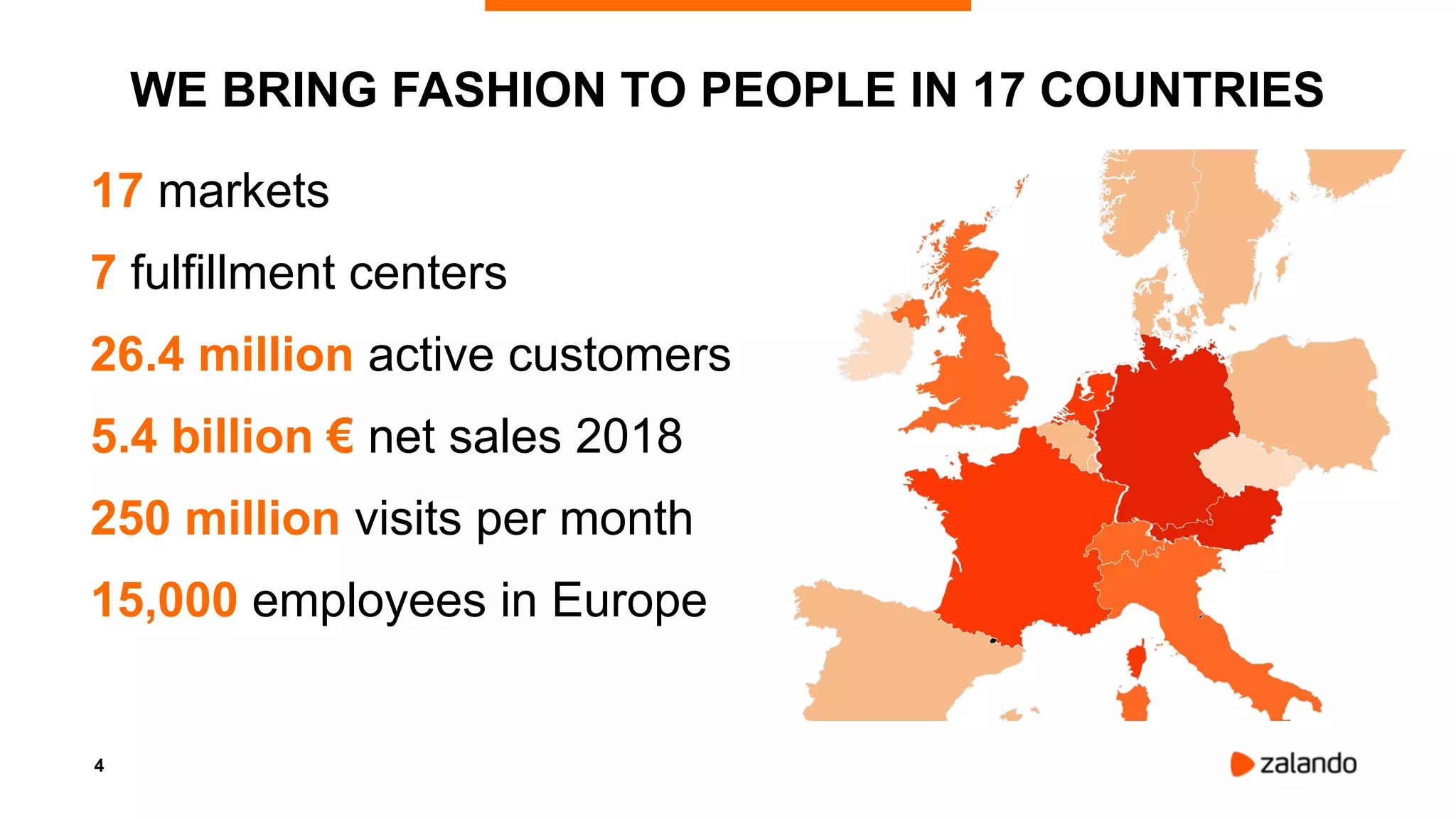
WE BRING FASHION TO PEOPLE IN 17 COUNTRIES
17 markets
7 fulfillment centers
26.4 million active customers
5.4 billion € net sales 2018
250 million visits per month
15,000 employees in Europe
5
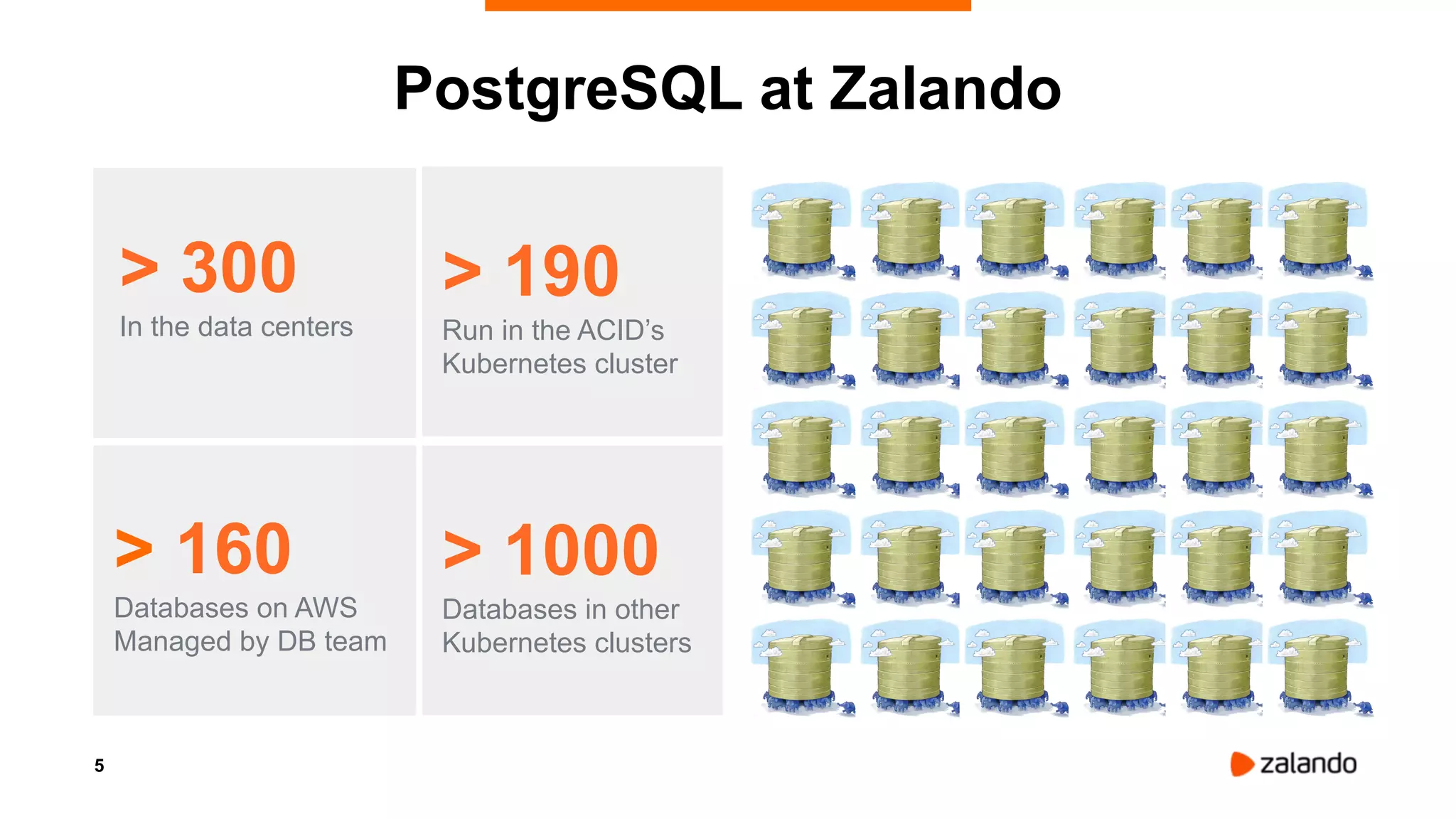
PostgreSQL at Zalando
> 300
In the data centers
> 160
Databases on AWS
Managed by DB team
> 1000
Databases in other
Kubernetes clusters
> 190
Run in the ACID’s
Kubernetes cluster
6
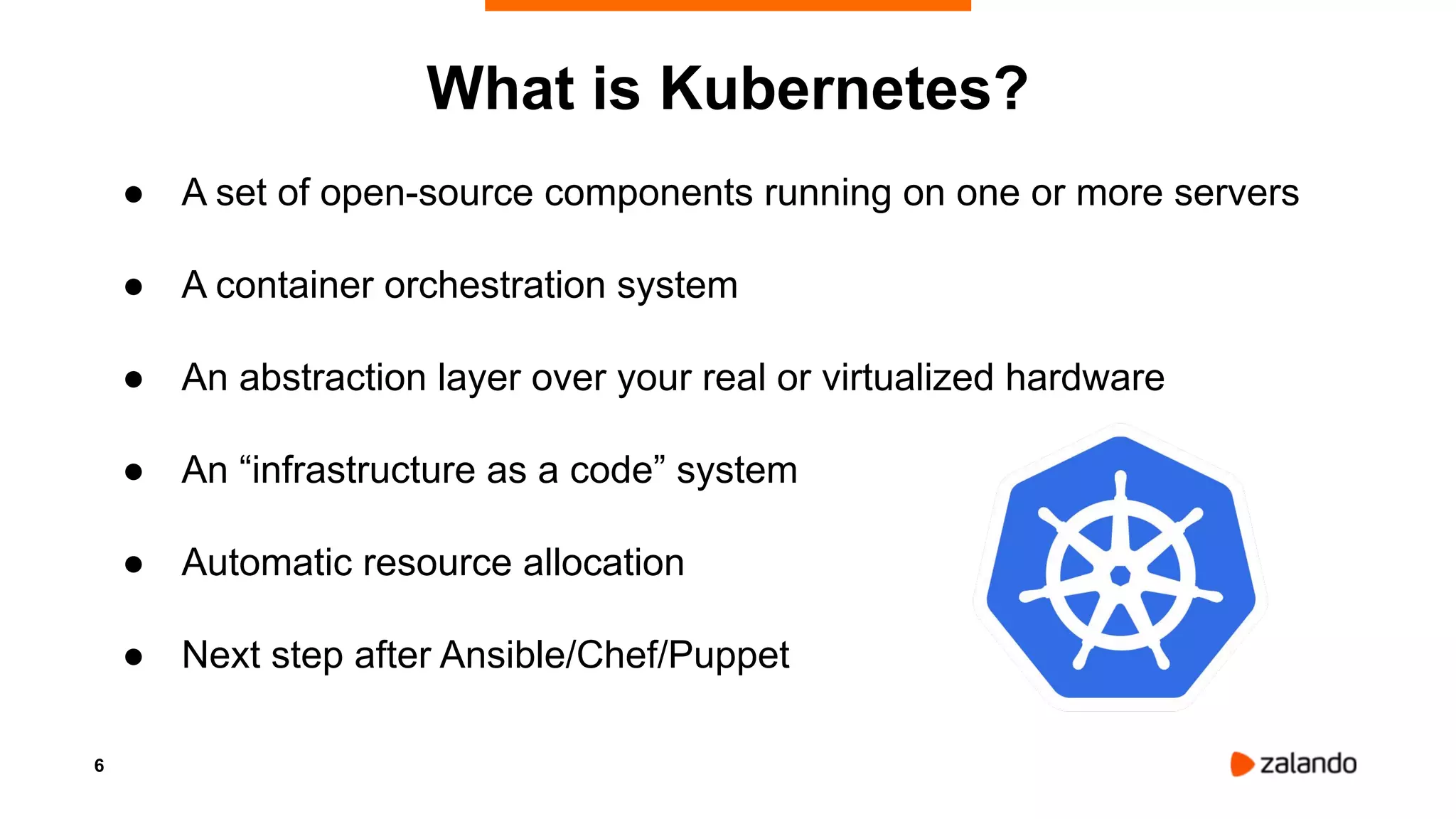
What is Kubernetes?
● A set of open-source components running on one or more servers
● A container orchestration system
● An abstraction layer over your real or virtualized hardware
● An “infrastructure as a code” system
● Automatic resource allocation
● Next step after Ansible/Chef/Puppet
7
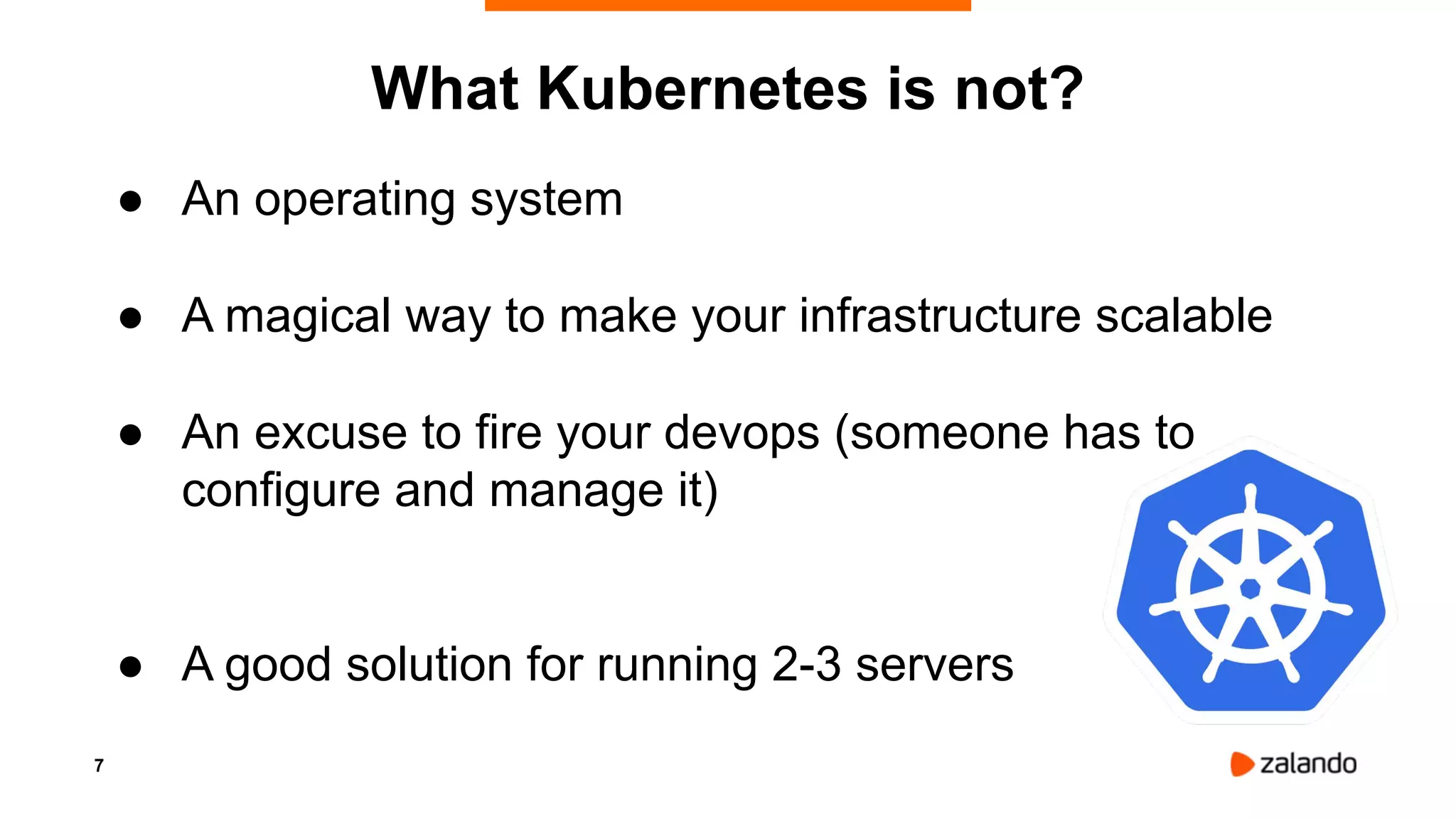
What Kubernetes is not?
● An operating system
● A magical way to make your infrastructure scalable
● An excuse to fire your devops (someone has to
configure and manage it)
● A good solution for running 2-3 servers
8
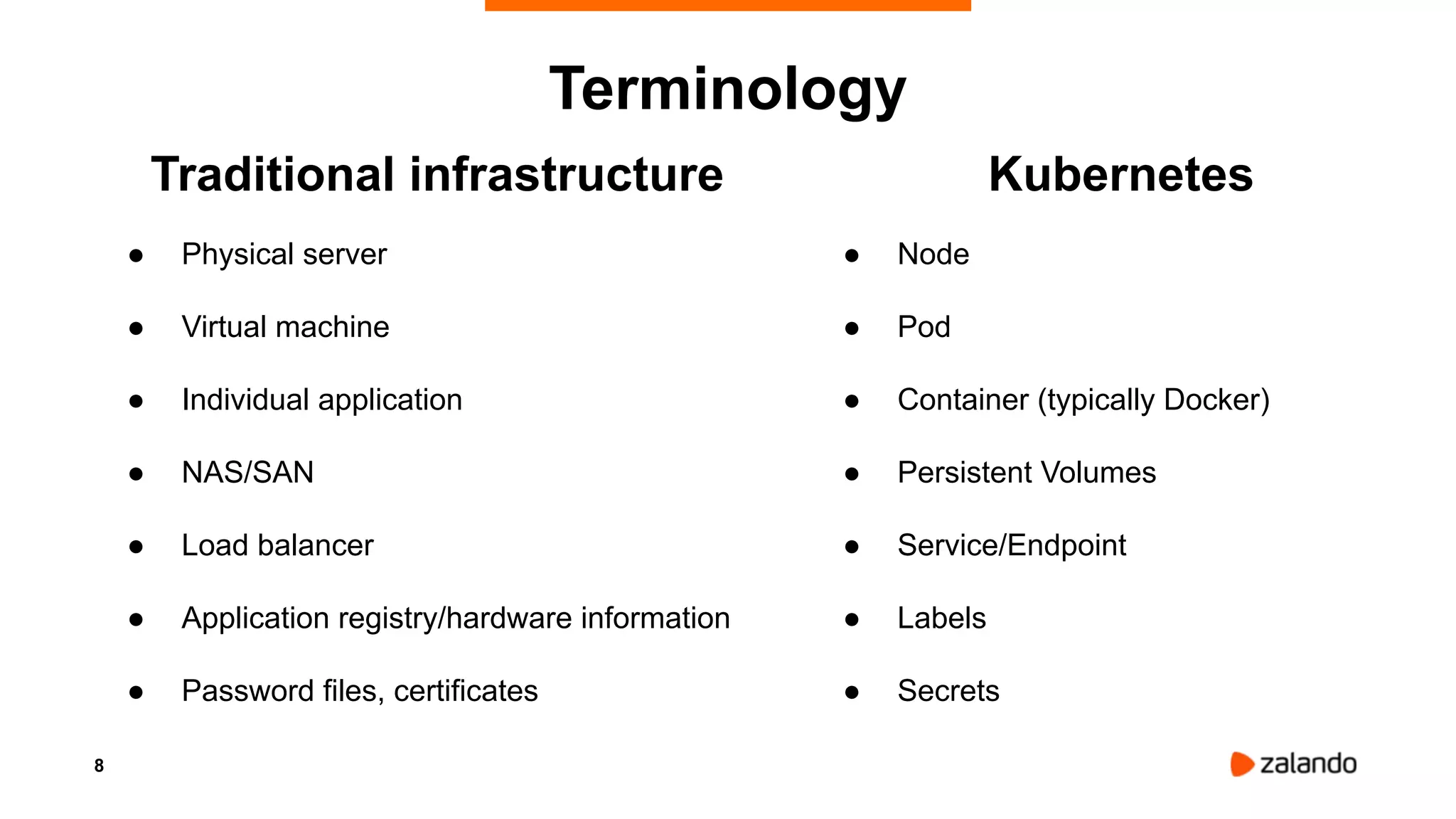
Terminology
Traditional infrastructure
● Physical server
● Virtual machine
● Individual application
● NAS/SAN
● Load balancer
● Application registry/hardware information
● Password files, certificates
Kubernetes
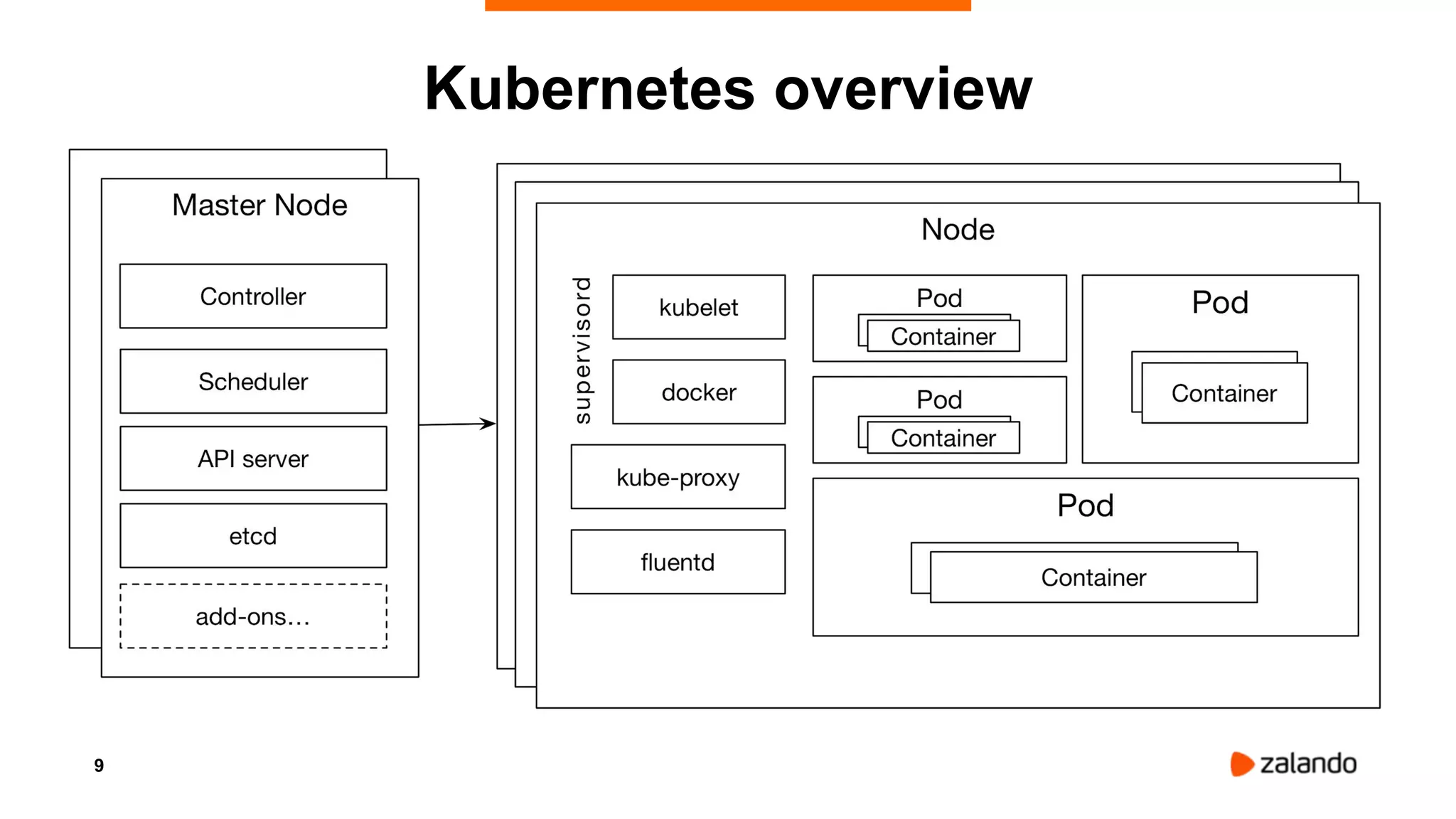
● Node
● Pod
● Container (typically Docker)
● Persistent Volumes
● Service/Endpoint
● Labels
● Secrets
9
Kubernetes overview
10
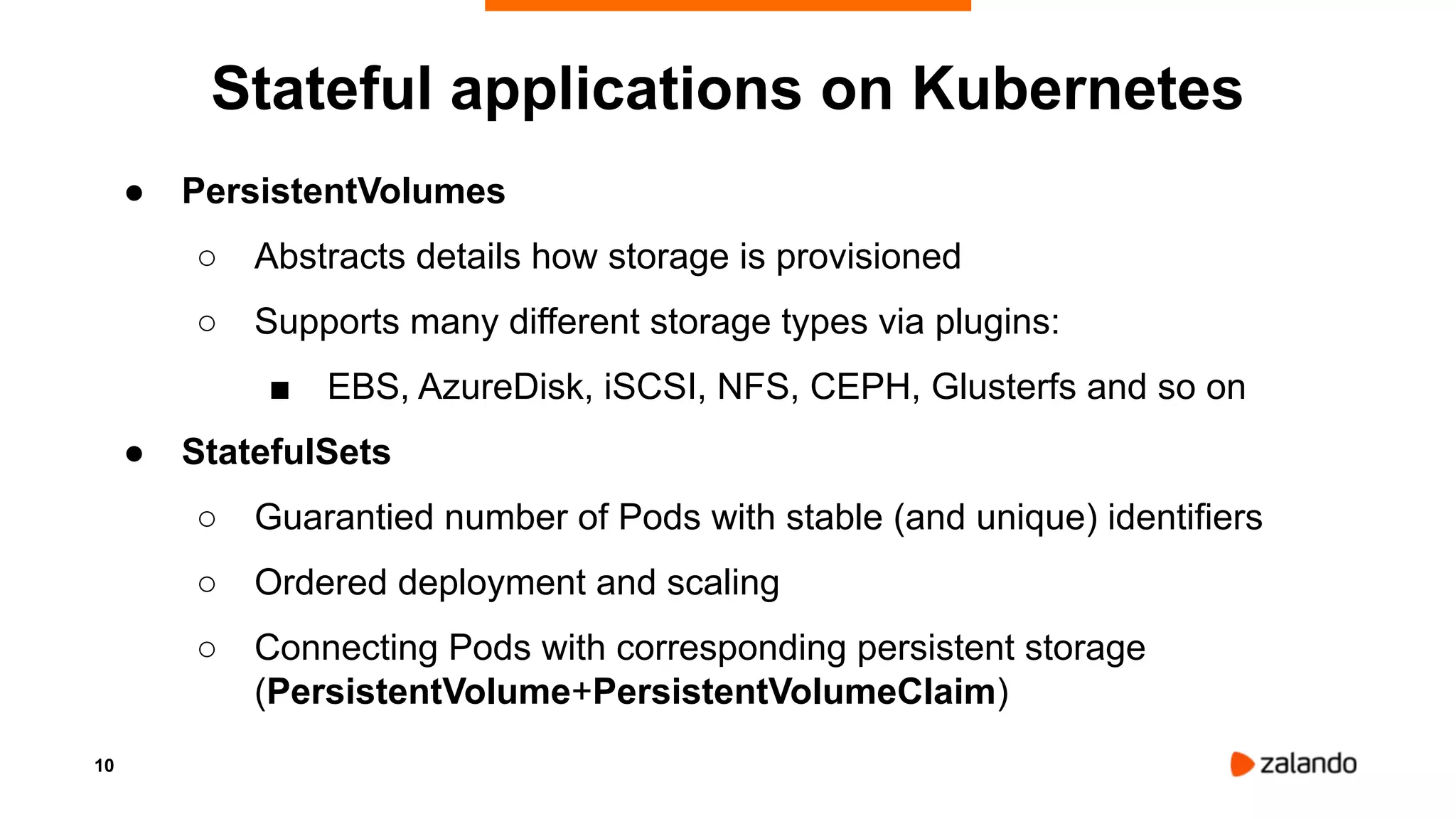
Stateful applications on Kubernetes
● PersistentVolumes
○ Abstracts details how storage is provisioned
○ Supports many different storage types via plugins:
■ EBS, AzureDisk, iSCSI, NFS, CEPH, Glusterfs and so on
● StatefulSets
○ Guarantied number of Pods with stable (and unique) identifiers
○ Ordered deployment and scaling
○ Connecting Pods with corresponding persistent storage
(PersistentVolume+PersistentVolumeClaim)
11
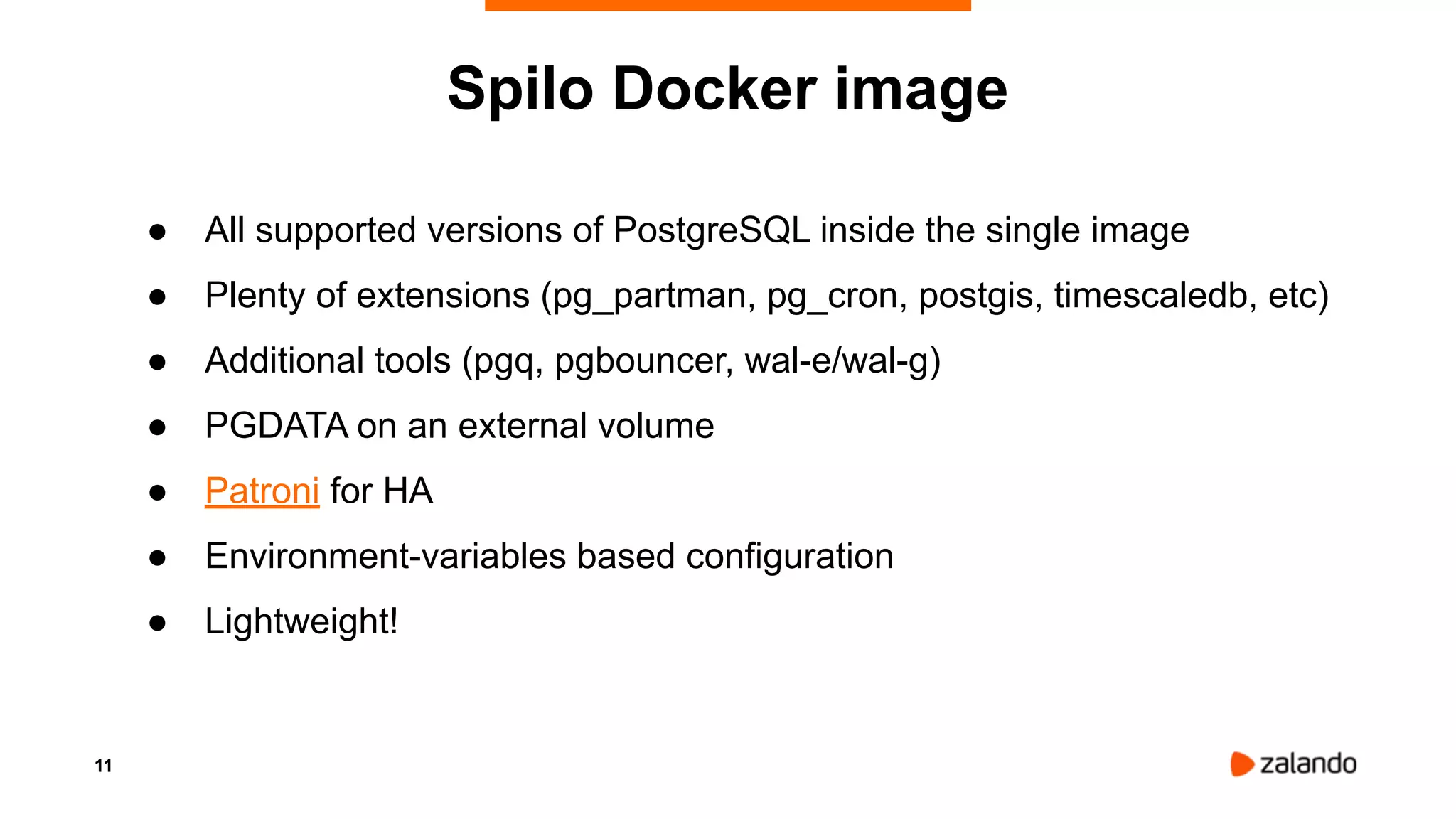
● All supported versions of PostgreSQL inside the single image
● Plenty of extensions (pg_partman, pg_cron, postgis, timescaledb, etc)
● Additional tools (pgq, pgbouncer, wal-e/wal-g)
● PGDATA on an external volume
● Patroni for HA
● Environment-variables based configuration
● Lightweight!
Spilo Docker image
12
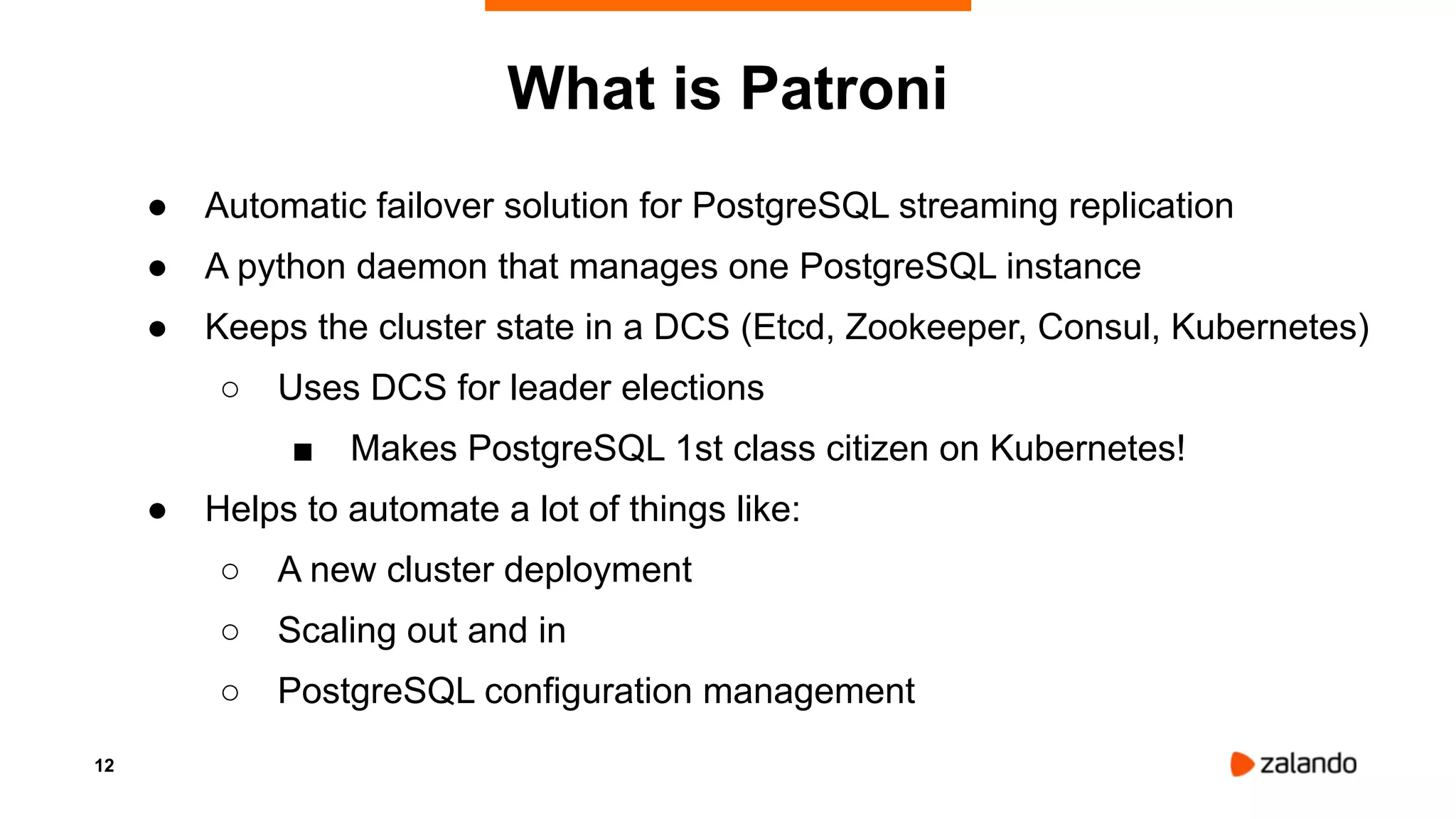
● Automatic failover solution for PostgreSQL streaming replication
● A python daemon that manages one PostgreSQL instance
● Keeps the cluster state in a DCS (Etcd, Zookeeper, Consul, Kubernetes)
○ Uses DCS for leader elections
■ Makes PostgreSQL 1st class citizen on Kubernetes!
● Helps to automate a lot of things like:
○ A new cluster deployment
○ Scaling out and in
○ PostgreSQL configuration management
What is Patroni
13
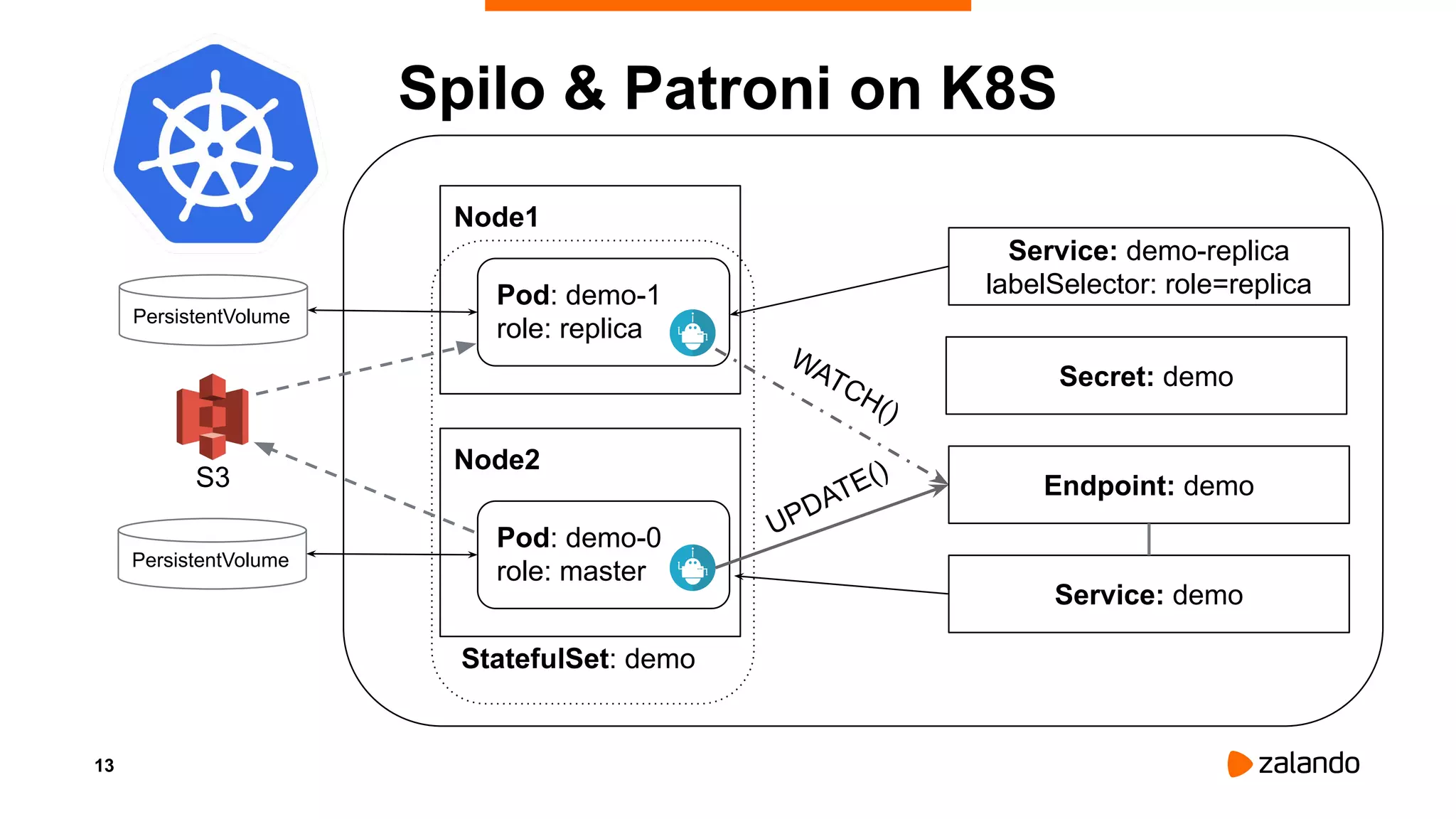
Spilo & Patroni on K8S
Node2
Pod: demo-0
role: master
PersistentVolume
PersistentVolume
Node1
StatefulSet: demo
Pod: demo-1
role: replica
Secret: demo
WATCH()
UPDATE()
Service: demo-replica
labelSelector: role=replica
Service: demo
Endpoint: demoS3
14
● A few long YAML manifests to write
● Different parts of PostgreSQL configuration spread over multiple
manifests
● No easy way to work with a cluster as a whole (update, delete)
● Manual generation of DB objects, i.e. users, and their passwords.
Manual deployment to Kubernetes
15
● Encapsulates knowledge of a human operating the service
● Implement a controller application to act on custom resources
● CRD (custom resource definitions) to describe a domain-specific object
(i.e. a Postgres cluster)
https://coreos.com/blog/introducing-operators.html
Kubernetes operator pattern
16
● Defines a custom Postgresql resource
● Watches instances of Postgresql, creates/updates/deletes corresponding
Kubernetes objects
● Allows updating running-cluster resources (memory, cpu, volumes), postgres
configuration
● Creates databases, users and automatically generates passwords
● Auto-repairs, smart rolling updates (switchover to replicas before updating
the master)
Zalando Postgres-Operator
17
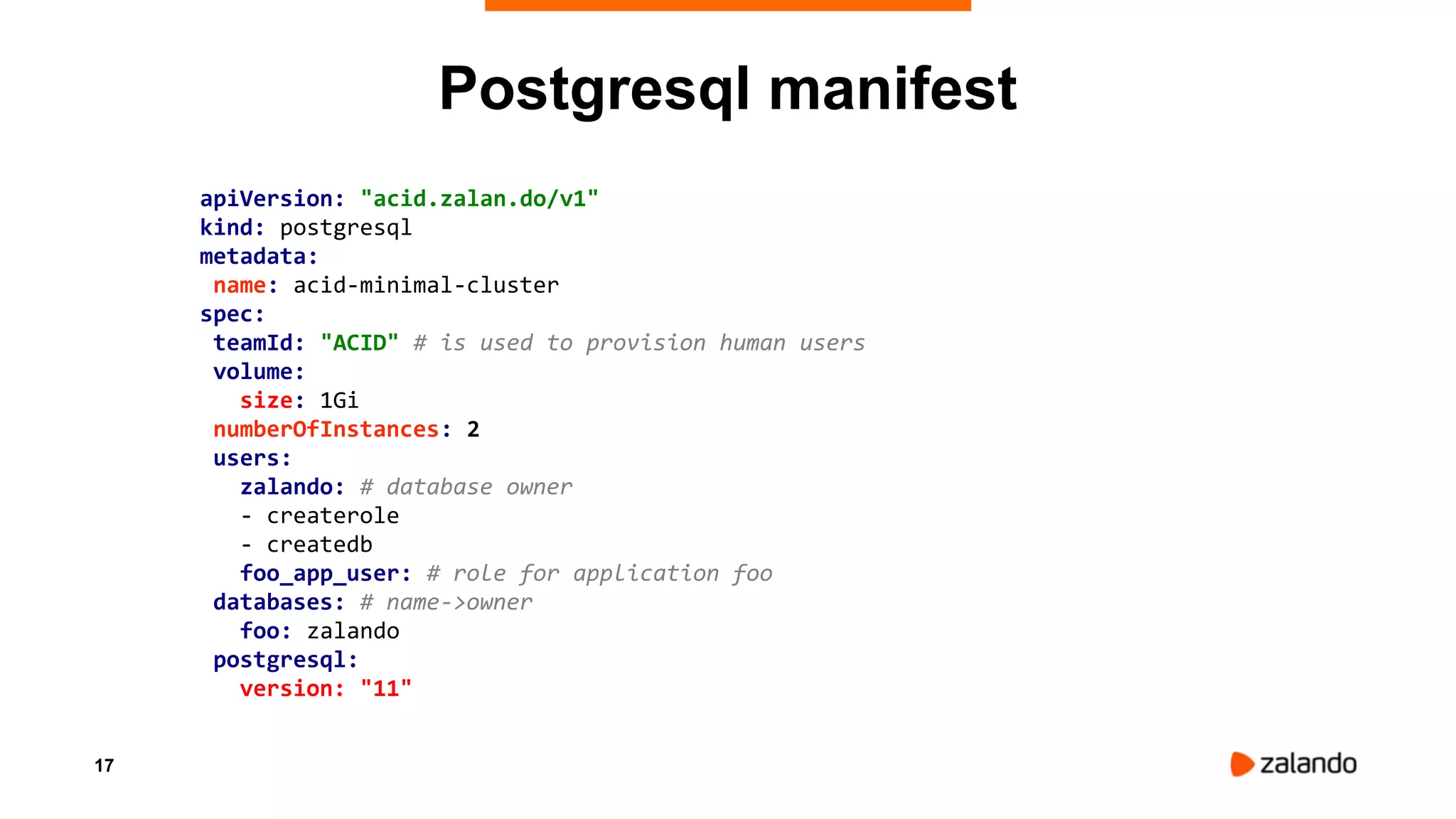
apiVersion: "acid.zalan.do/v1"
kind: postgresql
metadata:
name: acid-minimal-cluster
spec:
teamId: "ACID" # is used to provision human users
volume:
size: 1Gi
numberOfInstances: 2
users:
zalando: # database owner
- createrole
- createdb
foo_app_user: # role for application foo
databases: # name->owner
foo: zalando
postgresql:
version: "11"
Postgresql manifest
18
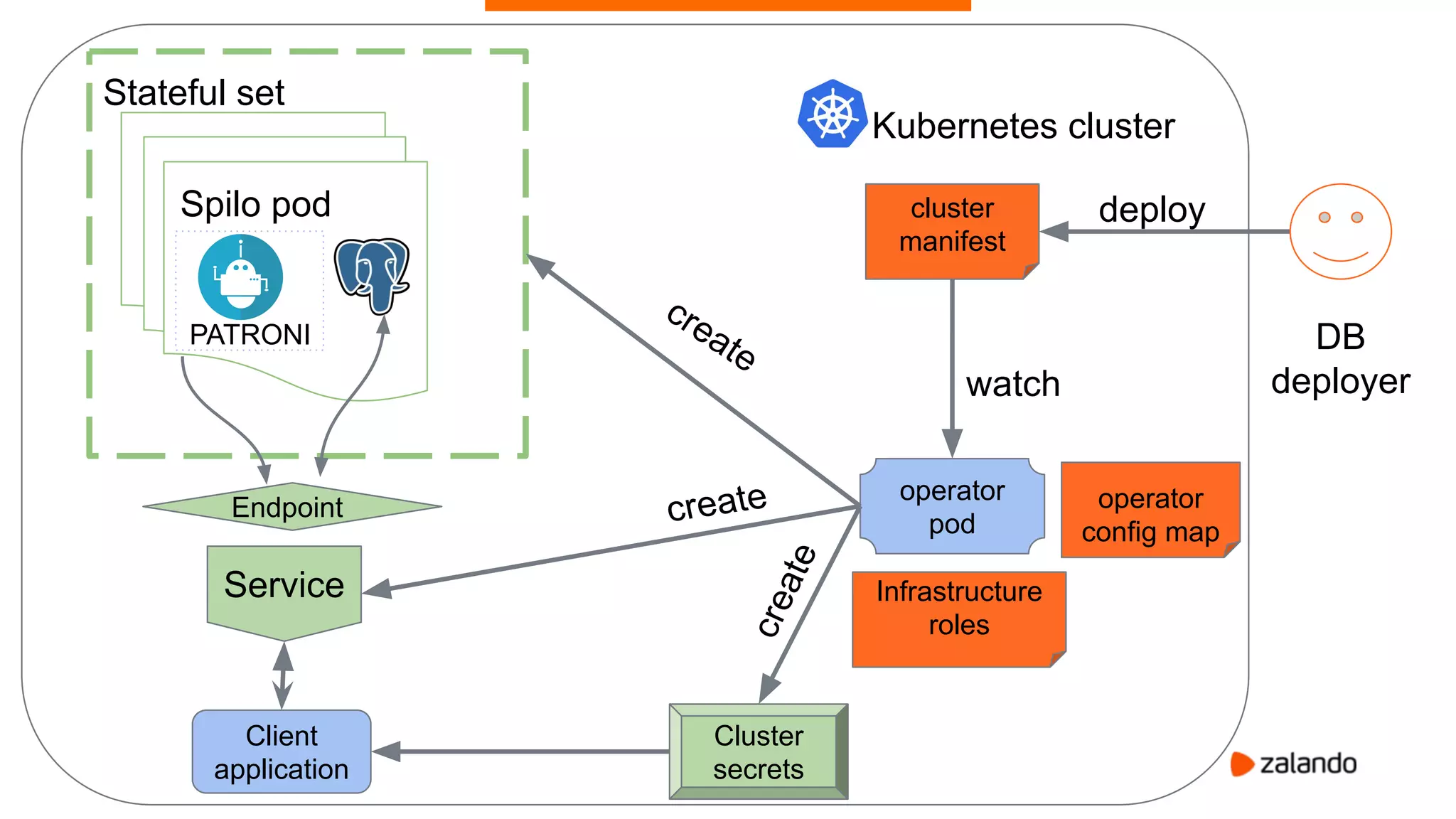
deploycluster
manifest
Stateful set
Spilo pod
Kubernetes cluster
PATRONI
operator
pod
Endpoint
Service
Client
application
operator
config map
Cluster
secrets
DB
deployer
create
create
create
watch
Infrastructure
roles
19
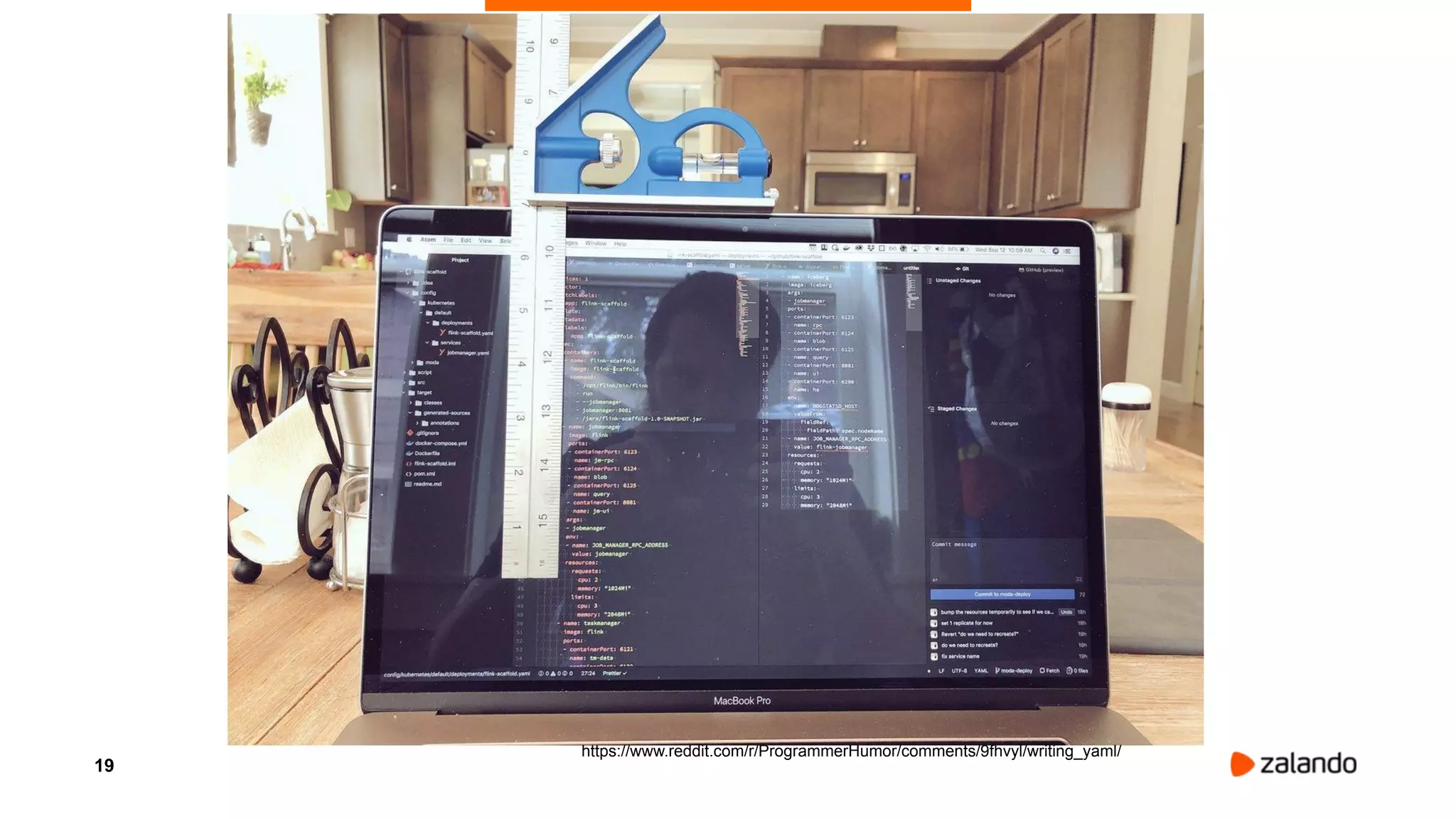
https://www.reddit.com/r/ProgrammerHumor/comments/9fhvyl/writing_yaml/
20
21
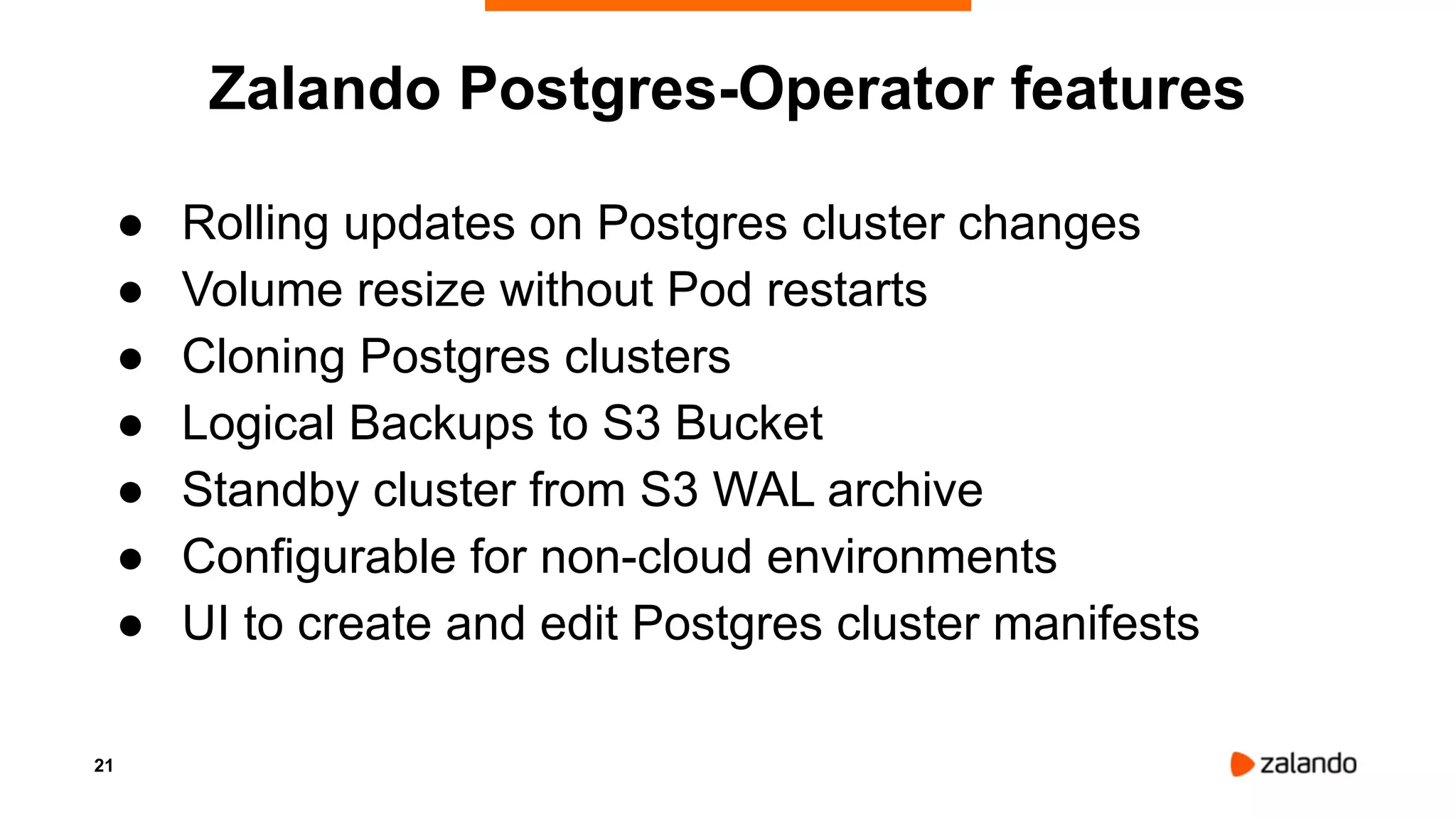
Zalando Postgres-Operator features
● Rolling updates on Postgres cluster changes
● Volume resize without Pod restarts
● Cloning Postgres clusters
● Logical Backups to S3 Bucket
● Standby cluster from S3 WAL archive
● Configurable for non-cloud environments
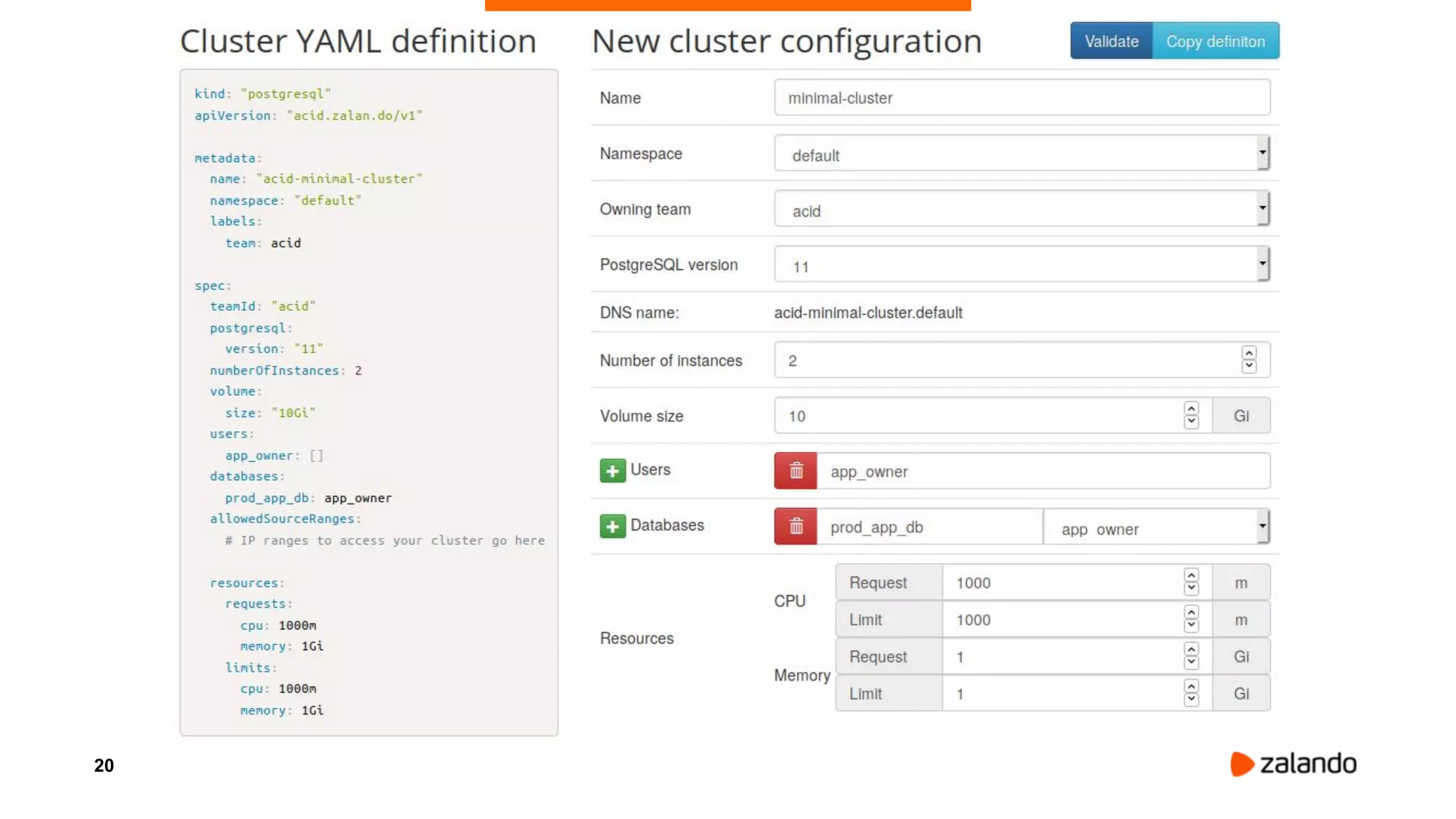
● UI to create and edit Postgres cluster manifests
22
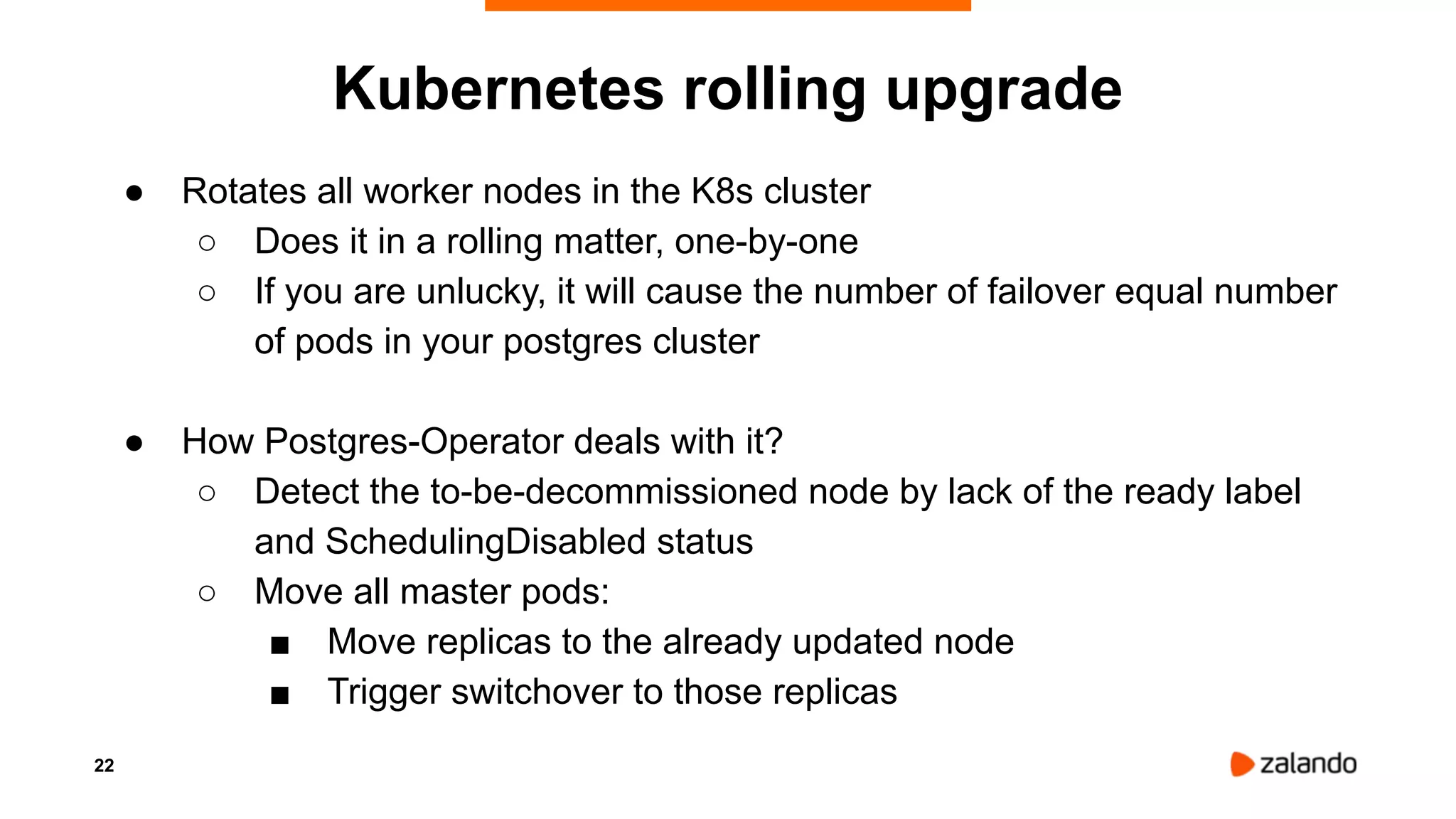
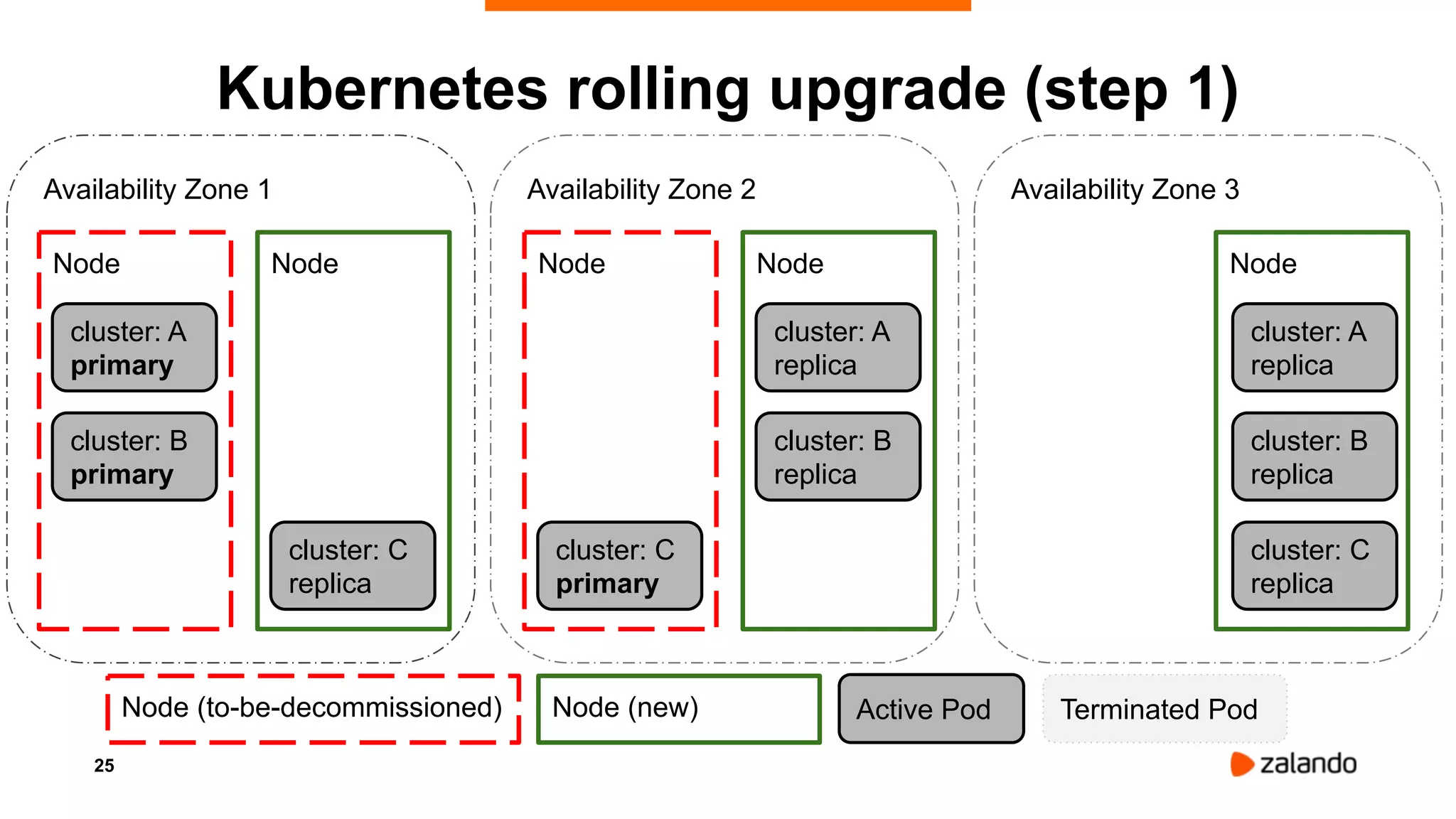
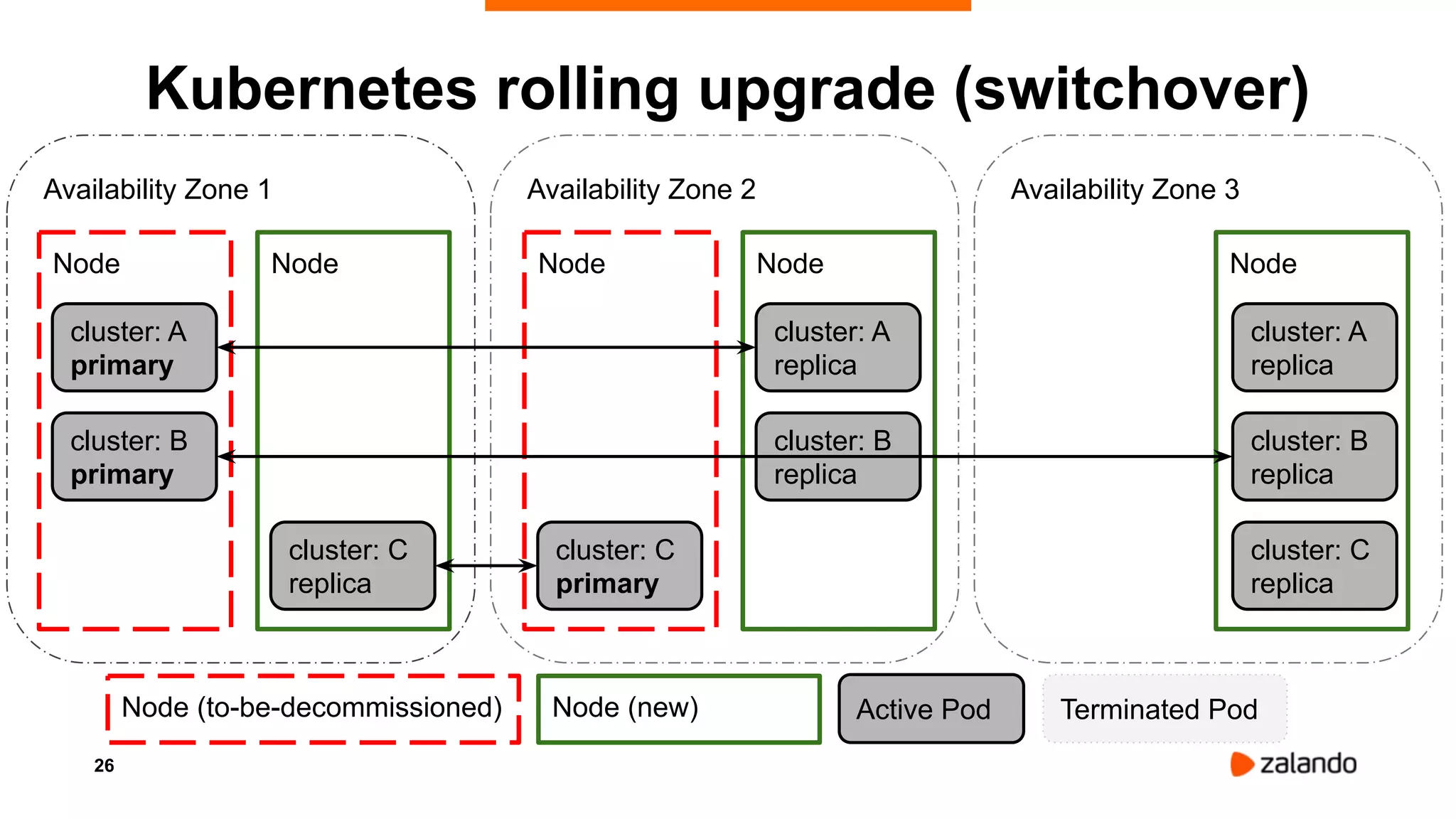
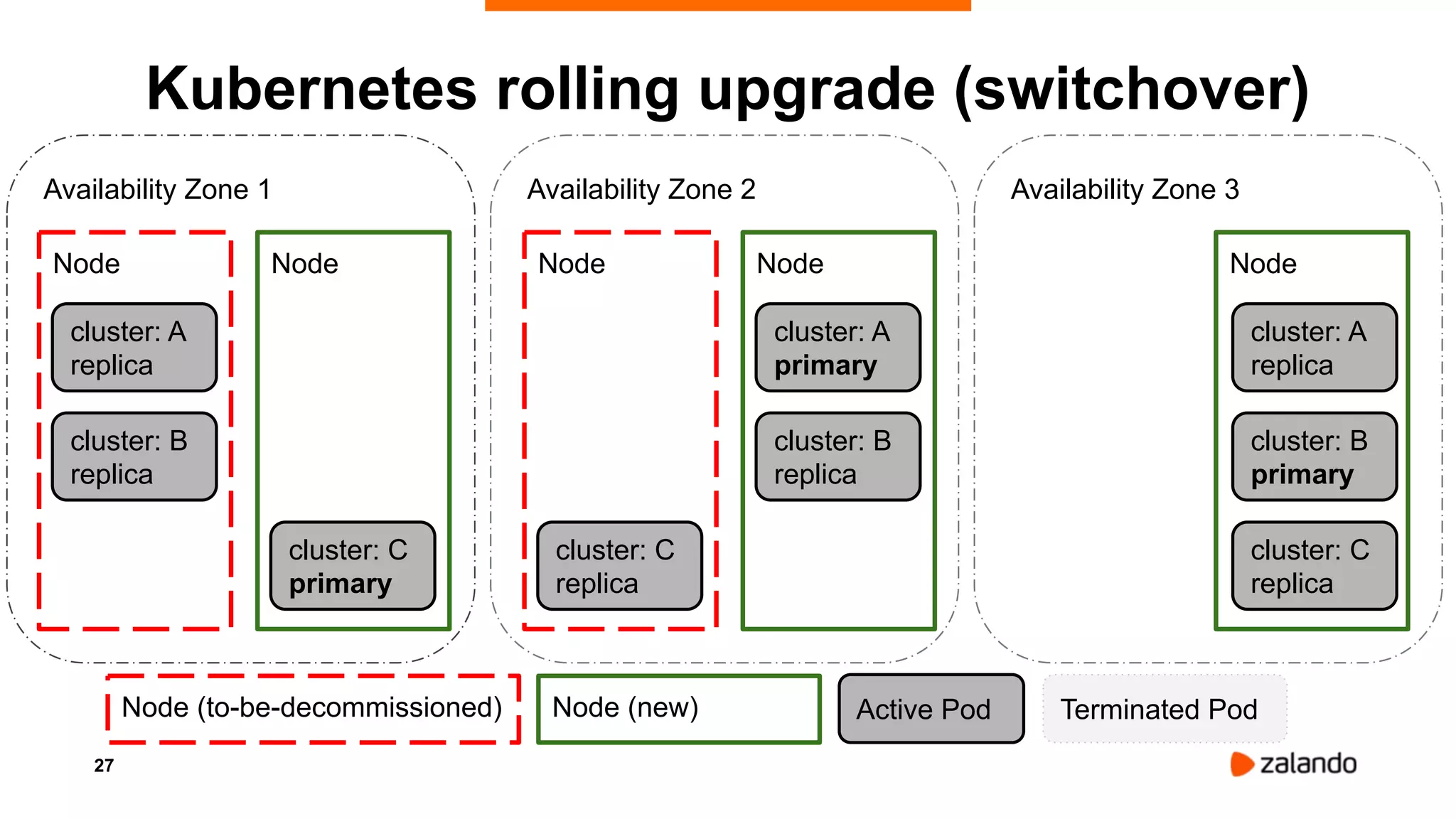
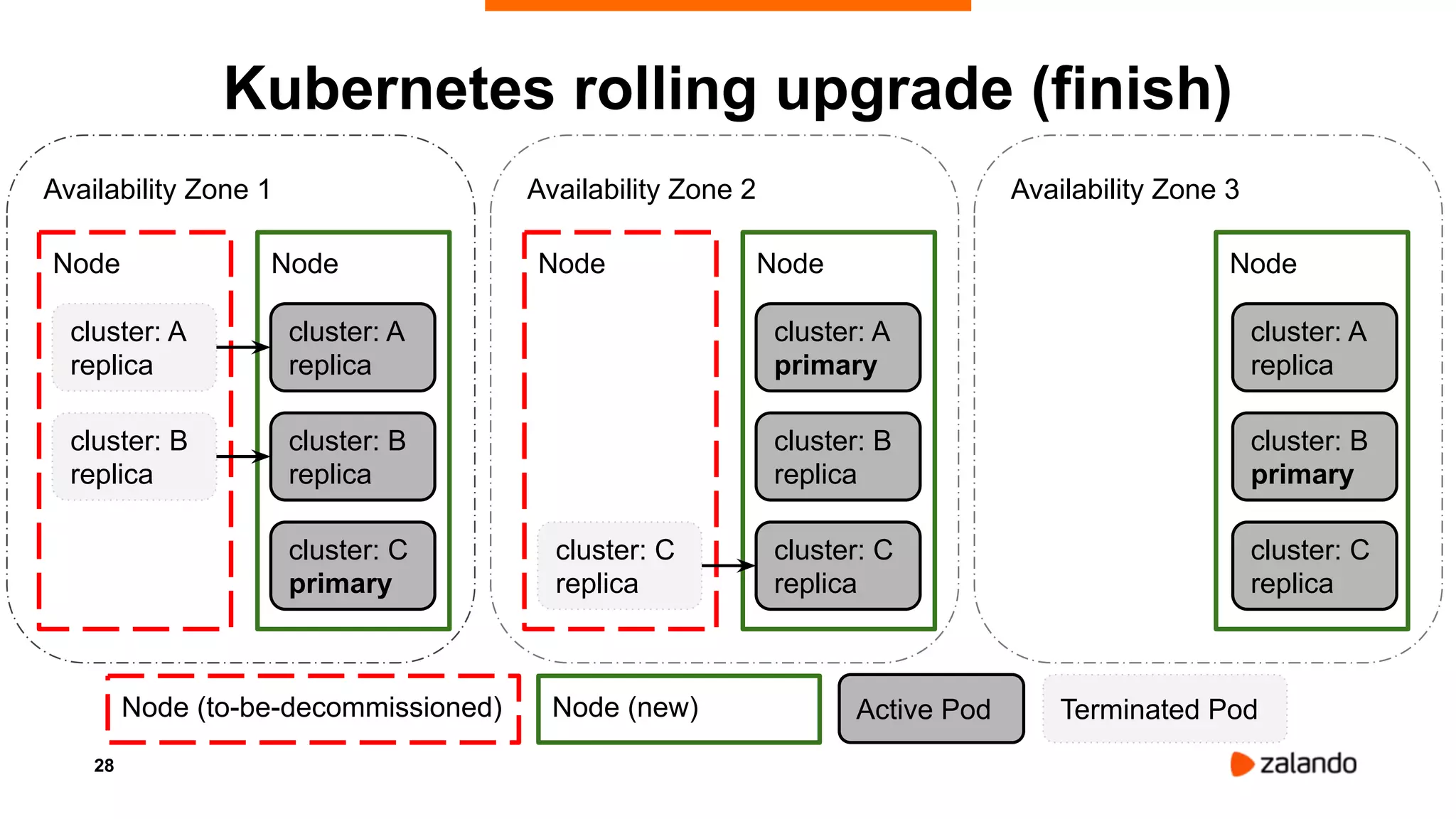
Kubernetes rolling upgrade
● Rotates all worker nodes in the K8s cluster
○ Does it in a rolling matter, one-by-one
○ If you are unlucky, it will cause the number of failover equal number
of pods in your postgres cluster
● How Postgres-Operator deals with it?
○ Detect the to-be-decommissioned node by lack of the ready label
and SchedulingDisabled status
○ Move all master pods:
■ Move replicas to the already updated node
■ Trigger switchover to those replicas
23
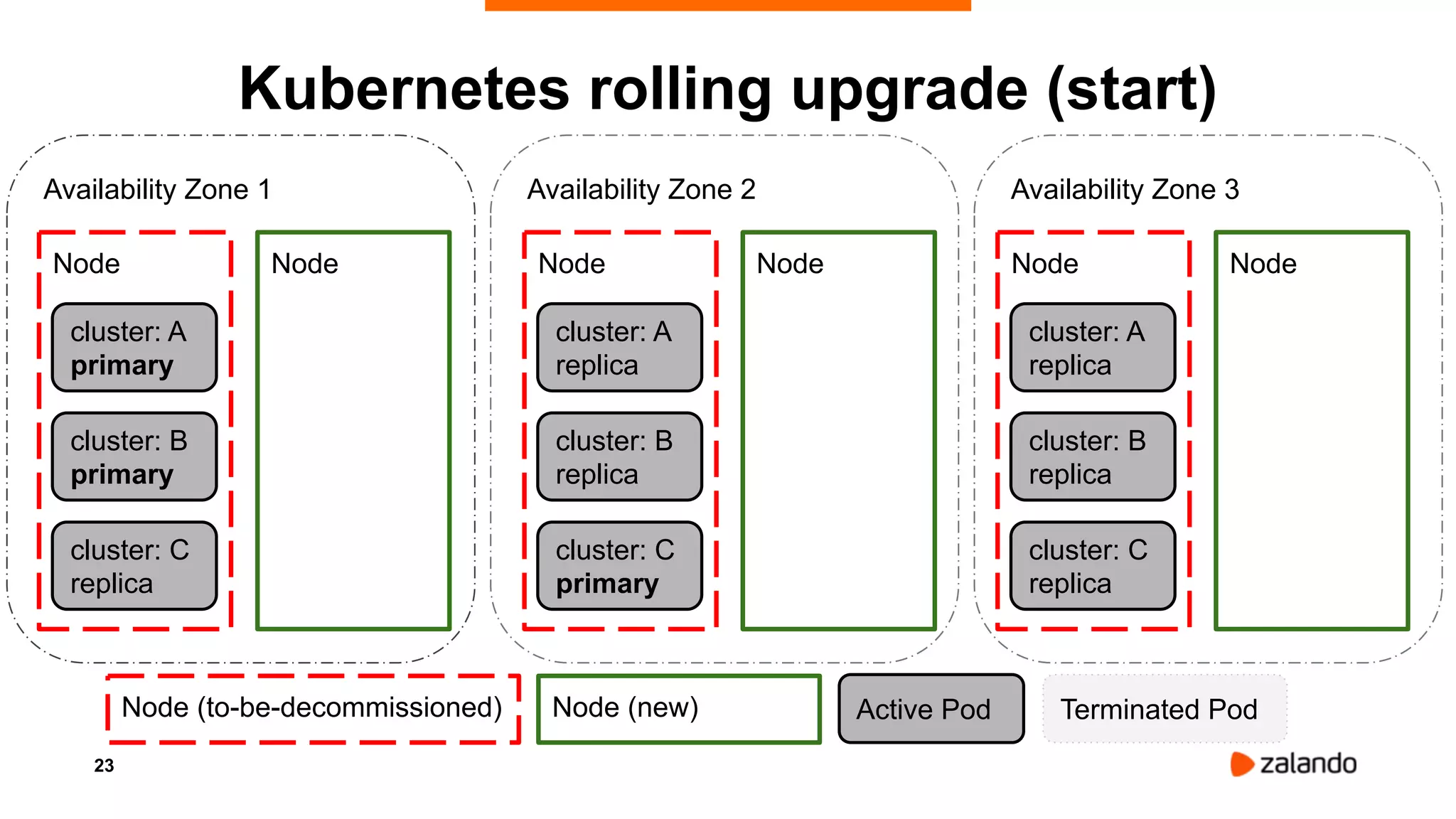
Availability Zone 1
Node
cluster: A
primary
cluster: B
primary
cluster: C
replica
Availability Zone 2 Availability Zone 3
Kubernetes rolling upgrade (start)
Node Node
cluster: A
replica
cluster: B
replica
cluster: C
primary
Node Node
cluster: A
replica
cluster: B
replica
cluster: C
replica
Node
Node (to-be-decommissioned) Node (new) Terminated PodActive Pod
24
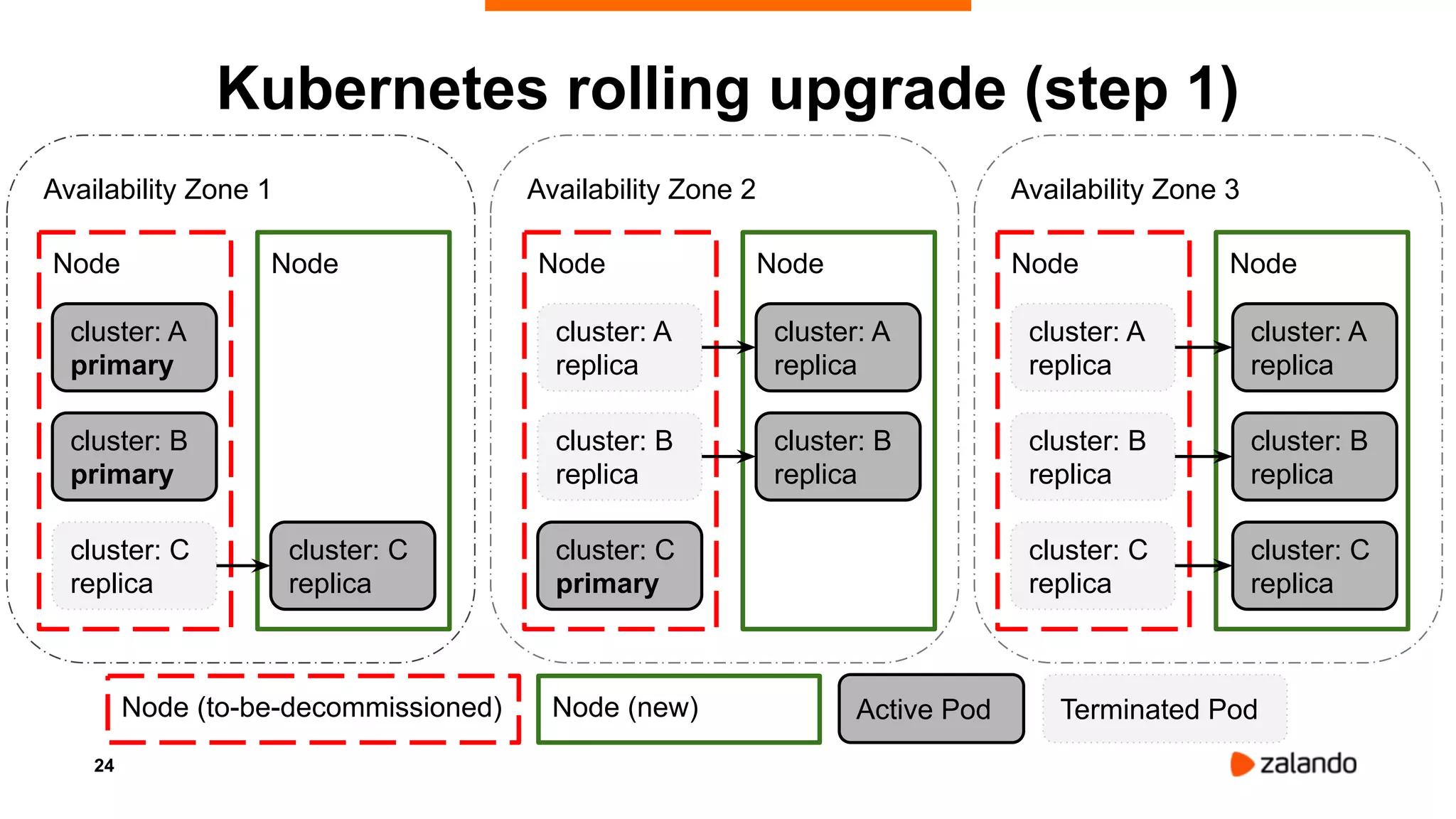
Availability Zone 1
Node
cluster: A
primary
cluster: B
primary
cluster: C
replica
Availability Zone 2 Availability Zone 3
Kubernetes rolling upgrade (step 1)
Node Node
cluster: A
replica
cluster: B
replica
cluster: C
primary
Node Node
cluster: A
replica
cluster: B
replica
cluster: C
replica
Node
cluster: A
replica
cluster: B
replica
cluster: A
replica
cluster: B
replica
cluster: C
replica
cluster: C
replica
Node (to-be-decommissioned) Node (new) Terminated PodActive Pod
25
Availability Zone 1
Node
cluster: A
primary
cluster: B
primary
Availability Zone 2 Availability Zone 3
Kubernetes rolling upgrade (step 1)
Node Node
cluster: C
primary
Node Node
cluster: A
replica
cluster: B
replica
cluster: A
replica
cluster: B
replica
cluster: C
replica
cluster: C
replica
Node (to-be-decommissioned) Node (new) Terminated PodActive Pod
26
Availability Zone 1
Node
cluster: A
primary
cluster: B
primary
Availability Zone 2 Availability Zone 3
Kubernetes rolling upgrade (switchover)
Node Node
cluster: C
primary
Node Node
cluster: A
replica
cluster: B
replica
cluster: A
replica
cluster: B
replica
cluster: C
replica
cluster: C
replica
Node (to-be-decommissioned) Node (new) Terminated PodActive Pod
27
Availability Zone 1
Node
cluster: A
replica
cluster: B
replica
Availability Zone 2 Availability Zone 3
Kubernetes rolling upgrade (switchover)
Node Node
cluster: C
replica
Node Node
cluster: A
primary
cluster: B
replica
cluster: A
replica
cluster: B
primary
cluster: C
replica
cluster: C
primary
Node (to-be-decommissioned) Node (new) Terminated PodActive Pod
28
Availability Zone 1
Node
Availability Zone 2 Availability Zone 3
Kubernetes rolling upgrade (finish)
Node
cluster: A
replica
cluster: B
replica
Node Node
cluster: C
replica
Node
cluster: A
primary
cluster: B
replica
cluster: A
replica
cluster: B
primary
cluster: C
replica
cluster: C
primary
Node (to-be-decommissioned) Node (new) Terminated PodActive Pod
cluster: A
replica
cluster: B
replica
cluster: C
replica
Most common issues
on K8s
30
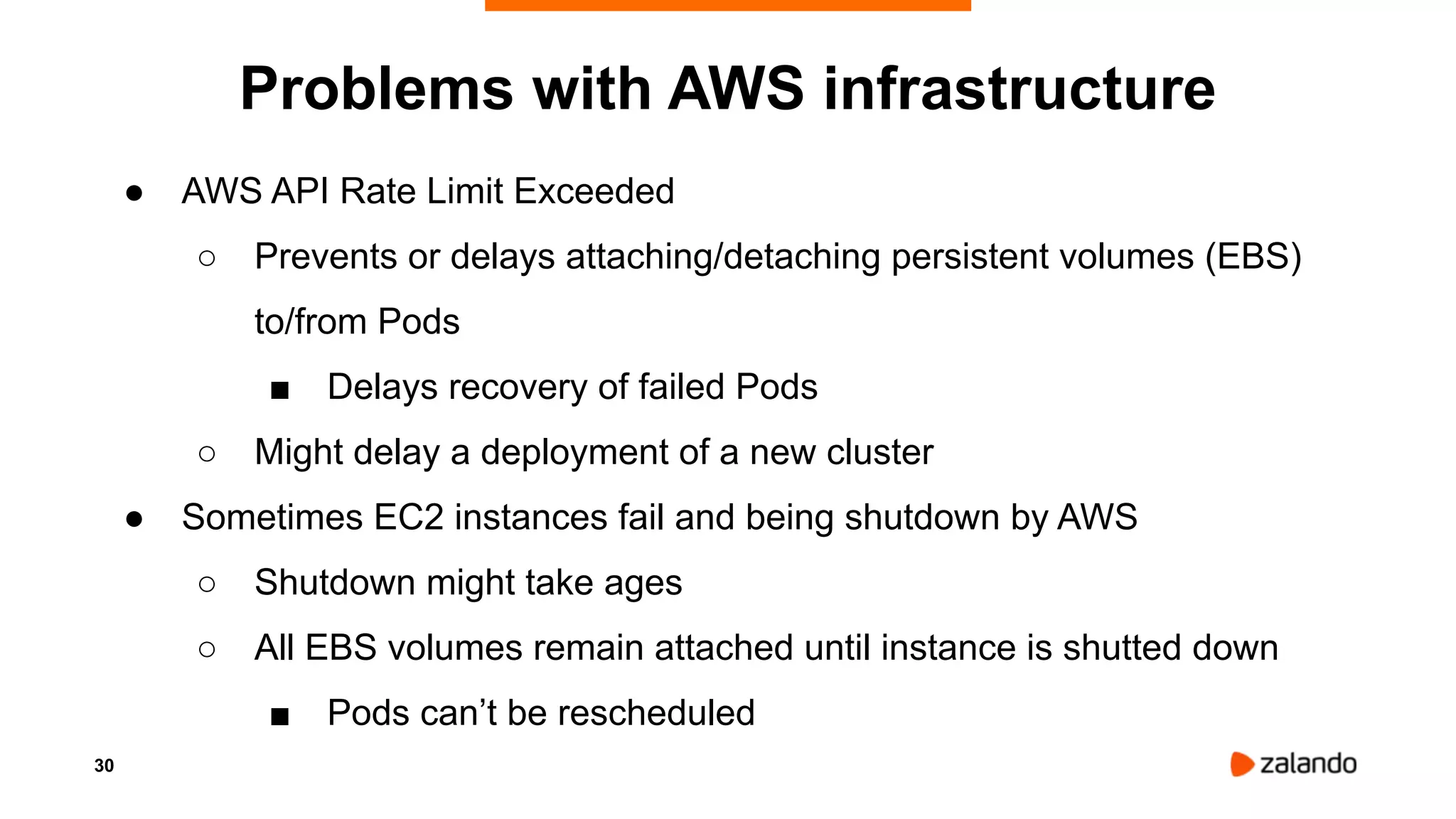
Problems with AWS infrastructure
● AWS API Rate Limit Exceeded
○ Prevents or delays attaching/detaching persistent volumes (EBS)
to/from Pods
■ Delays recovery of failed Pods
○ Might delay a deployment of a new cluster
● Sometimes EC2 instances fail and being shutdown by AWS
○ Shutdown might take ages
○ All EBS volumes remain attached until instance is shutted down
■ Pods can’t be rescheduled
31
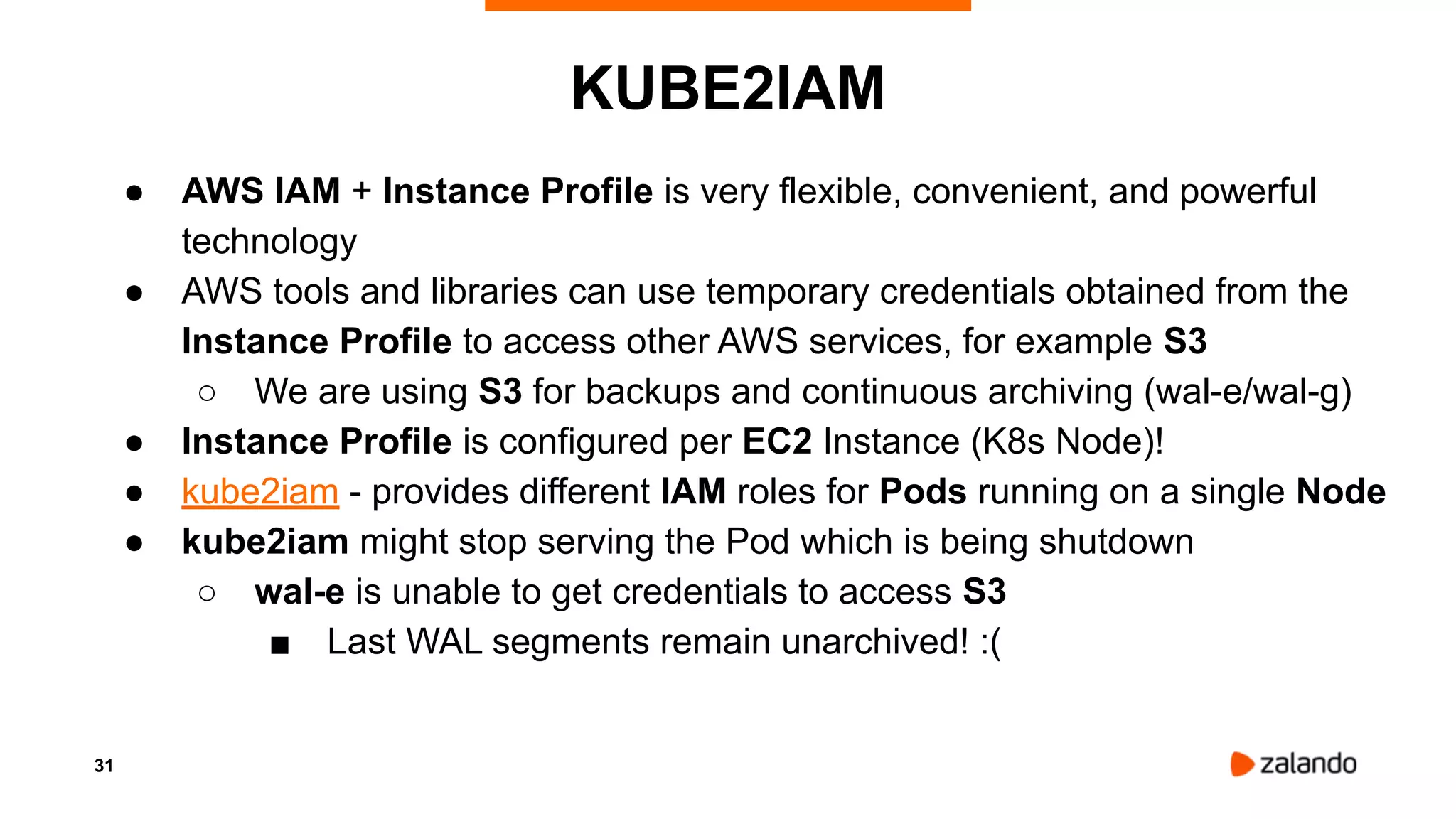
KUBE2IAM
● AWS IAM + Instance Profile is very flexible, convenient, and powerful
technology
● AWS tools and libraries can use temporary credentials obtained from the
Instance Profile to access other AWS services, for example S3
○ We are using S3 for backups and continuous archiving (wal-e/wal-g)
● Instance Profile is configured per EC2 Instance (K8s Node)!
● kube2iam - provides different IAM roles for Pods running on a single Node
● kube2iam might stop serving the Pod which is being shutdown
○ wal-e is unable to get credentials to access S3
■ Last WAL segments remain unarchived! :(
32
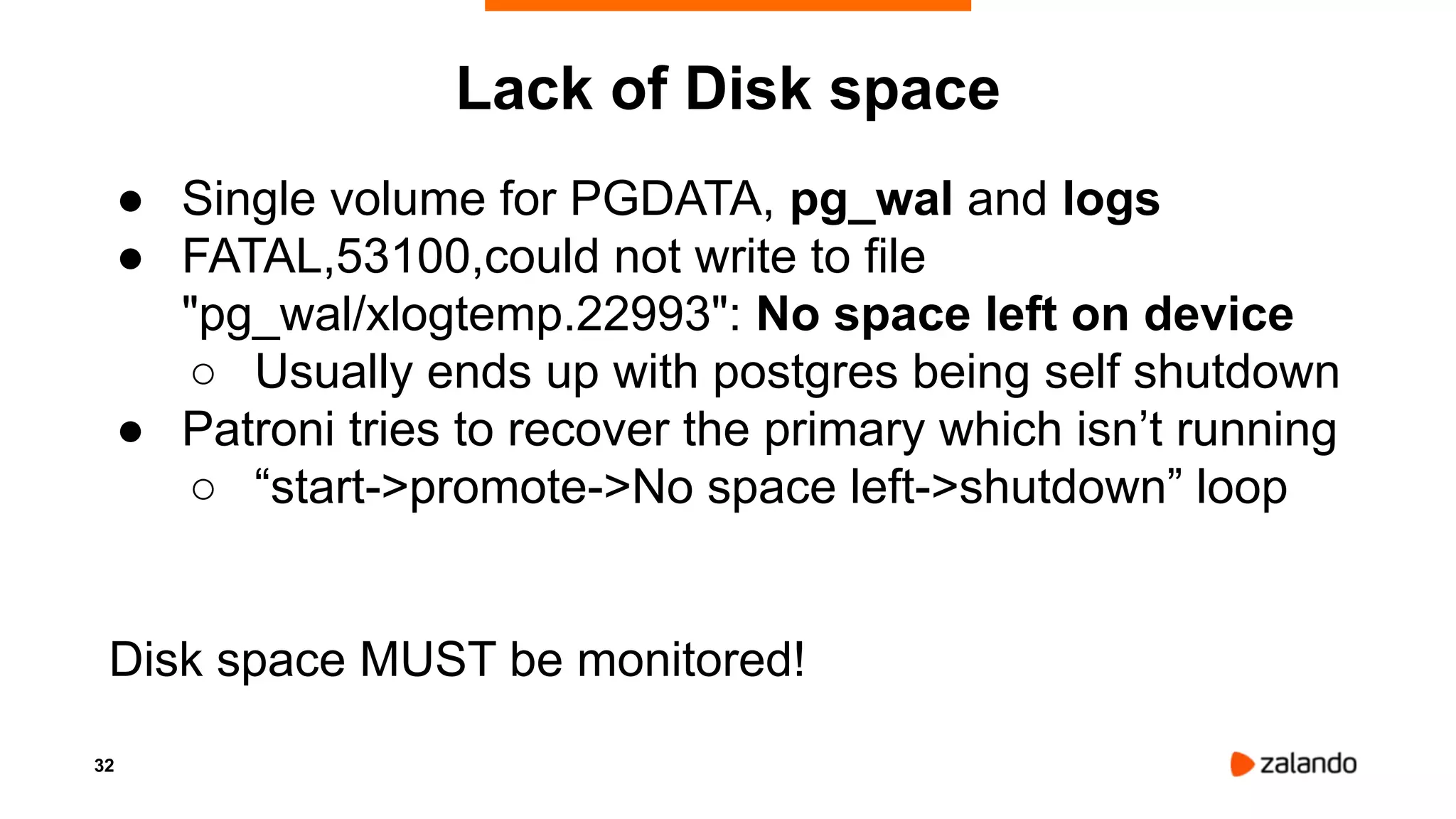
Lack of Disk space
● Single volume for PGDATA, pg_wal and logs
● FATAL,53100,could not write to file
"pg_wal/xlogtemp.22993": No space left on device
○ Usually ends up with postgres being self shutdown
● Patroni tries to recover the primary which isn’t running
○ “start->promote->No space left->shutdown” loop
Disk space MUST be monitored!
33
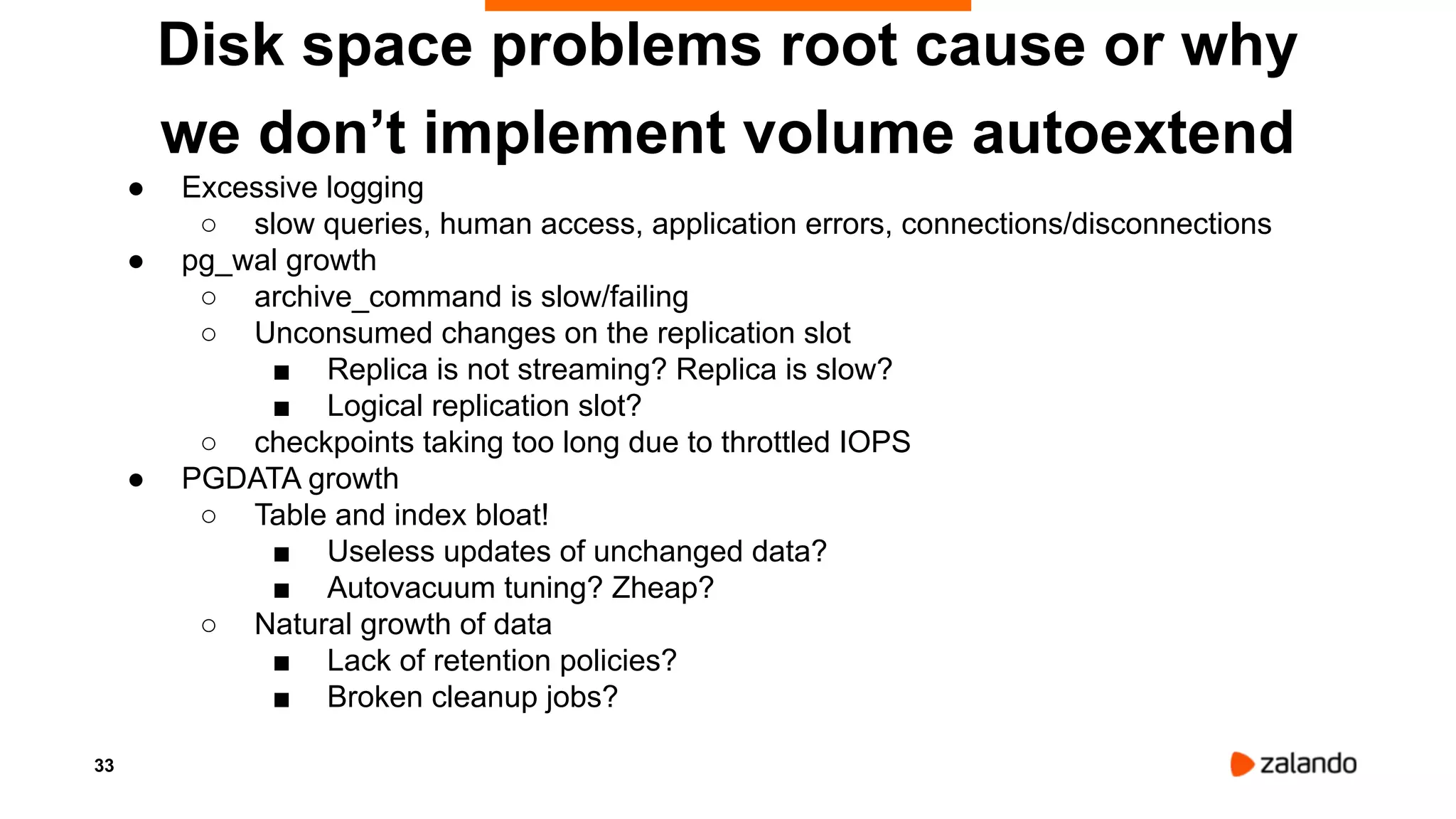
Disk space problems root cause or why
we don’t implement volume autoextend
● Excessive logging
○ slow queries, human access, application errors, connections/disconnections
● pg_wal growth
○ archive_command is slow/failing
○ Unconsumed changes on the replication slot
■ Replica is not streaming? Replica is slow?
■ Logical replication slot?
○ checkpoints taking too long due to throttled IOPS
● PGDATA growth
○ Table and index bloat!
■ Useless updates of unchanged data?
■ Autovacuum tuning? Zheap?
○ Natural growth of data
■ Lack of retention policies?
■ Broken cleanup jobs?
34
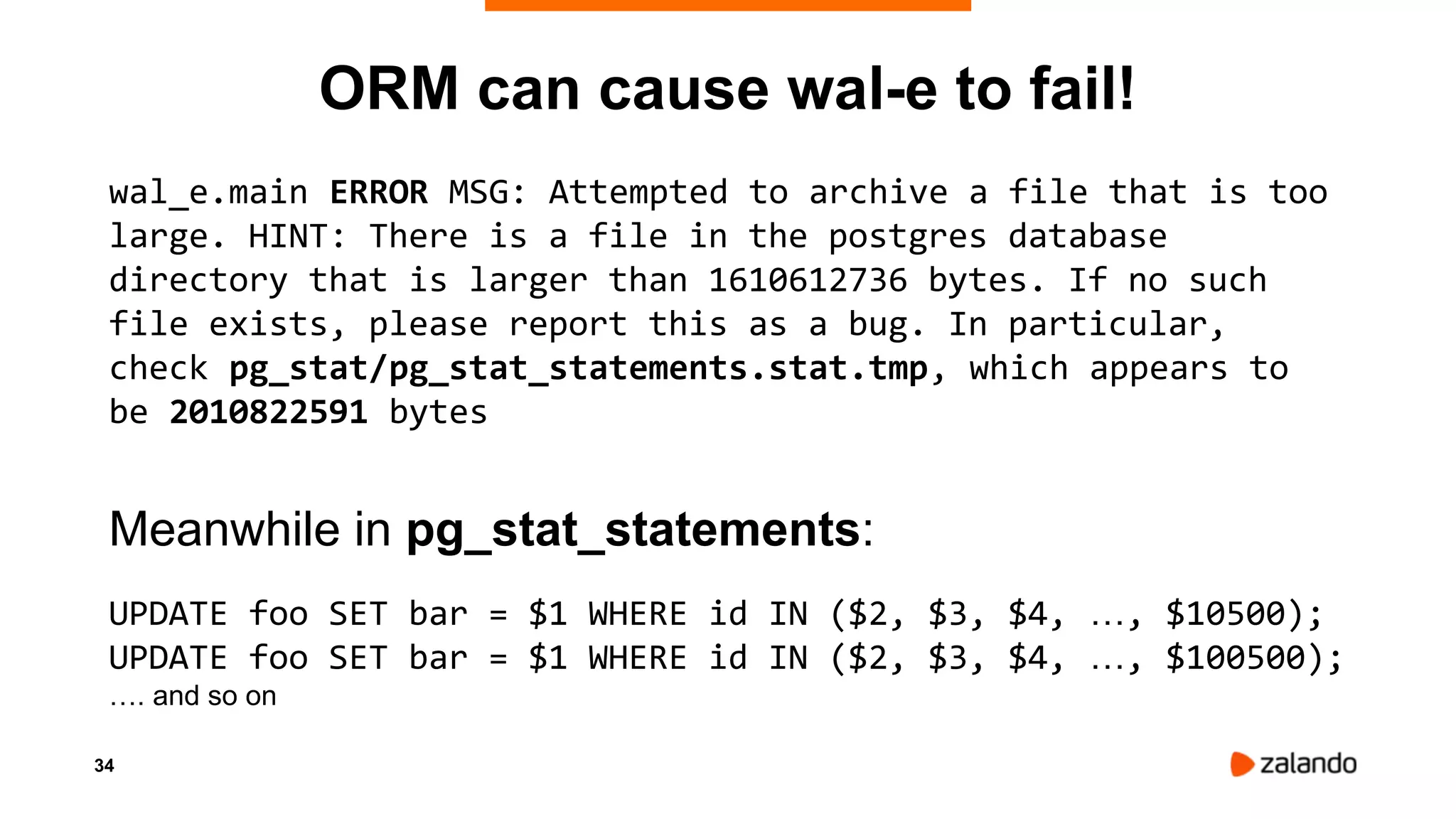
ORM can cause wal-e to fail!
wal_e.main ERROR MSG: Attempted to archive a file that is too
large. HINT: There is a file in the postgres database
directory that is larger than 1610612736 bytes. If no such
file exists, please report this as a bug. In particular,
check pg_stat/pg_stat_statements.stat.tmp, which appears to
be 2010822591 bytes
Meanwhile in pg_stat_statements:
UPDATE foo SET bar = $1 WHERE id IN ($2, $3, $4, …, $10500);
UPDATE foo SET bar = $1 WHERE id IN ($2, $3, $4, …, $100500);
…. and so on
35
Exclusive backup issues
PANIC,XX000,"online backup was canceled, recovery cannot
continue",,,,,"xlog redo at D45/EB000028 for
XLOG/CHECKPOINT_SHUTDOWN: redo D45/EB000028; tli 237; prev
tli 237; fpw true; xid 0:105446371; oid 187558; multi 1;
offset 0; oldest xid 544 in DB 1; oldest multi 1 in DB 1;
oldest/newest commit timestamp xid: 0/0; oldest running xid
0; shutdown",,,,""
● There is no way to join back such failed primary as a replica without
rebuilding (reinitializing) it!
○ wal-g supports non-exclusive backups, but not yet stable enough
36
● Postgres log:
server process (PID 10810) was terminated by signal 9: Killed
● dmesg -T:
[Wed Jul 31 01:35:35 2019] Memory cgroup out of memory: Kill process 14208
(postgres) score 606 or sacrifice child
[Wed Jul 31 01:35:35 2019] Killed process 14208 (postgres) total-vm:2972124kB,
anon-rss:68724kB, file-rss:1304kB, shmem-rss:2691844kB
[Wed Jul 31 01:35:35 2019] oom_reaper: reaped process 14208 (postgres), now
anon-rss:0kB, file-rss:0kB, shmem-rss:2691844kB
Out-Of-Memory Killer
37
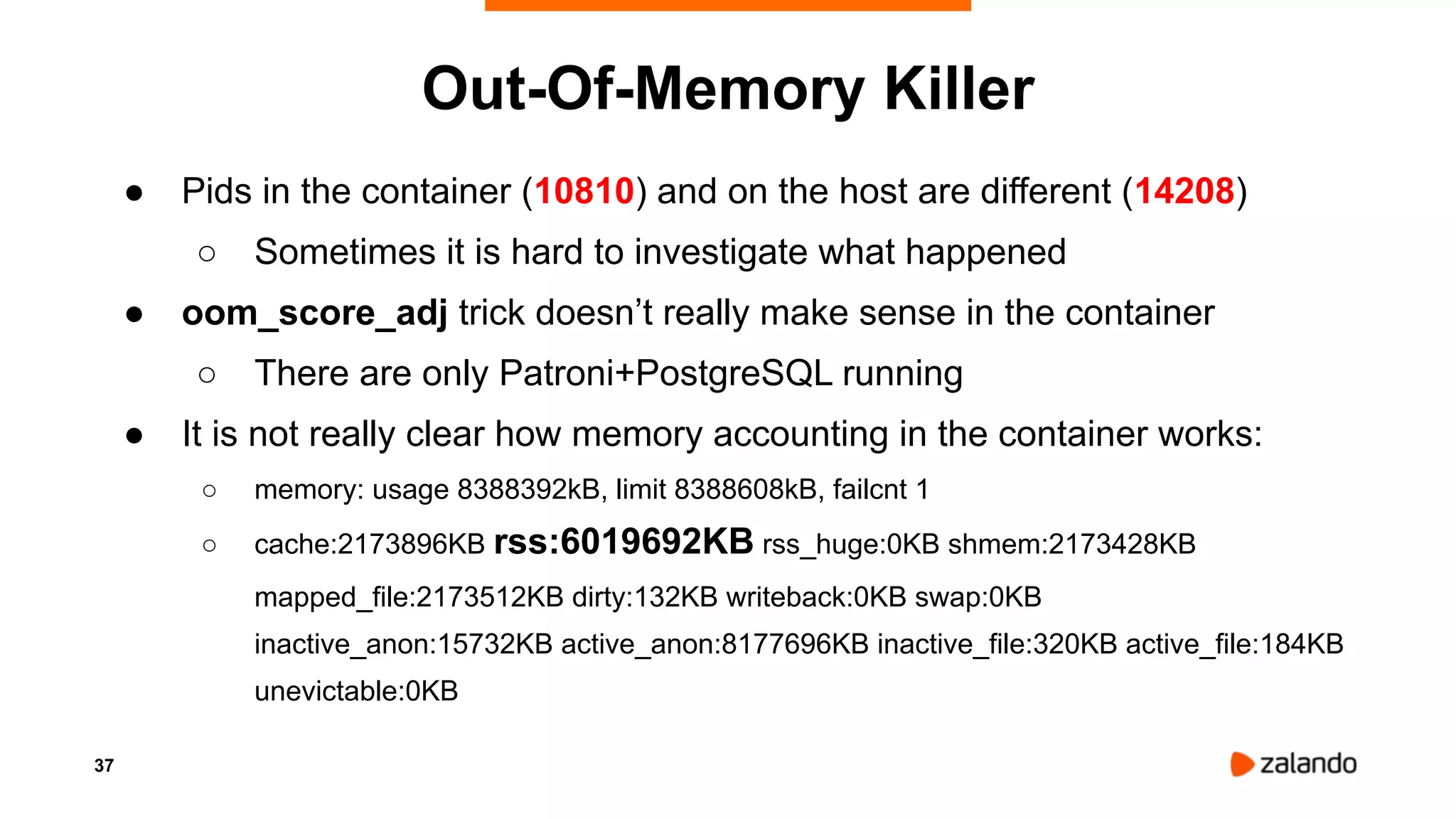
Out-Of-Memory Killer
● Pids in the container (10810) and on the host are different (14208)
○ Sometimes it is hard to investigate what happened
● oom_score_adj trick doesn’t really make sense in the container
○ There are only Patroni+PostgreSQL running
● It is not really clear how memory accounting in the container works:
○ memory: usage 8388392kB, limit 8388608kB, failcnt 1
○ cache:2173896KB rss:6019692KB rss_huge:0KB shmem:2173428KB
mapped_file:2173512KB dirty:132KB writeback:0KB swap:0KB
inactive_anon:15732KB active_anon:8177696KB inactive_file:320KB active_file:184KB
unevictable:0KB
38
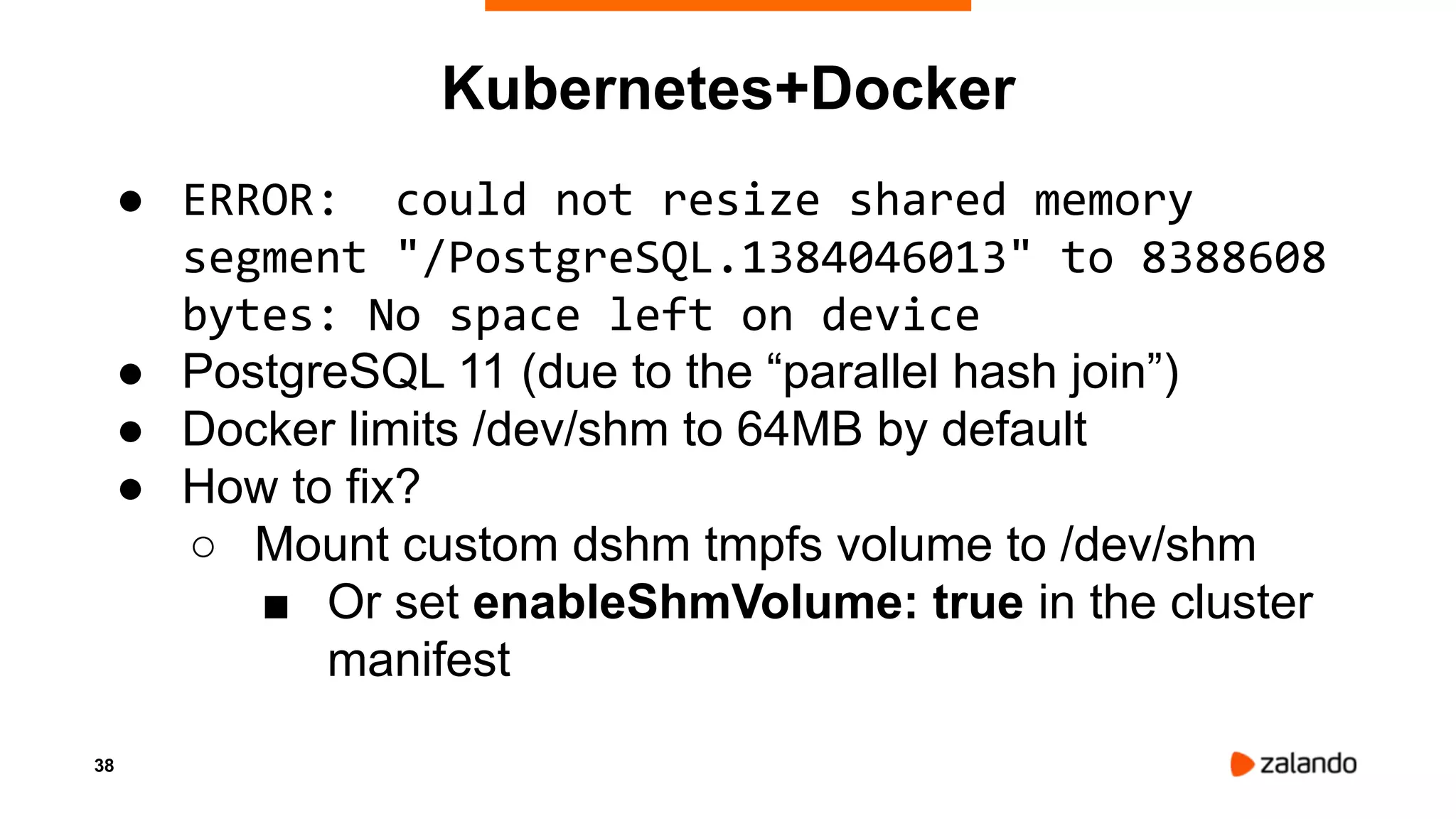
Kubernetes+Docker
● ERROR: could not resize shared memory
segment "/PostgreSQL.1384046013" to 8388608
bytes: No space left on device
● PostgreSQL 11 (due to the “parallel hash join”)
● Docker limits /dev/shm to 64MB by default
● How to fix?
○ Mount custom dshm tmpfs volume to /dev/shm
■ Or set enableShmVolume: true in the cluster
manifest
39
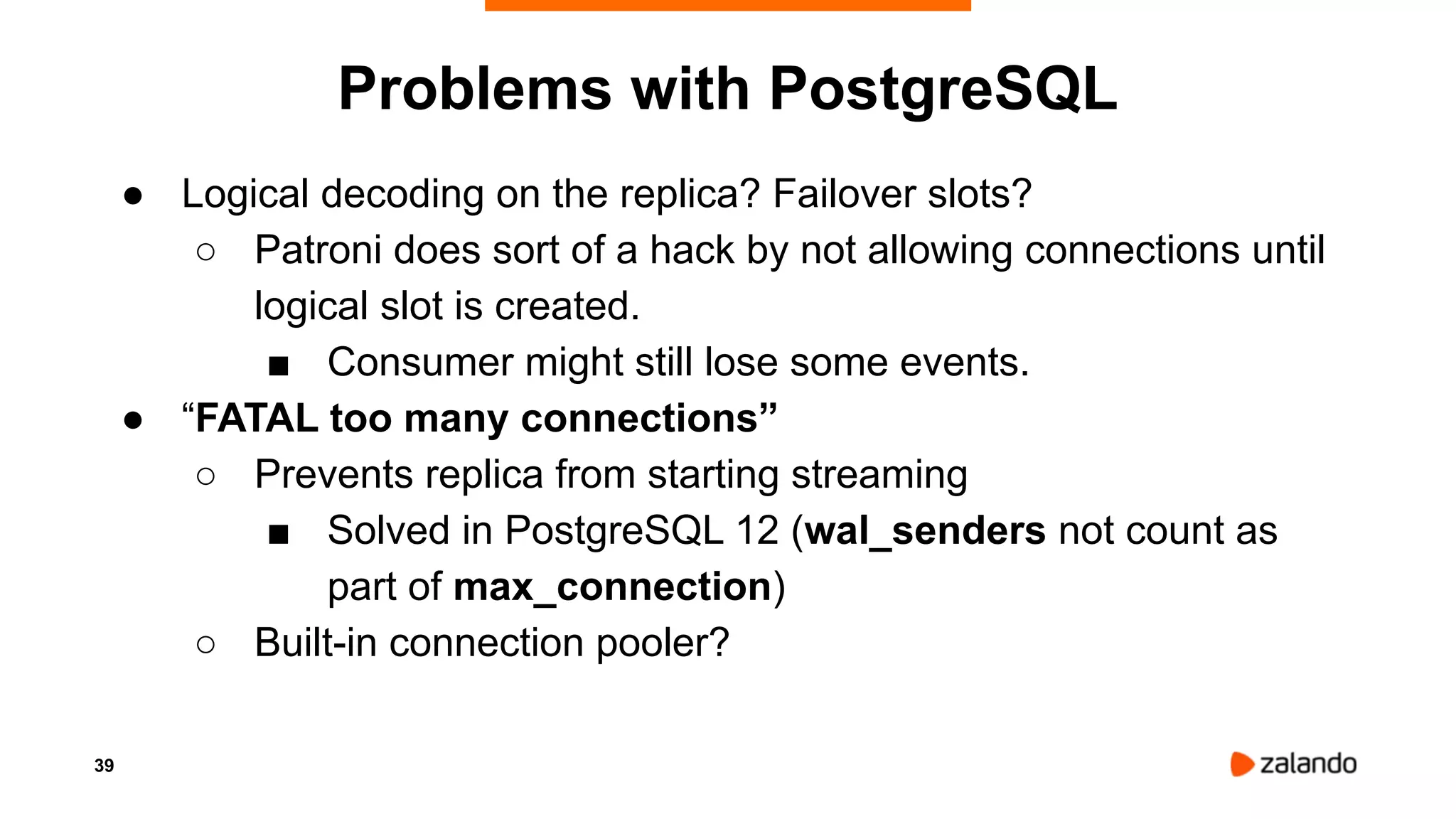
Problems with PostgreSQL
● Logical decoding on the replica? Failover slots?
○ Patroni does sort of a hack by not allowing connections until
logical slot is created.
■ Consumer might still lose some events.
● “FATAL too many connections”
○ Prevents replica from starting streaming
■ Solved in PostgreSQL 12 (wal_senders not count as
part of max_connection)
○ Built-in connection pooler?
40
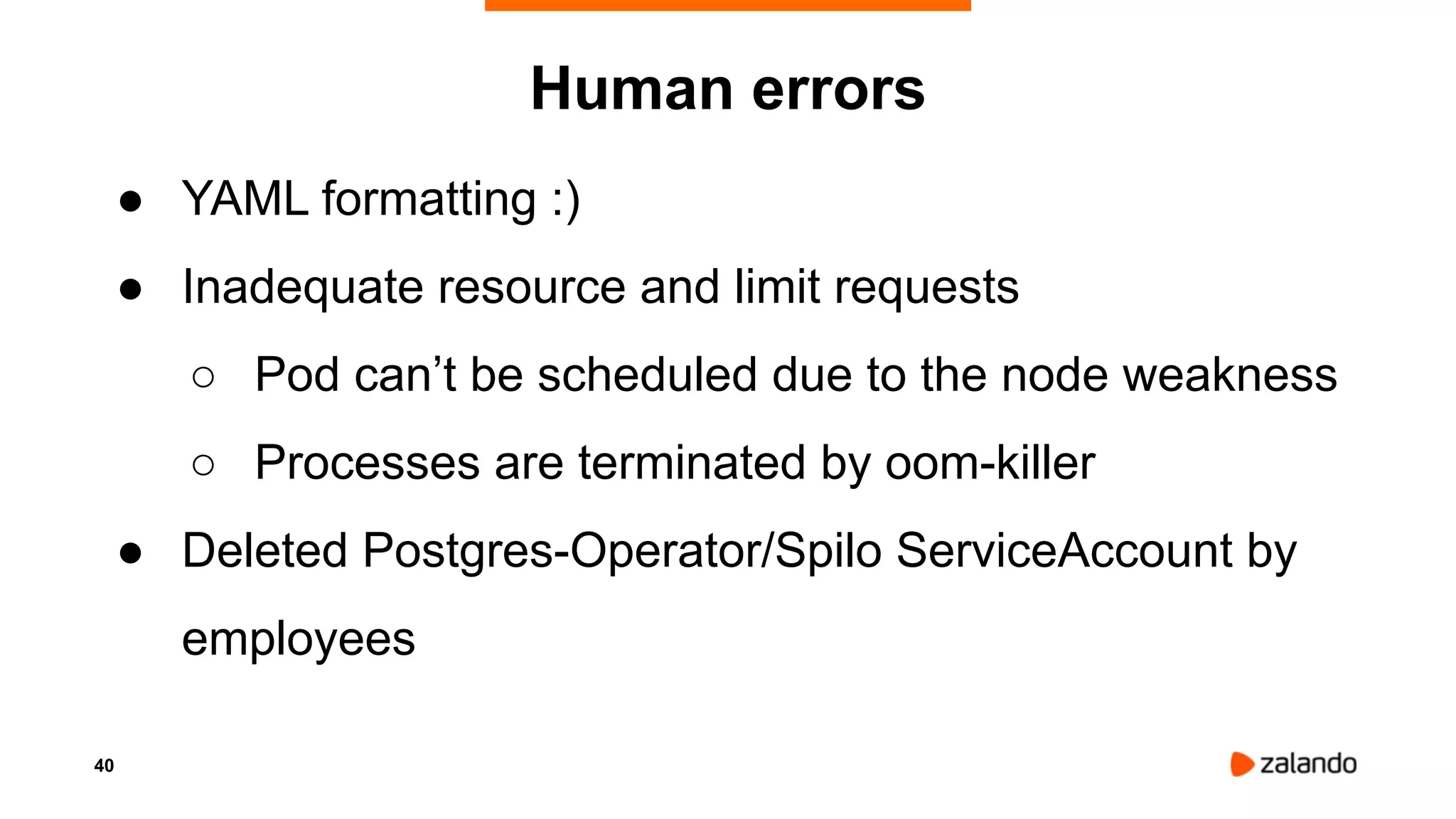
Human errors
● YAML formatting :)
● Inadequate resource and limit requests
○ Pod can’t be scheduled due to the node weakness
○ Processes are terminated by oom-killer
● Deleted Postgres-Operator/Spilo ServiceAccount by
employees
41
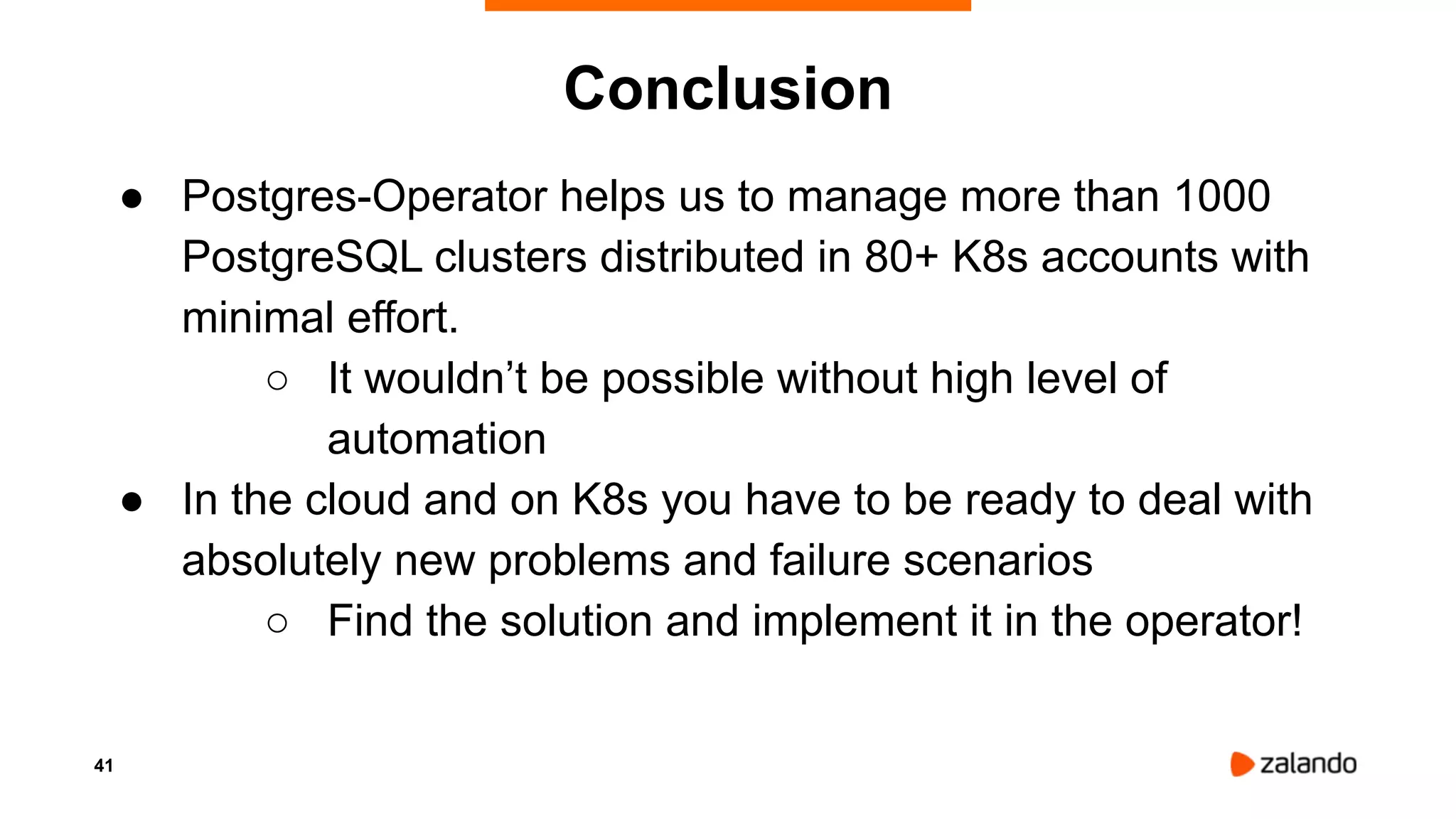
Conclusion
● Postgres-Operator helps us to manage more than 1000
PostgreSQL clusters distributed in 80+ K8s accounts with
minimal effort.
○ It wouldn’t be possible without high level of
automation
● In the cloud and on K8s you have to be ready to deal with
absolutely new problems and failure scenarios
○ Find the solution and implement it in the operator!
42
● Postgres-operator: https://github.com/zalando/postgres-operator
● Patroni: https://github.com/zalando/patroni
● Spilo: https://github.com/zalando/spilo
Open-source
Thank you!
Questions?

PGConf.ASIA 2019 Bali - PostgreSQL on K8S at Zalando - Alexander Kukushkin

  • 1.
    PGConf.ASIA 2019 Indonesia, Bali PostgreSQLon K8S at Zalando: two+ years in production ALEXANDER KUKUSHKIN 10-09-2019
  • 2.
    2 ABOUT ME Alexander Kukushkin DatabaseEngineer @ZalandoTech The Patroni guy alexander.kukushkin@zalando.de Twitter: @cyberdemn
  • 3.
    3 Typical problems andhorror stories Brief introduction to Kubernetes Spilo & Patroni Postgres-Operator AGENDA
  • 4.
    4 WE BRING FASHIONTO PEOPLE IN 17 COUNTRIES 17 markets 7 fulfillment centers 26.4 million active customers 5.4 billion € net sales 2018 250 million visits per month 15,000 employees in Europe
  • 5.
    5 PostgreSQL at Zalando >300 In the data centers > 160 Databases on AWS Managed by DB team > 1000 Databases in other Kubernetes clusters > 190 Run in the ACID’s Kubernetes cluster
  • 6.
    6 What is Kubernetes? ●A set of open-source components running on one or more servers ● A container orchestration system ● An abstraction layer over your real or virtualized hardware ● An “infrastructure as a code” system ● Automatic resource allocation ● Next step after Ansible/Chef/Puppet
  • 7.
    7 What Kubernetes isnot? ● An operating system ● A magical way to make your infrastructure scalable ● An excuse to fire your devops (someone has to configure and manage it) ● A good solution for running 2-3 servers
  • 8.
    8 Terminology Traditional infrastructure ● Physicalserver ● Virtual machine ● Individual application ● NAS/SAN ● Load balancer ● Application registry/hardware information ● Password files, certificates Kubernetes ● Node ● Pod ● Container (typically Docker) ● Persistent Volumes ● Service/Endpoint ● Labels ● Secrets
  • 9.
  • 10.
    10 Stateful applications onKubernetes ● PersistentVolumes ○ Abstracts details how storage is provisioned ○ Supports many different storage types via plugins: ■ EBS, AzureDisk, iSCSI, NFS, CEPH, Glusterfs and so on ● StatefulSets ○ Guarantied number of Pods with stable (and unique) identifiers ○ Ordered deployment and scaling ○ Connecting Pods with corresponding persistent storage (PersistentVolume+PersistentVolumeClaim)
  • 11.
    11 ● All supportedversions of PostgreSQL inside the single image ● Plenty of extensions (pg_partman, pg_cron, postgis, timescaledb, etc) ● Additional tools (pgq, pgbouncer, wal-e/wal-g) ● PGDATA on an external volume ● Patroni for HA ● Environment-variables based configuration ● Lightweight! Spilo Docker image
  • 12.
    12 ● Automatic failoversolution for PostgreSQL streaming replication ● A python daemon that manages one PostgreSQL instance ● Keeps the cluster state in a DCS (Etcd, Zookeeper, Consul, Kubernetes) ○ Uses DCS for leader elections ■ Makes PostgreSQL 1st class citizen on Kubernetes! ● Helps to automate a lot of things like: ○ A new cluster deployment ○ Scaling out and in ○ PostgreSQL configuration management What is Patroni
  • 13.
    13 Spilo & Patronion K8S Node2 Pod: demo-0 role: master PersistentVolume PersistentVolume Node1 StatefulSet: demo Pod: demo-1 role: replica Secret: demo WATCH() UPDATE() Service: demo-replica labelSelector: role=replica Service: demo Endpoint: demoS3
  • 14.
    14 ● A fewlong YAML manifests to write ● Different parts of PostgreSQL configuration spread over multiple manifests ● No easy way to work with a cluster as a whole (update, delete) ● Manual generation of DB objects, i.e. users, and their passwords. Manual deployment to Kubernetes
  • 15.
    15 ● Encapsulates knowledgeof a human operating the service ● Implement a controller application to act on custom resources ● CRD (custom resource definitions) to describe a domain-specific object (i.e. a Postgres cluster) https://coreos.com/blog/introducing-operators.html Kubernetes operator pattern
  • 16.
    16 ● Defines acustom Postgresql resource ● Watches instances of Postgresql, creates/updates/deletes corresponding Kubernetes objects ● Allows updating running-cluster resources (memory, cpu, volumes), postgres configuration ● Creates databases, users and automatically generates passwords ● Auto-repairs, smart rolling updates (switchover to replicas before updating the master) Zalando Postgres-Operator
  • 17.
    17 apiVersion: "acid.zalan.do/v1" kind: postgresql metadata: name:acid-minimal-cluster spec: teamId: "ACID" # is used to provision human users volume: size: 1Gi numberOfInstances: 2 users: zalando: # database owner - createrole - createdb foo_app_user: # role for application foo databases: # name->owner foo: zalando postgresql: version: "11" Postgresql manifest
  • 18.
    18 deploycluster manifest Stateful set Spilo pod Kubernetescluster PATRONI operator pod Endpoint Service Client application operator config map Cluster secrets DB deployer create create create watch Infrastructure roles
  • 19.
  • 20.
  • 21.
    21 Zalando Postgres-Operator features ●Rolling updates on Postgres cluster changes ● Volume resize without Pod restarts ● Cloning Postgres clusters ● Logical Backups to S3 Bucket ● Standby cluster from S3 WAL archive ● Configurable for non-cloud environments ● UI to create and edit Postgres cluster manifests
  • 22.
    22 Kubernetes rolling upgrade ●Rotates all worker nodes in the K8s cluster ○ Does it in a rolling matter, one-by-one ○ If you are unlucky, it will cause the number of failover equal number of pods in your postgres cluster ● How Postgres-Operator deals with it? ○ Detect the to-be-decommissioned node by lack of the ready label and SchedulingDisabled status ○ Move all master pods: ■ Move replicas to the already updated node ■ Trigger switchover to those replicas
  • 23.
    23 Availability Zone 1 Node cluster:A primary cluster: B primary cluster: C replica Availability Zone 2 Availability Zone 3 Kubernetes rolling upgrade (start) Node Node cluster: A replica cluster: B replica cluster: C primary Node Node cluster: A replica cluster: B replica cluster: C replica Node Node (to-be-decommissioned) Node (new) Terminated PodActive Pod
  • 24.
    24 Availability Zone 1 Node cluster:A primary cluster: B primary cluster: C replica Availability Zone 2 Availability Zone 3 Kubernetes rolling upgrade (step 1) Node Node cluster: A replica cluster: B replica cluster: C primary Node Node cluster: A replica cluster: B replica cluster: C replica Node cluster: A replica cluster: B replica cluster: A replica cluster: B replica cluster: C replica cluster: C replica Node (to-be-decommissioned) Node (new) Terminated PodActive Pod
  • 25.
    25 Availability Zone 1 Node cluster:A primary cluster: B primary Availability Zone 2 Availability Zone 3 Kubernetes rolling upgrade (step 1) Node Node cluster: C primary Node Node cluster: A replica cluster: B replica cluster: A replica cluster: B replica cluster: C replica cluster: C replica Node (to-be-decommissioned) Node (new) Terminated PodActive Pod
  • 26.
    26 Availability Zone 1 Node cluster:A primary cluster: B primary Availability Zone 2 Availability Zone 3 Kubernetes rolling upgrade (switchover) Node Node cluster: C primary Node Node cluster: A replica cluster: B replica cluster: A replica cluster: B replica cluster: C replica cluster: C replica Node (to-be-decommissioned) Node (new) Terminated PodActive Pod
  • 27.
    27 Availability Zone 1 Node cluster:A replica cluster: B replica Availability Zone 2 Availability Zone 3 Kubernetes rolling upgrade (switchover) Node Node cluster: C replica Node Node cluster: A primary cluster: B replica cluster: A replica cluster: B primary cluster: C replica cluster: C primary Node (to-be-decommissioned) Node (new) Terminated PodActive Pod
  • 28.
    28 Availability Zone 1 Node AvailabilityZone 2 Availability Zone 3 Kubernetes rolling upgrade (finish) Node cluster: A replica cluster: B replica Node Node cluster: C replica Node cluster: A primary cluster: B replica cluster: A replica cluster: B primary cluster: C replica cluster: C primary Node (to-be-decommissioned) Node (new) Terminated PodActive Pod cluster: A replica cluster: B replica cluster: C replica
  • 29.
  • 30.
    30 Problems with AWSinfrastructure ● AWS API Rate Limit Exceeded ○ Prevents or delays attaching/detaching persistent volumes (EBS) to/from Pods ■ Delays recovery of failed Pods ○ Might delay a deployment of a new cluster ● Sometimes EC2 instances fail and being shutdown by AWS ○ Shutdown might take ages ○ All EBS volumes remain attached until instance is shutted down ■ Pods can’t be rescheduled
  • 31.
    31 KUBE2IAM ● AWS IAM+ Instance Profile is very flexible, convenient, and powerful technology ● AWS tools and libraries can use temporary credentials obtained from the Instance Profile to access other AWS services, for example S3 ○ We are using S3 for backups and continuous archiving (wal-e/wal-g) ● Instance Profile is configured per EC2 Instance (K8s Node)! ● kube2iam - provides different IAM roles for Pods running on a single Node ● kube2iam might stop serving the Pod which is being shutdown ○ wal-e is unable to get credentials to access S3 ■ Last WAL segments remain unarchived! :(
  • 32.
    32 Lack of Diskspace ● Single volume for PGDATA, pg_wal and logs ● FATAL,53100,could not write to file "pg_wal/xlogtemp.22993": No space left on device ○ Usually ends up with postgres being self shutdown ● Patroni tries to recover the primary which isn’t running ○ “start->promote->No space left->shutdown” loop Disk space MUST be monitored!
  • 33.
    33 Disk space problemsroot cause or why we don’t implement volume autoextend ● Excessive logging ○ slow queries, human access, application errors, connections/disconnections ● pg_wal growth ○ archive_command is slow/failing ○ Unconsumed changes on the replication slot ■ Replica is not streaming? Replica is slow? ■ Logical replication slot? ○ checkpoints taking too long due to throttled IOPS ● PGDATA growth ○ Table and index bloat! ■ Useless updates of unchanged data? ■ Autovacuum tuning? Zheap? ○ Natural growth of data ■ Lack of retention policies? ■ Broken cleanup jobs?
  • 34.
    34 ORM can causewal-e to fail! wal_e.main ERROR MSG: Attempted to archive a file that is too large. HINT: There is a file in the postgres database directory that is larger than 1610612736 bytes. If no such file exists, please report this as a bug. In particular, check pg_stat/pg_stat_statements.stat.tmp, which appears to be 2010822591 bytes Meanwhile in pg_stat_statements: UPDATE foo SET bar = $1 WHERE id IN ($2, $3, $4, …, $10500); UPDATE foo SET bar = $1 WHERE id IN ($2, $3, $4, …, $100500); …. and so on
  • 35.
    35 Exclusive backup issues PANIC,XX000,"onlinebackup was canceled, recovery cannot continue",,,,,"xlog redo at D45/EB000028 for XLOG/CHECKPOINT_SHUTDOWN: redo D45/EB000028; tli 237; prev tli 237; fpw true; xid 0:105446371; oid 187558; multi 1; offset 0; oldest xid 544 in DB 1; oldest multi 1 in DB 1; oldest/newest commit timestamp xid: 0/0; oldest running xid 0; shutdown",,,,"" ● There is no way to join back such failed primary as a replica without rebuilding (reinitializing) it! ○ wal-g supports non-exclusive backups, but not yet stable enough
  • 36.
    36 ● Postgres log: serverprocess (PID 10810) was terminated by signal 9: Killed ● dmesg -T: [Wed Jul 31 01:35:35 2019] Memory cgroup out of memory: Kill process 14208 (postgres) score 606 or sacrifice child [Wed Jul 31 01:35:35 2019] Killed process 14208 (postgres) total-vm:2972124kB, anon-rss:68724kB, file-rss:1304kB, shmem-rss:2691844kB [Wed Jul 31 01:35:35 2019] oom_reaper: reaped process 14208 (postgres), now anon-rss:0kB, file-rss:0kB, shmem-rss:2691844kB Out-Of-Memory Killer
  • 37.
    37 Out-Of-Memory Killer ● Pidsin the container (10810) and on the host are different (14208) ○ Sometimes it is hard to investigate what happened ● oom_score_adj trick doesn’t really make sense in the container ○ There are only Patroni+PostgreSQL running ● It is not really clear how memory accounting in the container works: ○ memory: usage 8388392kB, limit 8388608kB, failcnt 1 ○ cache:2173896KB rss:6019692KB rss_huge:0KB shmem:2173428KB mapped_file:2173512KB dirty:132KB writeback:0KB swap:0KB inactive_anon:15732KB active_anon:8177696KB inactive_file:320KB active_file:184KB unevictable:0KB
  • 38.
    38 Kubernetes+Docker ● ERROR: couldnot resize shared memory segment "/PostgreSQL.1384046013" to 8388608 bytes: No space left on device ● PostgreSQL 11 (due to the “parallel hash join”) ● Docker limits /dev/shm to 64MB by default ● How to fix? ○ Mount custom dshm tmpfs volume to /dev/shm ■ Or set enableShmVolume: true in the cluster manifest
  • 39.
    39 Problems with PostgreSQL ●Logical decoding on the replica? Failover slots? ○ Patroni does sort of a hack by not allowing connections until logical slot is created. ■ Consumer might still lose some events. ● “FATAL too many connections” ○ Prevents replica from starting streaming ■ Solved in PostgreSQL 12 (wal_senders not count as part of max_connection) ○ Built-in connection pooler?
  • 40.
    40 Human errors ● YAMLformatting :) ● Inadequate resource and limit requests ○ Pod can’t be scheduled due to the node weakness ○ Processes are terminated by oom-killer ● Deleted Postgres-Operator/Spilo ServiceAccount by employees
  • 41.
    41 Conclusion ● Postgres-Operator helpsus to manage more than 1000 PostgreSQL clusters distributed in 80+ K8s accounts with minimal effort. ○ It wouldn’t be possible without high level of automation ● In the cloud and on K8s you have to be ready to deal with absolutely new problems and failure scenarios ○ Find the solution and implement it in the operator!
  • 42.
    42 ● Postgres-operator: https://github.com/zalando/postgres-operator ●Patroni: https://github.com/zalando/patroni ● Spilo: https://github.com/zalando/spilo Open-source
  • 43.