containerd Deep Dive
Akihiro Suda (NTT) & Wei Fu (Alibaba Cloud)
KubeCon EU 2020 Virtual (Aug 19, 2020)
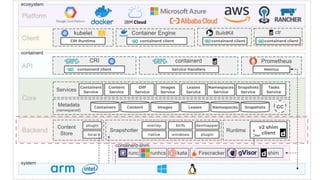
containerd overview
Akihiro Suda (NTT)
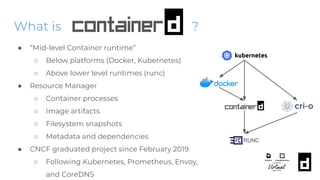
What is ?
● “Mid-level Container runtime”
○ Below platforms (Docker, Kubernetes)
○ Above lower level runtimes (runc)
● Resource Manager
○ Container processes
○ Image artifacts
○ Filesystem snapshots
○ Metadata and dependencies
● CNCF graduated project since February 2019
○ Following Kubernetes, Prometheus, Envoy,
and CoreDNS
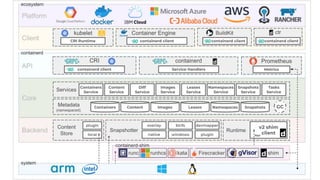
Highly customizable
● Runtime plugins
○ Runc, gVisor, Kata, Firecracker...
● Snapshotter plugins
○ OverlayFS, BtrFS, ZFS, …
● Content store plugins
○ Local, IPFS...
● Stream processor plugins
○ ImgCrypt, zstd...
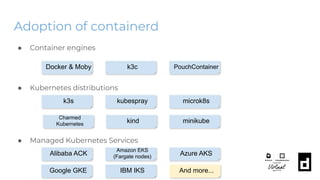
Adoption of containerd
● Container engines
● Kubernetes distributions
● Managed Kubernetes Services
Docker & Moby k3c PouchContainer
k3s kubespray microk8s
Alibaba ACK
Amazon EKS
(Fargate nodes)
Azure AKS
Google GKE IBM IKS
kind minikube
Charmed
Kubernetes
And more...
Adoption of containerd
● BuildKit
○ The modern implementation of `docker build`
● LinuxKit
○ Small Linux distro with containerd as the init
● Faasd
○ OpenFaaS for containerd
● VMware Fusion Nautilus
○ containerd on macOS, using VMware as the runtime plugin
Upcoming features in v1.4
Akihiro Suda (NTT)
Lazy pulling of images
● Run containers before completion of downloading the images
● Use cases:
○ Python/Ruby/Java/dotNET images
○ FaaS
○ Web apps with huge amount of HTML templates and media files
○ Jupyter Notebooks with big data samples included
○ Full GNOME/KDE desktop
Lazy pulling of images: Stargz & eStargz
● The containerd snapshotter plugin for Stargz & eStargz
https://github.com/containerd/stargz-snapshotter
● Stargz: seekable tar.gz for lazy-pullable container images
● eStargz: extended Stargz for batching frequently used files
● Both are fully compatible with legacy OCI tar.gz
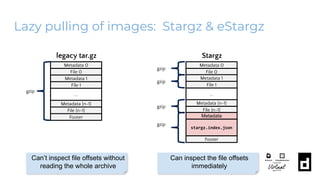
Lazy pulling of images: Stargz & eStargz
Metadata 0
File 0
Metadata 1
File 1
Metadata {n-1}
File {n-1}
Footer
...
gzip
legacy tar.gz Stargz
Metadata 0
File 0
gzip
Metadata 1
File 1
gzip
...
Metadata {n-1}
File {n-1}
gzip
gzip
Footer
Metadata
stargz.index.json
Can’t inspect file offsets without
reading the whole archive
Can inspect the file offsets
immediately
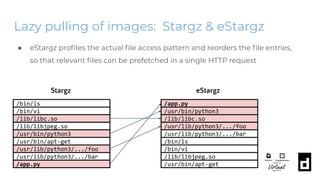
Lazy pulling of images: Stargz & eStargz
● eStargz profiles the actual file access pattern and reorders the file entries,
so that relevant files can be prefetched in a single HTTP request
/usr/bin/apt-get
/bin/ls
/bin/vi
/lib/libc.so
/lib/libjpeg.so
/usr/bin/python3
.../usr/lib/python3/.../foo
/usr/lib/python3/.../bar
/app.py
/bin/ls
/app.py
/usr/bin/python3
/lib/libc.so
/usr/lib/python3/.../foo
/usr/lib/python3/.../bar
.../bin/vi
/lib/libjpeg.so
/usr/bin/apt-get
Stargz eStargz
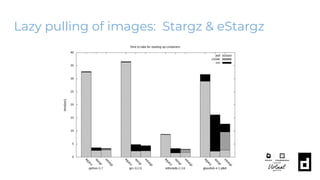
Lazy pulling of images: Stargz & eStargz
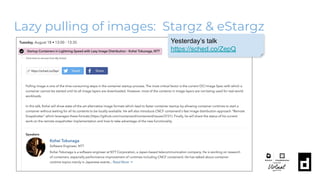
Yesterday’s talk
https://sched.co/ZepQ
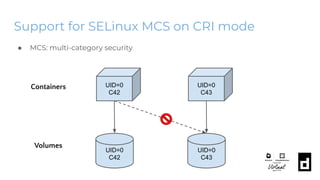
Support for SELinux MCS on CRI mode
● MCS: multi-category security
Containers
Volumes
UID=0
C42
UID=0
C42
UID=0
C43
UID=0
C43
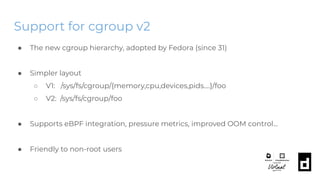
Support for cgroup v2
● The new cgroup hierarchy, adopted by Fedora (since 31)
● Simpler layout
○ V1: /sys/fs/cgroup/{memory,cpu,devices,pids….}/foo
○ V2: /sys/fs/cgroup/foo
● Supports eBPF integration, pressure metrics, improved OOM control...
● Friendly to non-root users
Improved support for rootless mode
● Run containerd (and relevant components) as a non-root user
● Protect the host from potential vulnerabilities
● Adoption in containerd-related projects
○ Docker
○ BuildKit
○ k3s
○ k3c (on plan)
○ Kubernetes (on proposal, KEP 1371)
Improved support for rootless mode
● [v1.3] No support for resource limitation (docker run --cpus … --memory ...)
○ Because unprivileged users cannot control cgroups
● [v1.3] No support for overlayfs snapshotter
○ Because unprivileged users cannot mount overlayfs
(except on Ubuntu/Debian kernels)
○ “Native” snapshotter can be used, but slow and wastes the disk
Improved support for rootless mode
● [v1.3] No support for resource limitation (docker run --cpus … --memory ...)
○ Because unprivileged users cannot control cgroups
● [v1.3] No support for overlayfs snapshotter
○ Because unprivileged users cannot mount overlayfs
(except on Ubuntu/Debian kernels)
○ “Native” snapshotter can be used, but slow and wastes the disk
→ v1.4 supports resource limitation
(requires cgroup v2 and systemd)
→ v1.4 supports FUSE-OverlayFS snapshotter
(requires kernel >= 4.18)
Demo: Rootless Kubernetes with Cgroup v2
“Usernetes” https://github.com/rootless-containers/usernetes
https://asciinema.org/a/349859
Other changes in v1.4
● Windows CRI
● systemd NOTIFY_SOCKET
● Support reloading CNI config without restarting the daemon
● Socat binary is no longer needed
Release note: https://github.com/containerd/containerd/releases
v1.5 planning
● NRI: Node Resource Interface (#4411)
○ The new common interface for node resources such as cgroup
○ The plugin spec is very similar to CNI
● Sandbox API (#4131)
○ Pod sandbox as a first-class object
○ No “/pause” process
● Filesystem quota (#759)
containerd: external plugins
Wei Fu (Alibaba Cloud)
Backend as external plugins
● Big goal - no re-compilation required!!!
● Stream processors
● gRPC proxy plugin for image storage
● RuntimeV2 proto for OCI Runtime
Stream processor
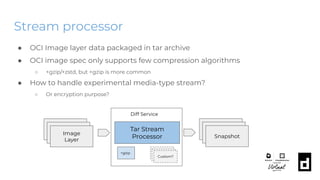
● OCI Image layer data packaged in tar archive
● OCI image spec only supports few compression algorithms
○ +gzip/+zstd, but +gzip is more common
● How to handle experimental media-type stream?
○ Or encryption purpose?
Image
Layer
Snapshot
Tar Stream
Processor
Diff Service
+gzip
Custom?
Stream processor
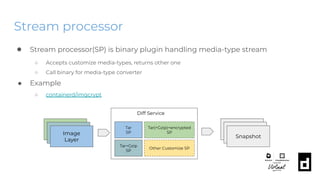
● Stream processor(SP) is binary plugin handling media-type stream
○ Accepts customize media-types, returns other one
○ Call binary for media-type converter
● Example
○ containerd/imgcrypt
Image
Layer
Snapshot
Tar
SP
Diff Service
Tar+Gzip
SP
Tar(+Gzip)+encrypted
SP
Other Customize SP
Stream processor - Demo
● Integrate with +zstd media-type
● asciinema link
[stream_processors]
[stream_processors."zstd"]
accepts = ["application/vnd.oci.image.layer.v1.tar+zstd"]
returns = "application/vnd.oci.image.layer.v1.tar"
path = "zstd"
args = ["-dcf"]
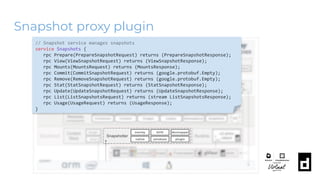
Snapshot proxy plugin
// Snapshot service manages snapshots
service Snapshots {
rpc Prepare(PrepareSnapshotRequest) returns (PrepareSnapshotResponse);
rpc View(ViewSnapshotRequest) returns (ViewSnapshotResponse);
rpc Mounts(MountsRequest) returns (MountsResponse);
rpc Commit(CommitSnapshotRequest) returns (google.protobuf.Empty);
rpc Remove(RemoveSnapshotRequest) returns (google.protobuf.Empty);
rpc Stat(StatSnapshotRequest) returns (StatSnapshotResponse);
rpc Update(UpdateSnapshotRequest) returns (UpdateSnapshotResponse);
rpc List(ListSnapshotsRequest) returns (stream ListSnapshotsResponse);
rpc Usage(UsageRequest) returns (UsageResponse);
}
Snapshot proxy plugin
package main
import(
"net"
"log"
"github.com/containerd/containerd/api/services/snapshots/v1"
"github.com/containerd/containerd/contrib/snapshotservice"
)
func main() {
rpc := grpc.NewServer()
sn := CustomSnapshotter()
service := snapshotservice.FromSnapshotter(sn)
snapshots.RegisterSnapshotsServer(rpc, service)
// Listen and serve
l, err := net.Listen("unix", "/var/run/mysnapshotter.sock")
if err != nil {
log.Fatalf("error: %vn", err)
}
if err := rpc.Serve(l); err != nil {
log.Fatalf("error: %vn", err)
}
}
● Configure with proxy_plugins
● Example
○ stargz-snapshotter
○ CVMFS Containerd Snapshotter
[proxy_plugins]
[proxy_plugins.customsnapshot]
type = "snapshot"
address = "/var/run/mysnapshotter.sock"
Runtime V2
● A first class shim API for runtime authors to integrate with containerd
○ More VM like runtimes have internal state and more abstract actions
○ A CLI approach introduces issues with state management
○ Each runtimes has its own values, but keep containerd in solid core scope
● Example
○ gVisor
○ KataContainer
○ Firecracker
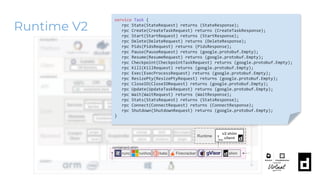
Runtime V2
service Task {
rpc State(StateRequest) returns (StateResponse);
rpc Create(CreateTaskRequest) returns (CreateTaskResponse);
rpc Start(StartRequest) returns (StartResponse);
rpc Delete(DeleteRequest) returns (DeleteResponse);
rpc Pids(PidsRequest) returns (PidsResponse);
rpc Pause(PauseRequest) returns (google.protobuf.Empty);
rpc Resume(ResumeRequest) returns (google.protobuf.Empty);
rpc Checkpoint(CheckpointTaskRequest) returns (google.protobuf.Empty);
rpc Kill(KillRequest) returns (google.protobuf.Empty);
rpc Exec(ExecProcessRequest) returns (google.protobuf.Empty);
rpc ResizePty(ResizePtyRequest) returns (google.protobuf.Empty);
rpc CloseIO(CloseIORequest) returns (google.protobuf.Empty);
rpc Update(UpdateTaskRequest) returns (google.protobuf.Empty);
rpc Wait(WaitRequest) returns (WaitResponse);
rpc Stats(StatsRequest) returns (StatsResponse);
rpc Connect(ConnectRequest) returns (ConnectResponse);
rpc Shutdown(ShutdownRequest) returns (google.protobuf.Empty);
}
Runtime V2 - Binary
● Binary naming convention
○ Name io.containerd.runc.v2 --> Binary containerd-shim-runc-v2
■ So both io.containerd.runc.v1 and io.containerd.runc.v2 are runtime V2
■ runc.v2 supports grouping several containers with less resource
■ runc.v2 as CRI plugin’s default runtime
○ Via a runtime binary available in containerd’s PATH
● Required start/delete sub-commands
○ Resources created by container will be cleanup by delete sub-command
Runtime V2 - Logging
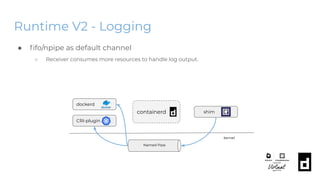
● fifo/npipe as default channel
○ Receiver consumes more resources to handle log output.
dockerd
CRI-plugin
containerd shim
kernel
Named Pipe
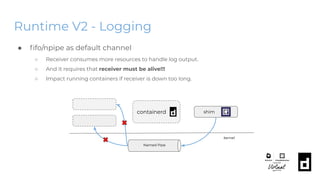
Runtime V2 - Logging
● fifo/npipe as default channel
○ Receiver consumes more resources to handle log output.
○ And it requires that receiver must be alive!!!
○ Impact running containers if receiver is down too long.
containerd shim
Named Pipe
kernel
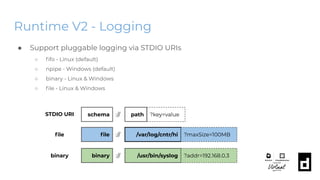
Runtime V2 - Logging
● Support pluggable logging via STDIO URIs
○ fifo - Linux (default)
○ npipe - Windows (default)
○ binary - Linux & Windows
○ file - Linux & Windows
schema path:// ?key=valueSTDIO URI
file file :// /var/log/cntr/hi ?maxSize=100MB
binary binary :// /usr/bin/syslog ?addr=192.168.0.3
Thank you

[KubeCon EU 2020] containerd Deep Dive

  • 1.
    containerd Deep Dive AkihiroSuda (NTT) & Wei Fu (Alibaba Cloud) KubeCon EU 2020 Virtual (Aug 19, 2020)
  • 2.
  • 3.
    What is ? ●“Mid-level Container runtime” ○ Below platforms (Docker, Kubernetes) ○ Above lower level runtimes (runc) ● Resource Manager ○ Container processes ○ Image artifacts ○ Filesystem snapshots ○ Metadata and dependencies ● CNCF graduated project since February 2019 ○ Following Kubernetes, Prometheus, Envoy, and CoreDNS
  • 5.
    Highly customizable ● Runtimeplugins ○ Runc, gVisor, Kata, Firecracker... ● Snapshotter plugins ○ OverlayFS, BtrFS, ZFS, … ● Content store plugins ○ Local, IPFS... ● Stream processor plugins ○ ImgCrypt, zstd...
  • 6.
    Adoption of containerd ●Container engines ● Kubernetes distributions ● Managed Kubernetes Services Docker & Moby k3c PouchContainer k3s kubespray microk8s Alibaba ACK Amazon EKS (Fargate nodes) Azure AKS Google GKE IBM IKS kind minikube Charmed Kubernetes And more...
  • 7.
    Adoption of containerd ●BuildKit ○ The modern implementation of `docker build` ● LinuxKit ○ Small Linux distro with containerd as the init ● Faasd ○ OpenFaaS for containerd ● VMware Fusion Nautilus ○ containerd on macOS, using VMware as the runtime plugin
  • 8.
    Upcoming features inv1.4 Akihiro Suda (NTT)
  • 9.
    Lazy pulling ofimages ● Run containers before completion of downloading the images ● Use cases: ○ Python/Ruby/Java/dotNET images ○ FaaS ○ Web apps with huge amount of HTML templates and media files ○ Jupyter Notebooks with big data samples included ○ Full GNOME/KDE desktop
  • 10.
    Lazy pulling ofimages: Stargz & eStargz ● The containerd snapshotter plugin for Stargz & eStargz https://github.com/containerd/stargz-snapshotter ● Stargz: seekable tar.gz for lazy-pullable container images ● eStargz: extended Stargz for batching frequently used files ● Both are fully compatible with legacy OCI tar.gz
  • 11.
    Lazy pulling ofimages: Stargz & eStargz Metadata 0 File 0 Metadata 1 File 1 Metadata {n-1} File {n-1} Footer ... gzip legacy tar.gz Stargz Metadata 0 File 0 gzip Metadata 1 File 1 gzip ... Metadata {n-1} File {n-1} gzip gzip Footer Metadata stargz.index.json Can’t inspect file offsets without reading the whole archive Can inspect the file offsets immediately
  • 12.
    Lazy pulling ofimages: Stargz & eStargz ● eStargz profiles the actual file access pattern and reorders the file entries, so that relevant files can be prefetched in a single HTTP request /usr/bin/apt-get /bin/ls /bin/vi /lib/libc.so /lib/libjpeg.so /usr/bin/python3 .../usr/lib/python3/.../foo /usr/lib/python3/.../bar /app.py /bin/ls /app.py /usr/bin/python3 /lib/libc.so /usr/lib/python3/.../foo /usr/lib/python3/.../bar .../bin/vi /lib/libjpeg.so /usr/bin/apt-get Stargz eStargz
  • 13.
    Lazy pulling ofimages: Stargz & eStargz
  • 14.
    Lazy pulling ofimages: Stargz & eStargz Yesterday’s talk https://sched.co/ZepQ
  • 15.
    Support for SELinuxMCS on CRI mode ● MCS: multi-category security Containers Volumes UID=0 C42 UID=0 C42 UID=0 C43 UID=0 C43
  • 16.
    Support for cgroupv2 ● The new cgroup hierarchy, adopted by Fedora (since 31) ● Simpler layout ○ V1: /sys/fs/cgroup/{memory,cpu,devices,pids….}/foo ○ V2: /sys/fs/cgroup/foo ● Supports eBPF integration, pressure metrics, improved OOM control... ● Friendly to non-root users
  • 17.
    Improved support forrootless mode ● Run containerd (and relevant components) as a non-root user ● Protect the host from potential vulnerabilities ● Adoption in containerd-related projects ○ Docker ○ BuildKit ○ k3s ○ k3c (on plan) ○ Kubernetes (on proposal, KEP 1371)
  • 18.
    Improved support forrootless mode ● [v1.3] No support for resource limitation (docker run --cpus … --memory ...) ○ Because unprivileged users cannot control cgroups ● [v1.3] No support for overlayfs snapshotter ○ Because unprivileged users cannot mount overlayfs (except on Ubuntu/Debian kernels) ○ “Native” snapshotter can be used, but slow and wastes the disk
  • 19.
    Improved support forrootless mode ● [v1.3] No support for resource limitation (docker run --cpus … --memory ...) ○ Because unprivileged users cannot control cgroups ● [v1.3] No support for overlayfs snapshotter ○ Because unprivileged users cannot mount overlayfs (except on Ubuntu/Debian kernels) ○ “Native” snapshotter can be used, but slow and wastes the disk → v1.4 supports resource limitation (requires cgroup v2 and systemd) → v1.4 supports FUSE-OverlayFS snapshotter (requires kernel >= 4.18)
  • 20.
    Demo: Rootless Kuberneteswith Cgroup v2 “Usernetes” https://github.com/rootless-containers/usernetes https://asciinema.org/a/349859
  • 21.
    Other changes inv1.4 ● Windows CRI ● systemd NOTIFY_SOCKET ● Support reloading CNI config without restarting the daemon ● Socat binary is no longer needed Release note: https://github.com/containerd/containerd/releases
  • 22.
    v1.5 planning ● NRI:Node Resource Interface (#4411) ○ The new common interface for node resources such as cgroup ○ The plugin spec is very similar to CNI ● Sandbox API (#4131) ○ Pod sandbox as a first-class object ○ No “/pause” process ● Filesystem quota (#759)
  • 23.
  • 25.
    Backend as externalplugins ● Big goal - no re-compilation required!!! ● Stream processors ● gRPC proxy plugin for image storage ● RuntimeV2 proto for OCI Runtime
  • 26.
    Stream processor ● OCIImage layer data packaged in tar archive ● OCI image spec only supports few compression algorithms ○ +gzip/+zstd, but +gzip is more common ● How to handle experimental media-type stream? ○ Or encryption purpose? Image Layer Snapshot Tar Stream Processor Diff Service +gzip Custom?
  • 27.
    Stream processor ● Streamprocessor(SP) is binary plugin handling media-type stream ○ Accepts customize media-types, returns other one ○ Call binary for media-type converter ● Example ○ containerd/imgcrypt Image Layer Snapshot Tar SP Diff Service Tar+Gzip SP Tar(+Gzip)+encrypted SP Other Customize SP
  • 28.
    Stream processor -Demo ● Integrate with +zstd media-type ● asciinema link [stream_processors] [stream_processors."zstd"] accepts = ["application/vnd.oci.image.layer.v1.tar+zstd"] returns = "application/vnd.oci.image.layer.v1.tar" path = "zstd" args = ["-dcf"]
  • 29.
    Snapshot proxy plugin //Snapshot service manages snapshots service Snapshots { rpc Prepare(PrepareSnapshotRequest) returns (PrepareSnapshotResponse); rpc View(ViewSnapshotRequest) returns (ViewSnapshotResponse); rpc Mounts(MountsRequest) returns (MountsResponse); rpc Commit(CommitSnapshotRequest) returns (google.protobuf.Empty); rpc Remove(RemoveSnapshotRequest) returns (google.protobuf.Empty); rpc Stat(StatSnapshotRequest) returns (StatSnapshotResponse); rpc Update(UpdateSnapshotRequest) returns (UpdateSnapshotResponse); rpc List(ListSnapshotsRequest) returns (stream ListSnapshotsResponse); rpc Usage(UsageRequest) returns (UsageResponse); }
  • 30.
    Snapshot proxy plugin packagemain import( "net" "log" "github.com/containerd/containerd/api/services/snapshots/v1" "github.com/containerd/containerd/contrib/snapshotservice" ) func main() { rpc := grpc.NewServer() sn := CustomSnapshotter() service := snapshotservice.FromSnapshotter(sn) snapshots.RegisterSnapshotsServer(rpc, service) // Listen and serve l, err := net.Listen("unix", "/var/run/mysnapshotter.sock") if err != nil { log.Fatalf("error: %vn", err) } if err := rpc.Serve(l); err != nil { log.Fatalf("error: %vn", err) } } ● Configure with proxy_plugins ● Example ○ stargz-snapshotter ○ CVMFS Containerd Snapshotter [proxy_plugins] [proxy_plugins.customsnapshot] type = "snapshot" address = "/var/run/mysnapshotter.sock"
  • 31.
    Runtime V2 ● Afirst class shim API for runtime authors to integrate with containerd ○ More VM like runtimes have internal state and more abstract actions ○ A CLI approach introduces issues with state management ○ Each runtimes has its own values, but keep containerd in solid core scope ● Example ○ gVisor ○ KataContainer ○ Firecracker
  • 32.
    Runtime V2 service Task{ rpc State(StateRequest) returns (StateResponse); rpc Create(CreateTaskRequest) returns (CreateTaskResponse); rpc Start(StartRequest) returns (StartResponse); rpc Delete(DeleteRequest) returns (DeleteResponse); rpc Pids(PidsRequest) returns (PidsResponse); rpc Pause(PauseRequest) returns (google.protobuf.Empty); rpc Resume(ResumeRequest) returns (google.protobuf.Empty); rpc Checkpoint(CheckpointTaskRequest) returns (google.protobuf.Empty); rpc Kill(KillRequest) returns (google.protobuf.Empty); rpc Exec(ExecProcessRequest) returns (google.protobuf.Empty); rpc ResizePty(ResizePtyRequest) returns (google.protobuf.Empty); rpc CloseIO(CloseIORequest) returns (google.protobuf.Empty); rpc Update(UpdateTaskRequest) returns (google.protobuf.Empty); rpc Wait(WaitRequest) returns (WaitResponse); rpc Stats(StatsRequest) returns (StatsResponse); rpc Connect(ConnectRequest) returns (ConnectResponse); rpc Shutdown(ShutdownRequest) returns (google.protobuf.Empty); }
  • 33.
    Runtime V2 -Binary ● Binary naming convention ○ Name io.containerd.runc.v2 --> Binary containerd-shim-runc-v2 ■ So both io.containerd.runc.v1 and io.containerd.runc.v2 are runtime V2 ■ runc.v2 supports grouping several containers with less resource ■ runc.v2 as CRI plugin’s default runtime ○ Via a runtime binary available in containerd’s PATH ● Required start/delete sub-commands ○ Resources created by container will be cleanup by delete sub-command
  • 34.
    Runtime V2 -Logging ● fifo/npipe as default channel ○ Receiver consumes more resources to handle log output. dockerd CRI-plugin containerd shim kernel Named Pipe
  • 35.
    Runtime V2 -Logging ● fifo/npipe as default channel ○ Receiver consumes more resources to handle log output. ○ And it requires that receiver must be alive!!! ○ Impact running containers if receiver is down too long. containerd shim Named Pipe kernel
  • 36.
    Runtime V2 -Logging ● Support pluggable logging via STDIO URIs ○ fifo - Linux (default) ○ npipe - Windows (default) ○ binary - Linux & Windows ○ file - Linux & Windows schema path:// ?key=valueSTDIO URI file file :// /var/log/cntr/hi ?maxSize=100MB binary binary :// /usr/bin/syslog ?addr=192.168.0.3
  • 37.