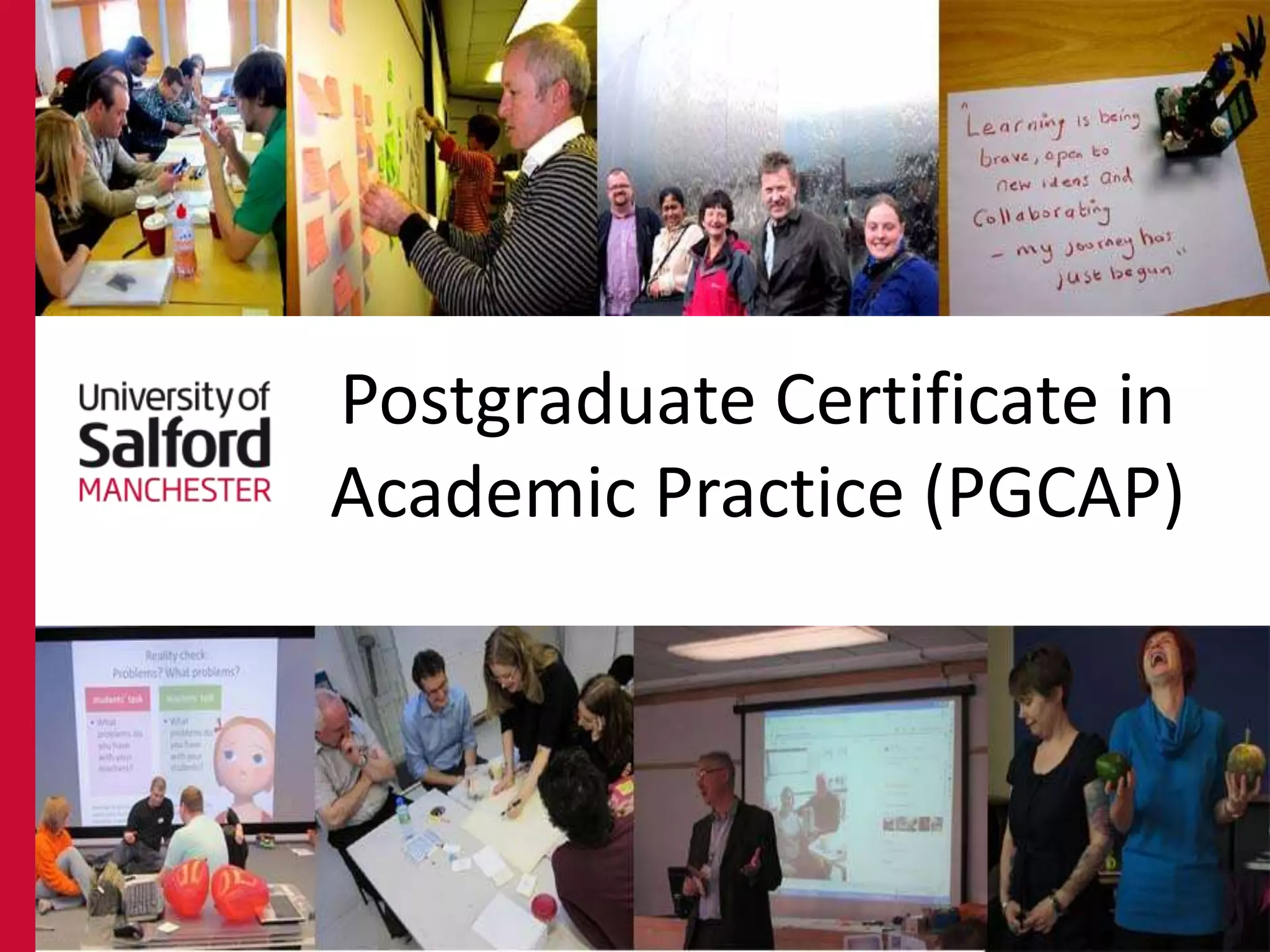
Postgraduate Certificate in
Academic Practice (PGCAP)


                          1
2
                    21st
“The illiterate of the     century will not be those who cannot
read and write, it will be those who cannot learn, unlearn and
relearn.” Alvin Toffler Future Shock, 1970


                      Postgraduate Certificate in
                      Academic Practice (PGCAP)
                                      #LTHEJan13: Induction event
                                                       (7 Feb 13)
                                                                         The PGCAP Team

                                                                           Chrissi Nerantzi
                                                                  Twitter @chrissinerantzi
                                                                                   @pgcap


                  http://www.hr.salford.ac.uk/employee-development-section/pgcap-

                You will need to download a QR scanner app to your smart phone first
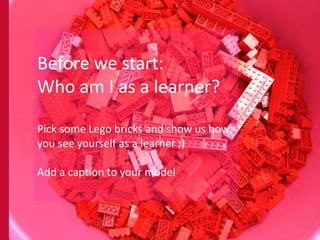
Before we start:
Who am I as a learner?

Pick some Lego bricks and show us how
you see yourself as a learner ;)

Add a caption to your model
4


Intended learning outcomes

• Discuss key features of the PGCAP, structure and
  requirements
• Explain key features of the Learning and Teaching in
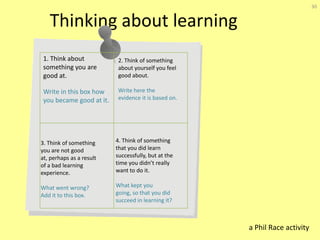
  Higher Education (LTHE or core) module and learning
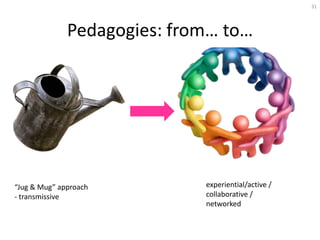
  practices
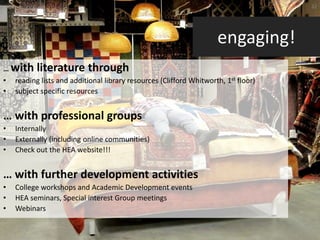
• Identify value of being part of a learning community

please add your personalised learning outcomes
AGENDA

          Welcome

 The PGCAP programme and
     the Salford context

Online programme space and
          portfolios

 Getting to know each other

     LTHE module (core)

Learning, Reflecting, Observin
               g

meet ‘n’ greet (Neil and Pete)
Learning and Teaching Strategy and
    Themes for future development
Accessible higher education
Student focused
Pedagogically excellent
Internationally orientated
Research informed
Employability and enterprise led
Sustainability
                                       6
Pedagogically excellent
• Development of active learning in partnership with the learners to
  develop an educative community.
• High quality teaching and supervision provided by staff on all modules
  and programmes.
• High quality and timely feedback provided to all students in all
  elements of their assessment.
• Opportunity for detailed evaluation and meaningful reflection
  on the quality of modules and programmes with time and
  resources provided for appropriate enhancement activity.
• Development and support for innovative and inclusive approaches to
  education and assessment which help staff and students to develop
  and learn more effectively.
• Clarity in what is expected of staff.
• Greater proportion of staff with PGCAP and Fellowship of HEA

 http://www.hr.salford.ac.uk/employee-development-section/learning-and-teaching-
The PGCAP
•   an exciting opportunity to learn
    and develop with colleagues from
    different disciplines and
    professional areas
•   to be open, creative, and
    experiment in a safe environment
    and within a learning community
•   to discuss, debate and challenge
    anything linked to teaching and
    learning including theories
•   to engage in a conversation about
    teaching and learning at the
    University of Salford
•   to become a professional teacher
    in HE
•   gain a recognised Teaching
    Qualification in HE
•   a programme accredited by the
    HEA and NMC
9


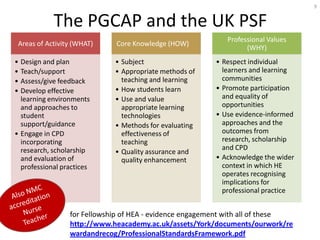
            The PGCAP and the UK PSF
                                                            Professional Values
 Areas of Activity (WHAT)    Core Knowledge (HOW)
                                                                  (WHY)
• Design and plan            • Subject                  • Respect individual
• Teach/support              • Appropriate methods of     learners and learning
• Assess/give feedback         teaching and learning      communities
• Develop effective          • How students learn       • Promote participation
  learning environments      • Use and value              and equality of
  and approaches to            appropriate learning       opportunities
  student                      technologies             • Use evidence-informed
  support/guidance           • Methods for evaluating     approaches and the
• Engage in CPD                effectiveness of           outcomes from
  incorporating                teaching                   research, scholarship
  research, scholarship                                   and CPD
                             • Quality assurance and
  and evaluation of            quality enhancement      • Acknowledge the wider
  professional practices                                  context in which HE
                                                          operates recognising
                                                          implications for
                                                          professional practice


                 for Fellowship of HEA - evidence engagement with all of these
                 http://www.heacademy.ac.uk/assets/York/documents/ourwork/re
                 wardandrecog/ProfessionalStandardsFramework.pdf
10


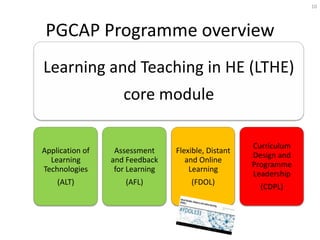
 PGCAP Programme overview
Learning and Teaching in HE (LTHE)
                    core module

                                                     Curriculum
Application of    Assessment     Flexible, Distant
                                                     Design and
  Learning       and Feedback       and Online

                                                     Programme
Technologies      for Learning       Learning
                                                     Leadership
    (ALT)            (AFL)           (FDOL)
                                                       (CDPL)
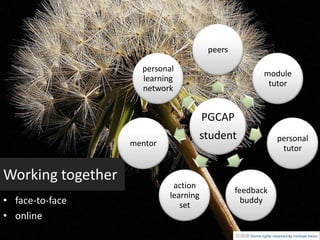
peers

                     personal
                                                      module
                     learning
                                                       tutor
                     network


                                       PGCAP
                                   student                personal
                   mentor
                                                           tutor


Working together
                             action
                                               feedback
                            learning
• face-to-face                 set
                                                 buddy
• online
Pete Whitton

  personal tutor
• Your first contact
• Provides general
  advice, support and
  guidance
• Pastoral support
• Face-to-face and
  remote tutorials (web-
  conferencing)
• Signposts when further
  assistance required
• the same person for
  the whole programme
13


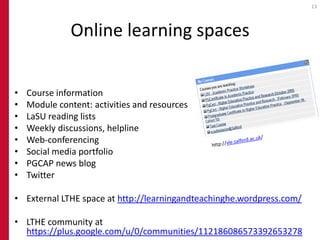
              Online learning spaces


•   Course information
•   Module content: activities and resources
•   LaSU reading lists
•   Weekly discussions, helpline
•   Web-conferencing
•   Social media portfolio
•   PGCAP news blog
•   Twitter

• External LTHE space at http://learningandteachinghe.wordpress.com/

• LTHE community at
  https://plus.google.com/u/0/communities/112186086573392653278
Learning and Assessment
                          14
15

    social media patchwork                 Best PGCAP
                                         portfolio awards
            portfolio                       Most creative
•     digital, online, mobile                 portfolio
                                           Most connected
•     reflect on your journey                 portfolio
•     use/create media-rich artefacts     Most motivational
                                              portfolio
•     share with tutor and peers
•     commenting
•     assessed
•     receive feedback throughout
•     NEW: creative commons portfolios
•     NEW: open badges


The same portfolio for the whole
PGCAP programme


    http://asboallstar.wordpress.com/
16


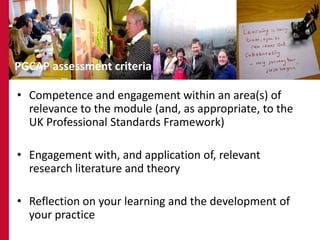
PGCAP assessment criteria

• Competence and engagement within an area(s) of
  relevance to the module (and, as appropriate, to the
  UK Professional Standards Framework)

• Engagement with, and application of, relevant
  research literature and theory

• Reflection on your learning and the development of
  your practice
17


PGCAP level of attainment descriptors

•   a passing (excellent) assignment
•   a passing (good) assignment
•   a passing assignment
•   a failing assignment
• ongoing opportunities to provide
               feedback, comment on any
               aspect of the module to
               tutor, programme leader

             • staff/student committee

             • opportunity to engage in
               research activities and provide
               input

Your voice   • Module Evaluation
               Questionnaire
• Exploring the use of video for
Current research     observations of teaching and
                     impact on reflection
                   • Professional discussions as a
                     summative assessment
                     approach
                   • Using Lego to aid reflection
                     and learning conversations
                   • Public feedback practice
                   • Open learning within
                     academic development, why
                     and how
20


Getting to know each other through
   collaborative storytelling and
            storymaking
Making is connecting

10 mins: In your action learning
sets, create a model that represents
effective teamwork for you using Lego.

Assess each other’s model
Who is the winning team?
23


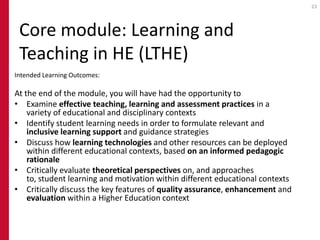
 Core module: Learning and
 Teaching in HE (LTHE)
Intended Learning Outcomes:

At the end of the module, you will have had the opportunity to
• Examine effective teaching, learning and assessment practices in a
    variety of educational and disciplinary contexts
• Identify student learning needs in order to formulate relevant and
    inclusive learning support and guidance strategies
• Discuss how learning technologies and other resources can be deployed
    within different educational contexts, based on an informed pedagogic
    rationale
• Critically evaluate theoretical perspectives on, and approaches
    to, student learning and motivation within different educational contexts
• Critically discuss the key features of quality assurance, enhancement and
    evaluation within a Higher Education context
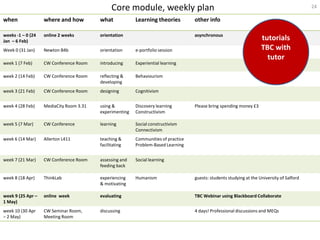
Core module, weekly plan                                                                     24

when               where and how         what            Learning theories         other info

weeks -1 – 0 (24   online 2 weeks        orientation                               asynchronous
Jan – 6 Feb)                                                                                                         tutorials
Week 0 (31 Jan)    Newton B4b            orientation     e-portfolio session                                         TBC with
                                                                                                                       tutor
week 1 (7 Feb)     CW Conference Room    introducing     Experiential learning

week 2 (14 Feb)    CW Conference Room    reflecting &    Behaviourism
                                         developing
week 3 (21 Feb)    CW Conference Room    designing       Cognitivism


week 4 (28 Feb)    MediaCity Room 3.31   using &         Discovery learning        Please bring spending money £3
                                         experimenting   Constructivism

week 5 (7 Mar)     CW Conference         learning        Social constructivism
                                                         Connectivism
week 6 (14 Mar)    Allerton L411         teaching &      Communities of practice
                                         facilitating    Problem-Based Learning


week 7 (21 Mar)    CW Conference Room    assessing and   Social learning
                                         feeding back

week 8 (18 Apr)    ThinkLab              experiencing    Humanism                  guests: students studying at the University of Salford
                                         & motivating

week 9 (25 Apr –   online week           evaluating                                TBC Webinar using Blackboard Collaborate
1 May)
week 10 (30 Apr    CW Seminar Room,      discussing                                4 days! Professional discussions and MEQs
– 2 May)           Meeting Room
25


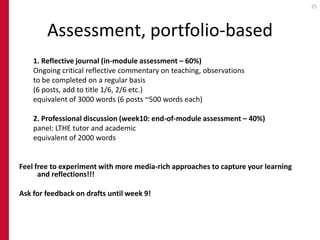
        Assessment, portfolio-based
    1. Reflective journal (in-module assessment – 60%)
    Ongoing critical reflective commentary on teaching, observations
    to be completed on a regular basis
    (6 posts, add to title 1/6, 2/6 etc.)
    equivalent of 3000 words (6 posts ~500 words each)

    2. Professional discussion (week10: end-of-module assessment – 40%)
    panel: LTHE tutor and academic
    equivalent of 2000 words


Feel free to experiment with more media-rich approaches to capture your learning
      and reflections!!!

Ask for feedback on drafts until week 9!
26


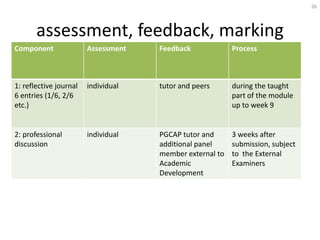
       assessment, feedback, marking
Component               Assessment   Feedback             Process


1: reflective journal   individual   tutor and peers      during the taught
6 entries (1/6, 2/6                                       part of the module
etc.)                                                     up to week 9


2: professional         individual   PGCAP tutor and      3 weeks after
discussion                           additional panel     submission, subject
                                     member external to   to the External
                                     Academic             Examiners
                                     Development
27


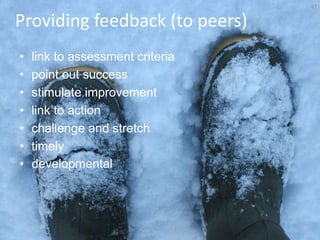
Providing feedback (to peers)
•   link to assessment criteria
•   point out success
•   stimulate improvement
•   link to action
•   challenge and stretch
•   timely
•   developmental
28


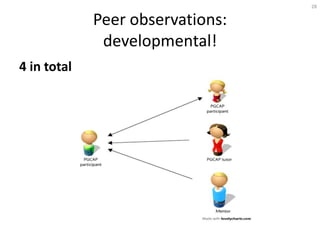
             Peer observations:
              developmental!
4 in total
30


   Thinking about learning
 1. Think about            2. Think of something
 something you are         about yourself you feel
 good at.                  good about.

 Write in this box how     Write here the
 you became good at it.    evidence it is based on.


3. Think of something     4. Think of something
you are not good          that you did learn
at, perhaps as a result   successfully, but at the
of a bad learning         time you didn’t really
experience.               want to do it.

What went wrong?          What kept you
Add it to this box.       going, so that you did
                          succeed in learning it?


                                                      a Phil Race activity
31


              Pedagogies: from… to…


“Jug & Mug” approach         experiential/active /
- transmissive               collaborative /
                             networked
32


                                                                    engaging!
… with literature through
• reading lists and additional library resources (Clifford Whitworth, 1st floor)
• subject specific resources


… with professional groups
•   Internally
•   Externally (including online communities)
•   Check out the HEA website!!!


… with further development activities
•   College workshops and Academic Development events
•   HEA seminars, Special interest Group meetings
•   Webinars
33
your wishes?


               34
36


Intended learning outcomes

• Discuss key features of the PGCAP, structure and
  requirements
• Explain key features of the Learning and Teaching in
  Higher Education (LTHE or core) module and learning
  practices
• Identify value of being part of a learning community

please add your personalised learning outcomes
37


                                      References
•   Andresen, L (1995) Accredited Courses in Teaching and Learning, in: Brew, A (ed.) Directions in Staff
    Development, Buckingham: The Society for Research into Higher Education & Open University Press, pp.
    36-50.

•   Cousin, G (2010) Education Development for the 21st Century, SEDA Conference, Chester 2010, 17
    November, (p. 6)

•   Kember, D et. al (1999) Determining the level of reflective thinking from students’ written journals using a
    coding scheme based on the work of Mezirow, International Journal of Lifelong Education, Vol 18, No 1,
    pp. 18-30.

•   Moon, J (2004) A handbook of reflective and experiential learning, theory and practice, Oxon:
    RoutledgeFalmer.
38


Postgraduate Certificate in Academic Practice (PGCAP),
University of Salford (UK)

Module: Learning and Teaching in HE (LTHE)

Module tutor: Chrissi Nerantzi, Academic Developer
Personal tutor: Pete Whitton


Site: http://www.hr.salford.ac.uk/employee-development-
section/pgcap-

Twitter: @pgcap
extras


         39
43

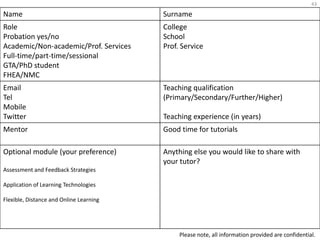
Name                                     Surname
Role                                     College
Probation yes/no                         School
Academic/Non-academic/Prof. Services     Prof. Service
Full-time/part-time/sessional
GTA/PhD student
FHEA/NMC
Email                                    Teaching qualification
Tel                                      (Primary/Secondary/Further/Higher)
Mobile
Twitter                                  Teaching experience (in years)
Mentor                                   Good time for tutorials

Optional module (your preference)        Anything else you would like to share with
                                         your tutor?
Assessment and Feedback Strategies

Application of Learning Technologies

Flexible, Distance and Online Learning


                                              Please note, all information provided are confidential.
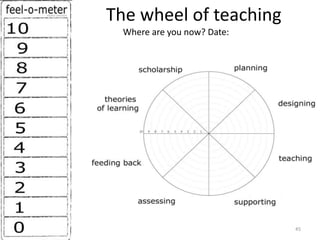
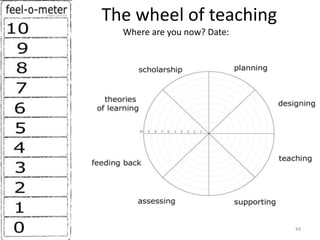
The wheel of teaching
  Where are you now? Date:


                             44
The wheel of teaching
  Where are you now? Date:


                             45
46


“Can we propose to travel together
and be open to surprises as to how
       we will get there?”

 Cousin, G (2010) Education Development for the 21st Century, SEDA Conference, Chester 2010, 17 November, (p. 4)
47


“I can’t believe it; for the first
time in my career I actually
couldn’t stop thinking about
teaching the whole night –
what have you done to us?”
(Andresen, 1995, p. 50)
48


           What participants said
• “The methods focussed on were primarily geared for
  knowledge delivery to smaller teaching groups, particularly
  ones that required less content delivery. Tried and tested
  methods like the power point presentations, widely
  accepted as one of the most useful high content delivery
  tools at our disposal, were at times ridiculed as “old
  fashioned”…..so much so that at group
  presentations, student shied away from it, opting to use T
  shirts with messages written on them instead. These
  creative methods expounded during the course would no
  doubt have their uses in teaching, but probably more so at
  a pre-university level rather than for high content
  knowledge delivery at Universities.” (cohort 1 participant)
49


            What participants said
“The PGCAP has made a real difference to my thinking
and how I approach teaching and learning. It has really
helped me to begin my journey as a reflective practitioner
and really think and reflect on the impact my teaching
has on my students. It has also helped me to think about
why I am teaching.
 The PGCAP is really excellent and the tutors are fantastic
role models, as they are both passionate about teaching
and learning. As well as learning specific teaching
techniques that have really enhanced my practice. I have
picked up small things that you both do that really make a
difference to teaching, learning and the whole student
experience.” (cohort 1 participant)
50


                                              Remember
“We need to be open to new ideas and to rival
explanations to our established views. Above all, I
think we need to become more interesting. Bring
into our frame novels, films, theoretical
alternatives, challenges from the margins.

In many ways, we have the most to learn from
those from whom we think we have the least to
learn.”
Cousin, G (2010) Education Development for the 21st Century, SEDA Conference, Chester 2010, 17 November, (p. 6)

PGCAP - LTHE week 1 introducing (LTHEJan13)

  • 1.
  • 2.
    2 21st “The illiterate of the century will not be those who cannot read and write, it will be those who cannot learn, unlearn and relearn.” Alvin Toffler Future Shock, 1970 Postgraduate Certificate in Academic Practice (PGCAP) #LTHEJan13: Induction event (7 Feb 13) The PGCAP Team Chrissi Nerantzi Twitter @chrissinerantzi @pgcap http://www.hr.salford.ac.uk/employee-development-section/pgcap- You will need to download a QR scanner app to your smart phone first
  • 3.
    Before we start: Whoam I as a learner? Pick some Lego bricks and show us how you see yourself as a learner ;) Add a caption to your model
  • 4.
    4 Intended learning outcomes •Discuss key features of the PGCAP, structure and requirements • Explain key features of the Learning and Teaching in Higher Education (LTHE or core) module and learning practices • Identify value of being part of a learning community please add your personalised learning outcomes
  • 5.
    AGENDA Welcome The PGCAP programme and the Salford context Online programme space and portfolios Getting to know each other LTHE module (core) Learning, Reflecting, Observin g meet ‘n’ greet (Neil and Pete)
  • 6.
    Learning and TeachingStrategy and Themes for future development Accessible higher education Student focused Pedagogically excellent Internationally orientated Research informed Employability and enterprise led Sustainability 6
  • 7.
    Pedagogically excellent • Developmentof active learning in partnership with the learners to develop an educative community. • High quality teaching and supervision provided by staff on all modules and programmes. • High quality and timely feedback provided to all students in all elements of their assessment. • Opportunity for detailed evaluation and meaningful reflection on the quality of modules and programmes with time and resources provided for appropriate enhancement activity. • Development and support for innovative and inclusive approaches to education and assessment which help staff and students to develop and learn more effectively. • Clarity in what is expected of staff. • Greater proportion of staff with PGCAP and Fellowship of HEA http://www.hr.salford.ac.uk/employee-development-section/learning-and-teaching-
  • 8.
    The PGCAP • an exciting opportunity to learn and develop with colleagues from different disciplines and professional areas • to be open, creative, and experiment in a safe environment and within a learning community • to discuss, debate and challenge anything linked to teaching and learning including theories • to engage in a conversation about teaching and learning at the University of Salford • to become a professional teacher in HE • gain a recognised Teaching Qualification in HE • a programme accredited by the HEA and NMC
  • 9.
    9 The PGCAP and the UK PSF Professional Values Areas of Activity (WHAT) Core Knowledge (HOW) (WHY) • Design and plan • Subject • Respect individual • Teach/support • Appropriate methods of learners and learning • Assess/give feedback teaching and learning communities • Develop effective • How students learn • Promote participation learning environments • Use and value and equality of and approaches to appropriate learning opportunities student technologies • Use evidence-informed support/guidance • Methods for evaluating approaches and the • Engage in CPD effectiveness of outcomes from incorporating teaching research, scholarship research, scholarship and CPD • Quality assurance and and evaluation of quality enhancement • Acknowledge the wider professional practices context in which HE operates recognising implications for professional practice for Fellowship of HEA - evidence engagement with all of these http://www.heacademy.ac.uk/assets/York/documents/ourwork/re wardandrecog/ProfessionalStandardsFramework.pdf
  • 10.
    10 PGCAP Programmeoverview Learning and Teaching in HE (LTHE) core module Curriculum Application of Assessment Flexible, Distant Design and Learning and Feedback and Online Programme Technologies for Learning Learning Leadership (ALT) (AFL) (FDOL) (CDPL)
  • 11.
    peers personal module learning tutor network PGCAP student personal mentor tutor Working together action feedback learning • face-to-face set buddy • online
  • 12.
    Pete Whitton personal tutor • Your first contact • Provides general advice, support and guidance • Pastoral support • Face-to-face and remote tutorials (web- conferencing) • Signposts when further assistance required • the same person for the whole programme
  • 13.
    13 Online learning spaces • Course information • Module content: activities and resources • LaSU reading lists • Weekly discussions, helpline • Web-conferencing • Social media portfolio • PGCAP news blog • Twitter • External LTHE space at http://learningandteachinghe.wordpress.com/ • LTHE community at https://plus.google.com/u/0/communities/112186086573392653278
  • 14.
  • 15.
    15 social media patchwork Best PGCAP portfolio awards portfolio Most creative • digital, online, mobile portfolio Most connected • reflect on your journey portfolio • use/create media-rich artefacts Most motivational portfolio • share with tutor and peers • commenting • assessed • receive feedback throughout • NEW: creative commons portfolios • NEW: open badges The same portfolio for the whole PGCAP programme http://asboallstar.wordpress.com/
  • 16.
    16 PGCAP assessment criteria •Competence and engagement within an area(s) of relevance to the module (and, as appropriate, to the UK Professional Standards Framework) • Engagement with, and application of, relevant research literature and theory • Reflection on your learning and the development of your practice
  • 17.
    17 PGCAP level ofattainment descriptors • a passing (excellent) assignment • a passing (good) assignment • a passing assignment • a failing assignment
  • 18.
    • ongoing opportunitiesto provide feedback, comment on any aspect of the module to tutor, programme leader • staff/student committee • opportunity to engage in research activities and provide input Your voice • Module Evaluation Questionnaire
  • 19.
    • Exploring theuse of video for Current research observations of teaching and impact on reflection • Professional discussions as a summative assessment approach • Using Lego to aid reflection and learning conversations • Public feedback practice • Open learning within academic development, why and how
  • 20.
    20 Getting to knoweach other through collaborative storytelling and storymaking
  • 21.
    Making is connecting 10mins: In your action learning sets, create a model that represents effective teamwork for you using Lego. Assess each other’s model Who is the winning team?
  • 22.
    23 Core module:Learning and Teaching in HE (LTHE) Intended Learning Outcomes: At the end of the module, you will have had the opportunity to • Examine effective teaching, learning and assessment practices in a variety of educational and disciplinary contexts • Identify student learning needs in order to formulate relevant and inclusive learning support and guidance strategies • Discuss how learning technologies and other resources can be deployed within different educational contexts, based on an informed pedagogic rationale • Critically evaluate theoretical perspectives on, and approaches to, student learning and motivation within different educational contexts • Critically discuss the key features of quality assurance, enhancement and evaluation within a Higher Education context
  • 23.
    Core module, weeklyplan 24 when where and how what Learning theories other info weeks -1 – 0 (24 online 2 weeks orientation asynchronous Jan – 6 Feb) tutorials Week 0 (31 Jan) Newton B4b orientation e-portfolio session TBC with tutor week 1 (7 Feb) CW Conference Room introducing Experiential learning week 2 (14 Feb) CW Conference Room reflecting & Behaviourism developing week 3 (21 Feb) CW Conference Room designing Cognitivism week 4 (28 Feb) MediaCity Room 3.31 using & Discovery learning Please bring spending money £3 experimenting Constructivism week 5 (7 Mar) CW Conference learning Social constructivism Connectivism week 6 (14 Mar) Allerton L411 teaching & Communities of practice facilitating Problem-Based Learning week 7 (21 Mar) CW Conference Room assessing and Social learning feeding back week 8 (18 Apr) ThinkLab experiencing Humanism guests: students studying at the University of Salford & motivating week 9 (25 Apr – online week evaluating TBC Webinar using Blackboard Collaborate 1 May) week 10 (30 Apr CW Seminar Room, discussing 4 days! Professional discussions and MEQs – 2 May) Meeting Room
  • 24.
    25 Assessment, portfolio-based 1. Reflective journal (in-module assessment – 60%) Ongoing critical reflective commentary on teaching, observations to be completed on a regular basis (6 posts, add to title 1/6, 2/6 etc.) equivalent of 3000 words (6 posts ~500 words each) 2. Professional discussion (week10: end-of-module assessment – 40%) panel: LTHE tutor and academic equivalent of 2000 words Feel free to experiment with more media-rich approaches to capture your learning and reflections!!! Ask for feedback on drafts until week 9!
  • 25.
    26 assessment, feedback, marking Component Assessment Feedback Process 1: reflective journal individual tutor and peers during the taught 6 entries (1/6, 2/6 part of the module etc.) up to week 9 2: professional individual PGCAP tutor and 3 weeks after discussion additional panel submission, subject member external to to the External Academic Examiners Development
  • 26.
    27 Providing feedback (topeers) • link to assessment criteria • point out success • stimulate improvement • link to action • challenge and stretch • timely • developmental
  • 27.
    28 Peer observations: developmental! 4 in total
  • 28.
    30 Thinking about learning 1. Think about 2. Think of something something you are about yourself you feel good at. good about. Write in this box how Write here the you became good at it. evidence it is based on. 3. Think of something 4. Think of something you are not good that you did learn at, perhaps as a result successfully, but at the of a bad learning time you didn’t really experience. want to do it. What went wrong? What kept you Add it to this box. going, so that you did succeed in learning it? a Phil Race activity
  • 29.
    31 Pedagogies: from… to… “Jug & Mug” approach experiential/active / - transmissive collaborative / networked
  • 30.
    32 engaging! … with literature through • reading lists and additional library resources (Clifford Whitworth, 1st floor) • subject specific resources … with professional groups • Internally • Externally (including online communities) • Check out the HEA website!!! … with further development activities • College workshops and Academic Development events • HEA seminars, Special interest Group meetings • Webinars
  • 31.
  • 32.
  • 33.
    36 Intended learning outcomes •Discuss key features of the PGCAP, structure and requirements • Explain key features of the Learning and Teaching in Higher Education (LTHE or core) module and learning practices • Identify value of being part of a learning community please add your personalised learning outcomes
  • 34.
    37 References • Andresen, L (1995) Accredited Courses in Teaching and Learning, in: Brew, A (ed.) Directions in Staff Development, Buckingham: The Society for Research into Higher Education & Open University Press, pp. 36-50. • Cousin, G (2010) Education Development for the 21st Century, SEDA Conference, Chester 2010, 17 November, (p. 6) • Kember, D et. al (1999) Determining the level of reflective thinking from students’ written journals using a coding scheme based on the work of Mezirow, International Journal of Lifelong Education, Vol 18, No 1, pp. 18-30. • Moon, J (2004) A handbook of reflective and experiential learning, theory and practice, Oxon: RoutledgeFalmer.
  • 35.
    38 Postgraduate Certificate inAcademic Practice (PGCAP), University of Salford (UK) Module: Learning and Teaching in HE (LTHE) Module tutor: Chrissi Nerantzi, Academic Developer Personal tutor: Pete Whitton Site: http://www.hr.salford.ac.uk/employee-development- section/pgcap- Twitter: @pgcap
  • 36.
  • 37.
    43 Name Surname Role College Probation yes/no School Academic/Non-academic/Prof. Services Prof. Service Full-time/part-time/sessional GTA/PhD student FHEA/NMC Email Teaching qualification Tel (Primary/Secondary/Further/Higher) Mobile Twitter Teaching experience (in years) Mentor Good time for tutorials Optional module (your preference) Anything else you would like to share with your tutor? Assessment and Feedback Strategies Application of Learning Technologies Flexible, Distance and Online Learning Please note, all information provided are confidential.
  • 38.
    The wheel ofteaching Where are you now? Date: 44
  • 39.
    The wheel ofteaching Where are you now? Date: 45
  • 40.
    46 “Can we proposeto travel together and be open to surprises as to how we will get there?” Cousin, G (2010) Education Development for the 21st Century, SEDA Conference, Chester 2010, 17 November, (p. 4)
  • 41.
    47 “I can’t believeit; for the first time in my career I actually couldn’t stop thinking about teaching the whole night – what have you done to us?” (Andresen, 1995, p. 50)
  • 42.
    48 What participants said • “The methods focussed on were primarily geared for knowledge delivery to smaller teaching groups, particularly ones that required less content delivery. Tried and tested methods like the power point presentations, widely accepted as one of the most useful high content delivery tools at our disposal, were at times ridiculed as “old fashioned”…..so much so that at group presentations, student shied away from it, opting to use T shirts with messages written on them instead. These creative methods expounded during the course would no doubt have their uses in teaching, but probably more so at a pre-university level rather than for high content knowledge delivery at Universities.” (cohort 1 participant)
  • 43.
    49 What participants said “The PGCAP has made a real difference to my thinking and how I approach teaching and learning. It has really helped me to begin my journey as a reflective practitioner and really think and reflect on the impact my teaching has on my students. It has also helped me to think about why I am teaching. The PGCAP is really excellent and the tutors are fantastic role models, as they are both passionate about teaching and learning. As well as learning specific teaching techniques that have really enhanced my practice. I have picked up small things that you both do that really make a difference to teaching, learning and the whole student experience.” (cohort 1 participant)
  • 44.
    50 Remember “We need to be open to new ideas and to rival explanations to our established views. Above all, I think we need to become more interesting. Bring into our frame novels, films, theoretical alternatives, challenges from the margins. In many ways, we have the most to learn from those from whom we think we have the least to learn.” Cousin, G (2010) Education Development for the 21st Century, SEDA Conference, Chester 2010, 17 November, (p. 6)

Editor's Notes

  • #3 QR: http://goqr.me/CN – to introduce myselfFlipchartMarkersSticky notesyellow tapenumbers on name tagsmy name tagmy toolkitbuilding blocksUK PSF print out for everybody, include in folders
  • #5 CN
  • #8 Teaching qualifications? More academics at Salford to gain teaching qualifications in HE through our PGCAP or the individual route to gain Fellowship of the Higher Education Academy? Could the UK Professional Standards Framework be mentioned here?
  • #10 NC
  • #11 core taughtoptional modules self-study with personal tutor support all optional modules together launch day bringing everybody together – groups, tutors
  • #14 NCLogin and demo the Bb spaceMention pre-induction tasks & twitter
  • #15 Use book assessment and feedback, read the extract in green book
  • #16 NC / CN
  • #17 NC
  • #18 CN
  • #21 arrange students in 2 rows, then work with partner on the stories. Make a cartoon, parallel stories. Share with others.
  • #24 design and plan learning activities appropriate for your subject apply effective teaching, learning, assessment/feedback and support strategies including technology enhanced approaches in your practice discuss learning theories linked to your own subjectdiscuss key features of quality assurance, enhancement and evaluation within the HE context and implications for professional practicedevelop reflective skills and engage in educational research
  • #25 CN
  • #26 CN
  • #27 CN
  • #28 Ask everybody to contribute to this. Then reveal
  • #29 NC
  • #30 CN
  • #31 Do on 4 sticky notes and then create on a wall the cross and see what other people have written (collect the data)NC
  • #32 Pedagogies (add literature maybe change images)Transmission -> experiential learning, social constructivism, networked learning, connectivism
  • #33 NC
  • #36 CN
  • #37 CN
  • #41 CNSplit group at this point. Half will go into LDU seminar room to create a thought for their learning journey and half will do this tasks. Need separate slides for the PP bit. Can we get at least one LTA to help set up and run the PP bit?
  • #42 CN
  • #43 CNhttp://www.hr.salford.ac.uk/development/mentoring
  • #45 use feel-o-meter to capture confidence in teaching
  • #46 use feel-o-meter to capture confidence in teaching
  • #48 To show after lunch break with music loop
  • #52 prepare smiley stickers (3 stickers for everybody)Aluminium foil