Gertrud Pfister
University of Copenhagen
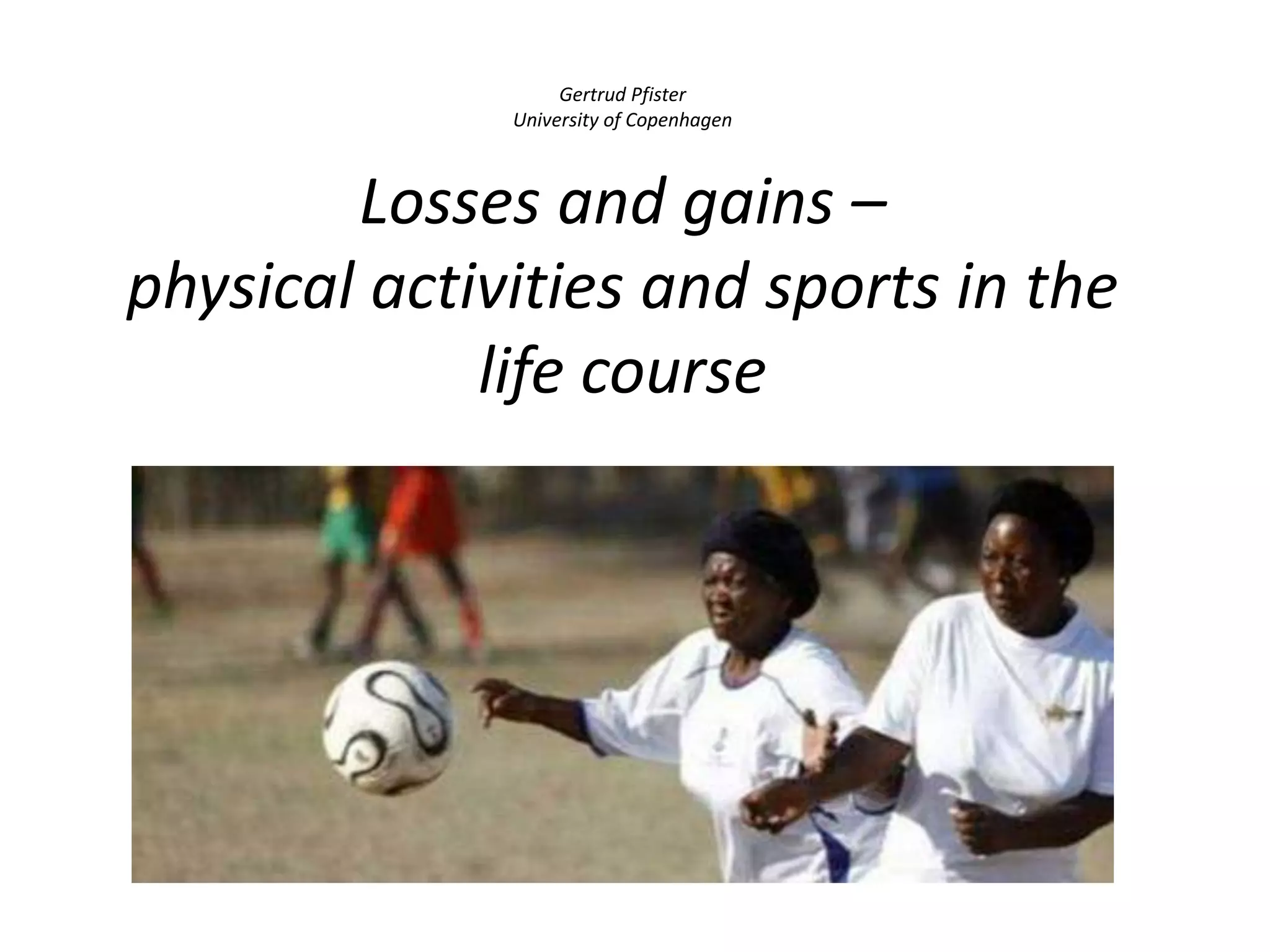
Losses and gains –
physical activities and sports in the
life course
Topics of my presentation
• Theoretical approaches, material and methods
• Context:
• Ageing discourses and policies, Denmark as example
• Getting old – circumstances of life
• Engagement of older adults in sports and physical activities -
current situation
• Sport ”careers” and sporting activities in later life – results of
several research projects
• Discussion and conclusion
Theoretical approaches
• Healthism - a Foucauldean perspective on
health politics and policies
• Youthism in the context of (self) marketing
and the current health and beauty discourses
• Ageing as a process of the life course
• Life long socialisation processes with a focus
on the active ”appropriation” of opportunities
and environments
Material and insights
– Long term ”observation” of 12 women – following
their changing sport/PA practices
– 20 interviews with older adults about their ”sport
biographies” and the role of sport/PA in different
phases of their lives – Denmark
– Auto-ethnographic approaches to sport
interventions (indoor hockey) with older women
– Interviews with participants in team activities in
several physiological studies
– Activity center project –opportunities and
challenges with regard to PA of older people
Seniors in Denmark and other countries–
an increasing percentage of the population
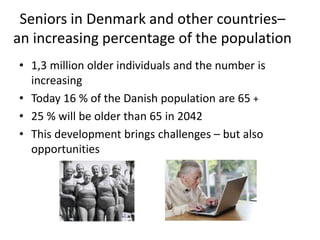
• 1,3 million older individuals and the number is
increasing
• Today 16 % of the Danish population are 65 +
• 25 % will be older than 65 in 2042
• This development brings challenges – but also
opportunities
Changes and challenges of aging
• Opportunities, activities and images of seniors have
changed in the last decades decisively – at least in
Western countries
• Important: differentiation
– e.g. with regard to age, gender, social and ethnic
backgrounds
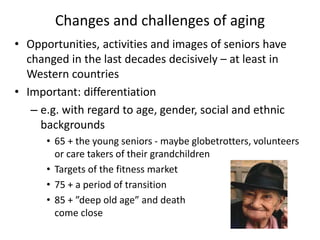
• 65 + the young seniors - maybe globetrotters, volunteers
or care takers of their grandchildren
• Targets of the fitness market
• 75 + a period of transition
• 85 + ”deep old age” and death
come close
Discourses
• Ageism – stereotypes about older persons and
discriminations (e.g. forced retirement)
• Youthism – glorification of youth,
marginalisation of old people and the
expectation to ”work” and ”invest” in a
youthful appearance
• Healthism – moral imperative to be healthy
(and not a burden for the wellfare state)
Discourses and practices
• An active life style as a signal of compliance and a pre-
condition of health
• Motto: retiring gracefully and active aging
• Numerous and various forms of propagation of
“successful aging”, e.g. many campaigns,
advertisements
• In Western countries: many opportunities to be
physically active – sport clubs, fitness centres, “activity
centres” of municipalities (more details later)
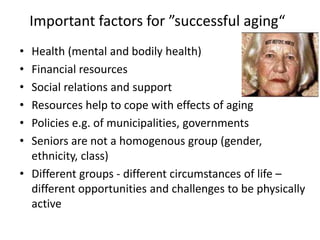
Important factors for ”successful aging“
• Health (mental and bodily health)
• Financial resources
• Social relations and support
• Resources help to cope with effects of aging
• Policies e.g. of municipalities, governments
• Seniors are not a homogenous group (gender,
ethnicity, class)
• Different groups - different circumstances of life –
different opportunities and challenges to be physically
active
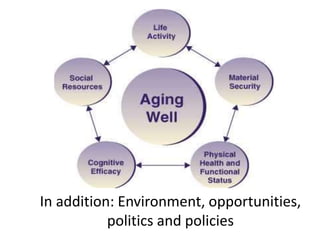
In addition: Environment, opportunities,
politics and policies
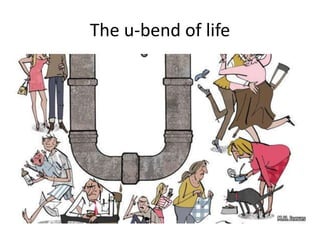
The u-bend of life
Physical activities and sport – DK as example
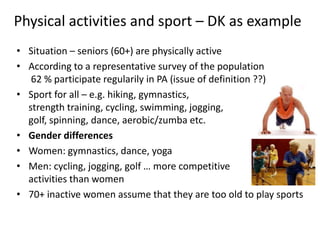
• Situation – seniors (60+) are physically active
• According to a representative survey of the population
62 % participate regularily in PA (issue of definition ??)
• Sport for all – e.g. hiking, gymnastics,
strength training, cycling, swimming, jogging,
golf, spinning, dance, aerobic/zumba etc.
• Gender differences
• Women: gymnastics, dance, yoga
• Men: cycling, jogging, golf … more competitive
activities than women
• 70+ inactive women assume that they are too old to play sports
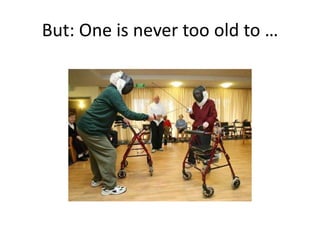
But: One is never too old to …
Seniors – Competitions and elite sport
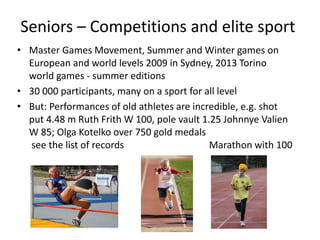
• Master Games Movement, Summer and Winter games on
European and world levels 2009 in Sydney, 2013 Torino
world games - summer editions
• 30 000 participants, many on a sport for all level
• But: Performances of old athletes are incredible, e.g. shot
put 4.48 m Ruth Frith W 100, pole vault 1.25 Johnnye Valien
W 85; Olga Kotelko over 750 gold medals
see the list of records Marathon with 100
Sharing insights from projects !!!
• G. Pfister & M. Sørensen
Ældre og fysisk aktivitet
• (seniors and physical activities)
Muligheder for Idræt og motion
i København. 2008
• download rapporten
• This mapping of sport opportunities showed
that older people have a large number of
options in the capital of Denmark.
Health discourses and (lack of) compliance
• Results of an interview study with women who took part
in a ”team games intervention”
• Participation in the intervention – ”inspired” by healthism
• All knew health recommendations and all had examples of
negative effects of an inactive life style
• None of the women had previously managed to comply
• Knowledge does not necessarily lead to ”compliance” –
there are numerous excuses for not being active
• Reason: Physical activities, mostly jogging or fitness, are
not experienced as rewarding per se
• One of the most important reasons for the participation in
the intervention was the obligation !
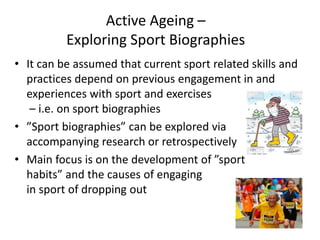
Active Ageing –
Exploring Sport Biographies
• It can be assumed that current sport related skills and
practices depend on previous engagement in and
experiences with sport and exercises
– i.e. on sport biographies
• ”Sport biographies” can be explored via
accompanying research or retrospectively
• Main focus is on the development of ”sport
habits” and the causes of engaging
in sport of dropping out
Exploring sport biographies
• Several studies
1. Interviews with 30 older adults (half of them
were physically active)
– Physical activity patterns
– Experiences with and memories about PE
• 2. ”Accompanying” women’s lives and sport
activities with ”ethnographic” methods
• 3. Participant observation in a ”hockey intervention”
with middle aged women and interviews
Sport socialisation and sporting
memories of older adults in Denmark
• Aim of the project was
• to gain an in-depth insight into and an
understanding of the factors and processes
which support or prevent an active lifestyle
of Danish adults- socialisation was a focus
• to explore the sport biographies of active and
matched inactive men and women (55 to 65)
of the Danish middle class.
19
Methods
• Semi-structured interviews which included
narrative parts
• Time plan of a ”normal” week
• Time line of sporting activities in the life course
• Projective techniques – telling stories about
pictures of their choice, e.g. a picture of a
sunny meadow, a mountain, etc.
• Reflections about various sporting scenarios
20
Interview Questions
• Levels of satisfaction with the body, self
concepts, and current attitudes, evaluations
and practices with regard to sport and PA.
• Current situation (among others, work, leisure
activities, everyday life, health)
• “Sport biographies” and sport-related
socialisation processes, the positive and
negative experiences during sport and physical
activities, “turning points” leading to inactivity
• Attitudes, opinions and experiences with PE
21
Procedures
• Qualitative content analysis
– Development of a system of categories
– Coding of the text with the help of atlas.ti
• Messages of the text are assigned to categories
• This allowed us to detect patterns
• Hermeneutical interpretation
• Comparison of the statements with other
sources (e.g. curricula, reports, pictures etc.)
22
Results – the sport active group
• Sport-biographies showed a red thread,
mostly there was a main sport
• Engagement in this sport, e.g. football,
swimming, tennis, started mostly early in life
• The ”main sport” was often accompanied by
other activities, e.g. jogging, and/or ”holiday
sports” such as skiing or hiking
• The choices of sport were gendered
23
Experiences with/in PE
• 13 of the 15 sport active informants had
positive attitudes to and memories about PE
• Two exceptions – from hate to love?
– JB skipped two classes, was by far the youngest
student and could not keep up in sport – he hated it
–four years in the US … he became a good and
engaged sport student
– IS, short sighted, could not catch a ball, hated PE,
later she became a teacher … She had good
instructors, learnt to deal with her problems and
started to like sport.
24
The importance to be good in sport
• The example of JB and IS show that opinions about
PE depended to large degree on skills and
performance/success
• 6 of the sport active informants had been ”sport
stars”
• 5 had been (very) good in some disciplines
• 3 were at least ok
• 2 did not provide exact information about their sport
skills
• To be „good in PE“ was the beginning of a „sport
career“
25
A short first conclusion
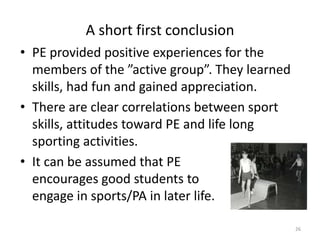
• PE provided positive experiences for the
members of the ”active group”. They learned
skills, had fun and gained appreciation.
• There are clear correlations between sport
skills, attitudes toward PE and life long
sporting activities.
• It can be assumed that PE
encourages good students to
engage in sports/PA in later life.
26
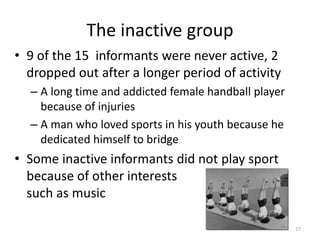
The inactive group
• 9 of the 15 informants were never active, 2
dropped out after a longer period of activity
– A long time and addicted female handball player
because of injuries
– A man who loved sports in his youth because he
dedicated himself to bridge
• Some inactive informants did not play sport
because of other interests
such as music
27
Inactivity and PE
• Only 2 of the 15 members of this group liked
PE - the two above mentioned drop-outs.
• 11 did not like/hated PE, only one of them
was good in sports, the others were bad in
sport in general or in some
activities/exercises, quite a few were bullied
• Some were afraid of balls, apparatus (wooden
horse), swimming, competitions and bullying!!
28
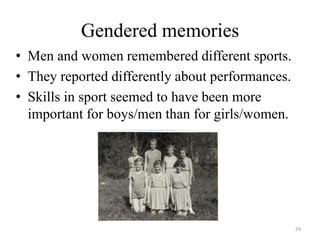
Gendered memories
• Men and women remembered different sports.
• They reported differently about performances.
• Skills in sport seemed to have been more
important for boys/men than for girls/women.
29
Quotes
• Ball games were very hurtful, I was always
always selected last (man).
• My PE teacher was just crazy, a hysterical
women. All she did was shout (woman).
• As a thick child you had a bad time, not only in
the gym hall but also in the changing rooms
(woman).
• In my class, there was always bullying, and PE
was hell, here the teachers did not have a lot
of control (man).
30
More quotes
• I hated everything, I was afraid to get hit by a
ball, and swimming in the cold water was
torture (woman).
• I felt always inferior, as a klutz – and I knew
that the PE teacher thought this too – it was
not enough for her that the students
participated, she expected us to be good
(woman).
31
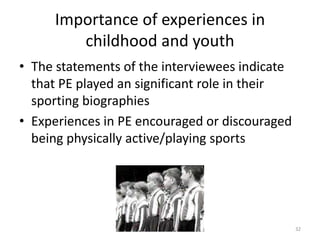
Importance of experiences in
childhood and youth
• The statements of the interviewees indicate
that PE played an significant role in their
sporting biographies
• Experiences in PE encouraged or discouraged
being physically active/playing sports
32
Following
women’s (sporting) lives
• In 2000, I started a project by ”following” the
”sporting careers” of 12 women of my age group,
some are friends, others aquaintances
• They were active in various sports when I started
this ”project”, they enjoyed their activities and
managed to continue in spite of various
problems, e.g. illness
• After 10 years, I finished this ”project” and wrote
an article about my and their experiences
33
A follow up of the project
• Telephone talks with the project participants (now
between 60 and 70 years of age) showed:
• Three are more or less physically inactive; two of
them go regularly for a walk.
• Reasons: The sport partners of 2 women stopped.
XX had to give up basketball as her team
dissolved, the former player gained a lot of weight
• Seven are still active, but some have changed
their activities, e.g. took up golf instead of tennis.
34
Participation in a floorball intervention
35
• Middle aged women
• Floorball intervention in the context of a
physiological project
• I was a participant observer
• Interviews
• Statements told a lot about
compliance and ”drop out”
Insights gained in the project
The informants were ”targets” of healthism –
widespread in Denmark
Several unsuccessful attempts to comply with the
official activity recommendations
Participation in the project provided the necessary
”obligation” because the trainer and the team
mates waited.
In addition, team activities provided „flow“ and a
sense of community.
The women continued to play after the intervention
had ended.
36
Main question
• Are there opportunities to play sport ?
• Yes and no – there are many sport programs
but they do not seem to attract people who
are not intrinsically interested and involved in
sport
• The following examples provide insight into
the Danish sport policies.
37
Programs - examples
• Numerous programs are available
– E.g. senior sport in clubs
– Sport during the day
– Programs in many municipalities
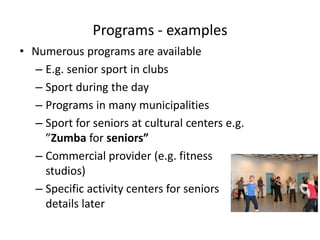
– Sport for seniors at cultural centers e.g.
”Zumba for seniors”
– Commercial provider (e.g. fitness
studios)
– Specific activity centers for seniors
details later
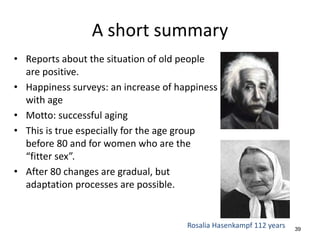
A short summary
• Reports about the situation of old people
are positive.
• Happiness surveys: an increase of happiness
with age
• Motto: successful aging
• This is true especially for the age group
before 80 and for women who are the
“fitter sex”.
• After 80 changes are gradual, but
adaptation processes are possible.
39
Rosalia Hasenkampf 112 years
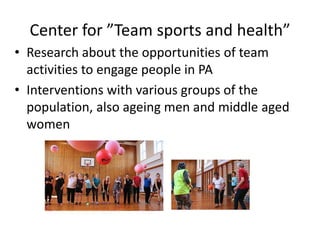
Center for ”Team sports and health”
• Research about the opportunities of team
activities to engage people in PA
• Interventions with various groups of the
population, also ageing men and middle aged
women
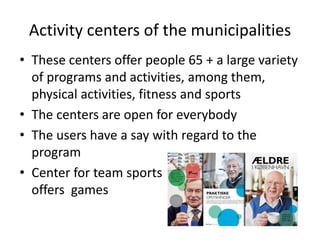
Activity centers of the municipalities
• These centers offer people 65 + a large variety
of programs and activities, among them,
physical activities, fitness and sports
• The centers are open for everybody
• The users have a say with regard to the
program
• Center for team sports
offers games
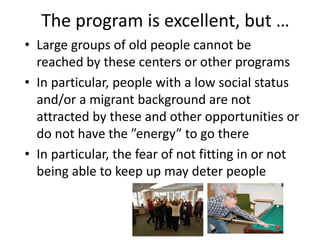
The program is excellent, but …
• Large groups of old people cannot be
reached by these centers or other programs
• In particular, people with a low social status
and/or a migrant background are not
attracted by these and other opportunities or
do not have the ”energy” to go there
• In particular, the fear of not fitting in or not
being able to keep up may deter people
Conclusion
• Older adults are not sitting beside their ovens,
many put on their training shoes and
participate in various programs
• Individuals with a life long activity career will
continue to be active, maybe in new
environments and programs
• Groups which are not socialized into sport and
had never adopted a sporting lifestyle face
barriers which they may not be able to cross
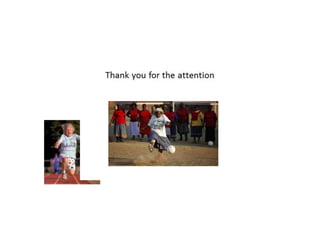
Gogos play football for Mandela
Your research
– Impact on PE on older people’s participation in
sport and physical activity – commitment,
establishing life-long habits
– Importance of time and how it impacts on
participation across the life-course, does ‘more
time’ enable older adults to do more exercise
– How health messages are internalised or not –
drawing on the research on middle- aged women.
• physical activity as a career and physical activity
participation can be affected by life-course
transitions.
• I am interested in how physical activity can
become habitual, routine, and part of older
people’s ‘everyday’ lives. There is another
seminar in the series that will focus on masters
athletes so I am keen that this seminar will focus
on the ‘everyday’ or the ‘ordinary’.
•
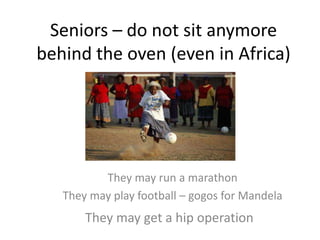
Seniors – do not sit anymore
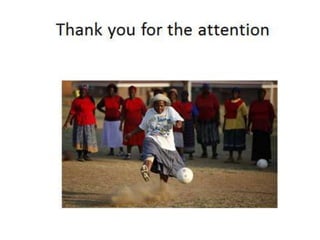
behind the oven (even in Africa)
They may run a marathon
They may play football – gogos for Mandela
They may get a hip operation
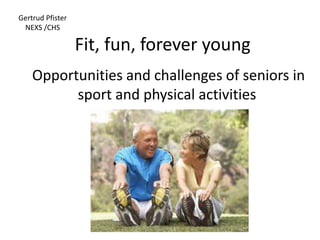
Fit, fun, forever young
Opportunities and challenges of seniors in
sport and physical activities
Gertrud Pfister
NEXS /CHS
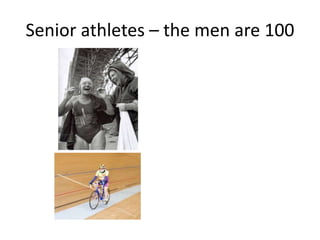
Senior athletes – the men are 100
Noreen
• Context – importance of physical activity in health
policy, importance of physical activity across the life
course and particularly in later life – ‘active ageing’ etc.
• Your research
– Impact on PE on older people’s participation in sport and
physical activity – commitment, establishing life-long
habits
– Importance of time and how it impacts on participation
across the life-course, does ‘more time’ enable older
adults to do more exercise
– How health messages are internalised or not – drawing on
the research on middle- aged women.
Context
• physical activity as a career and physical activity
participation can be affected by life-course
transitions.
• I am interested in how physical activity can
become habitual, routine, and part of older
people’s ‘everyday’ lives. There is another
seminar in the series that will focus on masters
athletes so I am keen that this seminar will focus
on the ‘everyday’ or the ‘ordinary’.
•

Losses and Gains: Physical Activities and Sports in the Life Course

  • 1.
    Gertrud Pfister University ofCopenhagen Losses and gains – physical activities and sports in the life course
  • 2.
    Topics of mypresentation • Theoretical approaches, material and methods • Context: • Ageing discourses and policies, Denmark as example • Getting old – circumstances of life • Engagement of older adults in sports and physical activities - current situation • Sport ”careers” and sporting activities in later life – results of several research projects • Discussion and conclusion
  • 3.
    Theoretical approaches • Healthism- a Foucauldean perspective on health politics and policies • Youthism in the context of (self) marketing and the current health and beauty discourses • Ageing as a process of the life course • Life long socialisation processes with a focus on the active ”appropriation” of opportunities and environments
  • 4.
    Material and insights –Long term ”observation” of 12 women – following their changing sport/PA practices – 20 interviews with older adults about their ”sport biographies” and the role of sport/PA in different phases of their lives – Denmark – Auto-ethnographic approaches to sport interventions (indoor hockey) with older women – Interviews with participants in team activities in several physiological studies – Activity center project –opportunities and challenges with regard to PA of older people
  • 5.
    Seniors in Denmarkand other countries– an increasing percentage of the population • 1,3 million older individuals and the number is increasing • Today 16 % of the Danish population are 65 + • 25 % will be older than 65 in 2042 • This development brings challenges – but also opportunities
  • 6.
    Changes and challengesof aging • Opportunities, activities and images of seniors have changed in the last decades decisively – at least in Western countries • Important: differentiation – e.g. with regard to age, gender, social and ethnic backgrounds • 65 + the young seniors - maybe globetrotters, volunteers or care takers of their grandchildren • Targets of the fitness market • 75 + a period of transition • 85 + ”deep old age” and death come close
  • 7.
    Discourses • Ageism –stereotypes about older persons and discriminations (e.g. forced retirement) • Youthism – glorification of youth, marginalisation of old people and the expectation to ”work” and ”invest” in a youthful appearance • Healthism – moral imperative to be healthy (and not a burden for the wellfare state)
  • 8.
    Discourses and practices •An active life style as a signal of compliance and a pre- condition of health • Motto: retiring gracefully and active aging • Numerous and various forms of propagation of “successful aging”, e.g. many campaigns, advertisements • In Western countries: many opportunities to be physically active – sport clubs, fitness centres, “activity centres” of municipalities (more details later)
  • 9.
    Important factors for”successful aging“ • Health (mental and bodily health) • Financial resources • Social relations and support • Resources help to cope with effects of aging • Policies e.g. of municipalities, governments • Seniors are not a homogenous group (gender, ethnicity, class) • Different groups - different circumstances of life – different opportunities and challenges to be physically active
  • 10.
    In addition: Environment,opportunities, politics and policies
  • 11.
  • 12.
    Physical activities andsport – DK as example • Situation – seniors (60+) are physically active • According to a representative survey of the population 62 % participate regularily in PA (issue of definition ??) • Sport for all – e.g. hiking, gymnastics, strength training, cycling, swimming, jogging, golf, spinning, dance, aerobic/zumba etc. • Gender differences • Women: gymnastics, dance, yoga • Men: cycling, jogging, golf … more competitive activities than women • 70+ inactive women assume that they are too old to play sports
  • 13.
    But: One isnever too old to …
  • 14.
    Seniors – Competitionsand elite sport • Master Games Movement, Summer and Winter games on European and world levels 2009 in Sydney, 2013 Torino world games - summer editions • 30 000 participants, many on a sport for all level • But: Performances of old athletes are incredible, e.g. shot put 4.48 m Ruth Frith W 100, pole vault 1.25 Johnnye Valien W 85; Olga Kotelko over 750 gold medals see the list of records Marathon with 100
  • 15.
    Sharing insights fromprojects !!! • G. Pfister & M. Sørensen Ældre og fysisk aktivitet • (seniors and physical activities) Muligheder for Idræt og motion i København. 2008 • download rapporten • This mapping of sport opportunities showed that older people have a large number of options in the capital of Denmark.
  • 16.
    Health discourses and(lack of) compliance • Results of an interview study with women who took part in a ”team games intervention” • Participation in the intervention – ”inspired” by healthism • All knew health recommendations and all had examples of negative effects of an inactive life style • None of the women had previously managed to comply • Knowledge does not necessarily lead to ”compliance” – there are numerous excuses for not being active • Reason: Physical activities, mostly jogging or fitness, are not experienced as rewarding per se • One of the most important reasons for the participation in the intervention was the obligation !
  • 17.
    Active Ageing – ExploringSport Biographies • It can be assumed that current sport related skills and practices depend on previous engagement in and experiences with sport and exercises – i.e. on sport biographies • ”Sport biographies” can be explored via accompanying research or retrospectively • Main focus is on the development of ”sport habits” and the causes of engaging in sport of dropping out
  • 18.
    Exploring sport biographies •Several studies 1. Interviews with 30 older adults (half of them were physically active) – Physical activity patterns – Experiences with and memories about PE • 2. ”Accompanying” women’s lives and sport activities with ”ethnographic” methods • 3. Participant observation in a ”hockey intervention” with middle aged women and interviews
  • 19.
    Sport socialisation andsporting memories of older adults in Denmark • Aim of the project was • to gain an in-depth insight into and an understanding of the factors and processes which support or prevent an active lifestyle of Danish adults- socialisation was a focus • to explore the sport biographies of active and matched inactive men and women (55 to 65) of the Danish middle class. 19
  • 20.
    Methods • Semi-structured interviewswhich included narrative parts • Time plan of a ”normal” week • Time line of sporting activities in the life course • Projective techniques – telling stories about pictures of their choice, e.g. a picture of a sunny meadow, a mountain, etc. • Reflections about various sporting scenarios 20
  • 21.
    Interview Questions • Levelsof satisfaction with the body, self concepts, and current attitudes, evaluations and practices with regard to sport and PA. • Current situation (among others, work, leisure activities, everyday life, health) • “Sport biographies” and sport-related socialisation processes, the positive and negative experiences during sport and physical activities, “turning points” leading to inactivity • Attitudes, opinions and experiences with PE 21
  • 22.
    Procedures • Qualitative contentanalysis – Development of a system of categories – Coding of the text with the help of atlas.ti • Messages of the text are assigned to categories • This allowed us to detect patterns • Hermeneutical interpretation • Comparison of the statements with other sources (e.g. curricula, reports, pictures etc.) 22
  • 23.
    Results – thesport active group • Sport-biographies showed a red thread, mostly there was a main sport • Engagement in this sport, e.g. football, swimming, tennis, started mostly early in life • The ”main sport” was often accompanied by other activities, e.g. jogging, and/or ”holiday sports” such as skiing or hiking • The choices of sport were gendered 23
  • 24.
    Experiences with/in PE •13 of the 15 sport active informants had positive attitudes to and memories about PE • Two exceptions – from hate to love? – JB skipped two classes, was by far the youngest student and could not keep up in sport – he hated it –four years in the US … he became a good and engaged sport student – IS, short sighted, could not catch a ball, hated PE, later she became a teacher … She had good instructors, learnt to deal with her problems and started to like sport. 24
  • 25.
    The importance tobe good in sport • The example of JB and IS show that opinions about PE depended to large degree on skills and performance/success • 6 of the sport active informants had been ”sport stars” • 5 had been (very) good in some disciplines • 3 were at least ok • 2 did not provide exact information about their sport skills • To be „good in PE“ was the beginning of a „sport career“ 25
  • 26.
    A short firstconclusion • PE provided positive experiences for the members of the ”active group”. They learned skills, had fun and gained appreciation. • There are clear correlations between sport skills, attitudes toward PE and life long sporting activities. • It can be assumed that PE encourages good students to engage in sports/PA in later life. 26
  • 27.
    The inactive group •9 of the 15 informants were never active, 2 dropped out after a longer period of activity – A long time and addicted female handball player because of injuries – A man who loved sports in his youth because he dedicated himself to bridge • Some inactive informants did not play sport because of other interests such as music 27
  • 28.
    Inactivity and PE •Only 2 of the 15 members of this group liked PE - the two above mentioned drop-outs. • 11 did not like/hated PE, only one of them was good in sports, the others were bad in sport in general or in some activities/exercises, quite a few were bullied • Some were afraid of balls, apparatus (wooden horse), swimming, competitions and bullying!! 28
  • 29.
    Gendered memories • Menand women remembered different sports. • They reported differently about performances. • Skills in sport seemed to have been more important for boys/men than for girls/women. 29
  • 30.
    Quotes • Ball gameswere very hurtful, I was always always selected last (man). • My PE teacher was just crazy, a hysterical women. All she did was shout (woman). • As a thick child you had a bad time, not only in the gym hall but also in the changing rooms (woman). • In my class, there was always bullying, and PE was hell, here the teachers did not have a lot of control (man). 30
  • 31.
    More quotes • Ihated everything, I was afraid to get hit by a ball, and swimming in the cold water was torture (woman). • I felt always inferior, as a klutz – and I knew that the PE teacher thought this too – it was not enough for her that the students participated, she expected us to be good (woman). 31
  • 32.
    Importance of experiencesin childhood and youth • The statements of the interviewees indicate that PE played an significant role in their sporting biographies • Experiences in PE encouraged or discouraged being physically active/playing sports 32
  • 33.
    Following women’s (sporting) lives •In 2000, I started a project by ”following” the ”sporting careers” of 12 women of my age group, some are friends, others aquaintances • They were active in various sports when I started this ”project”, they enjoyed their activities and managed to continue in spite of various problems, e.g. illness • After 10 years, I finished this ”project” and wrote an article about my and their experiences 33
  • 34.
    A follow upof the project • Telephone talks with the project participants (now between 60 and 70 years of age) showed: • Three are more or less physically inactive; two of them go regularly for a walk. • Reasons: The sport partners of 2 women stopped. XX had to give up basketball as her team dissolved, the former player gained a lot of weight • Seven are still active, but some have changed their activities, e.g. took up golf instead of tennis. 34
  • 35.
    Participation in afloorball intervention 35 • Middle aged women • Floorball intervention in the context of a physiological project • I was a participant observer • Interviews • Statements told a lot about compliance and ”drop out”
  • 36.
    Insights gained inthe project The informants were ”targets” of healthism – widespread in Denmark Several unsuccessful attempts to comply with the official activity recommendations Participation in the project provided the necessary ”obligation” because the trainer and the team mates waited. In addition, team activities provided „flow“ and a sense of community. The women continued to play after the intervention had ended. 36
  • 37.
    Main question • Arethere opportunities to play sport ? • Yes and no – there are many sport programs but they do not seem to attract people who are not intrinsically interested and involved in sport • The following examples provide insight into the Danish sport policies. 37
  • 38.
    Programs - examples •Numerous programs are available – E.g. senior sport in clubs – Sport during the day – Programs in many municipalities – Sport for seniors at cultural centers e.g. ”Zumba for seniors” – Commercial provider (e.g. fitness studios) – Specific activity centers for seniors details later
  • 39.
    A short summary •Reports about the situation of old people are positive. • Happiness surveys: an increase of happiness with age • Motto: successful aging • This is true especially for the age group before 80 and for women who are the “fitter sex”. • After 80 changes are gradual, but adaptation processes are possible. 39 Rosalia Hasenkampf 112 years
  • 40.
    Center for ”Teamsports and health” • Research about the opportunities of team activities to engage people in PA • Interventions with various groups of the population, also ageing men and middle aged women
  • 41.
    Activity centers ofthe municipalities • These centers offer people 65 + a large variety of programs and activities, among them, physical activities, fitness and sports • The centers are open for everybody • The users have a say with regard to the program • Center for team sports offers games
  • 42.
    The program isexcellent, but … • Large groups of old people cannot be reached by these centers or other programs • In particular, people with a low social status and/or a migrant background are not attracted by these and other opportunities or do not have the ”energy” to go there • In particular, the fear of not fitting in or not being able to keep up may deter people
  • 43.
    Conclusion • Older adultsare not sitting beside their ovens, many put on their training shoes and participate in various programs • Individuals with a life long activity career will continue to be active, maybe in new environments and programs • Groups which are not socialized into sport and had never adopted a sporting lifestyle face barriers which they may not be able to cross
  • 45.
  • 46.
    Your research – Impacton PE on older people’s participation in sport and physical activity – commitment, establishing life-long habits – Importance of time and how it impacts on participation across the life-course, does ‘more time’ enable older adults to do more exercise – How health messages are internalised or not – drawing on the research on middle- aged women.
  • 47.
    • physical activityas a career and physical activity participation can be affected by life-course transitions. • I am interested in how physical activity can become habitual, routine, and part of older people’s ‘everyday’ lives. There is another seminar in the series that will focus on masters athletes so I am keen that this seminar will focus on the ‘everyday’ or the ‘ordinary’. •
  • 49.
    Seniors – donot sit anymore behind the oven (even in Africa) They may run a marathon They may play football – gogos for Mandela They may get a hip operation
  • 50.
    Fit, fun, foreveryoung Opportunities and challenges of seniors in sport and physical activities Gertrud Pfister NEXS /CHS
  • 51.
    Senior athletes –the men are 100
  • 52.
    Noreen • Context –importance of physical activity in health policy, importance of physical activity across the life course and particularly in later life – ‘active ageing’ etc. • Your research – Impact on PE on older people’s participation in sport and physical activity – commitment, establishing life-long habits – Importance of time and how it impacts on participation across the life-course, does ‘more time’ enable older adults to do more exercise – How health messages are internalised or not – drawing on the research on middle- aged women.
  • 53.
    Context • physical activityas a career and physical activity participation can be affected by life-course transitions. • I am interested in how physical activity can become habitual, routine, and part of older people’s ‘everyday’ lives. There is another seminar in the series that will focus on masters athletes so I am keen that this seminar will focus on the ‘everyday’ or the ‘ordinary’. •