Steven Loy, Ph.D.
Department of Kinesiology
California State University, Northridge
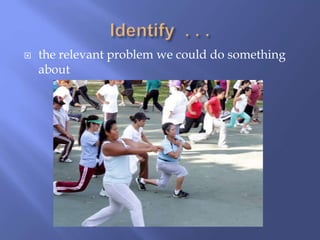
 the relevant problem we could do something
about
 And yes, obesity, heart disease, diabetes are
also problems we could address but we kept it
simple … initially.
 It is a Global Problem:
 9% of total deaths
 Related to 35% of mortality due to coronary heart
disease
 4th leading cause of mortality
 Globally 25% not active enough to receive health
benefits
 60% in California reportedly not active enough
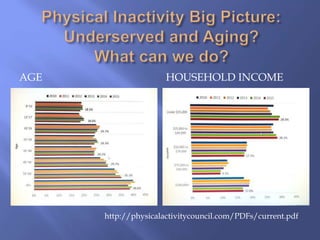
AGE HOUSEHOLD INCOME
http://physicalactivitycouncil.com/PDFs/current.pdf
 30 minutes aerobic activity a day most days . . .
etc.
 Physical Inactivity stats are worse if we include
the 2 days of muscle strengthening activity
 How many years have we been talking?
 How many more years we will talk?
 The public needs an assist . . . Not just a lecture
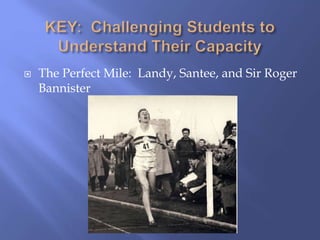
 The Perfect Mile: Landy, Santee, and Sir Roger
Bannister
 MINIMUM of 3 WINS
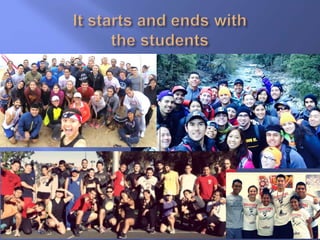
 For our students: To be empowered, they must
acquire the confidence borne by doing ... Being
involved so they understand and knowing
they CONTROL THEIR DESTINY.
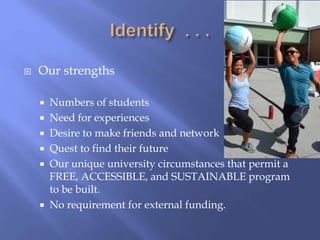
 Our strengths
 Numbers of students
 Need for experiences
 Desire to make friends and network
 Quest to find their future
 Our unique university circumstances that permit a
FREE, ACCESSIBLE, and SUSTAINABLE program
to be built.
 No requirement for external funding.
 Our challenges
 Companies looking for Kinesiology educated
students . . . We need to market ourselves
 Students understanding what “Control Your Destiny
means”
 A disconnect between Public Health, ACSM,
Kinesiology and the problem
 Talking and policy versus creating a programmatic
solution
 Department faculty and infrastructure
 An understanding that KINESIOLOGY CAN BE THE
SOLUTION through our STUDENTS NOW
 Why? Hypotheses . . .
 Viewed as personal responsibility
 I’m not convinced kinesiology and public health as a
whole are walking the talk
 Public health is policy not program oriented
 Kinesiology can do programs but for free?
 Why should we?
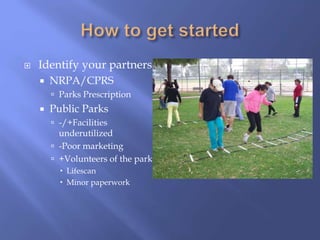
 Identify your partners
 NRPA/CPRS
 Parks Prescription
 Public Parks
 -/+Facilities
underutilized
 -Poor marketing
 +Volunteers of the park
 Lifescan
 Minor paperwork
 Identify your partners
 Public Health: Not well developed yet.
 -Always surprised when they see the program
 -No employment opportunities for Kinesiology. Will
need to be convinced by volume
 +CDC REACH; Park Prescription
 +Cedars Hospital
 +Providence Health and Services; Exercise is Medicine
 Mobile Health Van, HbA1C and Cholesterol
 ~+CACHI grant
 Identify your partners
 Participants
 Marketing
 Word of mouth
 Parks – limited
 Churches
 Schools (target parents drop off and pick up)
 Still believe we have not saturated the market with
awareness
 Identify your partners
 Students
 +Academic internship hours
 - Scheduling
 Pain and gain to be elaborated later
First they ignore you, then they laugh
at you, then they fight you, then you
win.
Mahatma Gandhi
Loy: And then you identify the next step
and you start again . . .
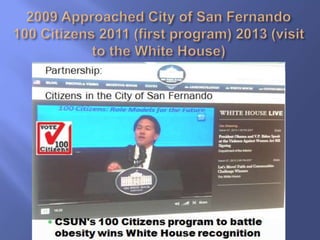
 Entering sixth year of operation
 No external funding required
 Two (park request) or three-day per week
program year-round meeting CDC
recommendations.
 Culturally appropriate with Spanish-speaking
students
 Offering the program at 8:30am, which allows
participants to attend the program after
dropping off their children at school.
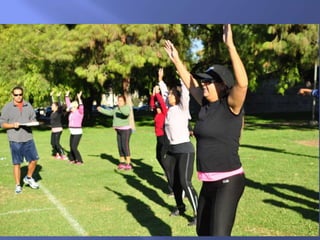
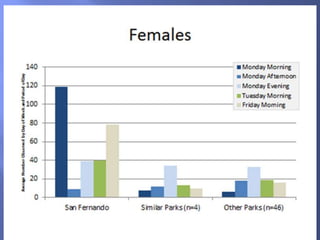
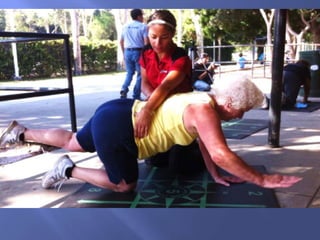
 Now in six public parks and is free of cost
 All fitness levels (low, moderate, and high) and
available for adults over the age of 18
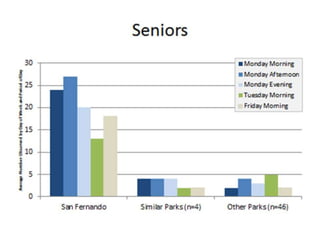
 Senior program at one park
 Addresses the challenges noted in the literature
of successful interventions not being
continuous in nature
 Over 250 participants collectively within six
different public parks.
 Healthy You: next slide
 Conducted by two undergraduate students
 Significant effect on participants’ weight, p < .001.
 43.5 % of the 23 participants lost more than 5% of
their body weight which research has shown reduces
risk for diabetes by 58%.
 The exercise program resulted in a significant
increase in distance covered in their 12 minute
walk/run test reflecting a greater cardiovascular
capacity.
 CSU Expansion model
 $140K
 Student Empowered
 Timeline
 Create a Crowdfunding video to the first of
two stakeholders: Students and University
(Presidents)
 Identifying the Customer Profile: Pain and
Gain of each
 Intent: Demonstrate how 100 Citizens can
alleviate the Pain for the student
 Intent: Demonstrate how 100 Citizens can
create gain for the University President
 Original intention of 100 Citizens was
providing for community health and job
creation for Kinesiology in the Parks and Public
Health
 In the process of creating a business, likely a
not-for-profit for 100 Citizens for our own
student leaders to create 100 Citizen programs
in Kinesiology Departments across the United
States . . . And maybe around the world
 Model: CGI U
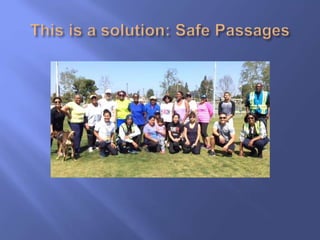
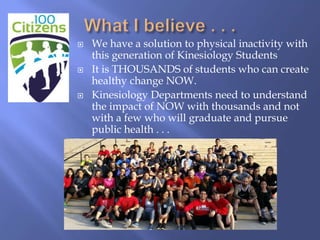
 We have a solution to physical inactivity with
this generation of Kinesiology Students
 It is THOUSANDS of students who can create
healthy change NOW.
 Kinesiology Departments need to understand
the impact of NOW with thousands and not
with a few who will graduate and pursue
public health . . .

100 citizens: Community-based student delivered solution to physical activity.

  • 1.
    Steven Loy, Ph.D. Departmentof Kinesiology California State University, Northridge
  • 2.
     the relevantproblem we could do something about
  • 3.
     And yes,obesity, heart disease, diabetes are also problems we could address but we kept it simple … initially.  It is a Global Problem:  9% of total deaths  Related to 35% of mortality due to coronary heart disease  4th leading cause of mortality  Globally 25% not active enough to receive health benefits  60% in California reportedly not active enough
  • 4.
  • 5.
     30 minutesaerobic activity a day most days . . . etc.  Physical Inactivity stats are worse if we include the 2 days of muscle strengthening activity  How many years have we been talking?  How many more years we will talk?  The public needs an assist . . . Not just a lecture
  • 8.
     The PerfectMile: Landy, Santee, and Sir Roger Bannister
  • 12.
     MINIMUM of3 WINS  For our students: To be empowered, they must acquire the confidence borne by doing ... Being involved so they understand and knowing they CONTROL THEIR DESTINY.
  • 14.
     Our strengths Numbers of students  Need for experiences  Desire to make friends and network  Quest to find their future  Our unique university circumstances that permit a FREE, ACCESSIBLE, and SUSTAINABLE program to be built.  No requirement for external funding.
  • 15.
     Our challenges Companies looking for Kinesiology educated students . . . We need to market ourselves  Students understanding what “Control Your Destiny means”  A disconnect between Public Health, ACSM, Kinesiology and the problem  Talking and policy versus creating a programmatic solution  Department faculty and infrastructure  An understanding that KINESIOLOGY CAN BE THE SOLUTION through our STUDENTS NOW
  • 16.
     Why? Hypotheses. . .  Viewed as personal responsibility  I’m not convinced kinesiology and public health as a whole are walking the talk  Public health is policy not program oriented  Kinesiology can do programs but for free?  Why should we?
  • 19.
     Identify yourpartners  NRPA/CPRS  Parks Prescription  Public Parks  -/+Facilities underutilized  -Poor marketing  +Volunteers of the park  Lifescan  Minor paperwork
  • 20.
     Identify yourpartners  Public Health: Not well developed yet.  -Always surprised when they see the program  -No employment opportunities for Kinesiology. Will need to be convinced by volume  +CDC REACH; Park Prescription  +Cedars Hospital  +Providence Health and Services; Exercise is Medicine  Mobile Health Van, HbA1C and Cholesterol  ~+CACHI grant
  • 21.
     Identify yourpartners  Participants  Marketing  Word of mouth  Parks – limited  Churches  Schools (target parents drop off and pick up)  Still believe we have not saturated the market with awareness
  • 22.
     Identify yourpartners  Students  +Academic internship hours  - Scheduling  Pain and gain to be elaborated later
  • 24.
    First they ignoreyou, then they laugh at you, then they fight you, then you win. Mahatma Gandhi Loy: And then you identify the next step and you start again . . .
  • 29.
     Entering sixthyear of operation  No external funding required  Two (park request) or three-day per week program year-round meeting CDC recommendations.  Culturally appropriate with Spanish-speaking students  Offering the program at 8:30am, which allows participants to attend the program after dropping off their children at school.
  • 30.
     Now insix public parks and is free of cost  All fitness levels (low, moderate, and high) and available for adults over the age of 18  Senior program at one park  Addresses the challenges noted in the literature of successful interventions not being continuous in nature  Over 250 participants collectively within six different public parks.  Healthy You: next slide
  • 31.
     Conducted bytwo undergraduate students  Significant effect on participants’ weight, p < .001.  43.5 % of the 23 participants lost more than 5% of their body weight which research has shown reduces risk for diabetes by 58%.  The exercise program resulted in a significant increase in distance covered in their 12 minute walk/run test reflecting a greater cardiovascular capacity.
  • 32.
     CSU Expansionmodel  $140K  Student Empowered  Timeline
  • 33.
     Create aCrowdfunding video to the first of two stakeholders: Students and University (Presidents)  Identifying the Customer Profile: Pain and Gain of each  Intent: Demonstrate how 100 Citizens can alleviate the Pain for the student  Intent: Demonstrate how 100 Citizens can create gain for the University President
  • 34.
     Original intentionof 100 Citizens was providing for community health and job creation for Kinesiology in the Parks and Public Health  In the process of creating a business, likely a not-for-profit for 100 Citizens for our own student leaders to create 100 Citizen programs in Kinesiology Departments across the United States . . . And maybe around the world  Model: CGI U
  • 35.
     We havea solution to physical inactivity with this generation of Kinesiology Students  It is THOUSANDS of students who can create healthy change NOW.  Kinesiology Departments need to understand the impact of NOW with thousands and not with a few who will graduate and pursue public health . . .