Project by Group – 05
Sanchari Mandal 17
Ashish Kumar Bhati 70
Gautam Sharma 78
Ankita Sanyal 81
Megha Das 83
INTRODUCTION
 In India Energy Sector is primary as our economy growth
depends on it
 During Pre- independence era petroleum industry was strongly
dominated by private companies
 However, post-independence era it is controlled by the
Government
 Oil is the magic word that is always on the news
 The word ‘petroleum’ is derived from two Latin words ‘petra’,
which means rock and ‘oleum’ which means oil.
 Petroleum is alternatively referred as oil or crude oil.
Crude Oil
History (Petroleum)
Pre-Independence period (1866-1947):
 The first commercial ial discovery of crude on the
country was made in 1889 at Digboi (Also known
as Oil City of Assam), Assam, India
 A new company called the Assam Oil Company
(AOC), founded in 1899
 By 1931, crude oil production had increased to
about 250,000 tons per year, and exploration
work spread throughout the Assam-Arakan
region
Post-Independence Period (1947-1960):
 The Government of India (GoI) recognized the
importance of oil and gas for its rapid
industrial development and its strategic role in
defense
 The development of the public sector with this
goal in mind at the end of 1955, the Oil and
Natural Gas Directorate (ONGD) was created
(subordinate body of the Ministry of Natural
Resources and Scientific Research)
 In October 1959, the ONGC was transformed
into a statutory body by an Act of the Indian
Parliament, further expanding the powers of
the commission
Economic Liberalization 1991:
• In February 1994, the ONGC
was reorganized as a limited
company under the Companies
Act
Post Liberalization:
• During 1993-94, ONGC production on
the west coast reached a minimum of
15.37 million tonnes, prompting ONGC
to establish joint ventures to develop
the Ravva, Mid and South Tapti,
Mukta and Panna field
• The DGH was created by Government
decree in April 1993, giving it some
management consulting functions,
but not development functions
Administered Pricing Mechanism (APM)
• From 1970s to 2002, there was an Administered Price Mechanism
(APM) system in place in oil sector.
• Under this system, the oil and gas sector was controlled at four stages
i.e., production, refining, distribution and marketing.
• The supply of raw material to the refineries at point of refining was
done at a pre-determined price called ‘delivered cost of crude’.
• The overall regime was based on the principle of allowing a pre-
determined return on investments to the oil companies.
o After the new Industrial Policy of 1991, the
government first opened refinery sector for private
participation.
o This led to emergence of one of the largest players
– Reliance Refinery.
o The decision to move from a industry to a market
driven petroleum sector was the most important
decision which resulted in the dismantling of the
Administered Price mechanism (APM) in April 2002.
Dynamic Pricing
Mechanism (DPM) The Government of India
has launched a new
nationwide fuel pricing
model from June 2017.
In this model, fuel prices
change on a daily basis,
which is called Dynamic
Fuel Pricing.
The change in policy in
India from a government
regulated system to a
dynamic system is to
bring parity with
international petroleum
product prices.
Another goal of this
change is to limit the
price speculation in
the petroleum
product market in
India.
To achieve broad objectives on a shift from APM to DPM, the GoI
suggested that the entire oil sector should be completely opened up:
• Removing all restrictions on imports and exports and on sourcing
type of crude oil product pattern.
• Allowing oil companies to decide on development of :
a. Infrastructure,
b. Mode of transportation,
c. Selection of marketing areas,
d. Appointment of dealers/distributors,
e. Amount of commission payable to intermediaries
f. The sales volume, purely on commercial considerations.
• Ensuring fair competition by setting up a regulatorybody to control
the market in a transparent manner.
• Setting up of an oil commodityexchange to provide an institutional
market for exchange of petroleum products at market relatedprices
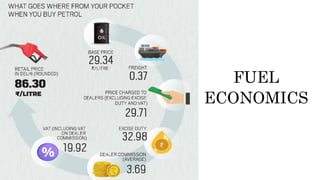
FUEL
ECONOMICS
IMPACT Of PETROL
PRICING
ON PEOPLE :
 According to a survey around 50 percent
Indians are cutting on their other expenses
to manage their spending on fuel prices.
 Another 15 percent are dipping into
savings to pay for petrol
 People owning private vehicles are now
taking govt transport because they can’t
afford petrol
 It should be noted that an increase in fuel
prices has a direct impact on the cost of
essential goods that need to be
transported over long distances
ON BUSINESS
 People in business are also getting
effected as transportation is costing a lot.
 Fare prices of even Govt are also
increasing
 High prices of petrol always tend to kill the
middle man
Remedy to the surge
in prices
oRemedy can be found in the reason,
the main reason for the rise in fuel
prices in the country is the high
central and state tax rate.
oEven when international crude oil
prices collapsed in 2020 due to
lower demand, Indians continued to
pay higher prices for gasoline and
diesel due to various taxes levied.
oTherefore, altering and curbing the
various taxes can remedy the urge in
fuel prices can defiantly help
everyone
CONCLUS
ION
High population growth which
gives rise to consumption in every
sector, also increases the price of
fuel due to its consumption use.
People suggest that introduction
to smart cards, promotion for the
use of public transport and
subsidies from government can
control prices in the economy.
THANK YOU

Petrol price in india

  • 1.
    Project by Group– 05 Sanchari Mandal 17 Ashish Kumar Bhati 70 Gautam Sharma 78 Ankita Sanyal 81 Megha Das 83
  • 2.
    INTRODUCTION  In IndiaEnergy Sector is primary as our economy growth depends on it  During Pre- independence era petroleum industry was strongly dominated by private companies  However, post-independence era it is controlled by the Government  Oil is the magic word that is always on the news  The word ‘petroleum’ is derived from two Latin words ‘petra’, which means rock and ‘oleum’ which means oil.  Petroleum is alternatively referred as oil or crude oil.
  • 3.
    Crude Oil History (Petroleum) Pre-Independenceperiod (1866-1947):  The first commercial ial discovery of crude on the country was made in 1889 at Digboi (Also known as Oil City of Assam), Assam, India  A new company called the Assam Oil Company (AOC), founded in 1899  By 1931, crude oil production had increased to about 250,000 tons per year, and exploration work spread throughout the Assam-Arakan region Post-Independence Period (1947-1960):  The Government of India (GoI) recognized the importance of oil and gas for its rapid industrial development and its strategic role in defense  The development of the public sector with this goal in mind at the end of 1955, the Oil and Natural Gas Directorate (ONGD) was created (subordinate body of the Ministry of Natural Resources and Scientific Research)  In October 1959, the ONGC was transformed into a statutory body by an Act of the Indian Parliament, further expanding the powers of the commission
  • 4.
    Economic Liberalization 1991: •In February 1994, the ONGC was reorganized as a limited company under the Companies Act Post Liberalization: • During 1993-94, ONGC production on the west coast reached a minimum of 15.37 million tonnes, prompting ONGC to establish joint ventures to develop the Ravva, Mid and South Tapti, Mukta and Panna field • The DGH was created by Government decree in April 1993, giving it some management consulting functions, but not development functions
  • 5.
    Administered Pricing Mechanism(APM) • From 1970s to 2002, there was an Administered Price Mechanism (APM) system in place in oil sector. • Under this system, the oil and gas sector was controlled at four stages i.e., production, refining, distribution and marketing. • The supply of raw material to the refineries at point of refining was done at a pre-determined price called ‘delivered cost of crude’. • The overall regime was based on the principle of allowing a pre- determined return on investments to the oil companies.
  • 6.
    o After thenew Industrial Policy of 1991, the government first opened refinery sector for private participation. o This led to emergence of one of the largest players – Reliance Refinery. o The decision to move from a industry to a market driven petroleum sector was the most important decision which resulted in the dismantling of the Administered Price mechanism (APM) in April 2002.
  • 7.
    Dynamic Pricing Mechanism (DPM)The Government of India has launched a new nationwide fuel pricing model from June 2017. In this model, fuel prices change on a daily basis, which is called Dynamic Fuel Pricing. The change in policy in India from a government regulated system to a dynamic system is to bring parity with international petroleum product prices. Another goal of this change is to limit the price speculation in the petroleum product market in India.
  • 8.
    To achieve broadobjectives on a shift from APM to DPM, the GoI suggested that the entire oil sector should be completely opened up: • Removing all restrictions on imports and exports and on sourcing type of crude oil product pattern. • Allowing oil companies to decide on development of : a. Infrastructure, b. Mode of transportation, c. Selection of marketing areas, d. Appointment of dealers/distributors, e. Amount of commission payable to intermediaries f. The sales volume, purely on commercial considerations. • Ensuring fair competition by setting up a regulatorybody to control the market in a transparent manner. • Setting up of an oil commodityexchange to provide an institutional market for exchange of petroleum products at market relatedprices
  • 9.
  • 10.
    IMPACT Of PETROL PRICING ONPEOPLE :  According to a survey around 50 percent Indians are cutting on their other expenses to manage their spending on fuel prices.  Another 15 percent are dipping into savings to pay for petrol  People owning private vehicles are now taking govt transport because they can’t afford petrol  It should be noted that an increase in fuel prices has a direct impact on the cost of essential goods that need to be transported over long distances ON BUSINESS  People in business are also getting effected as transportation is costing a lot.  Fare prices of even Govt are also increasing  High prices of petrol always tend to kill the middle man
  • 11.
    Remedy to thesurge in prices oRemedy can be found in the reason, the main reason for the rise in fuel prices in the country is the high central and state tax rate. oEven when international crude oil prices collapsed in 2020 due to lower demand, Indians continued to pay higher prices for gasoline and diesel due to various taxes levied. oTherefore, altering and curbing the various taxes can remedy the urge in fuel prices can defiantly help everyone
  • 12.
    CONCLUS ION High population growthwhich gives rise to consumption in every sector, also increases the price of fuel due to its consumption use. People suggest that introduction to smart cards, promotion for the use of public transport and subsidies from government can control prices in the economy.
  • 13.