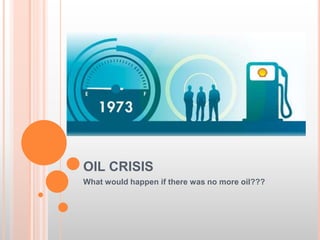
OIL CRISIS
What would happen if there was no more oil???
GROUP MEMBERS
Priyanka Limbachiya 512
Richa Modi 517
Anjal Surana 536
Priyanka Tiwari 537
Aditi Warang 547
OIL CRISIS, 1973
 The 1973 oil crisis began in October 1973 when the members
of the Organization of Arab Petroleum Exporting
Countries (OAPEC, consisting of the Arab members of
the OPEC, plus Egypt, Syria and Tunisia) proclaimed an OIL
embargo.
 By the end of the embargo in March 1974, the price of oil
had risen from $3 per barrel to nearly $12.
 The oil crisis, or "shock", had many short-term and long-
term effects on global politics and the global economy. It
was later called the first oil shock, with the 1979 oil
crisis being the "second oil shock."
OIL CRISIS OF 1973 – WHY DID IT HAPPEN??
 OPEC would decide the price and amount of oil.
 President Nixon showed his support of Israel by
giving them $ 2.5 billion worth of arms (weapons)
 OPEC nations retaliated against those nations
supporting Israel by putting an embargo on oil
shipments.
 EMBARGO – a type of trade barrier in which a
government places restrictions on imports and
exports of certain goods.
 Result – the price of gasoline shot way up as its
supply went down, leading to shortages.
1990 OIL PRICE SHOCK
o The 1990 OIL PRICE spike occurred in response to the Iraqi
invasion of Kuwait on August 2, 1990.
o Lasting only 9 months, the price shock was less extreme and of
shorter duration than the previous oil crises of 1973 and 1979-
1980, yet the rise in prices is widely believed to have been a
significant factor in the recession of the early 1990s.
o Average monthly prices of OIL rose from $17 per barrel in
July to $36 per barrel in October. As the U.S.-led coalition
experienced military success against Iraqi forces, concerns
about long-term supply shortages eased and prices began to
fall.
What is OPEC?
 The Organization of the Petroleum Exporting
Countries (OPEC), which then comprised 12 countries,
including Iran, seven Arab countries (Iraq, Kuwait, Libya,
Qatar, Saudi Arabia, the United Arab Emirates),
plus Venezuela, Indonesia, Nigeria, and Ecuador, had
been formed at a Baghdad conference on September 14,
1960.
 OPEC was organized to resist pressure by the "Seven
Sisters" (seven large oil companies, mostly owned by
U.S., British, and Dutch nationals) to reduce oil
prices and payments to producing countries.
WHAT WAS OPEC’S POINT?
They wanted to get the
attention of the international
community that was supporting
Israel.
OIL CRISIS AFFECTS INDIA’S ECONOMY
 India ranks among the top 10 largest oil- consuming
countries
 Oil accounts for about 30% of India's total energy
consumption.
 Now India imports about 70% of its total oil consumption
and makes no exports.
 This naturally would create a supply deficit, as domestic
oil production is unlikely to keep pace with demand.
 An IMF report says that among the oil importing
countries, the largest impact on GDP growth and the
balance of payments is expected to be felt in India,
Korea, Pakistan, Philippines, Thailand, and Turkey.
SKEWED BALANCE OF PAYMENTS DUE TO OIL
IMPORTS
 Although the entire burden of the spike in price has not
been passed to the domestic consumer, the Indian
government's finances have taken a sufficient hit,
affecting the macroeconomic outlook in India.
 India, as a result, will experience deterioration in its
balance of payments, putting downward pressure on
exchange rates.
 Ultimately, imports would become more expensive and
exports less valuable, leading to a drop in real national
income.
Global Oil Scenario
o World oil use is expected to grow from about 80 million barrels per day
(mbpd) in 2003 to 98 mbpd in 2015 and 118 mbpd in 2030 as per Energy
Information Administration (EIA), International Energy Outlook (IEO)
2006.
o In the IEO 2006 reference case, world oil prices rise from $31 per barrel
(in real 2004 dollars) in 2003 to $57 per barrel in 2030, and oil’s share of
total world energy use falls from 39 percent to 33 percent.
o To meet the projected increase in world oil demand, total petroleum supply
in 2030 will need to be 38 mbpd higher than the 2003 level of 80 mbpd.
o As per the same report India is expected to consume additional 2.2 mbpd.
OPEC producers are expected to provide 14.6 mbpd of the increase.
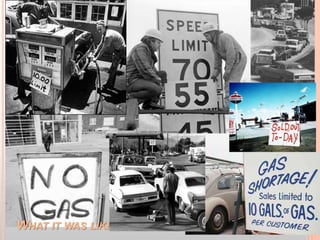
WHAT IT WAS LIKE IN 1973
IN OUR WORLD, WHAT ELSE IS
PETROLEUM USED FOR?
 When petroleum is refined, its various chemical
parts are separated and some become gasoline,
some asphalt, and other parts become the raw
materials for plastics and rubber for tires and many
more things.
 Examples of what can be obtained from petroleum:
crude oil, natural gas, and/or viscous or solid forms
 Fuels - like gasoline, diesel, propane (many people
use propane to heat their homes), heating oil
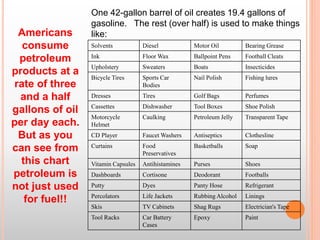
Solvents Diesel Motor Oil Bearing Grease
Ink Floor Wax Ballpoint Pens Football Cleats
Upholstery Sweaters Boats Insecticides
Bicycle Tires Sports Car
Bodies
Nail Polish Fishing lures
Dresses Tires Golf Bags Perfumes
Cassettes Dishwasher Tool Boxes Shoe Polish
Motorcycle
Helmet
Caulking Petroleum Jelly Transparent Tape
CD Player Faucet Washers Antiseptics Clothesline
Curtains Food
Preservatives
Basketballs Soap
Vitamin Capsules Antihistamines Purses Shoes
Dashboards Cortisone Deodorant Footballs
Putty Dyes Panty Hose Refrigerant
Percolators Life Jackets Rubbing Alcohol Linings
Skis TV Cabinets Shag Rugs Electrician's Tape
Tool Racks Car Battery
Cases
Epoxy Paint
One 42-gallon barrel of oil creates 19.4 gallons of
gasoline. The rest (over half) is used to make things
like:Americans
consume
petroleum
products at a
rate of three
and a half
gallons of oil
per day each.
But as you
can see from
this chart
petroleum is
not just used
for fuel!!
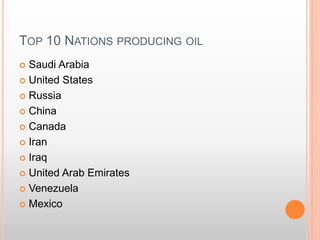
TOP 10 NATIONS PRODUCING OIL
 Saudi Arabia
 United States
 Russia
 China
 Canada
 Iran
 Iraq
 United Arab Emirates
 Venezuela
 Mexico
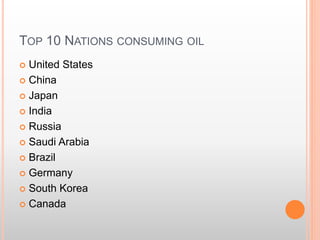
TOP 10 NATIONS CONSUMING OIL
 United States
 China
 Japan
 India
 Russia
 Saudi Arabia
 Brazil
 Germany
 South Korea
 Canada
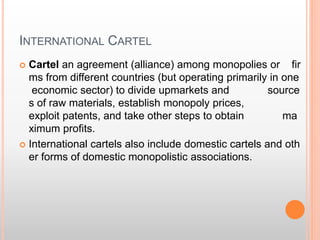
INTERNATIONAL CARTEL
 Cartel an agreement (alliance) among monopolies or fir
ms from different countries (but operating primarily in one
economic sector) to divide upmarkets and source
s of raw materials, establish monopoly prices,
exploit patents, and take other steps to obtain ma
ximum profits.
 International cartels also include domestic cartels and oth
er forms of domestic monopolistic associations.
 The petroleum cartel includes seven major oil trusts in
United States, Great Britain and Netherlands. These are
the standard oil company of New Jersey, Standard oil
company of California, Mobil oil, Gulf oil and Texaco in
United States, British Petroleum in Great Britain, and
Royal Dutch-Shell in Great Britain and the Netherlands.
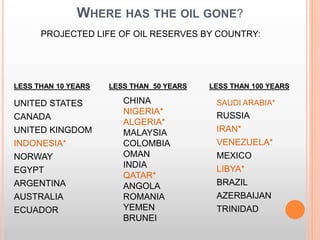
WHERE HAS THE OIL GONE?
UNITED STATES
CANADA
UNITED KINGDOM
INDONESIA*
NORWAY
EGYPT
ARGENTINA
AUSTRALIA
ECUADOR
PROJECTED LIFE OF OIL RESERVES BY COUNTRY:
CHINA
NIGERIA*
ALGERIA*
MALAYSIA
COLOMBIA
OMAN
INDIA
QATAR*
ANGOLA
ROMANIA
YEMEN
BRUNEI
SAUDI ARABIA*
RUSSIA
IRAN*
VENEZUELA*
MEXICO
LIBYA*
BRAZIL
AZERBAIJAN
TRINIDAD
LESS THAN 10 YEARS LESS THAN 50 YEARS LESS THAN 100 YEARS
WHAT WILL IT BE LIKE IN THE YEAR 2175?
 YOUR ASSIGNMENT IS TO CREATE A MIND MAP OF
WHAT THE WORLD WOULD BE LIKE IF WE RAN OUT
OF PETROLEUM.
 THINK ABOUT HOW YOUR DAILY LIFE WILL BE
AFFECTED?
 WHAT WILL THERE BE LESS OF?
 WHAT WILL THERE BE MORE OF?
 WHAT WILL WE DO DIFFERENTLY?
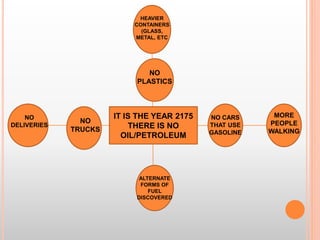
IT IS THE YEAR 2175
THERE IS NO
OIL/PETROLEUM
NO
TRUCKS
NO
DELIVERIES
ALTERNATE
FORMS OF
FUEL
DISCOVERED
MORE
PEOPLE
WALKING
NO CARS
THAT USE
GASOLINE
NO
PLASTICS
HEAVIER
CONTAINERS
(GLASS,
METAL, ETC
Oil crisis

Oil crisis

  • 1.
    OIL CRISIS What wouldhappen if there was no more oil???
  • 2.
    GROUP MEMBERS Priyanka Limbachiya512 Richa Modi 517 Anjal Surana 536 Priyanka Tiwari 537 Aditi Warang 547
  • 3.
    OIL CRISIS, 1973 The 1973 oil crisis began in October 1973 when the members of the Organization of Arab Petroleum Exporting Countries (OAPEC, consisting of the Arab members of the OPEC, plus Egypt, Syria and Tunisia) proclaimed an OIL embargo.  By the end of the embargo in March 1974, the price of oil had risen from $3 per barrel to nearly $12.  The oil crisis, or "shock", had many short-term and long- term effects on global politics and the global economy. It was later called the first oil shock, with the 1979 oil crisis being the "second oil shock."
  • 4.
    OIL CRISIS OF1973 – WHY DID IT HAPPEN??  OPEC would decide the price and amount of oil.  President Nixon showed his support of Israel by giving them $ 2.5 billion worth of arms (weapons)  OPEC nations retaliated against those nations supporting Israel by putting an embargo on oil shipments.  EMBARGO – a type of trade barrier in which a government places restrictions on imports and exports of certain goods.  Result – the price of gasoline shot way up as its supply went down, leading to shortages.
  • 5.
    1990 OIL PRICESHOCK o The 1990 OIL PRICE spike occurred in response to the Iraqi invasion of Kuwait on August 2, 1990. o Lasting only 9 months, the price shock was less extreme and of shorter duration than the previous oil crises of 1973 and 1979- 1980, yet the rise in prices is widely believed to have been a significant factor in the recession of the early 1990s. o Average monthly prices of OIL rose from $17 per barrel in July to $36 per barrel in October. As the U.S.-led coalition experienced military success against Iraqi forces, concerns about long-term supply shortages eased and prices began to fall.
  • 6.
  • 7.
     The Organizationof the Petroleum Exporting Countries (OPEC), which then comprised 12 countries, including Iran, seven Arab countries (Iraq, Kuwait, Libya, Qatar, Saudi Arabia, the United Arab Emirates), plus Venezuela, Indonesia, Nigeria, and Ecuador, had been formed at a Baghdad conference on September 14, 1960.  OPEC was organized to resist pressure by the "Seven Sisters" (seven large oil companies, mostly owned by U.S., British, and Dutch nationals) to reduce oil prices and payments to producing countries.
  • 8.
    WHAT WAS OPEC’SPOINT? They wanted to get the attention of the international community that was supporting Israel.
  • 9.
    OIL CRISIS AFFECTSINDIA’S ECONOMY  India ranks among the top 10 largest oil- consuming countries  Oil accounts for about 30% of India's total energy consumption.  Now India imports about 70% of its total oil consumption and makes no exports.  This naturally would create a supply deficit, as domestic oil production is unlikely to keep pace with demand.  An IMF report says that among the oil importing countries, the largest impact on GDP growth and the balance of payments is expected to be felt in India, Korea, Pakistan, Philippines, Thailand, and Turkey.
  • 10.
    SKEWED BALANCE OFPAYMENTS DUE TO OIL IMPORTS  Although the entire burden of the spike in price has not been passed to the domestic consumer, the Indian government's finances have taken a sufficient hit, affecting the macroeconomic outlook in India.  India, as a result, will experience deterioration in its balance of payments, putting downward pressure on exchange rates.  Ultimately, imports would become more expensive and exports less valuable, leading to a drop in real national income.
  • 11.
    Global Oil Scenario oWorld oil use is expected to grow from about 80 million barrels per day (mbpd) in 2003 to 98 mbpd in 2015 and 118 mbpd in 2030 as per Energy Information Administration (EIA), International Energy Outlook (IEO) 2006. o In the IEO 2006 reference case, world oil prices rise from $31 per barrel (in real 2004 dollars) in 2003 to $57 per barrel in 2030, and oil’s share of total world energy use falls from 39 percent to 33 percent. o To meet the projected increase in world oil demand, total petroleum supply in 2030 will need to be 38 mbpd higher than the 2003 level of 80 mbpd. o As per the same report India is expected to consume additional 2.2 mbpd. OPEC producers are expected to provide 14.6 mbpd of the increase.
  • 12.
    WHAT IT WASLIKE IN 1973
  • 13.
    IN OUR WORLD,WHAT ELSE IS PETROLEUM USED FOR?  When petroleum is refined, its various chemical parts are separated and some become gasoline, some asphalt, and other parts become the raw materials for plastics and rubber for tires and many more things.  Examples of what can be obtained from petroleum: crude oil, natural gas, and/or viscous or solid forms  Fuels - like gasoline, diesel, propane (many people use propane to heat their homes), heating oil
  • 14.
    Solvents Diesel MotorOil Bearing Grease Ink Floor Wax Ballpoint Pens Football Cleats Upholstery Sweaters Boats Insecticides Bicycle Tires Sports Car Bodies Nail Polish Fishing lures Dresses Tires Golf Bags Perfumes Cassettes Dishwasher Tool Boxes Shoe Polish Motorcycle Helmet Caulking Petroleum Jelly Transparent Tape CD Player Faucet Washers Antiseptics Clothesline Curtains Food Preservatives Basketballs Soap Vitamin Capsules Antihistamines Purses Shoes Dashboards Cortisone Deodorant Footballs Putty Dyes Panty Hose Refrigerant Percolators Life Jackets Rubbing Alcohol Linings Skis TV Cabinets Shag Rugs Electrician's Tape Tool Racks Car Battery Cases Epoxy Paint One 42-gallon barrel of oil creates 19.4 gallons of gasoline. The rest (over half) is used to make things like:Americans consume petroleum products at a rate of three and a half gallons of oil per day each. But as you can see from this chart petroleum is not just used for fuel!!
  • 15.
    TOP 10 NATIONSPRODUCING OIL  Saudi Arabia  United States  Russia  China  Canada  Iran  Iraq  United Arab Emirates  Venezuela  Mexico
  • 16.
    TOP 10 NATIONSCONSUMING OIL  United States  China  Japan  India  Russia  Saudi Arabia  Brazil  Germany  South Korea  Canada
  • 17.
    INTERNATIONAL CARTEL  Cartelan agreement (alliance) among monopolies or fir ms from different countries (but operating primarily in one economic sector) to divide upmarkets and source s of raw materials, establish monopoly prices, exploit patents, and take other steps to obtain ma ximum profits.  International cartels also include domestic cartels and oth er forms of domestic monopolistic associations.
  • 18.
     The petroleumcartel includes seven major oil trusts in United States, Great Britain and Netherlands. These are the standard oil company of New Jersey, Standard oil company of California, Mobil oil, Gulf oil and Texaco in United States, British Petroleum in Great Britain, and Royal Dutch-Shell in Great Britain and the Netherlands.
  • 19.
    WHERE HAS THEOIL GONE? UNITED STATES CANADA UNITED KINGDOM INDONESIA* NORWAY EGYPT ARGENTINA AUSTRALIA ECUADOR PROJECTED LIFE OF OIL RESERVES BY COUNTRY: CHINA NIGERIA* ALGERIA* MALAYSIA COLOMBIA OMAN INDIA QATAR* ANGOLA ROMANIA YEMEN BRUNEI SAUDI ARABIA* RUSSIA IRAN* VENEZUELA* MEXICO LIBYA* BRAZIL AZERBAIJAN TRINIDAD LESS THAN 10 YEARS LESS THAN 50 YEARS LESS THAN 100 YEARS
  • 20.
    WHAT WILL ITBE LIKE IN THE YEAR 2175?  YOUR ASSIGNMENT IS TO CREATE A MIND MAP OF WHAT THE WORLD WOULD BE LIKE IF WE RAN OUT OF PETROLEUM.  THINK ABOUT HOW YOUR DAILY LIFE WILL BE AFFECTED?  WHAT WILL THERE BE LESS OF?  WHAT WILL THERE BE MORE OF?  WHAT WILL WE DO DIFFERENTLY?
  • 21.
    IT IS THEYEAR 2175 THERE IS NO OIL/PETROLEUM NO TRUCKS NO DELIVERIES ALTERNATE FORMS OF FUEL DISCOVERED MORE PEOPLE WALKING NO CARS THAT USE GASOLINE NO PLASTICS HEAVIER CONTAINERS (GLASS, METAL, ETC