
ECONOMIC ANALYSIS &
INDUSTRY ANALYSIS –
indian refinary
Sachin
ECONOMIC ANALYSIS
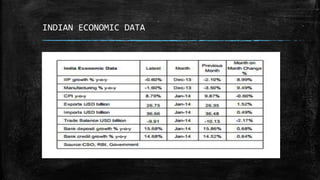
▪ The Central Statistical Office estimates that the economy will grow by
6.2%. RBI expects the same to be 5.7%
▪ Nineteenth largest exporter and the 10th-largest importer
▪ The IIP (Index of Industrial Production) growth for the April-December 2013
period was a negative 0.1% while the manufacturing growth was a negative
0.6%.
▪ Fiscal deficit of US$ 88 billion (4.8% of GDP) in the year 2012–13
▪ Inflation
Wholesale price index and Consumer price index are decreasing from November 2013 onwards
Consumer price inflation down to 6% by early 2016
Expected growth ofWPI to average 5.8% and 5.7% in FY 2014 and FY2015
High prices and sluggish growth presents a gloomy picture at global front
▪ Foreign Trade
Exports declined in Q1 2013
But, it registered a double digit growth in July (11.64%) and October (13.47%)
Lower Gold demand declined the total imports of the economy
On the lower imports and healthy exports, trade deficit got narrowed, helped curb CAD
▪ Current Account Deficit
▪ Gold imports and crude imports are major factors
▪ Three times hike in gold import duty to 10% in 2013 and other import restrictions curb
gold import
▪ Current Account Deficit (CAD) dropped to 0.9% in Q3 from 4.9% in Q1 of 2013
▪ Tighter lending norms, weak domestic demand and an increase in exports have
improved current account deficit
▪ Current Account Deficit was its lowest in three years at 2.6% of GDP from -5.0% in
2012
▪ Passenger vehicle sales were down 5.7% while commercial vehicle
sales were down 18.4% in the April-December 2013 period on a year
on year basis.
▪ January 2014 saw passenger vehicle and commercial vehicle sales
down 7% and 21% respectively year on year.
INDIAN ECONOMIC DATA
INDUSTRY ANALYSIS - refinery
▪ An oil refinery or petroleum refinery is an industrial process plant where crude oil is
processed and refined into more useful products such as petroleum naphtha,
gasoline, diesel fuel, asphalt base, heating oil, kerosene and liquefied petroleum
gas.
▪ Indian refining industry has done exceedingly well in establishing itself as a major
player globally.
▪ The country’s refining capacity has increased from a modest 62 Million MetricTons
Per Annum (MMTPA) in 1998 to 215.066 MMTPA at present, comprising of 22
refineries - 17 under Public Sector, 3 under private sector and 2 in JointVenture (JV).
GROWTH STRUCTURE OF REFINERY INDUSTRY
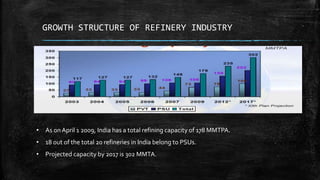
• As onApril 1 2009, India has a total refining capacity of 178 MMTPA.
• 18 out of the total 20 refineries in India belong to PSUs.
• Projected capacity by 2017 is 302 MMTA.
CHALLENGES
▪ Crude Oil Sourcing
– NEW EXPLORATION LICENSING POLICY (NELP)
– 206 oil and gas exploration blocks awarded
– 68 major discoveries reported
– World’s biggest deep water gas discovery made in 2002 (K-G Basin)
– INDIA HYDROCARBONVISION 2025
– 100% exploration coverage of all sedimentary basins by 2025
▪ Margin Improvement
– Input cost reduction
– Product mix development
▪ Environmental Issues
– Reducing GHG emission
– Efficient energy consumption
– Quality upgradation
▪ Funding for New Projects
– Majority of available funds are getting diverted in development of national infrastructure
like power generation, roads, railways, airports etc
MAJOR PLAYERS
▪ Reliance
▪ BPCL
▪ HPCL
▪ Cals Refineries
▪ Essar oil
▪ Chennai petro
COMPETITION IN REFINERY INDUSTRY
▪ In India the market of refinery is oligopoly.
▪ Price rigidity exists
▪ India has 18 refineries -- 17 in the public sector and one in the private,
with an installed capacity of 127.37 MMTPA.
GOVERNMENT POLICIES
▪ To attract private investment in exploration, the government has
announced that any company investing nearly US$400 million (Rs20 billion)
in exploration and production or other specified avenue, would be eligible
for marketing rights for petroleum products in India.This will allow the
international oil majors to enter into the lucrative marketing sector.
▪ In September 1997,the government has decided to dismantle
Administrative Pricing Mechanism (APM) in phased manner. By April, 2002
it will be fully dismantled and prices of petroleum products will be
determined on the basis of import parity system.
▪ No custom duty on imports required for petroleum operations.
▪ No minimum expenditure commitment during the exploration period.
▪ No mandatory state participation.
▪ No carried interest by NationalOil Companies
▪ Freedom to sell crude oil and natural gas in domestic market at market related
prices.
▪ Biddable cost recovery limit unto 100%
▪ Royalty payment: 12.5% for on land areas,10% for offshore and 5% for deep water
areas.
▪ Liberal depreciation provisions
▪ Seven years tax holidays from the commencement of production.
RESEARCH AND DEVELOPMENT
▪ The R&D works in collaboration with esteemed institutions like
Indian institute of Petroleum, Dehradun and Indian institute of
Technology, Chennai.
▪ Optimization and innovative improvements in the process operations
and undertaking exploratory research to find out new avenues for
growth and diversification are the other objectives of R&D Centre.
▪ R&D center is equipped with facilities for evaluation of crude oil
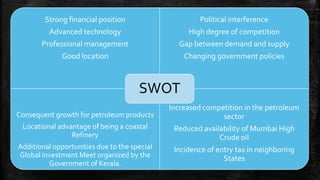
Strong financial position
Advanced technology
Professional management
Good location
Political interference
High degree of competition
Gap between demand and supply
Changing government policies
Consequent growth for petroleum products
Locational advantage of being a coastal
Refinery
Additional opportunities due to the special
Global investment Meet organized by the
Government of Kerala.
Increased competition in the petroleum
sector
Reduced availability of Mumbai High
Crude oil
Incidence of entry tax in neighboring
States
SWOT

Indian Refinery Industry Analysis

  • 1.
    ECONOMIC ANALYSIS & INDUSTRYANALYSIS – indian refinary Sachin
  • 2.
    ECONOMIC ANALYSIS ▪ TheCentral Statistical Office estimates that the economy will grow by 6.2%. RBI expects the same to be 5.7% ▪ Nineteenth largest exporter and the 10th-largest importer ▪ The IIP (Index of Industrial Production) growth for the April-December 2013 period was a negative 0.1% while the manufacturing growth was a negative 0.6%. ▪ Fiscal deficit of US$ 88 billion (4.8% of GDP) in the year 2012–13
  • 3.
    ▪ Inflation Wholesale priceindex and Consumer price index are decreasing from November 2013 onwards Consumer price inflation down to 6% by early 2016 Expected growth ofWPI to average 5.8% and 5.7% in FY 2014 and FY2015 High prices and sluggish growth presents a gloomy picture at global front ▪ Foreign Trade Exports declined in Q1 2013 But, it registered a double digit growth in July (11.64%) and October (13.47%) Lower Gold demand declined the total imports of the economy On the lower imports and healthy exports, trade deficit got narrowed, helped curb CAD
  • 4.
    ▪ Current AccountDeficit ▪ Gold imports and crude imports are major factors ▪ Three times hike in gold import duty to 10% in 2013 and other import restrictions curb gold import ▪ Current Account Deficit (CAD) dropped to 0.9% in Q3 from 4.9% in Q1 of 2013 ▪ Tighter lending norms, weak domestic demand and an increase in exports have improved current account deficit ▪ Current Account Deficit was its lowest in three years at 2.6% of GDP from -5.0% in 2012
  • 5.
    ▪ Passenger vehiclesales were down 5.7% while commercial vehicle sales were down 18.4% in the April-December 2013 period on a year on year basis. ▪ January 2014 saw passenger vehicle and commercial vehicle sales down 7% and 21% respectively year on year.
  • 6.
  • 7.
    INDUSTRY ANALYSIS -refinery ▪ An oil refinery or petroleum refinery is an industrial process plant where crude oil is processed and refined into more useful products such as petroleum naphtha, gasoline, diesel fuel, asphalt base, heating oil, kerosene and liquefied petroleum gas. ▪ Indian refining industry has done exceedingly well in establishing itself as a major player globally. ▪ The country’s refining capacity has increased from a modest 62 Million MetricTons Per Annum (MMTPA) in 1998 to 215.066 MMTPA at present, comprising of 22 refineries - 17 under Public Sector, 3 under private sector and 2 in JointVenture (JV).
  • 8.
    GROWTH STRUCTURE OFREFINERY INDUSTRY • As onApril 1 2009, India has a total refining capacity of 178 MMTPA. • 18 out of the total 20 refineries in India belong to PSUs. • Projected capacity by 2017 is 302 MMTA.
  • 9.
    CHALLENGES ▪ Crude OilSourcing – NEW EXPLORATION LICENSING POLICY (NELP) – 206 oil and gas exploration blocks awarded – 68 major discoveries reported – World’s biggest deep water gas discovery made in 2002 (K-G Basin) – INDIA HYDROCARBONVISION 2025 – 100% exploration coverage of all sedimentary basins by 2025
  • 10.
    ▪ Margin Improvement –Input cost reduction – Product mix development ▪ Environmental Issues – Reducing GHG emission – Efficient energy consumption – Quality upgradation ▪ Funding for New Projects – Majority of available funds are getting diverted in development of national infrastructure like power generation, roads, railways, airports etc
  • 11.
    MAJOR PLAYERS ▪ Reliance ▪BPCL ▪ HPCL ▪ Cals Refineries ▪ Essar oil ▪ Chennai petro
  • 12.
    COMPETITION IN REFINERYINDUSTRY ▪ In India the market of refinery is oligopoly. ▪ Price rigidity exists ▪ India has 18 refineries -- 17 in the public sector and one in the private, with an installed capacity of 127.37 MMTPA.
  • 13.
    GOVERNMENT POLICIES ▪ Toattract private investment in exploration, the government has announced that any company investing nearly US$400 million (Rs20 billion) in exploration and production or other specified avenue, would be eligible for marketing rights for petroleum products in India.This will allow the international oil majors to enter into the lucrative marketing sector. ▪ In September 1997,the government has decided to dismantle Administrative Pricing Mechanism (APM) in phased manner. By April, 2002 it will be fully dismantled and prices of petroleum products will be determined on the basis of import parity system.
  • 14.
    ▪ No customduty on imports required for petroleum operations. ▪ No minimum expenditure commitment during the exploration period. ▪ No mandatory state participation. ▪ No carried interest by NationalOil Companies ▪ Freedom to sell crude oil and natural gas in domestic market at market related prices. ▪ Biddable cost recovery limit unto 100% ▪ Royalty payment: 12.5% for on land areas,10% for offshore and 5% for deep water areas. ▪ Liberal depreciation provisions ▪ Seven years tax holidays from the commencement of production.
  • 15.
    RESEARCH AND DEVELOPMENT ▪The R&D works in collaboration with esteemed institutions like Indian institute of Petroleum, Dehradun and Indian institute of Technology, Chennai. ▪ Optimization and innovative improvements in the process operations and undertaking exploratory research to find out new avenues for growth and diversification are the other objectives of R&D Centre. ▪ R&D center is equipped with facilities for evaluation of crude oil
  • 16.
    Strong financial position Advancedtechnology Professional management Good location Political interference High degree of competition Gap between demand and supply Changing government policies Consequent growth for petroleum products Locational advantage of being a coastal Refinery Additional opportunities due to the special Global investment Meet organized by the Government of Kerala. Increased competition in the petroleum sector Reduced availability of Mumbai High Crude oil Incidence of entry tax in neighboring States SWOT