SRGE
1
Petri Nets: Properties, Analysis and
Applications
Presented By
Dr. Mohamed Torky
PHD in Computer Science (2018), Faculty of Science, Menoufyia University, Egypt.
Member in Scientific Research Group in Egypt (SRGE)
Agenda
2
1
• What is Petri Nets ?
2
• Analysis Methods of Petri Nets
3
• High Level Petri Nets
4
• Petri Nets Application: Rumor Detection and Blocking in OSN
5
• Orbital Petri Nets : A Promising Petri Net Approach
Agenda
3
1
• What is Petri Nets ?
2
• Analysis Methods of Petri Nets
3
• High Level Petri Nets
4
• Petri Nets Application: Rumor Detection and Blocking in OSN
5
• Orbital Petri Nets : A Promising Petri Net Approach
8/12/2018
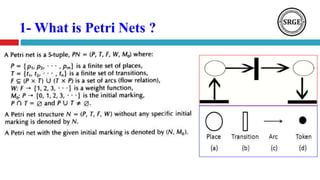
1- What is Petri Nets ?
8/12/2018
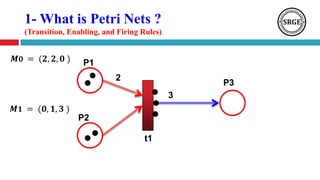
1- What is Petri Nets ?
(Transition, Enabling, and Firing Rules)
P1
P2
P3
t1
2
3
𝑴 𝟎 = (𝟐, 𝟐, 𝟎 )
𝑴 𝟏 = (𝟎, 𝟏, 𝟑 )
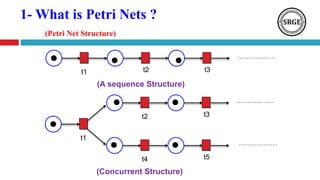
1- What is Petri Nets ?
(Petri Net Structure)
t1 t2 t3
t1
t2 t3
t4 t5
(A sequence Structure)
(Concurrent Structure)
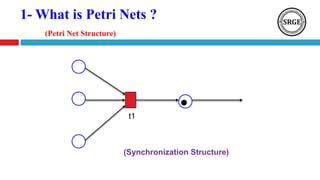
1- What is Petri Nets ?
(Petri Net Structure)
(Synchronization Structure)
t1
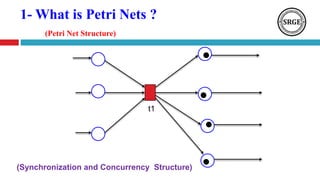
1- What is Petri Nets ?
(Petri Net Structure)
(Synchronization and Concurrency Structure)
t1
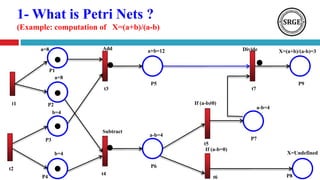
1- What is Petri Nets ?
(Example: computation of X=(a+b)/(a-b)
t6
t2
t3
t4
t5
t1
t7
P2
P1
P3
P4
P5
P6
P7
P8
P9
Add
Subtract
If (a-b≠0)
If (a-b=0)
Divide X=(a+b)/(a-b)=3a=8
a=8
b=4
b=4
a+b=12
a-b=4
X=Undefined
a-b=4
1- What is Petri Nets ?
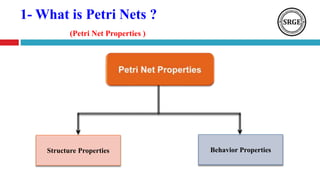
(Petri Net Properties )
Structure Properties Behavior Properties
1- What is Petri Nets ?
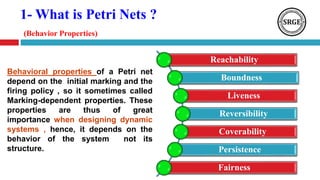
(Behavior Properties)
Reachability
Boundness
Liveness
Reversibility
Coverability
Persistence
Fairness
Behavioral properties of a Petri net
depend on the initial marking and the
firing policy , so it sometimes called
Marking-dependent properties. These
properties are thus of great
importance when designing dynamic
systems , hence, it depends on the
behavior of the system not its
structure.
1- What is Petri Nets ?
(Behavior Properties)
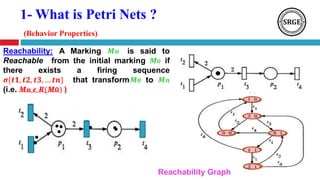
Reachability: A Marking 𝑴 𝒏 is said to
Reachable from the initial marking 𝑴 𝟎 if
there exists a firing sequence
𝝈{𝒕𝟏, 𝒕𝟐, 𝒕𝟑, … 𝒕𝒏} that transform𝑴 𝟎 to 𝑴 𝒏
(i.e. 𝑴 𝒏 𝝐 𝑹(𝑴 𝟎) )
Reachability Graph
1- What is Petri Nets ?
(Behavior Properties)
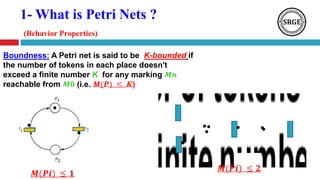
Boundness: A Petri net is said to be K-bounded if
the number of tokens in each place doesn't
exceed a finite number K for any marking 𝑴𝒏
reachable from 𝑴𝟎 (i.e. 𝑴(𝑷) ≤ 𝑲)
𝑴(𝑷𝒊) ≤ 𝟐
𝑴(𝑷𝒊) ≤ 𝟏
1- What is Petri Nets ?
(Behavior Properties)
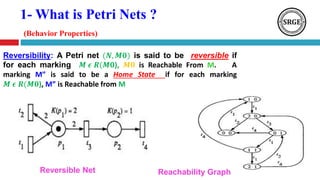
Reversibility: A Petri net (𝑵, 𝑴𝟎) is said to be reversible if
for each marking 𝑴 𝝐 𝑹(𝑴𝟎), 𝑴𝟎 is Reachable From M. A
marking M” is said to be a Home State if for each marking
𝑴 𝝐 𝑹(𝑴𝟎), M” is Reachable from M
Reachability GraphReversible Net
1- What is Petri Nets ?
(Behavior Properties)
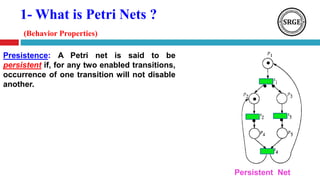
Presistence: A Petri net is said to be
persistent if, for any two enabled transitions,
occurrence of one transition will not disable
another.
Persistent Net
1- What is Petri Nets ?
(Behavior Properties)
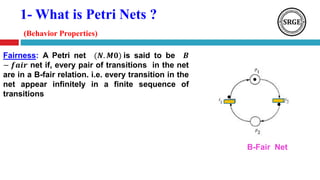
Fairness: A Petri net (𝑵. 𝑴𝟎) is said to be 𝑩
− 𝒇𝒂𝒊𝒓 net if, every pair of transitions in the net
are in a B-fair relation. i.e. every transition in the
net appear infinitely in a finite sequence of
transitions
B-Fair Net
1- What is Petri Nets ?
(Structure Properties)
Structure properties of depend only on its
structure, and not on the initial marking
and the firing policy. These properties are
thus of great importance when designing
static systems, since they depend only on
the layout, and not on the way the system
will be behave, Most of the structural
properties can be easily verified by means
of algebraic techniques.
Agenda
18
1
• What is Petri Nets ?
2
• Analysis Methods of Petri Nets
3
• High Level Petri Nets
4
• Petri Nets Application: Rumor Detection and Blocking in OSN
5
• Orbital Petri Nets : A Promising Petri Net Approach
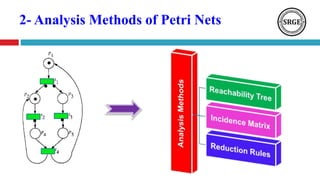
2- Analysis Methods of Petri Nets
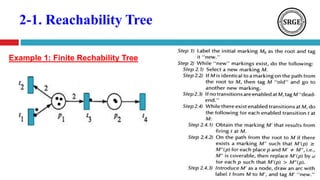
2-1. Reachability Tree
Reachability Tree
Example 1: Finite Rechability Tree
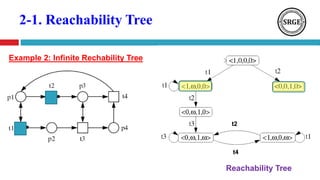
2-1. Reachability Tree
Reachability Tree
Example 2: Infinite Rechability Tree
t2
t4
2-2. Incidence Matrix
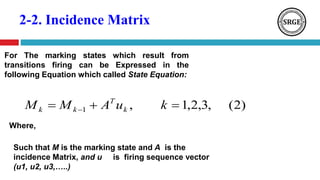
Incidence Matrix: for a Petri Net (𝑵. 𝑴𝟎) with
n Transitions and m Places , the Incidence
Matrix 𝑨 = [𝒂 𝒊𝒋] is (𝒏 𝒙 𝒎) matrix of integers
as:
)1(
 ijijij aaa
),( jiij ptwa 
),( ijij tpwa 
Where,
2-2. Incidence Matrix
For The marking states which result from
transitions firing can be Expressed in the
following Equation which called State Equation:
Where,
)2(,3,2,1,1   kuAMM k
T
kk
Such that M is the marking state and A is the
incidence Matrix, and u is firing sequence vector
(u1, u2, u3,…..)
2-2. Incidence Matrix
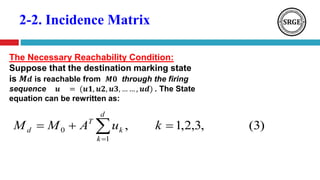
The Necessary Reachability Condition:
Suppose that the destination marking state
is 𝑴 𝒅 is reachable from 𝑴𝟎 through the firing
sequence 𝒖 = (𝒖𝟏, 𝒖𝟐, 𝒖𝟑, … … , 𝒖𝒅) . The State
equation can be rewritten as:
)3(,3,2,1,
1
0  
kuAMM
d
k
k
T
d
2-2. Incidence Matrix
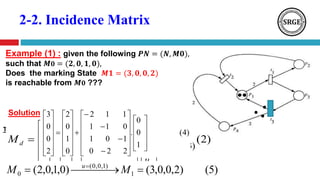
Example (1) : given the following 𝑷𝑵 = (𝑵, 𝑴𝟎),
such that 𝑴 𝟎 = (𝟐, 𝟎, 𝟏, 𝟎),
Does the marking State 𝑴𝟏 = (𝟑, 𝟎, 𝟎, 𝟐)
is reachable from 𝑴 𝟎 ???
)1(
220
101
011
112
















T
A
The Incidence Matrix
)2(,3,2,1,
1
0  
kuAMM
d
k
k
T
d
Solution:
)3(.
220
101
011
112
0
1
0
2
2
0
0
3
3
2
1




















































u
u
u )4(
1
0
0
.
220
101
011
112
0
1
0
2
2
0
0
3




















































)5()2,0,0,3()0,1,0,2( 1
)1,0,0(
0   
MM u
2-2. Incidence Matrix
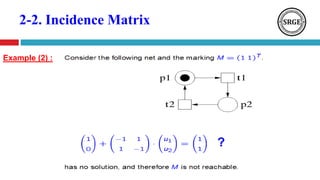
Example (2) :
?
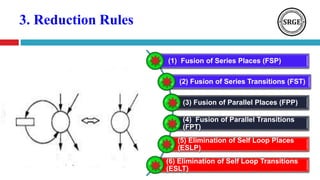
3. Reduction Rules
(1) Fusion of Series Places (FSP)
(2) Fusion of Series Transitions (FST)
(3) Fusion of Parallel Places (FPP)
(4) Fusion of Parallel Transitions
(FPT)
(5) Elimination of Self Loop Places
(ESLP)
(6) Elimination of Self Loop Transitions
(ESLT)
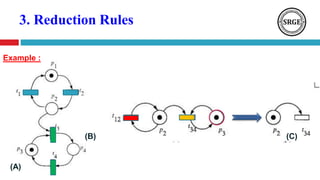
3. Reduction Rules
Example :
(A)
(B) (C)
Example :
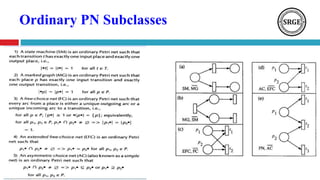
Ordinary PN Subclasses
Agenda
30
1
• What is Petri Nets ?
2
• Analysis Methods of Petri Nets
3
• High Level Petri Nets
4
• Petri Nets Application: Rumor Detection and Blocking in OSN
5
• Orbital Petri Nets : A Promising Petri Net Approach
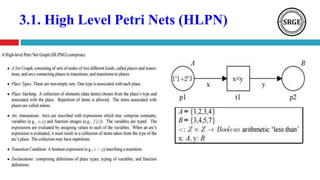
3.1. High Level Petri Nets (HLPN)
(Enabling, Firing Rule)
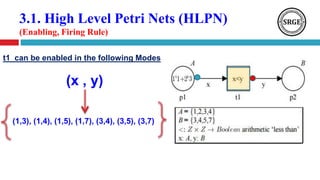
t1 can be enabled in the following Modes
(1,3), (1,4), (1,5), (1,7), (3,4), (3,5), (3,7)
(x , y)
3.1. High Level Petri Nets (HLPN)
(Enabling, Firing Rule)
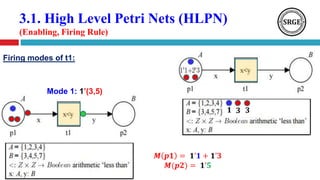
Firing modes of t1:
𝑴 𝒑𝟏 = 𝟏’𝟏 + 𝟏’𝟑
𝑴(𝒑𝟐) = 𝟏’𝟓
𝟏 𝟑 𝟑
Mode 1: 1’(3,5)
3.1. High Level Petri Nets (HLPN)
(Enabling, Firing Rule)
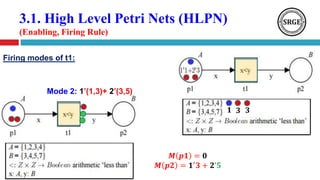
Firing modes of t1:
𝑴 𝒑𝟏 = 𝟎
𝑴 𝒑𝟐 = 𝟏′
𝟑 + 𝟐’𝟓
𝟏 𝟑 𝟑
Mode 2: 1’(1,3)+ 2’(3,5)
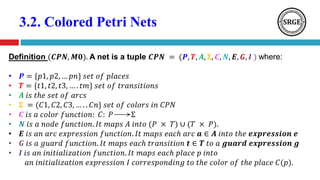
3.2. Colored Petri Nets
Definition (𝑪𝑷𝑵, 𝑴𝟎). A net is a tuple 𝑪𝑷𝑵 = (𝑷, 𝑻, 𝑨, 𝚺, 𝑪, 𝑵, 𝑬, 𝑮, 𝑰 ) where:
• 𝑷 = {𝑝1, 𝑝2, … 𝑝𝑛} 𝑠𝑒𝑡 𝑜𝑓 𝑝𝑙𝑎𝑐𝑒𝑠
• 𝑻 = {𝑡1, 𝑡2, 𝑡3, … . 𝑡𝑚} 𝑠𝑒𝑡 𝑜𝑓 𝑡𝑟𝑎𝑛𝑠𝑖𝑡𝑖𝑜𝑛𝑠
• 𝑨 𝑖𝑠 𝑡ℎ𝑒 𝑠𝑒𝑡 𝑜𝑓 𝑎𝑟𝑐𝑠
• 𝚺 = (𝐶1, 𝐶2, 𝐶3, … . . 𝐶𝑛} 𝑠𝑒𝑡 𝑜𝑓 𝑐𝑜𝑙𝑜𝑟𝑠 𝑖𝑛 𝐶𝑃𝑁
• 𝑪 𝑖𝑠 𝑎 𝑐𝑜𝑙𝑜𝑟 𝑓𝑢𝑛𝑐𝑡𝑖𝑜𝑛: 𝐶: 𝑃 Σ
• 𝑵 𝑖𝑠 𝑎 𝑛𝑜𝑑𝑒 𝑓𝑢𝑛𝑐𝑡𝑖𝑜𝑛. 𝐼𝑡 𝑚𝑎𝑝𝑠 𝐴 𝑖𝑛𝑡𝑜 (𝑃 × 𝑇) ∪ (𝑇 × 𝑃).
• 𝑬 𝑖𝑠 𝑎𝑛 𝑎𝑟𝑐 𝑒𝑥𝑝𝑟𝑒𝑠𝑠𝑖𝑜𝑛 𝑓𝑢𝑛𝑐𝑡𝑖𝑜𝑛. 𝐼𝑡 𝑚𝑎𝑝𝑠 𝑒𝑎𝑐ℎ 𝑎𝑟𝑐 𝒂 ∈ 𝑨 𝑖𝑛𝑡𝑜 𝑡ℎ𝑒 𝒆𝒙𝒑𝒓𝒆𝒔𝒔𝒊𝒐𝒏 𝒆
• 𝑮 𝑖𝑠 𝑎 𝑔𝑢𝑎𝑟𝑑 𝑓𝑢𝑛𝑐𝑡𝑖𝑜𝑛. 𝐼𝑡 𝑚𝑎𝑝𝑠 𝑒𝑎𝑐ℎ 𝑡𝑟𝑎𝑛𝑠𝑖𝑡𝑖𝑜𝑛 𝒕 ∈ 𝑻 𝑡𝑜 𝑎 𝒈𝒖𝒂𝒓𝒅 𝒆𝒙𝒑𝒓𝒆𝒔𝒔𝒊𝒐𝒏 𝒈
• 𝑰 𝑖𝑠 𝑎𝑛 𝑖𝑛𝑖𝑡𝑖𝑎𝑙𝑖𝑧𝑎𝑡𝑖𝑜𝑛 𝑓𝑢𝑛𝑐𝑡𝑖𝑜𝑛. 𝐼𝑡 𝑚𝑎𝑝𝑠 𝑒𝑎𝑐ℎ 𝑝𝑙𝑎𝑐𝑒 𝑝 𝑖𝑛𝑡𝑜
𝑎𝑛 𝑖𝑛𝑖𝑡𝑖𝑎𝑙𝑖𝑧𝑎𝑡𝑖𝑜𝑛 𝑒𝑥𝑝𝑟𝑒𝑠𝑠𝑖𝑜𝑛 𝐼 𝑐𝑜𝑟𝑟𝑒𝑠𝑝𝑜𝑛𝑑𝑖𝑛𝑔 𝑡𝑜 𝑡ℎ𝑒 𝑐𝑜𝑙𝑜𝑟 𝑜𝑓 𝑡ℎ𝑒 𝑝𝑙𝑎𝑐𝑒 𝐶(𝑝).
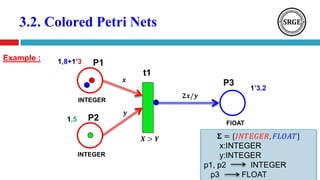
3.2. Colored Petri Nets
P1
P2
P3
t1
𝒙
𝟐𝒙/𝒚
1,8+1’3
INTEGER
INTEGER
FlOAT
1,5
𝒚
𝑿 > 𝒀
1’3.2
Example :
𝚺 = {𝐼𝑁𝑇𝐸𝐺𝐸𝑅, 𝐹𝐿𝑂𝐴𝑇}
x:INTEGER
y:INTEGER
p1, p2 INTEGER
p3 FLOAT
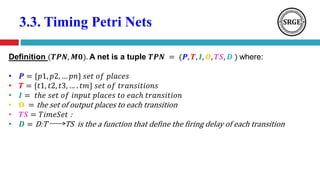
3.3. Timing Petri Nets
Definition (𝑻𝑷𝑵, 𝑴𝟎). A net is a tuple 𝑻𝑷𝑵 = (𝑷, 𝑻, 𝑰, 𝑶, 𝑻𝑺, 𝑫 ) where:
• 𝑷 = {𝑝1, 𝑝2, … 𝑝𝑛} 𝑠𝑒𝑡 𝑜𝑓 𝑝𝑙𝑎𝑐𝑒𝑠
• 𝑻 = {𝑡1, 𝑡2, 𝑡3, … . 𝑡𝑚} 𝑠𝑒𝑡 𝑜𝑓 𝑡𝑟𝑎𝑛𝑠𝑖𝑡𝑖𝑜𝑛𝑠
• 𝑰 = 𝑡ℎ𝑒 𝑠𝑒𝑡 𝑜𝑓 𝑖𝑛𝑝𝑢𝑡 𝑝𝑙𝑎𝑐𝑒𝑠 𝑡𝑜 𝑒𝑎𝑐ℎ 𝑡𝑟𝑎𝑛𝑠𝑖𝑡𝑖𝑜𝑛
• 𝐎 = the set of output places to each transition
• 𝑻𝑺 = 𝑇𝑖𝑚𝑒𝑆𝑒𝑡 :
• 𝑫 = D:T TS is the a function that define the firing delay of each transition
3.3. Timing Petri Nets
(Enabling, Firing Rule)
P1
P2
P3
[1] {4}
𝟐
1
3
1
5
5
𝑴𝟎 = {(𝑷𝟏, 𝟏), (𝑷𝟏, 𝟑), (𝑷𝟐, 𝟏), (𝑷𝟑, 𝟎)}
𝑴𝟏 = {(𝑷𝟏, 𝟑), (𝑷𝟐, 𝟎), 𝟐(𝑷𝟑, 𝟓)}
1 3
2 4
5
3.3. Timing Petri Nets
(Enabling, Firing Rule)
Tasks
[0,5] {5}
0
Busy 1
Free 1
Free 2
Busy 2
Output
Start 1 Finish 1
Start 2 Finish 2
1
0
[1] {5}
[5] {0}
[6] {0}
5
0
6
55
6
6
Example:
0 2
1 3
4
5
6
TIME
Agenda
40
1
• What is Petri Nets ?
2
• Analysis Methods of Petri Nets
3
• High Level Petri Nets
4
• Petri Nets Application: Rumor Detection and Blocking in OSN
5
• Orbital Petri Nets : A Promising Petri Net Approach
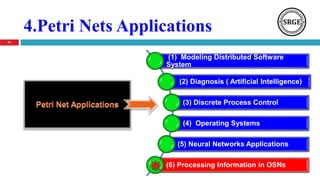
4.Petri Nets Applications
41
(1) Modeling Distributed Software
System
(2) Diagnosis ( Artificial Intelligence)
(3) Discrete Process Control
(4) Operating Systems
(5) Neural Networks Applications
(6) Processing Information in OSNs
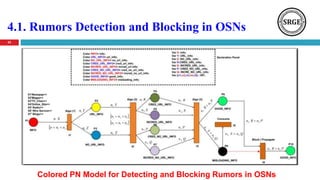
4.1. Rumors Detection and Blocking in OSNs
42
Colored PN Model for Detecting and Blocking Rumors in OSNs
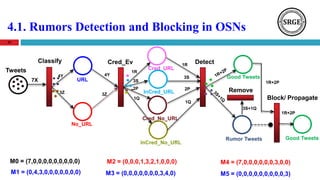
4.1. Rumors Detection and Blocking in OSNs
43
Tweets
URL7X
4Y
3Z
4Y
3Z
1R
3S
2P
1Q
1R
3S
2P
1Q
3S+1Q
1R+2P
1R+2P
Remove
M4 = (7,0,0,0,0,0,0,3,0,0)
M1 = (0,4,3,0,0,0,0,0,0,0)
M2 = (0,0,0,1,3,2,1,0,0,0)
M3 = (0,0,0,0,0,0,0,3,4,0)
M0 = (7,0,0,0,0,0,0,0,0,0)
M5 = (0,0,0,0,0,0,0,0,0,3)
Classify Cred_Ev Detect
Block/ Propagate
No_URL
Cred_URL
Cred_No_URL
InCred_No_URL
InCred_URL
Rumor Tweets
Good Tweets
Good Tweets
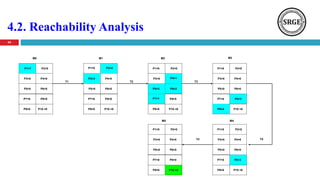
4.2. Reachability Analysis
44
T1
P10 =0P9=0
P8=0P7=0
P6=0P5=0
P4=0P3=0
P2=0 P1=0
T2
P10 =0P9=0
P8=0P7=0
P6=0P5=0
P4=0
P1=0
T3
P10 =0P9=0
P8=0
P3=0
P2=0 P1=0
T5
P10 =0
P7=0
P6=0P5=0
P4=0P3=0
P2=0
P1=0
P10 =0P9=0
P7=0
P6=0P5=0
P4=0P3=0
P2=0P1=0
P9=0
P8=0P7=0
P6=0P5=0
P4=0P3=0
P2=0
T4
P2=4
P3=3
P1=7
P4=1
P5=3 P6=2
P7=1 P8=3
P9=4
P8=3
P10 =3
M0 M1 M2 M3
M4M5
4.2. Reachability Analysis
45
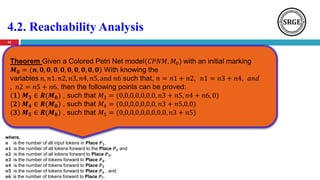
Theorem Given a Colored Petri Net model(𝐶𝑃𝑁𝑀, 𝑀0) with an initial marking
𝑴 𝟎 = (𝒏, 𝟎, 𝟎, 𝟎, 𝟎, 𝟎, 𝟎, 𝟎, 𝟎, 𝟎) With knowing the
variables 𝑛, 𝑛1. 𝑛2, 𝑛3, 𝑛4, 𝑛5, and 𝑛6 such that, 𝑛 = 𝑛1 + 𝑛2, 𝑛1 = 𝑛3 + 𝑛4, 𝑎𝑛𝑑
, 𝑛2 = 𝑛5 + 𝑛6, then the following points can be proved:
𝟏 𝑴 𝟑 ∈ 𝑹(𝑴 𝟎) , such that 𝑀3 = (0,0,0,0,0,0,0, 𝑛3 + 𝑛5, 𝑛4 + 𝑛6, 0)
𝟐 𝑴 𝟒 ∈ 𝑹(𝑴 𝟎) , such that 𝑀4 = (0,0,0,0,0,0,0, 𝑛3 + 𝑛5,0,0)
𝟑 𝑴 𝟓 ∈ 𝑹(𝑴 𝟎) , such that 𝑀5 = (0,0,0,0,0,0,0,0,0, 𝑛3 + 𝑛5)
where,
𝒏 is the number of all input tokens in Place 𝑷 𝟏,
𝒏𝟏 is the number of all tokens forward to the Place 𝑷 𝟐 and
𝒏𝟐 is the number of all tokens forward to Place 𝑷 𝟑.
𝒏𝟑 is the number of tokens forward to Place 𝑷 𝟒.
𝒏𝟒 is the number of tokens forward to Place 𝑷 𝟓
𝒏𝟓 is the number of tokens forward to Place 𝑷 𝟔 , and
𝒏𝟔 is the number of tokens forward to Place 𝑷 𝟕.
Agenda
46
1
• What is Petri Nets ?
2
• Analysis Methods of Petri Nets
3
• High Level Petri Nets
4
• Petri Nets Application: Rumor Detection and Blocking in OSN
5
• Orbital Petri Nets : A Promising Petri Net Approach
5. Orbital Petri Nets: A Promising Approach
47
5. Orbital Petri Nets: A Promising Approach
48
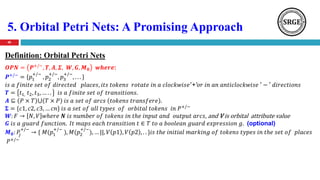
𝑶𝑷𝑵 = 𝑷+/−
, 𝑻, 𝑨, 𝜮, 𝑾, 𝑮, 𝑴 𝟎 𝒘𝒉𝒆𝒓𝒆:
𝑷+/−
= {𝑝1
+/−
, 𝑝2
+/−
, 𝑝3
+/−
, . . . }
𝑖𝑠 𝑎 𝑓𝑖𝑛𝑖𝑡𝑒 𝑠𝑒𝑡 𝑜𝑓 𝑑𝑖𝑟𝑒𝑐𝑡𝑒𝑑 𝑝𝑙𝑎𝑐𝑒𝑠, 𝑖𝑡𝑠 𝑡𝑜𝑘𝑒𝑛𝑠 𝑟𝑜𝑡𝑎𝑡𝑒 𝑖𝑛 𝑎 𝑐𝑙𝑜𝑐𝑘𝑤𝑖𝑠𝑒′
+′𝑜𝑟 𝑖𝑛 𝑎𝑛 𝑎𝑛𝑡𝑖𝑐𝑙𝑜𝑐𝑘𝑤𝑖𝑠𝑒 ′ − ′ 𝑑𝑖𝑟𝑒𝑐𝑡𝑖𝑜𝑛𝑠
𝑻 = 𝑡1, 𝑡2, 𝑡3, … . . 𝑖𝑠 𝑎 𝑓𝑖𝑛𝑖𝑡𝑒 𝑠𝑒𝑡 𝑜𝑓 𝑡𝑟𝑎𝑛𝑠𝑖𝑡𝑖𝑜𝑛𝑠.
𝑨 ⊆ 𝑃 × 𝑇 ⋃ 𝑇 × 𝑃 𝑖𝑠 𝑎 𝑠𝑒𝑡 𝑜𝑓 𝑎𝑟𝑐𝑠 𝑡𝑜𝑘𝑒𝑛𝑠 𝑡𝑟𝑎𝑛𝑠𝑓𝑒𝑟𝑒 .
𝚺 = {𝑐1, 𝑐2, 𝑐3, … 𝑐𝑛} 𝑖𝑠 𝑎 𝑠𝑒𝑡 𝑜𝑓 𝑎𝑙𝑙 𝑡𝑦𝑝𝑒𝑠 𝑜𝑓 𝑜𝑟𝑏𝑖𝑡𝑎𝑙 𝑡𝑜𝑘𝑒𝑛𝑠 𝑖𝑛 𝑃+/−
𝑾: 𝐹 → 𝑁, 𝑉 𝑤ℎ𝑒𝑟𝑒 𝑵 𝑖𝑠 𝑛𝑢𝑚𝑏𝑒𝑟 𝑜𝑓 𝑡𝑜𝑘𝑒𝑛𝑠 𝑖𝑛 𝑡ℎ𝑒 𝑖𝑛𝑝𝑢𝑡 𝑎𝑛𝑑 𝑜𝑢𝑡𝑝𝑢𝑡 𝑎𝑟𝑐𝑠, and V is orbital attribute value
𝑮 𝑖𝑠 𝑎 𝑔𝑢𝑎𝑟𝑑 𝑓𝑢𝑛𝑐𝑡𝑖𝑜𝑛. 𝐼𝑡 𝑚𝑎𝑝𝑠 𝑒𝑎𝑐ℎ 𝑡𝑟𝑎𝑛𝑠𝑖𝑡𝑖𝑜𝑛 𝑡 ∈ 𝑇 𝑡𝑜 𝑎 𝑏𝑜𝑜𝑙𝑒𝑎𝑛 𝑔𝑢𝑎𝑟𝑑 𝑒𝑥𝑝𝑟𝑒𝑠𝑠𝑖𝑜𝑛 𝑔. (optional)
𝑴 𝟎: 𝑃𝑗
+/−
→ { 𝑀(𝑝1
+/−
), 𝑀(𝑝2
+/−
), … ||, 𝑉 𝑝1 , 𝑉 𝑝2 , . . }𝑖𝑠 𝑡ℎ𝑒 𝑖𝑛𝑖𝑡𝑖𝑎𝑙 𝑚𝑎𝑟𝑘𝑖𝑛𝑔 𝑜𝑓 𝑡𝑜𝑘𝑒𝑛𝑠 𝑡𝑦𝑝𝑒𝑠 𝑖𝑛 𝑡ℎ𝑒 𝑠𝑒𝑡 𝑜𝑓 𝑝𝑙𝑎𝑐𝑒𝑠
𝑃+/−
Definition: Orbital Petri Nets
5. Orbital Petri Nets: A Promising Approach
(Enabling, Firing Rule)
49
P1
P2
P3
t1
[1,50]
[2,100]
𝑴 𝟎 = (𝟏, 𝟏, 𝟎, || 𝟓𝟎, 𝟕𝟎)
[1,70]
𝑴 𝟏 = (𝟎, 𝟎, 𝟐, || 𝟏𝟎𝟎)
5. Orbital Petri Nets: A Promising Approach
(Enabling, Firing Rule)
50
t1
t2
[1,50]
[1,80]
[1,100]
[1,60]
[2,130]
[2,20]
𝑴𝟎 = (𝟏, 𝟏, 𝟏, 𝟏, 𝟎, 𝟎 || 𝟓𝟎, 𝟖𝟎, 𝟏𝟎𝟎, 𝟔𝟎)
𝑴𝟏 = (𝟎, 𝟏, 𝟎, 𝟏, 𝟐, 𝟎 || 𝟖𝟎, 𝟔𝟎, 𝟏𝟑𝟎)
𝑴𝟐 = (𝟎, 𝟎, 𝟎, 𝟎, 𝟐, 𝟐 || 𝟏𝟑𝟎, 𝟐𝟎)
Example:
P1
P2
P3
P4
P5
P6
51
Orbital Petri Nets for
studying Satellites/Debris
Collisions is Recently our
Research Project
52

Petri Nets: Properties, Analysis and Applications

  • 1.
    SRGE 1 Petri Nets: Properties,Analysis and Applications Presented By Dr. Mohamed Torky PHD in Computer Science (2018), Faculty of Science, Menoufyia University, Egypt. Member in Scientific Research Group in Egypt (SRGE)
  • 2.
    Agenda 2 1 • What isPetri Nets ? 2 • Analysis Methods of Petri Nets 3 • High Level Petri Nets 4 • Petri Nets Application: Rumor Detection and Blocking in OSN 5 • Orbital Petri Nets : A Promising Petri Net Approach
  • 3.
    Agenda 3 1 • What isPetri Nets ? 2 • Analysis Methods of Petri Nets 3 • High Level Petri Nets 4 • Petri Nets Application: Rumor Detection and Blocking in OSN 5 • Orbital Petri Nets : A Promising Petri Net Approach
  • 4.
  • 5.
    8/12/2018 1- What isPetri Nets ? (Transition, Enabling, and Firing Rules) P1 P2 P3 t1 2 3 𝑴 𝟎 = (𝟐, 𝟐, 𝟎 ) 𝑴 𝟏 = (𝟎, 𝟏, 𝟑 )
  • 6.
    1- What isPetri Nets ? (Petri Net Structure) t1 t2 t3 t1 t2 t3 t4 t5 (A sequence Structure) (Concurrent Structure)
  • 7.
    1- What isPetri Nets ? (Petri Net Structure) (Synchronization Structure) t1
  • 8.
    1- What isPetri Nets ? (Petri Net Structure) (Synchronization and Concurrency Structure) t1
  • 9.
    1- What isPetri Nets ? (Example: computation of X=(a+b)/(a-b) t6 t2 t3 t4 t5 t1 t7 P2 P1 P3 P4 P5 P6 P7 P8 P9 Add Subtract If (a-b≠0) If (a-b=0) Divide X=(a+b)/(a-b)=3a=8 a=8 b=4 b=4 a+b=12 a-b=4 X=Undefined a-b=4
  • 10.
    1- What isPetri Nets ? (Petri Net Properties ) Structure Properties Behavior Properties
  • 11.
    1- What isPetri Nets ? (Behavior Properties) Reachability Boundness Liveness Reversibility Coverability Persistence Fairness Behavioral properties of a Petri net depend on the initial marking and the firing policy , so it sometimes called Marking-dependent properties. These properties are thus of great importance when designing dynamic systems , hence, it depends on the behavior of the system not its structure.
  • 12.
    1- What isPetri Nets ? (Behavior Properties) Reachability: A Marking 𝑴 𝒏 is said to Reachable from the initial marking 𝑴 𝟎 if there exists a firing sequence 𝝈{𝒕𝟏, 𝒕𝟐, 𝒕𝟑, … 𝒕𝒏} that transform𝑴 𝟎 to 𝑴 𝒏 (i.e. 𝑴 𝒏 𝝐 𝑹(𝑴 𝟎) ) Reachability Graph
  • 13.
    1- What isPetri Nets ? (Behavior Properties) Boundness: A Petri net is said to be K-bounded if the number of tokens in each place doesn't exceed a finite number K for any marking 𝑴𝒏 reachable from 𝑴𝟎 (i.e. 𝑴(𝑷) ≤ 𝑲) 𝑴(𝑷𝒊) ≤ 𝟐 𝑴(𝑷𝒊) ≤ 𝟏
  • 14.
    1- What isPetri Nets ? (Behavior Properties) Reversibility: A Petri net (𝑵, 𝑴𝟎) is said to be reversible if for each marking 𝑴 𝝐 𝑹(𝑴𝟎), 𝑴𝟎 is Reachable From M. A marking M” is said to be a Home State if for each marking 𝑴 𝝐 𝑹(𝑴𝟎), M” is Reachable from M Reachability GraphReversible Net
  • 15.
    1- What isPetri Nets ? (Behavior Properties) Presistence: A Petri net is said to be persistent if, for any two enabled transitions, occurrence of one transition will not disable another. Persistent Net
  • 16.
    1- What isPetri Nets ? (Behavior Properties) Fairness: A Petri net (𝑵. 𝑴𝟎) is said to be 𝑩 − 𝒇𝒂𝒊𝒓 net if, every pair of transitions in the net are in a B-fair relation. i.e. every transition in the net appear infinitely in a finite sequence of transitions B-Fair Net
  • 17.
    1- What isPetri Nets ? (Structure Properties) Structure properties of depend only on its structure, and not on the initial marking and the firing policy. These properties are thus of great importance when designing static systems, since they depend only on the layout, and not on the way the system will be behave, Most of the structural properties can be easily verified by means of algebraic techniques.
  • 18.
    Agenda 18 1 • What isPetri Nets ? 2 • Analysis Methods of Petri Nets 3 • High Level Petri Nets 4 • Petri Nets Application: Rumor Detection and Blocking in OSN 5 • Orbital Petri Nets : A Promising Petri Net Approach
  • 19.
    2- Analysis Methodsof Petri Nets
  • 20.
    2-1. Reachability Tree ReachabilityTree Example 1: Finite Rechability Tree
  • 21.
    2-1. Reachability Tree ReachabilityTree Example 2: Infinite Rechability Tree t2 t4
  • 22.
    2-2. Incidence Matrix IncidenceMatrix: for a Petri Net (𝑵. 𝑴𝟎) with n Transitions and m Places , the Incidence Matrix 𝑨 = [𝒂 𝒊𝒋] is (𝒏 𝒙 𝒎) matrix of integers as: )1(  ijijij aaa ),( jiij ptwa  ),( ijij tpwa  Where,
  • 23.
    2-2. Incidence Matrix ForThe marking states which result from transitions firing can be Expressed in the following Equation which called State Equation: Where, )2(,3,2,1,1   kuAMM k T kk Such that M is the marking state and A is the incidence Matrix, and u is firing sequence vector (u1, u2, u3,…..)
  • 24.
    2-2. Incidence Matrix TheNecessary Reachability Condition: Suppose that the destination marking state is 𝑴 𝒅 is reachable from 𝑴𝟎 through the firing sequence 𝒖 = (𝒖𝟏, 𝒖𝟐, 𝒖𝟑, … … , 𝒖𝒅) . The State equation can be rewritten as: )3(,3,2,1, 1 0   kuAMM d k k T d
  • 25.
    2-2. Incidence Matrix Example(1) : given the following 𝑷𝑵 = (𝑵, 𝑴𝟎), such that 𝑴 𝟎 = (𝟐, 𝟎, 𝟏, 𝟎), Does the marking State 𝑴𝟏 = (𝟑, 𝟎, 𝟎, 𝟐) is reachable from 𝑴 𝟎 ??? )1( 220 101 011 112                 T A The Incidence Matrix )2(,3,2,1, 1 0   kuAMM d k k T d Solution: )3(. 220 101 011 112 0 1 0 2 2 0 0 3 3 2 1                                                     u u u )4( 1 0 0 . 220 101 011 112 0 1 0 2 2 0 0 3                                                     )5()2,0,0,3()0,1,0,2( 1 )1,0,0( 0    MM u
  • 26.
  • 27.
    3. Reduction Rules (1)Fusion of Series Places (FSP) (2) Fusion of Series Transitions (FST) (3) Fusion of Parallel Places (FPP) (4) Fusion of Parallel Transitions (FPT) (5) Elimination of Self Loop Places (ESLP) (6) Elimination of Self Loop Transitions (ESLT)
  • 28.
    3. Reduction Rules Example: (A) (B) (C) Example :
  • 29.
  • 30.
    Agenda 30 1 • What isPetri Nets ? 2 • Analysis Methods of Petri Nets 3 • High Level Petri Nets 4 • Petri Nets Application: Rumor Detection and Blocking in OSN 5 • Orbital Petri Nets : A Promising Petri Net Approach
  • 31.
    3.1. High LevelPetri Nets (HLPN)
  • 32.
    3.1. High LevelPetri Nets (HLPN) (Enabling, Firing Rule) t1 can be enabled in the following Modes (1,3), (1,4), (1,5), (1,7), (3,4), (3,5), (3,7) (x , y)
  • 33.
    3.1. High LevelPetri Nets (HLPN) (Enabling, Firing Rule) Firing modes of t1: 𝑴 𝒑𝟏 = 𝟏’𝟏 + 𝟏’𝟑 𝑴(𝒑𝟐) = 𝟏’𝟓 𝟏 𝟑 𝟑 Mode 1: 1’(3,5)
  • 34.
    3.1. High LevelPetri Nets (HLPN) (Enabling, Firing Rule) Firing modes of t1: 𝑴 𝒑𝟏 = 𝟎 𝑴 𝒑𝟐 = 𝟏′ 𝟑 + 𝟐’𝟓 𝟏 𝟑 𝟑 Mode 2: 1’(1,3)+ 2’(3,5)
  • 35.
    3.2. Colored PetriNets Definition (𝑪𝑷𝑵, 𝑴𝟎). A net is a tuple 𝑪𝑷𝑵 = (𝑷, 𝑻, 𝑨, 𝚺, 𝑪, 𝑵, 𝑬, 𝑮, 𝑰 ) where: • 𝑷 = {𝑝1, 𝑝2, … 𝑝𝑛} 𝑠𝑒𝑡 𝑜𝑓 𝑝𝑙𝑎𝑐𝑒𝑠 • 𝑻 = {𝑡1, 𝑡2, 𝑡3, … . 𝑡𝑚} 𝑠𝑒𝑡 𝑜𝑓 𝑡𝑟𝑎𝑛𝑠𝑖𝑡𝑖𝑜𝑛𝑠 • 𝑨 𝑖𝑠 𝑡ℎ𝑒 𝑠𝑒𝑡 𝑜𝑓 𝑎𝑟𝑐𝑠 • 𝚺 = (𝐶1, 𝐶2, 𝐶3, … . . 𝐶𝑛} 𝑠𝑒𝑡 𝑜𝑓 𝑐𝑜𝑙𝑜𝑟𝑠 𝑖𝑛 𝐶𝑃𝑁 • 𝑪 𝑖𝑠 𝑎 𝑐𝑜𝑙𝑜𝑟 𝑓𝑢𝑛𝑐𝑡𝑖𝑜𝑛: 𝐶: 𝑃 Σ • 𝑵 𝑖𝑠 𝑎 𝑛𝑜𝑑𝑒 𝑓𝑢𝑛𝑐𝑡𝑖𝑜𝑛. 𝐼𝑡 𝑚𝑎𝑝𝑠 𝐴 𝑖𝑛𝑡𝑜 (𝑃 × 𝑇) ∪ (𝑇 × 𝑃). • 𝑬 𝑖𝑠 𝑎𝑛 𝑎𝑟𝑐 𝑒𝑥𝑝𝑟𝑒𝑠𝑠𝑖𝑜𝑛 𝑓𝑢𝑛𝑐𝑡𝑖𝑜𝑛. 𝐼𝑡 𝑚𝑎𝑝𝑠 𝑒𝑎𝑐ℎ 𝑎𝑟𝑐 𝒂 ∈ 𝑨 𝑖𝑛𝑡𝑜 𝑡ℎ𝑒 𝒆𝒙𝒑𝒓𝒆𝒔𝒔𝒊𝒐𝒏 𝒆 • 𝑮 𝑖𝑠 𝑎 𝑔𝑢𝑎𝑟𝑑 𝑓𝑢𝑛𝑐𝑡𝑖𝑜𝑛. 𝐼𝑡 𝑚𝑎𝑝𝑠 𝑒𝑎𝑐ℎ 𝑡𝑟𝑎𝑛𝑠𝑖𝑡𝑖𝑜𝑛 𝒕 ∈ 𝑻 𝑡𝑜 𝑎 𝒈𝒖𝒂𝒓𝒅 𝒆𝒙𝒑𝒓𝒆𝒔𝒔𝒊𝒐𝒏 𝒈 • 𝑰 𝑖𝑠 𝑎𝑛 𝑖𝑛𝑖𝑡𝑖𝑎𝑙𝑖𝑧𝑎𝑡𝑖𝑜𝑛 𝑓𝑢𝑛𝑐𝑡𝑖𝑜𝑛. 𝐼𝑡 𝑚𝑎𝑝𝑠 𝑒𝑎𝑐ℎ 𝑝𝑙𝑎𝑐𝑒 𝑝 𝑖𝑛𝑡𝑜 𝑎𝑛 𝑖𝑛𝑖𝑡𝑖𝑎𝑙𝑖𝑧𝑎𝑡𝑖𝑜𝑛 𝑒𝑥𝑝𝑟𝑒𝑠𝑠𝑖𝑜𝑛 𝐼 𝑐𝑜𝑟𝑟𝑒𝑠𝑝𝑜𝑛𝑑𝑖𝑛𝑔 𝑡𝑜 𝑡ℎ𝑒 𝑐𝑜𝑙𝑜𝑟 𝑜𝑓 𝑡ℎ𝑒 𝑝𝑙𝑎𝑐𝑒 𝐶(𝑝).
  • 36.
    3.2. Colored PetriNets P1 P2 P3 t1 𝒙 𝟐𝒙/𝒚 1,8+1’3 INTEGER INTEGER FlOAT 1,5 𝒚 𝑿 > 𝒀 1’3.2 Example : 𝚺 = {𝐼𝑁𝑇𝐸𝐺𝐸𝑅, 𝐹𝐿𝑂𝐴𝑇} x:INTEGER y:INTEGER p1, p2 INTEGER p3 FLOAT
  • 37.
    3.3. Timing PetriNets Definition (𝑻𝑷𝑵, 𝑴𝟎). A net is a tuple 𝑻𝑷𝑵 = (𝑷, 𝑻, 𝑰, 𝑶, 𝑻𝑺, 𝑫 ) where: • 𝑷 = {𝑝1, 𝑝2, … 𝑝𝑛} 𝑠𝑒𝑡 𝑜𝑓 𝑝𝑙𝑎𝑐𝑒𝑠 • 𝑻 = {𝑡1, 𝑡2, 𝑡3, … . 𝑡𝑚} 𝑠𝑒𝑡 𝑜𝑓 𝑡𝑟𝑎𝑛𝑠𝑖𝑡𝑖𝑜𝑛𝑠 • 𝑰 = 𝑡ℎ𝑒 𝑠𝑒𝑡 𝑜𝑓 𝑖𝑛𝑝𝑢𝑡 𝑝𝑙𝑎𝑐𝑒𝑠 𝑡𝑜 𝑒𝑎𝑐ℎ 𝑡𝑟𝑎𝑛𝑠𝑖𝑡𝑖𝑜𝑛 • 𝐎 = the set of output places to each transition • 𝑻𝑺 = 𝑇𝑖𝑚𝑒𝑆𝑒𝑡 : • 𝑫 = D:T TS is the a function that define the firing delay of each transition
  • 38.
    3.3. Timing PetriNets (Enabling, Firing Rule) P1 P2 P3 [1] {4} 𝟐 1 3 1 5 5 𝑴𝟎 = {(𝑷𝟏, 𝟏), (𝑷𝟏, 𝟑), (𝑷𝟐, 𝟏), (𝑷𝟑, 𝟎)} 𝑴𝟏 = {(𝑷𝟏, 𝟑), (𝑷𝟐, 𝟎), 𝟐(𝑷𝟑, 𝟓)} 1 3 2 4 5
  • 39.
    3.3. Timing PetriNets (Enabling, Firing Rule) Tasks [0,5] {5} 0 Busy 1 Free 1 Free 2 Busy 2 Output Start 1 Finish 1 Start 2 Finish 2 1 0 [1] {5} [5] {0} [6] {0} 5 0 6 55 6 6 Example: 0 2 1 3 4 5 6 TIME
  • 40.
    Agenda 40 1 • What isPetri Nets ? 2 • Analysis Methods of Petri Nets 3 • High Level Petri Nets 4 • Petri Nets Application: Rumor Detection and Blocking in OSN 5 • Orbital Petri Nets : A Promising Petri Net Approach
  • 41.
    4.Petri Nets Applications 41 (1)Modeling Distributed Software System (2) Diagnosis ( Artificial Intelligence) (3) Discrete Process Control (4) Operating Systems (5) Neural Networks Applications (6) Processing Information in OSNs
  • 42.
    4.1. Rumors Detectionand Blocking in OSNs 42 Colored PN Model for Detecting and Blocking Rumors in OSNs
  • 43.
    4.1. Rumors Detectionand Blocking in OSNs 43 Tweets URL7X 4Y 3Z 4Y 3Z 1R 3S 2P 1Q 1R 3S 2P 1Q 3S+1Q 1R+2P 1R+2P Remove M4 = (7,0,0,0,0,0,0,3,0,0) M1 = (0,4,3,0,0,0,0,0,0,0) M2 = (0,0,0,1,3,2,1,0,0,0) M3 = (0,0,0,0,0,0,0,3,4,0) M0 = (7,0,0,0,0,0,0,0,0,0) M5 = (0,0,0,0,0,0,0,0,0,3) Classify Cred_Ev Detect Block/ Propagate No_URL Cred_URL Cred_No_URL InCred_No_URL InCred_URL Rumor Tweets Good Tweets Good Tweets
  • 44.
    4.2. Reachability Analysis 44 T1 P10=0P9=0 P8=0P7=0 P6=0P5=0 P4=0P3=0 P2=0 P1=0 T2 P10 =0P9=0 P8=0P7=0 P6=0P5=0 P4=0 P1=0 T3 P10 =0P9=0 P8=0 P3=0 P2=0 P1=0 T5 P10 =0 P7=0 P6=0P5=0 P4=0P3=0 P2=0 P1=0 P10 =0P9=0 P7=0 P6=0P5=0 P4=0P3=0 P2=0P1=0 P9=0 P8=0P7=0 P6=0P5=0 P4=0P3=0 P2=0 T4 P2=4 P3=3 P1=7 P4=1 P5=3 P6=2 P7=1 P8=3 P9=4 P8=3 P10 =3 M0 M1 M2 M3 M4M5
  • 45.
    4.2. Reachability Analysis 45 TheoremGiven a Colored Petri Net model(𝐶𝑃𝑁𝑀, 𝑀0) with an initial marking 𝑴 𝟎 = (𝒏, 𝟎, 𝟎, 𝟎, 𝟎, 𝟎, 𝟎, 𝟎, 𝟎, 𝟎) With knowing the variables 𝑛, 𝑛1. 𝑛2, 𝑛3, 𝑛4, 𝑛5, and 𝑛6 such that, 𝑛 = 𝑛1 + 𝑛2, 𝑛1 = 𝑛3 + 𝑛4, 𝑎𝑛𝑑 , 𝑛2 = 𝑛5 + 𝑛6, then the following points can be proved: 𝟏 𝑴 𝟑 ∈ 𝑹(𝑴 𝟎) , such that 𝑀3 = (0,0,0,0,0,0,0, 𝑛3 + 𝑛5, 𝑛4 + 𝑛6, 0) 𝟐 𝑴 𝟒 ∈ 𝑹(𝑴 𝟎) , such that 𝑀4 = (0,0,0,0,0,0,0, 𝑛3 + 𝑛5,0,0) 𝟑 𝑴 𝟓 ∈ 𝑹(𝑴 𝟎) , such that 𝑀5 = (0,0,0,0,0,0,0,0,0, 𝑛3 + 𝑛5) where, 𝒏 is the number of all input tokens in Place 𝑷 𝟏, 𝒏𝟏 is the number of all tokens forward to the Place 𝑷 𝟐 and 𝒏𝟐 is the number of all tokens forward to Place 𝑷 𝟑. 𝒏𝟑 is the number of tokens forward to Place 𝑷 𝟒. 𝒏𝟒 is the number of tokens forward to Place 𝑷 𝟓 𝒏𝟓 is the number of tokens forward to Place 𝑷 𝟔 , and 𝒏𝟔 is the number of tokens forward to Place 𝑷 𝟕.
  • 46.
    Agenda 46 1 • What isPetri Nets ? 2 • Analysis Methods of Petri Nets 3 • High Level Petri Nets 4 • Petri Nets Application: Rumor Detection and Blocking in OSN 5 • Orbital Petri Nets : A Promising Petri Net Approach
  • 47.
    5. Orbital PetriNets: A Promising Approach 47
  • 48.
    5. Orbital PetriNets: A Promising Approach 48 𝑶𝑷𝑵 = 𝑷+/− , 𝑻, 𝑨, 𝜮, 𝑾, 𝑮, 𝑴 𝟎 𝒘𝒉𝒆𝒓𝒆: 𝑷+/− = {𝑝1 +/− , 𝑝2 +/− , 𝑝3 +/− , . . . } 𝑖𝑠 𝑎 𝑓𝑖𝑛𝑖𝑡𝑒 𝑠𝑒𝑡 𝑜𝑓 𝑑𝑖𝑟𝑒𝑐𝑡𝑒𝑑 𝑝𝑙𝑎𝑐𝑒𝑠, 𝑖𝑡𝑠 𝑡𝑜𝑘𝑒𝑛𝑠 𝑟𝑜𝑡𝑎𝑡𝑒 𝑖𝑛 𝑎 𝑐𝑙𝑜𝑐𝑘𝑤𝑖𝑠𝑒′ +′𝑜𝑟 𝑖𝑛 𝑎𝑛 𝑎𝑛𝑡𝑖𝑐𝑙𝑜𝑐𝑘𝑤𝑖𝑠𝑒 ′ − ′ 𝑑𝑖𝑟𝑒𝑐𝑡𝑖𝑜𝑛𝑠 𝑻 = 𝑡1, 𝑡2, 𝑡3, … . . 𝑖𝑠 𝑎 𝑓𝑖𝑛𝑖𝑡𝑒 𝑠𝑒𝑡 𝑜𝑓 𝑡𝑟𝑎𝑛𝑠𝑖𝑡𝑖𝑜𝑛𝑠. 𝑨 ⊆ 𝑃 × 𝑇 ⋃ 𝑇 × 𝑃 𝑖𝑠 𝑎 𝑠𝑒𝑡 𝑜𝑓 𝑎𝑟𝑐𝑠 𝑡𝑜𝑘𝑒𝑛𝑠 𝑡𝑟𝑎𝑛𝑠𝑓𝑒𝑟𝑒 . 𝚺 = {𝑐1, 𝑐2, 𝑐3, … 𝑐𝑛} 𝑖𝑠 𝑎 𝑠𝑒𝑡 𝑜𝑓 𝑎𝑙𝑙 𝑡𝑦𝑝𝑒𝑠 𝑜𝑓 𝑜𝑟𝑏𝑖𝑡𝑎𝑙 𝑡𝑜𝑘𝑒𝑛𝑠 𝑖𝑛 𝑃+/− 𝑾: 𝐹 → 𝑁, 𝑉 𝑤ℎ𝑒𝑟𝑒 𝑵 𝑖𝑠 𝑛𝑢𝑚𝑏𝑒𝑟 𝑜𝑓 𝑡𝑜𝑘𝑒𝑛𝑠 𝑖𝑛 𝑡ℎ𝑒 𝑖𝑛𝑝𝑢𝑡 𝑎𝑛𝑑 𝑜𝑢𝑡𝑝𝑢𝑡 𝑎𝑟𝑐𝑠, and V is orbital attribute value 𝑮 𝑖𝑠 𝑎 𝑔𝑢𝑎𝑟𝑑 𝑓𝑢𝑛𝑐𝑡𝑖𝑜𝑛. 𝐼𝑡 𝑚𝑎𝑝𝑠 𝑒𝑎𝑐ℎ 𝑡𝑟𝑎𝑛𝑠𝑖𝑡𝑖𝑜𝑛 𝑡 ∈ 𝑇 𝑡𝑜 𝑎 𝑏𝑜𝑜𝑙𝑒𝑎𝑛 𝑔𝑢𝑎𝑟𝑑 𝑒𝑥𝑝𝑟𝑒𝑠𝑠𝑖𝑜𝑛 𝑔. (optional) 𝑴 𝟎: 𝑃𝑗 +/− → { 𝑀(𝑝1 +/− ), 𝑀(𝑝2 +/− ), … ||, 𝑉 𝑝1 , 𝑉 𝑝2 , . . }𝑖𝑠 𝑡ℎ𝑒 𝑖𝑛𝑖𝑡𝑖𝑎𝑙 𝑚𝑎𝑟𝑘𝑖𝑛𝑔 𝑜𝑓 𝑡𝑜𝑘𝑒𝑛𝑠 𝑡𝑦𝑝𝑒𝑠 𝑖𝑛 𝑡ℎ𝑒 𝑠𝑒𝑡 𝑜𝑓 𝑝𝑙𝑎𝑐𝑒𝑠 𝑃+/− Definition: Orbital Petri Nets
  • 49.
    5. Orbital PetriNets: A Promising Approach (Enabling, Firing Rule) 49 P1 P2 P3 t1 [1,50] [2,100] 𝑴 𝟎 = (𝟏, 𝟏, 𝟎, || 𝟓𝟎, 𝟕𝟎) [1,70] 𝑴 𝟏 = (𝟎, 𝟎, 𝟐, || 𝟏𝟎𝟎)
  • 50.
    5. Orbital PetriNets: A Promising Approach (Enabling, Firing Rule) 50 t1 t2 [1,50] [1,80] [1,100] [1,60] [2,130] [2,20] 𝑴𝟎 = (𝟏, 𝟏, 𝟏, 𝟏, 𝟎, 𝟎 || 𝟓𝟎, 𝟖𝟎, 𝟏𝟎𝟎, 𝟔𝟎) 𝑴𝟏 = (𝟎, 𝟏, 𝟎, 𝟏, 𝟐, 𝟎 || 𝟖𝟎, 𝟔𝟎, 𝟏𝟑𝟎) 𝑴𝟐 = (𝟎, 𝟎, 𝟎, 𝟎, 𝟐, 𝟐 || 𝟏𝟑𝟎, 𝟐𝟎) Example: P1 P2 P3 P4 P5 P6
  • 51.
    51 Orbital Petri Netsfor studying Satellites/Debris Collisions is Recently our Research Project
  • 52.