PERVASIVE COMPUTING 
IN HEALTHCARE 
BHUPENDER SINGH JADON 
PGDBM ( MARKETING) 
IMT - HYDERABAD
INTRODUCTION 
• The word Pervasive mean “existing everywhere” 
• The aim of Pervasive Computing is for computing 
available everywhere it’s needed . It spreads intelligence 
and connectivity to more or less everything . 
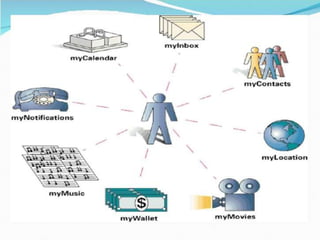
• Pervasive Computing devices are tiny, invisible 
microprocessors embedded in type of objects like clothes , 
, home , cars etc. 
 Ships , Aircrafts , Cars , Bridges , Machines , 
Refrigerators , Door Handles , Lighting fixtures 
 Mobile Internet access, Third – generation wireless 
communication , Bluetooth have made Pervasive 
Computing a reality
APPLICATION 
 HEALTHCARE 
 DEFENCE 
 TRANSPORTATION 
 INDUSTRIAL BUSINESS 
 DAILY LIFE
PC IN HEALTHCARE 
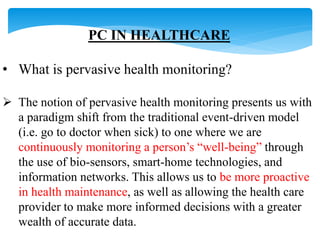
• What is pervasive health monitoring? 
 The notion of pervasive health monitoring presents us with 
a paradigm shift from the traditional event-driven model 
(i.e. go to doctor when sick) to one where we are 
continuously monitoring a person’s “well-being” through 
the use of bio-sensors, smart-home technologies, and 
information networks. This allows us to be more proactive 
in health maintenance, as well as allowing the health care 
provider to make more informed decisions with a greater 
wealth of accurate data.
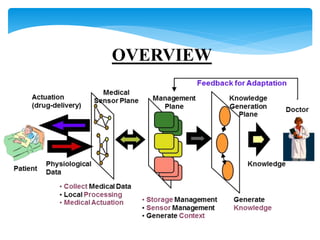
OVERVIEW
BIOSENSORS 
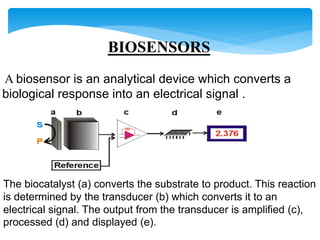
A biosensor is an analytical device which converts a 
biological response into an electrical signal . 
The biocatalyst (a) converts the substrate to product. This reaction 
is determined by the transducer (b) which converts it to an 
electrical signal. The output from the transducer is amplified (c), 
processed (d) and displayed (e).
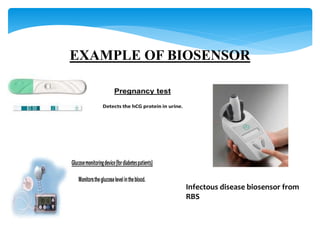
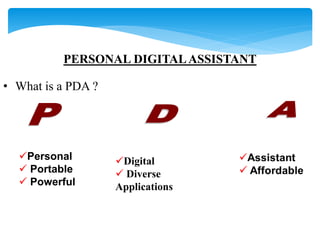
EXAMPLE OF BIOSENSOR 
Infectous disease biosensor from 
RBS
PERSONAL DIGITAL ASSISTANT 
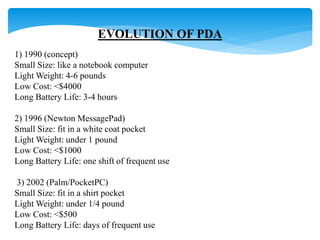
• What is a PDA ? 
Personal 
 Portable 
 Powerful 
Digital 
 Diverse 
Applications
EVOLUTION OF PDA 
1) 1990 (concept) 
Small Size: like a notebook computer 
Light Weight: 4-6 pounds 
Low Cost: <$4000 
Long Battery Life: 3-4 hours 
2) 1996 (Newton MessagePad) 
Small Size: fit in a white coat pocket 
Light Weight: under 1 pound 
Low Cost: <$1000 
Long Battery Life: one shift of frequent use 
3) 2002 (Palm/PocketPC) 
Small Size: fit in a shirt pocket 
Light Weight: under 1/4 pound 
Low Cost: <$500 
Long Battery Life: days of frequent use
WHY PDA’S? 
ADVANTAGES : DISADVANTAGES : 
Portability Limited Space 
Easy access No backup 
Fast data entry 
Low cost 
No training required
• Rapidly rising cost of healthcare 
• Greater awareness of medical errors 
• Increased physician demand 
• Increased demands on physicians 
• Advances in technology
WHY NOW? 
• Devices converging: PDA’s, cell phones, pagers 
• Acceptable Form factor: smaller, less intrusive devices 
• Price: 1/5 the cost of desktops in terms of capital and 
support 
• Improving Technology: 
Connectivity Battery Life 
Screen Technology Memory Capacity
OVERALL ASSESSMENT 
PERVASIVE 
COMPUTING IS 
EVERYWHERE TO 
MAKE OUR LIFE EASY
THANK YOU

Pervasive computing

  • 1.
    PERVASIVE COMPUTING INHEALTHCARE BHUPENDER SINGH JADON PGDBM ( MARKETING) IMT - HYDERABAD
  • 2.
    INTRODUCTION • Theword Pervasive mean “existing everywhere” • The aim of Pervasive Computing is for computing available everywhere it’s needed . It spreads intelligence and connectivity to more or less everything . • Pervasive Computing devices are tiny, invisible microprocessors embedded in type of objects like clothes , , home , cars etc.  Ships , Aircrafts , Cars , Bridges , Machines , Refrigerators , Door Handles , Lighting fixtures  Mobile Internet access, Third – generation wireless communication , Bluetooth have made Pervasive Computing a reality
  • 4.
    APPLICATION  HEALTHCARE  DEFENCE  TRANSPORTATION  INDUSTRIAL BUSINESS  DAILY LIFE
  • 5.
    PC IN HEALTHCARE • What is pervasive health monitoring?  The notion of pervasive health monitoring presents us with a paradigm shift from the traditional event-driven model (i.e. go to doctor when sick) to one where we are continuously monitoring a person’s “well-being” through the use of bio-sensors, smart-home technologies, and information networks. This allows us to be more proactive in health maintenance, as well as allowing the health care provider to make more informed decisions with a greater wealth of accurate data.
  • 6.
  • 7.
    BIOSENSORS A biosensoris an analytical device which converts a biological response into an electrical signal . The biocatalyst (a) converts the substrate to product. This reaction is determined by the transducer (b) which converts it to an electrical signal. The output from the transducer is amplified (c), processed (d) and displayed (e).
  • 8.
    EXAMPLE OF BIOSENSOR Infectous disease biosensor from RBS
  • 9.
    PERSONAL DIGITAL ASSISTANT • What is a PDA ? Personal  Portable  Powerful Digital  Diverse Applications
  • 10.
    EVOLUTION OF PDA 1) 1990 (concept) Small Size: like a notebook computer Light Weight: 4-6 pounds Low Cost: <$4000 Long Battery Life: 3-4 hours 2) 1996 (Newton MessagePad) Small Size: fit in a white coat pocket Light Weight: under 1 pound Low Cost: <$1000 Long Battery Life: one shift of frequent use 3) 2002 (Palm/PocketPC) Small Size: fit in a shirt pocket Light Weight: under 1/4 pound Low Cost: <$500 Long Battery Life: days of frequent use
  • 11.
    WHY PDA’S? ADVANTAGES: DISADVANTAGES : Portability Limited Space Easy access No backup Fast data entry Low cost No training required
  • 12.
    • Rapidly risingcost of healthcare • Greater awareness of medical errors • Increased physician demand • Increased demands on physicians • Advances in technology
  • 13.
    WHY NOW? •Devices converging: PDA’s, cell phones, pagers • Acceptable Form factor: smaller, less intrusive devices • Price: 1/5 the cost of desktops in terms of capital and support • Improving Technology: Connectivity Battery Life Screen Technology Memory Capacity
  • 14.
    OVERALL ASSESSMENT PERVASIVE COMPUTING IS EVERYWHERE TO MAKE OUR LIFE EASY
  • 15.