Problematic Integration TheoryTran My Trang: s3311623Duong Nguyen Phuong Nam: s3311632
OrganizationBackground and HistoryTwo kinds of Orientations in Problematic IntegrationForms of Problematic IntegrationApplying Problematic Integration
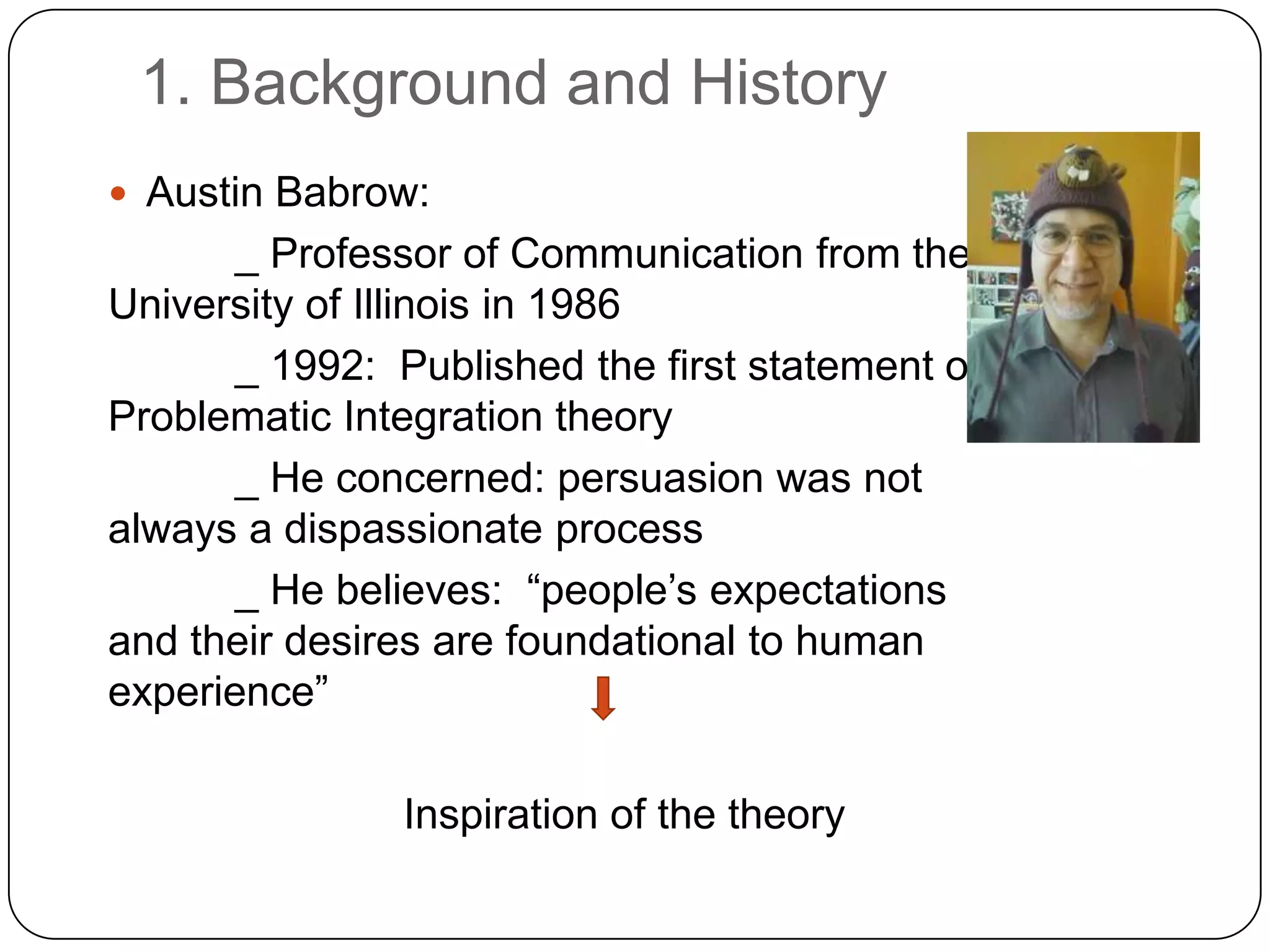
1. Background and HistoryAustin Babrow: _ Professor of Communication from the University of Illinois in 1986_ 1992:  Published the first statement of Problematic Integration theory _ He concerned: persuasion was not always a dispassionate process _ He believes:  “people’s expectations and their desires are foundational to human experience” Inspiration of the theory
Problematic Integration A general theory of message reception and processing  	how individuals receive, process and make sense of specific message and situations.
WHAT is being INTEGRATED in Problematic Integration ?
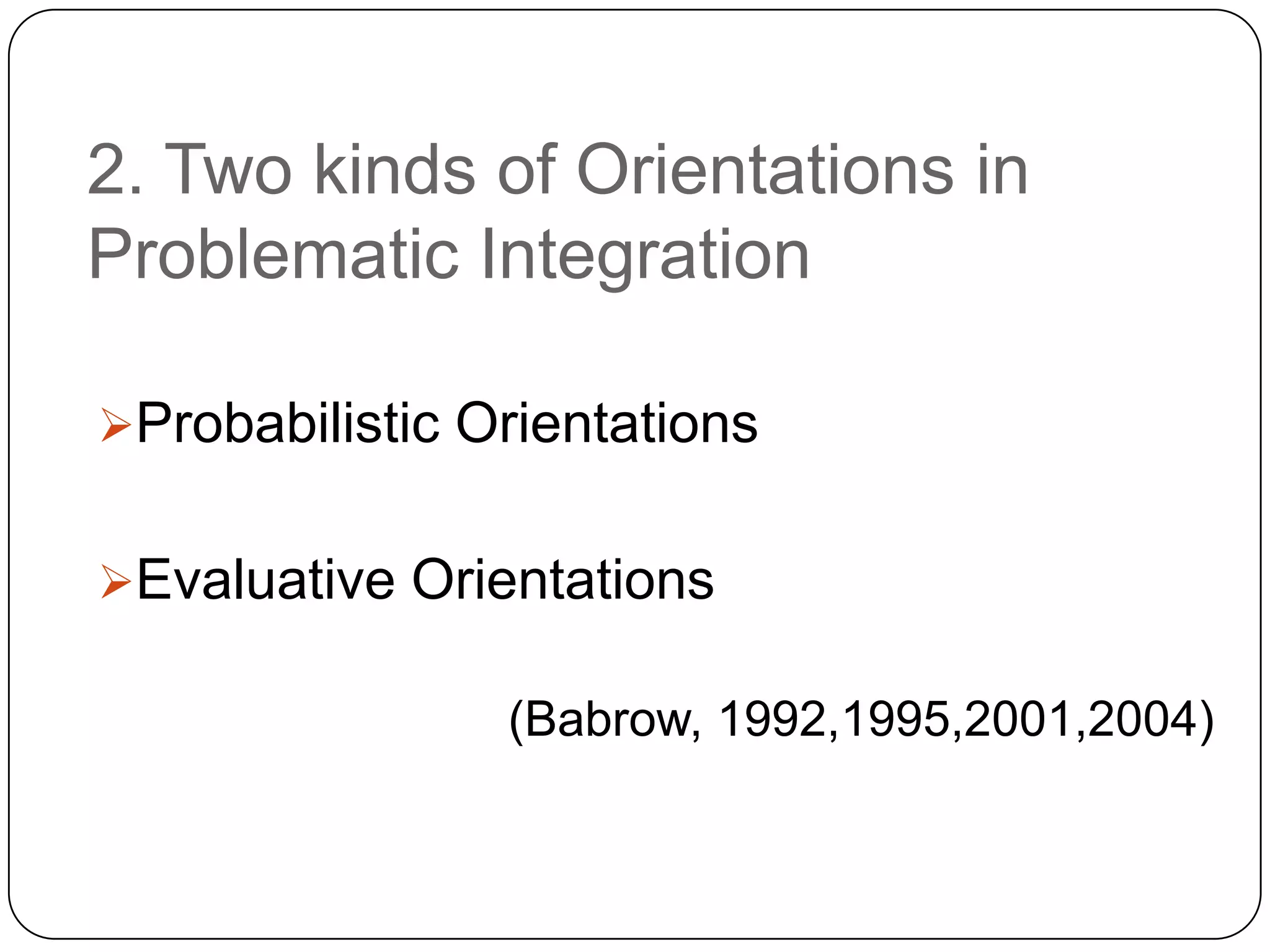
2. Two kinds of Orientations in Problematic IntegrationProbabilistic Orientations
Evaluative Orientations(Babrow, 1992,1995,2001,2004)
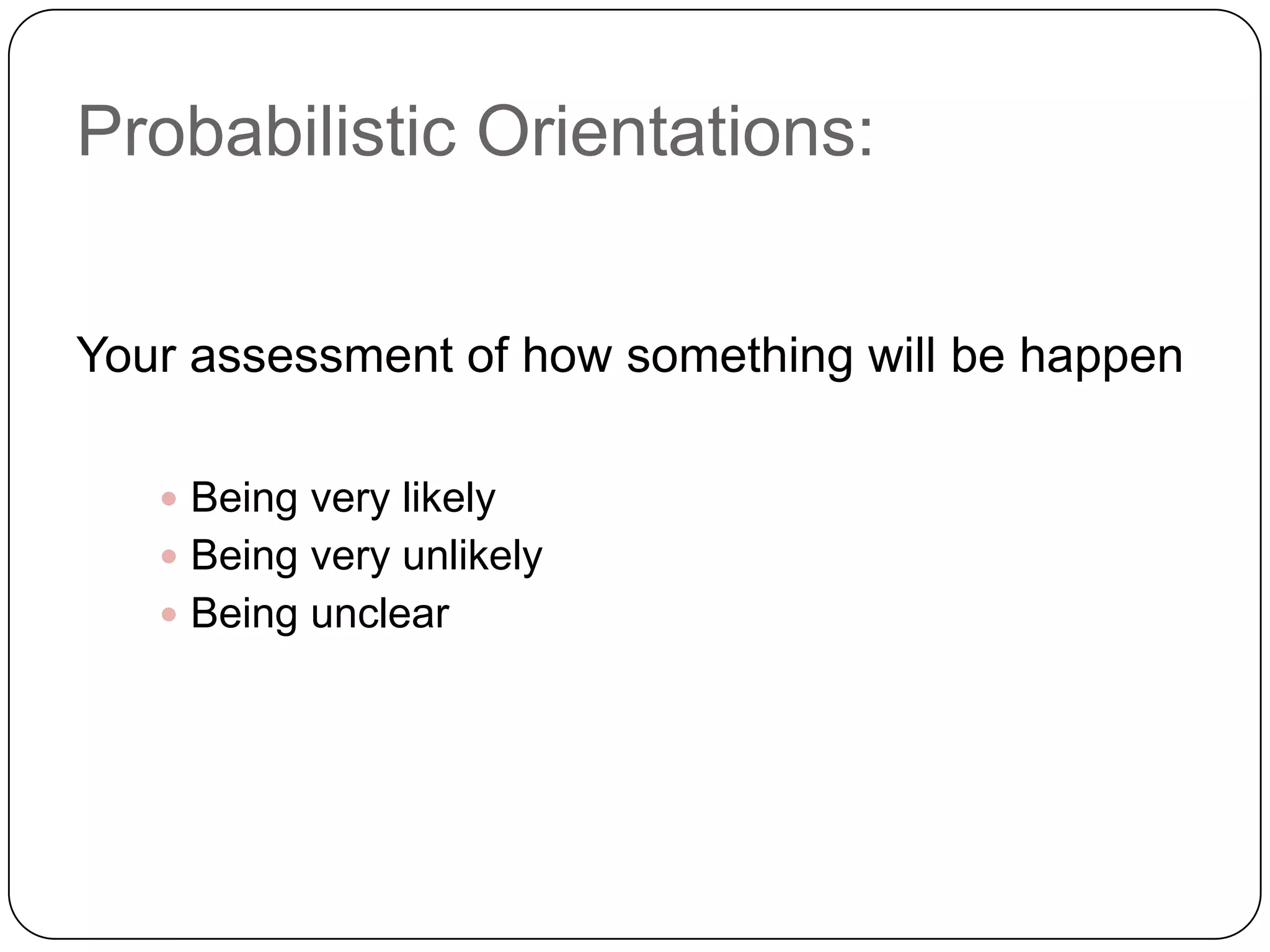
Probabilistic Orientations:Your assessment of how something will be happenBeing very likelyBeing very unlikelyBeing unclear
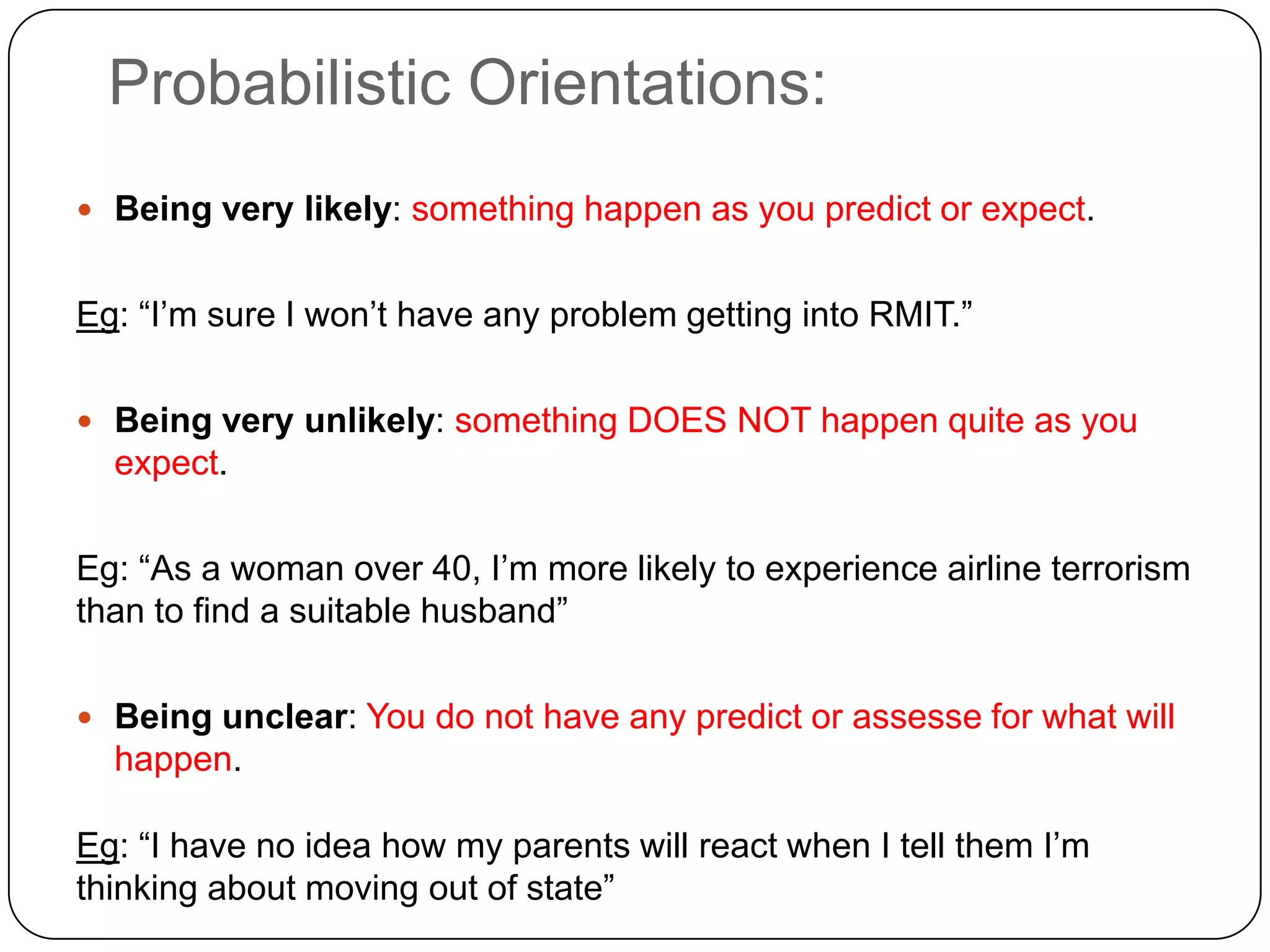
Probabilistic Orientations:Being very likely: something happen as you predict or expect.Eg: “I’m sure I won’t have any problem getting into RMIT.”Being very unlikely: something DOES NOT happen quite as you expect.Eg: “As a woman over 40, I’m more likely to experience airline terrorism than to find a suitable husband”Being unclear: You do not have any predict or assesse for what will happen.Eg: “I have no idea how my parents will react when I tell them I’m thinking about moving out of state”
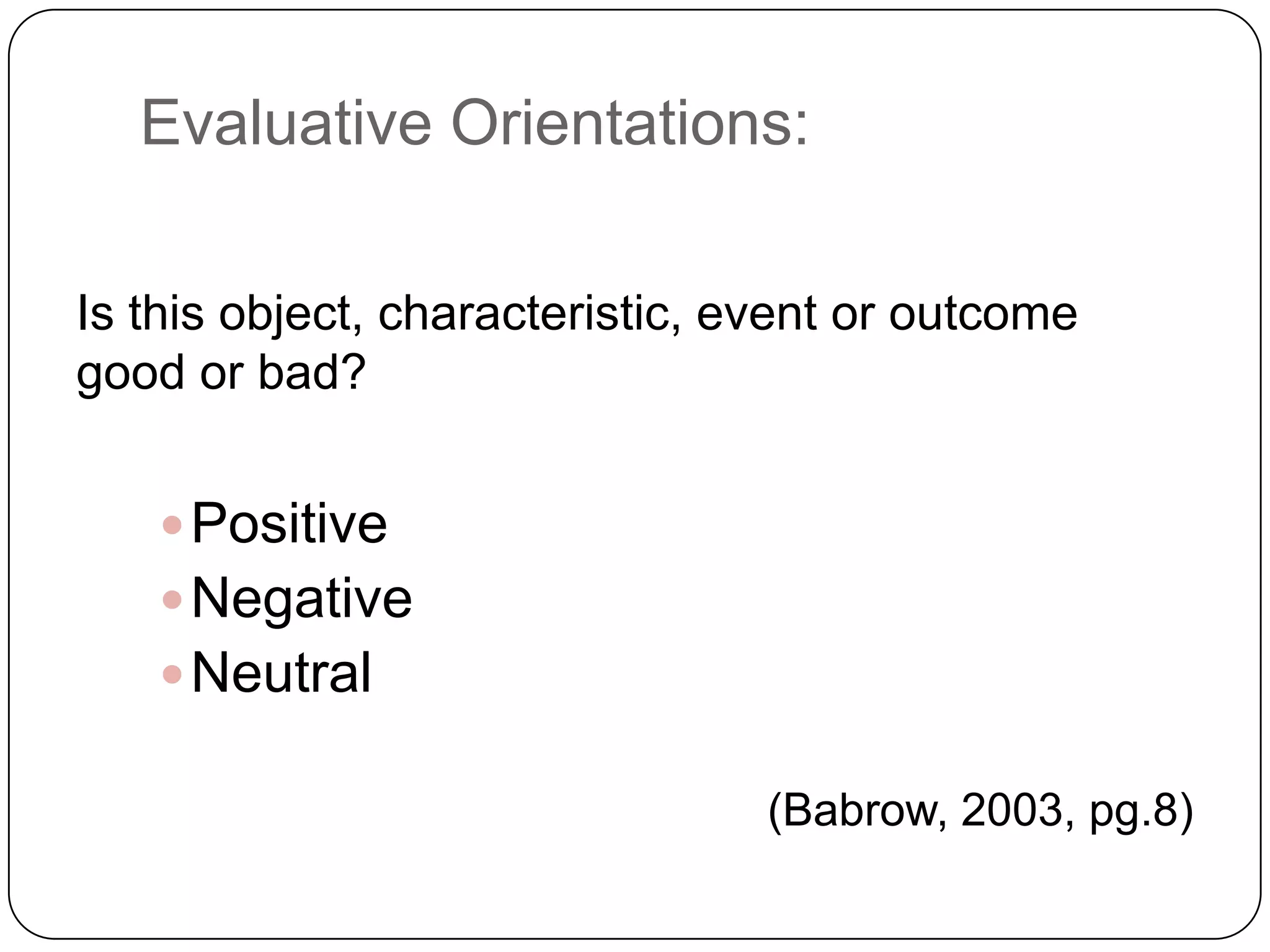
Evaluative Orientations:Is this object, characteristic, event or outcome good or bad? PositiveNegativeNeutral(Babrow, 2003, pg.8)
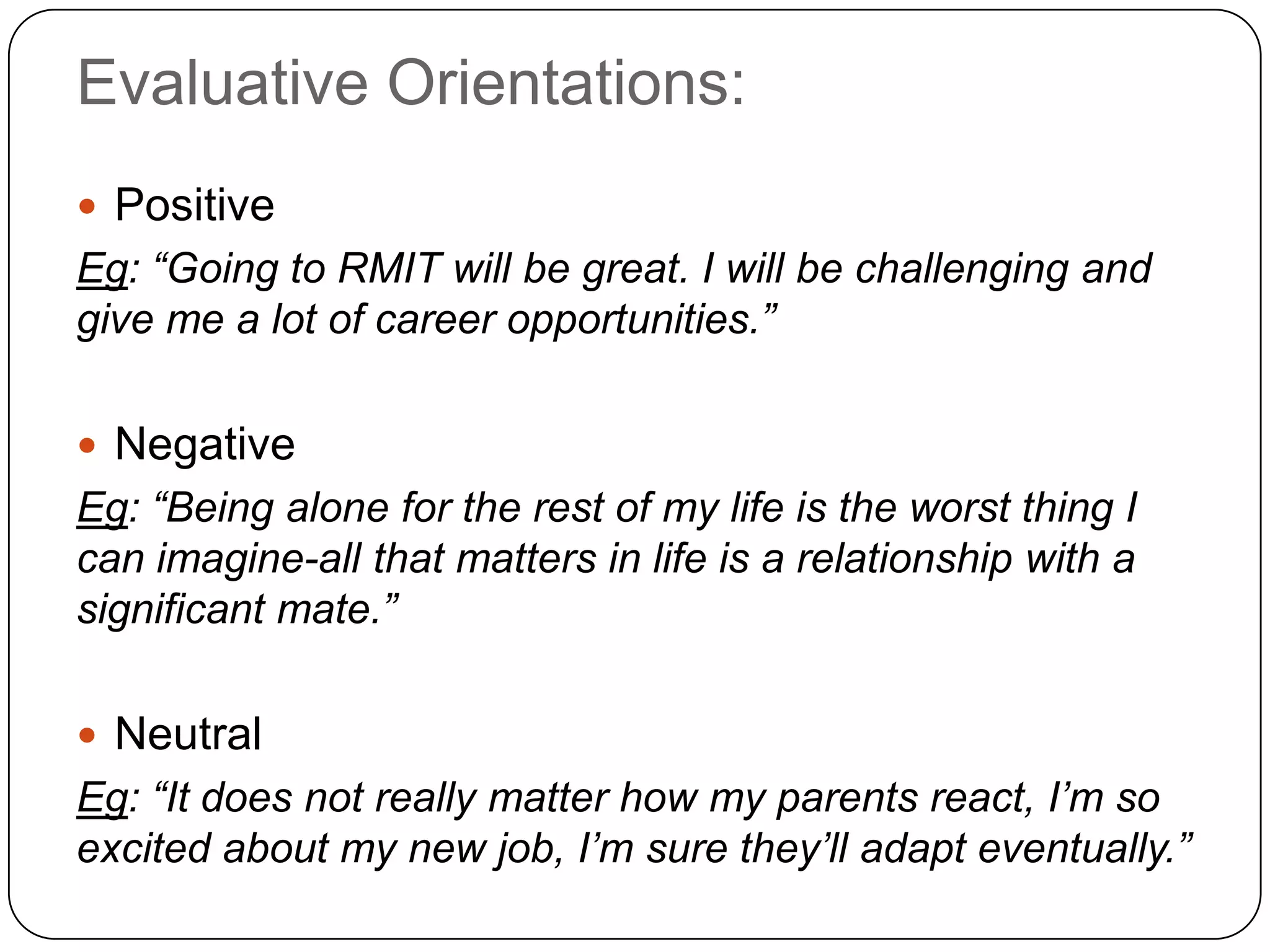
Evaluative Orientations:PositiveEg: “Going to RMIT will be great. I will be challenging and give me a lot of career opportunities.”NegativeEg: “Being alone for the rest of my life is the worst thing I can imagine-all that matters in life is a relationship with a significant mate.”NeutralEg: “It does not really matter how my parents react, I’m so excited about my new job, I’m sure they’ll adapt eventually.”
WHEN Is Integration Problematic?
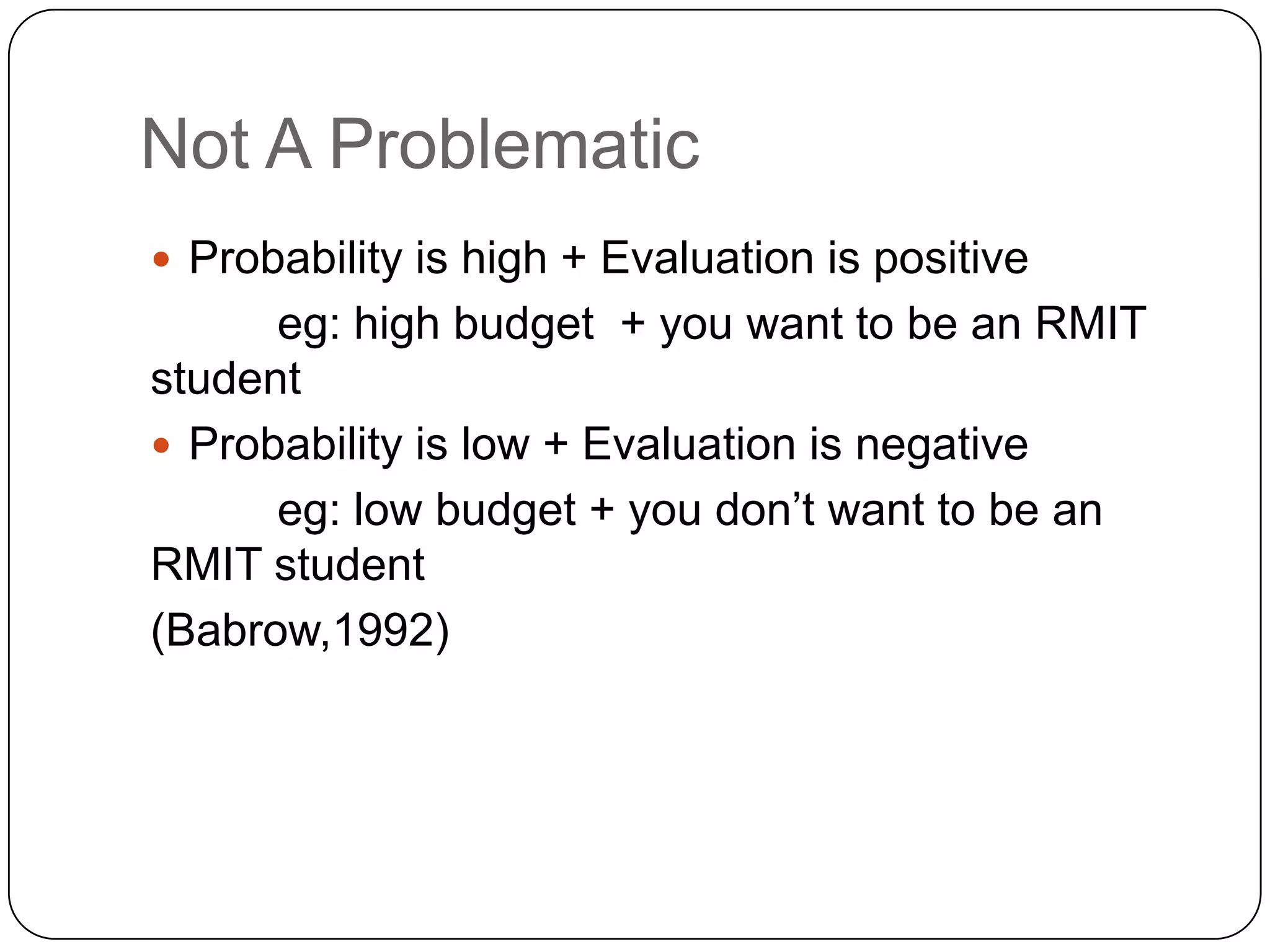
Not A Problematic Probability is high + Evaluation is positiveeg: high budget  + you want to be an RMIT student  Probability is low + Evaluation is negative eg: low budget + you don’t want to be an RMIT student(Babrow,1992)
Problematic When two orientations create tension/ conflict/ contradictory.4 basic forms: Divergence
Uncertainty
Ambivalence
Impossibility Divergence (when two things become different )Conflict: What you want (evaluation) >< What is likely (problematic judgment) 2 types:Unlikely happiness: eg: you love a girl but the she is married.Sorrow  eg. Married arrangement Positive evaluationNegative probabilisticNegative evaluationPositive probabilistic
Uncertainty Unknowns cover the orientation Knowledge Eg. Patients will have problematic integration when they lack of information EvaluativeHIV patients evaluate the reacts of their friends.
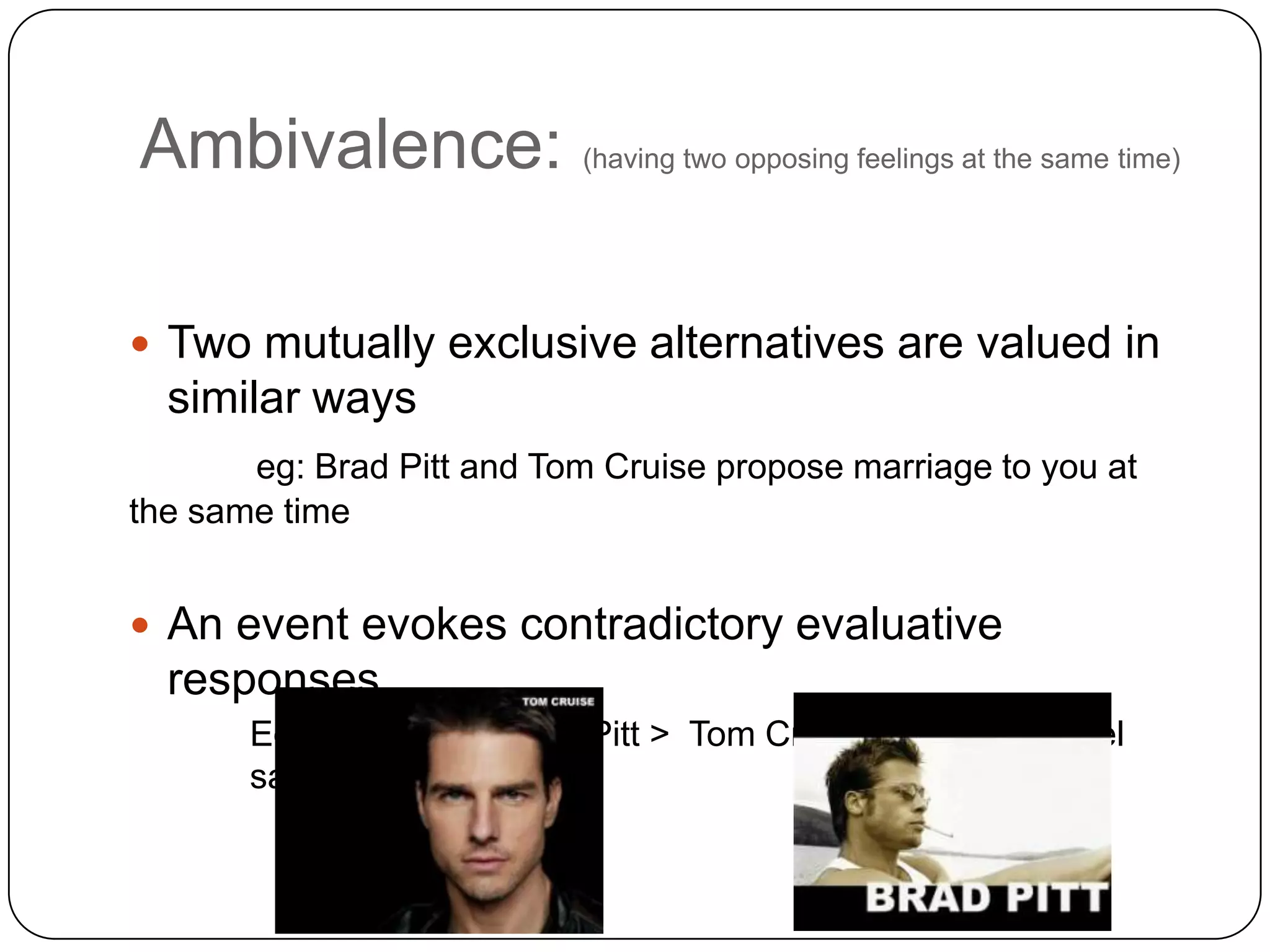
Ambivalence: (having two opposing feelings at the same time)Two mutually exclusive alternatives are valued in similar ways eg: Brad Pitt and Tom Cruise propose marriage to you at the same time  An event evokes contradictory evaluative responses. Eg: You choose Brad Pitt >  Tom Cruise cries >  you feel sad
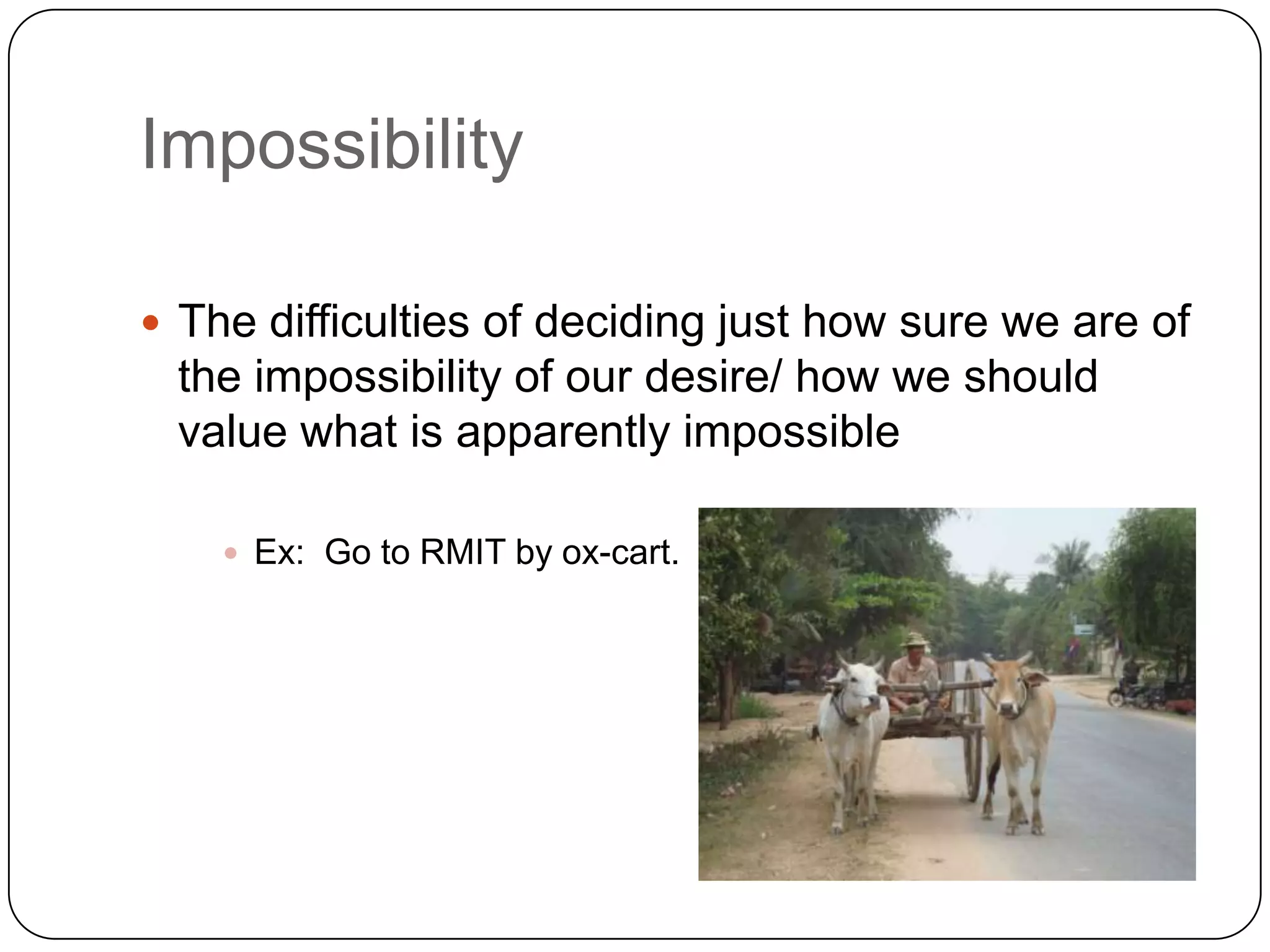
Impossibility The difficulties of deciding just how sure we are of the impossibility of our desire/ how we should value what is apparently impossible Ex:  Go to RMIT by ox-cart.
How Communication relates to PI Source: after communication, problem appear Medium:communication as a tool to solve the problem Resource :how can you change your mind to reduce the problem

Persuasion_ Theory of Problematic Integration

  • 1.
    Problematic Integration TheoryTranMy Trang: s3311623Duong Nguyen Phuong Nam: s3311632
  • 2.
    OrganizationBackground and HistoryTwokinds of Orientations in Problematic IntegrationForms of Problematic IntegrationApplying Problematic Integration
  • 3.
    1. Background andHistoryAustin Babrow: _ Professor of Communication from the University of Illinois in 1986_ 1992: Published the first statement of Problematic Integration theory _ He concerned: persuasion was not always a dispassionate process _ He believes: “people’s expectations and their desires are foundational to human experience” Inspiration of the theory
  • 4.
    Problematic Integration Ageneral theory of message reception and processing how individuals receive, process and make sense of specific message and situations.
  • 5.
    WHAT is beingINTEGRATED in Problematic Integration ?
  • 6.
    2. Two kindsof Orientations in Problematic IntegrationProbabilistic Orientations
  • 7.
  • 8.
    Probabilistic Orientations:Your assessmentof how something will be happenBeing very likelyBeing very unlikelyBeing unclear
  • 9.
    Probabilistic Orientations:Being verylikely: something happen as you predict or expect.Eg: “I’m sure I won’t have any problem getting into RMIT.”Being very unlikely: something DOES NOT happen quite as you expect.Eg: “As a woman over 40, I’m more likely to experience airline terrorism than to find a suitable husband”Being unclear: You do not have any predict or assesse for what will happen.Eg: “I have no idea how my parents will react when I tell them I’m thinking about moving out of state”
  • 10.
    Evaluative Orientations:Is thisobject, characteristic, event or outcome good or bad? PositiveNegativeNeutral(Babrow, 2003, pg.8)
  • 11.
    Evaluative Orientations:PositiveEg: “Goingto RMIT will be great. I will be challenging and give me a lot of career opportunities.”NegativeEg: “Being alone for the rest of my life is the worst thing I can imagine-all that matters in life is a relationship with a significant mate.”NeutralEg: “It does not really matter how my parents react, I’m so excited about my new job, I’m sure they’ll adapt eventually.”
  • 12.
    WHEN Is IntegrationProblematic?
  • 13.
    Not A ProblematicProbability is high + Evaluation is positiveeg: high budget + you want to be an RMIT student Probability is low + Evaluation is negative eg: low budget + you don’t want to be an RMIT student(Babrow,1992)
  • 14.
    Problematic When twoorientations create tension/ conflict/ contradictory.4 basic forms: Divergence
  • 15.
  • 16.
  • 17.
    Impossibility Divergence (whentwo things become different )Conflict: What you want (evaluation) >< What is likely (problematic judgment) 2 types:Unlikely happiness: eg: you love a girl but the she is married.Sorrow eg. Married arrangement Positive evaluationNegative probabilisticNegative evaluationPositive probabilistic
  • 18.
    Uncertainty Unknowns coverthe orientation Knowledge Eg. Patients will have problematic integration when they lack of information EvaluativeHIV patients evaluate the reacts of their friends.
  • 19.
    Ambivalence: (having twoopposing feelings at the same time)Two mutually exclusive alternatives are valued in similar ways eg: Brad Pitt and Tom Cruise propose marriage to you at the same time An event evokes contradictory evaluative responses. Eg: You choose Brad Pitt > Tom Cruise cries > you feel sad
  • 20.
    Impossibility The difficultiesof deciding just how sure we are of the impossibility of our desire/ how we should value what is apparently impossible Ex: Go to RMIT by ox-cart.
  • 21.
    How Communication relatesto PI Source: after communication, problem appear Medium:communication as a tool to solve the problem Resource :how can you change your mind to reduce the problem
  • 22.
    4. Applying problematicIntegrationDivergence game: Uncertainty: Ambivalence game: What will you say with Tom Cruise to heal his heart? Impossibility game: A thing that your different gender can do but you can’t.
  • 23.
    Conclusion IP: theway that individual receive, process and make sense of messages or situations in daily life. When we receive and process the message/ situation; we not only predict the outcomes (probabilistic orientations) but also put our assessment about the good/bad of that message ( evaluative orientations)4 types of IP happen when 2 orientations cannot integrate.
  • 24.
    Reference Ajzen, I1991, ‘The theory of planned behavior’, Organizational behavior and human decision resources, pp. 179-211.Babrow, A. S 1992, Communication and problematic integration: Understanding diverging probability and value, ambiguity, ambivalence, and impossibility, Communication Theory, vol 2, pp. 95-130.Miller, K 2005, ‘Communication theories: Perspective, process and contexts, 4thedn, chapter 8, McGram_Hall, US, pp. 124-142.

Editor's Notes

  • #8 A probabilistic orientation involves an assessment of how likely something is to occur(Your assessment of how something will be happen)
  • #10 Definition: answer the question: Is this object, characteristic, event or outcome good or bad? (Babrow, 2003, pg.8)
  • #11 The first statement reflects a positive evaluation about graduate schoolThe second statement is a negative evaluation of a solitary (alone) lifestyleThe third statement reflects a neutral evaluation but also includes an interesting twist
  • #15 http://www.youtube.com/watch?v=mTi4ZvPCDoE
  • #16 http://www.youtube.com/watch?v=IPlqhw8AoQI
  • #18 http://www.youtube.com/watch?v=I3DVN7XMiQk&amp;feature=fvst
  • #20 As a source: deals with the constitutive role of