Perspective
Consciousness
Jamie Smith
Perspective
Consciousness:
-the recognition or awareness on
the part of the individual that he
or she as a view of the world that
is not universally shared, that this
view of the world has been and
continues to be shaped by
influences that often escape
conscious detection, and that
others have views of the world
that are profoundly different
from one’s own
In other words:
-we have a perspective
-it can be shaped by
subtle influences
-others have different
perspectives
Perspectives are shaped by many factors
including but not limited to:
*ethnicity
*religion
*age
*sex
*social factors
“In our rapidly changing society,
an urgent need exists for
schools to address and infuse
global awareness into
curriculum instruction… a need
exists for students to examine
the world from varying
perspectives and to become
aware of the complex
interrelationships that
characterize it” (Burnouf,
2004).
What do teachers need to be able to develop
students’ perspective consciousness?
 Community Networks:
 Through social networking, teachers can connect with
international students and families to broaden personal
perspectives.
 Teachers need to take initiative to participate in experimental
learning through intentional involvement in diverse cultural
traditions and celebrations.
 Content Workshops:
 Teachers need to prepare for diversity and cultural literacy.
 Content should stress critical thinking and respect for other
cultures, not just isolated Social Studies facts
What does perspective consciousness
look like in the classroom?
“Everyday, teachers make instructional decisions that affect how students
perceive their own culture, their nation, the lives of people around the
world, and the issue and conflicts facing the planet” (Zajda, 2010).
INSTRUCTIONAL STRATEGIES SHOULD INCLUDE:
• discussion of multiple perspectives concerning ideas and issues
• simulations on perceptions of different social norms and
practices
• differentiation between prejudice and discrimination
• values clarification
• causes and consequences of stereotyping
• importance of respecting others with different orientations
(Zajda, 2010)
What needs to happen in order to foster the
development of perspective consciousness?
 Students need to identify their own cultural beliefs
and norms of behavior before they can appreciate
those of others.
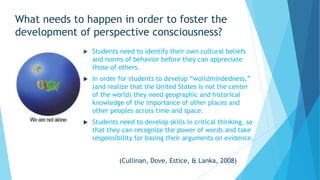
 In order for students to develop “worldmindedness,”
(and realize that the United States is not the center
of the world) they need geographic and historical
knowledge of the importance of other places and
other peoples across time and space.
 Students need to develop skills in critical thinking, so
that they can recognize the power of words and take
responsibility for basing their arguments on evidence.
(Cullinan, Dove, Estice, & Lanka, 2008)
Strategies for Teachers
 Classroom Language:
 Create a classroom language
that includes appropriate
vocabulary to provide students
with rich discussion of global
education. Important terms to
define include: culture, cultural
awareness, bias, stereotypes,
racism, and diversity.
Strategies for Teachers
 Literature on Intercultural Themes:
 Quality multicultural and global
children’s literature focuses on
intercultural interaction and
themes of marginalization and
acceptance.
 Historical fiction and non-fiction
historical accounts can enhance
emotional connections between the
reader and the human situations
presented in text (such as accounts
of the Holocaust).
Strategies for Teachers
 Cross Cultural Experiences:
Invite guest speakers/diverse
community members to visit
regularly with students and
to develop a relationship that
allows for open
communication of
differences, as well as
clarification of
misconceptions and
stereotypes.
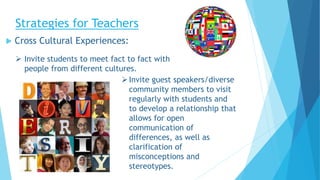
 Invite students to meet fact to fact with
people from different cultures.
The media influences how perspectives
are formed. It exercises the power of
reinforcing enduring cultural ideas,
themes, and stereotypes, yet has the
equally powerful capacity to mobilize
altogether new patterns of belief and
opinion practically overnight.
Students need to be exposed to other sources for a more balanced
influence: books, videos, biographies, guest speakers presentations,
and cross-cultural interactions.
(Hanvey, 2004)
References
Burnouf, L. (2004). Global awareness and its perspectives in global
education. Canadian Social Studies, 38 (3).
Cullinan, B., Dove, T., Estice, R., & Lanka, J. (2008). Becoming
conscious of different perspectives. Social Studies and the Young
Learner, 20 (4), p. 18-21.
Hanvey, R.G. (2004). An attainable global perspective. The American
Forum for Global Education.
Zajda, J. (2010). Global Pedagogies: Schooling for the Future,
Globalisation, Comparative Education, and Policy Research.

Perspective Consciousness

  • 1.
  • 2.
    Perspective Consciousness: -the recognition orawareness on the part of the individual that he or she as a view of the world that is not universally shared, that this view of the world has been and continues to be shaped by influences that often escape conscious detection, and that others have views of the world that are profoundly different from one’s own In other words: -we have a perspective -it can be shaped by subtle influences -others have different perspectives
  • 3.
    Perspectives are shapedby many factors including but not limited to: *ethnicity *religion *age *sex *social factors
  • 4.
    “In our rapidlychanging society, an urgent need exists for schools to address and infuse global awareness into curriculum instruction… a need exists for students to examine the world from varying perspectives and to become aware of the complex interrelationships that characterize it” (Burnouf, 2004).
  • 5.
    What do teachersneed to be able to develop students’ perspective consciousness?  Community Networks:  Through social networking, teachers can connect with international students and families to broaden personal perspectives.  Teachers need to take initiative to participate in experimental learning through intentional involvement in diverse cultural traditions and celebrations.  Content Workshops:  Teachers need to prepare for diversity and cultural literacy.  Content should stress critical thinking and respect for other cultures, not just isolated Social Studies facts
  • 6.
    What does perspectiveconsciousness look like in the classroom? “Everyday, teachers make instructional decisions that affect how students perceive their own culture, their nation, the lives of people around the world, and the issue and conflicts facing the planet” (Zajda, 2010). INSTRUCTIONAL STRATEGIES SHOULD INCLUDE: • discussion of multiple perspectives concerning ideas and issues • simulations on perceptions of different social norms and practices • differentiation between prejudice and discrimination • values clarification • causes and consequences of stereotyping • importance of respecting others with different orientations (Zajda, 2010)
  • 7.
    What needs tohappen in order to foster the development of perspective consciousness?  Students need to identify their own cultural beliefs and norms of behavior before they can appreciate those of others.  In order for students to develop “worldmindedness,” (and realize that the United States is not the center of the world) they need geographic and historical knowledge of the importance of other places and other peoples across time and space.  Students need to develop skills in critical thinking, so that they can recognize the power of words and take responsibility for basing their arguments on evidence. (Cullinan, Dove, Estice, & Lanka, 2008)
  • 8.
    Strategies for Teachers Classroom Language:  Create a classroom language that includes appropriate vocabulary to provide students with rich discussion of global education. Important terms to define include: culture, cultural awareness, bias, stereotypes, racism, and diversity.
  • 9.
    Strategies for Teachers Literature on Intercultural Themes:  Quality multicultural and global children’s literature focuses on intercultural interaction and themes of marginalization and acceptance.  Historical fiction and non-fiction historical accounts can enhance emotional connections between the reader and the human situations presented in text (such as accounts of the Holocaust).
  • 10.
    Strategies for Teachers Cross Cultural Experiences: Invite guest speakers/diverse community members to visit regularly with students and to develop a relationship that allows for open communication of differences, as well as clarification of misconceptions and stereotypes.  Invite students to meet fact to fact with people from different cultures.
  • 11.
    The media influenceshow perspectives are formed. It exercises the power of reinforcing enduring cultural ideas, themes, and stereotypes, yet has the equally powerful capacity to mobilize altogether new patterns of belief and opinion practically overnight. Students need to be exposed to other sources for a more balanced influence: books, videos, biographies, guest speakers presentations, and cross-cultural interactions. (Hanvey, 2004)
  • 12.
    References Burnouf, L. (2004).Global awareness and its perspectives in global education. Canadian Social Studies, 38 (3). Cullinan, B., Dove, T., Estice, R., & Lanka, J. (2008). Becoming conscious of different perspectives. Social Studies and the Young Learner, 20 (4), p. 18-21. Hanvey, R.G. (2004). An attainable global perspective. The American Forum for Global Education. Zajda, J. (2010). Global Pedagogies: Schooling for the Future, Globalisation, Comparative Education, and Policy Research.