Are you a Global Educator?
Julie Wakefield
McQueen High School
MATL, MS Geography, NBCT
So, are you?
HOW DO YOU KNOW??
What does it look like?
Working to make
all students
globally
competent
and ready for the
21st century.
What is global competence?
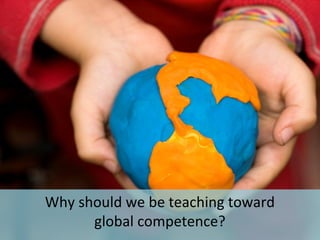
Why should we be teaching toward
global competence?
How can we help students develop
global competence?
Oxfam’s characteristics of a global citizen:
• Is aware of the wider world and has a sense of their
own role as a world citizen
• Respects and values diversity
• Understands how the world works economically,
politically, socially, culturally, technologically and
environmentally
• Challenges injustice
• Participates in and contributes to the community
from the local to the global
• Is willing to act to make the world a more equitable
and sustainable place
• Takes responsibility for their actions
Oxfam, Curriculum for Global Citizenship (1997)
What are some of the ways you and your
students experience globalization?
Globalization of the Economy
A changing world demands changing skills.
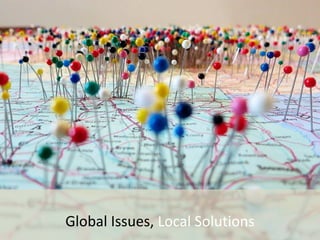
Global Issues, Local Solutions
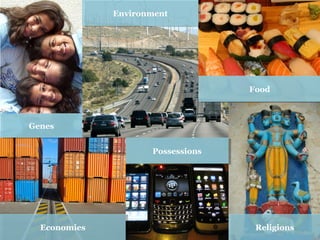
The global is part of our
everyday local lives.
GenesGenes
EconomiesEconomies ReligionsReligions
FoodFood
PossessionsPossessions
EnvironmentEnvironment
How do we define global competence?
 Content Knowledge Matters
 Global Knowledge, Skills, & Dispositions
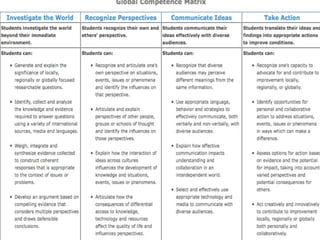
• Investigate the World
• Recognize Perspectives
• Communicate Ideas
• Take Action
Educating for Global Competence
“Global competence is the capacity and
disposition to understand and act on
issues of global significance.”
Veronica Boix Mansilla and Anthony Jackson,
Educating for Global Competence:
Preparing Our Youth to Engage the World, 2011, p. xiii
• Recognize and express how diverse
audiences perceive meaning and how
that affects communication.
• Listen to and communicate effectively
with diverse people.
• Select and use appropriate technology
and media to communicate with diverse
audiences.
• Reflect on how effective communication
affects understanding and collaboration
in an interdependent world.
• Recognize and express their own
perspective and identify influences on
that perspective.
• Examine others’ perspectives and
identify what influenced them.
• Explain the impact of cultural
interactions.
• Articulate how differential access to
knowledge, technology, and resources
affects quality of life and perspectives .
• Identify an issue, generate questions,
and explain its significance.
• Use variety of languages, sources and
media to identify and weigh relevant
evidence.
• Analyze, integrate, and synthesize
evidence to construct coherent
responses.
• Develop argument based on compelling
evidence and draws defensible
conclusions.
• Identify and create opportunities for
personal or collaborative action to
improve conditions.
• Assess options and plan actions based on
evidence and potential for impact.
• Act, personally or collaboratively, in
creative and ethical ways to contribute to
improvement, and assess impact of actions
taken.
• Reflect on capacity to advocate for and
contribute to improvement.
Investigate the World
Students investigate the world
beyond their immediate
environment.
Recognize Perspectives
Students recognize their own
and others’ perspectives.
Take Action
Students translate their ideas
into appropriate actions to
improve conditions.
Communicate Ideas
Students communicate their
ideas effectively with diverse
audiences.
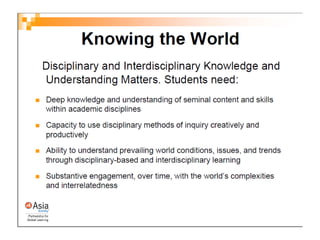
Understand the World through
Disciplinary and Interdisciplinary Study
p. 12p. 12
p. 55p. 55
Investigate the World
Recognize Perspectives
Communicate Ideas
Take Action
Teachers: What can you do?
• Create professional learning communities
• Target high-leverage entry points in the
curriculum
• Engage students in Project-Based Learning
opportunities
• Connect your classroom and curriculum to
cultural and educational institutions
• Develop your own global competence
Global approach Non-global
Teach about injustice and
how people have worked
against oppression.
Ex. Students create a timeline
of events in which Africans
worked for freedom against
European domination.
Have students develop
critical reading skills to
recognize bias and
underlying assumptions.
Ex. Students analyze colonial
documents and travel writing
for their assumptions about
race, power, and rights.
Often ignore oppression
and injustice in other
countries
Ex. Tells the story of
European colonization of
East Africa as “a glorious
era of Europeans bringing
light to the Dark
Continent”.
Often gloss over
American injustice and
oppression or imply it
was all in the past.
Ex. Teaches about the slave
trade in Africa without
attention to the suffering
and oppression of
Africans by Americans.
Global approach Non-global
Teach literature and history that
writes back against the
literature of the oppressors.
Ex. Students read excerpts
from Things Fall Apart by
Chinua Achebe and other
African literature to
understand colonialization
from Africans’ experiences
and knowledge.
Have students evaluate how
one’s worldview shapes how
one makes sense of events
and issues.
Ex. Students examine effects
of racist colonial language
and images on Americans’
perceptions of Africa by
surveying people in their
community.
Do not use knowledge
constructed by the Other
(US minorities, people in
Asia, Africa, the Middle East,
etc.) that challenges the
mainstream version of
events or issues.
Ex. Teaches a unit on colonial
Africa without using any
African sources or literature.
Global Resources
• Globalization 101
• Asia Society
• Oxfam Education
• Global Education Collaborative Ning
• The American Forum for Global Education
• US Global Competence Website
• European Youth Portal
Global Participation
• iEARN (International Education and Resource
Network)
• Global Nomads Group
• Taking It Global
• GLOBE Program (Science Collaborative
Projects)
Global Competency:
"Learn "with" the world...
not just "about" the world."

Are you a global educator

  • 1.
    Are you aGlobal Educator? Julie Wakefield McQueen High School MATL, MS Geography, NBCT
  • 2.
    So, are you? HOWDO YOU KNOW?? What does it look like?
  • 4.
    Working to make allstudents globally competent and ready for the 21st century.
  • 5.
    What is globalcompetence?
  • 6.
    Why should webe teaching toward global competence?
  • 7.
    How can wehelp students develop global competence?
  • 8.
    Oxfam’s characteristics ofa global citizen: • Is aware of the wider world and has a sense of their own role as a world citizen • Respects and values diversity • Understands how the world works economically, politically, socially, culturally, technologically and environmentally • Challenges injustice • Participates in and contributes to the community from the local to the global • Is willing to act to make the world a more equitable and sustainable place • Takes responsibility for their actions Oxfam, Curriculum for Global Citizenship (1997)
  • 10.
    What are someof the ways you and your students experience globalization?
  • 11.
  • 13.
    A changing worlddemands changing skills.
  • 14.
  • 16.
    The global ispart of our everyday local lives.
  • 17.
  • 19.
    How do wedefine global competence?  Content Knowledge Matters  Global Knowledge, Skills, & Dispositions • Investigate the World • Recognize Perspectives • Communicate Ideas • Take Action
  • 20.
  • 21.
    “Global competence isthe capacity and disposition to understand and act on issues of global significance.” Veronica Boix Mansilla and Anthony Jackson, Educating for Global Competence: Preparing Our Youth to Engage the World, 2011, p. xiii
  • 22.
    • Recognize andexpress how diverse audiences perceive meaning and how that affects communication. • Listen to and communicate effectively with diverse people. • Select and use appropriate technology and media to communicate with diverse audiences. • Reflect on how effective communication affects understanding and collaboration in an interdependent world. • Recognize and express their own perspective and identify influences on that perspective. • Examine others’ perspectives and identify what influenced them. • Explain the impact of cultural interactions. • Articulate how differential access to knowledge, technology, and resources affects quality of life and perspectives . • Identify an issue, generate questions, and explain its significance. • Use variety of languages, sources and media to identify and weigh relevant evidence. • Analyze, integrate, and synthesize evidence to construct coherent responses. • Develop argument based on compelling evidence and draws defensible conclusions. • Identify and create opportunities for personal or collaborative action to improve conditions. • Assess options and plan actions based on evidence and potential for impact. • Act, personally or collaboratively, in creative and ethical ways to contribute to improvement, and assess impact of actions taken. • Reflect on capacity to advocate for and contribute to improvement. Investigate the World Students investigate the world beyond their immediate environment. Recognize Perspectives Students recognize their own and others’ perspectives. Take Action Students translate their ideas into appropriate actions to improve conditions. Communicate Ideas Students communicate their ideas effectively with diverse audiences. Understand the World through Disciplinary and Interdisciplinary Study p. 12p. 12
  • 23.
  • 26.
  • 28.
  • 30.
  • 32.
  • 34.
    Teachers: What canyou do? • Create professional learning communities • Target high-leverage entry points in the curriculum • Engage students in Project-Based Learning opportunities • Connect your classroom and curriculum to cultural and educational institutions • Develop your own global competence
  • 35.
    Global approach Non-global Teachabout injustice and how people have worked against oppression. Ex. Students create a timeline of events in which Africans worked for freedom against European domination. Have students develop critical reading skills to recognize bias and underlying assumptions. Ex. Students analyze colonial documents and travel writing for their assumptions about race, power, and rights. Often ignore oppression and injustice in other countries Ex. Tells the story of European colonization of East Africa as “a glorious era of Europeans bringing light to the Dark Continent”. Often gloss over American injustice and oppression or imply it was all in the past. Ex. Teaches about the slave trade in Africa without attention to the suffering and oppression of Africans by Americans.
  • 36.
    Global approach Non-global Teachliterature and history that writes back against the literature of the oppressors. Ex. Students read excerpts from Things Fall Apart by Chinua Achebe and other African literature to understand colonialization from Africans’ experiences and knowledge. Have students evaluate how one’s worldview shapes how one makes sense of events and issues. Ex. Students examine effects of racist colonial language and images on Americans’ perceptions of Africa by surveying people in their community. Do not use knowledge constructed by the Other (US minorities, people in Asia, Africa, the Middle East, etc.) that challenges the mainstream version of events or issues. Ex. Teaches a unit on colonial Africa without using any African sources or literature.
  • 42.
    Global Resources • Globalization101 • Asia Society • Oxfam Education • Global Education Collaborative Ning • The American Forum for Global Education • US Global Competence Website • European Youth Portal
  • 43.
    Global Participation • iEARN(International Education and Resource Network) • Global Nomads Group • Taking It Global • GLOBE Program (Science Collaborative Projects)
  • 44.
    Global Competency: "Learn "with"the world... not just "about" the world."

Editor's Notes

  • #25 EdSteps: http://www.edsteps.org/CCSSO/Home.aspx