POL 202
UNIT: V
PERSONNEL: CLASSIFICATION
DR. MINARUL
PERSONNEL: CLASSIFICATION
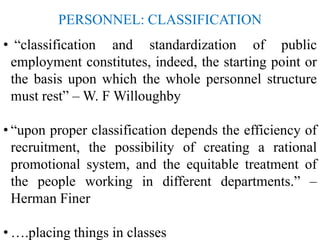
• “classification and standardization of public
employment constitutes, indeed, the starting point or
the basis upon which the whole personnel structure
must rest” – W. F Willoughby
• “upon proper classification depends the efficiency of
recruitment, the possibility of creating a rational
promotional system, and the equitable treatment of
the people working in different departments.” –
Herman Finer
• ….placing things in classes
PERSONNEL: CLASSIFICATION
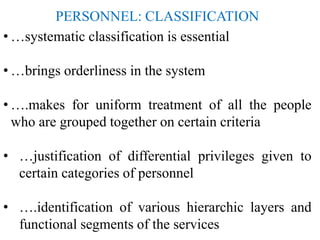
• …systematic classification is essential
• …brings orderliness in the system
• ….makes for uniform treatment of all the people
who are grouped together on certain criteria
• …justification of differential privileges given to
certain categories of personnel
• ….identification of various hierarchic layers and
functional segments of the services
PERSONNEL: CLASSIFICATION
• …has functional value and validity
• …two systems of classification in the World
• ….Position Classification and Rank Classification
Position Classification
• …USA, Japan, Canada follows this classification
• ….grouping of positions on the basis of
similarities of duties and requirement
PERSONNEL: CLASSIFICATION
Position Classification
• …classification of positions, not of persons
holding it
• …..positions may be vacant, occupied, temporary,
permanent, full time or part time
• ….classification of duties and responsibilities of
the positions being classified to justify
nomenclature, selection, pay and other personnel
matters
PERSONNEL: CLASSIFICATION
Position Classification
• …provides high degree of specialisation
• …..upholds the principle of equal pay for equal
work
• ….emphasis on merit than seniority
• ….brings rigidity in personnel administration
• …not suitable for developing countries
PERSONNEL: CLASSIFICATION
Rank Classification
• …classification based on rank
• …..UK, France, India, Pakistan, Germany follows
this
• ….employees are classified in hierarchical order
• ….employees are classified, not the job
• …salary and status depends on the ranks, not the
post
PERSONNEL: CLASSIFICATION
Rank Classification
• …an IAS enjoys the same salary and status
whether he/she serves Central or State
governments
• …..more suitable for generalist
• ….it makes the employees feel more secure
• ….it does not promote much specialization
• ….violates ‘equal pay for equal work’
PERSONNEL: CLASSIFICATION
Classification in India
1. All India Services
2. Central Services, Class I/Group -A
3. Central Services, Class II/Group -B
4. Central Services, Class III/Group -C
5. Central Services, Class IV/Group -D
6. Central Secretariat Services, Class I, II, III, IV/
Group –A, B, C, D
7. Specialist Services
8. State Services, Class I, II, III, IV
PERSONNEL: CLASSIFICATION
Classification in India
1. Gazetted Class
….Class I and Class II
…the names of the members are published in
the government gazette for appointment,
transfer, promotion and retirement
….are called officers
…enjoys certain privileges
2. Non-Gazetted Class
…..Class III and Class IV
…are called employees
PERSONNEL: CLASSIFICATION
Classification in India
• ….whether to continue with Rank Classification or
replace it with Position Classification?
• ..the IAS supports Rank Classification
• ….the IFS, IES supports Position Classification
• ..the ARC has recommended the adoption of
position classification

PERSONNEL CLASSIFICATION.ppt

  • 1.
    POL 202 UNIT: V PERSONNEL:CLASSIFICATION DR. MINARUL
  • 2.
    PERSONNEL: CLASSIFICATION • “classificationand standardization of public employment constitutes, indeed, the starting point or the basis upon which the whole personnel structure must rest” – W. F Willoughby • “upon proper classification depends the efficiency of recruitment, the possibility of creating a rational promotional system, and the equitable treatment of the people working in different departments.” – Herman Finer • ….placing things in classes
  • 3.
    PERSONNEL: CLASSIFICATION • …systematicclassification is essential • …brings orderliness in the system • ….makes for uniform treatment of all the people who are grouped together on certain criteria • …justification of differential privileges given to certain categories of personnel • ….identification of various hierarchic layers and functional segments of the services
  • 4.
    PERSONNEL: CLASSIFICATION • …hasfunctional value and validity • …two systems of classification in the World • ….Position Classification and Rank Classification Position Classification • …USA, Japan, Canada follows this classification • ….grouping of positions on the basis of similarities of duties and requirement
  • 5.
    PERSONNEL: CLASSIFICATION Position Classification •…classification of positions, not of persons holding it • …..positions may be vacant, occupied, temporary, permanent, full time or part time • ….classification of duties and responsibilities of the positions being classified to justify nomenclature, selection, pay and other personnel matters
  • 6.
    PERSONNEL: CLASSIFICATION Position Classification •…provides high degree of specialisation • …..upholds the principle of equal pay for equal work • ….emphasis on merit than seniority • ….brings rigidity in personnel administration • …not suitable for developing countries
  • 7.
    PERSONNEL: CLASSIFICATION Rank Classification •…classification based on rank • …..UK, France, India, Pakistan, Germany follows this • ….employees are classified in hierarchical order • ….employees are classified, not the job • …salary and status depends on the ranks, not the post
  • 8.
    PERSONNEL: CLASSIFICATION Rank Classification •…an IAS enjoys the same salary and status whether he/she serves Central or State governments • …..more suitable for generalist • ….it makes the employees feel more secure • ….it does not promote much specialization • ….violates ‘equal pay for equal work’
  • 9.
    PERSONNEL: CLASSIFICATION Classification inIndia 1. All India Services 2. Central Services, Class I/Group -A 3. Central Services, Class II/Group -B 4. Central Services, Class III/Group -C 5. Central Services, Class IV/Group -D 6. Central Secretariat Services, Class I, II, III, IV/ Group –A, B, C, D 7. Specialist Services 8. State Services, Class I, II, III, IV
  • 10.
    PERSONNEL: CLASSIFICATION Classification inIndia 1. Gazetted Class ….Class I and Class II …the names of the members are published in the government gazette for appointment, transfer, promotion and retirement ….are called officers …enjoys certain privileges 2. Non-Gazetted Class …..Class III and Class IV …are called employees
  • 11.
    PERSONNEL: CLASSIFICATION Classification inIndia • ….whether to continue with Rank Classification or replace it with Position Classification? • ..the IAS supports Rank Classification • ….the IFS, IES supports Position Classification • ..the ARC has recommended the adoption of position classification