The Power of Figurative Language
HOME
Figurative
Language
Similes &
Metaphors
Personification
Symbolism
What have I
learned?
You can FIGURE it out!
Figurative Language
can help you read
better, write better,
and be heard!
Let’s get started!
Goal: Developing a deep understanding of figurative language
and related vocabulary improves understanding of narratives
and poetry.
• 5th grade students will be able to define figure, figurative, language, similar, simile,
metaphor, person, personification, symbol, and symbolism.
Home What is Figurative Language?
• Students will be able to evaluate sentence context and choose the correct
vocabulary words to complete domain-specific questions
• Students will be able to recognize and identify examples of similes, metaphors, and
personification found in selected poetry.
Objectives
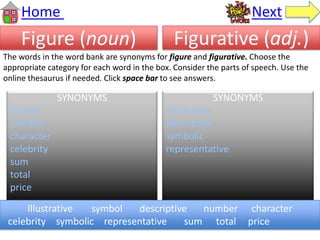
Figure (noun)
SYNONYMS
symbol
number
character
celebrity
sum
total
price
SYNONYMS
illustrative
descriptive
symbolic
representative
Home Next
Illustrative symbol descriptive number character
celebrity symbolic representative sum total price
The words in the word bank are synonyms for figure and figurative. Choose the
appropriate category for each word in the box. Consider the parts of speech. Use the
online thesaurus if needed. Click space bar to see answers.
Figurative (adj.)
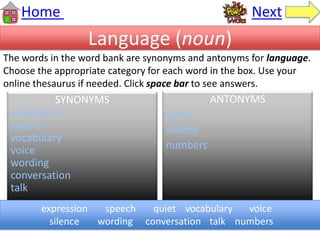
Language (noun)
SYNONYMS
expression
speech
vocabulary
voice
wording
conversation
talk
ANTONYMS
quiet
silence
numbers
Home Next
expression speech quiet vocabulary voice
silence wording conversation talk numbers
The words in the word bank are synonyms and antonyms for language.
Choose the appropriate category for each word in the box. Use your
online thesaurus if needed. Click space bar to see answers.
Figurative Language (noun)
Definition:
• Language that uses figures of speech, or words that
represent an idea using symbols
• Language that communicates ideas in an interesting
way
Home Similes & Metaphors
Examples:
• The eagle symbolizes a free nation because it soars freely
• A bird can be used to describe a plane:
The plane soared like a bird.
Now it’s time to discover
different types of figurative
Language…
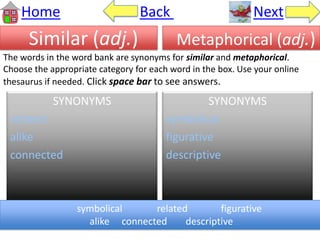
Similar (adj.)
SYNONYMS
related
alike
connected
SYNONYMS
symbolical
figurative
descriptive
Home Back Next
symbolical related figurative
alike connected descriptive
The words in the word bank are synonyms for similar and metaphorical.
Choose the appropriate category for each word in the box. Use your online
thesaurus if needed. Click space bar to see answers.
Metaphorical (adj.)
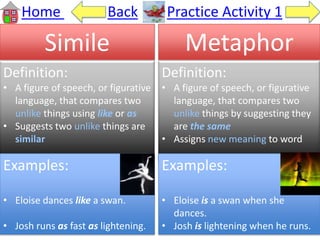
Simile
Definition:
• A figure of speech, or figurative
language, that compares two
unlike things using like or as
• Suggests two unlike things are
similar
Home Back Practice Activity 1
Metaphor
Definition:
• A figure of speech, or figurative
language, that compares two
unlike things by suggesting they
are the same
• Assigns new meaning to word
Examples:
• Eloise dances like a swan.
• Josh runs as fast as lightening.
Examples:
• Eloise is a swan when she
dances.
• Josh is lightening when he runs.
Home Back Practice Activity 2
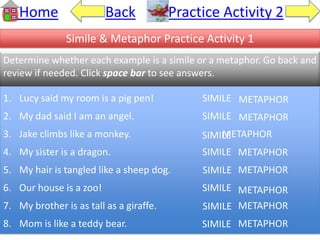
Simile & Metaphor Practice Activity 1
Determine whether each example is a simile or a metaphor. Go back and
review if needed. Click space bar to see answers.
1. Lucy said my room is a pig pen! SIMILE
2. My dad said I am an angel. SIMILE
3. Jake climbs like a monkey. METAPHOR
4. My sister is a dragon. SIMILE
5. My hair is tangled like a sheep dog. METAPHOR
6. Our house is a zoo! SIMILE
7. My brother is as tall as a giraffe. METAPHOR
8. Mom is like a teddy bear. METAPHOR
METAPHOR
METAPHOR
SIMILE
METAPHOR
SIMILE
METAPHOR
SIMILE
SIMILE
Home Back Personification
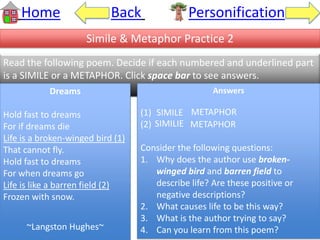
Simile & Metaphor Practice 2
Read the following poem. Decide if each numbered and underlined part
is a SIMILE or a METAPHOR. Click space bar to see answers.
Dreams
Hold fast to dreams
For if dreams die
Life is a broken-winged bird (1)
That cannot fly.
Hold fast to dreams
For when dreams go
Life is like a barren field (2)
Frozen with snow.
~Langston Hughes~
Answers
(1) SIMILE
(2) METAPHOR
Consider the following questions:
1. Why does the author use broken-
winged bird and barren field to
describe life? Are these positive or
negative descriptions?
2. What causes life to be this way?
3. What is the author trying to say?
4. Can you learn from this poem?
METAPHOR
SIMILIE
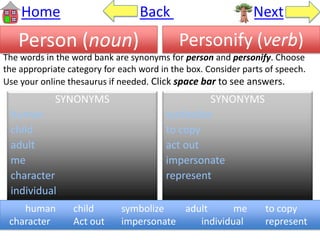
Person (noun)
SYNONYMS
human
child
adult
me
character
individual
SYNONYMS
symbolize
to copy
act out
impersonate
represent
Home Back Next
human child symbolize adult me to copy
character Act out impersonate individual represent
The words in the word bank are synonyms for person and personify. Choose
the appropriate category for each word in the box. Consider parts of speech.
Use your online thesaurus if needed. Click space bar to see answers.
Personify (verb)
Personification (noun)
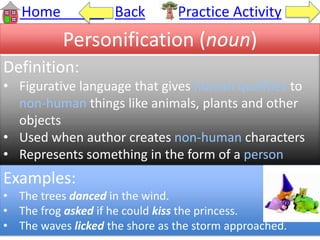
Definition:
• Figurative language that gives human qualities to
non-human things like animals, plants and other
objects
• Used when author creates non-human characters
• Represents something in the form of a person
Home Back Practice Activity
Examples:
• The trees danced in the wind.
• The frog asked if he could kiss the princess.
• The waves licked the shore as the storm approached.
Home Back Symbolism
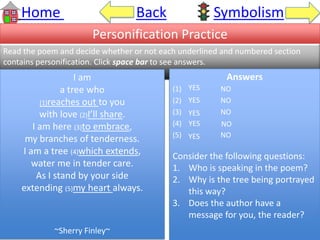
Personification Practice
Read the poem and decide whether or not each underlined and numbered section
contains personification. Click space bar to see answers.
I am
a tree who
(1)reaches out to you
with love (2)I’ll share.
I am here (3)to embrace,
my branches of tenderness.
I am a tree (4)which extends,
water me in tender care.
As I stand by your side
extending (5)my heart always.
~Sherry Finley~
Answers
(1) NO
(2) NO
(3) NO
(4) YES
(5) NO
Consider the following questions:
1. Who is speaking in the poem?
2. Why is the tree being portrayed
this way?
3. Does the author have a
message for you, the reader?
YES
YES
YES
NO
YES
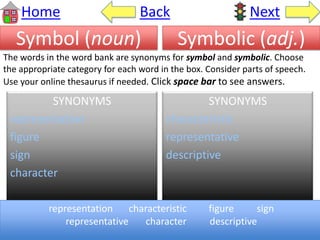
Symbol (noun)
SYNONYMS
representation
figure
sign
character
SYNONYMS
characteristic
representative
descriptive
Home Back Next
representation characteristic figure sign
representative character descriptive
The words in the word bank are synonyms for symbol and symbolic. Choose
the appropriate category for each word in the box. Consider parts of speech.
Use your online thesaurus if needed. Click space bar to see answers.
Symbolic (adj.)
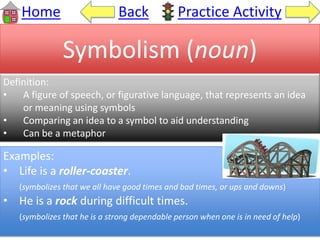
Symbolism (noun)
Definition:
• A figure of speech, or figurative language, that represents an idea
or meaning using symbols
• Comparing an idea to a symbol to aid understanding
• Can be a metaphor
Home Back Practice Activity
Examples:
• Life is a roller-coaster.
(symbolizes that we all have good times and bad times, or ups and downs)
• He is a rock during difficult times.
(symbolizes that he is a strong dependable person when one is in need of help)
Home Back What Have I Learned?
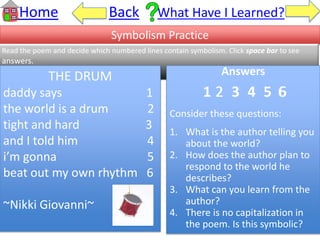
Symbolism Practice
Read the poem and decide which numbered lines contain symbolism. Click space bar to see
answers.
THE DRUM
daddy says 1
the world is a drum 2
tight and hard 3
and I told him 4
i’m gonna 5
beat out my own rhythm 6
~Nikki Giovanni~
Answers
1 2 3 4 5 6
Consider these questions:
1. What is the author telling you
about the world?
2. How does the author plan to
respond to the world he
describes?
3. What can you learn from the
author?
4. There is no capitalization in
the poem. Is this symbolic?
2 6
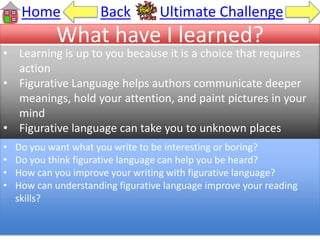
What have I learned?
• Learning is up to you because it is a choice that requires
action
• Figurative Language helps authors communicate deeper
meanings, hold your attention, and paint pictures in your
mind
• Figurative language can take you to unknown places
Home Back Ultimate Challenge
• Do you want what you write to be interesting or boring?
• Do you think figurative language can help you be heard?
• How can you improve your writing with figurative language?
• How can understanding figurative language improve your reading
skills?
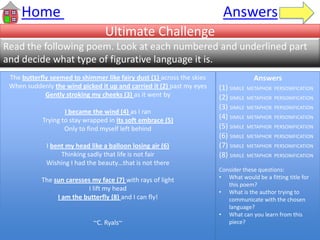
Ultimate Challenge
Read the following poem. Look at each numbered and underlined part
and decide what type of figurative language it is.
Home Answers
The butterfly seemed to shimmer like fairy dust (1) across the skies
When suddenly the wind picked it up and carried it (2) past my eyes
Gently stroking my cheeks (3) as it went by
I became the wind (4) as I ran
Trying to stay wrapped in its soft embrace (5)
Only to find myself left behind
I bent my head like a balloon losing air (6)
Thinking sadly that life is not fair
Wishing I had the beauty…that is not there
The sun caresses my face (7) with rays of light
I lift my head
I am the butterfly (8) and I can fly!
~C. Ryals~
Answers
(1) SIMILE METAPHOR PERSONIFICATION
(2) SIMILE METAPHOR PERSONIFICATION
(3) SIMILE METAPHOR PERSONIFICATION
(4) SIMILE METAPHOR PERSONIFICATION
(5) SIMILE METAPHOR PERSONIFICATION
(6) SIMILE METAPHOR PERSONIFICATION
(7) SIMILE METAPHOR PERSONIFICATION
(8) SIMILE METAPHOR PERSONIFICATION
Consider these questions:
• What would be a fitting title for
this poem?
• What is the author trying to
communicate with the chosen
language?
• What can you learn from this
piece?
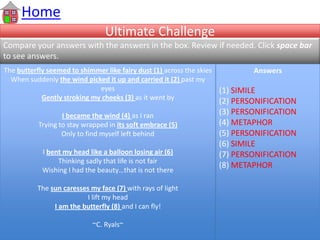
Ultimate Challenge
Compare your answers with the answers in the box. Review if needed. Click space bar
to see answers.
Home
The butterfly seemed to shimmer like fairy dust (1) across the skies
When suddenly the wind picked it up and carried it (2) past my
eyes
Gently stroking my cheeks (3) as it went by
I became the wind (4) as I ran
Trying to stay wrapped in its soft embrace (5)
Only to find myself left behind
I bent my head like a balloon losing air (6)
Thinking sadly that life is not fair
Wishing I had the beauty…that is not there
The sun caresses my face (7) with rays of light
I lift my head
I am the butterfly (8) and I can fly!
~C. Ryals~
Answers
(1) SIMILE
(2) PERSONIFICATION
(3) PERSONIFICATION
(4) METAPHOR
(5) PERSONIFICATION
(6) SIMILE
(7) PERSONIFICATION
(8) METAPHOR

Figurative Language

  • 1.
    The Power ofFigurative Language HOME Figurative Language Similes & Metaphors Personification Symbolism What have I learned? You can FIGURE it out! Figurative Language can help you read better, write better, and be heard! Let’s get started!
  • 2.
    Goal: Developing adeep understanding of figurative language and related vocabulary improves understanding of narratives and poetry. • 5th grade students will be able to define figure, figurative, language, similar, simile, metaphor, person, personification, symbol, and symbolism. Home What is Figurative Language? • Students will be able to evaluate sentence context and choose the correct vocabulary words to complete domain-specific questions • Students will be able to recognize and identify examples of similes, metaphors, and personification found in selected poetry. Objectives
  • 3.
    Figure (noun) SYNONYMS symbol number character celebrity sum total price SYNONYMS illustrative descriptive symbolic representative Home Next Illustrativesymbol descriptive number character celebrity symbolic representative sum total price The words in the word bank are synonyms for figure and figurative. Choose the appropriate category for each word in the box. Consider the parts of speech. Use the online thesaurus if needed. Click space bar to see answers. Figurative (adj.)
  • 4.
    Language (noun) SYNONYMS expression speech vocabulary voice wording conversation talk ANTONYMS quiet silence numbers Home Next expressionspeech quiet vocabulary voice silence wording conversation talk numbers The words in the word bank are synonyms and antonyms for language. Choose the appropriate category for each word in the box. Use your online thesaurus if needed. Click space bar to see answers.
  • 5.
    Figurative Language (noun) Definition: •Language that uses figures of speech, or words that represent an idea using symbols • Language that communicates ideas in an interesting way Home Similes & Metaphors Examples: • The eagle symbolizes a free nation because it soars freely • A bird can be used to describe a plane: The plane soared like a bird. Now it’s time to discover different types of figurative Language…
  • 6.
    Similar (adj.) SYNONYMS related alike connected SYNONYMS symbolical figurative descriptive Home BackNext symbolical related figurative alike connected descriptive The words in the word bank are synonyms for similar and metaphorical. Choose the appropriate category for each word in the box. Use your online thesaurus if needed. Click space bar to see answers. Metaphorical (adj.)
  • 7.
    Simile Definition: • A figureof speech, or figurative language, that compares two unlike things using like or as • Suggests two unlike things are similar Home Back Practice Activity 1 Metaphor Definition: • A figure of speech, or figurative language, that compares two unlike things by suggesting they are the same • Assigns new meaning to word Examples: • Eloise dances like a swan. • Josh runs as fast as lightening. Examples: • Eloise is a swan when she dances. • Josh is lightening when he runs.
  • 8.
    Home Back PracticeActivity 2 Simile & Metaphor Practice Activity 1 Determine whether each example is a simile or a metaphor. Go back and review if needed. Click space bar to see answers. 1. Lucy said my room is a pig pen! SIMILE 2. My dad said I am an angel. SIMILE 3. Jake climbs like a monkey. METAPHOR 4. My sister is a dragon. SIMILE 5. My hair is tangled like a sheep dog. METAPHOR 6. Our house is a zoo! SIMILE 7. My brother is as tall as a giraffe. METAPHOR 8. Mom is like a teddy bear. METAPHOR METAPHOR METAPHOR SIMILE METAPHOR SIMILE METAPHOR SIMILE SIMILE
  • 9.
    Home Back Personification Simile& Metaphor Practice 2 Read the following poem. Decide if each numbered and underlined part is a SIMILE or a METAPHOR. Click space bar to see answers. Dreams Hold fast to dreams For if dreams die Life is a broken-winged bird (1) That cannot fly. Hold fast to dreams For when dreams go Life is like a barren field (2) Frozen with snow. ~Langston Hughes~ Answers (1) SIMILE (2) METAPHOR Consider the following questions: 1. Why does the author use broken- winged bird and barren field to describe life? Are these positive or negative descriptions? 2. What causes life to be this way? 3. What is the author trying to say? 4. Can you learn from this poem? METAPHOR SIMILIE
  • 10.
    Person (noun) SYNONYMS human child adult me character individual SYNONYMS symbolize to copy actout impersonate represent Home Back Next human child symbolize adult me to copy character Act out impersonate individual represent The words in the word bank are synonyms for person and personify. Choose the appropriate category for each word in the box. Consider parts of speech. Use your online thesaurus if needed. Click space bar to see answers. Personify (verb)
  • 11.
    Personification (noun) Definition: • Figurativelanguage that gives human qualities to non-human things like animals, plants and other objects • Used when author creates non-human characters • Represents something in the form of a person Home Back Practice Activity Examples: • The trees danced in the wind. • The frog asked if he could kiss the princess. • The waves licked the shore as the storm approached.
  • 12.
    Home Back Symbolism PersonificationPractice Read the poem and decide whether or not each underlined and numbered section contains personification. Click space bar to see answers. I am a tree who (1)reaches out to you with love (2)I’ll share. I am here (3)to embrace, my branches of tenderness. I am a tree (4)which extends, water me in tender care. As I stand by your side extending (5)my heart always. ~Sherry Finley~ Answers (1) NO (2) NO (3) NO (4) YES (5) NO Consider the following questions: 1. Who is speaking in the poem? 2. Why is the tree being portrayed this way? 3. Does the author have a message for you, the reader? YES YES YES NO YES
  • 13.
    Symbol (noun) SYNONYMS representation figure sign character SYNONYMS characteristic representative descriptive Home BackNext representation characteristic figure sign representative character descriptive The words in the word bank are synonyms for symbol and symbolic. Choose the appropriate category for each word in the box. Consider parts of speech. Use your online thesaurus if needed. Click space bar to see answers. Symbolic (adj.)
  • 14.
    Symbolism (noun) Definition: • Afigure of speech, or figurative language, that represents an idea or meaning using symbols • Comparing an idea to a symbol to aid understanding • Can be a metaphor Home Back Practice Activity Examples: • Life is a roller-coaster. (symbolizes that we all have good times and bad times, or ups and downs) • He is a rock during difficult times. (symbolizes that he is a strong dependable person when one is in need of help)
  • 15.
    Home Back WhatHave I Learned? Symbolism Practice Read the poem and decide which numbered lines contain symbolism. Click space bar to see answers. THE DRUM daddy says 1 the world is a drum 2 tight and hard 3 and I told him 4 i’m gonna 5 beat out my own rhythm 6 ~Nikki Giovanni~ Answers 1 2 3 4 5 6 Consider these questions: 1. What is the author telling you about the world? 2. How does the author plan to respond to the world he describes? 3. What can you learn from the author? 4. There is no capitalization in the poem. Is this symbolic? 2 6
  • 16.
    What have Ilearned? • Learning is up to you because it is a choice that requires action • Figurative Language helps authors communicate deeper meanings, hold your attention, and paint pictures in your mind • Figurative language can take you to unknown places Home Back Ultimate Challenge • Do you want what you write to be interesting or boring? • Do you think figurative language can help you be heard? • How can you improve your writing with figurative language? • How can understanding figurative language improve your reading skills?
  • 17.
    Ultimate Challenge Read thefollowing poem. Look at each numbered and underlined part and decide what type of figurative language it is. Home Answers The butterfly seemed to shimmer like fairy dust (1) across the skies When suddenly the wind picked it up and carried it (2) past my eyes Gently stroking my cheeks (3) as it went by I became the wind (4) as I ran Trying to stay wrapped in its soft embrace (5) Only to find myself left behind I bent my head like a balloon losing air (6) Thinking sadly that life is not fair Wishing I had the beauty…that is not there The sun caresses my face (7) with rays of light I lift my head I am the butterfly (8) and I can fly! ~C. Ryals~ Answers (1) SIMILE METAPHOR PERSONIFICATION (2) SIMILE METAPHOR PERSONIFICATION (3) SIMILE METAPHOR PERSONIFICATION (4) SIMILE METAPHOR PERSONIFICATION (5) SIMILE METAPHOR PERSONIFICATION (6) SIMILE METAPHOR PERSONIFICATION (7) SIMILE METAPHOR PERSONIFICATION (8) SIMILE METAPHOR PERSONIFICATION Consider these questions: • What would be a fitting title for this poem? • What is the author trying to communicate with the chosen language? • What can you learn from this piece?
  • 18.
    Ultimate Challenge Compare youranswers with the answers in the box. Review if needed. Click space bar to see answers. Home The butterfly seemed to shimmer like fairy dust (1) across the skies When suddenly the wind picked it up and carried it (2) past my eyes Gently stroking my cheeks (3) as it went by I became the wind (4) as I ran Trying to stay wrapped in its soft embrace (5) Only to find myself left behind I bent my head like a balloon losing air (6) Thinking sadly that life is not fair Wishing I had the beauty…that is not there The sun caresses my face (7) with rays of light I lift my head I am the butterfly (8) and I can fly! ~C. Ryals~ Answers (1) SIMILE (2) PERSONIFICATION (3) PERSONIFICATION (4) METAPHOR (5) PERSONIFICATION (6) SIMILE (7) PERSONIFICATION (8) METAPHOR

Editor's Notes

  • #2 This page simplifies my goal into terms understood by 5th grade intervention studentsListing of Links include pictures that indicate something about each skillColors are used to divide categories, reduce confusion, and create atmosphere
  • #4 This page asks students to consider the root of figurative and how the words relate to each other in terms of parts of speech and how that alters meanings even though they are closely relatedUnderstanding what a figure is leads to a deeper understanding of figurative and how it uses figures to represent ideasJust as the title is in red, key terms will also be in red throughout the tutorial for ease of understanding and information location. Once students have decided which categories match the words, they can click spacebar to see answersIt is important for intervention students to never feel rushed when attempting to absorb difficult conceptsRushing students leads to shut down, choosing any answer just to move on, and blocks critical thinking patterns
  • #5 This page asks students to consider what language is and what it isn’tExploring opposite ideas of a term helps to solidify understanding of what it isA deeper understanding of language as an entity by itself will lead to a deeper understanding of different types of language, like figurativeOnce students have decided which categories match the words, they can click space bar to see answersStudents may take all the time they need to reflect on answers before moving on
  • #6 This page provides a simple definition using familiar languageThe definition includes why figurative language is usedStudent must be respected and told why a skill applies to their life of is important in helping them reach their personal goalsExamples are given to provide a visualStudents may study definition and examples as long as is needed before moving on
  • #7 Students are asked to explore two words that will help them connect to simile and metaphorThe thesaurus will most likely be used by all students on this page. It is meant to ensure they use the online thesaurus at least once during the tutorial to enforce habits that are stressed in the classroom setting.Once students have decided which categories match the words, they can click space bar to see answersStudents can move forward when readyStudent can move forward
  • #8 This page simplifies the definitions of simile and metaphor while comparing and contrasting the two ideasFigurative language and figure of speech is used in each definition to clarify that these skills are types of figurative language, they are one and the sameExamples give a visual of how the author can use these skills while contrasting the differences between the twoStudents can move to practice activity when ready, they will have the option to come back to this page if needed during the exercise
  • #9 Once students complete exercise, they can click to see correct answersStudents can move to activity 2 when ready, or go back and review
  • #10 After students select answers they can click to see correct answersStudents are provided questions to ponder, which lead to critical thinking about the messageQuestions are also written so that students reflect and make connections about the power of wordingStudents can move forward to personification when ready
  • #11 This page asks students to consider the root of personify and personification and how the words relate to each other in terms of parts of speech and how that alters meanings even though they are closely relatedUnderstanding person and personify leads to a deeper understanding of personification and how it is used to represent ideasOnce students have decided which categories match the words, they can click to see answersStudent may choose to move forward at his or her own pace
  • #12 This page simplifies the definition of personification Figurative language is used in the definition to clarify that this skills is a type of figurative language, they are one and the sameExamples give a visual of how the author can use these skills to bring non-human things to lifeStudents can move to practice activity when ready, they will have the option to come back to this page if needed during the exercise
  • #13 After students select answers, they can click space bar to see answersStudents are provided questions to ponder, which lead to critical thinking about the messageQuestions are also written so that students reflect and make connections about the power of wordingStudents can move forward to symbolism when ready
  • #14 This page asks students to consider the root of symbolic and symbolism and how the words relate to each other in terms of parts of speech and how that alters meanings even though they are closely relatedUnderstanding what a symbol is leads to a deeper understanding of symbolic and symbolism and how it uses symbols to represent ideasOnce students have decided which categories match the words, they can click space bar to see answersStudent may choose to move forward at his or her own pace
  • #15 This page simplifies the definition of symbolism Figurative language, figure of speech, and metaphor are used in the definition to clarify that this skills is a type of figurative language, they are one and the sameExamples give a visual of how the author can use symbols to portray ideas and characteristicsStudents can move to practice activity when ready, they will have the option to come back to this page if needed during the exercise
  • #16 After students select answers, they can click space bar for answersStudents are provided questions to ponder, which lead to critical thinking about the messageQuestions are also written so that students reflect and make connections about the power of wordingStudents can move forward to What I Learned when ready
  • #18 This page allows students to review by practicing what they learnedAfter students select answers, they can move to the next page to see the correct answersStudents are provided questions to ponder, which lead to critical thinking about the messageQuestions are also written so that students reflect and make connections about the power of wording
  • #19 This page allows students to review by practicing what they learnedCorrectanswers will appear so that students can review choicesStudents are provided questions to ponder, which lead to critical thinking about the messageQuestions are also written so that students reflect and make connections about the power of wording