Personas that change the
way you think
Gundega Lazdāne CBAP, Business analysis team lead at FMS, Latvia
Armands Ķirītis, Msc. Comp, Product owner at FMS, Latvia
Agenda
• Who are persons
• Who are Personas
• How to create Personas
• How to use Personas
• A practical example by Armands Ķirītis
Gundega Lazdāne, CBAP
• Ing. Sc. Masters degree
• 15 years in Business Analysis
• BA team lead at FMS
• President of Latvia IIBA® chapter
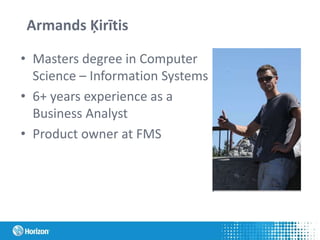
Armands Ķirītis
• Masters degree in Computer
Science – Information Systems
• 6+ years experience as a
Business Analyst
• Product owner at FMS
• One of the largest software companies in
Latvia complying ISO 9001:2009
• ERP system Horizon, System integration, BI
• R&D laboratory
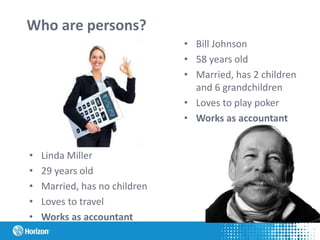
Who are persons?
• Linda Miller
• 29 years old
• Married, has no children
• Loves to travel
• Works as accountant
• Bill Johnson
• 58 years old
• Married, has 2 children
and 6 grandchildren
• Loves to play poker
• Works as accountant
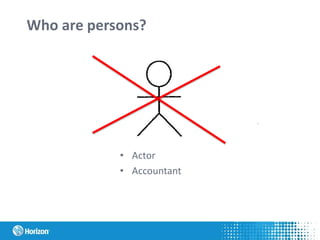
Who are persons?
• Actor
• Accountant
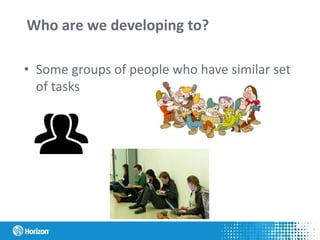
Who are we developing to?
• Some groups of people who have similar set
of tasks
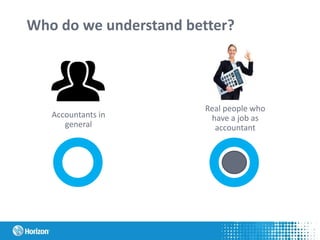
Who do we understand better?
Accountants in
general
Real people who
have a job as
accountant
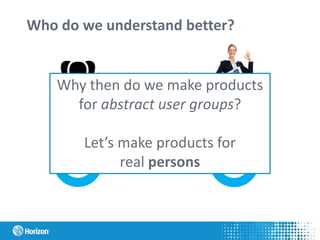
Who do we understand better?
Accountants in
general
Real people who
have a job as an
accountant
Why then do we make products
for abstract user groups?
Let’s make products for
real persons
Challenge:
• All people aren’t similar – if we create a
product based on requirements of a few
users, others won’t like it
Solution:
• Personas – real people alike archetypes that
are based on real-world data about user
groups
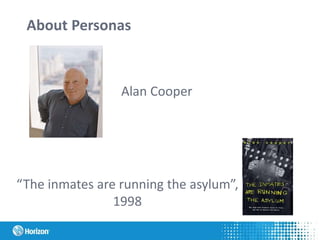
About Personas
“The inmates are running the asylum”,
1998
Alan Cooper
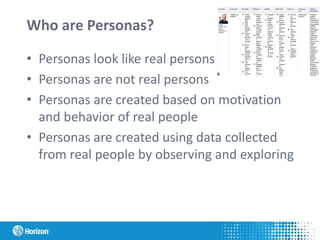
Who are Personas?
• Personas look like real persons
• Personas are not real persons
• Personas are created based on motivation
and behavior of real people
• Personas are created using data collected
from real people by observing and exploring
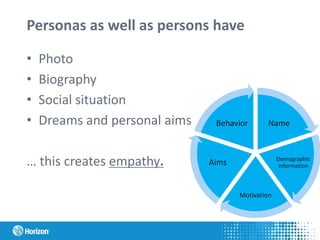
Personas as well as persons have
• Photo
• Biography
• Social situation
• Dreams and personal aims
… this creates empathy.
Name
Demographic
information
Motivation
Aims
Behavior
Personas as well as persons have
• Photo
• Biography
• Social situation
• Dreams and personal aims
… this creates empathy.
Name
Demographic
information
Motivation
Aims
Behavior
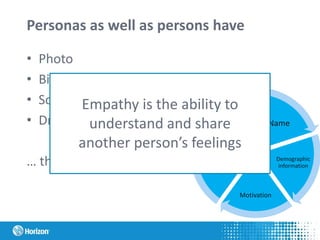
Empathy is the ability to
understand and share
another person’s feelings
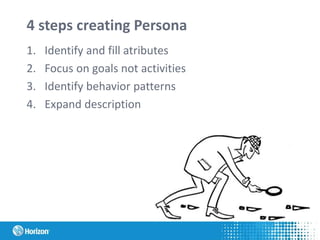
4 steps creating Persona
1. Identify and fill atributes
2. Focus on goals not activities
3. Identify behavior patterns
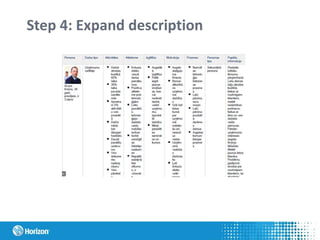
4. Expand description
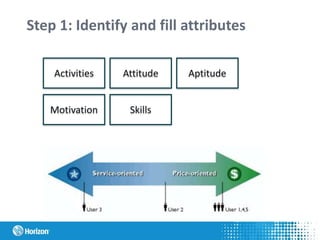
Step 1: Identify and fill attributes
Activities Attitude Aptitude
Motivation Skills
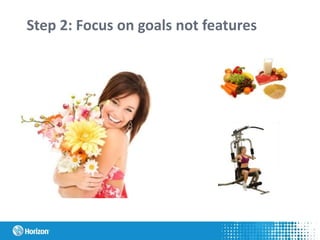
Step 2: Focus on goals not features
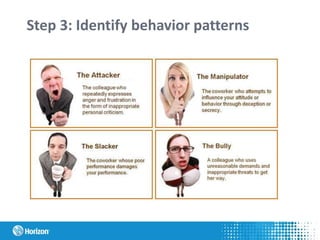
Step 3: Identify behavior patterns
Step 4: Expand description
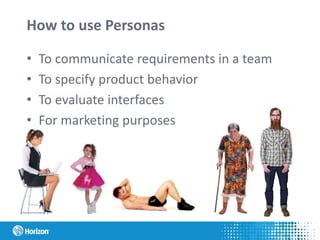
How to use Personas
• To communicate requirements in a team
• To specify product behavior
• To evaluate interfaces
• For marketing purposes
The Horizon WEB 2.0
Persona based improvement
• The most popular ERP system in Latvia
– About 30% of the market,
– About 80% of the public sector
• Desktop application
• 1500 clients (public and private sector)
• More than 20 years of development
Horizon WEB
• WEB counterpart of the Horizon system
• Self-service for employees
• Some specific usages for operators covered
History of Horizon WEB
• Was developed to make some functions
more accessible via WEB interface
• The functionality is expanded over time
The problem
• 20+ years of experience with ERP that is
meant for advanced users
• Implementing the WEB product in similar
style and interface as desktop Horizon
• Users aren’t always happy with the UI/UX of
the system as it is more document oriented
than user oriented
The job to do
• Find a method that allows us to transform
the system from document-focused to user-
focused
• Utilize that method
• Improve the UX by remaking the product
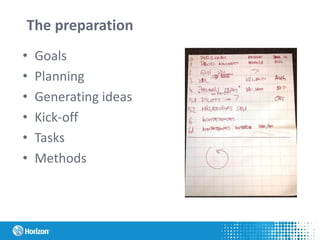
The preparation
• Goals
• Planning
• Generating ideas
• Kick-off
• Tasks
• Methods
The Personas – why?
• Several authors recommend this method as
very user-centric, for example, Scott
Klemmer, Marty Cagan
• Good feedback from practitioners
Our approach
• We have a lot of information about our
users:
– Regular seminars and meetings
– Client requests online
– Other ways to get feedback
• This information: the basis for creating
Personas
• Additional interviews for extra info and
observation
Creating a list of behavioral variables
Activities
• Office based or mobile
• Percentage of activities in product domain
• Few or many parallel tasks
Attitudes
• Attitude towards information systems
• Attitude towards electronic devices
Aptitudes
• Education level
• Additional courses taken
Motivations
• Salary level
• Enthusiastic about work
• Workload
Skills
• Computer user skills
• Communication skills
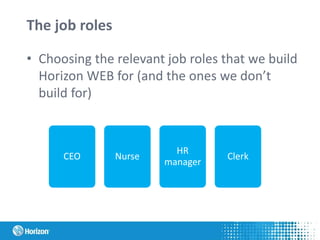
The job roles
• Choosing the relevant job roles that we build
Horizon WEB for (and the ones we don’t
build for)
CEO Nurse
HR
manager
Clerk
Continuing the work
• Process information about the subjects –
chosen from various job roles
• Investigating the variable values for those
roles
• Creating behavioral patterns for the roles
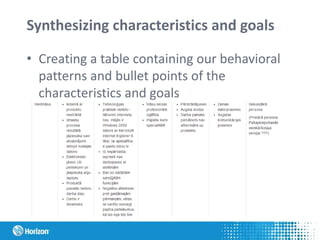
Synthesizing characteristics and goals
• Creating a table containing our behavioral
patterns and bullet points of the
characteristics and goals
Checking for redundancy and
completeness
• As the roles were planned in order to be
distinct, we didn’t find any redundancy
• By additional interviews found some roles
missing
• Added the information about the missing
roles and their behavioral patterns
Expanding description of attributes
• Adding a description about the person, a
narrative
• Still containing the bullet points for
completeness – a combination of both
narration and structure
• A photo found in the Internet that describes
the person
Assigning the persona types
• Positive personas: primary, secondary,
supplemental
• Negative personas
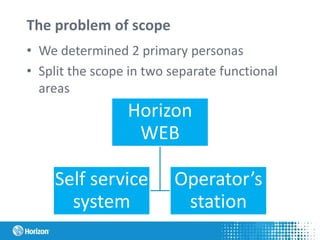
The problem of scope
• We determined 2 primary personas
• Split the scope in two separate functional
areas
Horizon
WEB
Self service
system
Operator’s
station
Reassigning the persona types
• Splitting the persona types to both self-
service and operator’s station
• Several personas are excluded from the
scope of operator’s stations as they do not
use this functionality
• Some personas are added as negative
persons for the self-service area as they do
not fit the user we’re building the self-
service system for
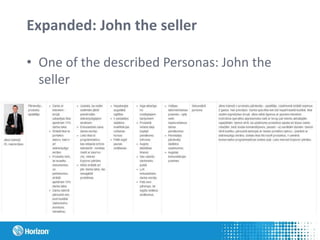
Expanded: John the seller
• One of the described Personas: John the
seller
The requirements
• Writing context scenarios for the primary
and some of the secondary personas
• Their typical workday involving the usage of
Horizon WEB
• Defining the requirements for improvements
The implementation
• The Horizon WEB 2.0
– New focus – the user
– New technology (WEB forms --> MVC)
• The system is modular: implementing the
changes in one module at a time
The benefits
• We had a set of characteristics for the
people we build the product for
• Terminology change: we develop for the
personas who have names (empathy)
• The priorities of requirements are defined
by the persona they’re derived from
The benefits
• User testing: we can do user testing from
the viewpoint of a persona without involving
real users at first
• Personas can also be used for creating
marketing material
Our results
• The first round changes in first specific
module: Document Circulation are already
implemented and delivered to our clients
• We did:
– User testing
– Surveys
– Analysis of usage logs
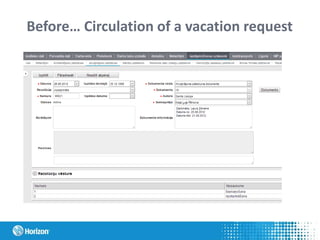
Before… Circulation of a vacation request
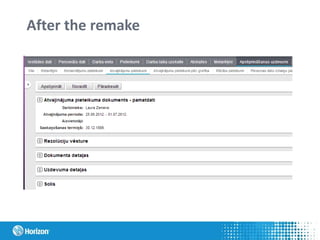
After the remake
Further perspective
• Remaking other modules in the same way
• The personas are reusable for future
projects thus making them a good tool for
long term product development
Pros and challenges
• Better understanding of end users
• The personas can be used as a
communication tool in the team
• The method brings results
• More analysis has to be done at first
• The thinking and development principles
have to be changed
Reading & learning suggestions
• Alan Cooper: About Face 3,
http://www.amazon.com/About-Face-Essentials-Interaction-Design/dp/0470084111
• Tamara Adlin, John Pruitt: The Essential
Persona Lifecycle
http://www.amazon.com/The-Essential-Persona-Lifecycle-Building/dp/0123814189
• Chris Nodder, Lynda.com course “UX Design
Techniques: Creating Personas”
http://www.lynda.com/Web-User-Experience-tutorials/UX-Design-Techniques-Creating-Personas/144082-2.html
• Scott Klemmer: Human-Computer
Interaction, course in Coursera, started on
30.06.2014.,
https://www.coursera.org/course/hciucsd
Thank you for your attention

Personas that change the way you think

  • 1.
    Personas that changethe way you think Gundega Lazdāne CBAP, Business analysis team lead at FMS, Latvia Armands Ķirītis, Msc. Comp, Product owner at FMS, Latvia
  • 2.
    Agenda • Who arepersons • Who are Personas • How to create Personas • How to use Personas • A practical example by Armands Ķirītis
  • 3.
    Gundega Lazdāne, CBAP •Ing. Sc. Masters degree • 15 years in Business Analysis • BA team lead at FMS • President of Latvia IIBA® chapter
  • 4.
    Armands Ķirītis • Mastersdegree in Computer Science – Information Systems • 6+ years experience as a Business Analyst • Product owner at FMS
  • 5.
    • One ofthe largest software companies in Latvia complying ISO 9001:2009 • ERP system Horizon, System integration, BI • R&D laboratory
  • 6.
    Who are persons? •Linda Miller • 29 years old • Married, has no children • Loves to travel • Works as accountant • Bill Johnson • 58 years old • Married, has 2 children and 6 grandchildren • Loves to play poker • Works as accountant
  • 7.
    Who are persons? •Actor • Accountant
  • 8.
    Who are wedeveloping to? • Some groups of people who have similar set of tasks
  • 9.
    Who do weunderstand better? Accountants in general Real people who have a job as accountant
  • 10.
    Who do weunderstand better? Accountants in general Real people who have a job as an accountant Why then do we make products for abstract user groups? Let’s make products for real persons
  • 11.
    Challenge: • All peoplearen’t similar – if we create a product based on requirements of a few users, others won’t like it Solution: • Personas – real people alike archetypes that are based on real-world data about user groups
  • 12.
    About Personas “The inmatesare running the asylum”, 1998 Alan Cooper
  • 13.
    Who are Personas? •Personas look like real persons • Personas are not real persons • Personas are created based on motivation and behavior of real people • Personas are created using data collected from real people by observing and exploring
  • 14.
    Personas as wellas persons have • Photo • Biography • Social situation • Dreams and personal aims … this creates empathy. Name Demographic information Motivation Aims Behavior
  • 15.
    Personas as wellas persons have • Photo • Biography • Social situation • Dreams and personal aims … this creates empathy. Name Demographic information Motivation Aims Behavior Empathy is the ability to understand and share another person’s feelings
  • 16.
    4 steps creatingPersona 1. Identify and fill atributes 2. Focus on goals not activities 3. Identify behavior patterns 4. Expand description
  • 17.
    Step 1: Identifyand fill attributes Activities Attitude Aptitude Motivation Skills
  • 18.
    Step 2: Focuson goals not features
  • 19.
    Step 3: Identifybehavior patterns
  • 20.
    Step 4: Expanddescription
  • 21.
    How to usePersonas • To communicate requirements in a team • To specify product behavior • To evaluate interfaces • For marketing purposes
  • 22.
    The Horizon WEB2.0 Persona based improvement
  • 23.
    • The mostpopular ERP system in Latvia – About 30% of the market, – About 80% of the public sector • Desktop application • 1500 clients (public and private sector) • More than 20 years of development
  • 24.
    Horizon WEB • WEBcounterpart of the Horizon system • Self-service for employees • Some specific usages for operators covered
  • 25.
    History of HorizonWEB • Was developed to make some functions more accessible via WEB interface • The functionality is expanded over time
  • 26.
    The problem • 20+years of experience with ERP that is meant for advanced users • Implementing the WEB product in similar style and interface as desktop Horizon • Users aren’t always happy with the UI/UX of the system as it is more document oriented than user oriented
  • 27.
    The job todo • Find a method that allows us to transform the system from document-focused to user- focused • Utilize that method • Improve the UX by remaking the product
  • 28.
    The preparation • Goals •Planning • Generating ideas • Kick-off • Tasks • Methods
  • 29.
    The Personas –why? • Several authors recommend this method as very user-centric, for example, Scott Klemmer, Marty Cagan • Good feedback from practitioners
  • 30.
    Our approach • Wehave a lot of information about our users: – Regular seminars and meetings – Client requests online – Other ways to get feedback • This information: the basis for creating Personas • Additional interviews for extra info and observation
  • 31.
    Creating a listof behavioral variables Activities • Office based or mobile • Percentage of activities in product domain • Few or many parallel tasks Attitudes • Attitude towards information systems • Attitude towards electronic devices Aptitudes • Education level • Additional courses taken Motivations • Salary level • Enthusiastic about work • Workload Skills • Computer user skills • Communication skills
  • 32.
    The job roles •Choosing the relevant job roles that we build Horizon WEB for (and the ones we don’t build for) CEO Nurse HR manager Clerk
  • 33.
    Continuing the work •Process information about the subjects – chosen from various job roles • Investigating the variable values for those roles • Creating behavioral patterns for the roles
  • 34.
    Synthesizing characteristics andgoals • Creating a table containing our behavioral patterns and bullet points of the characteristics and goals
  • 35.
    Checking for redundancyand completeness • As the roles were planned in order to be distinct, we didn’t find any redundancy • By additional interviews found some roles missing • Added the information about the missing roles and their behavioral patterns
  • 36.
    Expanding description ofattributes • Adding a description about the person, a narrative • Still containing the bullet points for completeness – a combination of both narration and structure • A photo found in the Internet that describes the person
  • 37.
    Assigning the personatypes • Positive personas: primary, secondary, supplemental • Negative personas
  • 38.
    The problem ofscope • We determined 2 primary personas • Split the scope in two separate functional areas Horizon WEB Self service system Operator’s station
  • 39.
    Reassigning the personatypes • Splitting the persona types to both self- service and operator’s station • Several personas are excluded from the scope of operator’s stations as they do not use this functionality • Some personas are added as negative persons for the self-service area as they do not fit the user we’re building the self- service system for
  • 40.
    Expanded: John theseller • One of the described Personas: John the seller
  • 41.
    The requirements • Writingcontext scenarios for the primary and some of the secondary personas • Their typical workday involving the usage of Horizon WEB • Defining the requirements for improvements
  • 42.
    The implementation • TheHorizon WEB 2.0 – New focus – the user – New technology (WEB forms --> MVC) • The system is modular: implementing the changes in one module at a time
  • 43.
    The benefits • Wehad a set of characteristics for the people we build the product for • Terminology change: we develop for the personas who have names (empathy) • The priorities of requirements are defined by the persona they’re derived from
  • 44.
    The benefits • Usertesting: we can do user testing from the viewpoint of a persona without involving real users at first • Personas can also be used for creating marketing material
  • 45.
    Our results • Thefirst round changes in first specific module: Document Circulation are already implemented and delivered to our clients • We did: – User testing – Surveys – Analysis of usage logs
  • 46.
    Before… Circulation ofa vacation request
  • 47.
  • 48.
    Further perspective • Remakingother modules in the same way • The personas are reusable for future projects thus making them a good tool for long term product development
  • 49.
    Pros and challenges •Better understanding of end users • The personas can be used as a communication tool in the team • The method brings results • More analysis has to be done at first • The thinking and development principles have to be changed
  • 50.
    Reading & learningsuggestions • Alan Cooper: About Face 3, http://www.amazon.com/About-Face-Essentials-Interaction-Design/dp/0470084111 • Tamara Adlin, John Pruitt: The Essential Persona Lifecycle http://www.amazon.com/The-Essential-Persona-Lifecycle-Building/dp/0123814189 • Chris Nodder, Lynda.com course “UX Design Techniques: Creating Personas” http://www.lynda.com/Web-User-Experience-tutorials/UX-Design-Techniques-Creating-Personas/144082-2.html • Scott Klemmer: Human-Computer Interaction, course in Coursera, started on 30.06.2014., https://www.coursera.org/course/hciucsd
  • 51.
    Thank you foryour attention