Personal protective
equipment safety
Group 1
• Dawn Eugenio D. Bunda
• Jericho De La Torre
• Billy Jhim Ariate
Herrera
• Jan Kervy Buenafe
PPE SAFETY
• Wear appropriate personal protective equipment
(PPE)
• Familiarize yourself with the lab layout and
equipment
• Read and understand safety guidelines and protocols
• Never perform work alone
• Follow proper personal hygiene practices
• Head Protection
• 1. Hard Hats: Protects against falling objects, electrical hazards, and
head impacts.
• 2. Safety Helmets: Similar to hard hats, with additional features like
visors or ear protection.
• 3. Bump Caps: Protects against minor head bumps and scrapes.
• Eye and Face Protection
• 1. Safety Glasses: Protects eyes from chemical splashes, dust, and
debris.
• 2. Goggles: Provides additional protection for eyes, including chemical
splashes and impact.
• 3. Face Shields: Protects face from chemical splashes, biological fluids,
and impact
• Hand Protection
• - Gloves: Provide protection against chemicals, sharp objects, electrical
hazards, and extreme temperatures. Types include:
• - Rubber gloves: For chemical and electrical protection.
• - Cut-resistant gloves: For sharp object protection.
• - Heat-resistant gloves: Used when handling hot materials or machinery.
• Foot Protection
• - Safety Boots/Shoes: Protect feet from heavy objects, falling debris,
sharp objects, and electric hazards.
• - Steel-toed Boots: Have reinforced toes to protect against impacts.
• - Non-slip Shoes: Prevent slips in wet or oily environments.
• Fall Protection
• 1. Harnesses: Prevents falls from heights.
• 2. Lanyards: Connects harnesses to anchor points.
• 3. Safety Nets: Catch-falls
• safety netting.
• Specialized PPE
• 1. Fire-Resistant Clothing:
• Protects against flames, heat.
• 2. Electrical Arc Flash PPE:
• Protects against electrical arcs.
• 3. Chemical-Resistant Suits:
• Respiratory Protection
• 1. N95 Masks: Filters 95% of airborne particles, including dust, bacteria, and viruse
• 2. Half-Face Respirators:
• Protects against organic vapors, dust, and particles.
• 3. Full-Face Respirators:
• Provides comprehensive respiratory protection.
• 4. Powered Air-Purifying
• Respirators (PAPRs):
• Advanced respiratory protection.
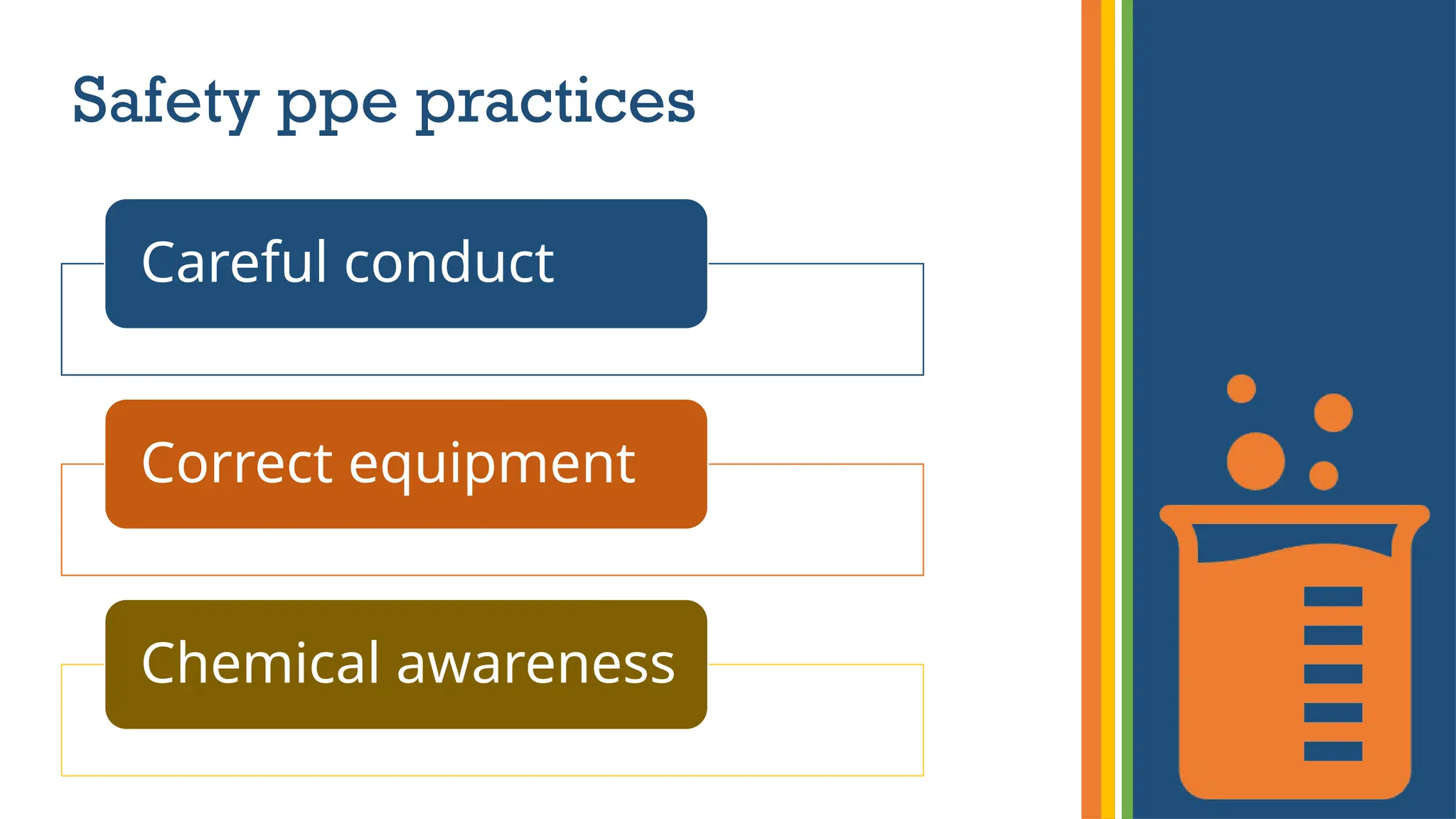
Safety ppe practices
Careful conduct
Correct equipment
Chemical awareness
Safety practices
Three key elements of ppe safety
Proper waste disposal
Emergency
preparedness
Labeling and storage
At the end of your time…
• Clean up: Thoroughly clean and organize your workspace, including removing
any spills, disposing of waste properly, and returning equipment to its
designated storage area.
• Properly store chemicals: Ensure all chemicals are stored securely in their
designated storage locations, with proper labeling and lids tightly closed. Check
for any expired or deteriorated chemicals and report them for disposal.
• Shutdown equipment: Turn off all equipment used during the session. This
includes gas valves, heating devices, and electrical equipment. Return shared
equipment to its default setting.
• Wash up: Practice good personal hygiene by washing your hands and removing
any lab coats or gloves before leaving the area. Prevent potential contamination
by leaving the lab environment clean and safe for others.
Safety first,
always! Thanks g
weep

Personal protective equipment safety.pptx

  • 1.
    Personal protective equipment safety Group1 • Dawn Eugenio D. Bunda • Jericho De La Torre • Billy Jhim Ariate Herrera • Jan Kervy Buenafe
  • 2.
    PPE SAFETY • Wearappropriate personal protective equipment (PPE) • Familiarize yourself with the lab layout and equipment • Read and understand safety guidelines and protocols • Never perform work alone • Follow proper personal hygiene practices
  • 3.
    • Head Protection •1. Hard Hats: Protects against falling objects, electrical hazards, and head impacts. • 2. Safety Helmets: Similar to hard hats, with additional features like visors or ear protection. • 3. Bump Caps: Protects against minor head bumps and scrapes. • Eye and Face Protection • 1. Safety Glasses: Protects eyes from chemical splashes, dust, and debris. • 2. Goggles: Provides additional protection for eyes, including chemical splashes and impact. • 3. Face Shields: Protects face from chemical splashes, biological fluids, and impact
  • 4.
    • Hand Protection •- Gloves: Provide protection against chemicals, sharp objects, electrical hazards, and extreme temperatures. Types include: • - Rubber gloves: For chemical and electrical protection. • - Cut-resistant gloves: For sharp object protection. • - Heat-resistant gloves: Used when handling hot materials or machinery. • Foot Protection • - Safety Boots/Shoes: Protect feet from heavy objects, falling debris, sharp objects, and electric hazards. • - Steel-toed Boots: Have reinforced toes to protect against impacts. • - Non-slip Shoes: Prevent slips in wet or oily environments.
  • 5.
    • Fall Protection •1. Harnesses: Prevents falls from heights. • 2. Lanyards: Connects harnesses to anchor points. • 3. Safety Nets: Catch-falls • safety netting. • Specialized PPE • 1. Fire-Resistant Clothing: • Protects against flames, heat. • 2. Electrical Arc Flash PPE: • Protects against electrical arcs. • 3. Chemical-Resistant Suits:
  • 6.
    • Respiratory Protection •1. N95 Masks: Filters 95% of airborne particles, including dust, bacteria, and viruse • 2. Half-Face Respirators: • Protects against organic vapors, dust, and particles. • 3. Full-Face Respirators: • Provides comprehensive respiratory protection. • 4. Powered Air-Purifying • Respirators (PAPRs): • Advanced respiratory protection.
  • 7.
    Safety ppe practices Carefulconduct Correct equipment Chemical awareness
  • 8.
    Safety practices Three keyelements of ppe safety Proper waste disposal Emergency preparedness Labeling and storage
  • 9.
    At the endof your time… • Clean up: Thoroughly clean and organize your workspace, including removing any spills, disposing of waste properly, and returning equipment to its designated storage area. • Properly store chemicals: Ensure all chemicals are stored securely in their designated storage locations, with proper labeling and lids tightly closed. Check for any expired or deteriorated chemicals and report them for disposal. • Shutdown equipment: Turn off all equipment used during the session. This includes gas valves, heating devices, and electrical equipment. Return shared equipment to its default setting. • Wash up: Practice good personal hygiene by washing your hands and removing any lab coats or gloves before leaving the area. Prevent potential contamination by leaving the lab environment clean and safe for others.
  • 10.