Personality
A distinctive pattern of
behavior, thoughts, motives
and emotions that
characterizes an individual
over time
Identity
A person’s perception of
one’s self as a unique
person / individual
Perspectives of Personality and
Identity Development
A. Biological
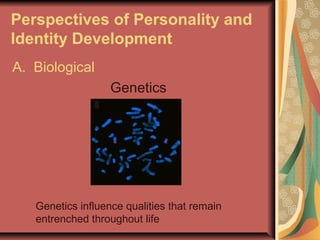
Genetics

Genetics influence qualities that remain
entrenched throughout life
For instance, Temperament
Individual differences in temperament
(ways of reacting to environment)
emerge early in life (and may exist
prenatally) and subsequently influence
personality development
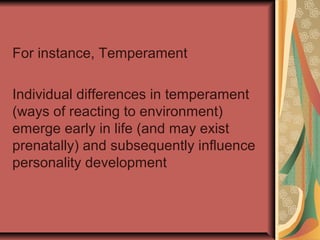
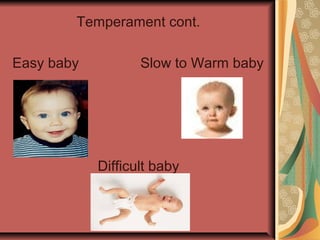
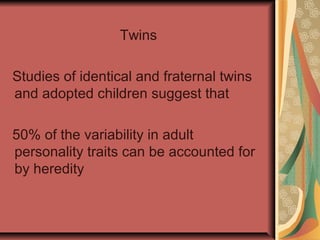
Temperament cont.
Easy baby

Slow to Warm baby

Difficult baby
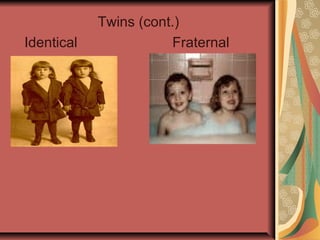
Twins
Studies of identical and fraternal twins
and adopted children suggest that
50% of the variability in adult
personality traits can be accounted for
by heredity
Identical

Twins (cont.)
Fraternal
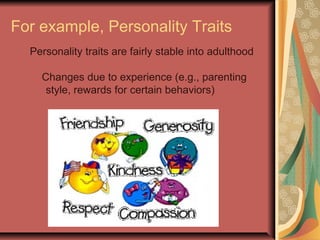
For example, Personality Traits
Personality traits are fairly stable into adulthood
Changes due to experience (e.g., parenting
style, rewards for certain behaviors)
B. Learning
People have distinctive life (and
learning) experiences
Behavior based on previous
experiences and the consequences of
those experiences
– People don’t have personality
traits, they simply show certain
behavior patterns
– Feelings, thoughts and values are
also learned behavior patterns
– Labels (e.g., aggressive) are
shorthand for the behavior they
demonstrate in certain situations
(e.g., when confronted with a line
at DMV, curse at clerk)
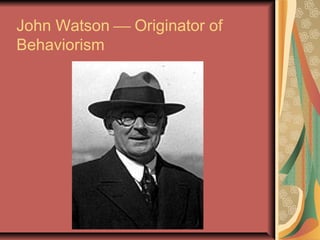
John Watson  Originator of
Behaviorism
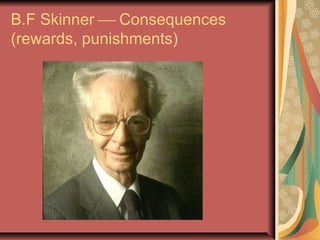
B.F Skinner  Consequences
(rewards, punishments)
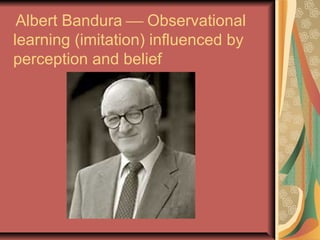
Albert Bandura  Observational
learning (imitation) influenced by
perception and belief
Bandura’s
Principles

Certain acts will be rewarded and others
punished, so people develop expectations
about whether their efforts will be
successful (“Why study if it has never
resulted in better grades?”)
Self-fulfilling Prophecy  A person’s
expectation leads to behavior that makes
the prediction come true (I expect to
succeed, so I work hard and then succeed
or I expect to fail, so I don’t try and then fail
C. Cultural

Complete this sentence “I am . . .”
Individualistic Cultures
Independence of individual
takes precedence over needs
of group
Self is often defined as a
collection of personality traits
(outgoing) or occupations (a
psychologist)
Collectivistic Cultures
Harmony of group takes
precedence over individual
wishes
Self is defined in context of
relationships (mother) and the
community (supporter of the
arts)
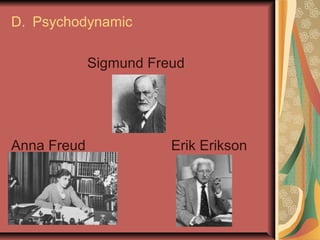
D. Psychodynamic
Sigmund Freud

Anna Freud

Erik Erikson
People are not rational, but governed by
instincts and emotions
– Movement of psychological energy
within a person’s mind
–Adult personality and ongoing
problems are formed primarily by
experiences during first 6 years of life
–Personality development occurs in
fixed stages, during which predictable
mental events occur and unconscious
issues or crises must be resolved
Sexual energy takes different forms
as child matures

1. Oral
2. Anal
3. Phallic
Adult personality determined by
How you progressed
What defense mechanisms you learned
to reduce anxiety
Whether ego internal referee (ego) is
strong enough to balance the conflict
between what you’d like to do (id) and
was your conscience (superego) is telling
you that you must do
Focus on fantasies and symbolic
meanings of events as the unconscious
mind perceives them, rather than on
actual experiences, as the main influences
on personality and behavior
Reliance on subjective rather than
objective methods of getting at the truth
(dream analysis, free association)
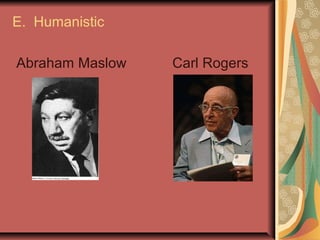
E. Humanistic
Abraham Maslow

Carl Rogers
People are active in determining their own
course of development toward goal of selfactualization
– Strive for lives that are meaningful,
challenging and satisfying
– Fully functioning people experience
harmony between the image they project
to others and their true feelings and
wishes
– Trusting, warm, open
Focus on positive aspects of human nature
(joy, love, happiness)
Freedom of choice and free will
We need “Unconditional Positive Regard”
 Love and support for another person

without any strings (or “conditions”)
attached

– It is the behavior, not the child, that is
bad or unacceptable
How do we integrate these
theories ?
 These 5 theoretical approaches
display a complex set of qualities
that make up our personality, our
identity
 Integrate by considering two
dimensions
Public Persona  characteristic habits
and temperaments and basic traits
Based on biology, learning and culture

Private Persona  Sense of self and
subjective experience of emotions,
memories, dreams, wishes and worries
Psychodynamic & humanistic theories
How Do These Theories Apply in
the Caribbean?
Dispersal of families during slavery
resulted in an extended family comprised
of people related by marriage and blood,
as well as godparents and adopted
children whose adoption is informal, and
friends
These communal families are being
broken down by the impact of capitalism
and the western focus on nuclear families
Children often do not live with two
biological parents throughout their
childhood, when identity is being
formed
All the theories (except biological)
predict that formation of personal
identity is easiest and most
successful when there is constancy
and consistency in parenting
Reading assignments for Personal
Identity:
None.
Think about your child rearing
experience and the factors that
influenced your personal identity.

PERSONAL IDENTITY

  • 2.
    Personality A distinctive patternof behavior, thoughts, motives and emotions that characterizes an individual over time
  • 3.
    Identity A person’s perceptionof one’s self as a unique person / individual
  • 4.
    Perspectives of Personalityand Identity Development A. Biological Genetics Genetics influence qualities that remain entrenched throughout life
  • 5.
    For instance, Temperament Individualdifferences in temperament (ways of reacting to environment) emerge early in life (and may exist prenatally) and subsequently influence personality development
  • 6.
    Temperament cont. Easy baby Slowto Warm baby Difficult baby
  • 7.
    Twins Studies of identicaland fraternal twins and adopted children suggest that 50% of the variability in adult personality traits can be accounted for by heredity
  • 8.
  • 9.
    For example, PersonalityTraits Personality traits are fairly stable into adulthood Changes due to experience (e.g., parenting style, rewards for certain behaviors)
  • 10.
    B. Learning People havedistinctive life (and learning) experiences Behavior based on previous experiences and the consequences of those experiences
  • 11.
    – People don’thave personality traits, they simply show certain behavior patterns – Feelings, thoughts and values are also learned behavior patterns – Labels (e.g., aggressive) are shorthand for the behavior they demonstrate in certain situations (e.g., when confronted with a line at DMV, curse at clerk)
  • 12.
    John Watson Originator of Behaviorism
  • 13.
    B.F Skinner Consequences (rewards, punishments)
  • 14.
    Albert Bandura Observational learning (imitation) influenced by perception and belief
  • 15.
    Bandura’s Principles Certain acts willbe rewarded and others punished, so people develop expectations about whether their efforts will be successful (“Why study if it has never resulted in better grades?”) Self-fulfilling Prophecy  A person’s expectation leads to behavior that makes the prediction come true (I expect to succeed, so I work hard and then succeed or I expect to fail, so I don’t try and then fail
  • 16.
    C. Cultural Complete thissentence “I am . . .”
  • 17.
    Individualistic Cultures Independence ofindividual takes precedence over needs of group Self is often defined as a collection of personality traits (outgoing) or occupations (a psychologist)
  • 18.
    Collectivistic Cultures Harmony ofgroup takes precedence over individual wishes Self is defined in context of relationships (mother) and the community (supporter of the arts)
  • 19.
  • 20.
    People are notrational, but governed by instincts and emotions – Movement of psychological energy within a person’s mind
  • 21.
    –Adult personality andongoing problems are formed primarily by experiences during first 6 years of life –Personality development occurs in fixed stages, during which predictable mental events occur and unconscious issues or crises must be resolved
  • 22.
    Sexual energy takesdifferent forms as child matures 1. Oral 2. Anal 3. Phallic
  • 23.
    Adult personality determinedby How you progressed What defense mechanisms you learned to reduce anxiety Whether ego internal referee (ego) is strong enough to balance the conflict between what you’d like to do (id) and was your conscience (superego) is telling you that you must do
  • 24.
    Focus on fantasiesand symbolic meanings of events as the unconscious mind perceives them, rather than on actual experiences, as the main influences on personality and behavior Reliance on subjective rather than objective methods of getting at the truth (dream analysis, free association)
  • 25.
  • 26.
    People are activein determining their own course of development toward goal of selfactualization – Strive for lives that are meaningful, challenging and satisfying – Fully functioning people experience harmony between the image they project to others and their true feelings and wishes – Trusting, warm, open
  • 27.
    Focus on positiveaspects of human nature (joy, love, happiness) Freedom of choice and free will We need “Unconditional Positive Regard”  Love and support for another person without any strings (or “conditions”) attached – It is the behavior, not the child, that is bad or unacceptable
  • 28.
    How do weintegrate these theories ?  These 5 theoretical approaches display a complex set of qualities that make up our personality, our identity  Integrate by considering two dimensions
  • 29.
    Public Persona characteristic habits and temperaments and basic traits Based on biology, learning and culture Private Persona  Sense of self and subjective experience of emotions, memories, dreams, wishes and worries Psychodynamic & humanistic theories
  • 30.
    How Do TheseTheories Apply in the Caribbean? Dispersal of families during slavery resulted in an extended family comprised of people related by marriage and blood, as well as godparents and adopted children whose adoption is informal, and friends These communal families are being broken down by the impact of capitalism and the western focus on nuclear families
  • 31.
    Children often donot live with two biological parents throughout their childhood, when identity is being formed All the theories (except biological) predict that formation of personal identity is easiest and most successful when there is constancy and consistency in parenting
  • 32.
    Reading assignments forPersonal Identity: None. Think about your child rearing experience and the factors that influenced your personal identity.

Editor's Notes