DEVELOPMENTAL STAGE
- HumanDevelopment focuses on human growth and
changes across the lifespan, including physical,
cognitive, social, intellectual, perceptual, personality and
emotional growth.
The study of human developmental stages is essential
to understanding how humans learn, mature and adapt.
Throughout their lives, humans go through various
stages of development.
5.
The human beingis either in a state of growth or
decline, but either condition imparts change. Some
aspects of our life change very little over time, are
consistent. Other aspects change dramatically. By
understanding these changes, we can better
respond and plan ahead effectively.
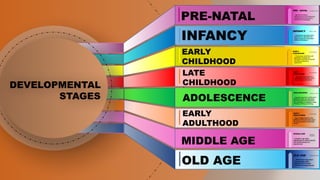
DEVELOPMENTAL STAGE
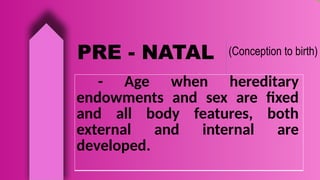
PRE - NATAL(Conception to birth)
- Age when hereditary
endowments and sex are fixed
and all body features, both
external and internal are
developed.
9.
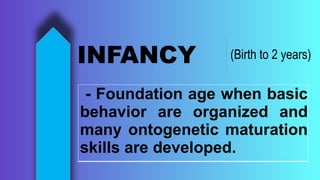
INFANCY (Birth to2 years)
- Foundation age when basic
behavior are organized and
many ontogenetic maturation
skills are developed.
10.
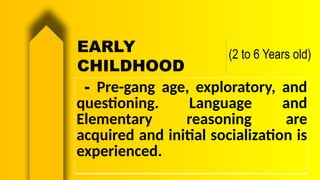
EARLY
CHILDHOOD
- Pre-gang age,exploratory, and
questioning. Language and
Elementary reasoning are
acquired and initial socialization is
experienced.
(2 to 6 Years old)
11.
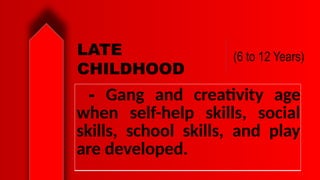
(6 to 12Years)
LATE
CHILDHOOD
- Gang and creativity age
when self-help skills, social
skills, school skills, and play
are developed.
12.
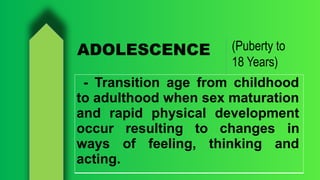
(Puberty to
18 Years)
ADOLESCENCE
-Transition age from childhood
to adulthood when sex maturation
and rapid physical development
occur resulting to changes in
ways of feeling, thinking and
acting.
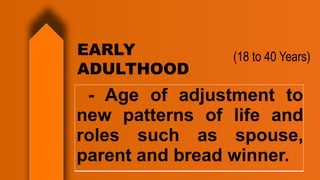
13.
(18 to 40Years)
EARLY
ADULTHOOD
- Age of adjustment to
new patterns of life and
roles such as spouse,
parent and bread winner.
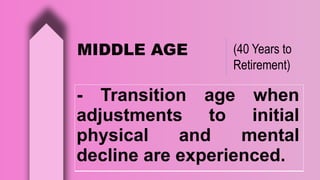
14.
(40 Years to
Retirement)
MIDDLEAGE
- Transition age when
adjustments to initial
physical and mental
decline are experienced.
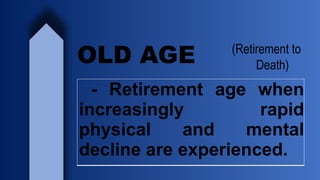
15.
OLD AGE (Retirementto
Death)
- Retirement age when
increasingly rapid
physical and mental
decline are experienced.
16.
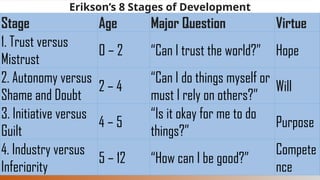
Stage Age MajorQuestion Virtue
1. Trust versus
Mistrust
0 – 2 “Can I trust the world?” Hope
2. Autonomy versus
Shame and Doubt
2 – 4
“Can I do things myself or
must I rely on others?”
Will
3. Initiative versus
Guilt
4 – 5
“Is it okay for me to do
things?”
Purpose
4. Industry versus
Inferiority
5 – 12 “How can I be good?”
Compete
nce
Erikson’s 8 Stages of Development
17.
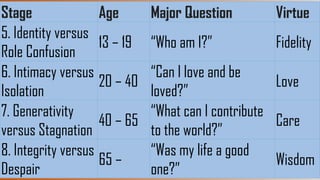
Stage Age MajorQuestion Virtue
5. Identity versus
Role Confusion
13 – 19 “Who am I?” Fidelity
6. Intimacy versus
Isolation
20 – 40
“Can I love and be
loved?”
Love
7. Generativity
versus Stagnation
40 – 65
“What can I contribute
to the world?”
Care
8. Integrity versus
Despair
65 –
“Was my life a good
one?”
Wisdom
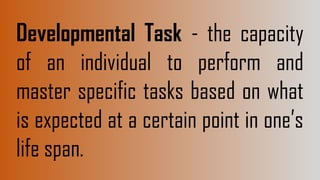
Developmental Task -the capacity
of an individual to perform and
master specific tasks based on what
is expected at a certain point in one’s
life span.
20.
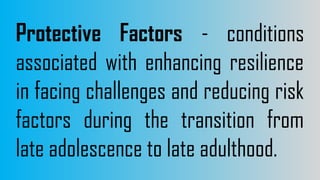
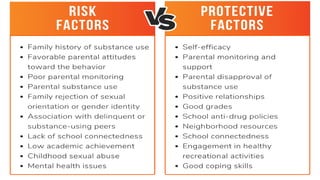
Protective Factors -conditions
associated with enhancing resilience
in facing challenges and reducing risk
factors during the transition from
late adolescence to late adulthood.
21.
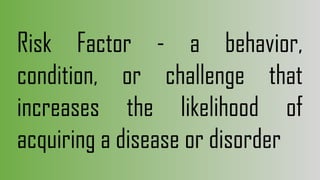
Risk Factor -a behavior,
condition, or challenge that
increases the likelihood of
acquiring a disease or disorder
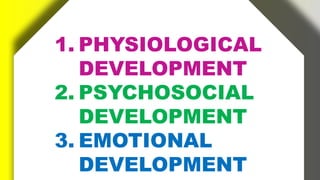
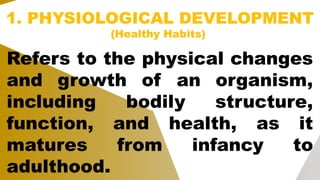
1. PHYSIOLOGICAL DEVELOPMENT
(HealthyHabits)
Refers to the physical changes
and growth of an organism,
including bodily structure,
function, and health, as it
matures from infancy to
adulthood.
25.
PSYCHOSOCIAL DEVELOPMENT
(Self-Concept andIdentity)
refers to how a person's
personality and social skills
develop from infancy through
adulthood, shaped by their
interactions with the social
environment and significant
relationships.
26.
3.EMOTIONAL DEVELOPMENT
(Self-Regulation)
the processby which individuals learn to
understand, experience, express, and
regulate their emotions. It encompasses the
development of emotional awareness,
empathy, self-regulation, and the ability to
form meaningful relationships. This process
begins at birth and continues throughout
life, with significant milestones occurring
during childhood and adolescence.

 Most read
 Most read
 Most read