Chapter 6:
Personality Assessment II: Personality
Judgment in Daily Life
The Personality Puzzle
Sixth Edition

by David C. Funder

Slides created by
Tera D. Letzring
Idaho State University
© 2013 W. W. Norton & Company, Inc.
Objectives
• Discuss why the assessments you make of
your personality and that of others are
important
• Discuss the criteria that can be used for
assessing accuracy
• Discuss the four moderators of accuracy and
the Realistic Accuracy Model (RAM)

© 2013 W. W. Norton & Company, Inc.

2
Think About It
• What is your reputation? How does it affect
you?
• Do you wish your reputation could be
different? How might you change your
reputation?
• Think of a time when you made a personality
judgment about someone that turned out to
be wrong. What was the cause of your
mistake?
© 2013 W. W. Norton & Company, Inc.

3
Consequences of Everyday Judgments
of Personality
• Opportunities
– Employment, friendships
– Examples: shyness, self-assuredness

• Expectancies
– Intellectual expectancy effects
• Rosenthal & Jacobson (1968): climate,
feedback, input, output
– Social expectancy effects
• Snyder, Tanke, & Berscheid (1977): self-fulfilling
prophecy
4

© 2013 W. W. Norton & Company, Inc.
Consequences of Everyday Judgments
of Personality
• Expectancies
– Expectancy effects in real life
• Where do expectancies generally come from?
• Expectancies are likely to be correct.
• Especially strong when held by more than one
important person for a long period of time

© 2013 W. W. Norton & Company, Inc.

5
The Accuracy of
Personality Judgment
• What criteria can be used to assess accuracy?
– Answer from constructivism: None, personality is
a social construction.
– Answer from critical realism: All information that
might be helpful

© 2013 W. W. Norton & Company, Inc.

6
The Accuracy of Personality
Judgment: Criteria for Accuracy
• Same as that for assessing the validity of a test
• Convergent validation
– The duck test
– Interjudge agreement
– Behavioral prediction

© 2013 W. W. Norton & Company, Inc.

7
The Accuracy of Personality
Judgment: First Impressions
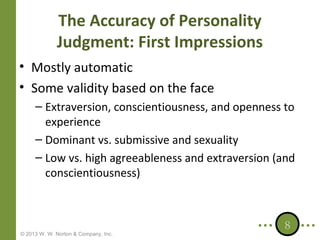
• Mostly automatic
• Some validity based on the face
– Extraversion, conscientiousness, and openness to
experience
– Dominant vs. submissive and sexuality
– Low vs. high agreeableness and extraversion (and
conscientiousness)

© 2013 W. W. Norton & Company, Inc.

8
The Accuracy of Personality
Judgment: First Impressions
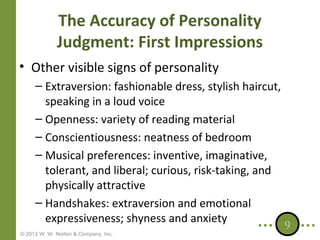
• Other visible signs of personality
– Extraversion: fashionable dress, stylish haircut,
speaking in a loud voice
– Openness: variety of reading material
– Conscientiousness: neatness of bedroom
– Musical preferences: inventive, imaginative,
tolerant, and liberal; curious, risk-taking, and
physically attractive
– Handshakes: extraversion and emotional
expressiveness; shyness and anxiety
© 2013 W. W. Norton & Company, Inc.

9
The Accuracy of Personality
Judgment: Moderators of Accuracy
• Definition

© 2013 W. W. Norton & Company, Inc.

10
The Accuracy of Personality
Judgment: Moderators of Accuracy
• The good judge
– Early findings: depends on the context or trait;
intelligent and conscientious
– Accuracy of men vs. women: mixed findings
– For males: extraverted, well-adjusted,
unconcerned with what others think of them

© 2013 W. W. Norton & Company, Inc.

11
The Accuracy of Personality
Judgment: Moderators of Accuracy
• The good judge
– For females: open, wide range of interests, value
independence
– High in communion; judge others favorably;
socially skilled, agreeable, and adjusted;
attributionally complex, open, positive,
expressive, and socially skilled

© 2013 W. W. Norton & Company, Inc.

12
The Accuracy of Personality
Judgment: Moderators of Accuracy
• The good target: stable and well-organized,
psychologically well adjusted, extraverted,
agreeable
– Related to psychological health and happiness

© 2013 W. W. Norton & Company, Inc.

13
The Accuracy of Personality
Judgment: Moderators of Accuracy
• The good trait: easy to observe, highly visible
– Evidence against the idea that peer judgments are
socially constructed and agreement is based on
communication
– Possible evolutionary basis (sociosexuality)

© 2013 W. W. Norton & Company, Inc.

14
The Accuracy of Personality
Judgment: Moderators of Accuracy
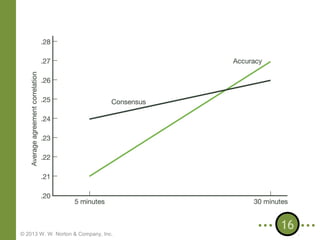
• Good information: amount or quantity
– The acquaintanceship effect and a boundary
– Affects self-other agreement but not consensus

© 2013 W. W. Norton & Company, Inc.

15
© 2013 W. W. Norton & Company, Inc.

16
The Accuracy of Personality
Judgment: Moderators of Accuracy
• Good information: quality
– Weak vs. strong situations
– Stressful or emotionally arousing situations
– Best situation: one that brings out the trait you
want to judge
– Thoughts and feelings vs. daily activities
– Unstructured vs. structured situations

© 2013 W. W. Norton & Company, Inc.

17
The Accuracy of Personality Judgment:
The Realistic Accuracy Model
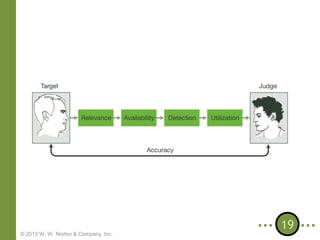
• One explanation for how accurate judgment is
possible

© 2013 W. W. Norton & Company, Inc.

18
© 2013 W. W. Norton & Company, Inc.

19
The Accuracy of Personality
Judgment: Implications of RAM
• Accurate personality judgment is difficult.
• Moderators of accuracy must be the result of
something that happens at one (or more) of
these four stages.
• Accuracy can be improved in four ways.

© 2013 W. W. Norton & Company, Inc.

20
Think About It
• What does it really mean to be “accurate”
about judging someone’s personality? If you
think a person is dishonest, and the person
thinks he is honest, can this kind of
discrepancy ever be resolved? How?

© 2013 W. W. Norton & Company, Inc.

21
Clicker Question #1
Personality judgments in daily life
a)are much less important than the results of
personality tests.
b)affect the opportunities that people are given.
c)easily reach a high level of accuracy.
d)have low accuracy for all judges.

© 2013 W. W. Norton & Company, Inc.

22
Clicker Question #2
Based on the four moderators of accuracy, it can
be concluded that
a)the good judge must have a specified set of
characteristics.
b)the trait that is being judged has the most
influence on the level of accuracy.
c)people who are easily judged tend to have
psychological disorders.
d)information quality will be high in weak,
unstructured, and emotionally arousing
situations.
© 2013 W. W. Norton & Company, Inc.

23
Clicker Question #3
The Realistic Accuracy Model
a)is useful for explaining how accurate
judgments of personality are possible.
b)includes five stages.
c)implies that accuracy cannot be improved.
d)is unrelated to the four moderators.

© 2013 W. W. Norton & Company, Inc.

24

PSY 239 401 Chapter 6 SLIDES

  • 1.
    Chapter 6: Personality AssessmentII: Personality Judgment in Daily Life The Personality Puzzle Sixth Edition by David C. Funder Slides created by Tera D. Letzring Idaho State University © 2013 W. W. Norton & Company, Inc.
  • 2.
    Objectives • Discuss whythe assessments you make of your personality and that of others are important • Discuss the criteria that can be used for assessing accuracy • Discuss the four moderators of accuracy and the Realistic Accuracy Model (RAM) © 2013 W. W. Norton & Company, Inc. 2
  • 3.
    Think About It •What is your reputation? How does it affect you? • Do you wish your reputation could be different? How might you change your reputation? • Think of a time when you made a personality judgment about someone that turned out to be wrong. What was the cause of your mistake? © 2013 W. W. Norton & Company, Inc. 3
  • 4.
    Consequences of EverydayJudgments of Personality • Opportunities – Employment, friendships – Examples: shyness, self-assuredness • Expectancies – Intellectual expectancy effects • Rosenthal & Jacobson (1968): climate, feedback, input, output – Social expectancy effects • Snyder, Tanke, & Berscheid (1977): self-fulfilling prophecy 4 © 2013 W. W. Norton & Company, Inc.
  • 5.
    Consequences of EverydayJudgments of Personality • Expectancies – Expectancy effects in real life • Where do expectancies generally come from? • Expectancies are likely to be correct. • Especially strong when held by more than one important person for a long period of time © 2013 W. W. Norton & Company, Inc. 5
  • 6.
    The Accuracy of PersonalityJudgment • What criteria can be used to assess accuracy? – Answer from constructivism: None, personality is a social construction. – Answer from critical realism: All information that might be helpful © 2013 W. W. Norton & Company, Inc. 6
  • 7.
    The Accuracy ofPersonality Judgment: Criteria for Accuracy • Same as that for assessing the validity of a test • Convergent validation – The duck test – Interjudge agreement – Behavioral prediction © 2013 W. W. Norton & Company, Inc. 7
  • 8.
    The Accuracy ofPersonality Judgment: First Impressions • Mostly automatic • Some validity based on the face – Extraversion, conscientiousness, and openness to experience – Dominant vs. submissive and sexuality – Low vs. high agreeableness and extraversion (and conscientiousness) © 2013 W. W. Norton & Company, Inc. 8
  • 9.
    The Accuracy ofPersonality Judgment: First Impressions • Other visible signs of personality – Extraversion: fashionable dress, stylish haircut, speaking in a loud voice – Openness: variety of reading material – Conscientiousness: neatness of bedroom – Musical preferences: inventive, imaginative, tolerant, and liberal; curious, risk-taking, and physically attractive – Handshakes: extraversion and emotional expressiveness; shyness and anxiety © 2013 W. W. Norton & Company, Inc. 9
  • 10.
    The Accuracy ofPersonality Judgment: Moderators of Accuracy • Definition © 2013 W. W. Norton & Company, Inc. 10
  • 11.
    The Accuracy ofPersonality Judgment: Moderators of Accuracy • The good judge – Early findings: depends on the context or trait; intelligent and conscientious – Accuracy of men vs. women: mixed findings – For males: extraverted, well-adjusted, unconcerned with what others think of them © 2013 W. W. Norton & Company, Inc. 11
  • 12.
    The Accuracy ofPersonality Judgment: Moderators of Accuracy • The good judge – For females: open, wide range of interests, value independence – High in communion; judge others favorably; socially skilled, agreeable, and adjusted; attributionally complex, open, positive, expressive, and socially skilled © 2013 W. W. Norton & Company, Inc. 12
  • 13.
    The Accuracy ofPersonality Judgment: Moderators of Accuracy • The good target: stable and well-organized, psychologically well adjusted, extraverted, agreeable – Related to psychological health and happiness © 2013 W. W. Norton & Company, Inc. 13
  • 14.
    The Accuracy ofPersonality Judgment: Moderators of Accuracy • The good trait: easy to observe, highly visible – Evidence against the idea that peer judgments are socially constructed and agreement is based on communication – Possible evolutionary basis (sociosexuality) © 2013 W. W. Norton & Company, Inc. 14
  • 15.
    The Accuracy ofPersonality Judgment: Moderators of Accuracy • Good information: amount or quantity – The acquaintanceship effect and a boundary – Affects self-other agreement but not consensus © 2013 W. W. Norton & Company, Inc. 15
  • 16.
    © 2013 W.W. Norton & Company, Inc. 16
  • 17.
    The Accuracy ofPersonality Judgment: Moderators of Accuracy • Good information: quality – Weak vs. strong situations – Stressful or emotionally arousing situations – Best situation: one that brings out the trait you want to judge – Thoughts and feelings vs. daily activities – Unstructured vs. structured situations © 2013 W. W. Norton & Company, Inc. 17
  • 18.
    The Accuracy ofPersonality Judgment: The Realistic Accuracy Model • One explanation for how accurate judgment is possible © 2013 W. W. Norton & Company, Inc. 18
  • 19.
    © 2013 W.W. Norton & Company, Inc. 19
  • 20.
    The Accuracy ofPersonality Judgment: Implications of RAM • Accurate personality judgment is difficult. • Moderators of accuracy must be the result of something that happens at one (or more) of these four stages. • Accuracy can be improved in four ways. © 2013 W. W. Norton & Company, Inc. 20
  • 21.
    Think About It •What does it really mean to be “accurate” about judging someone’s personality? If you think a person is dishonest, and the person thinks he is honest, can this kind of discrepancy ever be resolved? How? © 2013 W. W. Norton & Company, Inc. 21
  • 22.
    Clicker Question #1 Personalityjudgments in daily life a)are much less important than the results of personality tests. b)affect the opportunities that people are given. c)easily reach a high level of accuracy. d)have low accuracy for all judges. © 2013 W. W. Norton & Company, Inc. 22
  • 23.
    Clicker Question #2 Basedon the four moderators of accuracy, it can be concluded that a)the good judge must have a specified set of characteristics. b)the trait that is being judged has the most influence on the level of accuracy. c)people who are easily judged tend to have psychological disorders. d)information quality will be high in weak, unstructured, and emotionally arousing situations. © 2013 W. W. Norton & Company, Inc. 23
  • 24.
    Clicker Question #3 TheRealistic Accuracy Model a)is useful for explaining how accurate judgments of personality are possible. b)includes five stages. c)implies that accuracy cannot be improved. d)is unrelated to the four moderators. © 2013 W. W. Norton & Company, Inc. 24

Editor's Notes

  • #4 Cause of your mistake: Think about this throughout the lecture for new insights.
  • #5 Shyness, self-assuredness: Example in text of how shy people can be perceived as cold and aloof. Have students think about another trait, such as self-assuredness, and how this might be perceived by others (rude, conceited, etc.). Climate (warmer emotional attitude of teacher), feedback (more differentiated feedback that depends on whether the response is correct), input (teachers attempt to teach more and more difficult material), output (extra opportunities for students to show what they know) Self-fulfilling prophecy: Behavior is influenced by how others expect us to act (regardless of what we are really like). Snyder, Tanke, & Berscheid (1977): Attractive people were expected to be warm and friendly and people thought to be attractive responded in that way.
  • #6 Expectancies are likely to be correct: so they magnify or maintain behavioral tendencies
  • #7 Constructivism definition: The philosophical view that reality, as a concrete entity, does not exist and that only ideas or “constructions” of reality exist. Critical realism definition: The philosophical view that the absence of perfect, infallible criteria for truth does not imply that all interpretations of reality are equally valid.
  • #8 Convergent validation definition: the process of assembling diverse pieces of information that converge on a common conclusion Interjudge agreement definition: the degree to which two or more judges of the same person provide the same descriptions of personality Behavioral prediction: the degree to which a judgment can predict behavior Activity 6-2. Who is the most accurate judge?
  • #9 Consensus was better than .30 for extraversion, conscientiousness, and openness to experience based on sitting together without talking Accurate judgments for dominant vs. submissive and sexuality from looking at a person’s face From composite faces of extreme scorers, people could differentiate between low vs. high agreeableness, extraversion, and conscientiousness for male faces, and between low vs. high agreeableness and extraversion for female faces. Activity 6-1. You think you know me
  • #10 Neatness of bedroom: bed made, neat overall Musical preferences: Inventive, imaginative, tolerant, and liberal people tend to like reflective, complex music; curious, risk-taking, and physically attractive people tend to like aggressive and intense music. Handshakes: Firmness is positively related to extraversion and emotional expressiveness and negatively related to shyness and anxiety.
  • #11 Definition: variables that change the correlation between a judgment and its criterion
  • #12 Men vs. women: Findings are mixed; women were better at judging extraversion and positive emotionality at zero acquaintance (sitting around a table together); women were generally accurate in terms of normative accuracy after an interaction.
  • #14 Good trait example for visibility: talkative vs. ruminative
  • #15 Sociosexuality: the willingness to engage in sexual relations with minimal acquaintance with, or commitment to and from, one’s partner; self-other agreement was higher for this trait than other traits less directly relevant to reproduction.
  • #16 Amount of information: judgments by close acquaintances agreed more with self-judgments than those by strangers who had watched a five-minute videotape; acquaintance advantage goes away when judgments are used to predict what the target will do in a situation similar to the videotape shown to the strangers.
  • #17 Figure 6.3 on p. 189
  • #18 Stressful or emotionally arousing situations: good way to learn something extra about a person Best situation: What situation would be best for learning about dependability? flexibility? concern for others? Thoughts and feelings vs. daily activities: Watching a person talk about thoughts and feelings resulted in higher agreement with ratings from oneself and close friends. Unstructured vs. structured situations: unstructured results in more accurate judgments
  • #20 Figure 6.4 on p. 192 Relevance: to the trait being judged Available: in a manner and place that the judge can see it Detection: judge notices the information Utilization: accurately remember and correctly interpret the information Activity 6-3. Detect the jerk
  • #21 Accurate personality judgment is difficult: All four stages of RAM must be successful. Moderators of accuracy must be the result of something that happens at one (or more) of these four stages: Discuss how one or more of the moderators would result from processes at different stages. Accuracy can be improved in four ways: by improving each stage of RAM
  • #23 Correct answer: b
  • #24 Correct answer: d
  • #25 Correct answer: a