D . A . O
D EC EN TR A LIZE
D A U TON OMOU S
OR GA N IZATION
Introduction
A decentralized autonomous
organization (DAO), sometimes called
a decentralized autonomous
corporation (DAC), is
an organization represented by rules
encoded as a computer program that is
transparent, controlled by the organization
members and not influenced by a central
government, in other words they are
member-owned communities without
centralized leadership.
A DAO's financial transaction record and
program rules are maintained on
a blockchain. The precise legal status of this
type of business organization is unclear.
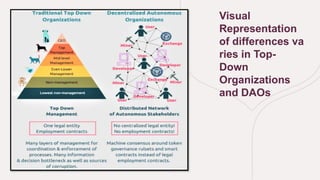
Visual
Representation
of differences va
ries in Top-
Down
Organizations
and DAOs
Background
Decentralized autonomous organizations are typified using blockchain
technology to provide a secure digital ledger to track digital
interactions across the internet, hardened against forgery by trusted
timestamping and dissemination of a distributed database.
This approach eliminates the need to involve a
mutually acceptable trusted third party in any decentralized
digital interaction or cryptocurrency transaction.
Government by algorithm (also known
as algorithmic regulation, algorithmic
legal order or algocracy) is an
alternative form
of government or social ordering,
where the usage
of computer algorithms,
especially of artificial intelligence and
blockchain, is applied to regulations,
law enforcement, and generally any
aspect of everyday life such
as transportation or land registration.
For ex. AI in government, COMPAS, Cyb
ersyn, DAO, Ofqual exam results algorit
hm, Predictive policing, Smart
city, Social Credit System.
Series -
Algocracy
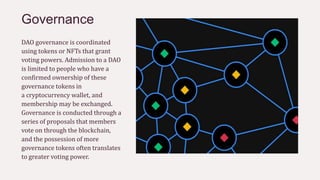
DAO governance is coordinated
using tokens or NFTs that grant
voting powers. Admission to a DAO
is limited to people who have a
confirmed ownership of these
governance tokens in
a cryptocurrency wallet, and
membership may be exchanged.
Governance is conducted through a
series of proposals that members
vote on through the blockchain,
and the possession of more
governance tokens often translates
to greater voting power.
Governance
Issues
with DAO
1. Unlimited Liability
Solution : To address this weakness, DAOs would have to register and be recognized as
a legal entity with limited liability.
Problem : DAO members do not generally enjoy the usual protections against liability
as do corporate shareholders. This is because a DAO is not typically formed as a
corporation or LLC.
Therefore, the potential liability of each member in a DAO is unlimited. Therefore, if
the DAO is hacked or declares bankruptcy, each member is exposed to liability for the
entire amount of funds. If a lawsuit follows and the plaintiff is unable to recover
completely from the “DAO partnership,” the plaintiff will turn next to the personal
assets of each DAO member until their claim is satisfied.
2. Regulatory Framework
Problem : There is no consistent regulatory framework for DAOs. Because they are
unincorporated, many DAO are defaulted to partnership status—which imposes unlimited
liability on its members and creates various legal issues.
With a DAO, individuals are often anonymous. As a result, compliance with AML/KYC policies
is very complicated, if not impossible. Sometimes, these burdens will prevent a DAO from
being formed in the first instance. Also, because DAOs can include individuals from around the
world, multiple jurisdictions´ laws are at play. Deciding which country´s laws apply can be
difficult and is likely to result in protracted legal battles if a dispute arises.
Solution : Only a consistent regulatory framework can provide the legal certainty needed for
DAOs to flourish without being hindered by regulatory inconsistency and gaps.
3. Ice Phishing & Cyber
Attacks
Problem : There are multiple types of phishing attacks in the web3 world. The technology is still
nascent, and new types of attacks may emerge. Some attacks look similar to traditional credential
phishing attacks observed on web2, but some are unique to web3. One aspect that the immutable
and public blockchain enables is complete transparency, so an attack can be observed and studied
after it occurred.
Recall that with the cryptographic keys (usually stored in a wallet), you hold the key to your
cryptocurrency coins. Disclose that key to an unauthorized party and your funds may be moved
without your consent. Stealing these keys is analogous to stealing credentials to web2
accounts. While attackers can utilize a similar tactic on web3 to get to your private key, given the
current adoption, the likelihood of an email landing on the inbox of a cryptocurrency user is
relatively low.
Solution : Review the smart contract you are interacting with. Manage your crypto currencies and
tokens through multiple wallets and/or periodically review and revoke token allowances.
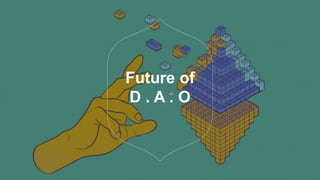
Future of
D . A . O
The ideology of the crypto-utopian is to remove faulty institutions across the globe by developing a blockchain
technology-based model from scratch. Initially, the visualization of cryptocurrency was not an asset but rather a
substitute payment gateway. Smart contracts, proposed by blockchain, are an attempt to establish a trustworthy
form of legal governance. Incorporating both to develop a reliable, efficient, and secure financial system is the sole
purpose of DeFi (Decentralized Finance).
However, DOA is the reconceptualized on-chain design of the traditional operation. Stan Larimer was initially the
creator of the DAC (Digital Autonomous Corporation) concept, which was later reconstructed as DAO (Digital
Autonomous Organization) by Vitalik Buterin, the originator of Ethereum.
For example: consider a vending machine requiring manual operations. It requires manual efforts to look for
technical flaws, pay the power consumption bills, collect the money, and reload more products. The human
interactions would have witnessed a reduction or elimination only if the machine was a DAO.
The mechanism could be capable of shipping records to the server, and subsequently, an automated system that
would perform what humans performed earlier.
DAOs will replace CEOs’ decisions, border meetings, and routine operations in organizations, thus avoiding extra
meaningless work. In addition, voting by shareholders can be done through tokens.
Also, DAOs can change the recruitment process, salary decision, or hiring developers, all by the power of
tokenomics.
Conclusion
Continuous innovations have become an integral part of the digital world. Like in
any other innovative system, DAOs are reflecting continuous improvements. As
every technology or concept has some advantages and disadvantages, the same is
true for open-source ecosystems. However, the limitless opportunities to disrupt
analog structures that delay processes with unnecessary administration can be
resolved with DAO in every economic sector.
While the DAO is still in its nascent stage and trying to strengthen its roots, it is
evident that there is something at the core of the DAO revolution that is here to
stay. Therefore, it will be interesting to witness its growth to the peak.
Thank
You

DAO.pptx

  • 1.
    D . A. O D EC EN TR A LIZE D A U TON OMOU S OR GA N IZATION
  • 2.
    Introduction A decentralized autonomous organization(DAO), sometimes called a decentralized autonomous corporation (DAC), is an organization represented by rules encoded as a computer program that is transparent, controlled by the organization members and not influenced by a central government, in other words they are member-owned communities without centralized leadership. A DAO's financial transaction record and program rules are maintained on a blockchain. The precise legal status of this type of business organization is unclear.
  • 3.
    Visual Representation of differences va riesin Top- Down Organizations and DAOs
  • 4.
    Background Decentralized autonomous organizationsare typified using blockchain technology to provide a secure digital ledger to track digital interactions across the internet, hardened against forgery by trusted timestamping and dissemination of a distributed database. This approach eliminates the need to involve a mutually acceptable trusted third party in any decentralized digital interaction or cryptocurrency transaction.
  • 5.
    Government by algorithm(also known as algorithmic regulation, algorithmic legal order or algocracy) is an alternative form of government or social ordering, where the usage of computer algorithms, especially of artificial intelligence and blockchain, is applied to regulations, law enforcement, and generally any aspect of everyday life such as transportation or land registration. For ex. AI in government, COMPAS, Cyb ersyn, DAO, Ofqual exam results algorit hm, Predictive policing, Smart city, Social Credit System. Series - Algocracy
  • 6.
    DAO governance iscoordinated using tokens or NFTs that grant voting powers. Admission to a DAO is limited to people who have a confirmed ownership of these governance tokens in a cryptocurrency wallet, and membership may be exchanged. Governance is conducted through a series of proposals that members vote on through the blockchain, and the possession of more governance tokens often translates to greater voting power. Governance
  • 7.
  • 8.
    1. Unlimited Liability Solution: To address this weakness, DAOs would have to register and be recognized as a legal entity with limited liability. Problem : DAO members do not generally enjoy the usual protections against liability as do corporate shareholders. This is because a DAO is not typically formed as a corporation or LLC. Therefore, the potential liability of each member in a DAO is unlimited. Therefore, if the DAO is hacked or declares bankruptcy, each member is exposed to liability for the entire amount of funds. If a lawsuit follows and the plaintiff is unable to recover completely from the “DAO partnership,” the plaintiff will turn next to the personal assets of each DAO member until their claim is satisfied.
  • 9.
    2. Regulatory Framework Problem: There is no consistent regulatory framework for DAOs. Because they are unincorporated, many DAO are defaulted to partnership status—which imposes unlimited liability on its members and creates various legal issues. With a DAO, individuals are often anonymous. As a result, compliance with AML/KYC policies is very complicated, if not impossible. Sometimes, these burdens will prevent a DAO from being formed in the first instance. Also, because DAOs can include individuals from around the world, multiple jurisdictions´ laws are at play. Deciding which country´s laws apply can be difficult and is likely to result in protracted legal battles if a dispute arises. Solution : Only a consistent regulatory framework can provide the legal certainty needed for DAOs to flourish without being hindered by regulatory inconsistency and gaps.
  • 10.
    3. Ice Phishing& Cyber Attacks Problem : There are multiple types of phishing attacks in the web3 world. The technology is still nascent, and new types of attacks may emerge. Some attacks look similar to traditional credential phishing attacks observed on web2, but some are unique to web3. One aspect that the immutable and public blockchain enables is complete transparency, so an attack can be observed and studied after it occurred. Recall that with the cryptographic keys (usually stored in a wallet), you hold the key to your cryptocurrency coins. Disclose that key to an unauthorized party and your funds may be moved without your consent. Stealing these keys is analogous to stealing credentials to web2 accounts. While attackers can utilize a similar tactic on web3 to get to your private key, given the current adoption, the likelihood of an email landing on the inbox of a cryptocurrency user is relatively low. Solution : Review the smart contract you are interacting with. Manage your crypto currencies and tokens through multiple wallets and/or periodically review and revoke token allowances.
  • 11.
  • 12.
    The ideology ofthe crypto-utopian is to remove faulty institutions across the globe by developing a blockchain technology-based model from scratch. Initially, the visualization of cryptocurrency was not an asset but rather a substitute payment gateway. Smart contracts, proposed by blockchain, are an attempt to establish a trustworthy form of legal governance. Incorporating both to develop a reliable, efficient, and secure financial system is the sole purpose of DeFi (Decentralized Finance). However, DOA is the reconceptualized on-chain design of the traditional operation. Stan Larimer was initially the creator of the DAC (Digital Autonomous Corporation) concept, which was later reconstructed as DAO (Digital Autonomous Organization) by Vitalik Buterin, the originator of Ethereum. For example: consider a vending machine requiring manual operations. It requires manual efforts to look for technical flaws, pay the power consumption bills, collect the money, and reload more products. The human interactions would have witnessed a reduction or elimination only if the machine was a DAO. The mechanism could be capable of shipping records to the server, and subsequently, an automated system that would perform what humans performed earlier. DAOs will replace CEOs’ decisions, border meetings, and routine operations in organizations, thus avoiding extra meaningless work. In addition, voting by shareholders can be done through tokens. Also, DAOs can change the recruitment process, salary decision, or hiring developers, all by the power of tokenomics.
  • 13.
    Conclusion Continuous innovations havebecome an integral part of the digital world. Like in any other innovative system, DAOs are reflecting continuous improvements. As every technology or concept has some advantages and disadvantages, the same is true for open-source ecosystems. However, the limitless opportunities to disrupt analog structures that delay processes with unnecessary administration can be resolved with DAO in every economic sector. While the DAO is still in its nascent stage and trying to strengthen its roots, it is evident that there is something at the core of the DAO revolution that is here to stay. Therefore, it will be interesting to witness its growth to the peak.
  • 14.