Security & Cryptography in Distributed Systems, Fall 1998 
SSmmaarrtt CCaarrddss 
By Michael Perlov 
(perl7849@cs.nyu.edu)
Outline of the Presentation 
• What is a Smart Card? Examples 
• Case Study: IBM MultiFunction Card 
• Smart Card Standards 
• Additional Resources 
08/26/14 Smart Cards 2
What is a Smart Card? 
• Technical definition: 
A card formed of plastic body with an 
embedded integrated circuit. 
• The devices come in several varieties, from 
simple memory cards to those carrying their 
own microprocessors. 
• There are four major categories 
08/26/14 Smart Cards 3
Unprotected memory cards 
• Act as a storage medium for tokens 
• Carry an application code and a simple 
mechanism to specify the issuer of the card 
• Can’t perform off-line processing 
• Used as prepaid phone cards in France, 
Holland and Germany 
08/26/14 Smart Cards 4
Wired logic memory cards 
• Have built-in EPROM or EEPROM 
• Can be reloaded with data (like monetary 
value) 
• Contain hard-wired data protection 
• Examples are electronic hotel keys and 
new-generation phone cards used in the 
Benelux countries 
08/26/14 Smart Cards 5
Microprocessor cards 
• Typically have 
– an 8-bit microprocessor with an OS in ROM 
– 96 to 512 KB of RAM 
– 3 to 16 KB of ROM 
– Use EEPROM for non-volatile memory, with 
capacities ranging from 1 to 16 KB 
• Some have an additional cryptography 
coprocessor eith extra RAM to perform 
private-key (DES) and/or public-key (RSA) 
cryptography 
08/26/14 Smart Cards 6
• Many cards of this type are multi-functional, 
providing the option of hosting 
several applications from various industry 
domains on a single card, key domains 
being: 
– Banking & Payment Systems 
• debit/credit 
• electronic purse 
– Health Care 
• health records 
• health insurance 
08/26/14 Smart Cards 7
– Travel & Transportation 
• ticketless air travel 
• car rental 
– Electronic commerce 
• cyber shopping 
• secure access/payment via the Internet 
• We will look at an example of this kind of 
card in the case-study later on in the talk 
08/26/14 Smart Cards 8
Contactless cards 
• Antenna is embedded in the plastic 
• How it works: 
– The antenna picks up an electromagnetic signal 
that emanates from the reader 
– The signal powers the card and transmits the 
data 
– The card updates its internal state and transmits 
a signal back 
• Useful when applications require high 
throughput, for ex. in mass transit 
08/26/14 Smart Cards 9
Case Study - IBM Multifunction 
Card 
Overview 
• A sophisticated smart card solution, built on 
top of the IBM MFC (Multifunction Card) 
OS 
• The chip can be fed with data and a variety 
of application programs that can be updated 
whenever necessary 
• Supports private-key (DES) and public-key 
(RSA) cryptography 
08/26/14 Smart Cards 10
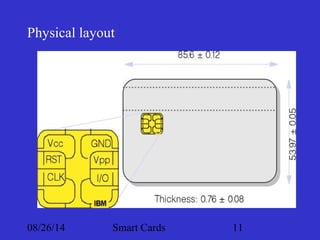
Physical layout 
08/26/14 Smart Cards 11
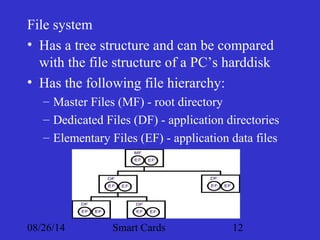
File system 
• Has a tree structure and can be compared 
with the file structure of a PC’s harddisk 
• Has the following file hierarchy: 
– Master Files (MF) - root directory 
– Dedicated Files (DF) - application directories 
– Elementary Files (EF) - application data files 
08/26/14 Smart Cards 12
Access conditions 
• Each file contained in the directory tree of a 
MultiFunction Card contains predefined 
access conditions assigned for each of the 
following access methods: 
– Read: read, seek, etc 
– Update: update, decrease, etc. 
– Administer: create/delete, invalidate, restore, 
etc. 
08/26/14 Smart Cards 13
• The following access conditions can be 
specified: 
– Always (ALW) - access without restriction 
– Card Holder verification (CHV) - card holder 
must present his secret CHV 
– External Authentication (AUT) - external world 
must authenticate itself 
– Protected (ENC) - either the command or the 
response is shielded with a cryptogram 
– Never (NEV) - the data cannot be accessed 
under any circumstances 
08/26/14 Smart Cards 14
Commands supported by MFC OS 
– Application data commands 
• Read - reads data from a selected file 
• Select - selects a file 
• Update - updates a record in a data file 
• Append - appends a record to a file 
– Security commands 
• Get challenge - generate an 8-byte random number 
• Verify CHV 
• External authentication - authentication of the 
external world based on a previously generated 
random number and a secret key 
• Load key file - loads or updates cryptographic keys 
08/26/14 Smart Cards 15
– Additional/modified commands available with 
public-key cryptography cards 
• Calculate hash 
• External authenticate - extension to the standard 
external authentication function using public-key 
cryptography 
• Generate signature - generates a digital signature 
based on a a card’s secret key (using RSA) 
• Verify signature - verifies a digital signature using 
a public key 
– Card management commands 
• Create file 
• Delete file 
08/26/14 Smart Cards 16
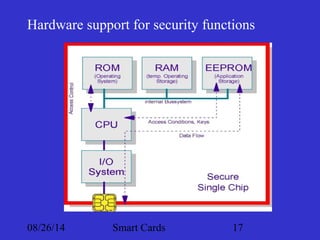
Hardware support for security functions 
08/26/14 Smart Cards 17
Standards 
Standardization plays a key role in the 
acceptance and growth of the smart card 
industry. Only the appropriate international 
standards can assure that a smart card fits 
into different card readers and terminals at 
different locations in the world 
08/26/14 Smart Cards 18
Smart card standardization is driven from two 
sides: 
• The international standards organizations 
(ISO, ANSI, etc) 
– ISO began working on standards for chip cards 
as early as 1983 
– The foundation of virtually all existing smart 
card standards is ISO 7816, which specifies 
• physical & electrical characteristics 
• formats and protocols for information exchange 
• functions provided by smart cards 
08/26/14 Smart Cards 19
• The industry. Key players include 
Mastercard, Visa, Europay, IBM, Sun and 
others 
– EMV 
• Specification for the application of smart cards to 
the payment industry 
• Created by Europay, Mastercard and Visa 
– OpenCard Framework 
• A set of guidelines announced by IBM, Netscape 
and Sun 
• Provides an architecture and a set of APIs for 
building smart card-aware solutions on OpenCard-compliant 
network computers 
08/26/14 Smart Cards 20
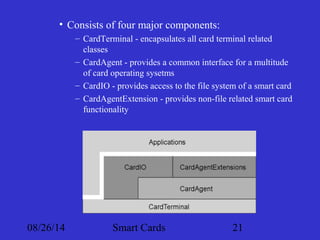
• Consists of four major components: 
– CardTerminal - encapsulates all card terminal related 
classes 
– CardAgent - provides a common interface for a multitude 
of card operating sysetms 
– CardIO - provides access to the file system of a smart card 
– CardAgentExtension - provides non-file related smart card 
functionality 
08/26/14 Smart Cards 21
– JavaCard 
• Is a standard set of APIs and classes that allows 
Java applets to run directly on a standard ISO 7816 
compliant card 
• The specifications are announced by Sun and Visa, 
with the support of leading smart card suppliers 
• Provides all the benefits of Java - portability, 
security, etc. 
– Smart Card SDK 
• Developed by Microsoft 
• Provides a set of APIs for developers to write smart 
card-aware Windows applications to operate with 
smart card readers that conform to the specification 
• The first integrated smart card PCs were to begin 
shipping this year 
08/26/14 Smart Cards 22
Additional Resources 
• Smart Card terminology 
http://www.gemplus.com/basics/terms.htm 
• IBM Smart Card solutions 
http://www.chipcard.ibm.com/overview/ 
• JavaCard 
http://java.sun.com/products/javacard/ 
• Smart Card software develpment - Gemplus 
http://www.gemplus.com 
08/26/14 Smart Cards 23
08/26/14 Smart Cards 24

Introduction to SmartCards - Michael Perlov

  • 1.
    Security & Cryptographyin Distributed Systems, Fall 1998 SSmmaarrtt CCaarrddss By Michael Perlov (perl7849@cs.nyu.edu)
  • 2.
    Outline of thePresentation • What is a Smart Card? Examples • Case Study: IBM MultiFunction Card • Smart Card Standards • Additional Resources 08/26/14 Smart Cards 2
  • 3.
    What is aSmart Card? • Technical definition: A card formed of plastic body with an embedded integrated circuit. • The devices come in several varieties, from simple memory cards to those carrying their own microprocessors. • There are four major categories 08/26/14 Smart Cards 3
  • 4.
    Unprotected memory cards • Act as a storage medium for tokens • Carry an application code and a simple mechanism to specify the issuer of the card • Can’t perform off-line processing • Used as prepaid phone cards in France, Holland and Germany 08/26/14 Smart Cards 4
  • 5.
    Wired logic memorycards • Have built-in EPROM or EEPROM • Can be reloaded with data (like monetary value) • Contain hard-wired data protection • Examples are electronic hotel keys and new-generation phone cards used in the Benelux countries 08/26/14 Smart Cards 5
  • 6.
    Microprocessor cards •Typically have – an 8-bit microprocessor with an OS in ROM – 96 to 512 KB of RAM – 3 to 16 KB of ROM – Use EEPROM for non-volatile memory, with capacities ranging from 1 to 16 KB • Some have an additional cryptography coprocessor eith extra RAM to perform private-key (DES) and/or public-key (RSA) cryptography 08/26/14 Smart Cards 6
  • 7.
    • Many cardsof this type are multi-functional, providing the option of hosting several applications from various industry domains on a single card, key domains being: – Banking & Payment Systems • debit/credit • electronic purse – Health Care • health records • health insurance 08/26/14 Smart Cards 7
  • 8.
    – Travel &Transportation • ticketless air travel • car rental – Electronic commerce • cyber shopping • secure access/payment via the Internet • We will look at an example of this kind of card in the case-study later on in the talk 08/26/14 Smart Cards 8
  • 9.
    Contactless cards •Antenna is embedded in the plastic • How it works: – The antenna picks up an electromagnetic signal that emanates from the reader – The signal powers the card and transmits the data – The card updates its internal state and transmits a signal back • Useful when applications require high throughput, for ex. in mass transit 08/26/14 Smart Cards 9
  • 10.
    Case Study -IBM Multifunction Card Overview • A sophisticated smart card solution, built on top of the IBM MFC (Multifunction Card) OS • The chip can be fed with data and a variety of application programs that can be updated whenever necessary • Supports private-key (DES) and public-key (RSA) cryptography 08/26/14 Smart Cards 10
  • 11.
  • 12.
    File system •Has a tree structure and can be compared with the file structure of a PC’s harddisk • Has the following file hierarchy: – Master Files (MF) - root directory – Dedicated Files (DF) - application directories – Elementary Files (EF) - application data files 08/26/14 Smart Cards 12
  • 13.
    Access conditions •Each file contained in the directory tree of a MultiFunction Card contains predefined access conditions assigned for each of the following access methods: – Read: read, seek, etc – Update: update, decrease, etc. – Administer: create/delete, invalidate, restore, etc. 08/26/14 Smart Cards 13
  • 14.
    • The followingaccess conditions can be specified: – Always (ALW) - access without restriction – Card Holder verification (CHV) - card holder must present his secret CHV – External Authentication (AUT) - external world must authenticate itself – Protected (ENC) - either the command or the response is shielded with a cryptogram – Never (NEV) - the data cannot be accessed under any circumstances 08/26/14 Smart Cards 14
  • 15.
    Commands supported byMFC OS – Application data commands • Read - reads data from a selected file • Select - selects a file • Update - updates a record in a data file • Append - appends a record to a file – Security commands • Get challenge - generate an 8-byte random number • Verify CHV • External authentication - authentication of the external world based on a previously generated random number and a secret key • Load key file - loads or updates cryptographic keys 08/26/14 Smart Cards 15
  • 16.
    – Additional/modified commandsavailable with public-key cryptography cards • Calculate hash • External authenticate - extension to the standard external authentication function using public-key cryptography • Generate signature - generates a digital signature based on a a card’s secret key (using RSA) • Verify signature - verifies a digital signature using a public key – Card management commands • Create file • Delete file 08/26/14 Smart Cards 16
  • 17.
    Hardware support forsecurity functions 08/26/14 Smart Cards 17
  • 18.
    Standards Standardization playsa key role in the acceptance and growth of the smart card industry. Only the appropriate international standards can assure that a smart card fits into different card readers and terminals at different locations in the world 08/26/14 Smart Cards 18
  • 19.
    Smart card standardizationis driven from two sides: • The international standards organizations (ISO, ANSI, etc) – ISO began working on standards for chip cards as early as 1983 – The foundation of virtually all existing smart card standards is ISO 7816, which specifies • physical & electrical characteristics • formats and protocols for information exchange • functions provided by smart cards 08/26/14 Smart Cards 19
  • 20.
    • The industry.Key players include Mastercard, Visa, Europay, IBM, Sun and others – EMV • Specification for the application of smart cards to the payment industry • Created by Europay, Mastercard and Visa – OpenCard Framework • A set of guidelines announced by IBM, Netscape and Sun • Provides an architecture and a set of APIs for building smart card-aware solutions on OpenCard-compliant network computers 08/26/14 Smart Cards 20
  • 21.
    • Consists offour major components: – CardTerminal - encapsulates all card terminal related classes – CardAgent - provides a common interface for a multitude of card operating sysetms – CardIO - provides access to the file system of a smart card – CardAgentExtension - provides non-file related smart card functionality 08/26/14 Smart Cards 21
  • 22.
    – JavaCard •Is a standard set of APIs and classes that allows Java applets to run directly on a standard ISO 7816 compliant card • The specifications are announced by Sun and Visa, with the support of leading smart card suppliers • Provides all the benefits of Java - portability, security, etc. – Smart Card SDK • Developed by Microsoft • Provides a set of APIs for developers to write smart card-aware Windows applications to operate with smart card readers that conform to the specification • The first integrated smart card PCs were to begin shipping this year 08/26/14 Smart Cards 22
  • 23.
    Additional Resources •Smart Card terminology http://www.gemplus.com/basics/terms.htm • IBM Smart Card solutions http://www.chipcard.ibm.com/overview/ • JavaCard http://java.sun.com/products/javacard/ • Smart Card software develpment - Gemplus http://www.gemplus.com 08/26/14 Smart Cards 23
  • 24.