
BASIC BIBLE SURVEY
L2 The Old Testament
Ministry Essentials Training
OLD TESTAMENT
(OLD COVENANT)
(FIRST AGREEMENT)
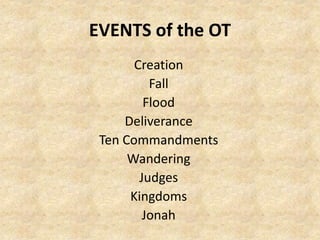
EVENTS of the OT
Creation
Fall
Flood
Deliverance
Ten Commandments
Wandering
Judges
Kingdoms
Jonah
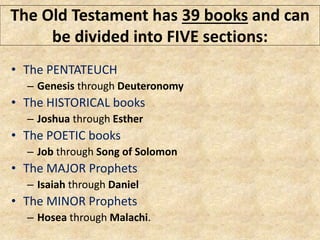
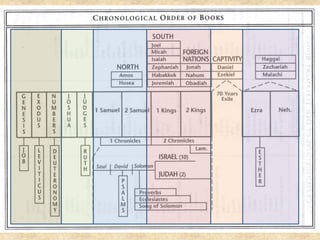
The Old Testament has 39 books and can
be divided into FIVE sections:
• The PENTATEUCH
– Genesis through Deuteronomy
• The HISTORICAL books
– Joshua through Esther
• The POETIC books
– Job through Song of Solomon
• The MAJOR Prophets
– Isaiah through Daniel
• The MINOR Prophets
– Hosea through Malachi.
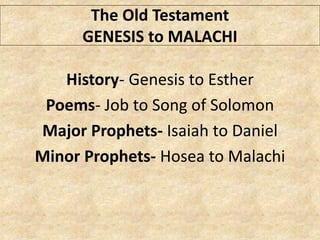
The Old Testament
GENESIS to MALACHI
History- Genesis to Esther
Poems- Job to Song of Solomon
Major Prophets- Isaiah to Daniel
Minor Prophets- Hosea to Malachi
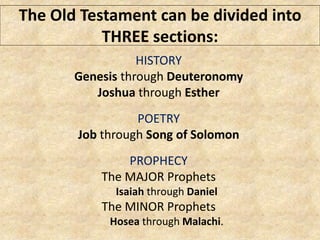
The Old Testament can be divided into
THREE sections:
HISTORY
Genesis through Deuteronomy
Joshua through Esther
POETRY
Job through Song of Solomon
PROPHECY
The MAJOR Prophets
Isaiah through Daniel
The MINOR Prophets
Hosea through Malachi.
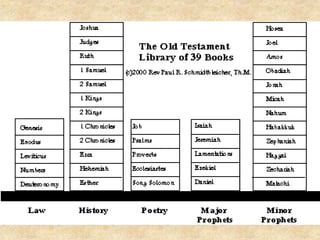
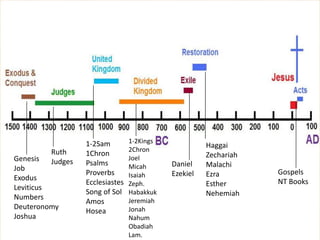
Genesis
Job
Exodus
Leviticus
Numbers
Deuteronomy
Joshua
Ruth
Judges
Gospels
NT Books
Haggai
Zechariah
Malachi
Ezra
Esther
Nehemiah
Daniel
Ezekiel
1-2Kings
2Chron
Joel
Micah
Isaiah
Zeph.
Habakkuk
Jeremiah
Jonah
Nahum
Obadiah
Lam.
1-2Sam
1Chron
Psalms
Proverbs
Ecclesiastes
Song of Sol
Amos
Hosea
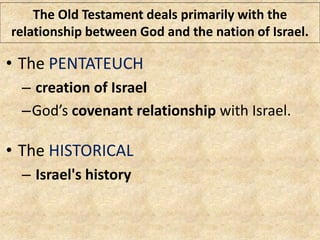
The Old Testament deals primarily with the
relationship between God and the nation of Israel.
• The PENTATEUCH
– creation of Israel
–God’s covenant relationship with Israel.
• The HISTORICAL
– Israel's history
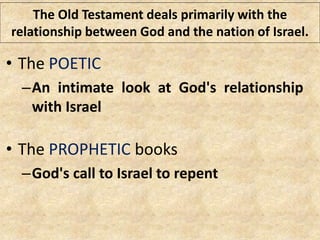
The Old Testament deals primarily with the
relationship between God and the nation of Israel.
• The POETIC
–An intimate look at God's relationship
with Israel
• The PROPHETIC books
–God's call to Israel to repent
Old Testament Synopsis
• The Old Testament tells the story of GOD'S
CHOSEN PEOPLE, the HEBREWS, who were later
known as ISRAELITES or JEWS.
• Sometime around 1800 B.C., God made a
covenant with a man named ABRAHAM to make
of his descendants a great nation.
Old Testament Synopsis
• The first few of these descendants migrated to
Egypt to escape a famine in their own land (JACOB
and his son JOSEPH).
• After many generations they had greatly
increased their numbers but had become
enslaved to the EGYPTIANS.
• God sent a great leader and prophet, MOSES, to
lead the Hebrews out of captivity and into the
PROMISED LAND of ISRAEL.
Old Testament Synopsis
• During this time God gave Moses the TEN
COMMANDMENTS.
• In addition to the Ten Commandments, the Old
Testament lists many other LAWS
– Circumcision, dietary restrictions, blood sacrifices,
Sabbath observance, tithing, social welfare, crimes,
social behavior, armies, etc.
– These laws regulated almost every aspect of Hebrew
life.
Old Testament Synopsis
• However, time and again, the Israelites fell
into idolatry, sin, or pride.
• When this happened, God called
PROPHETS, such as Elijah, Samuel, Jonah,
Isaiah and many others, to lead them back
to the right path.
Old Testament Synopsis
• The later Hebrew prophets foresaw the
coming of a Messiah (meaning
"anointed one"), a king who would
bring PEACE and everlasting
RIGHTEOUSNESS.
The POETICAL Books
• PSALMS was written during the
historical events of 2Samuel.
• The other three books, PROVERBS,
ECCLESIASTES and SONG OF
SOLOMON, were written during the
events covered in 1Kings.
The Divided Kingdom Era
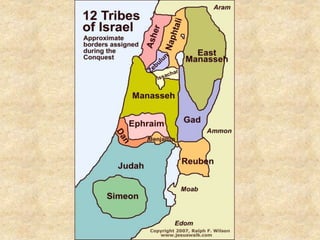
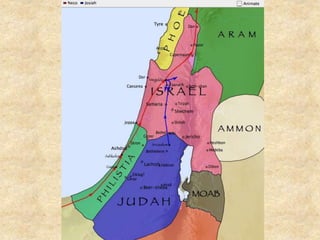
• After Solomon died, Israel SPLIT into
TWO nations.
– The year of the split was 931 B.C.
–What did they split over?
• They split over taxes.
The Divided Kingdom Era
• TEN of the tribes made up the NORTHERN
KINGDOM.
– What was its name?
• ISRAEL or EPHRAIM (after its largest tribe).
• Two of the tribes made up the SOUTHERN
KINGDOM.
– What was its name?
• JUDAH (after its largest tribe).
The Prophets of the Divided Kingdom Era
Israel
• Hosea & Amos
–The Lord sent prophets to Israel, but they
were rejected, laughed at and scorned.
• It is as if the national reaction to God’s prophets
was to laugh at them:
• “Ha, ha!” A way to remember the two writing
prophets sent to Israel is H.A. = Hosea and Amos.
The Prophets of the Divided Kingdom Era
Edom
• Obadiah
– The Edomites were the descendants of Esau, Jacob’s brother.
They were cousins to the Hebrews.
– However, in times of war, when the Hebrews were fleeing
the Promised Land to escape invaders, rather than helping
their cousins the Edomites would attack and plunder the
refugees.
– So the Lord sent a prophet to warn them that they were
doomed.
– Here is how to remember who went there: Edom was
doomed because they were bad.
– How bad were they? They were so bad that God sent O-bad-
iah to prophesy against them.
Prophets to Assyria
Jonah & Nahum
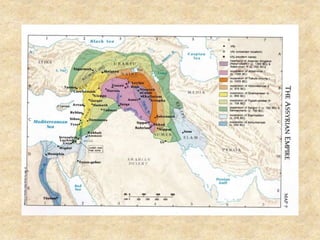
• The Assyrians were an evil empire raised up
by God to bring judgment upon the
apostate northern kingdom of Israel.
–The Assyrians repented.
• Then about 100 years later, God sent a
second prophet to Assyria: Nahum.
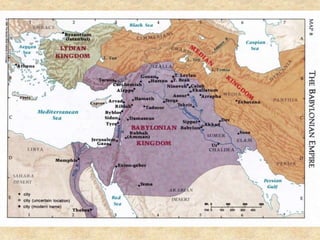
The Exiled Kingdom Era
• The southern kingdom (Judah) survived up until
586 B.C. when it was destroyed by Babylonia
(located in modern Eastern Iraq).
• The Babylonians had a different military policy
than did the Assyrians.
The Exiled Kingdom Era
• Rather than scatter conquered peoples all over,
they instead uprooted them and placed them all
in some new country: Babylonia.
• The time period when Judah was exiled in
Babylonia is called the Babylonian Exile.
• The “Exiled Kingdom” period lasted 70 years,
one year for every Year of Jubilee that the Jews
failed to observe as required by Moses.
The Prophets of the Exiled Kingdom
Ezekiel & Daniel
• During the Time of the Babylonian
Exile there were two writing
prophets.
The Post Kingdom Era
• Babylonia was eventually conquered by
the Medes and the Persians.
• Their attitude toward the Jews was more
lenient and they were allowed to return to
the Promised Land.
The Post Kingdom Era
• This exodus from Babylonia occurred in three
waves, led by three men: Zerubbabel, Ezra
and Nehemiah.
• Once back in the land there were no more
Jewish kings. Instead they were ruled by
governors.
• This period is commonly called the “Post
Kingdom” era.
The 400 Silent Years
• After the information in the book of
Nehemiah, there is no more inspired
Old Testament history.
• The Old Testament record ENDS with
Nehemiah busy rebuilding in the
Promised Land.
The 400 Silent Years
• The last recorded year was 425 B.C.
• There were no prophets from God to the
Jews until John the Baptist appeared in
Matthew’s Gospel.
• The 400 years BETWEEN the Old
Testament and the New Testament are
called the 400 silent years.
A Brief Synopsis of
each book of the Bible
Brief Summary of the Books of the Bible 1
Genesis
• Describes the creation; gives the history of the
old world, and of the steps taken by God toward
the formation of theocracy.
Exodus
• The history of Israel's departure from Egypt; the
giving of the law; the tabernacle.
Leviticus
• The ceremonial law.
Numbers
• The census of the people; the story of the
wanderings in the wilderness.
Deuteronomy
• The law rehearsed; the death of Moses.
Brief Summary of the Books of the Bible 2
Joshua
• The story of the conquest and partition of
Canaan.
Judges
• The history of the nation from Joshua to
Samson.
Ruth
• The story of the ancestors of the royal family of
Judah.
Brief Summary of the Books of the Bible 3
1Samuel
• The story of the nation during the judgeship of
Samuel and the reign of Saul.
2Samuel
• Story of the reign of David.
Brief Summary of the Books of the Bible 4
1 and 2Kings
• The history of the nation:
–FROM David's death and Solomon's
accession
–TO the destruction of the kingdom of Judah
and the desolation of Jerusalem.
Brief Summary of the Books of the Bible 5
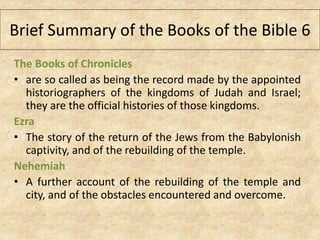
The Books of Chronicles
• are so called as being the record made by the appointed
historiographers of the kingdoms of Judah and Israel;
they are the official histories of those kingdoms.
Ezra
• The story of the return of the Jews from the Babylonish
captivity, and of the rebuilding of the temple.
Nehemiah
• A further account of the rebuilding of the temple and
city, and of the obstacles encountered and overcome.
Brief Summary of the Books of the Bible 6
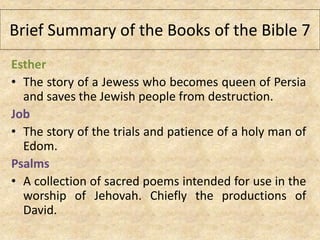
Esther
• The story of a Jewess who becomes queen of Persia
and saves the Jewish people from destruction.
Job
• The story of the trials and patience of a holy man of
Edom.
Psalms
• A collection of sacred poems intended for use in the
worship of Jehovah. Chiefly the productions of
David.
Brief Summary of the Books of the Bible 7
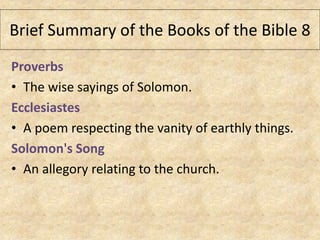
Proverbs
• The wise sayings of Solomon.
Ecclesiastes
• A poem respecting the vanity of earthly things.
Solomon's Song
• An allegory relating to the church.
Brief Summary of the Books of the Bible 8
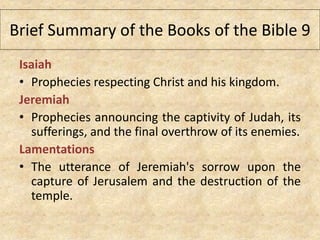
Isaiah
• Prophecies respecting Christ and his kingdom.
Jeremiah
• Prophecies announcing the captivity of Judah, its
sufferings, and the final overthrow of its enemies.
Lamentations
• The utterance of Jeremiah's sorrow upon the
capture of Jerusalem and the destruction of the
temple.
Brief Summary of the Books of the Bible 9
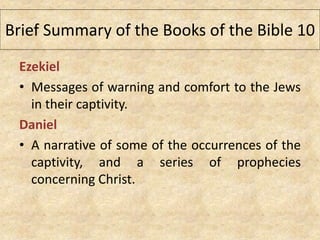
Ezekiel
• Messages of warning and comfort to the Jews
in their captivity.
Daniel
• A narrative of some of the occurrences of the
captivity, and a series of prophecies
concerning Christ.
Brief Summary of the Books of the Bible 10
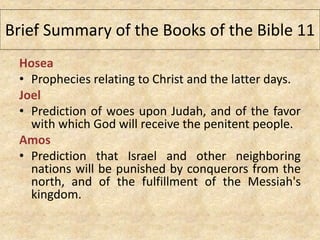
Hosea
• Prophecies relating to Christ and the latter days.
Joel
• Prediction of woes upon Judah, and of the favor
with which God will receive the penitent people.
Amos
• Prediction that Israel and other neighboring
nations will be punished by conquerors from the
north, and of the fulfillment of the Messiah's
kingdom.
Brief Summary of the Books of the Bible 11
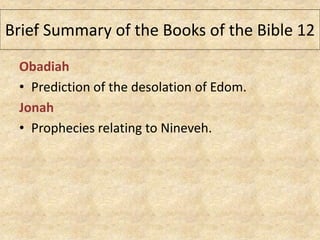
Obadiah
• Prediction of the desolation of Edom.
Jonah
• Prophecies relating to Nineveh.
Brief Summary of the Books of the Bible 12
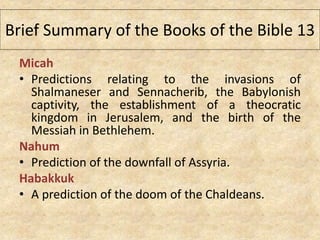
Micah
• Predictions relating to the invasions of
Shalmaneser and Sennacherib, the Babylonish
captivity, the establishment of a theocratic
kingdom in Jerusalem, and the birth of the
Messiah in Bethlehem.
Nahum
• Prediction of the downfall of Assyria.
Habakkuk
• A prediction of the doom of the Chaldeans.
Brief Summary of the Books of the Bible 13
Zephaniah
• A prediction of the overthrow of Judah for its
idolatry and wickedness.
Haggai
• Prophecies concerning the rebuilding of the
temple.
Brief Summary of the Books of the Bible 14
Zechariah
• Prophecies relating to the rebuilding of the
temple and the Messiah.
Malachi
• Prophecies relating to the calling of the
Gentiles and the coming of Christ.
Brief Summary of the Books of the Bible 15
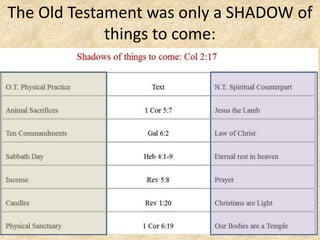
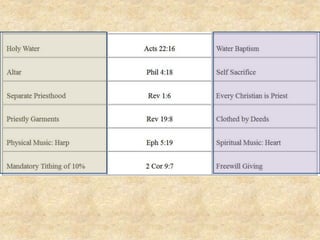
The Old Testament was only a SHADOW of
things to come:
THE END

Basic Bible Survey Lesson 2 Old Testament

  • 1.
    BASIC BIBLE SURVEY L2The Old Testament Ministry Essentials Training
  • 2.
  • 3.
    EVENTS of theOT Creation Fall Flood Deliverance Ten Commandments Wandering Judges Kingdoms Jonah
  • 4.
    The Old Testamenthas 39 books and can be divided into FIVE sections: • The PENTATEUCH – Genesis through Deuteronomy • The HISTORICAL books – Joshua through Esther • The POETIC books – Job through Song of Solomon • The MAJOR Prophets – Isaiah through Daniel • The MINOR Prophets – Hosea through Malachi.
  • 6.
    The Old Testament GENESISto MALACHI History- Genesis to Esther Poems- Job to Song of Solomon Major Prophets- Isaiah to Daniel Minor Prophets- Hosea to Malachi
  • 7.
    The Old Testamentcan be divided into THREE sections: HISTORY Genesis through Deuteronomy Joshua through Esther POETRY Job through Song of Solomon PROPHECY The MAJOR Prophets Isaiah through Daniel The MINOR Prophets Hosea through Malachi.
  • 9.
  • 10.
    The Old Testamentdeals primarily with the relationship between God and the nation of Israel. • The PENTATEUCH – creation of Israel –God’s covenant relationship with Israel. • The HISTORICAL – Israel's history
  • 11.
    The Old Testamentdeals primarily with the relationship between God and the nation of Israel. • The POETIC –An intimate look at God's relationship with Israel • The PROPHETIC books –God's call to Israel to repent
  • 12.
    Old Testament Synopsis •The Old Testament tells the story of GOD'S CHOSEN PEOPLE, the HEBREWS, who were later known as ISRAELITES or JEWS. • Sometime around 1800 B.C., God made a covenant with a man named ABRAHAM to make of his descendants a great nation.
  • 13.
    Old Testament Synopsis •The first few of these descendants migrated to Egypt to escape a famine in their own land (JACOB and his son JOSEPH). • After many generations they had greatly increased their numbers but had become enslaved to the EGYPTIANS. • God sent a great leader and prophet, MOSES, to lead the Hebrews out of captivity and into the PROMISED LAND of ISRAEL.
  • 14.
    Old Testament Synopsis •During this time God gave Moses the TEN COMMANDMENTS. • In addition to the Ten Commandments, the Old Testament lists many other LAWS – Circumcision, dietary restrictions, blood sacrifices, Sabbath observance, tithing, social welfare, crimes, social behavior, armies, etc. – These laws regulated almost every aspect of Hebrew life.
  • 15.
    Old Testament Synopsis •However, time and again, the Israelites fell into idolatry, sin, or pride. • When this happened, God called PROPHETS, such as Elijah, Samuel, Jonah, Isaiah and many others, to lead them back to the right path.
  • 16.
    Old Testament Synopsis •The later Hebrew prophets foresaw the coming of a Messiah (meaning "anointed one"), a king who would bring PEACE and everlasting RIGHTEOUSNESS.
  • 17.
    The POETICAL Books •PSALMS was written during the historical events of 2Samuel. • The other three books, PROVERBS, ECCLESIASTES and SONG OF SOLOMON, were written during the events covered in 1Kings.
  • 18.
    The Divided KingdomEra • After Solomon died, Israel SPLIT into TWO nations. – The year of the split was 931 B.C. –What did they split over? • They split over taxes.
  • 19.
    The Divided KingdomEra • TEN of the tribes made up the NORTHERN KINGDOM. – What was its name? • ISRAEL or EPHRAIM (after its largest tribe). • Two of the tribes made up the SOUTHERN KINGDOM. – What was its name? • JUDAH (after its largest tribe).
  • 22.
    The Prophets ofthe Divided Kingdom Era Israel • Hosea & Amos –The Lord sent prophets to Israel, but they were rejected, laughed at and scorned. • It is as if the national reaction to God’s prophets was to laugh at them: • “Ha, ha!” A way to remember the two writing prophets sent to Israel is H.A. = Hosea and Amos.
  • 23.
    The Prophets ofthe Divided Kingdom Era Edom • Obadiah – The Edomites were the descendants of Esau, Jacob’s brother. They were cousins to the Hebrews. – However, in times of war, when the Hebrews were fleeing the Promised Land to escape invaders, rather than helping their cousins the Edomites would attack and plunder the refugees. – So the Lord sent a prophet to warn them that they were doomed. – Here is how to remember who went there: Edom was doomed because they were bad. – How bad were they? They were so bad that God sent O-bad- iah to prophesy against them.
  • 24.
    Prophets to Assyria Jonah& Nahum • The Assyrians were an evil empire raised up by God to bring judgment upon the apostate northern kingdom of Israel. –The Assyrians repented. • Then about 100 years later, God sent a second prophet to Assyria: Nahum.
  • 26.
    The Exiled KingdomEra • The southern kingdom (Judah) survived up until 586 B.C. when it was destroyed by Babylonia (located in modern Eastern Iraq). • The Babylonians had a different military policy than did the Assyrians.
  • 27.
    The Exiled KingdomEra • Rather than scatter conquered peoples all over, they instead uprooted them and placed them all in some new country: Babylonia. • The time period when Judah was exiled in Babylonia is called the Babylonian Exile. • The “Exiled Kingdom” period lasted 70 years, one year for every Year of Jubilee that the Jews failed to observe as required by Moses.
  • 28.
    The Prophets ofthe Exiled Kingdom Ezekiel & Daniel • During the Time of the Babylonian Exile there were two writing prophets.
  • 30.
    The Post KingdomEra • Babylonia was eventually conquered by the Medes and the Persians. • Their attitude toward the Jews was more lenient and they were allowed to return to the Promised Land.
  • 31.
    The Post KingdomEra • This exodus from Babylonia occurred in three waves, led by three men: Zerubbabel, Ezra and Nehemiah. • Once back in the land there were no more Jewish kings. Instead they were ruled by governors. • This period is commonly called the “Post Kingdom” era.
  • 32.
    The 400 SilentYears • After the information in the book of Nehemiah, there is no more inspired Old Testament history. • The Old Testament record ENDS with Nehemiah busy rebuilding in the Promised Land.
  • 33.
    The 400 SilentYears • The last recorded year was 425 B.C. • There were no prophets from God to the Jews until John the Baptist appeared in Matthew’s Gospel. • The 400 years BETWEEN the Old Testament and the New Testament are called the 400 silent years.
  • 34.
    A Brief Synopsisof each book of the Bible
  • 35.
    Brief Summary ofthe Books of the Bible 1 Genesis • Describes the creation; gives the history of the old world, and of the steps taken by God toward the formation of theocracy. Exodus • The history of Israel's departure from Egypt; the giving of the law; the tabernacle. Leviticus • The ceremonial law.
  • 36.
    Numbers • The censusof the people; the story of the wanderings in the wilderness. Deuteronomy • The law rehearsed; the death of Moses. Brief Summary of the Books of the Bible 2
  • 37.
    Joshua • The storyof the conquest and partition of Canaan. Judges • The history of the nation from Joshua to Samson. Ruth • The story of the ancestors of the royal family of Judah. Brief Summary of the Books of the Bible 3
  • 38.
    1Samuel • The storyof the nation during the judgeship of Samuel and the reign of Saul. 2Samuel • Story of the reign of David. Brief Summary of the Books of the Bible 4
  • 39.
    1 and 2Kings •The history of the nation: –FROM David's death and Solomon's accession –TO the destruction of the kingdom of Judah and the desolation of Jerusalem. Brief Summary of the Books of the Bible 5
  • 40.
    The Books ofChronicles • are so called as being the record made by the appointed historiographers of the kingdoms of Judah and Israel; they are the official histories of those kingdoms. Ezra • The story of the return of the Jews from the Babylonish captivity, and of the rebuilding of the temple. Nehemiah • A further account of the rebuilding of the temple and city, and of the obstacles encountered and overcome. Brief Summary of the Books of the Bible 6
  • 41.
    Esther • The storyof a Jewess who becomes queen of Persia and saves the Jewish people from destruction. Job • The story of the trials and patience of a holy man of Edom. Psalms • A collection of sacred poems intended for use in the worship of Jehovah. Chiefly the productions of David. Brief Summary of the Books of the Bible 7
  • 42.
    Proverbs • The wisesayings of Solomon. Ecclesiastes • A poem respecting the vanity of earthly things. Solomon's Song • An allegory relating to the church. Brief Summary of the Books of the Bible 8
  • 43.
    Isaiah • Prophecies respectingChrist and his kingdom. Jeremiah • Prophecies announcing the captivity of Judah, its sufferings, and the final overthrow of its enemies. Lamentations • The utterance of Jeremiah's sorrow upon the capture of Jerusalem and the destruction of the temple. Brief Summary of the Books of the Bible 9
  • 44.
    Ezekiel • Messages ofwarning and comfort to the Jews in their captivity. Daniel • A narrative of some of the occurrences of the captivity, and a series of prophecies concerning Christ. Brief Summary of the Books of the Bible 10
  • 45.
    Hosea • Prophecies relatingto Christ and the latter days. Joel • Prediction of woes upon Judah, and of the favor with which God will receive the penitent people. Amos • Prediction that Israel and other neighboring nations will be punished by conquerors from the north, and of the fulfillment of the Messiah's kingdom. Brief Summary of the Books of the Bible 11
  • 46.
    Obadiah • Prediction ofthe desolation of Edom. Jonah • Prophecies relating to Nineveh. Brief Summary of the Books of the Bible 12
  • 47.
    Micah • Predictions relatingto the invasions of Shalmaneser and Sennacherib, the Babylonish captivity, the establishment of a theocratic kingdom in Jerusalem, and the birth of the Messiah in Bethlehem. Nahum • Prediction of the downfall of Assyria. Habakkuk • A prediction of the doom of the Chaldeans. Brief Summary of the Books of the Bible 13
  • 48.
    Zephaniah • A predictionof the overthrow of Judah for its idolatry and wickedness. Haggai • Prophecies concerning the rebuilding of the temple. Brief Summary of the Books of the Bible 14
  • 49.
    Zechariah • Prophecies relatingto the rebuilding of the temple and the Messiah. Malachi • Prophecies relating to the calling of the Gentiles and the coming of Christ. Brief Summary of the Books of the Bible 15
  • 50.
    The Old Testamentwas only a SHADOW of things to come:
  • 52.

Editor's Notes

  • #5 http://www.gotquestions.org/Old-Testament-Survey.html
  • #8 http://www.gotquestions.org/Old-Testament-Survey.html
  • #11 http://www.gotquestions.org/Old-Testament-Survey.html
  • #12 http://www.gotquestions.org/Old-Testament-Survey.html
  • #22 https://www.google.com.ph/url?sa=i&rct=j&q=&esrc=s&source=images&cd=&cad=rja&docid=-CXIIZfHtSYT5M&tbnid=UHPk7bnLG7MX5M:&ved=0CAUQjRw&url=http%3A%2F%2Fwww.accordancebible.com%2Farchive%2Fblog%2Farchive%2F2008_08_01_archive.html&ei=Yn6xUpDEHeyhigf9pIHQBA&bvm=bv.58187178,d.dGI&psig=AFQjCNGqUiP1_aJw2dtOwOvPjeqSMriNsg&ust=1387450328683159
  • #28 http://www.ewtn.com/jubilee/history/OT1.htm
  • #36 http://www.blueletterbible.org/study/parallel/paral15.cfm http://www.christianbiblereference.org/summary.htm http://www.free-bible-study-lessons.net/synopsis-of-bible-books.html http://www.holybible.com/resources/KJV_DFND/summary.htm http://www.easyenglish.info/bible-outline/
  • #37 http://www.blueletterbible.org/study/parallel/paral15.cfm http://www.christianbiblereference.org/summary.htm http://www.free-bible-study-lessons.net/synopsis-of-bible-books.html http://www.holybible.com/resources/KJV_DFND/summary.htm http://www.easyenglish.info/bible-outline/
  • #38 http://www.blueletterbible.org/study/parallel/paral15.cfm http://www.christianbiblereference.org/summary.htm http://www.free-bible-study-lessons.net/synopsis-of-bible-books.html http://www.holybible.com/resources/KJV_DFND/summary.htm http://www.easyenglish.info/bible-outline/
  • #39 http://www.blueletterbible.org/study/parallel/paral15.cfm http://www.christianbiblereference.org/summary.htm http://www.free-bible-study-lessons.net/synopsis-of-bible-books.html http://www.holybible.com/resources/KJV_DFND/summary.htm http://www.easyenglish.info/bible-outline/
  • #40 http://www.blueletterbible.org/study/parallel/paral15.cfm http://www.christianbiblereference.org/summary.htm http://www.free-bible-study-lessons.net/synopsis-of-bible-books.html http://www.holybible.com/resources/KJV_DFND/summary.htm http://www.easyenglish.info/bible-outline/
  • #41 http://www.blueletterbible.org/study/parallel/paral15.cfm http://www.christianbiblereference.org/summary.htm http://www.free-bible-study-lessons.net/synopsis-of-bible-books.html http://www.holybible.com/resources/KJV_DFND/summary.htm http://www.easyenglish.info/bible-outline/
  • #42 http://www.blueletterbible.org/study/parallel/paral15.cfm http://www.christianbiblereference.org/summary.htm http://www.free-bible-study-lessons.net/synopsis-of-bible-books.html http://www.holybible.com/resources/KJV_DFND/summary.htm http://www.easyenglish.info/bible-outline/
  • #43 http://www.blueletterbible.org/study/parallel/paral15.cfm http://www.christianbiblereference.org/summary.htm http://www.free-bible-study-lessons.net/synopsis-of-bible-books.html http://www.holybible.com/resources/KJV_DFND/summary.htm http://www.easyenglish.info/bible-outline/
  • #44 http://www.blueletterbible.org/study/parallel/paral15.cfm http://www.christianbiblereference.org/summary.htm http://www.free-bible-study-lessons.net/synopsis-of-bible-books.html http://www.holybible.com/resources/KJV_DFND/summary.htm http://www.easyenglish.info/bible-outline/
  • #45 http://www.blueletterbible.org/study/parallel/paral15.cfm http://www.christianbiblereference.org/summary.htm http://www.free-bible-study-lessons.net/synopsis-of-bible-books.html http://www.holybible.com/resources/KJV_DFND/summary.htm http://www.easyenglish.info/bible-outline/
  • #46 http://www.blueletterbible.org/study/parallel/paral15.cfm http://www.christianbiblereference.org/summary.htm http://www.free-bible-study-lessons.net/synopsis-of-bible-books.html http://www.holybible.com/resources/KJV_DFND/summary.htm http://www.easyenglish.info/bible-outline/
  • #47 http://www.blueletterbible.org/study/parallel/paral15.cfm http://www.christianbiblereference.org/summary.htm http://www.free-bible-study-lessons.net/synopsis-of-bible-books.html http://www.holybible.com/resources/KJV_DFND/summary.htm http://www.easyenglish.info/bible-outline/
  • #48 http://www.blueletterbible.org/study/parallel/paral15.cfm http://www.christianbiblereference.org/summary.htm http://www.free-bible-study-lessons.net/synopsis-of-bible-books.html http://www.holybible.com/resources/KJV_DFND/summary.htm http://www.easyenglish.info/bible-outline/
  • #49 http://www.blueletterbible.org/study/parallel/paral15.cfm http://www.christianbiblereference.org/summary.htm http://www.free-bible-study-lessons.net/synopsis-of-bible-books.html http://www.holybible.com/resources/KJV_DFND/summary.htm http://www.easyenglish.info/bible-outline/
  • #50 http://www.blueletterbible.org/study/parallel/paral15.cfm http://www.christianbiblereference.org/summary.htm http://www.free-bible-study-lessons.net/synopsis-of-bible-books.html http://www.holybible.com/resources/KJV_DFND/summary.htm http://www.easyenglish.info/bible-outline/