Group 3
 Biotechnology 1
 Period 5
(In no specific order)   Christopher Estrella
Tatyana Bidopia          Enid Moreira
Arlety Lopetegui         Alexis Ros
Juan Ramirez             Jade Regalado
Diana Alduncin           Michael De La Morena
Introduction To Human Testing
During clinical trials and after animal testing, most drugs
will continue testing by experimenting with human
subjects. By testing on humans, companies can ensure
that the drug is safe to the general public. Recently, there
has been a lot of controversy around human testing and
some people think it is unethical to test on humans.
Without proper human trials, the general public could be
exposed to a drug with the potential to kill everyone that
takes it because it didn’t affect rats the same way it
affects humans. Human trials are a very important phase
in clinical testing, and can shed tremendous amounts of
light on the drug and its possibilities.
Four Main Phases of Human Testing
The four main phases of testing on humans are:
1.) The drug is administered to healthy human volunteers and the
results reveal how the drug affects the human body.
2.) The drug is administered to volunteers with the condition being
researched and the data is noted.
3.) The company will determine the safety, efficacy, and optimal
dosing of the drug.
4.) The drug is submitted to the FDA for approval, and once it is
approved, further tests will be taken while the drug is on the market.
Throughout all of these tests under optimal conditions, the utmost
care is taken throughout all testing and can often take many years.
Cons of Human Testing
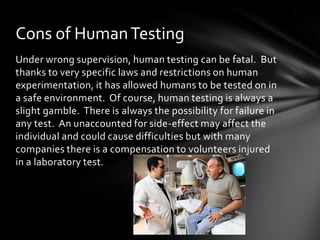
Under wrong supervision, human testing can be fatal. But
thanks to very specific laws and restrictions on human
experimentation, it has allowed humans to be tested on in
a safe environment. Of course, human testing is always a
slight gamble. There is always the possibility for failure in
any test. An unaccounted for side-effect may affect the
individual and could cause difficulties but with many
companies there is a compensation to volunteers injured
in a laboratory test.
Pros of Human Testing
Through human testing, companies have been able to release
miraculous drugs that have saved thousands of lives, or providing
patients with serious conditions with relief and sometimes
permanent cures. For example, do you think that aspirin was just put
out to market? People have been using plant extracts that contain
some of the same ingredients as aspirin for years, Hippocrates left
records of using willow extract to alleviate headaches and fevers, and
society today uses it all the time: approximately 40,000 tons of it is
consumed each year. Through extensive testing, even prehistoric
people were able to justify human testing for the greater good. In
the unfortunate case of an injury or loss of life in the laboratory, the
information gathered by scientists during that experiment will help
ensure that nobody ever faces the same fate while using the drug.


                                   Aspirin facts: http://en.wikipedia.org/wiki/Aspirin
http://news.stanford.edu/news/2006/february22/med-aaas-022206.html


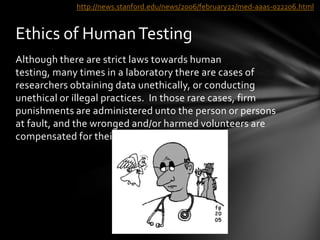
Ethics of Human Testing
Although there are strict laws towards human
testing, many times in a laboratory there are cases of
researchers obtaining data unethically, or conducting
unethical or illegal practices. In those rare cases, firm
punishments are administered unto the person or persons
at fault, and the wronged and/or harmed volunteers are
compensated for their struggles.
Abuses of Human Testing And How
They Can Be Avoided
This is not meant to offend anybody. The historical facts of the Holocaust are terrifying, yet true.

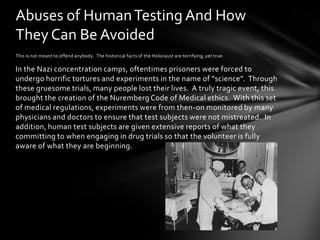
In the Nazi concentration camps, oftentimes prisoners were forced to
undergo horrific tortures and experiments in the name of “science”. Through
these gruesome trials, many people lost their lives. A truly tragic event, this
brought the creation of the Nuremberg Code of Medical ethics. With this set
of medical regulations, experiments were from then-on monitored by many
physicians and doctors to ensure that test subjects were not mistreated. In
addition, human test subjects are given extensive reports of what they
committing to when engaging in drug trials so that the volunteer is fully
aware of what they are beginning.
Conclusion
In conclusion, the involvement of humans in the experimentation for
medical research is a long thought-out process that has been in
question since even World War II. It’s harmful and beneficial effects
have prolonged different viewpoints in society with arguments such
as the abuse of human test subjects and the importance of a society’s
safety. However, in the contemporary world, this medical technique
serves a vital purpose that is too important to withstand. In
maintaining the legal status of human subject experimentation, new
products can still be introduced with little malfunction and ethical
guidelines can determine the physician’s relationship to the
experimental protocol.
Period 5 group 3 bioethics

Period 5 group 3 bioethics

  • 1.
    Group 3 Biotechnology1 Period 5 (In no specific order) Christopher Estrella Tatyana Bidopia Enid Moreira Arlety Lopetegui Alexis Ros Juan Ramirez Jade Regalado Diana Alduncin Michael De La Morena
  • 2.
    Introduction To HumanTesting During clinical trials and after animal testing, most drugs will continue testing by experimenting with human subjects. By testing on humans, companies can ensure that the drug is safe to the general public. Recently, there has been a lot of controversy around human testing and some people think it is unethical to test on humans. Without proper human trials, the general public could be exposed to a drug with the potential to kill everyone that takes it because it didn’t affect rats the same way it affects humans. Human trials are a very important phase in clinical testing, and can shed tremendous amounts of light on the drug and its possibilities.
  • 3.
    Four Main Phasesof Human Testing The four main phases of testing on humans are: 1.) The drug is administered to healthy human volunteers and the results reveal how the drug affects the human body. 2.) The drug is administered to volunteers with the condition being researched and the data is noted. 3.) The company will determine the safety, efficacy, and optimal dosing of the drug. 4.) The drug is submitted to the FDA for approval, and once it is approved, further tests will be taken while the drug is on the market. Throughout all of these tests under optimal conditions, the utmost care is taken throughout all testing and can often take many years.
  • 4.
    Cons of HumanTesting Under wrong supervision, human testing can be fatal. But thanks to very specific laws and restrictions on human experimentation, it has allowed humans to be tested on in a safe environment. Of course, human testing is always a slight gamble. There is always the possibility for failure in any test. An unaccounted for side-effect may affect the individual and could cause difficulties but with many companies there is a compensation to volunteers injured in a laboratory test.
  • 5.
    Pros of HumanTesting Through human testing, companies have been able to release miraculous drugs that have saved thousands of lives, or providing patients with serious conditions with relief and sometimes permanent cures. For example, do you think that aspirin was just put out to market? People have been using plant extracts that contain some of the same ingredients as aspirin for years, Hippocrates left records of using willow extract to alleviate headaches and fevers, and society today uses it all the time: approximately 40,000 tons of it is consumed each year. Through extensive testing, even prehistoric people were able to justify human testing for the greater good. In the unfortunate case of an injury or loss of life in the laboratory, the information gathered by scientists during that experiment will help ensure that nobody ever faces the same fate while using the drug. Aspirin facts: http://en.wikipedia.org/wiki/Aspirin
  • 6.
    http://news.stanford.edu/news/2006/february22/med-aaas-022206.html Ethics of HumanTesting Although there are strict laws towards human testing, many times in a laboratory there are cases of researchers obtaining data unethically, or conducting unethical or illegal practices. In those rare cases, firm punishments are administered unto the person or persons at fault, and the wronged and/or harmed volunteers are compensated for their struggles.
  • 7.
    Abuses of HumanTesting And How They Can Be Avoided This is not meant to offend anybody. The historical facts of the Holocaust are terrifying, yet true. In the Nazi concentration camps, oftentimes prisoners were forced to undergo horrific tortures and experiments in the name of “science”. Through these gruesome trials, many people lost their lives. A truly tragic event, this brought the creation of the Nuremberg Code of Medical ethics. With this set of medical regulations, experiments were from then-on monitored by many physicians and doctors to ensure that test subjects were not mistreated. In addition, human test subjects are given extensive reports of what they committing to when engaging in drug trials so that the volunteer is fully aware of what they are beginning.
  • 8.
    Conclusion In conclusion, theinvolvement of humans in the experimentation for medical research is a long thought-out process that has been in question since even World War II. It’s harmful and beneficial effects have prolonged different viewpoints in society with arguments such as the abuse of human test subjects and the importance of a society’s safety. However, in the contemporary world, this medical technique serves a vital purpose that is too important to withstand. In maintaining the legal status of human subject experimentation, new products can still be introduced with little malfunction and ethical guidelines can determine the physician’s relationship to the experimental protocol.