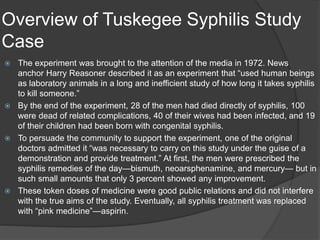
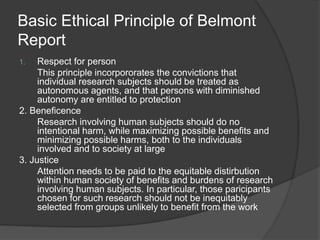
The document summarizes the unethical Tuskegee Syphilis Study conducted from 1932-1972 by the U.S. Public Health Service on 399 black men in Alabama. The men were told they were receiving treatment for "bad blood" but were not treated for their syphilis. They were studied to observe the long-term effects of untreated syphilis, which resulted in death and health complications. The study violated principles of informed consent, respect for persons, and was not stopped even after penicillin became available as treatment. It was exposed in 1972 and led to the 1979 Belmont Report establishing ethical guidelines to protect human subjects.








![Cleveland State University[email protected]Journal of Law](https://cdn.slidesharecdn.com/ss_thumbnails/clevelandstateuniversityemailprotectedjournaloflaw-220921133521-1475f766-thumbnail.jpg?width=640&height=640&fit=bounds)


