Performance Appraisal
What is Performance Appraisal? ‘ It is the process of evaluating the performance of employees, sharing that information with them and searching for ways to improve their performance. ’
Objectives of Performance Appraisal : To review the performance of employees over a given period of time. To judge the gap between actual and desired performance. Help management exercise organizational control. Help to strengthen the relationships & communications between employee, superior and subordinates. To diagnose the strengths and weaknesses of employees so as to identify the training and development needs of the future. To provide feedback to the employees regarding past performance. Provide clarity of the expectations and responsibilities of the functions to be performed by the employees.
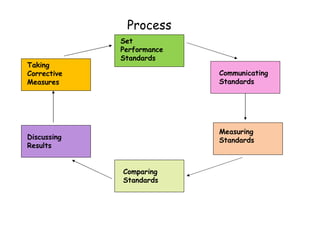
Process Set Performance Standards Communicating Standards Measuring Standards Comparing Standards Discussing Results Taking Corrective Measures
Types of Appraisal Self Appraisal Self & Authority [180º] 360º Appraisal Management by Objectives [MBO] Weighted Average Method Group Appraisal
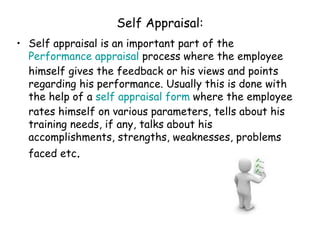
Self Appraisal: Self appraisal is an important part of the  Performance appraisal  process where the employee himself gives the feedback or his views and points regarding his performance. Usually this is done with the help of a  self appraisal form  where the employee rates himself on various parameters, tells about his training needs, if any, talks about his accomplishments, strengths, weaknesses, problems faced etc .
Self Appraisal Tips: Be honest &Truthful Prepare Be objective Be Positive Cover all the aspects Seek future responsibilities
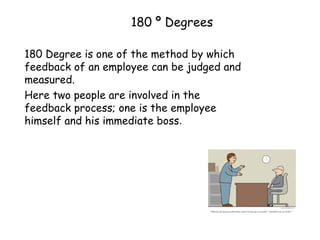
180 º Degrees 180 Degree is one of the method by which feedback of an employee can be judged and measured. Here two people are involved in the feedback process; one is the employee himself and his immediate boss .
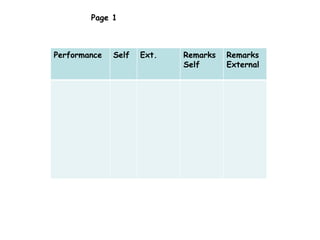
Page 1 Performance Self  Ext. Remarks Self Remarks External
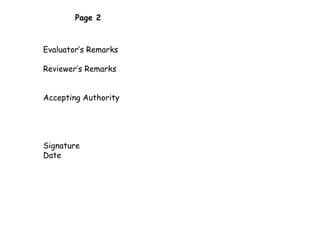
Page 2 Evaluator’s Remarks Reviewer’s Remarks Accepting Authority Signature Date
Page 3 Key Focus Area Activities Achievement [Narration]
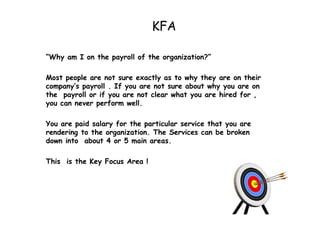
KFA “ Why am I on the payroll of the organization?”  Most people are not sure exactly as to why they are on their company’s payroll . If you are not sure about why you are on the  payroll or if you are not clear what you are hired for , you can never perform well. You are paid salary for the particular service that you are rendering to the organization. The Services can be broken down into  about 4 or 5 main areas. This  is the Key Focus Area !
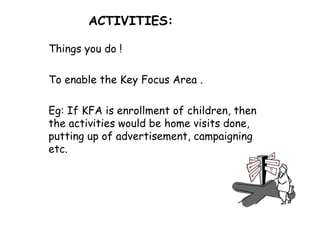
ACTIVITIES: Things you do !  To enable the Key Focus Area . Eg: If KFA is enrollment of children, then the activities would be home visits done, putting up of advertisement, campaigning etc.
ACHIVEMENT KFA – Enrollment ACTIVITIES – home visits, campaigning, advertisements  ACHIEVEMENT – how successful you were in the activities , hence how successful in KFA  -
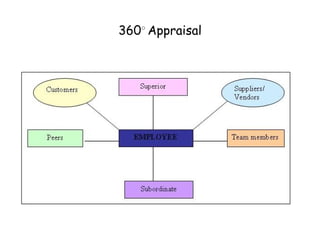
360 ○  Appraisal
Management By Objectives [MBO]: Employees and superiors come together and outline certain goal/objectives. The employee sets the goal, method it has to be achieved ,criteria for measurement of performance and action to be followed . MBO is all about participation. Ideally if employee themselves participate actively in the process they are more likely to fulfill their responsibilities .
Weighted Average Method: 5-Excellent 4-Good 3-Average 2-Below Average 1-Poor Category Weight Ratings Total [W*R] Performance 4 4 16 Attendance 3 4 12 Relationships 2 4 8 Honesty 1 4 4 Total 10 40
Team Appraisal While peers are on an equal standing with one another , they may not work closely together.  In a team setting it would be virtually impossible to separate, out an individual’s performance.
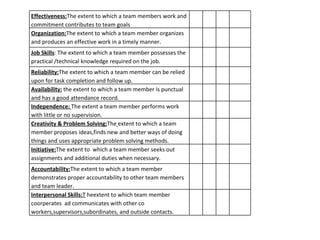
Effectiveness: The extent to which a team members work and commitment contributes to team goals Organization: The extent to which a team member organizes and produces an effective work in a timely manner. Job Skills : The extent to which a team member possesses the practical /technical knowledge required on the job. Reliability: The extent to which a team member can be relied upon for task completion and follow up. Availability:   the extent to which a team member is punctual and has a good attendance record. Independence:  The extent a team member performs work with little or no supervision. Creativity & Problem Solving: The   extent to which a team member proposes ideas,finds new and better ways of doing things and uses appropriate problem solving methods. Initiative: The extent to  which a team member seeks out assignments and additional duties when necessary. Accountability: The extent to which a team member demonstrates proper accountability to other team members and team leader. Interpersonal Skills: T  heextent to which team member coorperates  ad communicates with other co workers,supervisors,subordinates, and outside contacts.
Evaluator Signature ___________ Date ___________ Team Member’s signature ___________ Date ____________ If team member disagrees with appraisal he/she can attach appropriate comments.
Performance Appraisal & Succession Planning: Succession planning is ensuring the right people at the right place at the right time. It is a part of HR planning for the organization and involves finding the right people to take higher responsibilities in the organization. Succession planning is proactive in nature and results in the creation of a talent pool of candidates with the required potential and competencies who can take up higher positions in the future and help in the growth of the organization. Succession Planning is being practiced for long and is now an indispensable part of corporate strategy. One of the best approaches to succession planning is performance based succession planning.
Performance based PAY! Performance-related pay  is  money  paid to someone relating to how well one works . Like salesmen etc. get commission for selling more. Similarly all employees now would get more if they perform more.
Note : Employee 1) In your private notes, write  both your accomplishments   and   your less than superb job performance incidents  for the period the performance evaluation will cover.   2)  Mentally prepare some "talking points " to deliver as needed, if needed. 3)  Anticipate. What topics might arise in this appraisal?  What facts do you already know about those topics? What topics do you want to initiate if given the opportunity? 4)  Do your homework — but not just the night before the performance review. Keep private notes year-round  of your accomplishments as well as explanations for things you perceived as going awry despite your best intentions.   5) Don't babble during the performance appraisal session.  Speak clearly, concisely and with purpose. 6)  If you don't have goals or a ready-made plan  to improve some performance,  say so . Say: "I'll have to think about that and do some research on ways I can improve my ABC performance. Can I get back to you next Monday with my plan?" Then follow through with your promise.    
Note: Appraiser During an  employee appraisal  a  manager needs to listen more than they talk . This is easier to say rather than do.  Most managers leap straight into giving their opinion of an employee's performance  and then  giving the employee solutions on what they "should do to fix it". By talking more than listening  managers can create  over-dependence by their employees , leaving their  employee waiting for instruction rather than taking independent action.
Questions to Ask? Try and ask Open Ended Questions? What did you think about the performance evaluation? • What surprised you about the evaluation? • What pleased you most about the evaluation? • What accomplishments did you have this year that were not included in the evaluation? • What do you like most about your job? • What challenges you or frustrates you most about your job? • What could we do next year to make your job more challenging? • What could we do next year to make your job less frustrating? • If you could do one thing to change your job, what would it be? • How can I help you do your job better?  Before you have the next performance evaluation with an employee, think about how you can involve them in the conversation. Asking a few thought-provoking, open-ended questions might be the answer to getting them involved in the process
ANY QUESTIONS?
THANK YOU!
 

What is performance appraisal

  • 1.
  • 2.
    What is PerformanceAppraisal? ‘ It is the process of evaluating the performance of employees, sharing that information with them and searching for ways to improve their performance. ’
  • 3.
    Objectives of PerformanceAppraisal : To review the performance of employees over a given period of time. To judge the gap between actual and desired performance. Help management exercise organizational control. Help to strengthen the relationships & communications between employee, superior and subordinates. To diagnose the strengths and weaknesses of employees so as to identify the training and development needs of the future. To provide feedback to the employees regarding past performance. Provide clarity of the expectations and responsibilities of the functions to be performed by the employees.
  • 4.
    Process Set PerformanceStandards Communicating Standards Measuring Standards Comparing Standards Discussing Results Taking Corrective Measures
  • 5.
    Types of AppraisalSelf Appraisal Self & Authority [180º] 360º Appraisal Management by Objectives [MBO] Weighted Average Method Group Appraisal
  • 6.
    Self Appraisal: Selfappraisal is an important part of the Performance appraisal process where the employee himself gives the feedback or his views and points regarding his performance. Usually this is done with the help of a self appraisal form where the employee rates himself on various parameters, tells about his training needs, if any, talks about his accomplishments, strengths, weaknesses, problems faced etc .
  • 7.
    Self Appraisal Tips:Be honest &Truthful Prepare Be objective Be Positive Cover all the aspects Seek future responsibilities
  • 8.
    180 º Degrees180 Degree is one of the method by which feedback of an employee can be judged and measured. Here two people are involved in the feedback process; one is the employee himself and his immediate boss .
  • 9.
    Page 1 PerformanceSelf Ext. Remarks Self Remarks External
  • 10.
    Page 2 Evaluator’sRemarks Reviewer’s Remarks Accepting Authority Signature Date
  • 11.
    Page 3 KeyFocus Area Activities Achievement [Narration]
  • 12.
    KFA “ Whyam I on the payroll of the organization?” Most people are not sure exactly as to why they are on their company’s payroll . If you are not sure about why you are on the payroll or if you are not clear what you are hired for , you can never perform well. You are paid salary for the particular service that you are rendering to the organization. The Services can be broken down into about 4 or 5 main areas. This is the Key Focus Area !
  • 13.
    ACTIVITIES: Things youdo ! To enable the Key Focus Area . Eg: If KFA is enrollment of children, then the activities would be home visits done, putting up of advertisement, campaigning etc.
  • 14.
    ACHIVEMENT KFA –Enrollment ACTIVITIES – home visits, campaigning, advertisements ACHIEVEMENT – how successful you were in the activities , hence how successful in KFA -
  • 15.
    360 ○ Appraisal
  • 16.
    Management By Objectives[MBO]: Employees and superiors come together and outline certain goal/objectives. The employee sets the goal, method it has to be achieved ,criteria for measurement of performance and action to be followed . MBO is all about participation. Ideally if employee themselves participate actively in the process they are more likely to fulfill their responsibilities .
  • 17.
    Weighted Average Method:5-Excellent 4-Good 3-Average 2-Below Average 1-Poor Category Weight Ratings Total [W*R] Performance 4 4 16 Attendance 3 4 12 Relationships 2 4 8 Honesty 1 4 4 Total 10 40
  • 18.
    Team Appraisal Whilepeers are on an equal standing with one another , they may not work closely together. In a team setting it would be virtually impossible to separate, out an individual’s performance.
  • 19.
    Effectiveness: The extentto which a team members work and commitment contributes to team goals Organization: The extent to which a team member organizes and produces an effective work in a timely manner. Job Skills : The extent to which a team member possesses the practical /technical knowledge required on the job. Reliability: The extent to which a team member can be relied upon for task completion and follow up. Availability: the extent to which a team member is punctual and has a good attendance record. Independence: The extent a team member performs work with little or no supervision. Creativity & Problem Solving: The extent to which a team member proposes ideas,finds new and better ways of doing things and uses appropriate problem solving methods. Initiative: The extent to which a team member seeks out assignments and additional duties when necessary. Accountability: The extent to which a team member demonstrates proper accountability to other team members and team leader. Interpersonal Skills: T heextent to which team member coorperates ad communicates with other co workers,supervisors,subordinates, and outside contacts.
  • 20.
    Evaluator Signature ___________Date ___________ Team Member’s signature ___________ Date ____________ If team member disagrees with appraisal he/she can attach appropriate comments.
  • 21.
    Performance Appraisal &Succession Planning: Succession planning is ensuring the right people at the right place at the right time. It is a part of HR planning for the organization and involves finding the right people to take higher responsibilities in the organization. Succession planning is proactive in nature and results in the creation of a talent pool of candidates with the required potential and competencies who can take up higher positions in the future and help in the growth of the organization. Succession Planning is being practiced for long and is now an indispensable part of corporate strategy. One of the best approaches to succession planning is performance based succession planning.
  • 22.
    Performance based PAY!Performance-related pay is money paid to someone relating to how well one works . Like salesmen etc. get commission for selling more. Similarly all employees now would get more if they perform more.
  • 23.
    Note : Employee1) In your private notes, write both your accomplishments and your less than superb job performance incidents for the period the performance evaluation will cover.   2) Mentally prepare some "talking points " to deliver as needed, if needed. 3) Anticipate. What topics might arise in this appraisal? What facts do you already know about those topics? What topics do you want to initiate if given the opportunity? 4) Do your homework — but not just the night before the performance review. Keep private notes year-round of your accomplishments as well as explanations for things you perceived as going awry despite your best intentions.   5) Don't babble during the performance appraisal session. Speak clearly, concisely and with purpose. 6) If you don't have goals or a ready-made plan to improve some performance, say so . Say: "I'll have to think about that and do some research on ways I can improve my ABC performance. Can I get back to you next Monday with my plan?" Then follow through with your promise.    
  • 24.
    Note: Appraiser Duringan employee appraisal a manager needs to listen more than they talk . This is easier to say rather than do. Most managers leap straight into giving their opinion of an employee's performance and then giving the employee solutions on what they "should do to fix it". By talking more than listening managers can create over-dependence by their employees , leaving their employee waiting for instruction rather than taking independent action.
  • 25.
    Questions to Ask?Try and ask Open Ended Questions? What did you think about the performance evaluation? • What surprised you about the evaluation? • What pleased you most about the evaluation? • What accomplishments did you have this year that were not included in the evaluation? • What do you like most about your job? • What challenges you or frustrates you most about your job? • What could we do next year to make your job more challenging? • What could we do next year to make your job less frustrating? • If you could do one thing to change your job, what would it be? • How can I help you do your job better? Before you have the next performance evaluation with an employee, think about how you can involve them in the conversation. Asking a few thought-provoking, open-ended questions might be the answer to getting them involved in the process
  • 26.
  • 27.
  • 28.