







Effective Performance Appraisals - step by step
Your objectives for your performance appraisals?
The costs of  employee turnover?
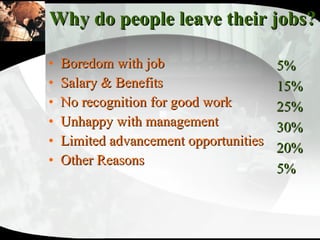
Why do people leave their jobs? Boredom with job Salary & Benefits No recognition for good work Unhappy with management Limited advancement opportunities Other Reasons 5% 15% 25% 30% 20%  5%
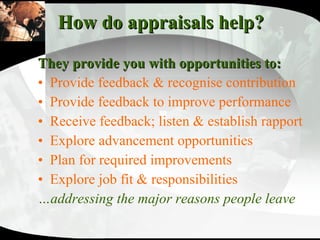
How do appraisals help? They provide you with opportunities to:   Provide feedback & recognise contribution Provide feedback to improve performance Receive feedback; listen & establish rapport Explore advancement opportunities Plan for required improvements Explore job fit & responsibilities … addressing the major reasons people leave
How does the 360 report help?  Provides a good reason for regular feedback Allows you to replace vague opinion with structured data  Uncovers heretofore unseen strengths Exposes specific areas for development focus Is perceived as more equitable and therefore more likely to prompt needed change
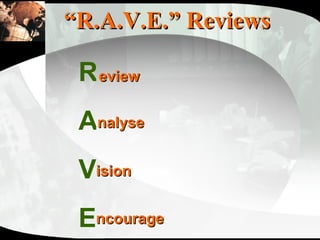
“ R.A.V.E.” Reviews eview nalyse ision ncourage R A V E
“ R.A.V.E.” Reviews R eview   their 360 Degree reports, development plans & any performance data or records in advance of the meeting.  Allow them to do so too.  NO surprises
“ R.A.V.E.” Reviews A nalyse   & discuss their personal development plans with them.  First strengths & then development objectives.  Discuss any “coal-face” performance issues &  agree performance development & attainment objectives .  Set next review date.
The Truth Hurts! … or does it?
Secret of Apositive Feedback “ That was great, take the shot  like that again….” “ ...except this time grip the club  more like this…” Coach : from strength to  required improvement
“ R.A.V.E.” Reviews V ision   for future growth and development for the individual to get to the next level.  Help them to “see” their potential.
“ R.A.V.E.” Reviews E ncourage   the person.  Give them a fine reputation to live up to.  Send them away on a high - even if they still have work to do to reach par.
“ R.A.V.E.” Reviews eview nalyse ision ncourage R A V E
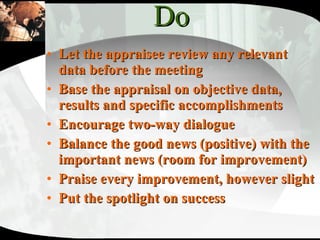
Do Let the appraisee review any relevant data before the meeting Base the appraisal on objective data, results and specific accomplishments Encourage two-way dialogue Balance the good news (positive) with the important news (room for improvement) Praise every improvement, however slight Put the spotlight on success
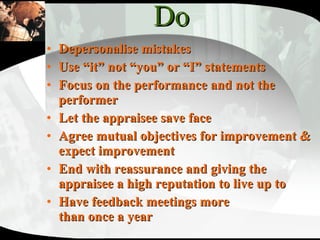
Do Depersonalise mistakes Use “it” not “you” or “I” statements Focus on the performance and not the performer Let the appraisee save face Agree mutual objectives for improvement & expect improvement End with reassurance and giving the appraisee a high reputation to live up to Have feedback meetings more  than once a year
Don’t Save up any unpleasant surprises Be an adversary Focus exclusively on failure Base your judgement on opinion Launch personal attacks or humiliate Expect miracles Criticise, condemn or complain Just “see what happens” Ignore him / her until next appraisal and still expect improvement
Don’t Make it a pay negotiation !!!
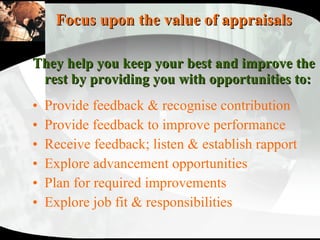
Focus upon the value of appraisals They help you keep your best and improve the rest by providing you with opportunities to: Provide feedback & recognise contribution Provide feedback to improve performance Receive feedback; listen & establish rapport Explore advancement opportunities Plan for required improvements Explore job fit & responsibilities
Effective Performance Appraisals - step by step

Appraisal Workshop

  • 1.
  • 2.
    Your objectives foryour performance appraisals?
  • 3.
    The costs of employee turnover?
  • 4.
    Why do peopleleave their jobs? Boredom with job Salary & Benefits No recognition for good work Unhappy with management Limited advancement opportunities Other Reasons 5% 15% 25% 30% 20% 5%
  • 5.
    How do appraisalshelp? They provide you with opportunities to: Provide feedback & recognise contribution Provide feedback to improve performance Receive feedback; listen & establish rapport Explore advancement opportunities Plan for required improvements Explore job fit & responsibilities … addressing the major reasons people leave
  • 6.
    How does the360 report help? Provides a good reason for regular feedback Allows you to replace vague opinion with structured data Uncovers heretofore unseen strengths Exposes specific areas for development focus Is perceived as more equitable and therefore more likely to prompt needed change
  • 7.
    “ R.A.V.E.” Reviewseview nalyse ision ncourage R A V E
  • 8.
    “ R.A.V.E.” ReviewsR eview their 360 Degree reports, development plans & any performance data or records in advance of the meeting. Allow them to do so too. NO surprises
  • 9.
    “ R.A.V.E.” ReviewsA nalyse & discuss their personal development plans with them. First strengths & then development objectives. Discuss any “coal-face” performance issues & agree performance development & attainment objectives . Set next review date.
  • 10.
    The Truth Hurts!… or does it?
  • 11.
    Secret of ApositiveFeedback “ That was great, take the shot like that again….” “ ...except this time grip the club more like this…” Coach : from strength to required improvement
  • 12.
    “ R.A.V.E.” ReviewsV ision for future growth and development for the individual to get to the next level. Help them to “see” their potential.
  • 13.
    “ R.A.V.E.” ReviewsE ncourage the person. Give them a fine reputation to live up to. Send them away on a high - even if they still have work to do to reach par.
  • 14.
    “ R.A.V.E.” Reviewseview nalyse ision ncourage R A V E
  • 15.
    Do Let theappraisee review any relevant data before the meeting Base the appraisal on objective data, results and specific accomplishments Encourage two-way dialogue Balance the good news (positive) with the important news (room for improvement) Praise every improvement, however slight Put the spotlight on success
  • 16.
    Do Depersonalise mistakesUse “it” not “you” or “I” statements Focus on the performance and not the performer Let the appraisee save face Agree mutual objectives for improvement & expect improvement End with reassurance and giving the appraisee a high reputation to live up to Have feedback meetings more than once a year
  • 17.
    Don’t Save upany unpleasant surprises Be an adversary Focus exclusively on failure Base your judgement on opinion Launch personal attacks or humiliate Expect miracles Criticise, condemn or complain Just “see what happens” Ignore him / her until next appraisal and still expect improvement
  • 18.
    Don’t Make ita pay negotiation !!!
  • 19.
    Focus upon thevalue of appraisals They help you keep your best and improve the rest by providing you with opportunities to: Provide feedback & recognise contribution Provide feedback to improve performance Receive feedback; listen & establish rapport Explore advancement opportunities Plan for required improvements Explore job fit & responsibilities
  • 20.