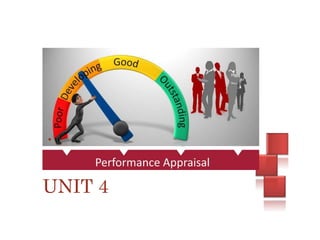
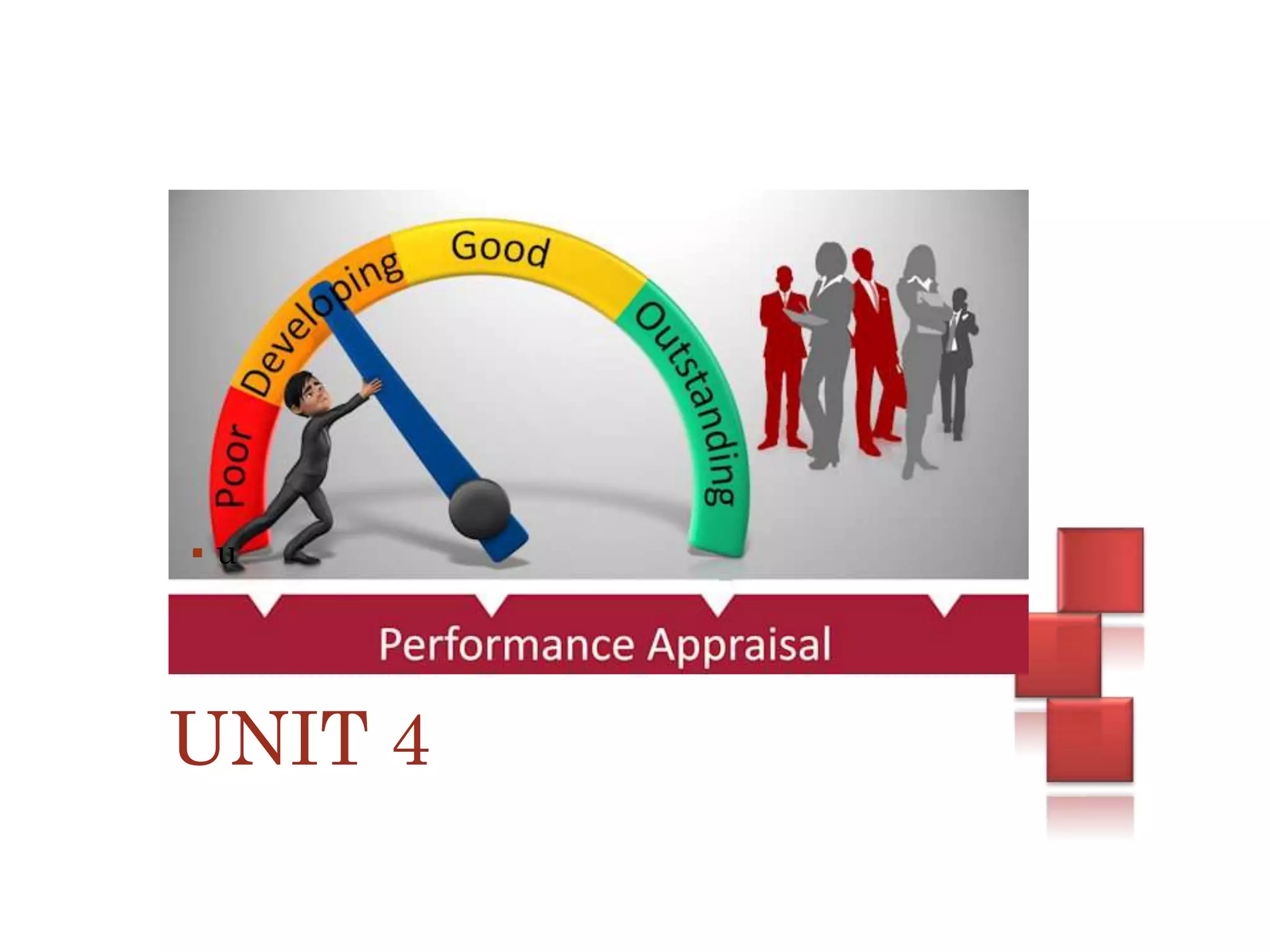
UNIT 4
 u
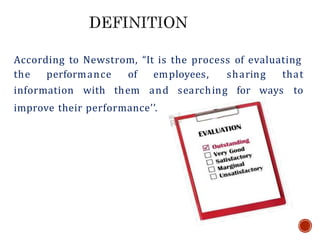
According to Newstrom, “It is the process of evaluating
the performance
information with
of employees, sharing that
them and searching for ways to
improve their performance’’.
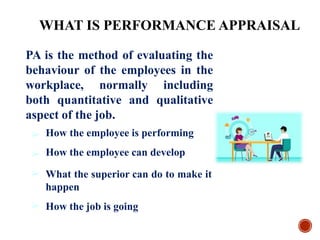
PA is the method of evaluating the
behaviour of the employees in the
workplace, normally including
both quantitative and qualitative
aspect of the job.
➢
➢
➢
How the employee is performing
How the employee can develop
What the superior can do to make it
happen
➢ How the job is going
WHAT IS PERFORMANCE APPRAISAL
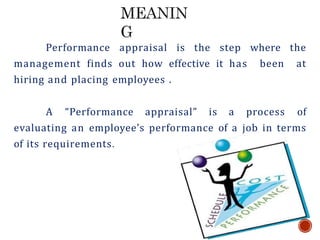
Performance appraisal is the step where the
management finds out how effective it has been at
hiring and placing employees .
A “Performance appraisal” is a process of
evaluating an employee’s performance of a job in terms
of its requirements.
• The Appraisee
• The Appraiser
• HR Department
WHO ARE INVOLVED IN
PERFORMANCE APPRAISAL
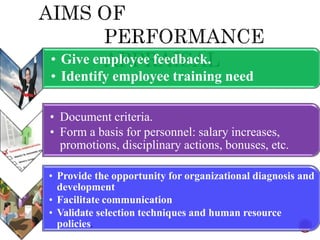
• Give employee feedback.
• Identify employee training need
• Document criteria.
• Form a basis for personnel: salary increases,
promotions, disciplinary actions, bonuses, etc.
• Provide the opportunity for organizational diagnosis and
development
• Facilitate communication
• Validate selection techniques and human resource
policies.
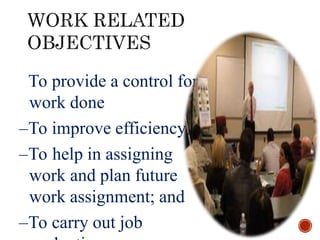
–To provide a control for
work done
–To improve efficiency
–To help in assigning
work and plan future
work assignment; and
–To carry out job
– To identify strong and weak points and
encourage finding remedies for weak
points through training;
– To determine career potential;
– To plan developmental( promotional or
lateral) assignments; and
– To plan career goals
• To provide adequate feedback on
performance;
• To clearly establish goals, i.e what is
expected of the staff members in terms
of performance and future work
assignments;
• To provide counseling and job
satisfaction through open discussion on
performance and
• To let employees assess where they
stand within the organization in terms of
their performance.
• To serve as a basis for
promotion or demotion;
• To serve as a basis for
allocating incentives;
• To serve as a basis for
determining transfers ; and
• To serve as a basis for
termination in case of reduction
of staff.
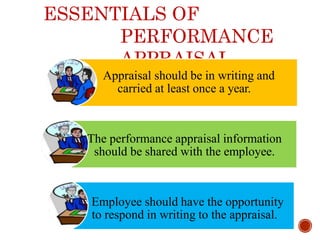
ESSENTIALS OF
PERFORMANCE
APPRAISAL
Appraisal should be in writing and
carried at least once a year.
The performance appraisal information
should be shared with the employee.
Employee should have the opportunity
to respond in writing to the appraisal.
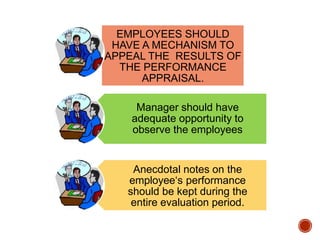
EMPLOYEES SHOULD
HAVE A MECHANISM TO
APPEAL THE RESULTS OF
THE PERFORMANCE
APPRAISAL.
Manager should have
adequate opportunity to
observe the employees
Anecdotal notes on the
employee‘s performance
should be kept during the
entire evaluation period.
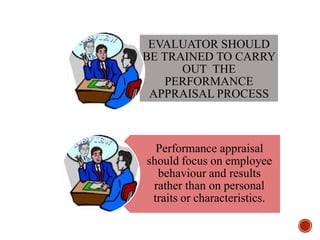
EVALUATOR SHOULD
BE TRAINED TO CARRY
OUT THE
PERFORMANCE
APPRAISAL PROCESS
Performance appraisal
should focus on employee
behaviour and results
rather than on personal
traits or characteristics.
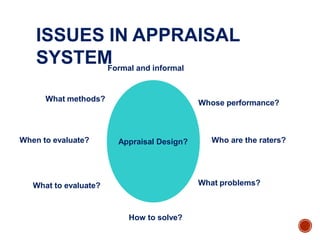
ISSUES IN APPRAISAL
SYSTEM
Appraisal Design?
Formal and informal
Whose performance?
Who are the raters?
What problems?
How to solve?
What to evaluate?
When to evaluate?
What methods?
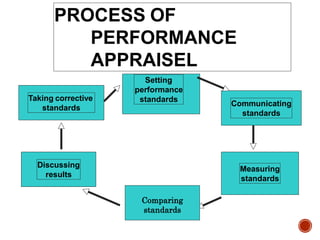
PROCESS OF
PERFORMANCE
APPRAISEL
Setting
performance
standards
Taking corrective
standards
Discussing
results
Measuring
standards
Communicating
standards
Comparing
standards
 The appraisal process begins with the establishment of per-
formance standards. The managers must determine what outputs,
accomplishments and skills will be evaluated. These standards
should have evolved out of job analysis and job descriptions.
 These performance standards should also be clear and objective
to be understood and measured. Standards should not be
expressed in an articulated or vague manner such as “a good job”
or “a full day’s work” as these vague phrases tells nothing.
 Once the performance standards are established, this need to be
communicated to the respective employees so that they come to know
what is expected of them. Past experience indicates that not
communicating standards to the employees compounds the appraisal
problem.
 Here, it must be noted that mere transference of information
(relating to performance standards, for example) from the manager
to the employees is not communication It becomes communication
only when the transference of information has taken place and has
been received and understood by the employees’.
 The feedback from the employees on the standards communicated to
them must be obtained. If required, the standards may be modified
or revised in the light of feedback obtained from the employees. It is
important to note that communication is a two-way street.
 This is the third step involved in the appraisal process. In this
stage, the actual performance of the employee is measured on the
basis of information available from various sources such as
personal observation, statistical reports, oral reports, and written
reports.
 Needless to mention, the evaluator’s feelings should not influence
the performance measurement of the employee. Measurement
must be objective based on facts and findings. This is because
what we measure is more critical and important to the evaluation
process than how we measure.
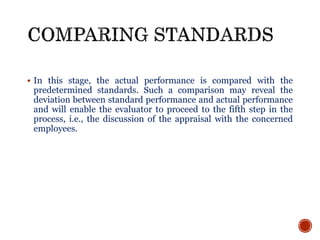
 In this stage, the actual performance is compared with the
predetermined standards. Such a comparison may reveal the
deviation between standard performance and actual performance
and will enable the evaluator to proceed to the fifth step in the
process, i.e., the discussion of the appraisal with the concerned
employees.
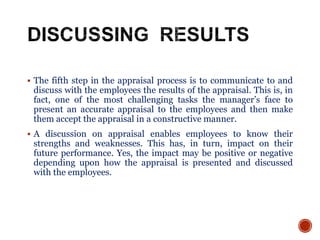
 The fifth step in the appraisal process is to communicate to and
discuss with the employees the results of the appraisal. This is, in
fact, one of the most challenging tasks the manager’s face to
present an accurate appraisal to the employees and then make
them accept the appraisal in a constructive manner.
 A discussion on appraisal enables employees to know their
strengths and weaknesses. This has, in turn, impact on their
future performance. Yes, the impact may be positive or negative
depending upon how the appraisal is presented and discussed
with the employees.
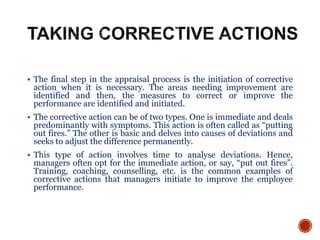
 The final step in the appraisal process is the initiation of corrective
action when it is necessary. The areas needing improvement are
identified and then, the measures to correct or improve the
performance are identified and initiated.
 The corrective action can be of two types. One is immediate and deals
predominantly with symptoms. This action is often called as “putting
out fires.” The other is basic and delves into causes of deviations and
seeks to adjust the difference permanently.
 This type of action involves time to analyse deviations. Hence,
managers often opt for the immediate action, or say, “put out fires”.
Training, coaching, counselling, etc. is the common examples of
corrective actions that managers initiate to improve the employee
performance.
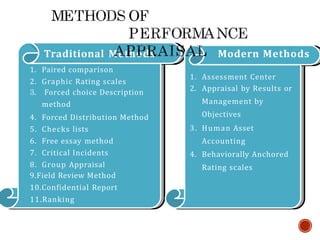
1. Paired comparison
2. Graphic Rating scales
3. Forced choice Description
method
4. Forced Distribution Method
5. Checks lists
6. Free essay method
7. Critical Incidents
8. Group Appraisal
9.Field Review Method
10.Confidential Report
11.Ranking
1. Assessment Center
2. Appraisal by Results or
Management by
Objectives
3. Human Asset
Accounting
4. Behaviorally Anchored
Rating scales
Traditional Methods Modern Methods
TRADITIONAL METHODS
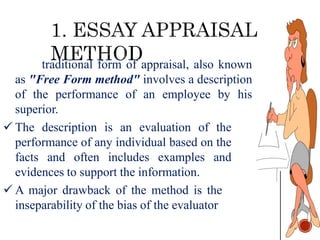
 This traditional form of appraisal, also known
as "Free Form method" involves a description
of the performance of an employee by his
superior.
 The description is an evaluation of the
performance of any individual based on the
facts and often includes examples and
evidences to support the information.
 A major drawback of the method is the
inseparability of the bias of the evaluator.
1. This is one of the oldest and simplest techniques
of performance appraisal.
2. In this method, the appraiser ranks the employees
from the best to the poorest on the basis of their
overall performance.
3. It is quite useful for a comparative evaluation.
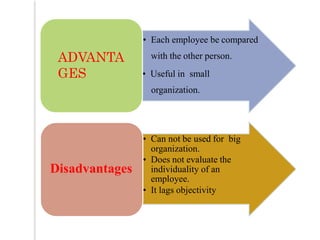
• Each employee be compared
with the other person.
• Useful in small
organization.
ADVANTA
GES
• Can not be used for big
organization.
• Does not evaluate the
individuality of an
employee.
• It lags objectivity
Disadvantages
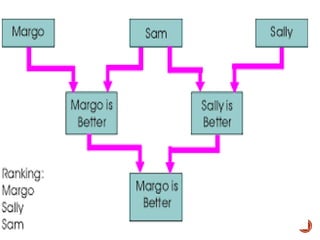
• A better technique of comparison than the
straight ranking method, this method
compares each employee with all others in
the group, one at a time.
• After all the comparisons on the basis of the
overall comparisons, the employees are
given the final rankings.
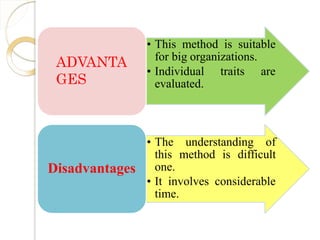
• This method is suitable
for big organizations.
• Individual traits are
evaluated.
ADVANTA
GES
• The understanding of
this method is difficult
one.
• It involves considerable
time.
Disadvantages
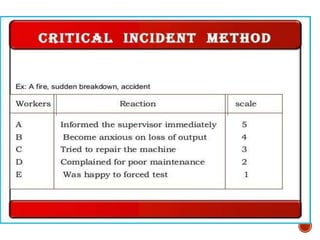
• In this method of Performance
appraisal the evaluator rates the
employee on the basis of critical
events and how the employee behaved
during those incidents.
• It includes both negative and positive
points.
• The drawback of this method is that
the supervisor has to note down the
critical incidents and the employee
behavior as and when they occur.
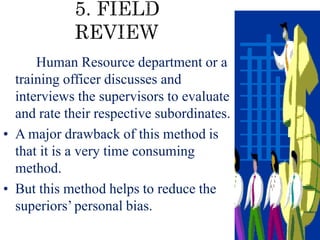
• In this method, a senior member of
the Human Resource department or a
training officer discusses and
interviews the supervisors to evaluate
and rate their respective subordinates.
• A major drawback of this method is
that it is a very time consuming
method.
• But this method helps to reduce the
superiors’personal bias.
⚫ An employee’s performance is appraised through an
interview between the rater and the immediate superior or
superior of a concerned employee.
⚫ The rater asks the superiors questions about the
performance of an employee; the personnel department
prepares a detail report on the basis of this collected
information.
⚫ A copy of this report is placed in the personnel file of
the concerned employee after getting approval from the
superior.
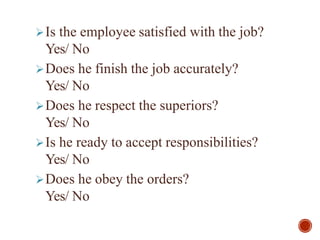
• The rater is given a checklist of the
descriptions of the behaviour of the
employees on job.
• The checklist contains a list of
statements on the basis of which the
rater describes the on the job
performance of the employees.
Is the employee satisfied with the job?
Yes/ No
Does he finish the job accurately?
Yes/ No
Does he respect the superiors?
Yes/ No
Is he ready to accept responsibilities?
Yes/ No
Does he obey the orders?
Yes/ No
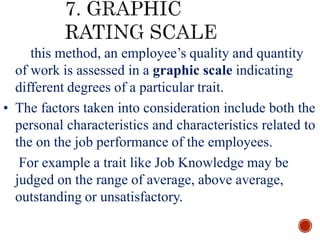
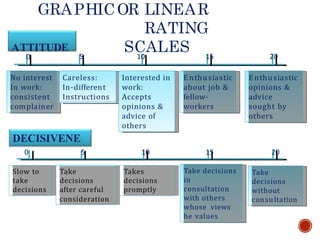
• In this method, an employee’s quality and quantity
of work is assessed in a graphic scale indicating
different degrees of a particular trait.
• The factors taken into consideration include both the
personal characteristics and characteristics related to
the on the job performance of the employees.
• For example a trait like Job Knowledge may be
judged on the range of average, above average,
outstanding or unsatisfactory.
GRAPHICOR LINEAR
RATING
SCALES
No interest
In work:
consistent
complainer
Careless:
In-different
Instructions
Interested in
work:
Accepts
opinions &
advice of
others
Enthusiastic
about job &
fellow-
workers
Enthusiastic
opinions &
advice
sought by
others
DECISIVENE
Take decisions
in
consultation
with others
whose views
he values
Slow to Take Takes
take decisions decisions
decisions after careful promptly
consideration
Take
decisions
without
consultation
0 5 10 15 20
ATTITUDE
0 5 10 15 20
• To eliminate the element of bias from the
rater’s ratings, the evaluator is asked to
distribute the employees in some fixed
categories of ratings like on a normal
distribution curve.
• The rater chooses the appropriate fit for the
categories on his own discretion
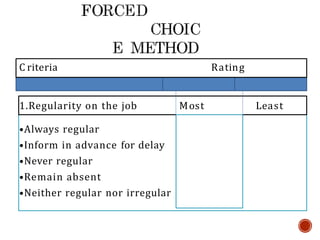
C riteria Rating
1.Regularity on the job Most Least
•Always regular
•Inform in advance for delay
•Never regular
•Remain absent
•Neither regular nor irregular
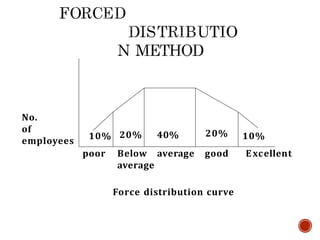
No.
of
employees 10% 20% 40% 20% 10%
poor Below average
average
good Excellent
Force distribution curve
• An assessment centre typically involves the
use of methods like social/informal events,
tests and exercises, assignments being given
to a group of employees to assess their
competencies to take higher responsibilities
in the future.
• Generally, employees are given an
assignment similar to the job they would be
expected to perform if promoted.
• The trained evaluators observe and evaluate
employees as they perform the assigned jobs
and are evaluated on job related
• Is a relatively new technique which combines the
graphic rating scale and critical incidents method.
• It consists of predetermined critical areas of job
performance or sets of behavioral statements
describing important job performance qualities as
good or bad.
• In this method, an employee’s actual job behavior is
judged against the desired behavior by recording and
comparing the behavior with BARS.
• Human resources are valuable assets
for every organization. Human
resource accounting method tries to
find the relative worth of these assets
in the terms of money.
• In this method the Performance
appraisal of the employees is judged
in terms of cost and contribution of
the employees.
• The cost of employees include all the
expenses incurred on them like their
compensation, recruitment and selection
costs, induction and training costs etc
whereas their contribution includes the
total value added (in monetary terms).
• The difference between the cost and the
contribution will be the performance of the
employees.
• Ideally, the contribution of the employees
should be greater than the cost incurred on
them.
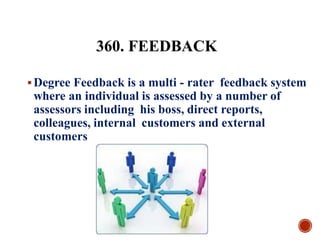
WHAT IS 360. FEEDBACK
Degree Feedback is a multi - rater feedback system
where an individual is assessed by a number of
assessors including his boss, direct reports,
colleagues, internal customers and external
customers
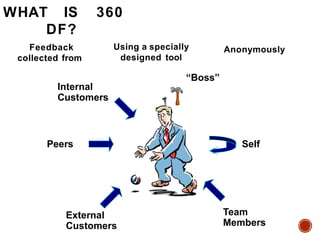
360
Internal
Customers
Peers
External
Customers
Team
Members
Self
Feedback
collected from
Using a specially
designed tool
“Boss”
Anonymously
WHAT IS 360
DF?
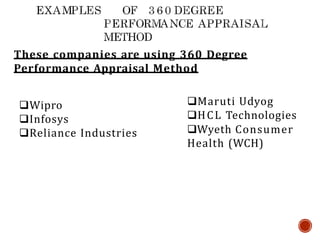
These companies are using 360 Degree
Performance Appraisal Method
Wipro
Infosys
Reliance Industries
Maruti Udyog
HCL Technologies
Wyeth Consumer
Health (WCH)
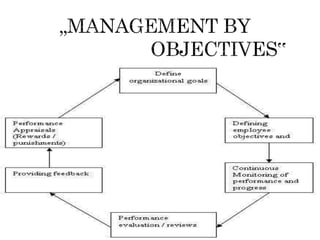
It means management by objectives and the performance is rated
against the achievement of objectives stated by the management.
MBO process goes as under.
 Establish goals and desired outcomes for each subordinate
 Setting performance standards
 Comparison of actual goals with goals attained by the
employee
 Establish new goals and new strategies for goals not achieved
in previous year
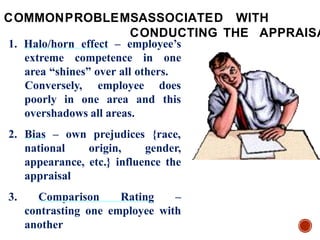
1. Halo/horn effect – employee’s
extreme competence in one
area “shines” over all others.
poorly in one area and
Conversely, employee does
this
overshadows all areas.
2. Bias – own prejudices {race,
national origin, gender,
appearance, etc.} influence the
appraisal
3. Comparison Rating –
contrasting one employee with
another
COMMONPROBLEMSASSOCIATED WITH
CONDUCTING THE APPRAISA
4. Recency Effect – focusing on recent
performance instead of entire year
5. Personal Prejudice – If the rater dislikes one
group or employees, he may rate them at the
lower end.
6. Favoritism – evaluating friends or those who
don’t make waves, etc. more favorably than
others
Common Problems Associated with Conducting the
Appraisal
3. Central Tendency – rate everyone as average

4.1 Performanced appraisel.pptx

  • 1.
  • 2.
    According to Newstrom,“It is the process of evaluating the performance information with of employees, sharing that them and searching for ways to improve their performance’’.
  • 3.
    PA is themethod of evaluating the behaviour of the employees in the workplace, normally including both quantitative and qualitative aspect of the job. ➢ ➢ ➢ How the employee is performing How the employee can develop What the superior can do to make it happen ➢ How the job is going WHAT IS PERFORMANCE APPRAISAL
  • 4.
    Performance appraisal isthe step where the management finds out how effective it has been at hiring and placing employees . A “Performance appraisal” is a process of evaluating an employee’s performance of a job in terms of its requirements.
  • 5.
    • The Appraisee •The Appraiser • HR Department WHO ARE INVOLVED IN PERFORMANCE APPRAISAL
  • 6.
    • Give employeefeedback. • Identify employee training need • Document criteria. • Form a basis for personnel: salary increases, promotions, disciplinary actions, bonuses, etc. • Provide the opportunity for organizational diagnosis and development • Facilitate communication • Validate selection techniques and human resource policies.
  • 8.
    –To provide acontrol for work done –To improve efficiency –To help in assigning work and plan future work assignment; and –To carry out job
  • 9.
    – To identifystrong and weak points and encourage finding remedies for weak points through training; – To determine career potential; – To plan developmental( promotional or lateral) assignments; and – To plan career goals
  • 10.
    • To provideadequate feedback on performance; • To clearly establish goals, i.e what is expected of the staff members in terms of performance and future work assignments; • To provide counseling and job satisfaction through open discussion on performance and • To let employees assess where they stand within the organization in terms of their performance.
  • 11.
    • To serveas a basis for promotion or demotion; • To serve as a basis for allocating incentives; • To serve as a basis for determining transfers ; and • To serve as a basis for termination in case of reduction of staff.
  • 12.
    ESSENTIALS OF PERFORMANCE APPRAISAL Appraisal shouldbe in writing and carried at least once a year. The performance appraisal information should be shared with the employee. Employee should have the opportunity to respond in writing to the appraisal.
  • 13.
    EMPLOYEES SHOULD HAVE AMECHANISM TO APPEAL THE RESULTS OF THE PERFORMANCE APPRAISAL. Manager should have adequate opportunity to observe the employees Anecdotal notes on the employee‘s performance should be kept during the entire evaluation period.
  • 14.
    EVALUATOR SHOULD BE TRAINEDTO CARRY OUT THE PERFORMANCE APPRAISAL PROCESS Performance appraisal should focus on employee behaviour and results rather than on personal traits or characteristics.
  • 15.
    ISSUES IN APPRAISAL SYSTEM AppraisalDesign? Formal and informal Whose performance? Who are the raters? What problems? How to solve? What to evaluate? When to evaluate? What methods?
  • 16.
  • 17.
     The appraisalprocess begins with the establishment of per- formance standards. The managers must determine what outputs, accomplishments and skills will be evaluated. These standards should have evolved out of job analysis and job descriptions.  These performance standards should also be clear and objective to be understood and measured. Standards should not be expressed in an articulated or vague manner such as “a good job” or “a full day’s work” as these vague phrases tells nothing.
  • 18.
     Once theperformance standards are established, this need to be communicated to the respective employees so that they come to know what is expected of them. Past experience indicates that not communicating standards to the employees compounds the appraisal problem.  Here, it must be noted that mere transference of information (relating to performance standards, for example) from the manager to the employees is not communication It becomes communication only when the transference of information has taken place and has been received and understood by the employees’.  The feedback from the employees on the standards communicated to them must be obtained. If required, the standards may be modified or revised in the light of feedback obtained from the employees. It is important to note that communication is a two-way street.
  • 19.
     This isthe third step involved in the appraisal process. In this stage, the actual performance of the employee is measured on the basis of information available from various sources such as personal observation, statistical reports, oral reports, and written reports.  Needless to mention, the evaluator’s feelings should not influence the performance measurement of the employee. Measurement must be objective based on facts and findings. This is because what we measure is more critical and important to the evaluation process than how we measure.
  • 20.
     In thisstage, the actual performance is compared with the predetermined standards. Such a comparison may reveal the deviation between standard performance and actual performance and will enable the evaluator to proceed to the fifth step in the process, i.e., the discussion of the appraisal with the concerned employees.
  • 21.
     The fifthstep in the appraisal process is to communicate to and discuss with the employees the results of the appraisal. This is, in fact, one of the most challenging tasks the manager’s face to present an accurate appraisal to the employees and then make them accept the appraisal in a constructive manner.  A discussion on appraisal enables employees to know their strengths and weaknesses. This has, in turn, impact on their future performance. Yes, the impact may be positive or negative depending upon how the appraisal is presented and discussed with the employees.
  • 22.
     The finalstep in the appraisal process is the initiation of corrective action when it is necessary. The areas needing improvement are identified and then, the measures to correct or improve the performance are identified and initiated.  The corrective action can be of two types. One is immediate and deals predominantly with symptoms. This action is often called as “putting out fires.” The other is basic and delves into causes of deviations and seeks to adjust the difference permanently.  This type of action involves time to analyse deviations. Hence, managers often opt for the immediate action, or say, “put out fires”. Training, coaching, counselling, etc. is the common examples of corrective actions that managers initiate to improve the employee performance.
  • 23.
    1. Paired comparison 2.Graphic Rating scales 3. Forced choice Description method 4. Forced Distribution Method 5. Checks lists 6. Free essay method 7. Critical Incidents 8. Group Appraisal 9.Field Review Method 10.Confidential Report 11.Ranking 1. Assessment Center 2. Appraisal by Results or Management by Objectives 3. Human Asset Accounting 4. Behaviorally Anchored Rating scales Traditional Methods Modern Methods
  • 24.
  • 25.
     This traditionalform of appraisal, also known as "Free Form method" involves a description of the performance of an employee by his superior.  The description is an evaluation of the performance of any individual based on the facts and often includes examples and evidences to support the information.  A major drawback of the method is the inseparability of the bias of the evaluator.
  • 26.
    1. This isone of the oldest and simplest techniques of performance appraisal. 2. In this method, the appraiser ranks the employees from the best to the poorest on the basis of their overall performance. 3. It is quite useful for a comparative evaluation.
  • 27.
    • Each employeebe compared with the other person. • Useful in small organization. ADVANTA GES • Can not be used for big organization. • Does not evaluate the individuality of an employee. • It lags objectivity Disadvantages
  • 28.
    • A bettertechnique of comparison than the straight ranking method, this method compares each employee with all others in the group, one at a time. • After all the comparisons on the basis of the overall comparisons, the employees are given the final rankings.
  • 30.
    • This methodis suitable for big organizations. • Individual traits are evaluated. ADVANTA GES • The understanding of this method is difficult one. • It involves considerable time. Disadvantages
  • 31.
    • In thismethod of Performance appraisal the evaluator rates the employee on the basis of critical events and how the employee behaved during those incidents. • It includes both negative and positive points. • The drawback of this method is that the supervisor has to note down the critical incidents and the employee behavior as and when they occur.
  • 33.
    • In thismethod, a senior member of the Human Resource department or a training officer discusses and interviews the supervisors to evaluate and rate their respective subordinates. • A major drawback of this method is that it is a very time consuming method. • But this method helps to reduce the superiors’personal bias.
  • 34.
    ⚫ An employee’sperformance is appraised through an interview between the rater and the immediate superior or superior of a concerned employee. ⚫ The rater asks the superiors questions about the performance of an employee; the personnel department prepares a detail report on the basis of this collected information. ⚫ A copy of this report is placed in the personnel file of the concerned employee after getting approval from the superior.
  • 35.
    • The rateris given a checklist of the descriptions of the behaviour of the employees on job. • The checklist contains a list of statements on the basis of which the rater describes the on the job performance of the employees.
  • 36.
    Is the employeesatisfied with the job? Yes/ No Does he finish the job accurately? Yes/ No Does he respect the superiors? Yes/ No Is he ready to accept responsibilities? Yes/ No Does he obey the orders? Yes/ No
  • 37.
    • In thismethod, an employee’s quality and quantity of work is assessed in a graphic scale indicating different degrees of a particular trait. • The factors taken into consideration include both the personal characteristics and characteristics related to the on the job performance of the employees. • For example a trait like Job Knowledge may be judged on the range of average, above average, outstanding or unsatisfactory.
  • 38.
    GRAPHICOR LINEAR RATING SCALES No interest Inwork: consistent complainer Careless: In-different Instructions Interested in work: Accepts opinions & advice of others Enthusiastic about job & fellow- workers Enthusiastic opinions & advice sought by others DECISIVENE Take decisions in consultation with others whose views he values Slow to Take Takes take decisions decisions decisions after careful promptly consideration Take decisions without consultation 0 5 10 15 20 ATTITUDE 0 5 10 15 20
  • 39.
    • To eliminatethe element of bias from the rater’s ratings, the evaluator is asked to distribute the employees in some fixed categories of ratings like on a normal distribution curve. • The rater chooses the appropriate fit for the categories on his own discretion
  • 40.
    C riteria Rating 1.Regularityon the job Most Least •Always regular •Inform in advance for delay •Never regular •Remain absent •Neither regular nor irregular
  • 41.
    No. of employees 10% 20%40% 20% 10% poor Below average average good Excellent Force distribution curve
  • 43.
    • An assessmentcentre typically involves the use of methods like social/informal events, tests and exercises, assignments being given to a group of employees to assess their competencies to take higher responsibilities in the future. • Generally, employees are given an assignment similar to the job they would be expected to perform if promoted. • The trained evaluators observe and evaluate employees as they perform the assigned jobs and are evaluated on job related
  • 44.
    • Is arelatively new technique which combines the graphic rating scale and critical incidents method. • It consists of predetermined critical areas of job performance or sets of behavioral statements describing important job performance qualities as good or bad. • In this method, an employee’s actual job behavior is judged against the desired behavior by recording and comparing the behavior with BARS.
  • 45.
    • Human resourcesare valuable assets for every organization. Human resource accounting method tries to find the relative worth of these assets in the terms of money. • In this method the Performance appraisal of the employees is judged in terms of cost and contribution of the employees.
  • 46.
    • The costof employees include all the expenses incurred on them like their compensation, recruitment and selection costs, induction and training costs etc whereas their contribution includes the total value added (in monetary terms). • The difference between the cost and the contribution will be the performance of the employees. • Ideally, the contribution of the employees should be greater than the cost incurred on them.
  • 47.
    WHAT IS 360.FEEDBACK Degree Feedback is a multi - rater feedback system where an individual is assessed by a number of assessors including his boss, direct reports, colleagues, internal customers and external customers 360
  • 48.
    Internal Customers Peers External Customers Team Members Self Feedback collected from Using aspecially designed tool “Boss” Anonymously WHAT IS 360 DF?
  • 49.
    These companies areusing 360 Degree Performance Appraisal Method Wipro Infosys Reliance Industries Maruti Udyog HCL Technologies Wyeth Consumer Health (WCH)
  • 50.
    It means managementby objectives and the performance is rated against the achievement of objectives stated by the management. MBO process goes as under.  Establish goals and desired outcomes for each subordinate  Setting performance standards  Comparison of actual goals with goals attained by the employee  Establish new goals and new strategies for goals not achieved in previous year
  • 52.
    1. Halo/horn effect– employee’s extreme competence in one area “shines” over all others. poorly in one area and Conversely, employee does this overshadows all areas. 2. Bias – own prejudices {race, national origin, gender, appearance, etc.} influence the appraisal 3. Comparison Rating – contrasting one employee with another COMMONPROBLEMSASSOCIATED WITH CONDUCTING THE APPRAISA
  • 53.
    4. Recency Effect– focusing on recent performance instead of entire year 5. Personal Prejudice – If the rater dislikes one group or employees, he may rate them at the lower end. 6. Favoritism – evaluating friends or those who don’t make waves, etc. more favorably than others Common Problems Associated with Conducting the Appraisal 3. Central Tendency – rate everyone as average