Performance
Appraisal


Presentation By,
V.Gayathri
I MBA[GA]
What is Performance Appraisal

• It is the process by which organization evaluate
  employee job performance.

• It is a process that involves determining and
  communicating to an employee how he or she is
  performing the job and ideally establishing a plan
  of improvement.

• It is a systematic and objective way of evaluating
  both work-related behaviour and potential of
  employees.

03/25/13                                               2
Difference between PM and PA

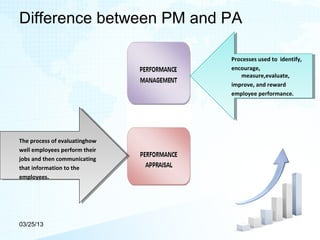
                                Processes used to identify,
                                 Processes used to identify,
                                encourage,
                                 encourage,
                                    measure,evaluate,
                                     measure,evaluate,
                                improve, and reward
                                 improve, and reward
                                employee performance.
                                 employee performance.


The process of evaluatinghow
 The process of evaluatinghow
well employees perform their
 well employees perform their
jobs and then communicating
 jobs and then communicating
that information to the
 that information to the
employees.
 employees.


03/25/13
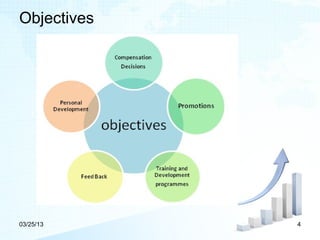
Objectives


03/25/13     4
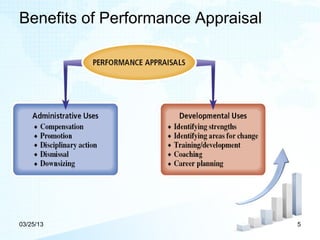
Benefits of Performance Appraisal


03/25/13                            5
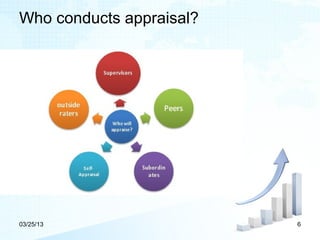
Who conducts appraisal?


03/25/13                  6
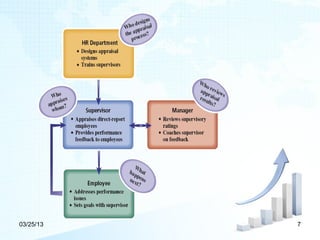
03/25/13   7
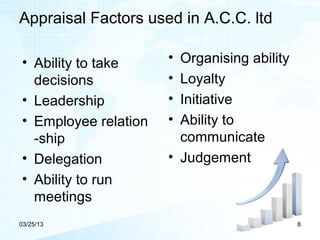
Appraisal Factors used in A.C.C. ltd

• Ability to take     • Organising ability
  decisions           • Loyalty
• Leadership          • Initiative
• Employee relation   • Ability to
  -ship                 communicate
• Delegation          • Judgement
• Ability to run
  meetings
03/25/13                                     8
03/25/13   9
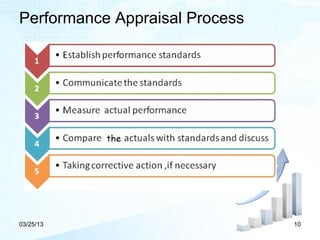
Performance Appraisal Process


03/25/13                        10
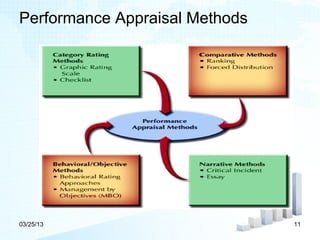
Performance Appraisal Methods


03/25/13                        11
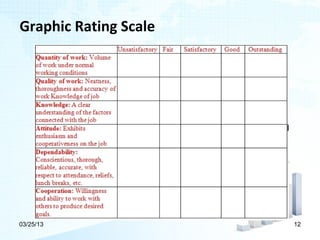
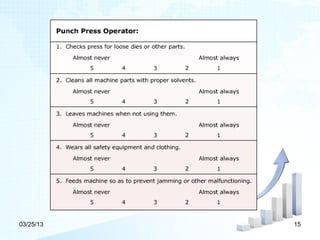
Graphic Rating Scale


03/25/13               12
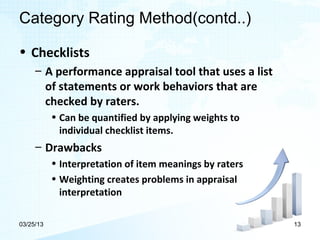
Category Rating Method(contd..)

• Checklists
     – A performance appraisal tool that uses a list
       of statements or work behaviors that are
       checked by raters.
           • Can be quantified by applying weights to
             individual checklist items.
     – Drawbacks
           • Interpretation of item meanings by raters
           • Weighting creates problems in appraisal
             interpretation

03/25/13                                                 13
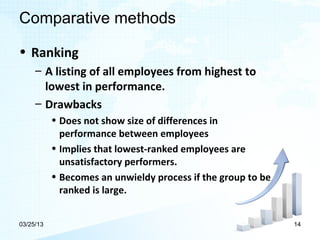
Comparative methods

• Ranking
     – A listing of all employees from highest to
       lowest in performance.
     – Drawbacks
           • Does not show size of differences in
             performance between employees
           • Implies that lowest-ranked employees are
             unsatisfactory performers.
           • Becomes an unwieldy process if the group to be
             ranked is large.


03/25/13                                                      14
03/25/13   15
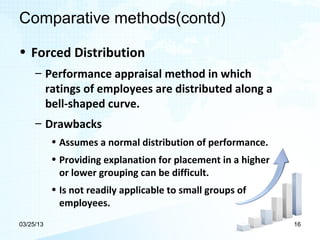
Comparative methods(contd)

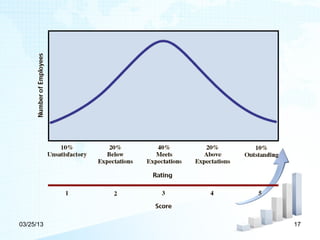
• Forced Distribution
     – Performance appraisal method in which
       ratings of employees are distributed along a
       bell-shaped curve.
     – Drawbacks
           • Assumes a normal distribution of performance.
           • Providing explanation for placement in a higher
             or lower grouping can be difficult.
           • Is not readily applicable to small groups of
             employees.
03/25/13                                                       16
03/25/13   17
Narrative Methods
• Critical Incident
     – Manager keeps a written record of
         highly favorable and unfavorable
         employee actions.
     – Drawbacks
          • Variations in how managers define a
            “critical incident”
          • Time involved in documenting
            employee actions
          • Most employee actions are not
            observed and may become different
03/25/13                                          18
            if observed
Narrative Methods(contd..)

• Essay
   – Manager writes a short essay describing
     an employee’s performance.
   – Drawback
      • Depends on the managers’ writing
        skills and their ability to express
        themselves.


03/25/13                                       19
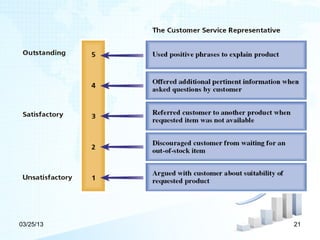
Behavioral /Objective methods

• Behavioral Rating Approach
     – Assesses employees’ behaviors instead of other
       characteristics
     – Consists of a series of scales created by:
           • Identifying important job dimensions
           • Creating statements describing a range of desired and
             undesirable behaviors (anchors)
     – Type of behavioral scale
           • Behaviorally anchored rating scales (BARS)


03/25/13                                                             20
03/25/13   21
Behavioral /Objective methods
• Management by Objectives
   – Specifying the performance goals that an
     individual and his or her manager agree the
     employee will to try to attain within an
     appropriate length of time.
• Key MBO Ideas
     – Employee involvement creates higher levels of
         commitment and performance.
     – Encourages employees to work effectively toward
         achieving desired results.
     – Performance measures should be measurable
03/25/13                                             22
         and should define results.
360 Feed Back System


• A    system     of   collecting    performance
  information from multiple parties.

• Multiple parties include one’s subordinates
  peers,supervisors and customers

• It is also used to design promotion and
  reward.

03/25/13                                           23
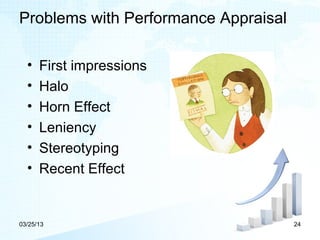
Problems with Performance Appraisal

  •   First impressions
  •   Halo
  •   Horn Effect
  •   Leniency
  •   Stereotyping
  •   Recent Effect


03/25/13                              24
03/25/13   25

Performance pp tnew

  • 1.
  • 2.
    What is PerformanceAppraisal • It is the process by which organization evaluate employee job performance. • It is a process that involves determining and communicating to an employee how he or she is performing the job and ideally establishing a plan of improvement. • It is a systematic and objective way of evaluating both work-related behaviour and potential of employees. 03/25/13 2
  • 3.
    Difference between PMand PA Processes used to identify, Processes used to identify, encourage, encourage, measure,evaluate, measure,evaluate, improve, and reward improve, and reward employee performance. employee performance. The process of evaluatinghow The process of evaluatinghow well employees perform their well employees perform their jobs and then communicating jobs and then communicating that information to the that information to the employees. employees. 03/25/13
  • 4.
  • 5.
    Benefits of PerformanceAppraisal 03/25/13 5
  • 6.
  • 7.
  • 8.
    Appraisal Factors usedin A.C.C. ltd • Ability to take • Organising ability decisions • Loyalty • Leadership • Initiative • Employee relation • Ability to -ship communicate • Delegation • Judgement • Ability to run meetings 03/25/13 8
  • 9.
  • 10.
  • 11.
  • 12.
  • 13.
    Category Rating Method(contd..) •Checklists – A performance appraisal tool that uses a list of statements or work behaviors that are checked by raters. • Can be quantified by applying weights to individual checklist items. – Drawbacks • Interpretation of item meanings by raters • Weighting creates problems in appraisal interpretation 03/25/13 13
  • 14.
    Comparative methods • Ranking – A listing of all employees from highest to lowest in performance. – Drawbacks • Does not show size of differences in performance between employees • Implies that lowest-ranked employees are unsatisfactory performers. • Becomes an unwieldy process if the group to be ranked is large. 03/25/13 14
  • 15.
  • 16.
    Comparative methods(contd) • ForcedDistribution – Performance appraisal method in which ratings of employees are distributed along a bell-shaped curve. – Drawbacks • Assumes a normal distribution of performance. • Providing explanation for placement in a higher or lower grouping can be difficult. • Is not readily applicable to small groups of employees. 03/25/13 16
  • 17.
  • 18.
    Narrative Methods • CriticalIncident – Manager keeps a written record of highly favorable and unfavorable employee actions. – Drawbacks • Variations in how managers define a “critical incident” • Time involved in documenting employee actions • Most employee actions are not observed and may become different 03/25/13 18 if observed
  • 19.
    Narrative Methods(contd..) • Essay – Manager writes a short essay describing an employee’s performance. – Drawback • Depends on the managers’ writing skills and their ability to express themselves. 03/25/13 19
  • 20.
    Behavioral /Objective methods •Behavioral Rating Approach – Assesses employees’ behaviors instead of other characteristics – Consists of a series of scales created by: • Identifying important job dimensions • Creating statements describing a range of desired and undesirable behaviors (anchors) – Type of behavioral scale • Behaviorally anchored rating scales (BARS) 03/25/13 20
  • 21.
  • 22.
    Behavioral /Objective methods •Management by Objectives – Specifying the performance goals that an individual and his or her manager agree the employee will to try to attain within an appropriate length of time. • Key MBO Ideas – Employee involvement creates higher levels of commitment and performance. – Encourages employees to work effectively toward achieving desired results. – Performance measures should be measurable 03/25/13 22 and should define results.
  • 23.
    360 Feed BackSystem • A system of collecting performance information from multiple parties. • Multiple parties include one’s subordinates peers,supervisors and customers • It is also used to design promotion and reward. 03/25/13 23
  • 24.
    Problems with PerformanceAppraisal • First impressions • Halo • Horn Effect • Leniency • Stereotyping • Recent Effect 03/25/13 24
  • 25.