

Ryan Fernando M.Sc. Food Biotechnology - University of Strathclyde – United Kingdom M.Sc. Clinical Biochemistry - Goa Medical College – India. Performance Nutrition AMPLIFIED
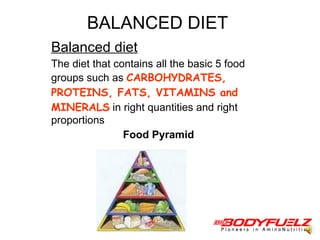
BALANCED DIET  Balanced diet The diet that contains all the basic 5 food groups such as  CARBOHYDRATES, PROTEINS, FATS, VITAMINS and MINERALS  in right quantities and right proportions Food Pyramid
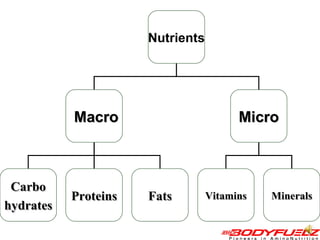
Nutrients Macro Micro Carbo hydrates Proteins Fats Vitamins Minerals
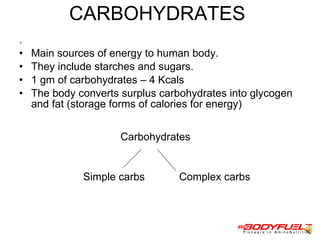
CARBOHYDRATES  .  Main sources of energy to human body.  They include starches and sugars. 1 gm of carbohydrates – 4 Kcals  The body converts surplus carbohydrates into glycogen and fat (storage forms of calories for energy)  Carbohydrates  Simple carbs  Complex carbs
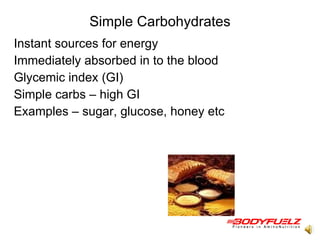
Simple Carbohydrates Instant sources for energy  Immediately absorbed in to the blood  Glycemic index (GI) Simple carbs – high GI Examples – sugar, glucose, honey etc
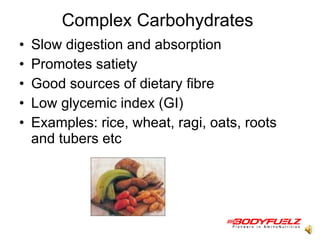
Complex Carbohydrates  Slow digestion and absorption Promotes satiety  Good sources of dietary fibre Low glycemic index (GI) Examples: rice, wheat, ragi, oats, roots and tubers etc
Fats  Concentrated source of energy  1 gm of fat = 9 Kcals  Fats  fatty acids  Fatty acids   Essential fatty acids or good fats  Non essential fatty acids or bad fats
Essential fatty acids  Omega3 – linoleic acid  Omega6 – linolenic acid, arachidonic acid, EPA (Eicosapentanoic acid) DHA (Docosa hexanoic acid)  Sources  Fish liver oil, vegetable & peanut oils etc
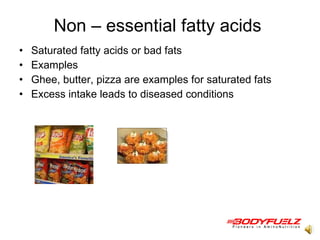
Non – essential fatty acids  Saturated fatty acids or bad fats  Examples Ghee, butter, pizza are examples for saturated fats  Excess intake leads to diseased conditions
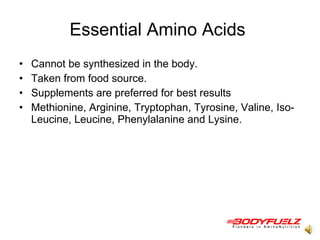
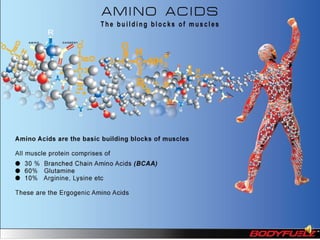
Proteins – Body Building Nutrient Amino Acids – Building Blocks of Protein. .  They help in building up and repair of muscles, tissues, bones, hair etc,  Regulates important metabolic process in the body.  Sources -  Milk, meat, egg, fish, chicken etc  Amino Acids Essential   Non – Essential
Essential Amino Acids  Cannot be synthesized in the body.  Taken from food source.  Supplements are preferred for best results  Methionine, Arginine, Tryptophan, Tyrosine, Valine, Iso-Leucine, Leucine, Phenylalanine and Lysine.
Non Essential Amino Acids Synthesized in the body. Alanine, Aspartic Acid, Aspargine,  Cysteine, Histidine, Glutamine, Glycine, Proline, Serine, Tyrosine .
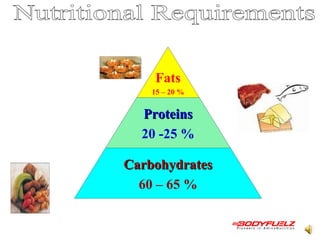
Nutritional Requirements Fats 15 – 20 % Proteins 20 -25 % Carbohydrates 60 – 65 %
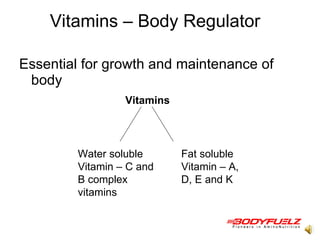
Vitamins – Body Regulator  Essential for growth and maintenance of body  Vitamins  Water soluble   Vitamin – C and B complex vitamins  Fat soluble   Vitamin – A, D, E and K
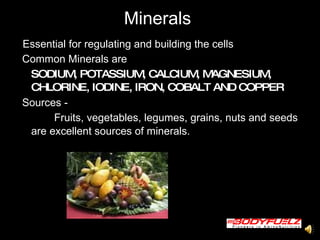
Minerals  Essential for regulating and building the cells  Common Minerals are  SODIUM, POTASSIUM, CALCIUM, MAGNESIUM, CHLORINE, IODINE, IRON, COBALT AND COPPER Sources -   Fruits, vegetables, legumes, grains, nuts and seeds are excellent sources of minerals.
 
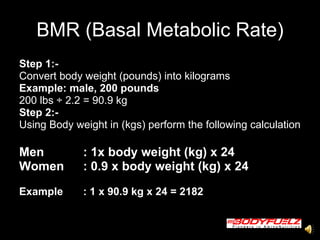
BMR (Basal Metabolic Rate) Step 1:- Convert body weight (pounds) into kilograms Example: male, 200 pounds   200 lbs  ÷ 2.2 = 90.9 kg Step 2:-   Using Body weight in (kgs) perform the following calculation  Men  : 1x body weight (kg) x 24 Women  : 0.9 x body weight (kg) x 24 Example : 1 x 90.9 kg x 24 = 2182
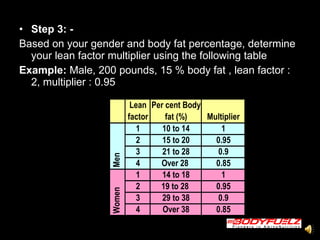
Step 3: -   Based on your gender and body fat percentage, determine your lean factor multiplier using the following table  Example:  Male, 200 pounds, 15 % body fat , lean factor : 2, multiplier : 0.95
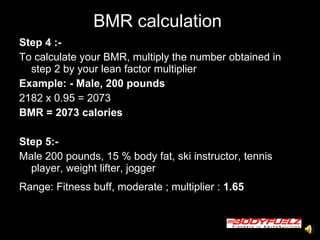
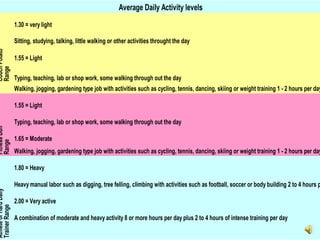
BMR calculation  Step 4 :-  To calculate your BMR, multiply the number obtained in step 2 by your lean factor multiplier Example: - Male, 200 pounds   2182 x 0.95 = 2073  BMR = 2073 calories   Step 5:-  Male 200 pounds, 15 % body fat, ski instructor, tennis player, weight lifter, jogger  Range: Fitness buff, moderate ; multiplier :  1.65
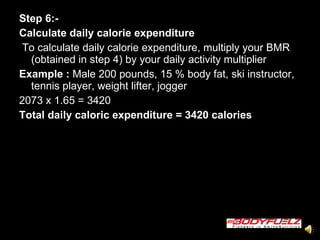
Step 6:-   Calculate daily calorie expenditure   To calculate daily calorie expenditure, multiply your BMR (obtained in step 4) by your daily activity multiplier  Example :  Male 200 pounds, 15 % body fat, ski instructor, tennis player, weight lifter, jogger  2073 x 1.65 = 3420  Total daily caloric expenditure = 3420 calories
 
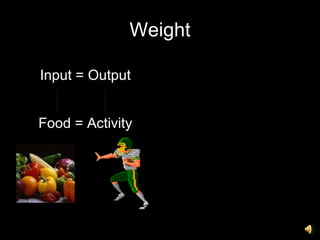
Weight Input = Output Food = Activity
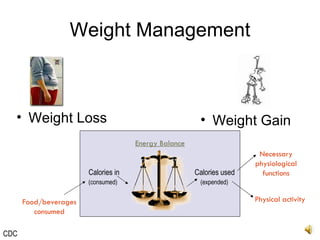
Weight Management Weight Loss Weight Gain Food/beverages consumed Necessary physiological functions Physical activity (consumed) Calories in Calories used (expended) Energy Balance CDC
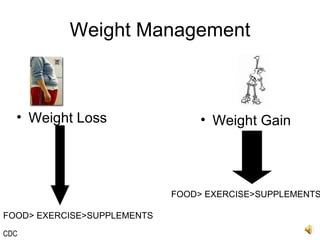
Weight Management Weight Loss Weight Gain CDC FOOD> EXERCISE>SUPPLEMENTS FOOD> EXERCISE>SUPPLEMENTS
Summary Exercise requirements- Nutrition Golden Hour Catabolism Aminonutrition
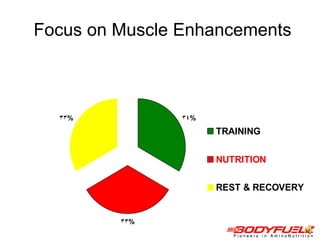
Focus on Muscle Enhancements
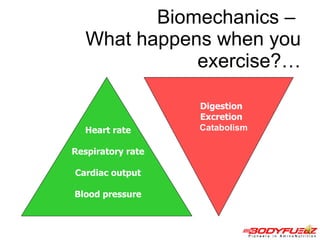
Biomechanics –  What happens when you exercise?… Heart rate Respiratory rate Cardiac output Blood pressure Digestion Excretion Catabolism
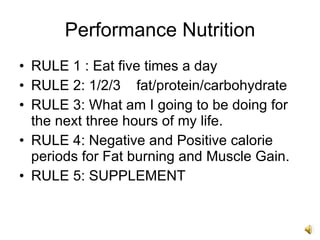
Performance Nutrition RULE 1 : Eat five times a day RULE 2: 1/2/3  fat/protein/carbohydrate RULE 3: What am I going to be doing for the next three hours of my life. RULE 4: Negative and Positive calorie periods for Fat burning and Muscle Gain. RULE 5: SUPPLEMENT
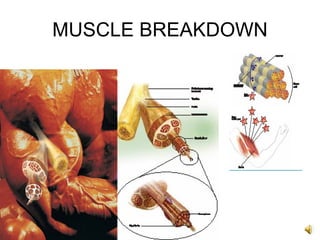
MUSCLE BREAKDOWN
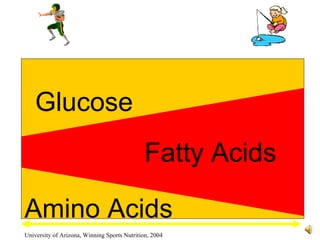
Glucose Fatty Acids Amino Acids High Intensity Activity Low Intensity Activity University of Arizona, Winning Sports Nutrition, 2004
 
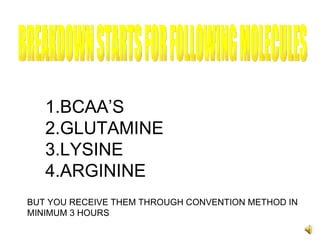
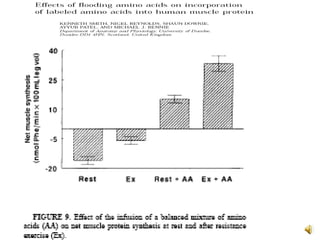
BREAKDOWN STARTS FOR FOLLOWING MOLECULES BCAA’S GLUTAMINE LYSINE ARGININE BUT YOU RECEIVE THEM THROUGH CONVENTION METHOD IN MINIMUM 3 HOURS
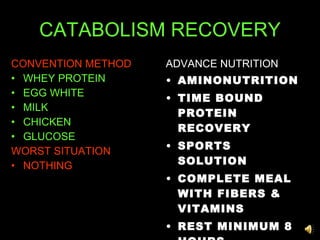
CATABOLISM RECOVERY CONVENTION METHOD WHEY PROTEIN EGG WHITE MILK CHICKEN GLUCOSE WORST SITUATION  NOTHING ADVANCE NUTRITION AMINONUTRITION TIME BOUND PROTEIN RECOVERY SPORTS SOLUTION COMPLETE MEAL WITH FIBERS & VITAMINS  REST MINIMUM 8 HOURS
 
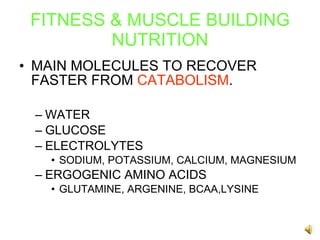
FITNESS & MUSCLE BUILDING NUTRITION MAIN MOLECULES TO RECOVER FASTER FROM  CATABOLISM . WATER GLUCOSE ELECTROLYTES  SODIUM, POTASSIUM, CALCIUM, MAGNESIUM ERGOGENIC AMINO ACIDS GLUTAMINE, ARGENINE, BCAA,LYSINE
FITNESS & MUSCLE BUILDING NUTRITION WHEY PROTEIN CASEIN SOYA PROTEIN ALBUMEN CREATINE CARNITINE EPHEDRINE Glucosamine Prohormones DHEA ANDROSTENDIONE Antioxidants Green Tea Ginkgo Biloba Bilberry Thistle
 
 
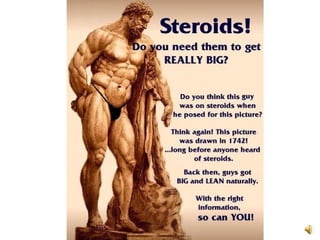
Steroids may help  to get A GREAT PHYSIQUE (But with a damaged body) Why Use STEROIDS  when there now are  safer Alternatives

Performance Nutrition Simplified

  • 1.
    Ryan Fernando M.Sc.Food Biotechnology - University of Strathclyde – United Kingdom M.Sc. Clinical Biochemistry - Goa Medical College – India. Performance Nutrition AMPLIFIED
  • 2.
    BALANCED DIET Balanced diet The diet that contains all the basic 5 food groups such as CARBOHYDRATES, PROTEINS, FATS, VITAMINS and MINERALS in right quantities and right proportions Food Pyramid
  • 3.
    Nutrients Macro MicroCarbo hydrates Proteins Fats Vitamins Minerals
  • 4.
    CARBOHYDRATES . Main sources of energy to human body. They include starches and sugars. 1 gm of carbohydrates – 4 Kcals The body converts surplus carbohydrates into glycogen and fat (storage forms of calories for energy) Carbohydrates Simple carbs Complex carbs
  • 5.
    Simple Carbohydrates Instantsources for energy Immediately absorbed in to the blood Glycemic index (GI) Simple carbs – high GI Examples – sugar, glucose, honey etc
  • 6.
    Complex Carbohydrates Slow digestion and absorption Promotes satiety Good sources of dietary fibre Low glycemic index (GI) Examples: rice, wheat, ragi, oats, roots and tubers etc
  • 7.
    Fats Concentratedsource of energy 1 gm of fat = 9 Kcals Fats fatty acids Fatty acids Essential fatty acids or good fats Non essential fatty acids or bad fats
  • 8.
    Essential fatty acids Omega3 – linoleic acid Omega6 – linolenic acid, arachidonic acid, EPA (Eicosapentanoic acid) DHA (Docosa hexanoic acid) Sources Fish liver oil, vegetable & peanut oils etc
  • 9.
    Non – essentialfatty acids Saturated fatty acids or bad fats Examples Ghee, butter, pizza are examples for saturated fats Excess intake leads to diseased conditions
  • 10.
    Proteins – BodyBuilding Nutrient Amino Acids – Building Blocks of Protein. . They help in building up and repair of muscles, tissues, bones, hair etc, Regulates important metabolic process in the body. Sources - Milk, meat, egg, fish, chicken etc Amino Acids Essential Non – Essential
  • 11.
    Essential Amino Acids Cannot be synthesized in the body. Taken from food source. Supplements are preferred for best results Methionine, Arginine, Tryptophan, Tyrosine, Valine, Iso-Leucine, Leucine, Phenylalanine and Lysine.
  • 12.
    Non Essential AminoAcids Synthesized in the body. Alanine, Aspartic Acid, Aspargine, Cysteine, Histidine, Glutamine, Glycine, Proline, Serine, Tyrosine .
  • 13.
    Nutritional Requirements Fats15 – 20 % Proteins 20 -25 % Carbohydrates 60 – 65 %
  • 14.
    Vitamins – BodyRegulator Essential for growth and maintenance of body Vitamins Water soluble Vitamin – C and B complex vitamins Fat soluble Vitamin – A, D, E and K
  • 15.
    Minerals Essentialfor regulating and building the cells Common Minerals are SODIUM, POTASSIUM, CALCIUM, MAGNESIUM, CHLORINE, IODINE, IRON, COBALT AND COPPER Sources - Fruits, vegetables, legumes, grains, nuts and seeds are excellent sources of minerals.
  • 16.
  • 17.
    BMR (Basal MetabolicRate) Step 1:- Convert body weight (pounds) into kilograms Example: male, 200 pounds 200 lbs ÷ 2.2 = 90.9 kg Step 2:- Using Body weight in (kgs) perform the following calculation Men : 1x body weight (kg) x 24 Women : 0.9 x body weight (kg) x 24 Example : 1 x 90.9 kg x 24 = 2182
  • 18.
    Step 3: - Based on your gender and body fat percentage, determine your lean factor multiplier using the following table Example: Male, 200 pounds, 15 % body fat , lean factor : 2, multiplier : 0.95
  • 19.
    BMR calculation Step 4 :- To calculate your BMR, multiply the number obtained in step 2 by your lean factor multiplier Example: - Male, 200 pounds 2182 x 0.95 = 2073 BMR = 2073 calories Step 5:- Male 200 pounds, 15 % body fat, ski instructor, tennis player, weight lifter, jogger Range: Fitness buff, moderate ; multiplier : 1.65
  • 20.
    Step 6:- Calculate daily calorie expenditure To calculate daily calorie expenditure, multiply your BMR (obtained in step 4) by your daily activity multiplier Example : Male 200 pounds, 15 % body fat, ski instructor, tennis player, weight lifter, jogger 2073 x 1.65 = 3420 Total daily caloric expenditure = 3420 calories
  • 21.
  • 22.
    Weight Input =Output Food = Activity
  • 23.
    Weight Management WeightLoss Weight Gain Food/beverages consumed Necessary physiological functions Physical activity (consumed) Calories in Calories used (expended) Energy Balance CDC
  • 24.
    Weight Management WeightLoss Weight Gain CDC FOOD> EXERCISE>SUPPLEMENTS FOOD> EXERCISE>SUPPLEMENTS
  • 25.
    Summary Exercise requirements-Nutrition Golden Hour Catabolism Aminonutrition
  • 26.
    Focus on MuscleEnhancements
  • 27.
    Biomechanics – What happens when you exercise?… Heart rate Respiratory rate Cardiac output Blood pressure Digestion Excretion Catabolism
  • 28.
    Performance Nutrition RULE1 : Eat five times a day RULE 2: 1/2/3 fat/protein/carbohydrate RULE 3: What am I going to be doing for the next three hours of my life. RULE 4: Negative and Positive calorie periods for Fat burning and Muscle Gain. RULE 5: SUPPLEMENT
  • 29.
  • 30.
    Glucose Fatty AcidsAmino Acids High Intensity Activity Low Intensity Activity University of Arizona, Winning Sports Nutrition, 2004
  • 31.
  • 32.
    BREAKDOWN STARTS FORFOLLOWING MOLECULES BCAA’S GLUTAMINE LYSINE ARGININE BUT YOU RECEIVE THEM THROUGH CONVENTION METHOD IN MINIMUM 3 HOURS
  • 33.
    CATABOLISM RECOVERY CONVENTIONMETHOD WHEY PROTEIN EGG WHITE MILK CHICKEN GLUCOSE WORST SITUATION NOTHING ADVANCE NUTRITION AMINONUTRITION TIME BOUND PROTEIN RECOVERY SPORTS SOLUTION COMPLETE MEAL WITH FIBERS & VITAMINS REST MINIMUM 8 HOURS
  • 34.
  • 35.
    FITNESS & MUSCLEBUILDING NUTRITION MAIN MOLECULES TO RECOVER FASTER FROM CATABOLISM . WATER GLUCOSE ELECTROLYTES SODIUM, POTASSIUM, CALCIUM, MAGNESIUM ERGOGENIC AMINO ACIDS GLUTAMINE, ARGENINE, BCAA,LYSINE
  • 36.
    FITNESS & MUSCLEBUILDING NUTRITION WHEY PROTEIN CASEIN SOYA PROTEIN ALBUMEN CREATINE CARNITINE EPHEDRINE Glucosamine Prohormones DHEA ANDROSTENDIONE Antioxidants Green Tea Ginkgo Biloba Bilberry Thistle
  • 37.
  • 38.
  • 39.
    Steroids may help to get A GREAT PHYSIQUE (But with a damaged body) Why Use STEROIDS when there now are safer Alternatives