The Macronutrients’
Role in Physical
Performance
Chad Wessinger
Wessinger 2015
What are the 3 Macronutrients?
Wessinger 2015
What are the 3 Macronutrients?
•Fat
•Carbohydrates
•Protein
Wessinger 2015
The Basics: Fat
• Functions:
• Storage form of excess energy
• Protects organs
• Absorption & transport of certain micronutrients
• Cell membrane structure
• Bile
• Sex hormone precursor
• Forms:
• Phospholipids, lipoproteins
• Fatty acids, sterols
Wessinger 2015
Fat & Athletic Performance
• Strength Athletes
• Muscle building: testosterone precursor
• EnduranceAthletes
• Fuel: fuel source during prolonged, sub-maximal aerobic exercise
• Timing
• Avoid high-fat meals immediately before exercise
• Metabolism During Exercise
• Carbohydrates & fat metabolized together, nature of mixture dependent on
intensity, duration, aerobic fitness level, amount of available intramuscular
stores
Wessinger 2015
The Basics: Carbohydrates
• Functions:
• Associated with ATP (energy) generation
• Energy stored as glycogen
• Converted to fat when glycogen stores are full
• Primary energy source of CNS
• Blood sugar
• Forms:
• Monosaccharides, disaccharides, oligosaccharides
• Polysaccharides
• Fiber
Wessinger 2015
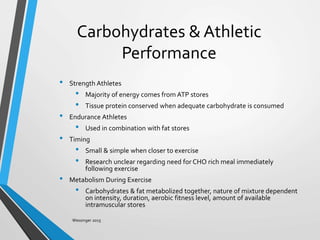
Carbohydrates & Athletic
Performance
• Strength Athletes
• Majority of energy comes from ATP stores
• Tissue protein conserved when adequate carbohydrate is consumed
• Endurance Athletes
• Used in combination with fat stores
• Timing
• Small & simple when closer to exercise
• Research unclear regarding need for CHO rich meal immediately
following exercise
• Metabolism During Exercise
• Carbohydrates & fat metabolized together, nature of mixture dependent
on intensity, duration, aerobic fitness level, amount of available
intramuscular stores
Wessinger 2015
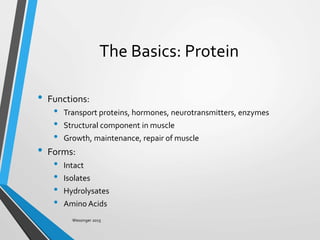
The Basics: Protein
• Functions:
• Transport proteins, hormones, neurotransmitters, enzymes
• Structural component in muscle
• Growth, maintenance, repair of muscle
• Forms:
• Intact
• Isolates
• Hydrolysates
• Amino Acids
Wessinger 2015
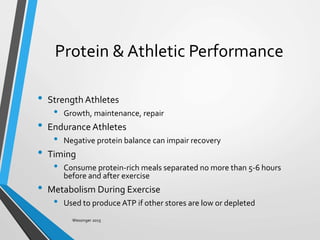
Protein & Athletic Performance
• Strength Athletes
• Growth, maintenance, repair
• Endurance Athletes
• Negative protein balance can impair recovery
• Timing
• Consume protein-rich meals separated no more than 5-6 hours
before and after exercise
• Metabolism During Exercise
• Used to produce ATP if other stores are low or depleted
Wessinger 2015
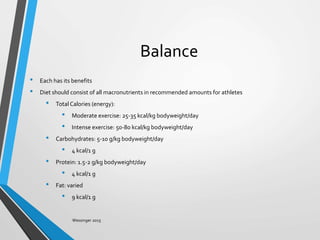
Balance
• Each has its benefits
• Diet should consist of all macronutrients in recommended amounts for athletes
• TotalCalories (energy):
• Moderate exercise: 25-35 kcal/kg bodyweight/day
• Intense exercise: 50-80 kcal/kg bodyweight/day
• Carbohydrates: 5-10 g/kg bodyweight/day
• 4 kcal/1 g
• Protein: 1.5-2 g/kg bodyweight/day
• 4 kcal/1 g
• Fat: varied
• 9 kcal/1 g
Wessinger 2015
Individualization & Specificity
• Guidelines and recommendations are not set in stone
• Athletes should use trial and error to determine what
combination works best for them
• Different sports, different energy requirements
• Strength athlete vs. distance runner
Wessinger 2015
Review
• Which macronutrient’s primary role is to supply the body with
energy?
• Fat
• Carbohydrates
• Protein
• All athletes should consume the same macronutrient
distribution
• True
• False
Wessinger 2015
Review
• Which macronutrient’s primary role is to supply the body with
energy?
• Fat
• Carbohydrates
• Protein
• All athletes should consume the same macronutrient
distribution
• True
• False
Wessinger 2015
Summary
• Fat, carbohydrates, & protein
• All have benefits to the athlete
• Energy production, storage of excess energy, growth & recovery
• Individual should determine best combination for
themselves using trial and error
Wessinger 2015
References
1. Kerksick, C.M. Nutrient timing: metabolic optimization for health, performance, and
recovery. London,GBR: CRC Press; 2011. Retrieved from
http://www.ebrary.com.pitt.idm.oclc.orgISSN
2. Kreider et al. ISSN exercise & sport nutrition review: research and rocomendations.
Journal of the International Society of Sports Nutrition. 2010;7:7.
3. Aragon, Alan, Schoenfeld, Brad. Nutrient timing revisited: is there a post-exercise
anabolic window?. Journal of the International Society of Sports Nutrition. 2013;10:5.
4. Dorfman, Lisa. Nutrition in exercise and sports. In: Krause’s food and the nutrition care
process. St. Louis, MO: Elsevier; 2012:507-530.
5. Ferrier, Denise R. Lippincott’s illustrated reviews: biochemistry. Baltimore, MD; 2014.
Wessinger 2015

The Macronutrients' Role in Physical Performance

  • 1.
    The Macronutrients’ Role inPhysical Performance Chad Wessinger Wessinger 2015
  • 2.
    What are the3 Macronutrients? Wessinger 2015
  • 3.
    What are the3 Macronutrients? •Fat •Carbohydrates •Protein Wessinger 2015
  • 4.
    The Basics: Fat •Functions: • Storage form of excess energy • Protects organs • Absorption & transport of certain micronutrients • Cell membrane structure • Bile • Sex hormone precursor • Forms: • Phospholipids, lipoproteins • Fatty acids, sterols Wessinger 2015
  • 5.
    Fat & AthleticPerformance • Strength Athletes • Muscle building: testosterone precursor • EnduranceAthletes • Fuel: fuel source during prolonged, sub-maximal aerobic exercise • Timing • Avoid high-fat meals immediately before exercise • Metabolism During Exercise • Carbohydrates & fat metabolized together, nature of mixture dependent on intensity, duration, aerobic fitness level, amount of available intramuscular stores Wessinger 2015
  • 6.
    The Basics: Carbohydrates •Functions: • Associated with ATP (energy) generation • Energy stored as glycogen • Converted to fat when glycogen stores are full • Primary energy source of CNS • Blood sugar • Forms: • Monosaccharides, disaccharides, oligosaccharides • Polysaccharides • Fiber Wessinger 2015
  • 7.
    Carbohydrates & Athletic Performance •Strength Athletes • Majority of energy comes from ATP stores • Tissue protein conserved when adequate carbohydrate is consumed • Endurance Athletes • Used in combination with fat stores • Timing • Small & simple when closer to exercise • Research unclear regarding need for CHO rich meal immediately following exercise • Metabolism During Exercise • Carbohydrates & fat metabolized together, nature of mixture dependent on intensity, duration, aerobic fitness level, amount of available intramuscular stores Wessinger 2015
  • 8.
    The Basics: Protein •Functions: • Transport proteins, hormones, neurotransmitters, enzymes • Structural component in muscle • Growth, maintenance, repair of muscle • Forms: • Intact • Isolates • Hydrolysates • Amino Acids Wessinger 2015
  • 9.
    Protein & AthleticPerformance • Strength Athletes • Growth, maintenance, repair • Endurance Athletes • Negative protein balance can impair recovery • Timing • Consume protein-rich meals separated no more than 5-6 hours before and after exercise • Metabolism During Exercise • Used to produce ATP if other stores are low or depleted Wessinger 2015
  • 10.
    Balance • Each hasits benefits • Diet should consist of all macronutrients in recommended amounts for athletes • TotalCalories (energy): • Moderate exercise: 25-35 kcal/kg bodyweight/day • Intense exercise: 50-80 kcal/kg bodyweight/day • Carbohydrates: 5-10 g/kg bodyweight/day • 4 kcal/1 g • Protein: 1.5-2 g/kg bodyweight/day • 4 kcal/1 g • Fat: varied • 9 kcal/1 g Wessinger 2015
  • 11.
    Individualization & Specificity •Guidelines and recommendations are not set in stone • Athletes should use trial and error to determine what combination works best for them • Different sports, different energy requirements • Strength athlete vs. distance runner Wessinger 2015
  • 12.
    Review • Which macronutrient’sprimary role is to supply the body with energy? • Fat • Carbohydrates • Protein • All athletes should consume the same macronutrient distribution • True • False Wessinger 2015
  • 13.
    Review • Which macronutrient’sprimary role is to supply the body with energy? • Fat • Carbohydrates • Protein • All athletes should consume the same macronutrient distribution • True • False Wessinger 2015
  • 14.
    Summary • Fat, carbohydrates,& protein • All have benefits to the athlete • Energy production, storage of excess energy, growth & recovery • Individual should determine best combination for themselves using trial and error Wessinger 2015
  • 15.
    References 1. Kerksick, C.M.Nutrient timing: metabolic optimization for health, performance, and recovery. London,GBR: CRC Press; 2011. Retrieved from http://www.ebrary.com.pitt.idm.oclc.orgISSN 2. Kreider et al. ISSN exercise & sport nutrition review: research and rocomendations. Journal of the International Society of Sports Nutrition. 2010;7:7. 3. Aragon, Alan, Schoenfeld, Brad. Nutrient timing revisited: is there a post-exercise anabolic window?. Journal of the International Society of Sports Nutrition. 2013;10:5. 4. Dorfman, Lisa. Nutrition in exercise and sports. In: Krause’s food and the nutrition care process. St. Louis, MO: Elsevier; 2012:507-530. 5. Ferrier, Denise R. Lippincott’s illustrated reviews: biochemistry. Baltimore, MD; 2014. Wessinger 2015