AGREEGATE
PERFORMANCE
MANAGEMENT IN
THE 21ST CENTURY
PRIVATE SCHOOLS
DR. S. A. BABARINDE (P.HD) (MSC.)
HEAD OF DEPT., BUSINESS ADMIN & MGT, LAGOS CITY POLYTECHNIC, IKEJA,
LAGOS STATE.
1.1 DEFINITIONS
1.2 THE NEED FOR PERFORMNANCE MANAGEMENT
1.3 GOALS AND OBJECTIVES OF PERFORMANCE
MANAGEMENT
1.4 CONTRIBUTIONS OF PERFORMANCE MANAGEMENT
1.5 COST OF POOR PERFORMANCE MANAGEMENT
1.6 IDEALS OF PERFORMANCE MANAGEMENT
1.0 INTRODUCTION TO PERFORMANCE MANAGEMENT
2.1 UNDERSTANDING THE PERFORMANCE MANAGEMENT
MODEL
2.2 SCOPE OF PERFORMANCE MANAGEMENT
2.3 PREPARING FOR PERFORMANCE MANGEMENT
PROCESS
2.4 UNDERSTANDING ORGANISATIONAL GOALS AND
OBJECTIVES
2.0 ELEMENTS OF PERFORMANCE MANAGEMENT
3.1 PERFORMANCE PLANNING
3.2 PERFORMANCE SUPERVISION AND COACHING
3.3 PERFORMANCE CONCURRENT FEEDBACK
3.4 PERFORMANCE REVIEW
3.5 PERFORMANCE DEVELOPMENT PLAN
 3.0 PERFORMANCE MANAGEMENT PROCESS
1.0 INTRODUCTION TO
PERFORMANCE MANAGEMENT
 Like Every Other Business, School Management Requires Wide Experience In Not Only
The Regards Of Effective Teaching Delivery But Also Administration Of All The School
Resources.
 One Of The Salient Resources Required For The Start-up And Going Concern Of
School Management Is Human Resources(teachers)
 Of All The Internal Factors That Have Gross Impact On The Productivity Of Schools,
Teachers’ Performance Have More Influence.
 Effective Teachers’ Performance Management Is One Key Tool That Enhances
Productivity, Profitability Through Increased Patronage.
 Effective Teachers Performance Is Also A Key Tool In Making The Decision Of “Who
Needs To Stay Or Be Fired” Thereby Reducing Human Capital Cost And Redundancy.
 So The Question Now Is Less About How Performance Management Itself Is Evolving
And More About How Performance Management Is Embedding Into The Strategic
Management Process To Ensure That People Are Adding Value To The Organization
And Hence Driving Business Performance.
 In 1998 The Cipd (Armstrong And Baron 1998) Concluded That Performance Management Is
A Process That Contributes To The Effective Management Of Individuals And Teams To
Achieve High Levels Of Organisation Performance. As Such, It Establishes Shared
Understanding About What Is To Be Achieved And An Approach To Leading And Developing
People That Will Ensure It Is Achieved.
 However, Undoubtedly The Twenty-first Century Has Seen Acceptance That The Way
Forward To Organisational Performance And Growth Is To Create High-performance, High-
commitment Work Systems That Rely On Relationships With Managers Built On Trust,
Understanding And Mutual Co-operation. With The Old Carrot And Stick Approach To
Management Long Consigned To The Scrap Heap, The Greater Preoccupation With
Employee Engagement And Commitment Has Cemented The Place Of Performance
Management As The Centrepiece Of Communication Between Manager And Individual.
 This Shift Has Resulted In Performance Management Being Perceived As A Continuous
Process Rather Than A Discrete Event, With Latham Et Al (2007) Commenting That ‘A
Distinguishing Feature Of Performance Management Relative To Performance Appraisal Is
That The Former Is An Ongoing Process Whereas The Latter Is Done At Discrete Time
Intervals…it Is Therefore Owned And Driven By Line Managers Rather Than Hr.’
Work conducted by the then Institute of Personnel Management in 1992 produced the following
definition of performance management:
‘A strategy which relates to every activity of the organization set in the context of its human resources
policies, culture, style and communications systems. The nature of the strategy depends on the
organizational context and can vary from organization to organization.’
Briscoe and Claus (2008) defines ‘Performance management as the system through which
organizations set work goals, determine performance standards, assign and evaluate work, provide
performance feedback, determine training and development needs and distribute rewards.’
Performance management is the process through which supervisors and those they lead gain a shared
understanding of work expectations and goals, exchange performance feedback, identify learning and
development opportunities, and evaluate performance results.
Performance management is a continuous process of identifying, measuring and developing
performance in organizations by linking each individual’s performance and objectives to the
organization’s overall mission and goals.
Performance management is a continuous activity-based function in an organization that aligns
individual and organizational interest to evolve and sustain passion towards the realization of set goals
through continual review and assessment of actions.
 1.1 DEFINITIONS OF PERFORMANCE MANAGEMENT
1.2 THE NEED FOR
PERFORMNANCE MANAGEMENT
 The people management aspect of the line manager’s role was explored as
part of the ‘Black Box’ work carried out for the CIPD by a team led by
Professor John Purcell at Bath University and published in 2003. They found
that the relationships between an individual and their line manager is the most
significant factor impacting on the individual’s willingness to perform. As such
they concluded that line managers have a crucial role to play in bringing HR
policies to life and none more so than performance management. They
therefore identified performance management as one of the critical processes
shaping the link between people management and organisational
performance.
 As such, performance management becomes a primary tool for managing the
business if it is significant in shaping individual behaviour and ensuring these
are directed towards achieving the strategic aims of the organisation. As
Mohrman and Mohrman (1995) emphasised, ‘performance management is
managing the business’; in other words, it is what line managers do all the
time.
1.3 GOALS AND OBJECTIVES
OF PERFORMANCE
MANAGEMENT
• Improve staff performance in meeting department, division and overall goals
and objectives.
• Support staff development and continuous learning
• Align compensation with desired organization outcomes
• Strengthen management accountability
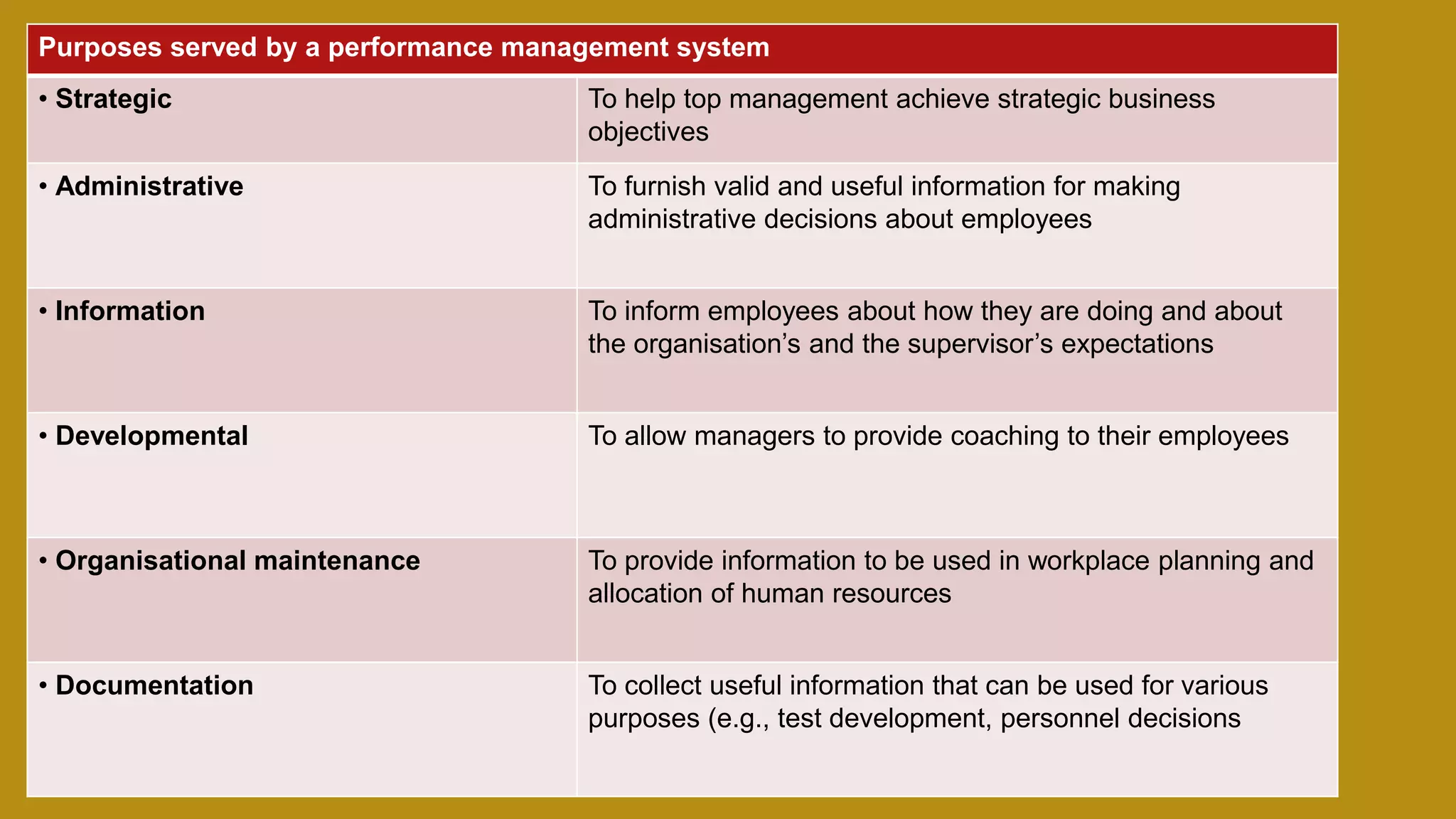
Purposes served by a performance management system
• Strategic To help top management achieve strategic business
objectives
• Administrative To furnish valid and useful information for making
administrative decisions about employees
• Information To inform employees about how they are doing and about
the organisation’s and the supervisor’s expectations
• Developmental To allow managers to provide coaching to their employees
• Organisational maintenance To provide information to be used in workplace planning and
allocation of human resources
• Documentation To collect useful information that can be used for various
purposes (e.g., test development, personnel decisions
1.4 CONTRIBUTIONS OF
PERFORMANCE MANAGEMENT
• Motivation to perform is increased
• Self-esteem is increased
• Managers gain insight about subordinates
• The definitions of job and criteria are clarified
• Self-insight and development are enhanced
• Personnel actions are more fair and appropriate
• Organisational goals are made clear
• Employees become more competent
• There is better protection from lawsuits
• There is better and more timely differentiation between good and poor performers
• Supervisors’ views of performance are communicated more clearly
• Organisational change is facilitated
What CEOs Say About the Contribution of
Performance Management Systems
 A study conducted by Development Dimensions International (DDI), a
global human resource consulting firm specialising in leadership and
selection, found that performance management systems are a key tool that
organisations use to translate business strategy into business results.
Specifically, performance management systems influence ‘financial
performance, productivity, product or service quality, customer satisfaction,
and employee job satisfaction.’ In addition, 79 per cent of the CEOs
surveyed say that the performance management systems implemented in
their organisations drive the ‘cultural strategies that maximise human
assets.’
 SOURCE: Sumlin, R. Performance management: impacts and trends.
DDI white paper.
1.5 COST OF POOR
PERFORMANCE MANAGEMENT
• Employees may quit due to results
• False or misleading information may be used
• Self-esteem may be lowered
• Time and money are wasted
• Relationships are damaged
• Motivation to perform is decreased
• Employees suffer from job burnout and job dissatisfaction
• There is increased risk of litigation
• Managers are required to use an unjustified amount of resources
• Standards and ratings vary and are unfair
• Biases can replace standards
• Mystery surrounds how ratings were derived
1.6 IDEALS OF PERFORMANCE MANAGEMENT
• Ideal performance management systems are rare. Such ideal systems are:
 − congruent with strategy (i.e., there is a clear link between individual, unit and organizational goals);
 − thorough (e.g., they include all relevant performance dimensions);
 − practical (e.g., they do not require excessive time and resources);
 − meaningful (e.g., they have important consequences);
 − specific (e.g., they provide a concrete employee improvement agenda);
 − able to identify effective and ineffective performance (e.g., they help to distinguish
 employees with different performance levels);
 − reliable (e.g., the measurement of performance is consistent);
 − valid (e.g., the measures of performance are not contaminated or deficient);
 − fair (e.g., people participating in the system believe the processes and outcomes are just);
 − inclusive (i.e., they include input from multiple sources on an ongoing basis);
 − open (i.e., they are transparent and there are no secrets);
 − correctable (i.e., they include mechanisms so that errors can be corrected);
 − standardised (i.e., performance is evaluated consistently across people and time);
 − ethical (i.e., they comply with ethical standards).
 Many trade-offs take place in the real-world implementation of performance managementsystems. However, the closer the
system is to the ideal characteristics, the greaterthe return will be for employees, supervisors, and the organisation as a whole.
2.0 ELEMENTS OF PERFORMANCE MANAGEMENT
SYSTEM
ALIGNMENT OF ORGANISATIONAL VISION,
GOALS AND STRATEGY WITH A PERFORMANCE
PLAN
PERFORMANCE COACHING, MENTORING AND
FEEDBACK
PERFORMANCE EVALUATION AND REVIEW
THE PERFORMANCE DEVELOPMENT PLAN
(PDP)
2.1 UNDERSTANDING THE PERFORMANCE
MANAGEMENT MODEL
2.2 SCOPE OF PERFORMANCE MANAGEMENT
PERFORMANCE
MANAGEMENT
VISION &
GOALS
EMPLOYEE
PERSONAL
INTEREST
TASK
PERFORMANC
E &
STANDARD
CHECKS
EMPLOYE
R
INTEREST
EMPLOYE
R
2.3 PREPARING FOR PERFORMANCE MANGEMENT
PROCESS
• the strategic plan of the organization
• the strategic plans of the department and division (note these plans should
be in alignment with each other and supportive of the organization’s
strategic plan)
•one-year short-term operational plan of the department or division, if one
exists.
•job descriptions of each employee
•performance appraisal for each employee for the previous year
Information and
Data Gathering:
•why performance management is important (purpose)
•how will it benefit the employee, the manager, and the organization
•the supervisor’s general philosophy or approach (e.g., working
together, centered on self evaluation, focus on prevention of
performance problems
Preparing and
Educating Staff:
2.4 UNDERSTANDING ORGANISATIONAL GOALS
AND OBJECTIVES
Effective performance goals flow from and support the mission, vision, and goals
of the team, department, and organisation.
PERSONAL GOALS
Department &
Team Goals
Org. Strategy
Org. Mission, Vision, &
Values
2.4 UNDERSTANDING ORGANISATIONAL GOALS AND
OBJECTIVES
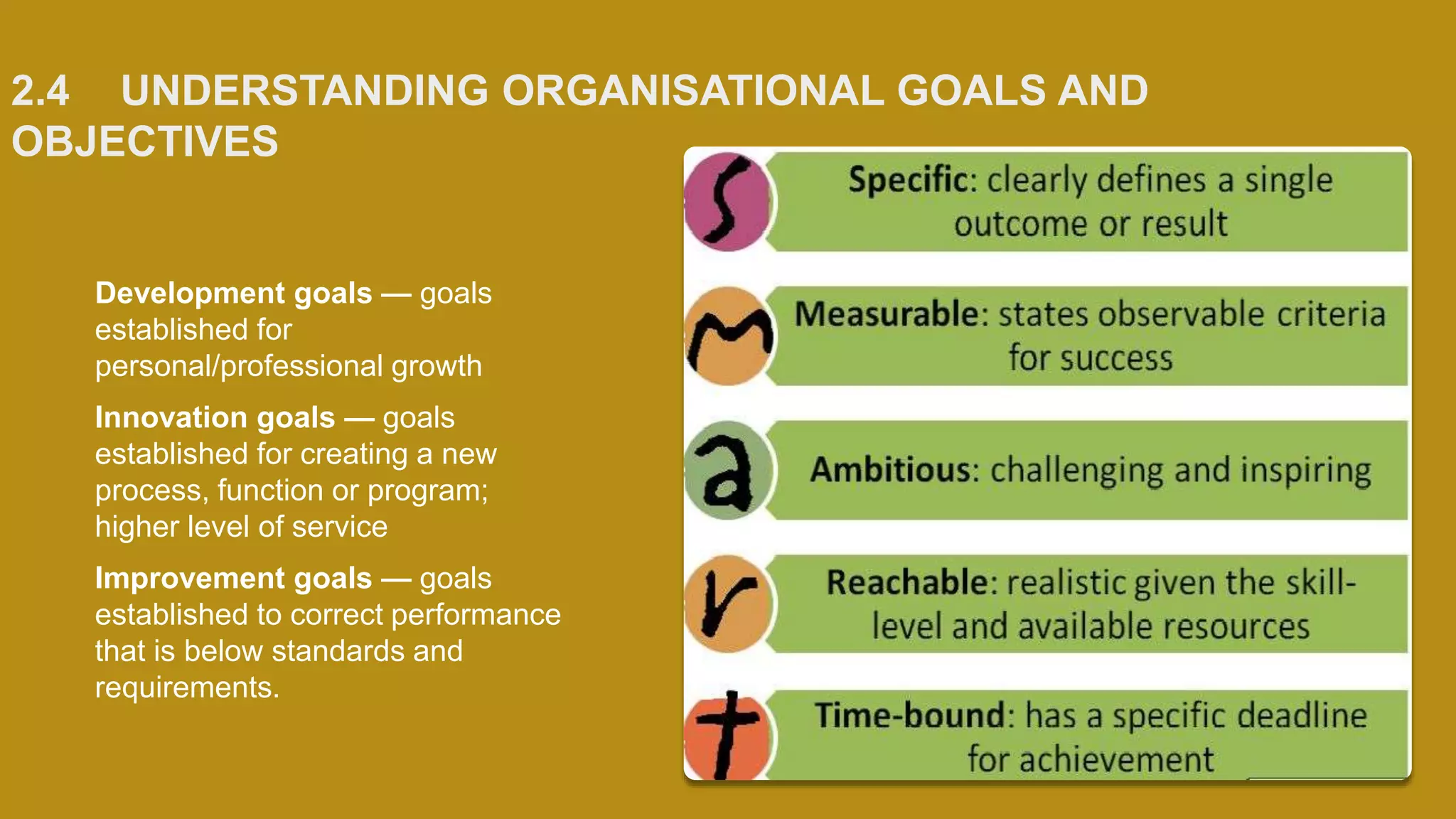
Development goals — goals
established for
personal/professional growth
Innovation goals — goals
established for creating a new
process, function or program;
higher level of service
Improvement goals — goals
established to correct performance
that is below standards and
requirements.
Consider the following example
Alice model academy owns a computer system that is used for typesetting exam
questions for pupils. Examination commences in a month. Joe’s job is to typeset
for the school. The school offers 8 subjects per class( Basic One - Basic Six). On
Tuesday morning at 8:30, proprietor tells Joe to have all examination question
papers for Basic One - Basic Six ready for correction in a 3 weeks, so that the
school will be able to commence exam in 2 weeks.
This is a SMART goal because:
 the proprietor identified exactly which specific activity she wants Joe to perform
(typeset exam questions);
 Joe’s performance is measurable ( 48 subjects );
 The target is attainable (an average of 3 subjects per day);
 Typesetting exam questions is relevant / related to the company goals (Joe
must meet his personal goal in order for the company to meet its daily
production goal); and
 Joe’s target is time-based (3weeks)
STRATEGY FORMULATION PHASES
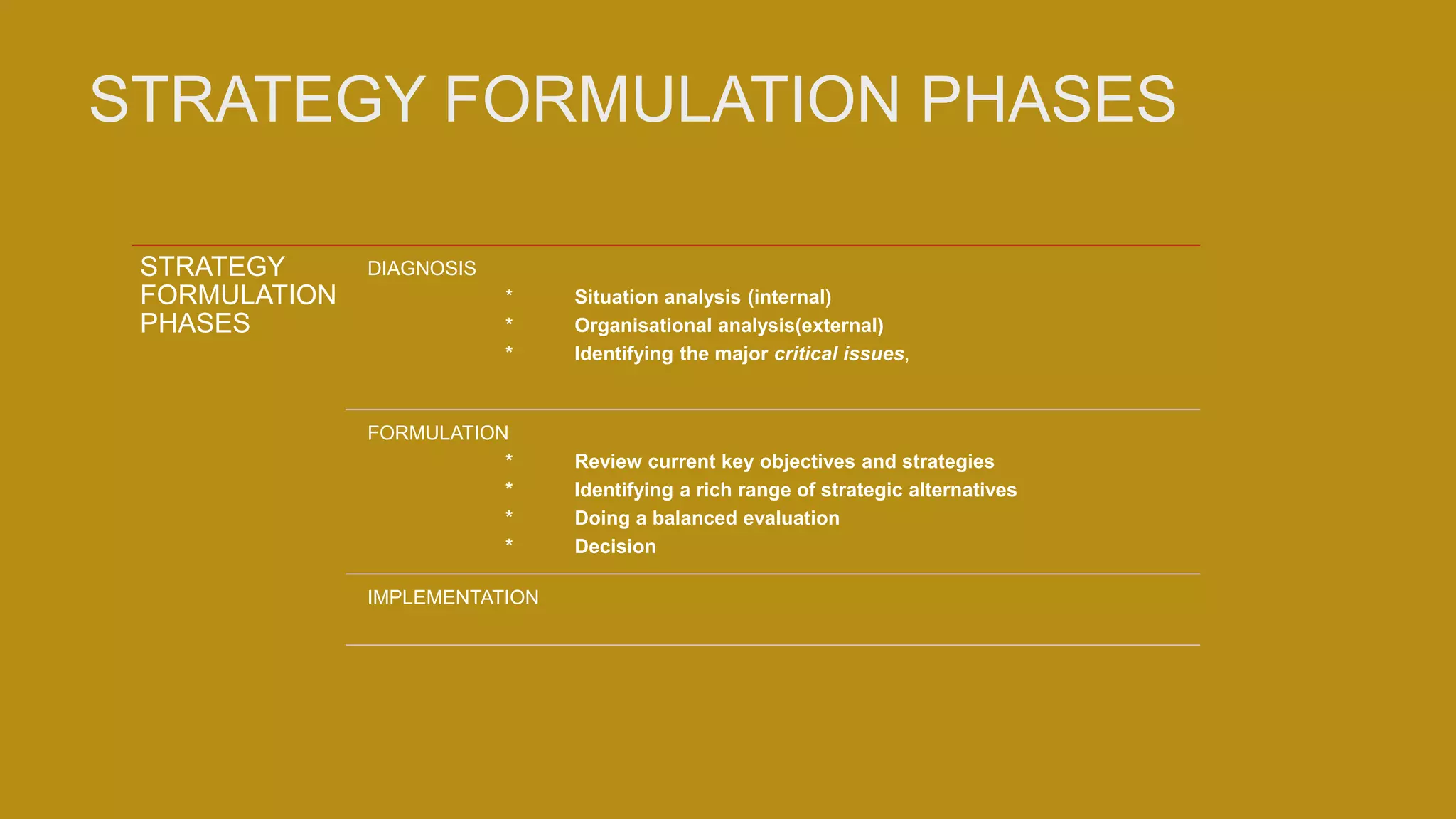
STRATEGY
FORMULATION
PHASES
DIAGNOSIS
* Situation analysis (internal)
* Organisational analysis(external)
* Identifying the major critical issues,
FORMULATION
* Review current key objectives and strategies
* Identifying a rich range of strategic alternatives
* Doing a balanced evaluation
* Decision
IMPLEMENTATION
STRATEGY FORMULATION PHASES
STRATEGY
FORMULATION
LEVEL
Corporate Level Strategy:
* Growth or directional strategy
* portfolio strategy
* parenting strategy
Competitive Strategy (often called Business Level Strategy
* Overall Price (Cost) Leadership Strategy
* Differentiation strategy
* Best-Cost Provider Strategy
Functional Strategy:
* Sourcing strategy
* Marketing strategy
* Financial strategy
* R&D strategy
3.0 PERFORMANCE MANAGEMENT PROCESS
 Performance planning is the second step in the performance management
process. It is a dialogue between a supervisor and an employee to:
• establish and agree upon performance expectations,
• clarify what the employee will be evaluated on, and
• set the stage for ongoing feedback and coaching throughout the year.
3.1 PERFORMANCE PLANNING
PERFORMANCE EXPECTATIONS
What is a Performance Expectation?
 A description of the results expected for the fully satisfied performance of a job
function/task.
 Defines “how well” each function or task must be performed.
 Provides a benchmark against which to evaluate work performance.
A performance expectation should be:
 Derived from mission, goals and values
 Mutually understood
 Developed collaboratively, if appropriate
 Descriptive of how a job is to be performed
 Descriptive of fully satisfactory performance
 Expressed in measurable/observable terms
 Reasonable and attainable
When Should Performance
Expectations be Set?
 When an employee is hired
 When responsibilities are changed or added
 When clarification of responsibilities is needed
TYPES OF PERFORMANCE
EXPECTATIONS
 Behavioral Expectations
During the performance planning process, managers should review and discuss these behavioral standards with employees. It is
important for managers to make sure employees understand how the behavioral standards relate to their specific jobs. Behaviors are
important because they reflect how an employee goes about getting the job done—how the individual supports the team,
communicates, mentors others and so forth.
 Results Expectations
The results or goals to be achieved by employees should be tied to the organization’s strategy and goals. The employee’s development
needs should also be taken into account in the goal setting process. Development goals can be targeted either to improving current job
performance or preparing for career advancement. Example of goals for an employee might be:
 Complete project “X” by time “Y.”
 Increase sales by 10 percent.
 Successfully mentor employee “X” to develop skill “Y.”
 Activity Expectations
This perspective identifies and describes the core employee roles, and the responsibilities of each role.
For example : class management of teachers
Employer’s / Supervisor’s Role
 Have a thorough understanding of the work involved – the critical functions and key tasks.
 Review job description to ensure that information is accurate and up to date.
 Keep in mind the performance planning process involves a relatively equal partnership between
supervisor and employee. They negotiate together, because they share a common interest –
success.
 Since the supervisor may be more expert in the “big picture” issues his/her responsibility is to
discuss how the employee supports the organizational needs of the department or division and fits
with other employees in the unit.
 Know what constitutes “successful performance” and effectively communicate this. Because the
employee is an expert in the job, it is the employee who should, by and large, generate the criteria
used to gauge success, with the supervisor’s involvement.
 Identify priority areas, if appropriate, among the core and job-specific competencies that will be
emphasized in the evaluation.
 Communicate how the results of the employee’s work contribute to the department’s, division’s or
university’s goals.
 Ask the employee what information, resources, tools, training and supervision is needed.
 Create a climate for real dialogue and teamwork during the meeting.
Outcome of Performance Planning:
The purpose of performance planning can best be defined in terms of outcomes. By the
conclusion of the performance planning session the following outcomes should have
been achieved:
• The job task and objectives of the employee will be aligned with the goals and
objectives of the department and division. The employee will understand the link
between his or her responsibilities and the overall goals.
• Job responsibilities will be modified to reflect any changes in the work context.
• Supervisor and employee will agree to the major job tasks and objectives for the
employee, how success will be measured, what assignments are most or least
important, and the level of authority the employee has with respect to each job
responsibility.
• The supervisor and employee will identify any help the manager can provide, any
potential barriers to achieving the objectives, and means for overcoming the barriers.
• A formal document (a performance plan) will be produced that summarizes the
discussions and agreements and is signed by both the supervisor and employee
Don’t Forget To:
DISCUSS
PRIORITY
The purpose of this discussion is
to help the employee know where
to allocate his or her time without
having to consult with the
supervisor on everything. A simply
way to do this is to designate a
priority for each task or objective.
For example, you might rate them
as
priority one – essential,
priority two important, and
priority three – least important
DISCUSS
AUTHORITY
Employees need to know when they
can make decisions on their own and
when they need to consult the
supervisor. For each objective,
discuss the level of decision making
available to the employee. A
supervisor might use the following
rating system:
Complete Authority: No need to get
permission or report afterward
Act and Report: Employee can make
decision and act, but needs to report
decision to the supervisor
Ask: Employee needs to get decision
or permission to decide from
supervisor
DISCUSS
DIFFICULTY
It is important that the supervisor
and employee discuss any
difficulties, challenges, or
problems that might interfere with
achieving the objectives and
meeting standards. As a partner in
the process, the supervisor’s role
is to actively participate in
identifying ways he or she can
assist the employee in being
successful. This dialogue may also
include the identification of training
or development needs of the
employee that are important to his
or her success.
3.2 PERFORMANCE
SUPERVISION AND COACHING
Coaching is an ongoing process of communication between the supervisor and the
employee focused on improving current performance and building capabilities for the future. It
involves the supervisor and employee working together to share information about work
progress, potential barriers and problems, possible solutions to problems, and how the supervisor
can help the employee. It is a dialogue that links performance planning and performance review.
It involves informal conversations or notes, as well as more formal coaching meetings and written
documentation.
 Coaching includes a variety of activities, such as:
• observing performance
• providing instruction
• directing employee’s efforts
• providing encouragement
• correcting poor performance
• recognizing excellent performance
• listening to employee concerns and ideas
SUPERVISION :
Observation
It is recommended that managers observe their employees with the
intent of documenting behaviors related to performance. Look for:
 Trends in performance
 Is it steadily improving or declining?
 Does the individual have “peaks and
valleys” – spurts of excellent
performance followed by extended
periods of mediocre performance?
 Critical incidents
 Outstanding successes or failures.
 Performance events that stand out
from typical behavior
SUPERVISION :
Documentation
 Structured Diary
Experts in performance management recommend that managers spend 30
minutes a week documenting employee performance. Document performance
in behavioral terms, rather than inferential or judgmental.
 List the performance expectations and goals for the appraisal cycle and
space to document date, skills exhibited results of behavior and other
comments.
As an example:
SUPERVISION
Unstructured Diary
Informal documentation of
performance events. For example,
jot down notes about employee
behavior in your Day timer.
Work Samples
Maintain copies of work that
illustrate the performance
dimensions being measured.
Employee Fact File
A file where notes about
performance events and work
samples can be maintained.
Remember, this file could be
viewed by others if necessary
When Coaching An Employee:
• Do allow time for coaching. Even on informal basis, it takes time to do it well.
• Do ask how you can be of help to the employee.
• Do ask the employee what prevents him or her from performing, if the coaching is about not meeting
expectations.
• Do ask the employee for solutions to the problem.
• Do describe the employee’s performance as specifically as possible. Describe what impact it has on
others, the department or division, and the organizational as a whole.
• Do write down what you and the employee each agree to do.
• Do talk about follow up. Will you meet again to discuss the issue? When?
• Don’t be distracted by interruptions.
• Don’t assume the employee knows what you are thinking.
• Don’t assume that the performance issue exists because the employee has a bad attitude.
• Don’t end on a threatening or negative note. Re-state your support and willingness to help the
employee be successful.
3.3 PERFORMANCE
CONCURRENT FEEDBACK
Getting feedback from multiple sources helps employees know when they are
doing something really well, and when it would be helpful to do something a little
differently. Multiple sources of feedback could include one or more of the following:
• Self-evaluation
• Upward feedback (people who report to you)
• Peer feedback (people with whom you work)
• Customer feedback (people you serve both in and outside the unit).
• Work environment surveys (an expanded form of upward feedback)
Every employee should receive feedback from at least one other source in addition
to their supervisor and their own self-evaluation
Why Collect Feedback from Multiple Sources?
Gathering feedback information from multiple sources regarding an
employee’s performance can serve the following purposes:
 To determine instances of great or poor performance
 To identify the causes of performance problems
 To ascertain the factors behind excellent performance
 To provide evidence to determine whether the employee has achieved his
or her objectives and met standards
FORMS OF FEEDBACK
SELF-EVALUATION
CUSTOMER AND WORK
ENVIRONMENT SURVEYS
 This source of feedback serves to
target areas of performance
improvement that creates the greatest
value-added benefits for customers
served by the employee or
department.
 Feedback through this source is
critical for those individuals serving a
significant customer base of either
internal or external customers.
 Self-evaluation can be very helpful to
employees, by encouraging them to reflect on
their skills, areas of growth, and how their
work contributes to the larger organization.
 Self-evaluation helps the employee prepare
to actively engage in the performance review,
and demonstrates that improving
performance is a shared responsibility.
 Finally, self-evaluations that are shared with
the supervisor prior to the performance
review provide valuable information to the
review process
PERFORMANCE
CHECK-INs
Adopt the practice of meeting at least once per
quarter to review goals, progress, and
results, acknowledge successes, and identify
improvement opportunities.
1. Check progress
 What’s working well?
 What’s not working?
2. Make mid-course adjustments where
needed
 What changes would enhance performance
or progress toward the goal?
 The tools below can help to facilitate
performance check-in conversations:
3.4 PERFORMANCE REVIEW
During performance reviews managers and employees work together to:
• Establish objectives that were set and achieved by the employee, and also set
work expectations and performance goals for the coming year,
• Review the employee’s work achievements and challenges over the past year,
where performance exceeded, met, or fell below expectations
• Define the employee’s professional development goals and the learning
received and needed for the coming year
• Feedback from others affected by the employee’s performance.
Performance reviews succeed under the following
conditions:
• The supervisor takes on the role of helper and problem solver, rather than primary
evaluator.
• The employee is actively involved in the partnership and engaged in realistic self
evaluation.
• The supervisor uses appropriate interpersonal skills to involve the employee.
• The employee understands what to expect, in terms of content and process, before
walking in the door.
• The supervisor treats the review meeting as important, something that should not
be delayed and rescheduled.
• Both parties understand the why of performance review – that it’s not to punish, but
to improve performance so everyone wins.
The Performance Appraisal
Process
Gather the following information:
i. Self-appraisal information
ii. The employee’s job description
iii. The goals and objectives from the
previous performance appraisal
(if available)
iv. Agreed upon expectations for
performance
v. Your structured or unstructured
diaries of employee performance
events
 Solicit information from others that
know the employee’s work such as
a co-supervisor or Department
Head. The primary rater should be
the employee’s primary supervisor.
1. The employee will complete the
self-appraisal form.
2. 2. Gather the documentation you
have regarding performance.
3. Write the appraisal.
The Dilemma of Individual Performance
Review
Our culture and many organizations require that employee performance be
evaluated on an individual basis. However, if we focus solely on employee
performance and do not look at context or conditions that limit performance, then
efforts at continuous improvement fail.
Supervisors need to recognize that individual performance is not completely (or
even mostly) under the control of the employee. Job performance is influenced by
multiple factors, including:
• individual effort and skill
• decisions of others
• resources made available
• work systems and processes
During the performance review:
• Provide specific feedback on the employee’s performance, including priority objectives identified during
performance planning.
• Offer the employee an opportunity to share his or her self-evaluation, if one has been completed.
• Discuss learning and development needs of the employee.
• Set objectives for improvement.
• Set learning and development objectives, if appropriate.
• Answer employee questions with regard to the performance review.
• Sign performance review and obtain the employee’s signature.
Suggested Guidelines for
Conducting a Performance Review
1. Make it “priority time.”
• Create an agenda for the meeting
• Minimize interruptions
2. Set a tone of collaboration.
• Start the discussion on a positive note
• Encourage the employee’s participation
3. Be clear about your purpose.
• Reinforce that the discussion will address strengths and areas of improvement
4. Review performance objectives.
• Discuss the performance objectives and critical priorities
• Be clear about performance standards
5. Discuss performance that exceeds, meets, and is below expectations.
• Use language that is clear and specific; use examples
• Describe performance, not personality
Suggested Guidelines for Conducting a
Performance Review Contd.
6. Ask the employee what he or she thinks.
• Allow the employee to speak freely before responding to his or her comments
• Actively listen to the employee
• Clarify the employee’s concerns, then address them
7. Set objectives to:
• Improve performance in selected areas
• Build on strengths
• Develop the employee’s knowledge, skills, and abilities
• Align the employee’s work with the needs of the department or division
8. Agree to follow up.
• Schedule at least one interim check-in on performance during the year
• Ask how the employee prefers to receive feedback (written or verbal)
• Discuss how the employee likes to be recognized for good work
9. Close with encouragement.
• Offer your help and support
• End on a positive note by summarizing the employee’s strengths and contributions
Pitfalls to Avoid in Performance
Review
 First impression error – appraiser giving favorable ratings in all areas based on impressive
performance in just one area.
 Horns error – Downgrading an employee across all performance dimensions exclusively because
of poor performance in one dimension.
 Halo error – Developing a negative or positive opinion of an employee early in the review cycle
and allowing that to negatively or positively influence all later perceptions of performance.
 Recency error – Allowing performance, either good or bad, at the end of the review cycle to play
too large a role in determining an employee’s overall performance evaluation.
 Leniency error – Consistently rating an employee higher that is deserved.
 Severity error – Rating an employee consistently lower than is deserved.
 Central tendency error – Avoiding extremes in rating across all performance dimensions.
 Clone error – Giving better ratings to an employee who is like the rater in behavior and/or
personality.
 Spillover error – Continuing to downgrade an employee for performance errors in prior review
periods
Appraising Poor Performance
While most of us think of the performance appraisal as an annual event, there
are other times when it is appropriate to conduct a performance appraisal
session. Primarily, this is when an employee is exhibiting poor performance or
training/coaching is needed. When conducting performance review, if an
employee is receiving a rating of “needs improvement” or “unacceptable” on a
particular performance factor, it is important to insure that it is truly the
performance of the employee that is causing the less than satisfactory results.
Be sure to examine the job itself and the context in which the job is being
performed.
After the performance review:
• Make a copy of the review for the employee and yourself.
• Return the original to the appropriate individual in the unit for filing.
3.5 PERFORMANCE DEVELOPMENT PLAN
(PDP)
 Using the information from the employee’s self-appraisal form and your
own observations, determine the developmental opportunities that will
assist the employee not only in achieving short-term goals, but long-term
career goals as well.
 The greatest employee development comes from managers taking time to
develop employees through mentoring, assigning interesting projects and
identifying improvement areas.” Managers’ interest in their employees’
development is also a strong motivator. The key to the successful
development plan is the follow-up that occurs after the plan has been
agreed upon.
PURPOSE OF P.D.P.
 The performance Development Plan (PDP) is an organized approach to
professional development activities and programs that are designed to
improve the employee’s professional skills and the department’s productivity.
This is a joint process, both in design and execution, in that supervisors are
more familiar with the department’s future directions and the employee is
more aware of specific, individual needs and aspirations.
EVOLVING THE PERFORMANCE
DEVELOPMENT PLAN
The following process is a model. The process involves the following steps:
1. Prepare the Individual Development Plan at the conclusion of the
employee’s evaluation period i.e performance review.
2. Involve the employee in the design of the IDP. You may want to do
this early in the process, when you have only identified major areas where
development should take place and let the employee propose the more
specific ways to accomplish this. Or, you may prefer to have the employee
design the plan and then jointly review and refine the content.
EVOLVING THE PERFORMANCE
DEVELOPMENT PLAN contd.
3. Consider each area of the employee’s performance from the following perspectives and determine which should be
developed in the upcoming evaluation period:
 Strengths that, if enhanced, will contribute to the overall mission of the organization and increase productivity.
 New skills that will be needed in the upcoming evaluation period.
 Areas of performance/skills that need to be improved.
The above constitute the purpose of the development activity.
Some additional needs that contribute to establishing the purpose may include:
 Mission need • Relationship building
 Change in technology • Future staffing need
 New assignment • Leadership development
 Though you want the PDP to be thorough and cover the individual’s major development needs, try to keep it brief and
to the point so that it does not give the impression of being unwieldy or overwhelming.
 Focus on key areas to be developed.
EVOLVING THE PERFORMANCE
DEVELOPMENT PLAN contd.
4. Determine the appropriate learning methods and resources that will be needed.
5. Once the learning methods and resources have been selected, define the
measures or criteria that will be used to determine if the targeted learning has
been accomplished.
6. The supervisor and the employee sign the PDP to document mutual agreement
with it and commitment to completing it. Clarify responsibilities with the employee.
7. Set up a reporting system so that the employee’s progress can be gauged at
any time and adjustments can be made to the plan as needed.
Developmental Activities
Each employee’s development plan is unique based on their individual needs and career
opportunities. Listed below are a few of the developmental activities that you may want to
consider
 Assignments
Job rotation
Stretch
Temporary
 Committees
Work groups
Presentations
 Cross-Training
Changing functions
Shift changes
Working with new people
 Develop in Place
Mentoring
Individual projects
Perspective building
Tough challenge
Shift in size of job
 Formal Training/Development
Professional
Technical
Leadership
Executive
 Start-ups
New team
New system/service/process
Developmental Activities
 Off the Job Opportunities
Joining/leading community groups
Trying a new skill in a volunteer organization
Giving presentations to civic groups
 On the Job Opportunities
Taking on new projects or assignments
Temporary assignments e.g. – filling in for
someone on vacation
Assuming lead role responsibilities
Improving a process or procedure
 Self-Development
Readings/Self-study
Professional organizations
College/University Programs
Seminars
QUESTIONS AND CLARIFICATIONS
REFERENCES
 A Supervisor’s Guide for Performance Management by the U.S. Department of Labor. Published by U.S.
Department of Labor of Washington, D.C. in 1989.
 Perfect Phrases for Performance Reviews: Hundreds of Ready-to-Use Phrases That Describe Your
Employees’ Performance by Douglas Max, Robert Bacal. Published by McGraw-Hill in 2002.
 Masterful Coaching by Robert Hargrove. Published by Jossey-Bass/Pfeiffer of San Francisco in 2002.
 Performance Management: A Tool For Employee Success, Guidelines, Process and Useful Hints for
Supervisors and Staff (Updated 1/08) Division of Finance & Administration, University of Missouri, U.S.A.
 DeNisi, A. S., & Kluger, A. N. (2000). Feedback effectiveness: Can 360-degree appraisals be improved?
Academy of Management Executive, 14(1), 129-139.
 Dr. Herman Aguinis Performance Management, Edinburgh Business School, Heriot-Watt University,
U.S.A
 Case Study: Employee Performance Management in an International Retailer, 2GC Active Management.
 Overview of Performance Management, University of South Florida, U.S.A
 ARMSTRONG, M. and BARON, A. (2005) Managing performance: performance management in action.
London: CIPD.
 BRISCOE, D.B. and CLAUS, L.M. (2008) Employee performance management: policies and practices in
multinational enterprises. In: BUDWAH, P.W. and DENISI, A. (eds). Performance management systems: a
global perspective. Abingdon: Routledge.
THANK YOU

Agreegate performance management in the 21 st century private

  • 1.
    AGREEGATE PERFORMANCE MANAGEMENT IN THE 21STCENTURY PRIVATE SCHOOLS DR. S. A. BABARINDE (P.HD) (MSC.) HEAD OF DEPT., BUSINESS ADMIN & MGT, LAGOS CITY POLYTECHNIC, IKEJA, LAGOS STATE.
  • 2.
    1.1 DEFINITIONS 1.2 THENEED FOR PERFORMNANCE MANAGEMENT 1.3 GOALS AND OBJECTIVES OF PERFORMANCE MANAGEMENT 1.4 CONTRIBUTIONS OF PERFORMANCE MANAGEMENT 1.5 COST OF POOR PERFORMANCE MANAGEMENT 1.6 IDEALS OF PERFORMANCE MANAGEMENT 1.0 INTRODUCTION TO PERFORMANCE MANAGEMENT
  • 3.
    2.1 UNDERSTANDING THEPERFORMANCE MANAGEMENT MODEL 2.2 SCOPE OF PERFORMANCE MANAGEMENT 2.3 PREPARING FOR PERFORMANCE MANGEMENT PROCESS 2.4 UNDERSTANDING ORGANISATIONAL GOALS AND OBJECTIVES 2.0 ELEMENTS OF PERFORMANCE MANAGEMENT
  • 4.
    3.1 PERFORMANCE PLANNING 3.2PERFORMANCE SUPERVISION AND COACHING 3.3 PERFORMANCE CONCURRENT FEEDBACK 3.4 PERFORMANCE REVIEW 3.5 PERFORMANCE DEVELOPMENT PLAN  3.0 PERFORMANCE MANAGEMENT PROCESS
  • 5.
    1.0 INTRODUCTION TO PERFORMANCEMANAGEMENT  Like Every Other Business, School Management Requires Wide Experience In Not Only The Regards Of Effective Teaching Delivery But Also Administration Of All The School Resources.  One Of The Salient Resources Required For The Start-up And Going Concern Of School Management Is Human Resources(teachers)  Of All The Internal Factors That Have Gross Impact On The Productivity Of Schools, Teachers’ Performance Have More Influence.  Effective Teachers’ Performance Management Is One Key Tool That Enhances Productivity, Profitability Through Increased Patronage.  Effective Teachers Performance Is Also A Key Tool In Making The Decision Of “Who Needs To Stay Or Be Fired” Thereby Reducing Human Capital Cost And Redundancy.  So The Question Now Is Less About How Performance Management Itself Is Evolving And More About How Performance Management Is Embedding Into The Strategic Management Process To Ensure That People Are Adding Value To The Organization And Hence Driving Business Performance.
  • 6.
     In 1998The Cipd (Armstrong And Baron 1998) Concluded That Performance Management Is A Process That Contributes To The Effective Management Of Individuals And Teams To Achieve High Levels Of Organisation Performance. As Such, It Establishes Shared Understanding About What Is To Be Achieved And An Approach To Leading And Developing People That Will Ensure It Is Achieved.  However, Undoubtedly The Twenty-first Century Has Seen Acceptance That The Way Forward To Organisational Performance And Growth Is To Create High-performance, High- commitment Work Systems That Rely On Relationships With Managers Built On Trust, Understanding And Mutual Co-operation. With The Old Carrot And Stick Approach To Management Long Consigned To The Scrap Heap, The Greater Preoccupation With Employee Engagement And Commitment Has Cemented The Place Of Performance Management As The Centrepiece Of Communication Between Manager And Individual.  This Shift Has Resulted In Performance Management Being Perceived As A Continuous Process Rather Than A Discrete Event, With Latham Et Al (2007) Commenting That ‘A Distinguishing Feature Of Performance Management Relative To Performance Appraisal Is That The Former Is An Ongoing Process Whereas The Latter Is Done At Discrete Time Intervals…it Is Therefore Owned And Driven By Line Managers Rather Than Hr.’
  • 7.
    Work conducted bythe then Institute of Personnel Management in 1992 produced the following definition of performance management: ‘A strategy which relates to every activity of the organization set in the context of its human resources policies, culture, style and communications systems. The nature of the strategy depends on the organizational context and can vary from organization to organization.’ Briscoe and Claus (2008) defines ‘Performance management as the system through which organizations set work goals, determine performance standards, assign and evaluate work, provide performance feedback, determine training and development needs and distribute rewards.’ Performance management is the process through which supervisors and those they lead gain a shared understanding of work expectations and goals, exchange performance feedback, identify learning and development opportunities, and evaluate performance results. Performance management is a continuous process of identifying, measuring and developing performance in organizations by linking each individual’s performance and objectives to the organization’s overall mission and goals. Performance management is a continuous activity-based function in an organization that aligns individual and organizational interest to evolve and sustain passion towards the realization of set goals through continual review and assessment of actions.  1.1 DEFINITIONS OF PERFORMANCE MANAGEMENT
  • 8.
    1.2 THE NEEDFOR PERFORMNANCE MANAGEMENT  The people management aspect of the line manager’s role was explored as part of the ‘Black Box’ work carried out for the CIPD by a team led by Professor John Purcell at Bath University and published in 2003. They found that the relationships between an individual and their line manager is the most significant factor impacting on the individual’s willingness to perform. As such they concluded that line managers have a crucial role to play in bringing HR policies to life and none more so than performance management. They therefore identified performance management as one of the critical processes shaping the link between people management and organisational performance.  As such, performance management becomes a primary tool for managing the business if it is significant in shaping individual behaviour and ensuring these are directed towards achieving the strategic aims of the organisation. As Mohrman and Mohrman (1995) emphasised, ‘performance management is managing the business’; in other words, it is what line managers do all the time.
  • 9.
    1.3 GOALS ANDOBJECTIVES OF PERFORMANCE MANAGEMENT • Improve staff performance in meeting department, division and overall goals and objectives. • Support staff development and continuous learning • Align compensation with desired organization outcomes • Strengthen management accountability
  • 10.
    Purposes served bya performance management system • Strategic To help top management achieve strategic business objectives • Administrative To furnish valid and useful information for making administrative decisions about employees • Information To inform employees about how they are doing and about the organisation’s and the supervisor’s expectations • Developmental To allow managers to provide coaching to their employees • Organisational maintenance To provide information to be used in workplace planning and allocation of human resources • Documentation To collect useful information that can be used for various purposes (e.g., test development, personnel decisions
  • 11.
    1.4 CONTRIBUTIONS OF PERFORMANCEMANAGEMENT • Motivation to perform is increased • Self-esteem is increased • Managers gain insight about subordinates • The definitions of job and criteria are clarified • Self-insight and development are enhanced • Personnel actions are more fair and appropriate • Organisational goals are made clear • Employees become more competent • There is better protection from lawsuits • There is better and more timely differentiation between good and poor performers • Supervisors’ views of performance are communicated more clearly • Organisational change is facilitated
  • 12.
    What CEOs SayAbout the Contribution of Performance Management Systems  A study conducted by Development Dimensions International (DDI), a global human resource consulting firm specialising in leadership and selection, found that performance management systems are a key tool that organisations use to translate business strategy into business results. Specifically, performance management systems influence ‘financial performance, productivity, product or service quality, customer satisfaction, and employee job satisfaction.’ In addition, 79 per cent of the CEOs surveyed say that the performance management systems implemented in their organisations drive the ‘cultural strategies that maximise human assets.’  SOURCE: Sumlin, R. Performance management: impacts and trends. DDI white paper.
  • 13.
    1.5 COST OFPOOR PERFORMANCE MANAGEMENT • Employees may quit due to results • False or misleading information may be used • Self-esteem may be lowered • Time and money are wasted • Relationships are damaged • Motivation to perform is decreased • Employees suffer from job burnout and job dissatisfaction • There is increased risk of litigation • Managers are required to use an unjustified amount of resources • Standards and ratings vary and are unfair • Biases can replace standards • Mystery surrounds how ratings were derived
  • 14.
    1.6 IDEALS OFPERFORMANCE MANAGEMENT • Ideal performance management systems are rare. Such ideal systems are:  − congruent with strategy (i.e., there is a clear link between individual, unit and organizational goals);  − thorough (e.g., they include all relevant performance dimensions);  − practical (e.g., they do not require excessive time and resources);  − meaningful (e.g., they have important consequences);  − specific (e.g., they provide a concrete employee improvement agenda);  − able to identify effective and ineffective performance (e.g., they help to distinguish  employees with different performance levels);  − reliable (e.g., the measurement of performance is consistent);  − valid (e.g., the measures of performance are not contaminated or deficient);  − fair (e.g., people participating in the system believe the processes and outcomes are just);  − inclusive (i.e., they include input from multiple sources on an ongoing basis);  − open (i.e., they are transparent and there are no secrets);  − correctable (i.e., they include mechanisms so that errors can be corrected);  − standardised (i.e., performance is evaluated consistently across people and time);  − ethical (i.e., they comply with ethical standards).  Many trade-offs take place in the real-world implementation of performance managementsystems. However, the closer the system is to the ideal characteristics, the greaterthe return will be for employees, supervisors, and the organisation as a whole.
  • 15.
    2.0 ELEMENTS OFPERFORMANCE MANAGEMENT SYSTEM ALIGNMENT OF ORGANISATIONAL VISION, GOALS AND STRATEGY WITH A PERFORMANCE PLAN PERFORMANCE COACHING, MENTORING AND FEEDBACK PERFORMANCE EVALUATION AND REVIEW THE PERFORMANCE DEVELOPMENT PLAN (PDP)
  • 16.
    2.1 UNDERSTANDING THEPERFORMANCE MANAGEMENT MODEL
  • 17.
    2.2 SCOPE OFPERFORMANCE MANAGEMENT PERFORMANCE MANAGEMENT VISION & GOALS EMPLOYEE PERSONAL INTEREST TASK PERFORMANC E & STANDARD CHECKS EMPLOYE R INTEREST EMPLOYE R
  • 18.
    2.3 PREPARING FORPERFORMANCE MANGEMENT PROCESS • the strategic plan of the organization • the strategic plans of the department and division (note these plans should be in alignment with each other and supportive of the organization’s strategic plan) •one-year short-term operational plan of the department or division, if one exists. •job descriptions of each employee •performance appraisal for each employee for the previous year Information and Data Gathering: •why performance management is important (purpose) •how will it benefit the employee, the manager, and the organization •the supervisor’s general philosophy or approach (e.g., working together, centered on self evaluation, focus on prevention of performance problems Preparing and Educating Staff:
  • 19.
    2.4 UNDERSTANDING ORGANISATIONALGOALS AND OBJECTIVES Effective performance goals flow from and support the mission, vision, and goals of the team, department, and organisation. PERSONAL GOALS Department & Team Goals Org. Strategy Org. Mission, Vision, & Values
  • 20.
    2.4 UNDERSTANDING ORGANISATIONALGOALS AND OBJECTIVES Development goals — goals established for personal/professional growth Innovation goals — goals established for creating a new process, function or program; higher level of service Improvement goals — goals established to correct performance that is below standards and requirements.
  • 21.
    Consider the followingexample Alice model academy owns a computer system that is used for typesetting exam questions for pupils. Examination commences in a month. Joe’s job is to typeset for the school. The school offers 8 subjects per class( Basic One - Basic Six). On Tuesday morning at 8:30, proprietor tells Joe to have all examination question papers for Basic One - Basic Six ready for correction in a 3 weeks, so that the school will be able to commence exam in 2 weeks. This is a SMART goal because:  the proprietor identified exactly which specific activity she wants Joe to perform (typeset exam questions);  Joe’s performance is measurable ( 48 subjects );  The target is attainable (an average of 3 subjects per day);  Typesetting exam questions is relevant / related to the company goals (Joe must meet his personal goal in order for the company to meet its daily production goal); and  Joe’s target is time-based (3weeks)
  • 22.
    STRATEGY FORMULATION PHASES STRATEGY FORMULATION PHASES DIAGNOSIS *Situation analysis (internal) * Organisational analysis(external) * Identifying the major critical issues, FORMULATION * Review current key objectives and strategies * Identifying a rich range of strategic alternatives * Doing a balanced evaluation * Decision IMPLEMENTATION
  • 23.
    STRATEGY FORMULATION PHASES STRATEGY FORMULATION LEVEL CorporateLevel Strategy: * Growth or directional strategy * portfolio strategy * parenting strategy Competitive Strategy (often called Business Level Strategy * Overall Price (Cost) Leadership Strategy * Differentiation strategy * Best-Cost Provider Strategy Functional Strategy: * Sourcing strategy * Marketing strategy * Financial strategy * R&D strategy
  • 24.
  • 25.
     Performance planningis the second step in the performance management process. It is a dialogue between a supervisor and an employee to: • establish and agree upon performance expectations, • clarify what the employee will be evaluated on, and • set the stage for ongoing feedback and coaching throughout the year. 3.1 PERFORMANCE PLANNING
  • 26.
    PERFORMANCE EXPECTATIONS What isa Performance Expectation?  A description of the results expected for the fully satisfied performance of a job function/task.  Defines “how well” each function or task must be performed.  Provides a benchmark against which to evaluate work performance.
  • 27.
    A performance expectationshould be:  Derived from mission, goals and values  Mutually understood  Developed collaboratively, if appropriate  Descriptive of how a job is to be performed  Descriptive of fully satisfactory performance  Expressed in measurable/observable terms  Reasonable and attainable
  • 28.
    When Should Performance Expectationsbe Set?  When an employee is hired  When responsibilities are changed or added  When clarification of responsibilities is needed
  • 29.
    TYPES OF PERFORMANCE EXPECTATIONS Behavioral Expectations During the performance planning process, managers should review and discuss these behavioral standards with employees. It is important for managers to make sure employees understand how the behavioral standards relate to their specific jobs. Behaviors are important because they reflect how an employee goes about getting the job done—how the individual supports the team, communicates, mentors others and so forth.  Results Expectations The results or goals to be achieved by employees should be tied to the organization’s strategy and goals. The employee’s development needs should also be taken into account in the goal setting process. Development goals can be targeted either to improving current job performance or preparing for career advancement. Example of goals for an employee might be:  Complete project “X” by time “Y.”  Increase sales by 10 percent.  Successfully mentor employee “X” to develop skill “Y.”  Activity Expectations This perspective identifies and describes the core employee roles, and the responsibilities of each role. For example : class management of teachers
  • 30.
    Employer’s / Supervisor’sRole  Have a thorough understanding of the work involved – the critical functions and key tasks.  Review job description to ensure that information is accurate and up to date.  Keep in mind the performance planning process involves a relatively equal partnership between supervisor and employee. They negotiate together, because they share a common interest – success.  Since the supervisor may be more expert in the “big picture” issues his/her responsibility is to discuss how the employee supports the organizational needs of the department or division and fits with other employees in the unit.  Know what constitutes “successful performance” and effectively communicate this. Because the employee is an expert in the job, it is the employee who should, by and large, generate the criteria used to gauge success, with the supervisor’s involvement.  Identify priority areas, if appropriate, among the core and job-specific competencies that will be emphasized in the evaluation.  Communicate how the results of the employee’s work contribute to the department’s, division’s or university’s goals.  Ask the employee what information, resources, tools, training and supervision is needed.  Create a climate for real dialogue and teamwork during the meeting.
  • 31.
    Outcome of PerformancePlanning: The purpose of performance planning can best be defined in terms of outcomes. By the conclusion of the performance planning session the following outcomes should have been achieved: • The job task and objectives of the employee will be aligned with the goals and objectives of the department and division. The employee will understand the link between his or her responsibilities and the overall goals. • Job responsibilities will be modified to reflect any changes in the work context. • Supervisor and employee will agree to the major job tasks and objectives for the employee, how success will be measured, what assignments are most or least important, and the level of authority the employee has with respect to each job responsibility. • The supervisor and employee will identify any help the manager can provide, any potential barriers to achieving the objectives, and means for overcoming the barriers. • A formal document (a performance plan) will be produced that summarizes the discussions and agreements and is signed by both the supervisor and employee
  • 32.
    Don’t Forget To: DISCUSS PRIORITY Thepurpose of this discussion is to help the employee know where to allocate his or her time without having to consult with the supervisor on everything. A simply way to do this is to designate a priority for each task or objective. For example, you might rate them as priority one – essential, priority two important, and priority three – least important DISCUSS AUTHORITY Employees need to know when they can make decisions on their own and when they need to consult the supervisor. For each objective, discuss the level of decision making available to the employee. A supervisor might use the following rating system: Complete Authority: No need to get permission or report afterward Act and Report: Employee can make decision and act, but needs to report decision to the supervisor Ask: Employee needs to get decision or permission to decide from supervisor DISCUSS DIFFICULTY It is important that the supervisor and employee discuss any difficulties, challenges, or problems that might interfere with achieving the objectives and meeting standards. As a partner in the process, the supervisor’s role is to actively participate in identifying ways he or she can assist the employee in being successful. This dialogue may also include the identification of training or development needs of the employee that are important to his or her success.
  • 33.
    3.2 PERFORMANCE SUPERVISION ANDCOACHING Coaching is an ongoing process of communication between the supervisor and the employee focused on improving current performance and building capabilities for the future. It involves the supervisor and employee working together to share information about work progress, potential barriers and problems, possible solutions to problems, and how the supervisor can help the employee. It is a dialogue that links performance planning and performance review. It involves informal conversations or notes, as well as more formal coaching meetings and written documentation.  Coaching includes a variety of activities, such as: • observing performance • providing instruction • directing employee’s efforts • providing encouragement • correcting poor performance • recognizing excellent performance • listening to employee concerns and ideas
  • 34.
    SUPERVISION : Observation It isrecommended that managers observe their employees with the intent of documenting behaviors related to performance. Look for:  Trends in performance  Is it steadily improving or declining?  Does the individual have “peaks and valleys” – spurts of excellent performance followed by extended periods of mediocre performance?  Critical incidents  Outstanding successes or failures.  Performance events that stand out from typical behavior
  • 35.
    SUPERVISION : Documentation  StructuredDiary Experts in performance management recommend that managers spend 30 minutes a week documenting employee performance. Document performance in behavioral terms, rather than inferential or judgmental.  List the performance expectations and goals for the appraisal cycle and space to document date, skills exhibited results of behavior and other comments. As an example:
  • 36.
    SUPERVISION Unstructured Diary Informal documentationof performance events. For example, jot down notes about employee behavior in your Day timer. Work Samples Maintain copies of work that illustrate the performance dimensions being measured. Employee Fact File A file where notes about performance events and work samples can be maintained. Remember, this file could be viewed by others if necessary
  • 37.
    When Coaching AnEmployee: • Do allow time for coaching. Even on informal basis, it takes time to do it well. • Do ask how you can be of help to the employee. • Do ask the employee what prevents him or her from performing, if the coaching is about not meeting expectations. • Do ask the employee for solutions to the problem. • Do describe the employee’s performance as specifically as possible. Describe what impact it has on others, the department or division, and the organizational as a whole. • Do write down what you and the employee each agree to do. • Do talk about follow up. Will you meet again to discuss the issue? When? • Don’t be distracted by interruptions. • Don’t assume the employee knows what you are thinking. • Don’t assume that the performance issue exists because the employee has a bad attitude. • Don’t end on a threatening or negative note. Re-state your support and willingness to help the employee be successful.
  • 38.
    3.3 PERFORMANCE CONCURRENT FEEDBACK Gettingfeedback from multiple sources helps employees know when they are doing something really well, and when it would be helpful to do something a little differently. Multiple sources of feedback could include one or more of the following: • Self-evaluation • Upward feedback (people who report to you) • Peer feedback (people with whom you work) • Customer feedback (people you serve both in and outside the unit). • Work environment surveys (an expanded form of upward feedback) Every employee should receive feedback from at least one other source in addition to their supervisor and their own self-evaluation
  • 39.
    Why Collect Feedbackfrom Multiple Sources? Gathering feedback information from multiple sources regarding an employee’s performance can serve the following purposes:  To determine instances of great or poor performance  To identify the causes of performance problems  To ascertain the factors behind excellent performance  To provide evidence to determine whether the employee has achieved his or her objectives and met standards
  • 40.
    FORMS OF FEEDBACK SELF-EVALUATION CUSTOMERAND WORK ENVIRONMENT SURVEYS  This source of feedback serves to target areas of performance improvement that creates the greatest value-added benefits for customers served by the employee or department.  Feedback through this source is critical for those individuals serving a significant customer base of either internal or external customers.  Self-evaluation can be very helpful to employees, by encouraging them to reflect on their skills, areas of growth, and how their work contributes to the larger organization.  Self-evaluation helps the employee prepare to actively engage in the performance review, and demonstrates that improving performance is a shared responsibility.  Finally, self-evaluations that are shared with the supervisor prior to the performance review provide valuable information to the review process
  • 41.
    PERFORMANCE CHECK-INs Adopt the practiceof meeting at least once per quarter to review goals, progress, and results, acknowledge successes, and identify improvement opportunities. 1. Check progress  What’s working well?  What’s not working? 2. Make mid-course adjustments where needed  What changes would enhance performance or progress toward the goal?  The tools below can help to facilitate performance check-in conversations:
  • 42.
    3.4 PERFORMANCE REVIEW Duringperformance reviews managers and employees work together to: • Establish objectives that were set and achieved by the employee, and also set work expectations and performance goals for the coming year, • Review the employee’s work achievements and challenges over the past year, where performance exceeded, met, or fell below expectations • Define the employee’s professional development goals and the learning received and needed for the coming year • Feedback from others affected by the employee’s performance.
  • 43.
    Performance reviews succeedunder the following conditions: • The supervisor takes on the role of helper and problem solver, rather than primary evaluator. • The employee is actively involved in the partnership and engaged in realistic self evaluation. • The supervisor uses appropriate interpersonal skills to involve the employee. • The employee understands what to expect, in terms of content and process, before walking in the door. • The supervisor treats the review meeting as important, something that should not be delayed and rescheduled. • Both parties understand the why of performance review – that it’s not to punish, but to improve performance so everyone wins.
  • 44.
    The Performance Appraisal Process Gatherthe following information: i. Self-appraisal information ii. The employee’s job description iii. The goals and objectives from the previous performance appraisal (if available) iv. Agreed upon expectations for performance v. Your structured or unstructured diaries of employee performance events  Solicit information from others that know the employee’s work such as a co-supervisor or Department Head. The primary rater should be the employee’s primary supervisor. 1. The employee will complete the self-appraisal form. 2. 2. Gather the documentation you have regarding performance. 3. Write the appraisal.
  • 45.
    The Dilemma ofIndividual Performance Review Our culture and many organizations require that employee performance be evaluated on an individual basis. However, if we focus solely on employee performance and do not look at context or conditions that limit performance, then efforts at continuous improvement fail. Supervisors need to recognize that individual performance is not completely (or even mostly) under the control of the employee. Job performance is influenced by multiple factors, including: • individual effort and skill • decisions of others • resources made available • work systems and processes
  • 46.
    During the performancereview: • Provide specific feedback on the employee’s performance, including priority objectives identified during performance planning. • Offer the employee an opportunity to share his or her self-evaluation, if one has been completed. • Discuss learning and development needs of the employee. • Set objectives for improvement. • Set learning and development objectives, if appropriate. • Answer employee questions with regard to the performance review. • Sign performance review and obtain the employee’s signature.
  • 47.
    Suggested Guidelines for Conductinga Performance Review 1. Make it “priority time.” • Create an agenda for the meeting • Minimize interruptions 2. Set a tone of collaboration. • Start the discussion on a positive note • Encourage the employee’s participation 3. Be clear about your purpose. • Reinforce that the discussion will address strengths and areas of improvement 4. Review performance objectives. • Discuss the performance objectives and critical priorities • Be clear about performance standards 5. Discuss performance that exceeds, meets, and is below expectations. • Use language that is clear and specific; use examples • Describe performance, not personality
  • 48.
    Suggested Guidelines forConducting a Performance Review Contd. 6. Ask the employee what he or she thinks. • Allow the employee to speak freely before responding to his or her comments • Actively listen to the employee • Clarify the employee’s concerns, then address them 7. Set objectives to: • Improve performance in selected areas • Build on strengths • Develop the employee’s knowledge, skills, and abilities • Align the employee’s work with the needs of the department or division 8. Agree to follow up. • Schedule at least one interim check-in on performance during the year • Ask how the employee prefers to receive feedback (written or verbal) • Discuss how the employee likes to be recognized for good work 9. Close with encouragement. • Offer your help and support • End on a positive note by summarizing the employee’s strengths and contributions
  • 49.
    Pitfalls to Avoidin Performance Review  First impression error – appraiser giving favorable ratings in all areas based on impressive performance in just one area.  Horns error – Downgrading an employee across all performance dimensions exclusively because of poor performance in one dimension.  Halo error – Developing a negative or positive opinion of an employee early in the review cycle and allowing that to negatively or positively influence all later perceptions of performance.  Recency error – Allowing performance, either good or bad, at the end of the review cycle to play too large a role in determining an employee’s overall performance evaluation.  Leniency error – Consistently rating an employee higher that is deserved.  Severity error – Rating an employee consistently lower than is deserved.  Central tendency error – Avoiding extremes in rating across all performance dimensions.  Clone error – Giving better ratings to an employee who is like the rater in behavior and/or personality.  Spillover error – Continuing to downgrade an employee for performance errors in prior review periods
  • 50.
    Appraising Poor Performance Whilemost of us think of the performance appraisal as an annual event, there are other times when it is appropriate to conduct a performance appraisal session. Primarily, this is when an employee is exhibiting poor performance or training/coaching is needed. When conducting performance review, if an employee is receiving a rating of “needs improvement” or “unacceptable” on a particular performance factor, it is important to insure that it is truly the performance of the employee that is causing the less than satisfactory results. Be sure to examine the job itself and the context in which the job is being performed.
  • 51.
    After the performancereview: • Make a copy of the review for the employee and yourself. • Return the original to the appropriate individual in the unit for filing.
  • 52.
    3.5 PERFORMANCE DEVELOPMENTPLAN (PDP)  Using the information from the employee’s self-appraisal form and your own observations, determine the developmental opportunities that will assist the employee not only in achieving short-term goals, but long-term career goals as well.  The greatest employee development comes from managers taking time to develop employees through mentoring, assigning interesting projects and identifying improvement areas.” Managers’ interest in their employees’ development is also a strong motivator. The key to the successful development plan is the follow-up that occurs after the plan has been agreed upon.
  • 53.
    PURPOSE OF P.D.P. The performance Development Plan (PDP) is an organized approach to professional development activities and programs that are designed to improve the employee’s professional skills and the department’s productivity. This is a joint process, both in design and execution, in that supervisors are more familiar with the department’s future directions and the employee is more aware of specific, individual needs and aspirations.
  • 54.
    EVOLVING THE PERFORMANCE DEVELOPMENTPLAN The following process is a model. The process involves the following steps: 1. Prepare the Individual Development Plan at the conclusion of the employee’s evaluation period i.e performance review. 2. Involve the employee in the design of the IDP. You may want to do this early in the process, when you have only identified major areas where development should take place and let the employee propose the more specific ways to accomplish this. Or, you may prefer to have the employee design the plan and then jointly review and refine the content.
  • 55.
    EVOLVING THE PERFORMANCE DEVELOPMENTPLAN contd. 3. Consider each area of the employee’s performance from the following perspectives and determine which should be developed in the upcoming evaluation period:  Strengths that, if enhanced, will contribute to the overall mission of the organization and increase productivity.  New skills that will be needed in the upcoming evaluation period.  Areas of performance/skills that need to be improved. The above constitute the purpose of the development activity. Some additional needs that contribute to establishing the purpose may include:  Mission need • Relationship building  Change in technology • Future staffing need  New assignment • Leadership development  Though you want the PDP to be thorough and cover the individual’s major development needs, try to keep it brief and to the point so that it does not give the impression of being unwieldy or overwhelming.  Focus on key areas to be developed.
  • 56.
    EVOLVING THE PERFORMANCE DEVELOPMENTPLAN contd. 4. Determine the appropriate learning methods and resources that will be needed. 5. Once the learning methods and resources have been selected, define the measures or criteria that will be used to determine if the targeted learning has been accomplished. 6. The supervisor and the employee sign the PDP to document mutual agreement with it and commitment to completing it. Clarify responsibilities with the employee. 7. Set up a reporting system so that the employee’s progress can be gauged at any time and adjustments can be made to the plan as needed.
  • 57.
    Developmental Activities Each employee’sdevelopment plan is unique based on their individual needs and career opportunities. Listed below are a few of the developmental activities that you may want to consider  Assignments Job rotation Stretch Temporary  Committees Work groups Presentations  Cross-Training Changing functions Shift changes Working with new people  Develop in Place Mentoring Individual projects Perspective building Tough challenge Shift in size of job  Formal Training/Development Professional Technical Leadership Executive  Start-ups New team New system/service/process
  • 58.
    Developmental Activities  Offthe Job Opportunities Joining/leading community groups Trying a new skill in a volunteer organization Giving presentations to civic groups  On the Job Opportunities Taking on new projects or assignments Temporary assignments e.g. – filling in for someone on vacation Assuming lead role responsibilities Improving a process or procedure  Self-Development Readings/Self-study Professional organizations College/University Programs Seminars
  • 59.
  • 60.
    REFERENCES  A Supervisor’sGuide for Performance Management by the U.S. Department of Labor. Published by U.S. Department of Labor of Washington, D.C. in 1989.  Perfect Phrases for Performance Reviews: Hundreds of Ready-to-Use Phrases That Describe Your Employees’ Performance by Douglas Max, Robert Bacal. Published by McGraw-Hill in 2002.  Masterful Coaching by Robert Hargrove. Published by Jossey-Bass/Pfeiffer of San Francisco in 2002.  Performance Management: A Tool For Employee Success, Guidelines, Process and Useful Hints for Supervisors and Staff (Updated 1/08) Division of Finance & Administration, University of Missouri, U.S.A.  DeNisi, A. S., & Kluger, A. N. (2000). Feedback effectiveness: Can 360-degree appraisals be improved? Academy of Management Executive, 14(1), 129-139.  Dr. Herman Aguinis Performance Management, Edinburgh Business School, Heriot-Watt University, U.S.A  Case Study: Employee Performance Management in an International Retailer, 2GC Active Management.  Overview of Performance Management, University of South Florida, U.S.A  ARMSTRONG, M. and BARON, A. (2005) Managing performance: performance management in action. London: CIPD.  BRISCOE, D.B. and CLAUS, L.M. (2008) Employee performance management: policies and practices in multinational enterprises. In: BUDWAH, P.W. and DENISI, A. (eds). Performance management systems: a global perspective. Abingdon: Routledge.
  • 61.