Indonesian Journal of Electrical Engineering and Computer Science
Vol. 25, No. 3, March 2022, pp. 1275~1286
ISSN: 2502-4752, DOI: 10.11591/ijeecs.v25.i3.pp1275-1286  1275
Journal homepage: http://ijeecs.iaescore.com
Performance comparison and impact of weather conditions on
different photovoltaic modules in two different cities
Caouthar Bahanni1
, Mustapha Adar1
, Sofia Boulmrharj2
, Mohammed Khaidar2
, Mustapha Mabrouki1
1
Industrial Engineering Laboratory, Faculty of Sciences and Technologies, Sultan Moulay Slimane University, Beni Mellal, Morocco
2
CUR’’EnR&SIE’’, Faculty of Sciences El Jadida, Chouaib Doukkali University, El Jadida, Morocco
Article Info ABSTRACT
Article history:
Received Jul 2, 2021
Revised Jan 4, 2022
Accepted Jan 19, 2022
This work is based on a comparative study of the impact of meteorological
conditions as well as the assessment of the production performance of two
identical photovoltaic stations installed in two Moroccan cities, the stations
are based on three different technologies. The measures of one year of
operation from January 2017 to December 2017 were evaluated. The annual
average performance ratios were found to be 82.42%, 79.99% and 78.74% in
Beni Mellal, and 85.29%, 84.61% and 70.41% in El Jadida for the
polycrystalline (pc-Si), monocrystalline (mc-Si), and amorphous (a-Si)
respectively. The photovoltaic efficiency was calculated at 12.24%, 11.89%,
and 11.71% in Beni Mellal; and 12.59%, 12.49%, and 10.42% in El Jadida
by the same order. Statistical analysis was carried out to establish the
correlation with photovoltaic (PV) production showed that after irradiation,
the temperature is the most influencing meteorological factor for PV
production, revealing a degradation in the performance ratio of 2.5%, 2%,
and 1% for each increase of 8 °C in temperature for monocrystalline,
polycrystalline and amorphous technologies respectively at Beni Mellal.
While at El Jadida the reduction in the performance ratio is evaluated by
5.5%, 5.2%, and 3% for each 8 °C increase in temperature for the same
order.
Keywords:
Performance analysis
photovoltaic silicon
technologies
PV efficiency
PV system
Weather conditions impact
This is an open access article under the CC BY-SA license.
Corresponding Author:
Bahanni Caouthar
Industrial Engineering Laboratory, Faculty of Sciences and Technologies
Sultan Moulay Slimane University
Mghila Campus, BP 523, 23000, Beni Mellal, Morocco
Email: Caouthar.bahanni@usms.ma
1. INTRODUCTION
Solar energy in Morocco is a critical economic subject consistent with sustainable development. The
risks are consequently doubly high, agreed with the unrestrained growth in the costs of traditional energies,
which are having a negative influence on the environment. With 3,000 hours of sunshine per year and an
average irradiation of more than 5 kWh/m², Morocco has considerable solar potential. The country intends to
massively take advantage of this clean and inexhaustible energy. It is increasingly asserting itself as an
investment destination in the clean energy sector.
In this logic the project "Propre.ma" thrown, is an ambitious program at a national scale financed by
research institute for solar energy and new energies (IRESEN), linking all the Moroccan public universities
in 20 cities for the development of a mapping of the photovoltaic producible in Morocco. Currently, research
in the arena of photovoltaic solar energy is increasingly dynamic. Besides, most studies focus on refining the
conversion of solar radiation into electrical energy [1]. In general, there are several technologies of
photovoltaic cells, the most dominant by 97% in the world in 2018 [2], and which represents the best
 ISSN: 2502-4752
Indonesian J Elec Eng & Comp Sci, Vol. 25, No. 3, March 2022: 1275-1286
1276
performance is that based on crystalline silicon, barely the amorphous silicon which is part of the thin films
becomes more and more competitive with crystalline silicon under certain weather conditions (more details
on photovoltaic technologies in [3]).
The environmental conditions under which the photovoltaic modules are called upon to operate in
real conditions (temperature, humidity, wind, irradiation, and dust) must be taken into account given their
crucial impact on photovoltaic production [1], [4], [5]. Particularly in Morocco, which is characterized by a
climate conditions placing the photovoltaic systems during their most operating time outside the standard test
conditions (STC): corresponding to a temperature of 25 °C and sunshine of 1000 W/m2
; consequently, this
makes the evolution of the performance of modules increasingly problematic. For this purpose, several works
have taken this sense of study to always remind us to pose this issue [6]-[8].
Nour-eddine et al. [9] worked on the same kind of our present work on a PV installation similar to
those used here, all within the framework of the “Propre.ma” project; The results showed that the
performance ratio of p-Si (polycrystalline) technology is higher compared to that of m-Si (monocrystalline)
technology during the hottest months of the year, which explains the impact of temperature on the PV
production. Roumpakias and Stamatelos [10] studied the deterioration of PV efficiency and deviations from
STC conditions, using data from a grid-connected photovoltaic park of 99.84 kWp in central Greece. This
study was performed for a three-year period (from 2013 to 2015). The results extracted from these studies
showed that the efficiency of PV modules during the two primary years was found to be higher than the STC
conditions, while during the third year, a slight decrease in efficiency compared to the STC conditions has
been registered. However, the behavior of PV efficiency decreases over time. Jed et al. [11] presented a
performance assessment of a 954,809 kWp photovoltaic plant of micro-amorphous silicon situated in
Nouakchott, using one-year data of operation from September 2014 to August 2015, the authors find as
results that the photovoltaic array performances rest on both illumination and climatic conditions, whilst
wind speed variation does not influence those energies.
Al-Addous et al. [12] presented a performance evaluation work of an off-grid PV system in Jordan
valley in which a four-year historical meteorological database was used for the development of a model to
estimate the effect of temperature on electricity production. Indeed, with prior knowledge of the site which is
characterized by a high temperature, the results denote that the PV efficiency is strongly affected by the
increase in temperature, and thanks to a cooling system, the authors observed a nearly 2% improvement in
efficiency in different radiation modalities. Elibol et al. [13] applied performance tests on a PV plant installed
on the roof of the scientific and technological research and application center of Düzce University (DUBİT)
in Düzce province, Turkey. Among these tests, the authors carried out an examination of the variations of the
panels energy conversion efficiency according to the temperature; the results of this examination showed that
when increasing the temperature by 1 °C the efficiency of pc-Si and a-Si technology increases by 0.033%
and 0.029% respectively, while the efficiency of mc-Si technology decreases by 0.084%. Daher et al. [14]
presented a research work in which the impact of tropical desert maritime climate on the performance of a
PV grid-connected power plant was analyzed, the results show that the average PR for PV arrays and the
global grid-connected system was found to be 90% and 84% respectively, while the monthly average daily
PV module efficiencies of 12.68%. from these results, the authors deduce that the ambient temperature has an
impact on the performance ratio, estimated by a decrease of 0.7% for each increase of 1 °C in the daily
ambient temperature. In the literature many works are used performance indicators such as performance ratio,
capacity factor, final yield to analyze the performance of PV plants [15]-[17]. Other analyzed the impact of
meteorological conditions in their PV plant [18]-[20].
This paper aims to compare the evaluation of energy performance and to analyze. The impact of
environmental conditions on monocrystalline, polycrystalline, and amorphous photovoltaic modules under
the climate of Beni Mellal and El Jadida cities (in Morocco). This performance analysis is made up based on
the international energy agency norms (IEA) [21].
2. PV PLANT DESCRIPTION
The photovoltaic plants of Beni Mellal and El Jadida were installed on the rooftop of the Faculty of
Sciences and Techniques shown in Figure 1 and the Faculty of Science shown in Figure 2 respectively. Each
station generates in totality 6 KWp where 2 kWp produced by each silicon technology (monocrystalline (mc-
Si), polycrystalline (pc-Si) and amorphous (a-Si)). All descriptions of the plants will be found in [1],
[22]-[24]. In addition to the photovoltaic system, the plants also consist of similar weather stations in each
city described briefly in [25].
Indonesian J Elec Eng & Comp Sci ISSN: 2502-4752 
Performance comparison and impact of weather conditions on different photovoltaic … (Caouthar Bahanni)
1277
Figure 1. Beni Mellal PV plant Figure 2. El Jadida PV plant
2.1. Site of PV plants
Table 1 summarizes the geographical coordinates and the value of certain meteorological parameters
of the two different cities where the photovoltaic installations are located. Beni Mellal city has a very hot dry
climate in summer and very cool in winter, while El Jadida is characterized by a Mediterranean climate that
is also hot in summer and cool in winter. According to the Koppen-Geiger classification [26], the climates of
both cities (Beni Mellal and El Jadida) are classified as Csa type. However, by comparing the average
temperatures of the two cities we see that Beni Mellal has a very hot climate in summer and also very cool in
winter compared to El Jadida which will influence the production yield in both locations. Figure 3 shows the
Moroccan map with the geographic locations of PV plants in the cities of Beni Mellal and El Jadida [27], [28].
Table 1. Geographic coordinates, mean temperature and global horizontal irradiation of cities
Beni Mellal El Jadida Beni Mellal
Latitude 32°20’ North 33°14’ North
Longitude 6°21’ West 8°30’ West
Average temperature 23,47 21,67
Overall horizontal Irradiation (kWh/m2
/year) 2392,87 2268,81
Figure 3. Moroccan map with geographic locations of the PV plants
3. PERFORMANCE INDICATORS
3.1. Energy production
Monthly energy production is the amount of energy that a PV system can produce in each month of
the year. It is considered as the main parameter in the performance evaluation of PV systems. This parameter
is also used to assess the degradation of PV modules.
3.2. The reference yield (Yr)
The reference yield Yr is the total solar radiation in the plane Ht (kWh/m2) divided by the PV’s
reference irradiance G0 (kW/m2). It represents the number of hours of which the illumination is equivalent to
the reference irradiance. The Yr defines the solar resource for the PV system. It depends on several criteria
such as the orientation of the photovoltaic modules, the location, and variability of weather conditions
depending on the time.
 ISSN: 2502-4752
Indonesian J Elec Eng & Comp Sci, Vol. 25, No. 3, March 2022: 1275-1286
1278
Yr =
Ht
G0
(1)
3.3. The final yield (Yf)
The final yield of the PV system Yf, is the net energy Eg (kWh) produced by the PV system,
divided by the nominal power P0 (kWp) of the installed photovoltaic module. This quantity represents the
number of hours during which the photovoltaic system operate at its nominal power. Reads as (2).
Yf =
EDC
P0
(2)
3.4. Performance ratio
The performance ratio (PR), is an essential parameter to assess the quality of the PV installation; it
makes it possible to quantify the performance of the photovoltaic installations. It shows the relationship
between theoretical energy and real energy generated by a PV system. The performance ratio is a number
between 0 and 100% (or 0 and 1). The closer it is to 100% (or to 1), the more efficient the installation is,
from an electrical point of view. Considering that every photovoltaic installation is unique while losses
cannot be avoided, an installation with a performance ratio of up to 80% is considered to be a high-
performance PV installation. The PR is expressed as (3).
PR =
Yf
Yr
(3)
3.5. Array yield (Ya)
The array yield, defined as the ratio between the total energy produced by the photovoltaic generator
(EDC) during a distinct period (day, month or year), and the nominal power of the PV system P0. It
represents the number of hours during which the PV panel needs to operate at its nominal power. The (Ya) is
expressed as (4).
Ya =
EDC
P0
(4)
3.6. Energy density
The energy density (ED), is an indicator used in the choice of solar photovoltaic technologies. ED
represents the energy produced by a solar photovoltaic system in a period of time (month and year) per unit
area of modules [21]. It is measured to be aware of the optimization of the space available for electricity
production by the PV plant.
ED =
EDC
Am
(5)
Am: is the total area of the module plane.
3.7. Capacity factor
The capacity factor CF, is an indicator measured to represent the energy generated by a PV system.
It is defined as the ratio of actual monthly energy output to the quantity of energy the PV system can deliver
at its rated capacity for 24h per day during the month. The CF is expressed as (6).
CF =
Yf (monthly)
24h∗N
(6)
N: Number of days during each month.
3.8. PV efficiency
PV efficiency remains the efficient energy produced by a PV module in terms of available radiation,
it tells us how effective a solar panel is in transforming irradiance into useful electricity through the
photovoltaic effect. PV efficiency described as the ratio of the energy production to the product of the surface
area and the irradiation received on the surface of the PV modules. The PV is expressed as (7).
hpv =
EDC
Am∗Ht
(7)
Indonesian J Elec Eng & Comp Sci ISSN: 2502-4752 
Performance comparison and impact of weather conditions on different photovoltaic … (Caouthar Bahanni)
1279
4. RESULT AND DISCUSSION
4.1. Correlation analysis
To find out the meteorological parameter most influencing the photovoltaic production in the two
cities, we studied the correlation between the meteorological parameters (irradiation, temperature, wind
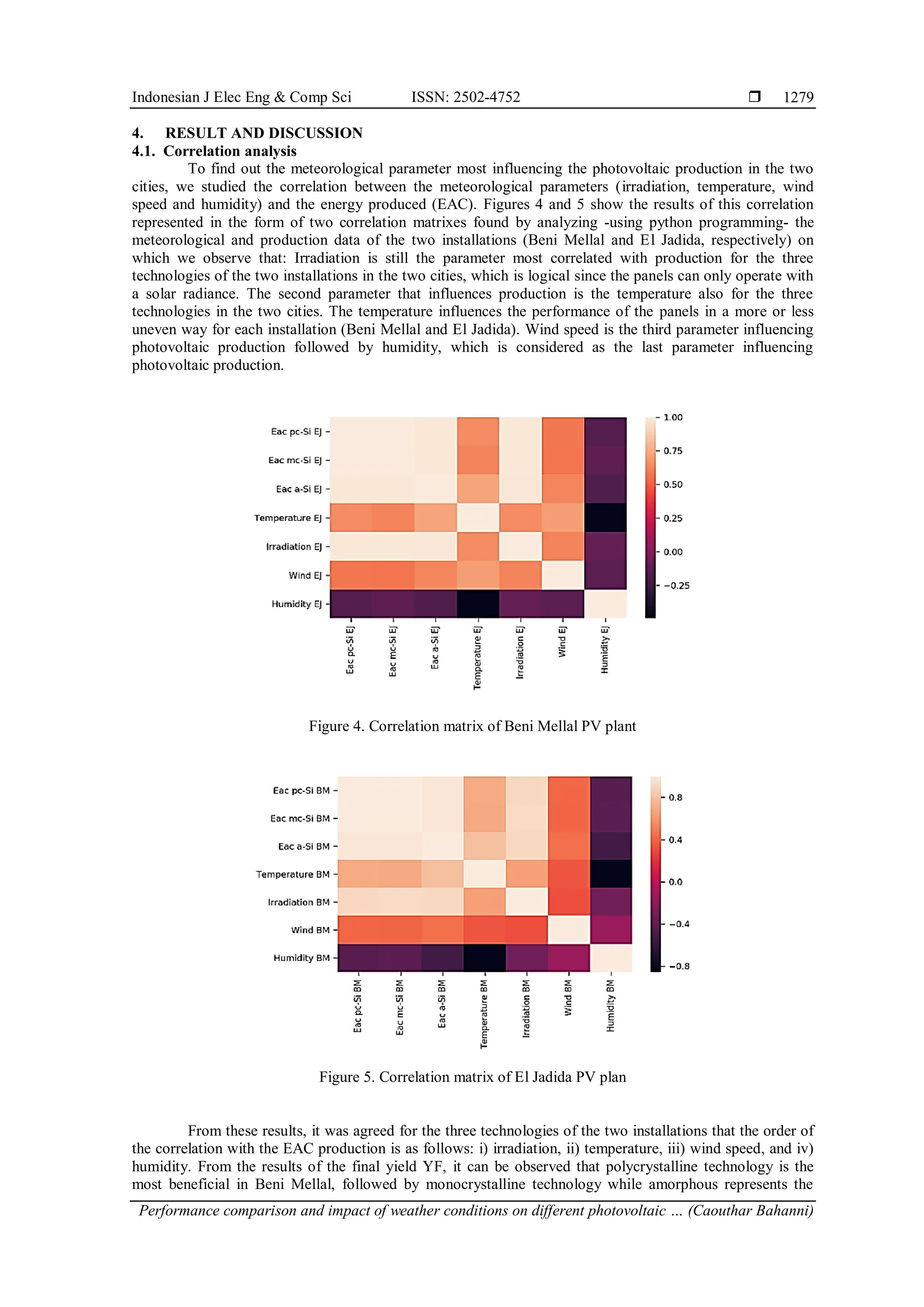
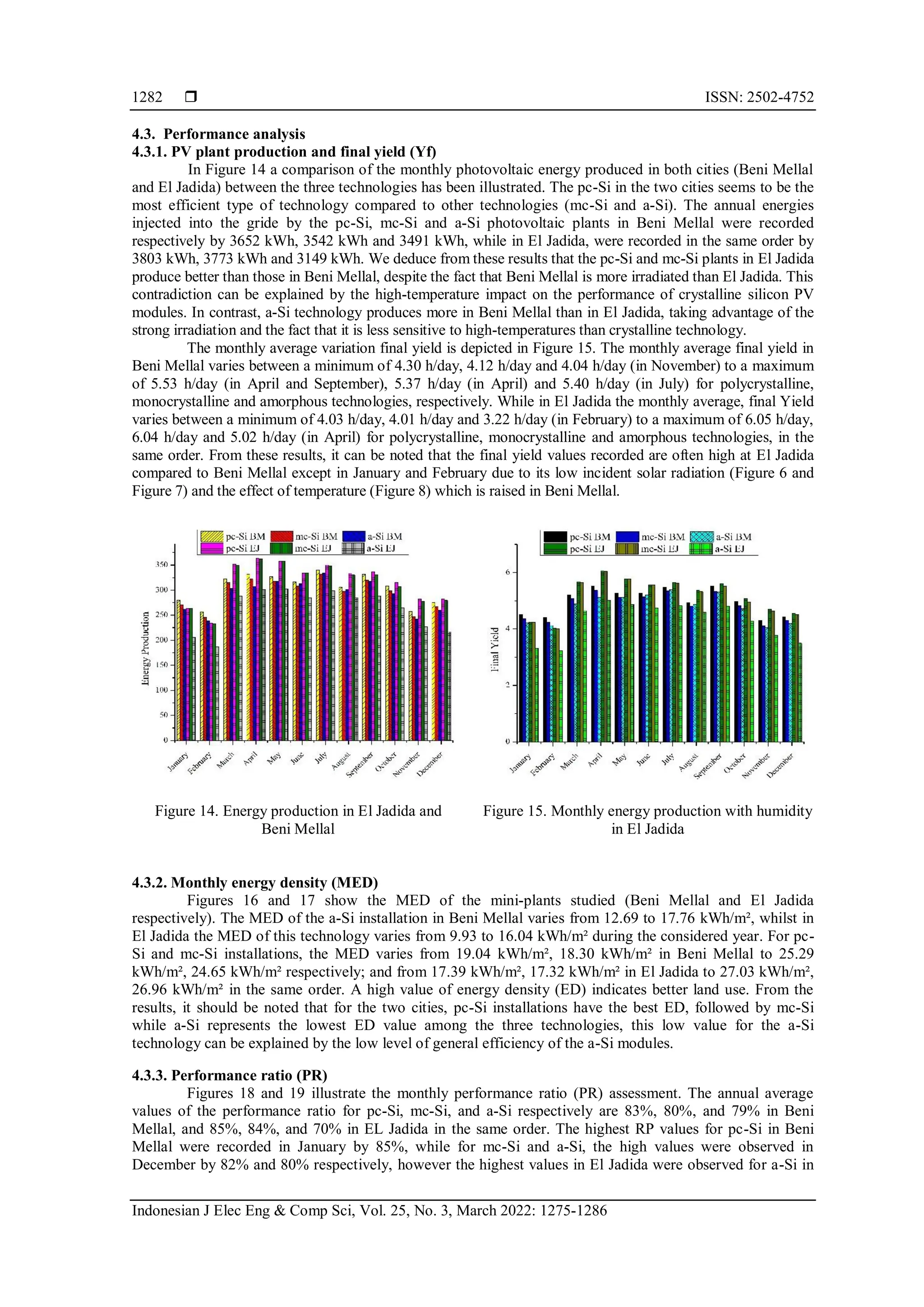
speed and humidity) and the energy produced (EAC). Figures 4 and 5 show the results of this correlation
represented in the form of two correlation matrixes found by analyzing -using python programming- the
meteorological and production data of the two installations (Beni Mellal and El Jadida, respectively) on
which we observe that: Irradiation is still the parameter most correlated with production for the three
technologies of the two installations in the two cities, which is logical since the panels can only operate with
a solar radiance. The second parameter that influences production is the temperature also for the three
technologies in the two cities. The temperature influences the performance of the panels in a more or less
uneven way for each installation (Beni Mellal and El Jadida). Wind speed is the third parameter influencing
photovoltaic production followed by humidity, which is considered as the last parameter influencing
photovoltaic production.
Figure 4. Correlation matrix of Beni Mellal PV plant
Figure 5. Correlation matrix of El Jadida PV plan
From these results, it was agreed for the three technologies of the two installations that the order of
the correlation with the EAC production is as follows: i) irradiation, ii) temperature, iii) wind speed, and iv)
humidity. From the results of the final yield YF, it can be observed that polycrystalline technology is the
most beneficial in Beni Mellal, followed by monocrystalline technology while amorphous represents the
 ISSN: 2502-4752
Indonesian J Elec Eng & Comp Sci, Vol. 25, No. 3, March 2022: 1275-1286
1280
leastefficient technology among those three. These results briefly explain the order of the correlation between
the energy produced EAC of the three technologies and irradiation. Indeed, irradiation represents the first
factor influencing the production of electricity by PV panels [29], although it is obvious that it is the first
parameter correlated with PV production, that is to say, it is obviously logical that there will be a decrease in
PV production with the decrease in irradiation and vice versa. Indeed, temperature is the second parameter
that influences PV production for the three technologies. From the results we see that the ambient
temperature induces a noticeable effect on the photovoltaic production, this is explained by the great
influence of the ambient temperature on the panels temperature and therefore of the photovoltaic cells. In
fact, it appears that more the temperature of the cell increases, more the power of the latter decreases,
because the temperature of a photovoltaic cell affects its voltage and the power of the cell being equal to the
product of the current and the voltage. On top of that, the wind speed is considered as the third parameter that
influences photovoltaic production. Although the wind speed does not have a big influence on the
production, but it has a more or less important role in the cooling of solar panels and therefore the
improvement of the production. Lastly, we can observe that the increase in the air humidity rate generates
frequent cloud cover formation and lasting, thus, making the control of the electricity production by solar
panels delicate and more difficult, nevertheless this influence is not crucial, which make humidity turns out to
be the last parameter that influences photovoltaic production.
4.2. Impact of weather conditions
4.2.1. Irradiation
Figures 6 and 7 represent the impact of irradiation on the photovoltaic production of the three
technologies in the two cities (Beni Mellal and El Jadida) respectively. The results show that the irradiation
always follows the same behavior of the PV production for the three technologies, this shows the great
irradiation impact on the PV production, and however, the pc-Si technology represents the technology most
influenced by the irradiation while the a-Si is the least influenced in the two installations.
Figure 6. Monthly solar irradiation with monthly
energy production in Beni Mellal
Figure 7. Monthly solar irradiation with monthly
energy production in El Jadida
4.2.2. Temperature
Figures 8 and 9 show the influence of temperature on the photovoltaic production of mc-Si, pc-Si
and a-Si technologies in Beni Mellal and El Jadida respectively, in both figures we observe an inverse
behavior of temperature with respect to production photovoltaic, because the rise in temperature always
coincides with the decrease in production and vice versa.
4.2.3. Wind
The Figures 10 and 11 represent the impact of wind speed on photovoltaic production in Beni Mellal
and El Jadida [29] respectively. It is outstanding that most of the time the curve of the wind speed follows the
same path as those of the production of the three technologies in the two cities, this explains the proportional
correlation of the wind speed with the photovoltaic production for the three technologies under the two
antagonistic climatic conditions.
Indonesian J Elec Eng & Comp Sci ISSN: 2502-4752 
Performance comparison and impact of weather conditions on different photovoltaic … (Caouthar Bahanni)
1281
Figure 8. Monthly energy production with
temperature in Beni Mellal
Figure 9. Monthly energy production with
temperature in El Jadida
Figure 10. Monthly energy production with wind
speed in Beni Mellal
Figure 11. Monthly energy production with wind
speed in El Jadida
4.2.4. Humidity
Figures 12 and 13 show the impact of humidity on photovoltaic production in Beni Mellal and El
Jadida [29] respectively. The results depicted in the figures show that the humidity has an inversely
proportional relation with the production of the solar panels for the three technologies in both locations since
it generates cloud covers, as well as generates water grains under the glass of the panels which avoid sunlight
to reach solar cells.
Figure 12. Monthly energy production with humidity
in Beni Mellal
Figure 13. Monthly energy production with humidity
in El Jadida
 ISSN: 2502-4752
Indonesian J Elec Eng & Comp Sci, Vol. 25, No. 3, March 2022: 1275-1286
1282
4.3. Performance analysis
4.3.1. PV plant production and final yield (Yf)
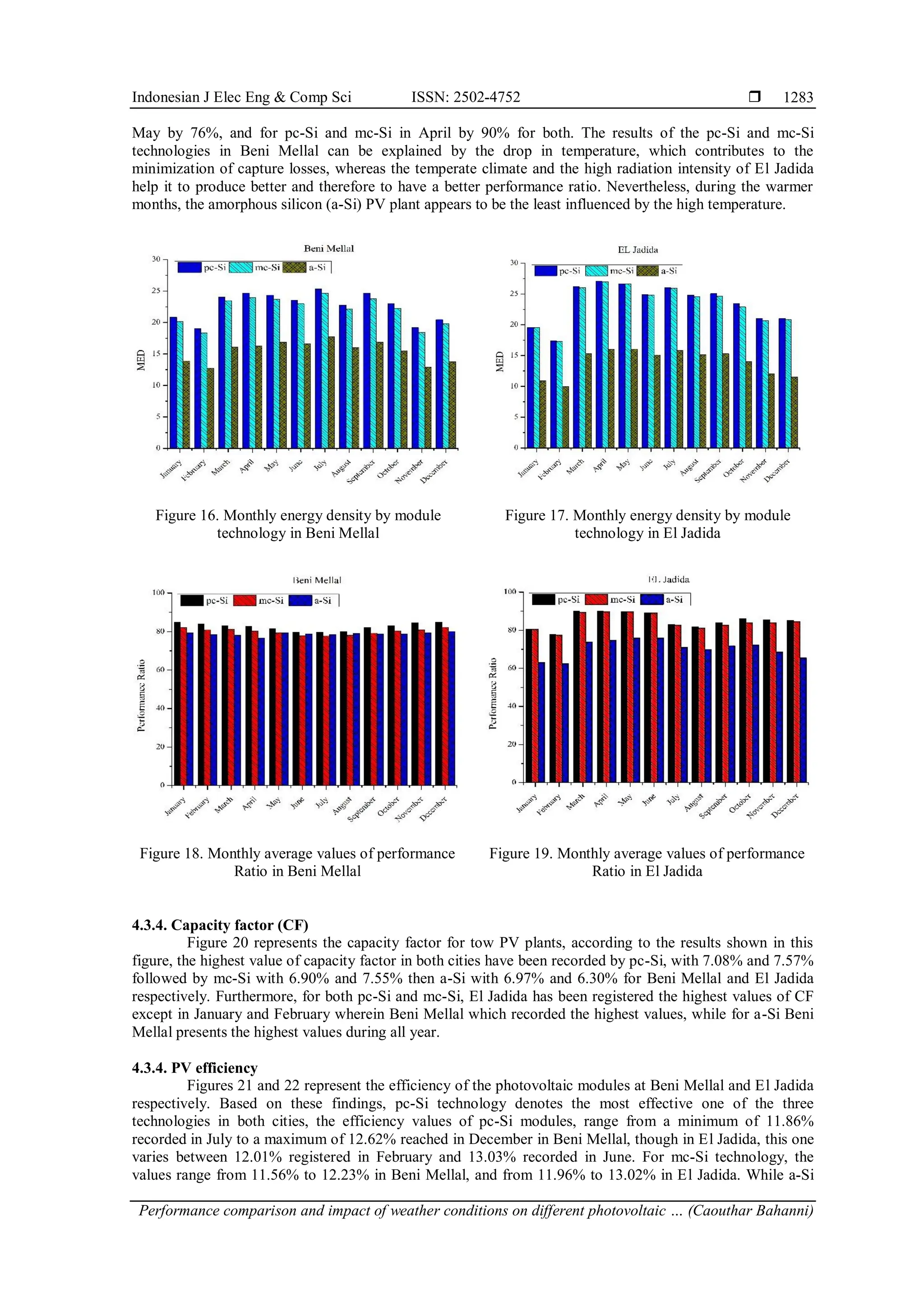
In Figure 14 a comparison of the monthly photovoltaic energy produced in both cities (Beni Mellal
and El Jadida) between the three technologies has been illustrated. The pc-Si in the two cities seems to be the
most efficient type of technology compared to other technologies (mc-Si and a-Si). The annual energies
injected into the gride by the pc-Si, mc-Si and a-Si photovoltaic plants in Beni Mellal were recorded
respectively by 3652 kWh, 3542 kWh and 3491 kWh, while in El Jadida, were recorded in the same order by
3803 kWh, 3773 kWh and 3149 kWh. We deduce from these results that the pc-Si and mc-Si plants in El Jadida
produce better than those in Beni Mellal, despite the fact that Beni Mellal is more irradiated than El Jadida. This
contradiction can be explained by the high-temperature impact on the performance of crystalline silicon PV
modules. In contrast, a-Si technology produces more in Beni Mellal than in El Jadida, taking advantage of the
strong irradiation and the fact that it is less sensitive to high-temperatures than crystalline technology.
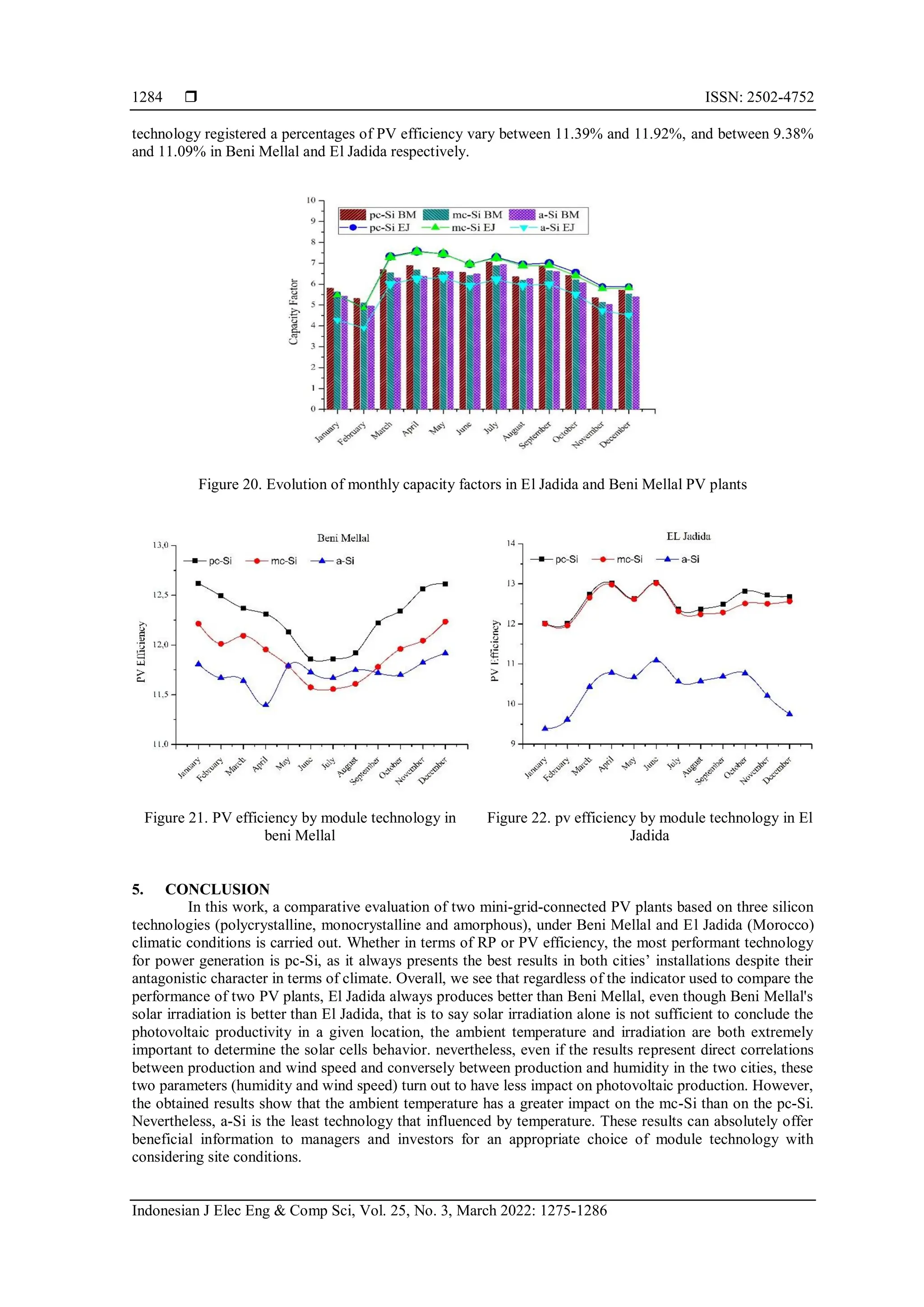
The monthly average variation final yield is depicted in Figure 15. The monthly average final yield in
Beni Mellal varies between a minimum of 4.30 h/day, 4.12 h/day and 4.04 h/day (in November) to a maximum
of 5.53 h/day (in April and September), 5.37 h/day (in April) and 5.40 h/day (in July) for polycrystalline,
monocrystalline and amorphous technologies, respectively. While in El Jadida the monthly average, final Yield
varies between a minimum of 4.03 h/day, 4.01 h/day and 3.22 h/day (in February) to a maximum of 6.05 h/day,
6.04 h/day and 5.02 h/day (in April) for polycrystalline, monocrystalline and amorphous technologies, in the
same order. From these results, it can be noted that the final yield values recorded are often high at El Jadida
compared to Beni Mellal except in January and February due to its low incident solar radiation (Figure 6 and
Figure 7) and the effect of temperature (Figure 8) which is raised in Beni Mellal.
Figure 14. Energy production in El Jadida and
Beni Mellal
Figure 15. Monthly energy production with humidity
in El Jadida
4.3.2. Monthly energy density (MED)
Figures 16 and 17 show the MED of the mini-plants studied (Beni Mellal and El Jadida
respectively). The MED of the a-Si installation in Beni Mellal varies from 12.69 to 17.76 kWh/m², whilst in
El Jadida the MED of this technology varies from 9.93 to 16.04 kWh/m² during the considered year. For pc-
Si and mc-Si installations, the MED varies from 19.04 kWh/m², 18.30 kWh/m² in Beni Mellal to 25.29
kWh/m², 24.65 kWh/m² respectively; and from 17.39 kWh/m², 17.32 kWh/m² in El Jadida to 27.03 kWh/m²,
26.96 kWh/m² in the same order. A high value of energy density (ED) indicates better land use. From the
results, it should be noted that for the two cities, pc-Si installations have the best ED, followed by mc-Si
while a-Si represents the lowest ED value among the three technologies, this low value for the a-Si
technology can be explained by the low level of general efficiency of the a-Si modules.
4.3.3. Performance ratio (PR)
Figures 18 and 19 illustrate the monthly performance ratio (PR) assessment. The annual average
values of the performance ratio for pc-Si, mc-Si, and a-Si respectively are 83%, 80%, and 79% in Beni
Mellal, and 85%, 84%, and 70% in EL Jadida in the same order. The highest RP values for pc-Si in Beni
Mellal were recorded in January by 85%, while for mc-Si and a-Si, the high values were observed in
December by 82% and 80% respectively, however the highest values in El Jadida were observed for a-Si in
Indonesian J Elec Eng & Comp Sci ISSN: 2502-4752 
Performance comparison and impact of weather conditions on different photovoltaic … (Caouthar Bahanni)
1283
May by 76%, and for pc-Si and mc-Si in April by 90% for both. The results of the pc-Si and mc-Si
technologies in Beni Mellal can be explained by the drop in temperature, which contributes to the
minimization of capture losses, whereas the temperate climate and the high radiation intensity of El Jadida
help it to produce better and therefore to have a better performance ratio. Nevertheless, during the warmer
months, the amorphous silicon (a-Si) PV plant appears to be the least influenced by the high temperature.
Figure 16. Monthly energy density by module
technology in Beni Mellal
Figure 17. Monthly energy density by module
technology in El Jadida
Figure 18. Monthly average values of performance
Ratio in Beni Mellal
Figure 19. Monthly average values of performance
Ratio in El Jadida
4.3.4. Capacity factor (CF)
Figure 20 represents the capacity factor for tow PV plants, according to the results shown in this
figure, the highest value of capacity factor in both cities have been recorded by pc-Si, with 7.08% and 7.57%
followed by mc-Si with 6.90% and 7.55% then a-Si with 6.97% and 6.30% for Beni Mellal and El Jadida
respectively. Furthermore, for both pc-Si and mc-Si, El Jadida has been registered the highest values of CF
except in January and February wherein Beni Mellal which recorded the highest values, while for a-Si Beni
Mellal presents the highest values during all year.
4.3.4. PV efficiency
Figures 21 and 22 represent the efficiency of the photovoltaic modules at Beni Mellal and El Jadida
respectively. Based on these findings, pc-Si technology denotes the most effective one of the three
technologies in both cities, the efficiency values of pc-Si modules, range from a minimum of 11.86%
recorded in July to a maximum of 12.62% reached in December in Beni Mellal, though in El Jadida, this one
varies between 12.01% registered in February and 13.03% recorded in June. For mc-Si technology, the
values range from 11.56% to 12.23% in Beni Mellal, and from 11.96% to 13.02% in El Jadida. While a-Si
 ISSN: 2502-4752
Indonesian J Elec Eng & Comp Sci, Vol. 25, No. 3, March 2022: 1275-1286
1284
technology registered a percentages of PV efficiency vary between 11.39% and 11.92%, and between 9.38%
and 11.09% in Beni Mellal and El Jadida respectively.
Figure 20. Evolution of monthly capacity factors in El Jadida and Beni Mellal PV plants
Figure 21. PV efficiency by module technology in
beni Mellal
Figure 22. pv efficiency by module technology in El
Jadida
5. CONCLUSION
In this work, a comparative evaluation of two mini-grid-connected PV plants based on three silicon
technologies (polycrystalline, monocrystalline and amorphous), under Beni Mellal and El Jadida (Morocco)
climatic conditions is carried out. Whether in terms of RP or PV efficiency, the most performant technology
for power generation is pc-Si, as it always presents the best results in both cities’ installations despite their
antagonistic character in terms of climate. Overall, we see that regardless of the indicator used to compare the
performance of two PV plants, El Jadida always produces better than Beni Mellal, even though Beni Mellal's
solar irradiation is better than El Jadida, that is to say solar irradiation alone is not sufficient to conclude the
photovoltaic productivity in a given location, the ambient temperature and irradiation are both extremely
important to determine the solar cells behavior. nevertheless, even if the results represent direct correlations
between production and wind speed and conversely between production and humidity in the two cities, these
two parameters (humidity and wind speed) turn out to have less impact on photovoltaic production. However,
the obtained results show that the ambient temperature has a greater impact on the mc-Si than on the pc-Si.
Nevertheless, a-Si is the least technology that influenced by temperature. These results can absolutely offer
beneficial information to managers and investors for an appropriate choice of module technology with
considering site conditions.
Indonesian J Elec Eng & Comp Sci ISSN: 2502-4752 
Performance comparison and impact of weather conditions on different photovoltaic … (Caouthar Bahanni)
1285
REFERENCES
[1] C. Bahanni, M. Adar, S. Boulmrharj, M. Khaidar, and M. Mabrouki, “Analysis of weather impact on the yield of PV plants
installed in two antagonists cities in Morocco,” 2020 5th International Conference on Renewable Energies for Developing
Countries (REDEC), 2020, pp. 1-6, doi: 10.1109/REDEC49234.2020.9163841.
[2] P. Mints, Solar PV Supply and Demand 2018: Is this a crossroads for the PV Industry?, 2018. Accessed: Nov. 20, 2018. [Online].
Available:https://www.intersolarglobal.com/fileadmin/Intersolar-
Global/Webinars/North_America/20181120_Intersolar_North_America_Webinar_Solar_PV_Supply_and_Demand_2018_by_Paula_Min
ts.pdf
[3] E. Despotou, “Vision for photovoltaics in the future,” Comprehensive Renewable Energy, vol. 1, pp. 179-198, 2012, doi:
10.1016/B978-0-08-087872-0.00109-8.
[4] M. A. Green, K. Emery, Y. Hishikawa, W. Warta, and E. D. Dunlop, “Solar cell efficiency tables (version 40),” Progress in
photovoltaics, vol. 20, no. 5, pp. 606-614, 2012, doi: 10.1002/pip.2267.
[5] T. Huld, R. Gottschalg, H. G. Beyer, and M. Topič, “Mapping the performance of PV modules, effects of module type and data
averaging,” Solar Energy, vol. 84, no. 2, pp. 324–338, 2010, doi: 10.1016/j.solener.2009.12.002.
[6] B. M. Dawoud and S. C. Lim, “Performance comparison of fixed and single axis tracker photovoltaic system in large scale solar
power plants in Malaysia,” Indonesian Journal of Electrical Engineering and Computer Science, vol. 21, no. 1, pp. 10-17, 2021,
doi: 10.11591/ijeecs.v21.i1.pp10-17.
[7] M. N. Raj and J. Pasupuleti, “Performance assessment of a 619kW photovoltaic power plant in the northeast of peninsular
Malaysia,” Indonesian Journal of Electrical Engineering and Computer Science, vol. 20, no. 1, pp. 9-15, 2020, doi:
10.11591/ijeecs.v20.i1.pp9-15.
[8] A. M. Ates and H. Singh, “Rooftop solar Photovoltaic (PV) plant – performance analysis and critical evaluation,” Journal of King
Saud University - Science, vol. 33, no. 3, 2021, doi: 10.1016/j.jksus.2021.101361.
[9] I. Omar Nour-eddine, B. Lahcen, O. H. Fahd, B. Amin, and O. Aziz, “Outdoor performance analysis of different PV technologies
under hot semi-arid climate,” Energy Reports, vol. 6, no. 6, pp. 36-48, 2020, doi: 10.1016/j.egyr.2020.08.023.
[10] E. Roumpakias and A. Stamatelos, “Comparative performance analysis of grid-connected photovoltaic system by use of existing
performance models,” Energy Conversion and Management, vol. 150, pp. 14–25, 2017, doi: 10.1016/j.enconman.2017.08.001.
[11] M. E. H. Jed, R. Ihaddadene, N. Ihaddadene, C. E. E. Sidi, and M. E. Bah, “Performance analysis of 954,809 kWp PV array of
Sheikh Zayed solar power plant (Nouakchott, Mauritania),” Renewable Energy Focus, vol. 32, pp. 45-54, 2020, doi:
10.1016/j.ref.2019.11.002.
[12] M. Al-Addous, Z. Dalala, C. B. Class, F. Alawneh, and H. Al-Taani, “Performance analysis of off-grid PV systems in the Jordan
Valley,” Renewable Energy, vol. 113, pp. 930-941, 2017, doi: 10.1016/j.renene.2017.06.034.
[13] E. Elibol, Ö. T. Özmen, N. Tutkun, and O. Köysal, “Outdoor performance analysis of different PV panel types,” Renewable and
Sustainable Energy Reviews, vol. 67, pp. 651-661, 2017, doi: 10.1016/j.rser.2016.09.051.
[14] D. H. Daher, L. Gaillard, M. Amara, and C. Ménézo, “Impact of tropical desert maritime climate on the performance of a PV
grid-connected power plant,” Renewable Energy, vol. 125, pp. 729-737, 2018, doi: 10.1016/j.renene.2018.03.013.
[15] A. Haffaf, F. Lakdja, D. O. Abdeslam, and R. Meziane, “Monitoring, measured and simulated performance analysis of a 2.4 kWp
grid-connected PV system installed on the Mulhouse campus, France,” Energy for Sustainable Development, vol. 62, pp. 44-55,
2021, doi: 10.1016/J.ESD.2021.03.006.
[16] M. E. H. Dahmoun, B. Bekkouche, K. Sudhakar, M. Guezgouz, A. Chenafi, and A. Chaouch, “Performance evaluation and
analysis of grid-tied large scale PV plant in Algeria,” Energy for Sustainable Development, vol. 61, pp. 181-195, Apr. 2021, doi:
10.1016/j.esd.2021.02.004.
[17] A. Gopi, K. Sudhakar, W. K. Ngui, I. M. Kirpichnikova, and E. Cuce, “Energy analysis of utility-scale PV plant in the rain-
dominated tropical monsoon climates,” Case Studies in Thermal Engineering, vol. 26, Aug. 2021, doi:
10.1016/j.csite.2021.101123.
[18] P. Bevilacqua, R. Bruno, and N. Arcuri, “Comparing the performances of different cooling strategies to increase photovoltaic
electric performance in different meteorological conditions,” Energy, vol. 195, Mar. 2020, doi: 10.1016/j.energy.2020.116950.
[19] A. Ziane et al., “Photovoltaic output power performance assessment and forecasting: Impact of meteorological variables,” Solar
Energy, vol. 220, pp. 745-757, May 2021, doi: 10.1016/j.solener.2021.04.004.
[20] A. Murat Ates and H. Singh, “Rooftop solar Photovoltaic (PV) plant – One year measured performance and imulations,” Journal
of King Saud University - Science, vol. 33, no. 3, May 2021, doi: 10.1016/j.jksus.2021.101361.
[21] International Energy Agency, Energy Policies Beyond IEA Countries, 2019. Accessed: Apr. 14, 2021. [Online]. Available:
https://iea.blob.core.windows.net/assets/138e3195-d0e6-4345-a66c-92ebe4abbeaf/Energy_Policies_beyond_IEA_Countries_Morocco.pdf
[22] M. Adar, Y. Najih, M. Gouskir, A. Chebak, M. Mabrouki, and A. Bennouna, “Three PV plants performance analysis using the
principal component analysis method,” Energy, vol. 207, 2020, doi: 10.1016/j.energy.2020.118315.
[23] M. Adar, H. Bazine, Y. Najih, C. Bahanni, M. Mabrouki, and A. Chebak, “Simulation Study of three PV Systems,” 2018 6th
International Renewable and Sustainable Energy Conference (IRSEC), 2018, pp. 1-5, doi: 10.1109/IRSEC.2018.8702827.
[24] M. Adar, Z. Khaouch, M. Mabrouki, A. Benouna, and A. Chebak, “Performance Analysis of PV Grid-Connected in Fours Special
Months of the Year,” 2017 International Renewable and Sustainable Energy Conference (IRSEC), 2017, pp. 1-5, doi:
10.1109/IRSEC.2017.8477373.
[25] N. Erraissi, M. Raoufi, N. Aarich, M. Akhsassi, and A. Bennouna, “Implementation of a low-cost data acquisition system for
‘PROPRE.MA’ project,” Measurement, vol. 117, pp. 21-40, 2018, doi: 10.1016/j.measurement.2017.11.058.
[26] M. Kottek, J. Grieser, C. Beck, B. Rudolf, and F. Rubel, “World map of the Köppen-Geiger climate classification updated,”
Meteorologische Zeitschrift, vol. 15, no. 3, pp. 259-263, 2006, doi: 10.1127/0941-2948/2006/0130.
[27] Google Maps. Accessed Apr. 03, 2021. [Online]. Available: www.google.com/maps/@32.3772878,-
6.3187493,191m/data=!3m1!1e3
[28] Google Maps. Accessed Apr. 03, 2021. [Online]. Available: www.google.com/maps/@33.225388,-
8.4861296,186m/data=!3m1!1e3
[29] Global Modeling and Assimilation Office (GMAO), MERRA-2 tavg1_2d_slv_Nx: 2d,1-Hourly,Time-Averaged,Single-
Level,Assimilation,Single-Level Diagnostics V5.12.4, Greenbelt, MD, USA, Goddard Earth Sciences Data and Information
Services Center (GES DISC), 2015, doi: 10.5067/VJAFPLI1CSIV. Accessed: Mar. 04, 2021. [Online]. Available:
https://disc.gsfc.nasa.gov/datasets/M2T1NXSLV_5.12.4/summary
 ISSN: 2502-4752
Indonesian J Elec Eng & Comp Sci, Vol. 25, No. 3, March 2022: 1275-1286
1286
BIOGRAPHIES OF AUTHORS
Caouthar Bahanni received the license degree in mechanical engineering from
Hassan 1 university, Settat, Morocco, in 2015 and the master degree in mechanical production
technology from Abdelmalek Essaadi University, Tetouan, Morocco, in 2017. She is currently
PhD student in the Industriel Engineering Laboratory at University of Science and
Technology, Beni Mellal, Morocco. Her current research interests include artificial
intelligence in the field of photovoltaic solar energy and applications in PV plant installed in
the roof of the faculty by the team of PROPRE.MA project. She can be contacted at email:
Caouthar.bahanni@usms.ma.
Mustapha Adar is a Doctor in Materials and Energy from the Faculty of Science
and Technology of Sultan Moulay Slimane University, Morocco. He is a researcher in
renewable energy and material surface and interface engineering. Previously, he was a
contract professor of physics at the Polydisciplinary Faculty of Sultan Moulay Slimane
University. President of the USMS- Young Minds Section of the European Physical Society.
He can be contacted at email: adar.mustapha@gmail.com.
Sofia Boulmrharj is a post-doctoral researcher at the International University of
Rabat (UIR). She holds a PhD degree in Physics-Energetic from the Faculty of Sciences at
Chouaib Doukkali University in El Jadida in September 2020. Her PhD work was prepared at
UIR within the framework of MIGRID (USAID-PEER program, 2017-2020) and PROPRE
(IRESEN, 2013-2018) projects. She has published a number of papers in international peer-
reviewed journals, books, and conferences. Her main research focus is on the integration of
renewable energy sources and storage systems into smart micro-grids for buildings together
with their sizing and modeling. She has actively been working in the area of energy storage.
She can be contacted at email: sofia.boulmrharj@uir.ac.ma.
Mohammed Khaidar received PhD degree (Doctorat d’Etat ès-Sciences
Physiques) from the Cadi Ayyad University of Marrakech (UCA), Morocco, in 1989, and a
3rd cycle Doctorate form National Polytechnic Institute, INP-G, Grenoble/France, 1981.
Expert in EcoEnv (Environment Economy). Since 1981, he was Research - Teacher in Cadi
Ayyad University -Marrakech and Chouaib Doukkali University – El Jadida/Morocco. He was
supervisor of several PhD. He was initiator and manager of CUR’’EnR&SIE’’ (University
Research Center in Renewable Energies and Smart Systems for Energy -UCD), since its
creation in 2017 until 2019. He was coordinator GRIPAS – UCD (Interdisciplinary Research
group on Soil Preservation and Improvement) (1999-2002) and regional coordinator of
PROPRE (University research consortium for mapping photovoltaic productivity in Morocco)
(2013-2018). His research interests focused on the fields of material sciences, thin films and
renewable energies. Recently, he is conducting research in the fields of renewable energy
Integration into Smart Building, environmental sciences and precision agriculture. He can be
contacted at email: khaidar.medd@gmail.com.
Mustapha Mabrouki currently works at the Physics Department, University
Sultan Molay Slimane Faculty of Science and Technology, Beni Mellal, Morocco. He does
research in Smart grids and smart cities, Photovoltaic Materials Synthesis and Integration,
Phosphates and derivatives, Biotechnology and Microbiology. His current projects are i)
'PROPRE.MA'. Build photovoltaic yield maps of grid connected mono, poly and amorphous
PV modules for all Morocco with land calibration on 20 identical plants. ii) AFM project, iii)
Phosphate project, iv) Solar Decathlon Africa competition. He can be contacted at email:
mus_mabrouki@yahoo.com.

Performance comparison and impact of weather conditions on different photovoltaic modules in two different cities

  • 1.
    Indonesian Journal ofElectrical Engineering and Computer Science Vol. 25, No. 3, March 2022, pp. 1275~1286 ISSN: 2502-4752, DOI: 10.11591/ijeecs.v25.i3.pp1275-1286  1275 Journal homepage: http://ijeecs.iaescore.com Performance comparison and impact of weather conditions on different photovoltaic modules in two different cities Caouthar Bahanni1 , Mustapha Adar1 , Sofia Boulmrharj2 , Mohammed Khaidar2 , Mustapha Mabrouki1 1 Industrial Engineering Laboratory, Faculty of Sciences and Technologies, Sultan Moulay Slimane University, Beni Mellal, Morocco 2 CUR’’EnR&SIE’’, Faculty of Sciences El Jadida, Chouaib Doukkali University, El Jadida, Morocco Article Info ABSTRACT Article history: Received Jul 2, 2021 Revised Jan 4, 2022 Accepted Jan 19, 2022 This work is based on a comparative study of the impact of meteorological conditions as well as the assessment of the production performance of two identical photovoltaic stations installed in two Moroccan cities, the stations are based on three different technologies. The measures of one year of operation from January 2017 to December 2017 were evaluated. The annual average performance ratios were found to be 82.42%, 79.99% and 78.74% in Beni Mellal, and 85.29%, 84.61% and 70.41% in El Jadida for the polycrystalline (pc-Si), monocrystalline (mc-Si), and amorphous (a-Si) respectively. The photovoltaic efficiency was calculated at 12.24%, 11.89%, and 11.71% in Beni Mellal; and 12.59%, 12.49%, and 10.42% in El Jadida by the same order. Statistical analysis was carried out to establish the correlation with photovoltaic (PV) production showed that after irradiation, the temperature is the most influencing meteorological factor for PV production, revealing a degradation in the performance ratio of 2.5%, 2%, and 1% for each increase of 8 °C in temperature for monocrystalline, polycrystalline and amorphous technologies respectively at Beni Mellal. While at El Jadida the reduction in the performance ratio is evaluated by 5.5%, 5.2%, and 3% for each 8 °C increase in temperature for the same order. Keywords: Performance analysis photovoltaic silicon technologies PV efficiency PV system Weather conditions impact This is an open access article under the CC BY-SA license. Corresponding Author: Bahanni Caouthar Industrial Engineering Laboratory, Faculty of Sciences and Technologies Sultan Moulay Slimane University Mghila Campus, BP 523, 23000, Beni Mellal, Morocco Email: Caouthar.bahanni@usms.ma 1. INTRODUCTION Solar energy in Morocco is a critical economic subject consistent with sustainable development. The risks are consequently doubly high, agreed with the unrestrained growth in the costs of traditional energies, which are having a negative influence on the environment. With 3,000 hours of sunshine per year and an average irradiation of more than 5 kWh/m², Morocco has considerable solar potential. The country intends to massively take advantage of this clean and inexhaustible energy. It is increasingly asserting itself as an investment destination in the clean energy sector. In this logic the project "Propre.ma" thrown, is an ambitious program at a national scale financed by research institute for solar energy and new energies (IRESEN), linking all the Moroccan public universities in 20 cities for the development of a mapping of the photovoltaic producible in Morocco. Currently, research in the arena of photovoltaic solar energy is increasingly dynamic. Besides, most studies focus on refining the conversion of solar radiation into electrical energy [1]. In general, there are several technologies of photovoltaic cells, the most dominant by 97% in the world in 2018 [2], and which represents the best
  • 2.
     ISSN: 2502-4752 IndonesianJ Elec Eng & Comp Sci, Vol. 25, No. 3, March 2022: 1275-1286 1276 performance is that based on crystalline silicon, barely the amorphous silicon which is part of the thin films becomes more and more competitive with crystalline silicon under certain weather conditions (more details on photovoltaic technologies in [3]). The environmental conditions under which the photovoltaic modules are called upon to operate in real conditions (temperature, humidity, wind, irradiation, and dust) must be taken into account given their crucial impact on photovoltaic production [1], [4], [5]. Particularly in Morocco, which is characterized by a climate conditions placing the photovoltaic systems during their most operating time outside the standard test conditions (STC): corresponding to a temperature of 25 °C and sunshine of 1000 W/m2 ; consequently, this makes the evolution of the performance of modules increasingly problematic. For this purpose, several works have taken this sense of study to always remind us to pose this issue [6]-[8]. Nour-eddine et al. [9] worked on the same kind of our present work on a PV installation similar to those used here, all within the framework of the “Propre.ma” project; The results showed that the performance ratio of p-Si (polycrystalline) technology is higher compared to that of m-Si (monocrystalline) technology during the hottest months of the year, which explains the impact of temperature on the PV production. Roumpakias and Stamatelos [10] studied the deterioration of PV efficiency and deviations from STC conditions, using data from a grid-connected photovoltaic park of 99.84 kWp in central Greece. This study was performed for a three-year period (from 2013 to 2015). The results extracted from these studies showed that the efficiency of PV modules during the two primary years was found to be higher than the STC conditions, while during the third year, a slight decrease in efficiency compared to the STC conditions has been registered. However, the behavior of PV efficiency decreases over time. Jed et al. [11] presented a performance assessment of a 954,809 kWp photovoltaic plant of micro-amorphous silicon situated in Nouakchott, using one-year data of operation from September 2014 to August 2015, the authors find as results that the photovoltaic array performances rest on both illumination and climatic conditions, whilst wind speed variation does not influence those energies. Al-Addous et al. [12] presented a performance evaluation work of an off-grid PV system in Jordan valley in which a four-year historical meteorological database was used for the development of a model to estimate the effect of temperature on electricity production. Indeed, with prior knowledge of the site which is characterized by a high temperature, the results denote that the PV efficiency is strongly affected by the increase in temperature, and thanks to a cooling system, the authors observed a nearly 2% improvement in efficiency in different radiation modalities. Elibol et al. [13] applied performance tests on a PV plant installed on the roof of the scientific and technological research and application center of Düzce University (DUBİT) in Düzce province, Turkey. Among these tests, the authors carried out an examination of the variations of the panels energy conversion efficiency according to the temperature; the results of this examination showed that when increasing the temperature by 1 °C the efficiency of pc-Si and a-Si technology increases by 0.033% and 0.029% respectively, while the efficiency of mc-Si technology decreases by 0.084%. Daher et al. [14] presented a research work in which the impact of tropical desert maritime climate on the performance of a PV grid-connected power plant was analyzed, the results show that the average PR for PV arrays and the global grid-connected system was found to be 90% and 84% respectively, while the monthly average daily PV module efficiencies of 12.68%. from these results, the authors deduce that the ambient temperature has an impact on the performance ratio, estimated by a decrease of 0.7% for each increase of 1 °C in the daily ambient temperature. In the literature many works are used performance indicators such as performance ratio, capacity factor, final yield to analyze the performance of PV plants [15]-[17]. Other analyzed the impact of meteorological conditions in their PV plant [18]-[20]. This paper aims to compare the evaluation of energy performance and to analyze. The impact of environmental conditions on monocrystalline, polycrystalline, and amorphous photovoltaic modules under the climate of Beni Mellal and El Jadida cities (in Morocco). This performance analysis is made up based on the international energy agency norms (IEA) [21]. 2. PV PLANT DESCRIPTION The photovoltaic plants of Beni Mellal and El Jadida were installed on the rooftop of the Faculty of Sciences and Techniques shown in Figure 1 and the Faculty of Science shown in Figure 2 respectively. Each station generates in totality 6 KWp where 2 kWp produced by each silicon technology (monocrystalline (mc- Si), polycrystalline (pc-Si) and amorphous (a-Si)). All descriptions of the plants will be found in [1], [22]-[24]. In addition to the photovoltaic system, the plants also consist of similar weather stations in each city described briefly in [25].
  • 3.
    Indonesian J ElecEng & Comp Sci ISSN: 2502-4752  Performance comparison and impact of weather conditions on different photovoltaic … (Caouthar Bahanni) 1277 Figure 1. Beni Mellal PV plant Figure 2. El Jadida PV plant 2.1. Site of PV plants Table 1 summarizes the geographical coordinates and the value of certain meteorological parameters of the two different cities where the photovoltaic installations are located. Beni Mellal city has a very hot dry climate in summer and very cool in winter, while El Jadida is characterized by a Mediterranean climate that is also hot in summer and cool in winter. According to the Koppen-Geiger classification [26], the climates of both cities (Beni Mellal and El Jadida) are classified as Csa type. However, by comparing the average temperatures of the two cities we see that Beni Mellal has a very hot climate in summer and also very cool in winter compared to El Jadida which will influence the production yield in both locations. Figure 3 shows the Moroccan map with the geographic locations of PV plants in the cities of Beni Mellal and El Jadida [27], [28]. Table 1. Geographic coordinates, mean temperature and global horizontal irradiation of cities Beni Mellal El Jadida Beni Mellal Latitude 32°20’ North 33°14’ North Longitude 6°21’ West 8°30’ West Average temperature 23,47 21,67 Overall horizontal Irradiation (kWh/m2 /year) 2392,87 2268,81 Figure 3. Moroccan map with geographic locations of the PV plants 3. PERFORMANCE INDICATORS 3.1. Energy production Monthly energy production is the amount of energy that a PV system can produce in each month of the year. It is considered as the main parameter in the performance evaluation of PV systems. This parameter is also used to assess the degradation of PV modules. 3.2. The reference yield (Yr) The reference yield Yr is the total solar radiation in the plane Ht (kWh/m2) divided by the PV’s reference irradiance G0 (kW/m2). It represents the number of hours of which the illumination is equivalent to the reference irradiance. The Yr defines the solar resource for the PV system. It depends on several criteria such as the orientation of the photovoltaic modules, the location, and variability of weather conditions depending on the time.
  • 4.
     ISSN: 2502-4752 IndonesianJ Elec Eng & Comp Sci, Vol. 25, No. 3, March 2022: 1275-1286 1278 Yr = Ht G0 (1) 3.3. The final yield (Yf) The final yield of the PV system Yf, is the net energy Eg (kWh) produced by the PV system, divided by the nominal power P0 (kWp) of the installed photovoltaic module. This quantity represents the number of hours during which the photovoltaic system operate at its nominal power. Reads as (2). Yf = EDC P0 (2) 3.4. Performance ratio The performance ratio (PR), is an essential parameter to assess the quality of the PV installation; it makes it possible to quantify the performance of the photovoltaic installations. It shows the relationship between theoretical energy and real energy generated by a PV system. The performance ratio is a number between 0 and 100% (or 0 and 1). The closer it is to 100% (or to 1), the more efficient the installation is, from an electrical point of view. Considering that every photovoltaic installation is unique while losses cannot be avoided, an installation with a performance ratio of up to 80% is considered to be a high- performance PV installation. The PR is expressed as (3). PR = Yf Yr (3) 3.5. Array yield (Ya) The array yield, defined as the ratio between the total energy produced by the photovoltaic generator (EDC) during a distinct period (day, month or year), and the nominal power of the PV system P0. It represents the number of hours during which the PV panel needs to operate at its nominal power. The (Ya) is expressed as (4). Ya = EDC P0 (4) 3.6. Energy density The energy density (ED), is an indicator used in the choice of solar photovoltaic technologies. ED represents the energy produced by a solar photovoltaic system in a period of time (month and year) per unit area of modules [21]. It is measured to be aware of the optimization of the space available for electricity production by the PV plant. ED = EDC Am (5) Am: is the total area of the module plane. 3.7. Capacity factor The capacity factor CF, is an indicator measured to represent the energy generated by a PV system. It is defined as the ratio of actual monthly energy output to the quantity of energy the PV system can deliver at its rated capacity for 24h per day during the month. The CF is expressed as (6). CF = Yf (monthly) 24h∗N (6) N: Number of days during each month. 3.8. PV efficiency PV efficiency remains the efficient energy produced by a PV module in terms of available radiation, it tells us how effective a solar panel is in transforming irradiance into useful electricity through the photovoltaic effect. PV efficiency described as the ratio of the energy production to the product of the surface area and the irradiation received on the surface of the PV modules. The PV is expressed as (7). hpv = EDC Am∗Ht (7)
  • 5.
    Indonesian J ElecEng & Comp Sci ISSN: 2502-4752  Performance comparison and impact of weather conditions on different photovoltaic … (Caouthar Bahanni) 1279 4. RESULT AND DISCUSSION 4.1. Correlation analysis To find out the meteorological parameter most influencing the photovoltaic production in the two cities, we studied the correlation between the meteorological parameters (irradiation, temperature, wind speed and humidity) and the energy produced (EAC). Figures 4 and 5 show the results of this correlation represented in the form of two correlation matrixes found by analyzing -using python programming- the meteorological and production data of the two installations (Beni Mellal and El Jadida, respectively) on which we observe that: Irradiation is still the parameter most correlated with production for the three technologies of the two installations in the two cities, which is logical since the panels can only operate with a solar radiance. The second parameter that influences production is the temperature also for the three technologies in the two cities. The temperature influences the performance of the panels in a more or less uneven way for each installation (Beni Mellal and El Jadida). Wind speed is the third parameter influencing photovoltaic production followed by humidity, which is considered as the last parameter influencing photovoltaic production. Figure 4. Correlation matrix of Beni Mellal PV plant Figure 5. Correlation matrix of El Jadida PV plan From these results, it was agreed for the three technologies of the two installations that the order of the correlation with the EAC production is as follows: i) irradiation, ii) temperature, iii) wind speed, and iv) humidity. From the results of the final yield YF, it can be observed that polycrystalline technology is the most beneficial in Beni Mellal, followed by monocrystalline technology while amorphous represents the
  • 6.
     ISSN: 2502-4752 IndonesianJ Elec Eng & Comp Sci, Vol. 25, No. 3, March 2022: 1275-1286 1280 leastefficient technology among those three. These results briefly explain the order of the correlation between the energy produced EAC of the three technologies and irradiation. Indeed, irradiation represents the first factor influencing the production of electricity by PV panels [29], although it is obvious that it is the first parameter correlated with PV production, that is to say, it is obviously logical that there will be a decrease in PV production with the decrease in irradiation and vice versa. Indeed, temperature is the second parameter that influences PV production for the three technologies. From the results we see that the ambient temperature induces a noticeable effect on the photovoltaic production, this is explained by the great influence of the ambient temperature on the panels temperature and therefore of the photovoltaic cells. In fact, it appears that more the temperature of the cell increases, more the power of the latter decreases, because the temperature of a photovoltaic cell affects its voltage and the power of the cell being equal to the product of the current and the voltage. On top of that, the wind speed is considered as the third parameter that influences photovoltaic production. Although the wind speed does not have a big influence on the production, but it has a more or less important role in the cooling of solar panels and therefore the improvement of the production. Lastly, we can observe that the increase in the air humidity rate generates frequent cloud cover formation and lasting, thus, making the control of the electricity production by solar panels delicate and more difficult, nevertheless this influence is not crucial, which make humidity turns out to be the last parameter that influences photovoltaic production. 4.2. Impact of weather conditions 4.2.1. Irradiation Figures 6 and 7 represent the impact of irradiation on the photovoltaic production of the three technologies in the two cities (Beni Mellal and El Jadida) respectively. The results show that the irradiation always follows the same behavior of the PV production for the three technologies, this shows the great irradiation impact on the PV production, and however, the pc-Si technology represents the technology most influenced by the irradiation while the a-Si is the least influenced in the two installations. Figure 6. Monthly solar irradiation with monthly energy production in Beni Mellal Figure 7. Monthly solar irradiation with monthly energy production in El Jadida 4.2.2. Temperature Figures 8 and 9 show the influence of temperature on the photovoltaic production of mc-Si, pc-Si and a-Si technologies in Beni Mellal and El Jadida respectively, in both figures we observe an inverse behavior of temperature with respect to production photovoltaic, because the rise in temperature always coincides with the decrease in production and vice versa. 4.2.3. Wind The Figures 10 and 11 represent the impact of wind speed on photovoltaic production in Beni Mellal and El Jadida [29] respectively. It is outstanding that most of the time the curve of the wind speed follows the same path as those of the production of the three technologies in the two cities, this explains the proportional correlation of the wind speed with the photovoltaic production for the three technologies under the two antagonistic climatic conditions.
  • 7.
    Indonesian J ElecEng & Comp Sci ISSN: 2502-4752  Performance comparison and impact of weather conditions on different photovoltaic … (Caouthar Bahanni) 1281 Figure 8. Monthly energy production with temperature in Beni Mellal Figure 9. Monthly energy production with temperature in El Jadida Figure 10. Monthly energy production with wind speed in Beni Mellal Figure 11. Monthly energy production with wind speed in El Jadida 4.2.4. Humidity Figures 12 and 13 show the impact of humidity on photovoltaic production in Beni Mellal and El Jadida [29] respectively. The results depicted in the figures show that the humidity has an inversely proportional relation with the production of the solar panels for the three technologies in both locations since it generates cloud covers, as well as generates water grains under the glass of the panels which avoid sunlight to reach solar cells. Figure 12. Monthly energy production with humidity in Beni Mellal Figure 13. Monthly energy production with humidity in El Jadida
  • 8.
     ISSN: 2502-4752 IndonesianJ Elec Eng & Comp Sci, Vol. 25, No. 3, March 2022: 1275-1286 1282 4.3. Performance analysis 4.3.1. PV plant production and final yield (Yf) In Figure 14 a comparison of the monthly photovoltaic energy produced in both cities (Beni Mellal and El Jadida) between the three technologies has been illustrated. The pc-Si in the two cities seems to be the most efficient type of technology compared to other technologies (mc-Si and a-Si). The annual energies injected into the gride by the pc-Si, mc-Si and a-Si photovoltaic plants in Beni Mellal were recorded respectively by 3652 kWh, 3542 kWh and 3491 kWh, while in El Jadida, were recorded in the same order by 3803 kWh, 3773 kWh and 3149 kWh. We deduce from these results that the pc-Si and mc-Si plants in El Jadida produce better than those in Beni Mellal, despite the fact that Beni Mellal is more irradiated than El Jadida. This contradiction can be explained by the high-temperature impact on the performance of crystalline silicon PV modules. In contrast, a-Si technology produces more in Beni Mellal than in El Jadida, taking advantage of the strong irradiation and the fact that it is less sensitive to high-temperatures than crystalline technology. The monthly average variation final yield is depicted in Figure 15. The monthly average final yield in Beni Mellal varies between a minimum of 4.30 h/day, 4.12 h/day and 4.04 h/day (in November) to a maximum of 5.53 h/day (in April and September), 5.37 h/day (in April) and 5.40 h/day (in July) for polycrystalline, monocrystalline and amorphous technologies, respectively. While in El Jadida the monthly average, final Yield varies between a minimum of 4.03 h/day, 4.01 h/day and 3.22 h/day (in February) to a maximum of 6.05 h/day, 6.04 h/day and 5.02 h/day (in April) for polycrystalline, monocrystalline and amorphous technologies, in the same order. From these results, it can be noted that the final yield values recorded are often high at El Jadida compared to Beni Mellal except in January and February due to its low incident solar radiation (Figure 6 and Figure 7) and the effect of temperature (Figure 8) which is raised in Beni Mellal. Figure 14. Energy production in El Jadida and Beni Mellal Figure 15. Monthly energy production with humidity in El Jadida 4.3.2. Monthly energy density (MED) Figures 16 and 17 show the MED of the mini-plants studied (Beni Mellal and El Jadida respectively). The MED of the a-Si installation in Beni Mellal varies from 12.69 to 17.76 kWh/m², whilst in El Jadida the MED of this technology varies from 9.93 to 16.04 kWh/m² during the considered year. For pc- Si and mc-Si installations, the MED varies from 19.04 kWh/m², 18.30 kWh/m² in Beni Mellal to 25.29 kWh/m², 24.65 kWh/m² respectively; and from 17.39 kWh/m², 17.32 kWh/m² in El Jadida to 27.03 kWh/m², 26.96 kWh/m² in the same order. A high value of energy density (ED) indicates better land use. From the results, it should be noted that for the two cities, pc-Si installations have the best ED, followed by mc-Si while a-Si represents the lowest ED value among the three technologies, this low value for the a-Si technology can be explained by the low level of general efficiency of the a-Si modules. 4.3.3. Performance ratio (PR) Figures 18 and 19 illustrate the monthly performance ratio (PR) assessment. The annual average values of the performance ratio for pc-Si, mc-Si, and a-Si respectively are 83%, 80%, and 79% in Beni Mellal, and 85%, 84%, and 70% in EL Jadida in the same order. The highest RP values for pc-Si in Beni Mellal were recorded in January by 85%, while for mc-Si and a-Si, the high values were observed in December by 82% and 80% respectively, however the highest values in El Jadida were observed for a-Si in
  • 9.
    Indonesian J ElecEng & Comp Sci ISSN: 2502-4752  Performance comparison and impact of weather conditions on different photovoltaic … (Caouthar Bahanni) 1283 May by 76%, and for pc-Si and mc-Si in April by 90% for both. The results of the pc-Si and mc-Si technologies in Beni Mellal can be explained by the drop in temperature, which contributes to the minimization of capture losses, whereas the temperate climate and the high radiation intensity of El Jadida help it to produce better and therefore to have a better performance ratio. Nevertheless, during the warmer months, the amorphous silicon (a-Si) PV plant appears to be the least influenced by the high temperature. Figure 16. Monthly energy density by module technology in Beni Mellal Figure 17. Monthly energy density by module technology in El Jadida Figure 18. Monthly average values of performance Ratio in Beni Mellal Figure 19. Monthly average values of performance Ratio in El Jadida 4.3.4. Capacity factor (CF) Figure 20 represents the capacity factor for tow PV plants, according to the results shown in this figure, the highest value of capacity factor in both cities have been recorded by pc-Si, with 7.08% and 7.57% followed by mc-Si with 6.90% and 7.55% then a-Si with 6.97% and 6.30% for Beni Mellal and El Jadida respectively. Furthermore, for both pc-Si and mc-Si, El Jadida has been registered the highest values of CF except in January and February wherein Beni Mellal which recorded the highest values, while for a-Si Beni Mellal presents the highest values during all year. 4.3.4. PV efficiency Figures 21 and 22 represent the efficiency of the photovoltaic modules at Beni Mellal and El Jadida respectively. Based on these findings, pc-Si technology denotes the most effective one of the three technologies in both cities, the efficiency values of pc-Si modules, range from a minimum of 11.86% recorded in July to a maximum of 12.62% reached in December in Beni Mellal, though in El Jadida, this one varies between 12.01% registered in February and 13.03% recorded in June. For mc-Si technology, the values range from 11.56% to 12.23% in Beni Mellal, and from 11.96% to 13.02% in El Jadida. While a-Si
  • 10.
     ISSN: 2502-4752 IndonesianJ Elec Eng & Comp Sci, Vol. 25, No. 3, March 2022: 1275-1286 1284 technology registered a percentages of PV efficiency vary between 11.39% and 11.92%, and between 9.38% and 11.09% in Beni Mellal and El Jadida respectively. Figure 20. Evolution of monthly capacity factors in El Jadida and Beni Mellal PV plants Figure 21. PV efficiency by module technology in beni Mellal Figure 22. pv efficiency by module technology in El Jadida 5. CONCLUSION In this work, a comparative evaluation of two mini-grid-connected PV plants based on three silicon technologies (polycrystalline, monocrystalline and amorphous), under Beni Mellal and El Jadida (Morocco) climatic conditions is carried out. Whether in terms of RP or PV efficiency, the most performant technology for power generation is pc-Si, as it always presents the best results in both cities’ installations despite their antagonistic character in terms of climate. Overall, we see that regardless of the indicator used to compare the performance of two PV plants, El Jadida always produces better than Beni Mellal, even though Beni Mellal's solar irradiation is better than El Jadida, that is to say solar irradiation alone is not sufficient to conclude the photovoltaic productivity in a given location, the ambient temperature and irradiation are both extremely important to determine the solar cells behavior. nevertheless, even if the results represent direct correlations between production and wind speed and conversely between production and humidity in the two cities, these two parameters (humidity and wind speed) turn out to have less impact on photovoltaic production. However, the obtained results show that the ambient temperature has a greater impact on the mc-Si than on the pc-Si. Nevertheless, a-Si is the least technology that influenced by temperature. These results can absolutely offer beneficial information to managers and investors for an appropriate choice of module technology with considering site conditions.
  • 11.
    Indonesian J ElecEng & Comp Sci ISSN: 2502-4752  Performance comparison and impact of weather conditions on different photovoltaic … (Caouthar Bahanni) 1285 REFERENCES [1] C. Bahanni, M. Adar, S. Boulmrharj, M. Khaidar, and M. Mabrouki, “Analysis of weather impact on the yield of PV plants installed in two antagonists cities in Morocco,” 2020 5th International Conference on Renewable Energies for Developing Countries (REDEC), 2020, pp. 1-6, doi: 10.1109/REDEC49234.2020.9163841. [2] P. Mints, Solar PV Supply and Demand 2018: Is this a crossroads for the PV Industry?, 2018. Accessed: Nov. 20, 2018. [Online]. Available:https://www.intersolarglobal.com/fileadmin/Intersolar- Global/Webinars/North_America/20181120_Intersolar_North_America_Webinar_Solar_PV_Supply_and_Demand_2018_by_Paula_Min ts.pdf [3] E. Despotou, “Vision for photovoltaics in the future,” Comprehensive Renewable Energy, vol. 1, pp. 179-198, 2012, doi: 10.1016/B978-0-08-087872-0.00109-8. [4] M. A. Green, K. Emery, Y. Hishikawa, W. Warta, and E. D. Dunlop, “Solar cell efficiency tables (version 40),” Progress in photovoltaics, vol. 20, no. 5, pp. 606-614, 2012, doi: 10.1002/pip.2267. [5] T. Huld, R. Gottschalg, H. G. Beyer, and M. Topič, “Mapping the performance of PV modules, effects of module type and data averaging,” Solar Energy, vol. 84, no. 2, pp. 324–338, 2010, doi: 10.1016/j.solener.2009.12.002. [6] B. M. Dawoud and S. C. Lim, “Performance comparison of fixed and single axis tracker photovoltaic system in large scale solar power plants in Malaysia,” Indonesian Journal of Electrical Engineering and Computer Science, vol. 21, no. 1, pp. 10-17, 2021, doi: 10.11591/ijeecs.v21.i1.pp10-17. [7] M. N. Raj and J. Pasupuleti, “Performance assessment of a 619kW photovoltaic power plant in the northeast of peninsular Malaysia,” Indonesian Journal of Electrical Engineering and Computer Science, vol. 20, no. 1, pp. 9-15, 2020, doi: 10.11591/ijeecs.v20.i1.pp9-15. [8] A. M. Ates and H. Singh, “Rooftop solar Photovoltaic (PV) plant – performance analysis and critical evaluation,” Journal of King Saud University - Science, vol. 33, no. 3, 2021, doi: 10.1016/j.jksus.2021.101361. [9] I. Omar Nour-eddine, B. Lahcen, O. H. Fahd, B. Amin, and O. Aziz, “Outdoor performance analysis of different PV technologies under hot semi-arid climate,” Energy Reports, vol. 6, no. 6, pp. 36-48, 2020, doi: 10.1016/j.egyr.2020.08.023. [10] E. Roumpakias and A. Stamatelos, “Comparative performance analysis of grid-connected photovoltaic system by use of existing performance models,” Energy Conversion and Management, vol. 150, pp. 14–25, 2017, doi: 10.1016/j.enconman.2017.08.001. [11] M. E. H. Jed, R. Ihaddadene, N. Ihaddadene, C. E. E. Sidi, and M. E. Bah, “Performance analysis of 954,809 kWp PV array of Sheikh Zayed solar power plant (Nouakchott, Mauritania),” Renewable Energy Focus, vol. 32, pp. 45-54, 2020, doi: 10.1016/j.ref.2019.11.002. [12] M. Al-Addous, Z. Dalala, C. B. Class, F. Alawneh, and H. Al-Taani, “Performance analysis of off-grid PV systems in the Jordan Valley,” Renewable Energy, vol. 113, pp. 930-941, 2017, doi: 10.1016/j.renene.2017.06.034. [13] E. Elibol, Ö. T. Özmen, N. Tutkun, and O. Köysal, “Outdoor performance analysis of different PV panel types,” Renewable and Sustainable Energy Reviews, vol. 67, pp. 651-661, 2017, doi: 10.1016/j.rser.2016.09.051. [14] D. H. Daher, L. Gaillard, M. Amara, and C. Ménézo, “Impact of tropical desert maritime climate on the performance of a PV grid-connected power plant,” Renewable Energy, vol. 125, pp. 729-737, 2018, doi: 10.1016/j.renene.2018.03.013. [15] A. Haffaf, F. Lakdja, D. O. Abdeslam, and R. Meziane, “Monitoring, measured and simulated performance analysis of a 2.4 kWp grid-connected PV system installed on the Mulhouse campus, France,” Energy for Sustainable Development, vol. 62, pp. 44-55, 2021, doi: 10.1016/J.ESD.2021.03.006. [16] M. E. H. Dahmoun, B. Bekkouche, K. Sudhakar, M. Guezgouz, A. Chenafi, and A. Chaouch, “Performance evaluation and analysis of grid-tied large scale PV plant in Algeria,” Energy for Sustainable Development, vol. 61, pp. 181-195, Apr. 2021, doi: 10.1016/j.esd.2021.02.004. [17] A. Gopi, K. Sudhakar, W. K. Ngui, I. M. Kirpichnikova, and E. Cuce, “Energy analysis of utility-scale PV plant in the rain- dominated tropical monsoon climates,” Case Studies in Thermal Engineering, vol. 26, Aug. 2021, doi: 10.1016/j.csite.2021.101123. [18] P. Bevilacqua, R. Bruno, and N. Arcuri, “Comparing the performances of different cooling strategies to increase photovoltaic electric performance in different meteorological conditions,” Energy, vol. 195, Mar. 2020, doi: 10.1016/j.energy.2020.116950. [19] A. Ziane et al., “Photovoltaic output power performance assessment and forecasting: Impact of meteorological variables,” Solar Energy, vol. 220, pp. 745-757, May 2021, doi: 10.1016/j.solener.2021.04.004. [20] A. Murat Ates and H. Singh, “Rooftop solar Photovoltaic (PV) plant – One year measured performance and imulations,” Journal of King Saud University - Science, vol. 33, no. 3, May 2021, doi: 10.1016/j.jksus.2021.101361. [21] International Energy Agency, Energy Policies Beyond IEA Countries, 2019. Accessed: Apr. 14, 2021. [Online]. Available: https://iea.blob.core.windows.net/assets/138e3195-d0e6-4345-a66c-92ebe4abbeaf/Energy_Policies_beyond_IEA_Countries_Morocco.pdf [22] M. Adar, Y. Najih, M. Gouskir, A. Chebak, M. Mabrouki, and A. Bennouna, “Three PV plants performance analysis using the principal component analysis method,” Energy, vol. 207, 2020, doi: 10.1016/j.energy.2020.118315. [23] M. Adar, H. Bazine, Y. Najih, C. Bahanni, M. Mabrouki, and A. Chebak, “Simulation Study of three PV Systems,” 2018 6th International Renewable and Sustainable Energy Conference (IRSEC), 2018, pp. 1-5, doi: 10.1109/IRSEC.2018.8702827. [24] M. Adar, Z. Khaouch, M. Mabrouki, A. Benouna, and A. Chebak, “Performance Analysis of PV Grid-Connected in Fours Special Months of the Year,” 2017 International Renewable and Sustainable Energy Conference (IRSEC), 2017, pp. 1-5, doi: 10.1109/IRSEC.2017.8477373. [25] N. Erraissi, M. Raoufi, N. Aarich, M. Akhsassi, and A. Bennouna, “Implementation of a low-cost data acquisition system for ‘PROPRE.MA’ project,” Measurement, vol. 117, pp. 21-40, 2018, doi: 10.1016/j.measurement.2017.11.058. [26] M. Kottek, J. Grieser, C. Beck, B. Rudolf, and F. Rubel, “World map of the Köppen-Geiger climate classification updated,” Meteorologische Zeitschrift, vol. 15, no. 3, pp. 259-263, 2006, doi: 10.1127/0941-2948/2006/0130. [27] Google Maps. Accessed Apr. 03, 2021. [Online]. Available: www.google.com/maps/@32.3772878,- 6.3187493,191m/data=!3m1!1e3 [28] Google Maps. Accessed Apr. 03, 2021. [Online]. Available: www.google.com/maps/@33.225388,- 8.4861296,186m/data=!3m1!1e3 [29] Global Modeling and Assimilation Office (GMAO), MERRA-2 tavg1_2d_slv_Nx: 2d,1-Hourly,Time-Averaged,Single- Level,Assimilation,Single-Level Diagnostics V5.12.4, Greenbelt, MD, USA, Goddard Earth Sciences Data and Information Services Center (GES DISC), 2015, doi: 10.5067/VJAFPLI1CSIV. Accessed: Mar. 04, 2021. [Online]. Available: https://disc.gsfc.nasa.gov/datasets/M2T1NXSLV_5.12.4/summary
  • 12.
     ISSN: 2502-4752 IndonesianJ Elec Eng & Comp Sci, Vol. 25, No. 3, March 2022: 1275-1286 1286 BIOGRAPHIES OF AUTHORS Caouthar Bahanni received the license degree in mechanical engineering from Hassan 1 university, Settat, Morocco, in 2015 and the master degree in mechanical production technology from Abdelmalek Essaadi University, Tetouan, Morocco, in 2017. She is currently PhD student in the Industriel Engineering Laboratory at University of Science and Technology, Beni Mellal, Morocco. Her current research interests include artificial intelligence in the field of photovoltaic solar energy and applications in PV plant installed in the roof of the faculty by the team of PROPRE.MA project. She can be contacted at email: Caouthar.bahanni@usms.ma. Mustapha Adar is a Doctor in Materials and Energy from the Faculty of Science and Technology of Sultan Moulay Slimane University, Morocco. He is a researcher in renewable energy and material surface and interface engineering. Previously, he was a contract professor of physics at the Polydisciplinary Faculty of Sultan Moulay Slimane University. President of the USMS- Young Minds Section of the European Physical Society. He can be contacted at email: adar.mustapha@gmail.com. Sofia Boulmrharj is a post-doctoral researcher at the International University of Rabat (UIR). She holds a PhD degree in Physics-Energetic from the Faculty of Sciences at Chouaib Doukkali University in El Jadida in September 2020. Her PhD work was prepared at UIR within the framework of MIGRID (USAID-PEER program, 2017-2020) and PROPRE (IRESEN, 2013-2018) projects. She has published a number of papers in international peer- reviewed journals, books, and conferences. Her main research focus is on the integration of renewable energy sources and storage systems into smart micro-grids for buildings together with their sizing and modeling. She has actively been working in the area of energy storage. She can be contacted at email: sofia.boulmrharj@uir.ac.ma. Mohammed Khaidar received PhD degree (Doctorat d’Etat ès-Sciences Physiques) from the Cadi Ayyad University of Marrakech (UCA), Morocco, in 1989, and a 3rd cycle Doctorate form National Polytechnic Institute, INP-G, Grenoble/France, 1981. Expert in EcoEnv (Environment Economy). Since 1981, he was Research - Teacher in Cadi Ayyad University -Marrakech and Chouaib Doukkali University – El Jadida/Morocco. He was supervisor of several PhD. He was initiator and manager of CUR’’EnR&SIE’’ (University Research Center in Renewable Energies and Smart Systems for Energy -UCD), since its creation in 2017 until 2019. He was coordinator GRIPAS – UCD (Interdisciplinary Research group on Soil Preservation and Improvement) (1999-2002) and regional coordinator of PROPRE (University research consortium for mapping photovoltaic productivity in Morocco) (2013-2018). His research interests focused on the fields of material sciences, thin films and renewable energies. Recently, he is conducting research in the fields of renewable energy Integration into Smart Building, environmental sciences and precision agriculture. He can be contacted at email: khaidar.medd@gmail.com. Mustapha Mabrouki currently works at the Physics Department, University Sultan Molay Slimane Faculty of Science and Technology, Beni Mellal, Morocco. He does research in Smart grids and smart cities, Photovoltaic Materials Synthesis and Integration, Phosphates and derivatives, Biotechnology and Microbiology. His current projects are i) 'PROPRE.MA'. Build photovoltaic yield maps of grid connected mono, poly and amorphous PV modules for all Morocco with land calibration on 20 identical plants. ii) AFM project, iii) Phosphate project, iv) Solar Decathlon Africa competition. He can be contacted at email: mus_mabrouki@yahoo.com.