


Performance Benchmarking By  Douglass Keller
Introduction What is performance benchmarking? Why use benchmarking? Who benefits? How does the process work? Significant results of an example.
Usefulness of Benchmarking Pareto rule PDCA Increase profit Greater customer satisfaction
What Is It? Benchmarking Initiator Target Performance
Performance Categories Productivity Research and development Marketing Quality Cost analysis
Why? Competitive advantage Increased market share Lower costs Increase sales
Who Benefits? Initiator Target Industries Consumers
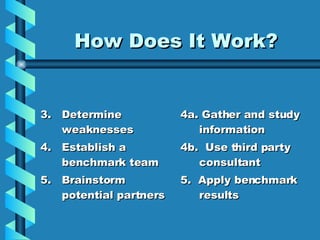
How Does It Work? Determine weaknesses Establish a benchmark team Brainstorm potential partners 4a. Gather and study information 4b.  Use third party consultant 5.  Apply benchmark results
Determine Weakness Comparisons Shortcomings Goals
Form a Team Find experts Involve related departments Set objectives
Set Targets Brainstorm Research Contact Learn Reciprocate
Analyze Benchmarked Information Gather  Analyze Plan
Third Party Consultants Integrity Benefits Risks
Take Action Re - address the plan Test the plan Study the results Act
Dell Computers JIT Online ordering Mass customization
Dell Computers Excellence in turns Advantages Disadvantages
Dell Computers Ordering online Advantages  Disadvantages
Dell Computers Mass customization Advantages Disadvantages
Exercise Research Dell Computers’ inventory information and compare those results with the results from Compaq Computers’  inventory statistics.  Which company is the leader and which has something to learn from their superior?
Summary Initiator Target Industry Customer Necessary Beneficial
Bibliography Internet ,  Dell Computers, Benchmarking, and  Consultants Managing Quality , S. Thomas  Foster  2001.  Pages  152 – 167. Value Line   October 2001. Operations Management,  Chase, Aquilano,  Jacobs 2001 Pages 5, 100, and 272. Operations Management,  Heizer, Render 2001.  Pages 176 – 177.

Performance benchmarking[1]

Editor's Notes